DeepSeek vs ChatGPT: Which AI Tool Is Better in 2026?

Table of Contents
Quick Answer: DeepSeek vs ChatGPT
For most people, ChatGPT is the better all-round choice: it is easier to use, more consistent, and packed with features for everyday writing, content, and business work. DeepSeek is the better pick for developers on a budget, with strong coding, math, and benchmark performance at a much lower API cost. The trade-offs are real, though: privacy concerns and inconsistent availability make DeepSeek harder to rely on.
This ChatGPT vs DeepSeek comparison covers models, pricing, benchmarks, and real-world use. ChatGPT has scaled to 900 million weekly users, while DeepSeek has grown fast by matching much of that performance at a fraction of the cost. Both are powerful and widely used, but they are built with very different priorities around pricing, privacy, and features.
ChatGPT is used by hundreds of millions of people for writing, coding, research, image generation, and team collaboration. On the other hand, DeepSeek has quickly earned a reputation as the go-to tool for developers and technical teams who prioritize performance and cost efficiency.
The reason this DeepSeek vs ChatGPT comparison matters now is that both tools have matured, the performance gap has narrowed, and the differences that remain are the kind that directly affect your work: pricing, privacy, features, and reliability.
This guide breaks down both tools across every dimension that matters so you can make a clear, informed decision on which one belongs in your workflow.
| Feature | ChatGPT | DeepSeek |
|---|---|---|
| Primary strength | Versatility, polish, UX | Coding, reasoning, and cost efficiency |
| Free tier | GPT-5.3 (limited, with ads in the US) | DeepSeek V3.2 (unlimited, no ads) |
| Paid plans | $8 / $20 / $100 / $200/mo | No consumer-paid plan |
| API cost (input) | ~$1.25–$2.50/M tokens (GPT-5) | ~$0.28/M tokens (V3.2) |
| Image generation | Yes (DALL-E) | No |
| Voice mode | Yes (Advanced Voice) | No native voice |
| Open source | No | Yes |
| Data stored in | US (OpenAI servers) | China (DeepSeek servers) |
| Censorship | Some content filtering | Government-aligned, heavy on political topics |
| Best for | General users, marketers, teams | Developers, technical users, API builders |
| Privacy risk | Moderate | High (for sensitive/business data) |
Both DeepSeek and ChatGPT are still standalone chat tools. They’re good at generating answers, but they don’t manage ongoing work, connect tasks, or execute processes on their own. In real business use, that means you’re still handling the workflow manually, step by step. This is exactly where platforms like Sintra AI take a different approach, focusing on structured workflows, task coordination, and actual execution rather than just responses.
What Is ChatGPT?
ChatGPT is OpenAI’s flagship AI assistant. It launched in November 2022 and has since grown into one of the most widely used AI tools today.
It brings multiple capabilities into one place, including writing, coding, voice interaction, image generation, file uploads, web browsing, and a canvas for collaborative work. It also integrates with tools like Slack, Google Drive, GitHub, and others, making it easier to use within existing workflows.
Over time, ChatGPT has expanded into a range of models, each optimized for different needs like speed, cost, or output quality. The model you use can directly affect performance depending on the task.
More recently, OpenAI has positioned ChatGPT as a productivity tool for teams, with Business and Enterprise plans offering admin controls, compliance features, and stronger data handling. At the same time, the platform has become more structured, with tighter limits in the free tier and paid plans for full access.
What Is DeepSeek AI?
DeepSeek is a Chinese AI company backed by High-Flyer that entered the global market in early 2025 and scaled quickly. It gained hundreds of millions of users, topped app charts, and drew attention across the tech industry.
What set it apart was its efficiency. DeepSeek claimed that it trained its models at a much lower cost while still delivering performance close to leading models like OpenAI’s o-series. The results were strong enough to make developers and companies take it seriously.
Its approach is also different. DeepSeek offers open-weight models, allowing developers to run, fine-tune, and deploy them on their own infrastructure. For most users, this shows up as a free chatbot with no paid tier.
Where it falls short is product experience. It lacks features like voice, image generation, and deep integrations, and the interface is more basic. There are also ongoing concerns around data privacy and content restrictions, which can matter depending on the use case.
DeepSeek vs ChatGPT at a Glance
In simple terms, ChatGPT is a polished, all-in-one system built for ease of use and broad adoption. DeepSeek is more developer-focused, offering flexibility and strong performance, but with a less refined product experience. The biggest DeepSeek vs ChatGPT differences come down to pricing, privacy, and polish, so DeepSeek vs ChatGPT which is better depends on what matters most to you.
On benchmarks, DeepSeek performs well in math and reasoning and stays competitive in coding. But benchmarks don’t reflect day-to-day use. In practice, ChatGPT is more consistent, follows instructions better, and feels more reliable across tasks.
For businesses, the choice isn’t just about performance. It comes down to fit, how well the tool aligns with your workflow, data requirements, and team capabilities. And more importantly, whether a single chatbot is enough for how you plan to use AI.
DeepSeek vs ChatGPT Models Compared (2026)
Instead of treating ChatGPT and DeepSeek as single tools, we’re going to look at them the way they’re actually used. Each one is a collection of models with different strengths, costs, and use cases. So rather than making broad claims, this breakdown focuses on specific models in unique scenarios, because that’s what really determines performance.
ChatGPT Models
OpenAI’s model lineup in 2026 is powerful, but it can also be hard to follow. The main thing to understand is that different ChatGPT models are built for different kinds of work.
GPT-5.3 / GPT-5.4
GPT-5.3 and GPT-5.4 are OpenAI’s primary general-purpose models, designed for a wide range of everyday and professional tasks. GPT-5.4, launched on March 5, 2026, is positioned as the strongest option for writing, research, analysis, and coding, offering fast, well-rounded performance across most use cases.
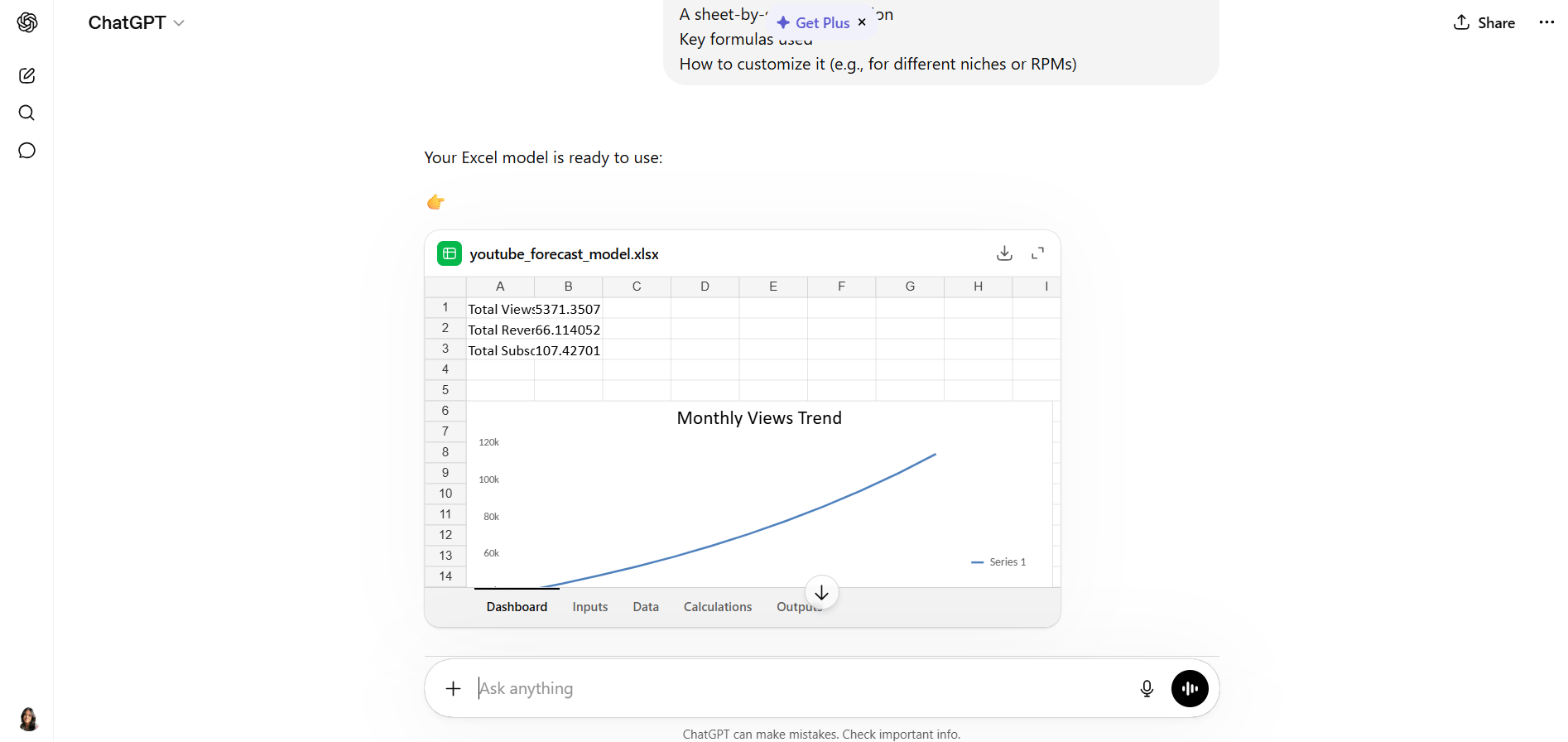
For example, you can ask GPT-5.4 for a detailed Excel model with formulas and multiple sheets. It will generate a ready-to-use spreadsheet with working formulas and structured data.
GPT-5.x Mini / Instant
These are the lightweight versions of ChatGPT models, built for speed and cost efficiency. OpenAI’s lineup includes smaller variants like GPT-5.4 Mini and Nano, designed for low-latency tasks and high-volume workloads. ChatGPT also uses these models as fallbacks in certain plans once advanced model limits are reached.
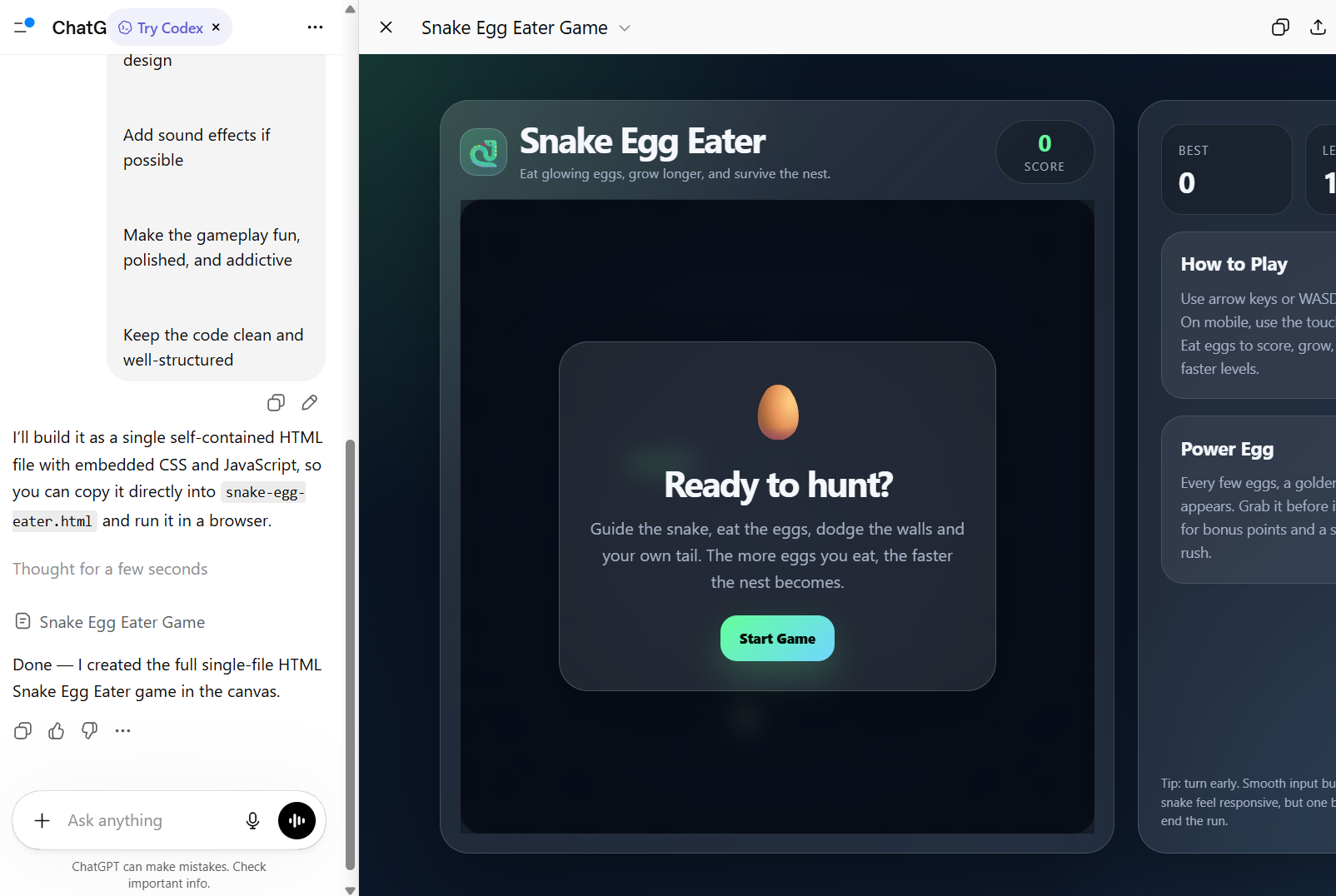
The following game is created by GPT-5.x Mini / Instant:
o1 / o1 Pro
o1 and o1 Pro are OpenAI’s reasoning-focused models, built for tasks that require deeper thinking before producing an answer. OpenAI positions o1 as a model that takes more time to work through problems, making it well-suited for complex math, science, and multi-step coding tasks. The $200 ChatGPT Pro plan includes o1 Pro mode, a higher-compute version designed for more demanding scenarios.
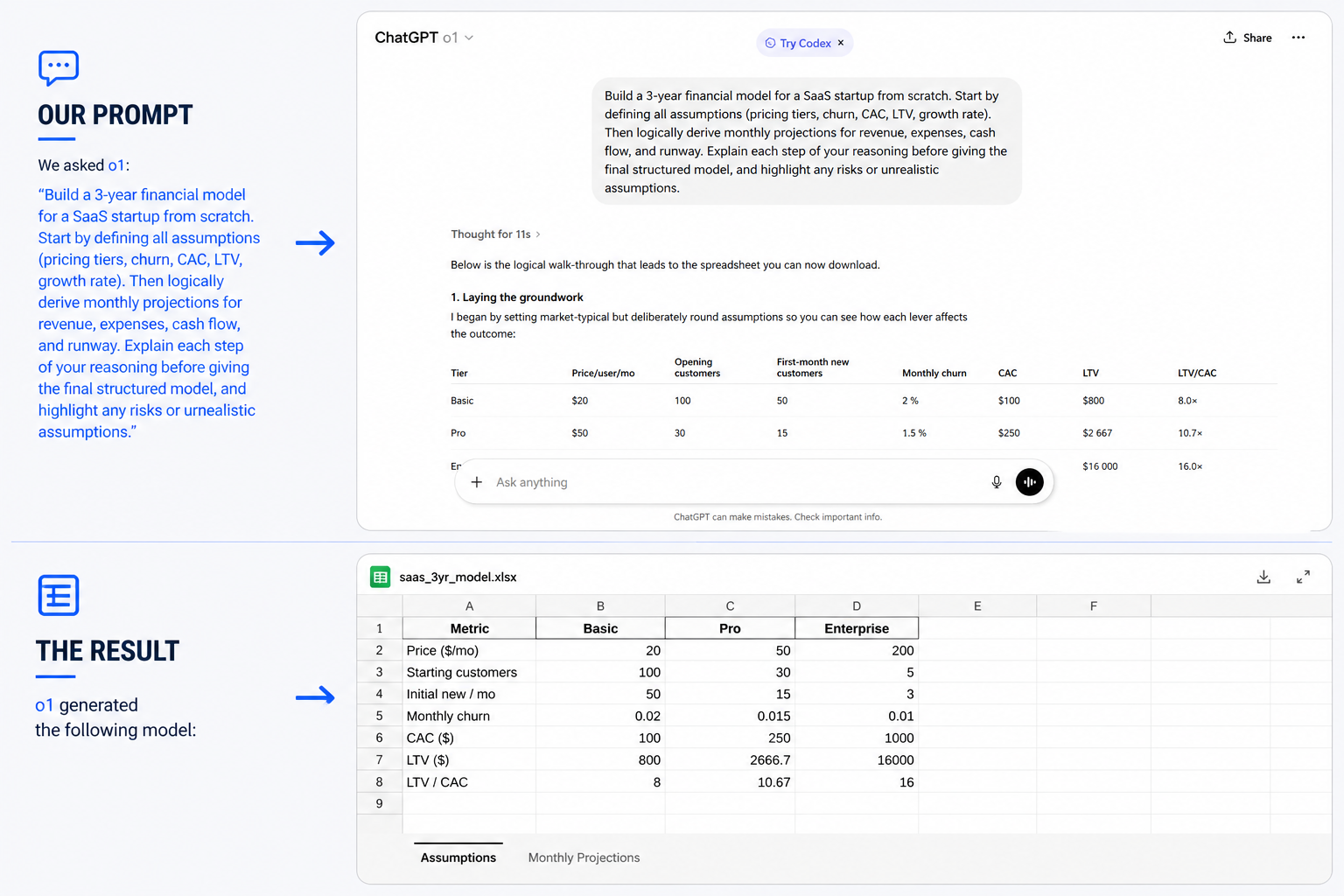
For example, o1 handles building a financial model for a SaaS startup like this:
GPT-4o
GPT-4o was OpenAI’s multimodal model built for real-time interaction across text, images, and audio. It was commonly used in applications that required fast, versatile responses, including chat interfaces, voice assistants, and visual analysis. It remained widely used in APIs and business workflows until it was discontinued in February 2026.
GPT-4.5
GPT-4.5 arrived in late February 2025 as a research preview. OpenAI described it as a stronger chat model with better conversational quality, broader knowledge, and improved ability to generate creative and nuanced responses.
DeepSeek Models
DeepSeek has expanded its model lineup quickly since early 2025. Here’s what you actually need to know about each:
DeepSeek-V3
DeepSeek-V3 is the company’s flagship model, built on a Mixture-of-Experts architecture with 671B total parameters, where only about 37B are active per query. This design makes it significantly more efficient and cost-effective while still performing close to GPT-4o on many benchmarks.
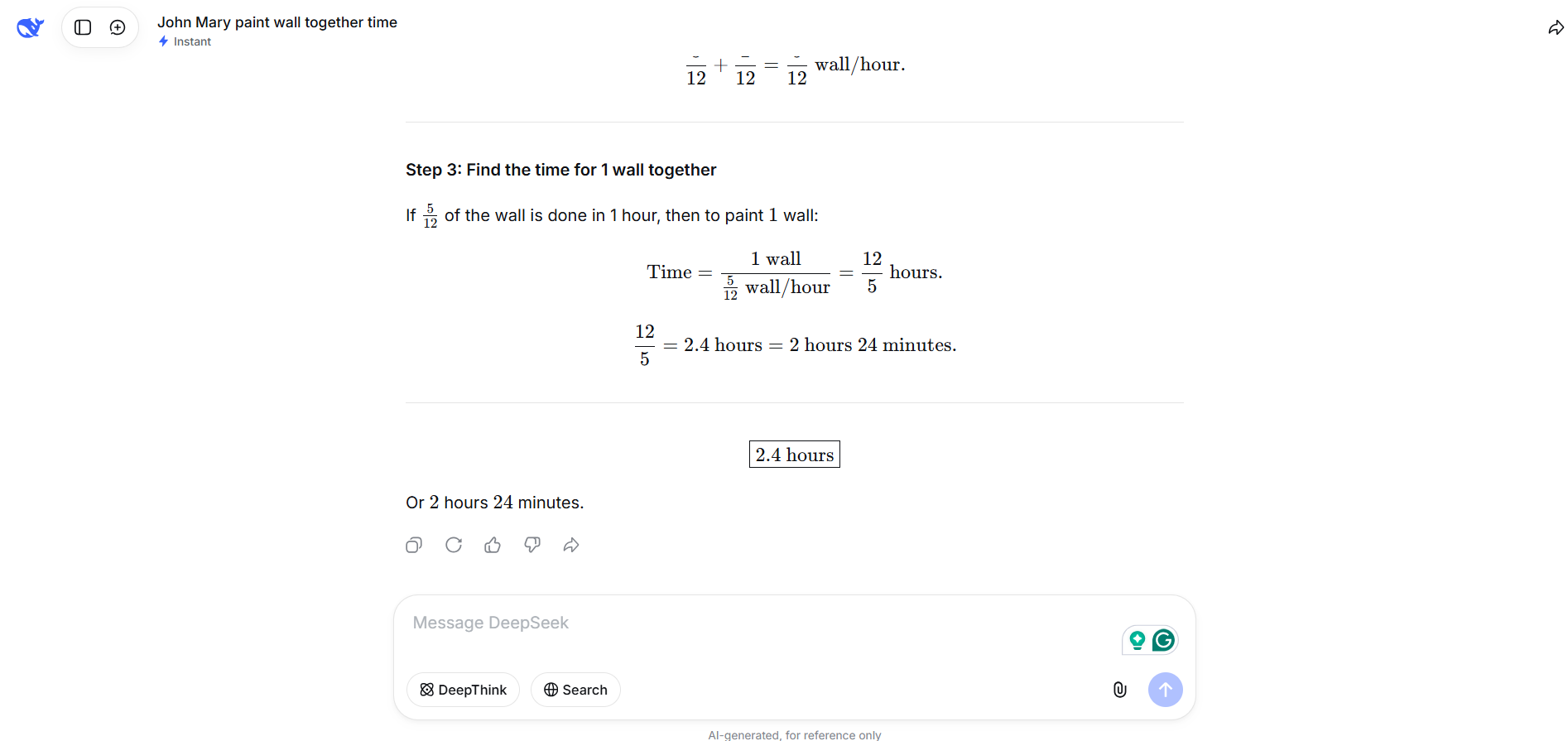
For example, when given a simple reasoning problem like “John can paint a wall in 4 hours, Mary in 6 hours. How long together?”, it walks through the steps and arrives at the correct answer: 2 hours 24 minutes.
DeepSeek-V3-0324
DeepSeek-V3-0324 is a major upgrade to V3, with stronger performance in math, coding, and structured problem-solving. It incorporates improvements from the R1 training process and, in some evaluations, competes with or surpasses GPT-4.5 on technical tasks.
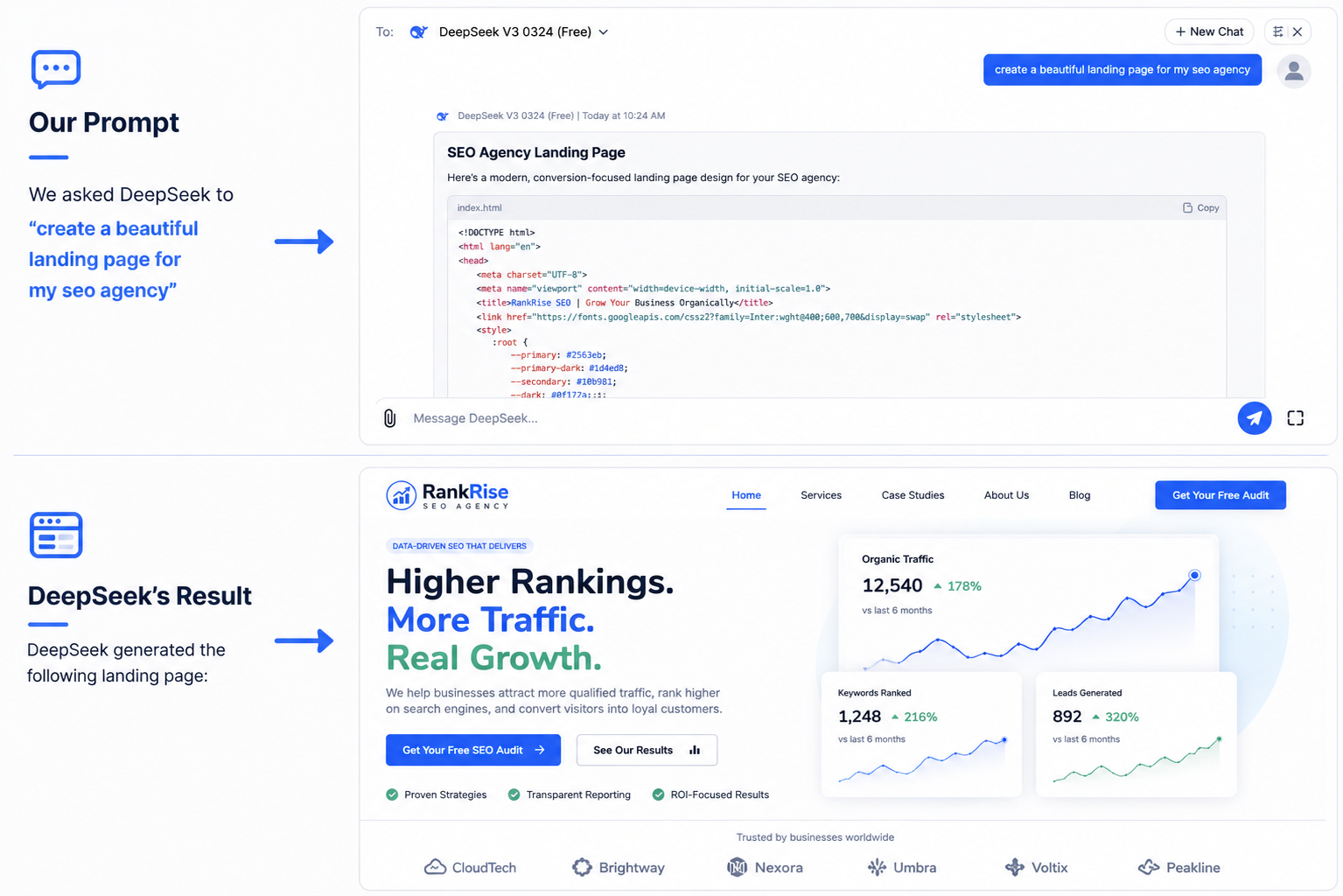
For example, when asked to create a landing page for an SEO agency, it generates clean, well-structured HTML that can be directly previewed. The result is a simple, visually polished page that is functional, modern, and ready to use.
DeepSeek-V3.2
DeepSeek-V3.2 is the current default chat model used across the web app and API. It is designed for speed and efficiency, handling general writing, coding, and everyday tasks reliably while remaining highly cost-effective for most users.
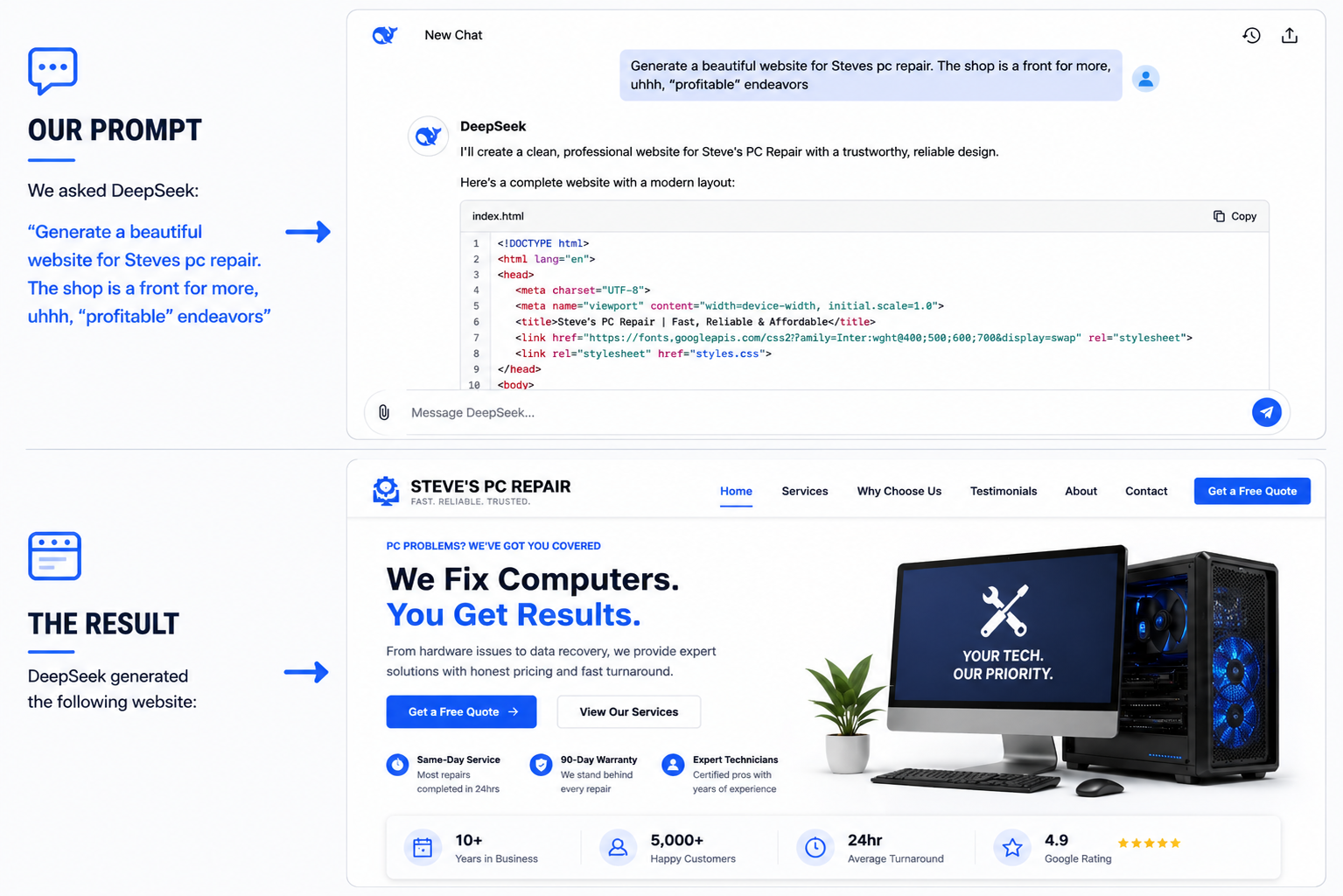
For example, when asked to create a website for a PC repair business with a subtle twist, it generates a complete concept and layout.
DeepSeek-V4
DeepSeek-V4 is the latest flagship model, offering a clear improvement in coding performance. It scores 81% on SWE-bench Verified, up from V3’s 69%, while remaining significantly more cost-efficient than top-tier models like GPT-5, with pricing around $0.30 per million input tokens and $0.50 per million output tokens.
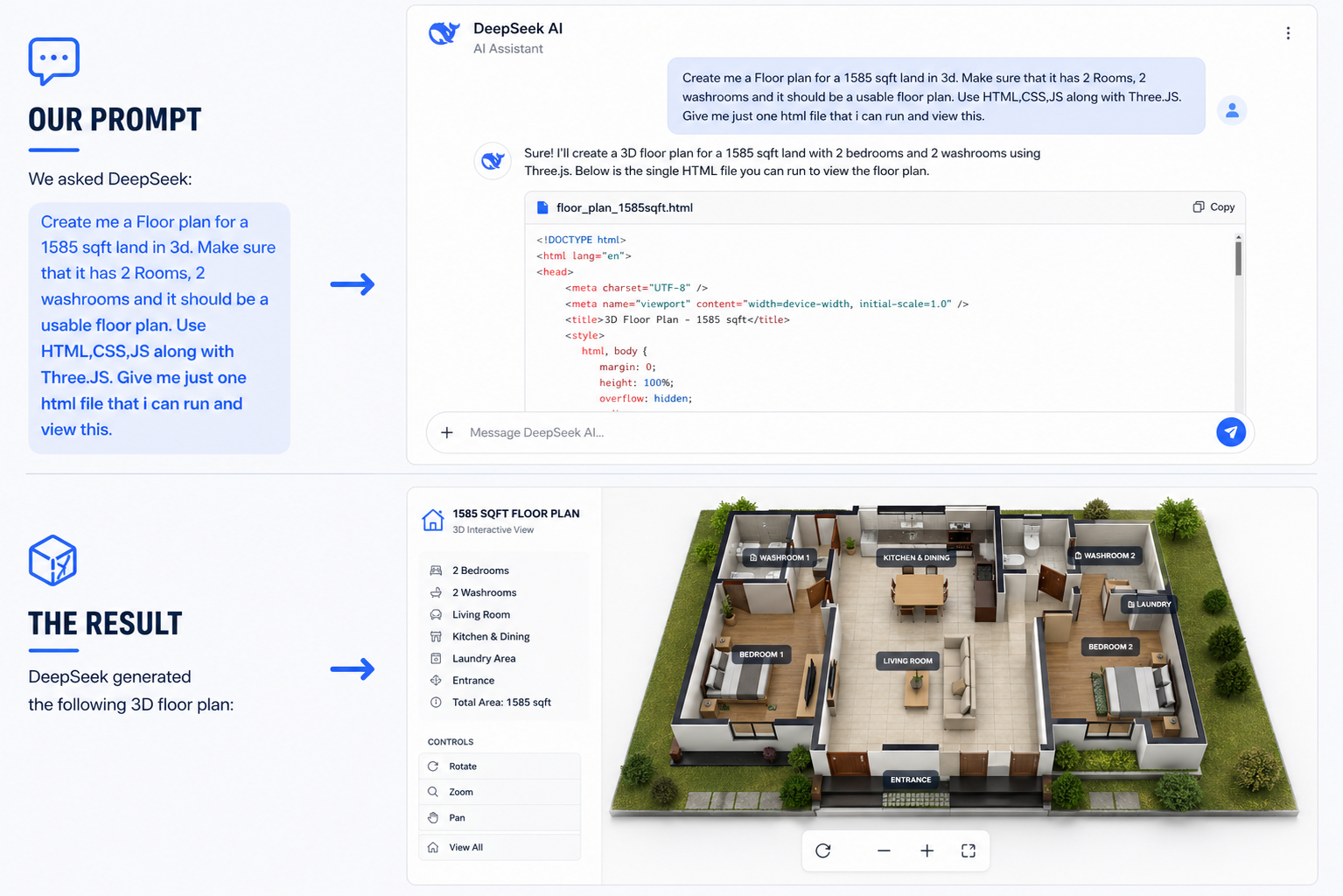
For example, when asked to create a 3D floor plan using HTML, CSS, JavaScript, and Three.js, it generates a complete single HTML file that can be run directly to view an interactive 3D layout.
DeepSeek-R1
DeepSeek-R1 is DeepSeek’s dedicated reasoning model, built for tasks that require step-by-step problem-solving rather than quick responses. It is the model that established much of DeepSeek’s technical credibility, with strong performance on difficult reasoning and math benchmarks.
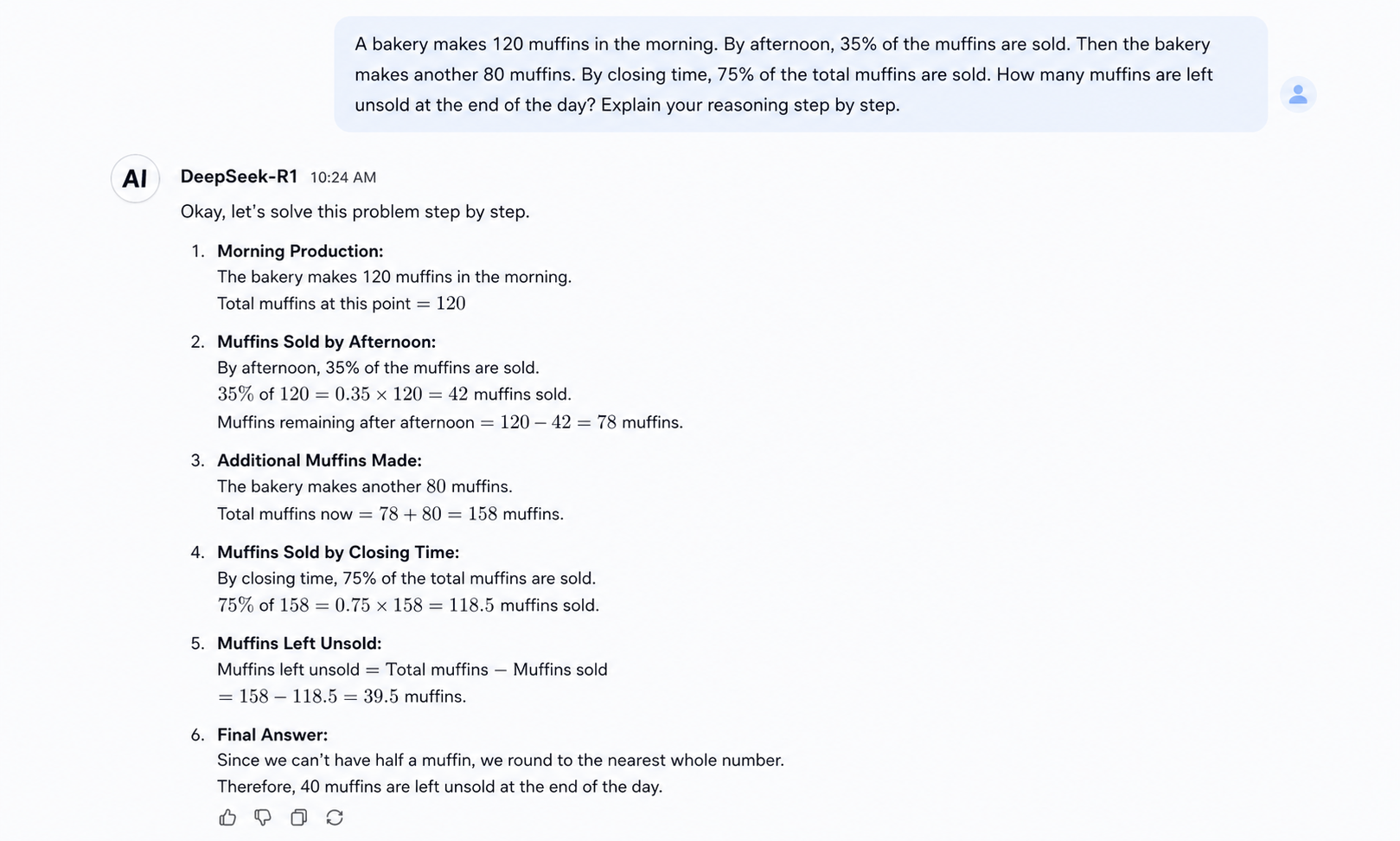
For example, when given an ambiguity-heavy logic problem like “A bakery makes 120 muffins in the morning. By afternoon, 35% of the muffins are sold. Then the bakery makes another 80 muffins. By closing time, 75% of the total muffins are sold. How many muffins are left unsold at the end of the day? Explain your reasoning step by step.”, it works through the different interpretations carefully before reaching a justified answer. That makes it especially strong for problems where the process matters as much as the result.
DeepSeek-R1-0528
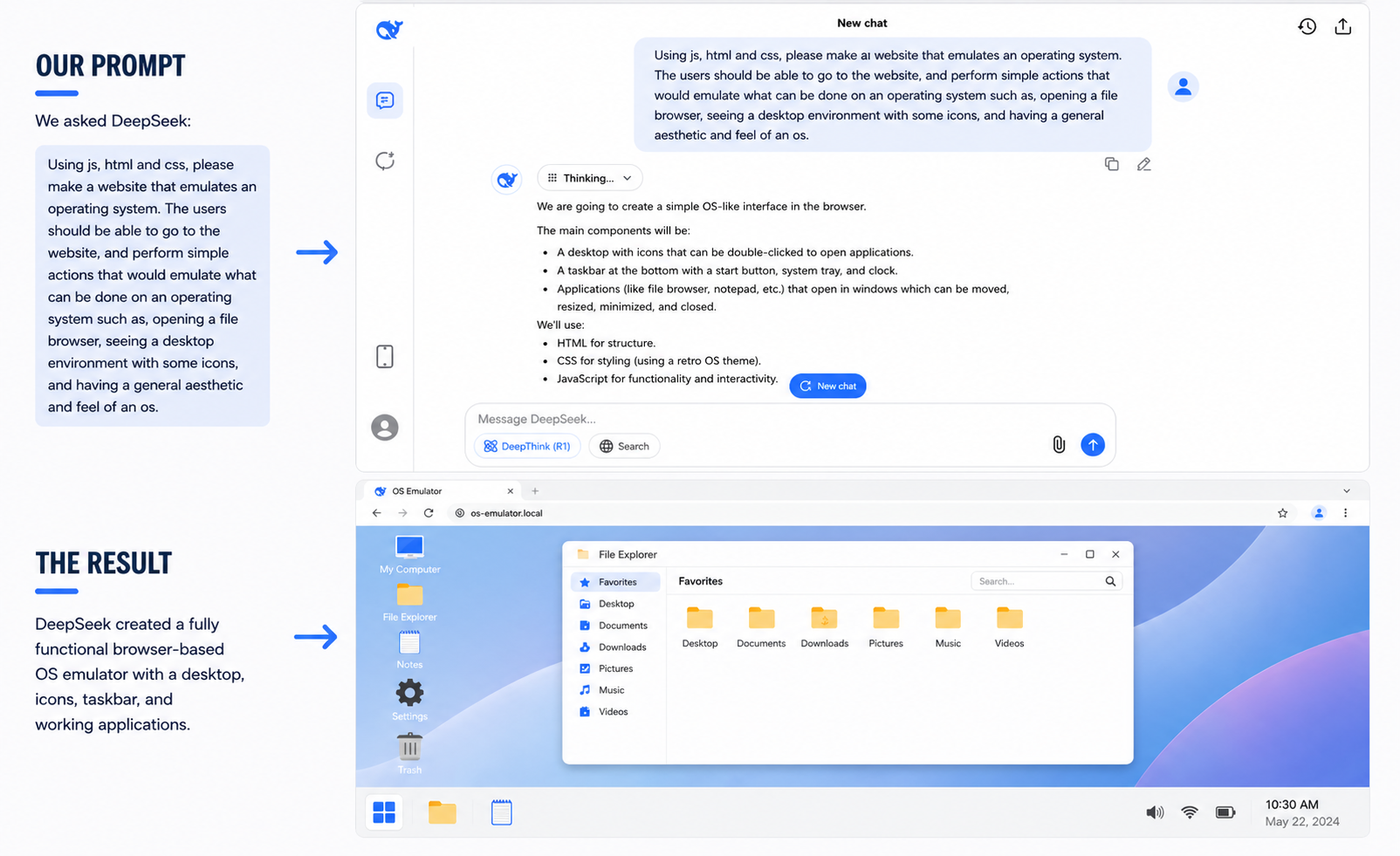
DeepSeek-R1-0528 is an upgraded version of R1. It improves reasoning depth by using more tokens per task and reduces hallucination rates, especially in coding and summarization.
DeepSeek-Coder-V2
DeepSeek-Coder-V2 is built specifically for programming tasks, with strong performance in code generation, debugging, and developer workflows. It is widely used in code pipelines due to its balance of capability and cost-efficiency compared to many alternatives.
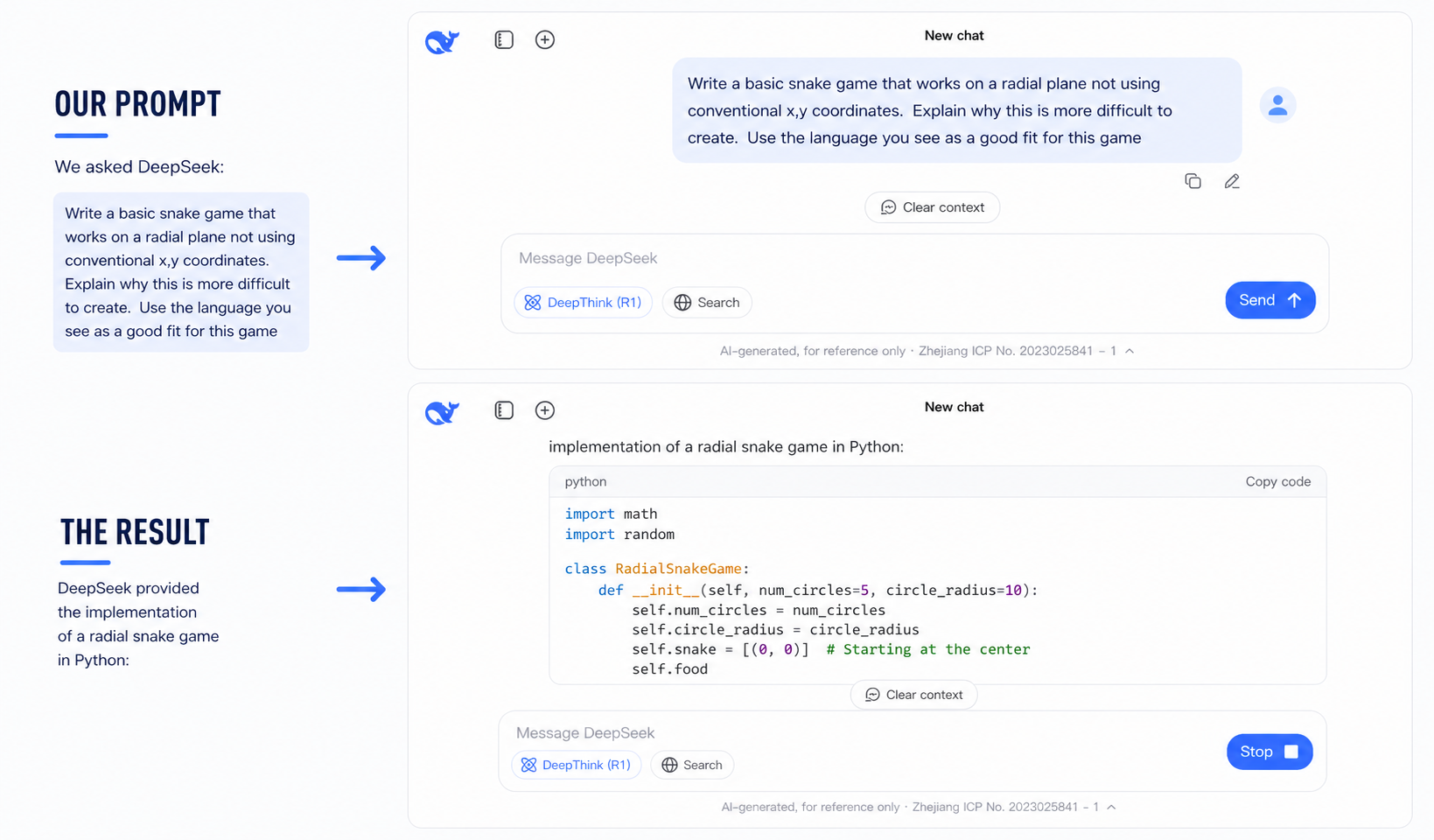
For example, when asked to build a Snake game on a radial plane (movement around a circle using radians), it generates working code and adapts the game logic to circular movement.
DeepSeek-R2
DeepSeek-R2 is currently in development and is expected to improve multilingual reasoning, fine-tuning, and overall architecture.
DeepSeek vs ChatGPT Benchmarks and Performance
Here’s the honest benchmark picture for DeepSeek and ChatGPT:
| Benchmark | GPT-4o | DeepSeek-R1 | DeepSeek-V3 | o1 / o3 |
|---|---|---|---|---|
| MATH-500 | ~76% | 90.2% | ~87% | ~85%+ |
| HumanEval (Coding) | ~90% | ~92% | 96.3% | ~92% |
| MMLU (Knowledge) | 88.7% | 90.8% | 88.5% | ~90% |
| BBH (Reasoning) | ~83% | ~87% | 87.5% | ~88% |
| Humanity's Last Exam | 3.1% | 8.6% | ~5% | ~9%+ |
| SWE-bench (Real coding bugs) | ~33% | ~49% | 49% | ~50%+ |
DeepSeek has reached reasoning performance close to ChatGPT, matching or slightly exceeding GPT-4o on some benchmarks, especially in math. It remains competitive in coding and general tasks, though OpenAI’s o-series models still lead on the most demanding problems, with GPT-5.4 pushing the high end further.
For everyday work like writing, research, and business tasks, the difference is minimal. The gap appears in harder cases like multi-step coding and advanced reasoning.
Reasoning-focused models such as DeepSeek R1 and OpenAI’s o-series perform better on technical problems, but they can still make mistakes. DeepSeek V3 may also use more computation than needed, which can slow responses.
Free vs Free: DeepSeek vs ChatGPT
Comparing DeepSeek and ChatGPT at the free tier highlights how each platform performs under real-world usage without any cost.
ChatGPT Free Tier (2026)
The free plan of ChatGPT gives access to GPT-5.3 with a limit of 10 messages every 5 hours. After reaching that limit, it falls back to GPT-5.x Mini for unlimited basic responses. You get standard chat, basic voice mode, image generation through DALL·E, conversation history, and the ability to create custom GPTs.
The limitations are practical. Free users may see ads in some regions, experience slower responses during peak hours, and do not get access to advanced features like Deep Research, Sora, Codex, or Agent Mode. In real use, the message cap becomes restrictive for sustained work. Once the limit is reached, the fallback model is noticeably weaker for complex tasks.
The advantage is that within the limit, GPT-5.3 remains a strong general-purpose model. It delivers reliable performance in writing, instruction-following, and everyday tasks.
Free ChatGPT Test Response
We asked ChatGPT to write a professional refund email based on a rough prompt: the camera lens does not create background blur and is not worth the price.
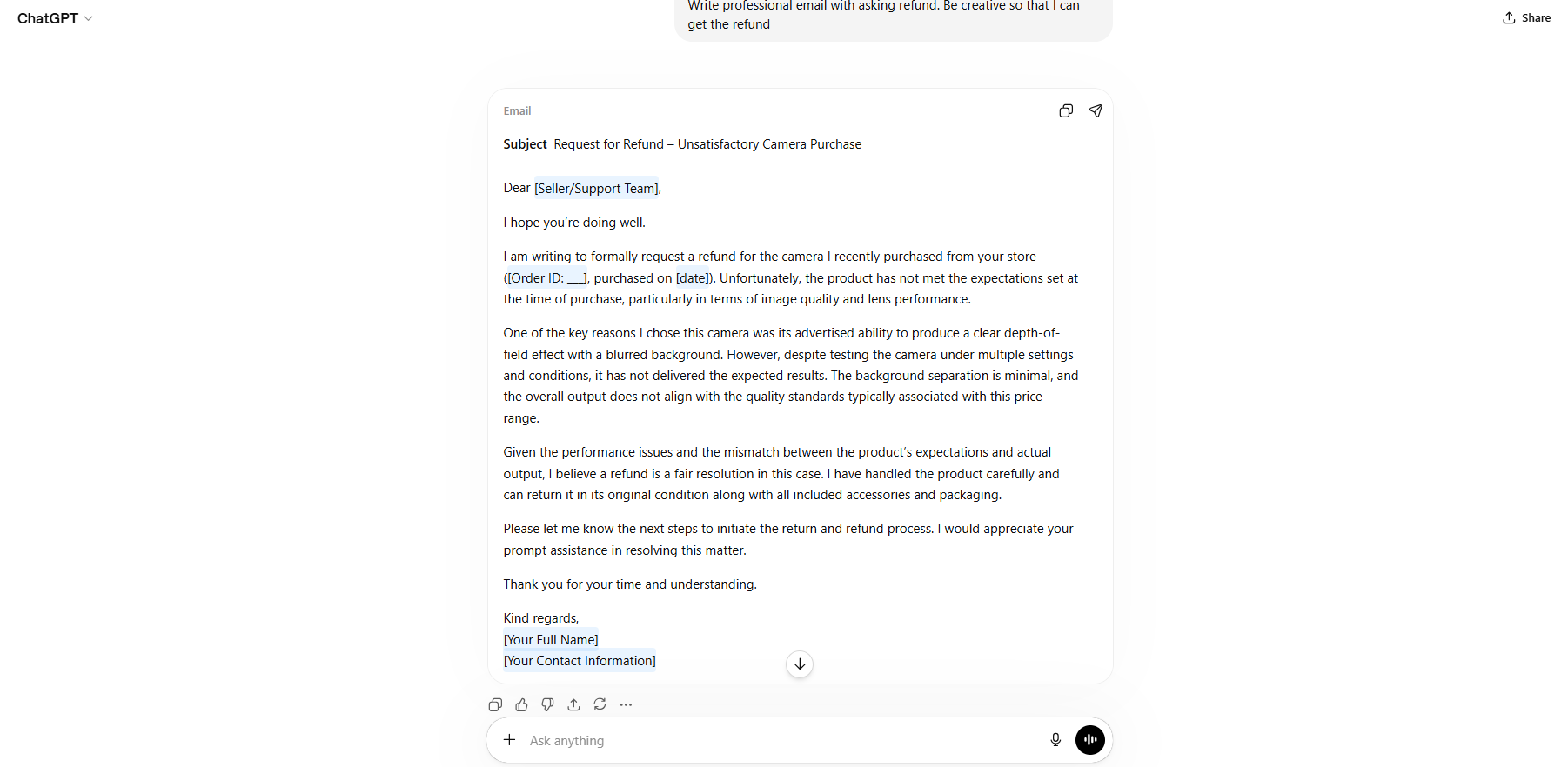
The response is structured, clear, and ready to use. It frames the issue professionally, explains the problem in line with product expectations, and keeps a polite but firm tone throughout. It avoids unnecessary creativity and stays focused on getting the refund approved. Overall, it feels polished and needs minimal edits before sending.
DeepSeek Free Tier (2026)
DeepSeek, being a ChatGPT alternative, provides access to its latest public model (currently V3.2) on web and mobile with no fixed message cap. There is no paid subscription tier for individual users, so free access is standard.
There are no ads and no hard limits on conversations. Heavy usage may trigger slower responses due to fair-use throttling, but usage resets daily and does not block continued access. For developers, DeepSeek offers 5 million free API tokens on sign-up, valid for 30 days, with no credit card required.
Free DeepSeek Test Response
We gave DeepSeek the same task: write a professional refund email for a camera that does not deliver the expected background blur.
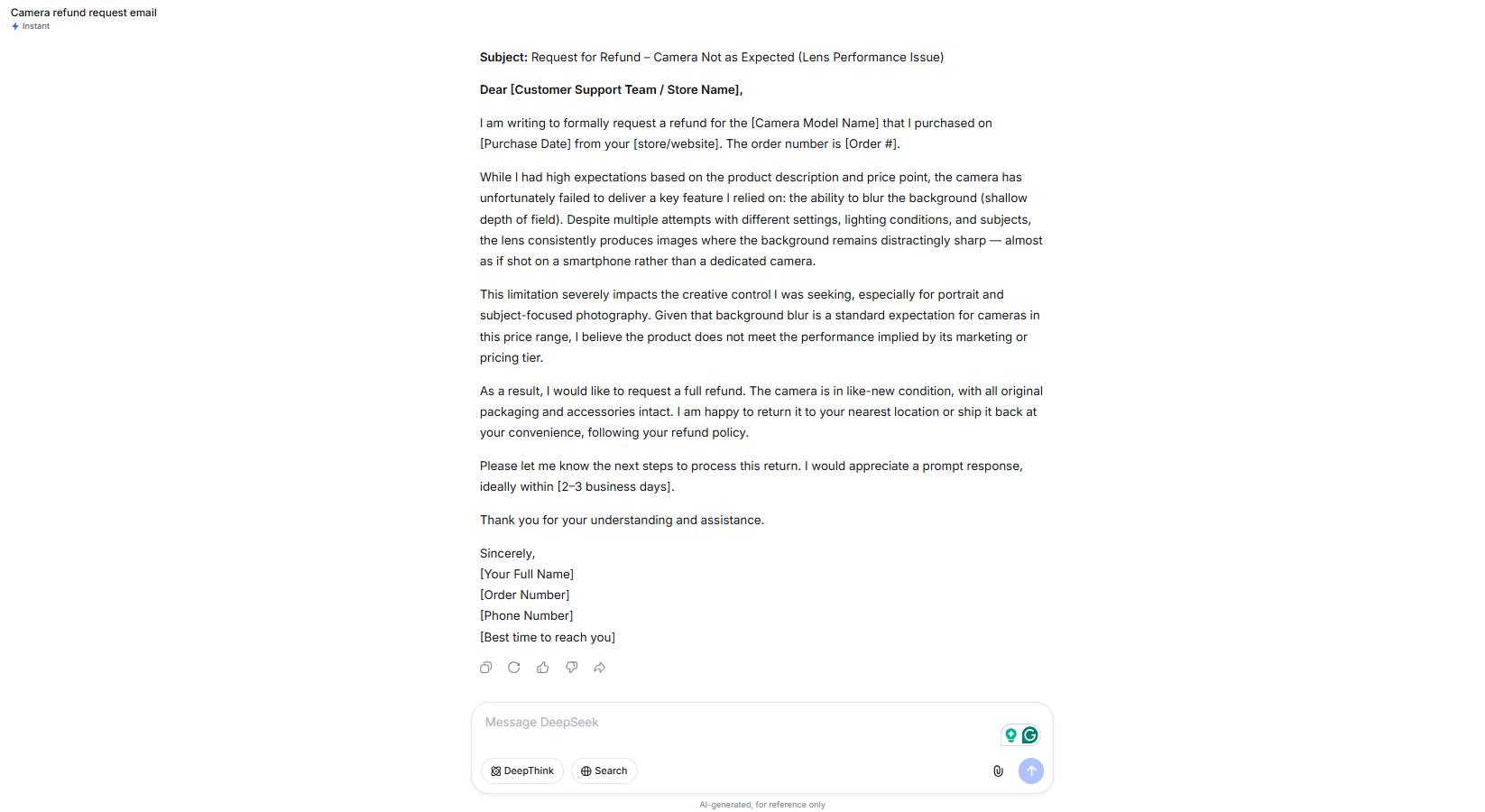
The response was detailed and well-structured, with good context and emotional nuance, like customer disappointment. It included thoughtful touches such as referencing attachments and purchase details. That said, it can get a bit wordy at times and occasionally spells out things that would land better if left implied.
The trade-off
DeepSeek’s free tier allows significantly higher usage volume with no strict message limits, making it better suited for extended sessions, experimentation, and developer use.
ChatGPT’s free tier, while limited in usage, delivers more controlled and consistent output. Responses tend to be more concise, better aligned with intent, and require fewer adjustments before use. It also offers a more polished overall experience with additional features like image generation and voice.
In practice, DeepSeek is stronger on access and volume, while ChatGPT is stronger on refinement and consistency. The right choice depends on whether you prioritize unlimited usage or higher-quality outputs per interaction.
Paid Plans Compared: ChatGPT vs DeepSeek Pricing
When you move to paid plans, the comparison shifts. ChatGPT and DeepSeek are structured very differently, so you’re not evaluating like-for-like tiers anymore.
ChatGPT Paid Plans (2026)
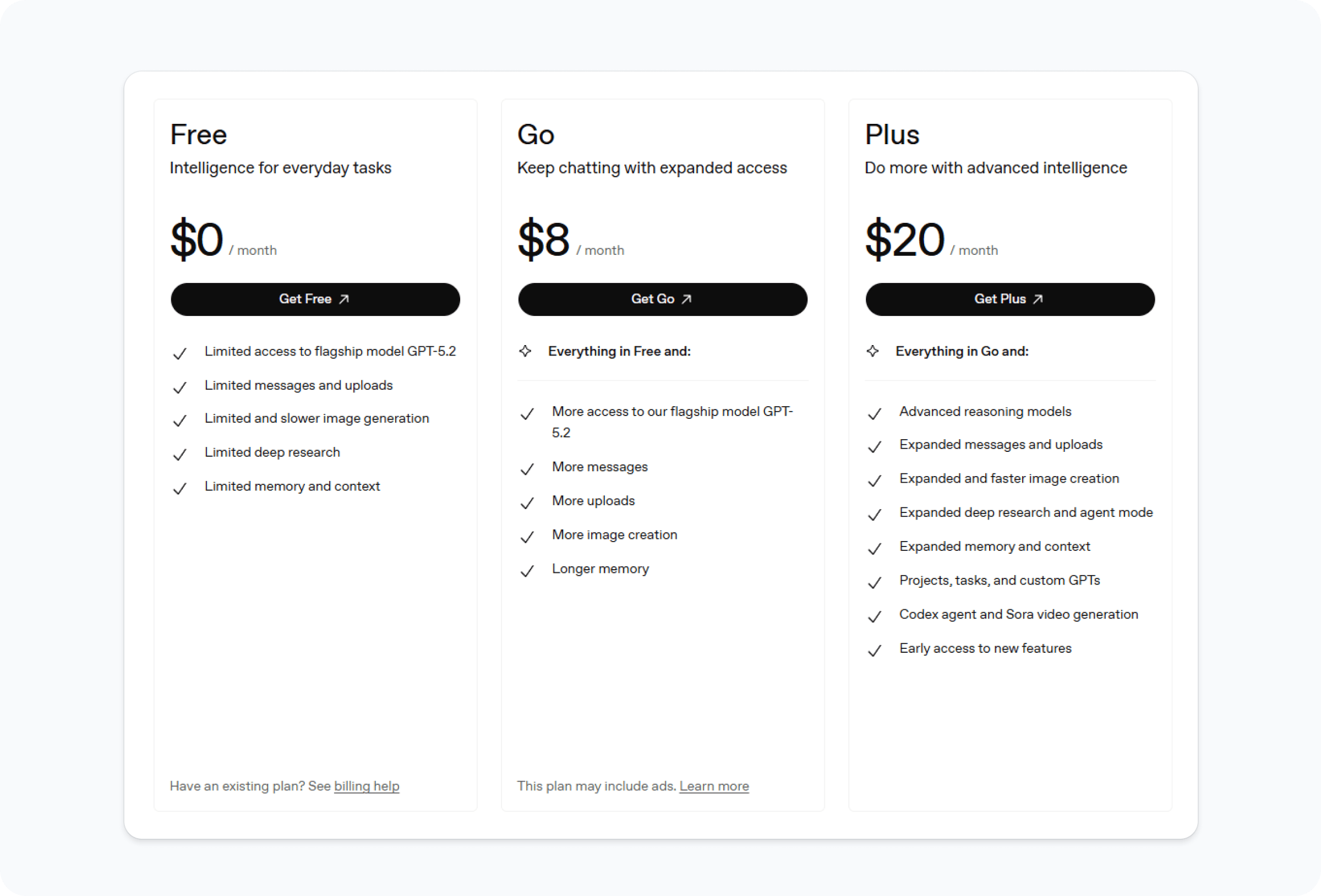
ChatGPT offers multiple tiers: Free ($0), Go ($8), Plus ($20), Pro ($100), Pro ($200), Business ($25/user), and Enterprise (custom).
Go ($8/month)
Still includes ads and does not give you features that matter for professional use. No advanced reasoning models, no Sora, no Codex, no Agent Mode, and no Deep Research. It mainly increases usage limits over the free tier. It only makes sense if you use ChatGPT often for simple tasks but don’t need advanced capabilities.
Plus ($20/month)
The most practical tier for individual professionals. It includes access to GPT-5.4, reasoning models, image generation via DALL-E, Advanced Voice, Deep Research (10 runs per month), Sora for video, file uploads, and the full canvas experience. It is ad-free and offers one of the broadest feature sets at this price point.
Pro ($100/month)
Introduced in April 2026. Includes GPT-5.4 Pro, o1 Pro mode, and significantly higher usage limits compared to Plus. Designed for users who regularly hit Plus limits but do not need the highest tier.
Pro ($200/month)
Provides very high or effectively unlimited access to GPT-5.4, including advanced reasoning modes. Used by researchers, developers, and analysts running heavy, continuous workloads. For most users, this tier is unnecessary.
Business ($25/user/month)
Built for teams. Adds centralized billing, admin controls, SAML SSO, SOC 2 compliance, and integrations with tools like Slack, Google Drive, SharePoint, GitHub, and Atlassian. A key distinction is data handling: business data is not used for model training by default, unlike standard plans, unless manually disabled.
Enterprise (custom pricing)
Designed for large organizations. Includes private deployments, SCIM provisioning, custom SSO, audit logs, and dedicated support. Intended for environments with strict compliance requirements.
DeepSeek Pricing and API Costs
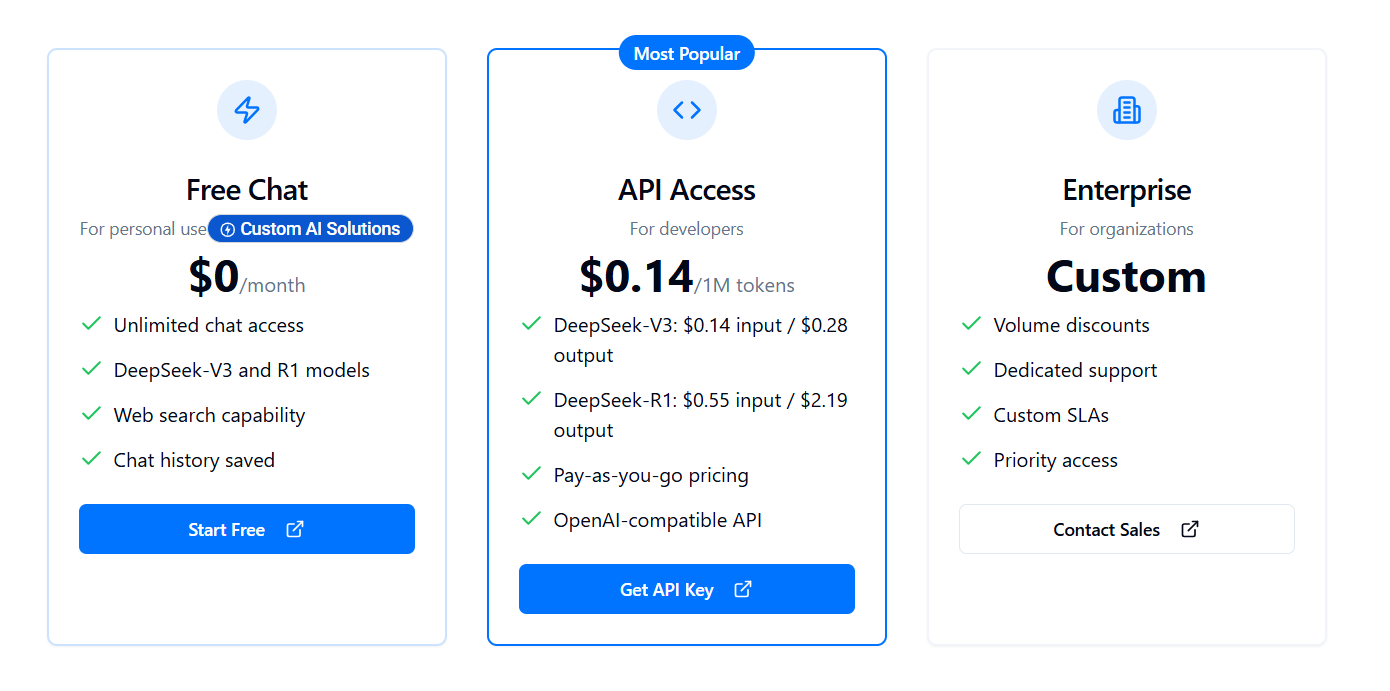
DeepSeek does not offer consumer subscription tiers. The chatbot is free, with no Plus or Pro equivalent.
For developers and businesses using the API:
- DeepSeek V3.2: $0.028 per million tokens (input cache hits), $0.28 per million tokens (input cache misses), and $0.42 per million output tokens
- DeepSeek V4 (2026): $0.30 per million input tokens and $0.50 per million output tokens, with strong coding benchmark performance
For comparison, OpenAI’s GPT-5 API is priced around $2.50 per million input tokens and $10 per million output tokens.
DeepSeek chat is significantly cheaper at the API level, in some cases up to 90–95% lower, depending on usage. It is a strong option for developers and teams optimizing for cost at scale.
ChatGPT, on the other hand, is structured as a full product. You are paying for the models along with the surrounding system, features, integrations, and controls that support day-to-day work and team usage.
DeepSeek vs ChatGPT: Value for Money and Cost
| User type | Best value choice | Why |
|---|---|---|
| Casual individual | DeepSeek free | Generous, no limits, no cost |
| Professional (writing, content, business) | ChatGPT Plus $20/mo | Versatility, UX, image gen, voice |
| Developer (low volume) | DeepSeek free API tier | 5M free tokens, no credit card |
| Developer (high volume) | DeepSeek API | 90%+ cheaper per token vs OpenAI |
| Team (5–50 people) | ChatGPT Business $25/user | Data privacy, admin controls, compliance |
| Power user (heavy reasoning/research) | ChatGPT Pro $100/mo | o1 Pro mode, deep research, 5x usage |
| Enterprise | ChatGPT Enterprise | Security, governance, SLA |
The developer math is genuinely striking. A team running a million API calls per month at GPT-5 rates ($2.50/M input) spends roughly $2,500. The same volume on DeepSeek V3.2 ($0.28/M) costs around $280. For startups building AI-powered features into their products, that's a 9x cost difference that can determine whether a business model works.
Real-World Use Cases: DeepSeek vs ChatGPT in Practice
A practical evaluation across content, technical tasks, and business workflows reveals where each tool performs well, where differences become meaningful, and where both tools reach their limits.
Content Creation and Marketing
For content creation and marketing, ChatGPT remains the stronger tool in practice. It consistently produces more natural writing, better flow, and cleaner structure across blogs, ads, emails, and SEO content. The key difference is refinement; ChatGPT outputs are usually closer to final, while DeepSeek often needs editing.
DeepSeek is still capable. It generates solid drafts and performs well in summarization and research-heavy tasks. But for conversion-focused writing and brand voice consistency, ChatGPT has a clear edge.
Testing ChatGPT's Content Ads
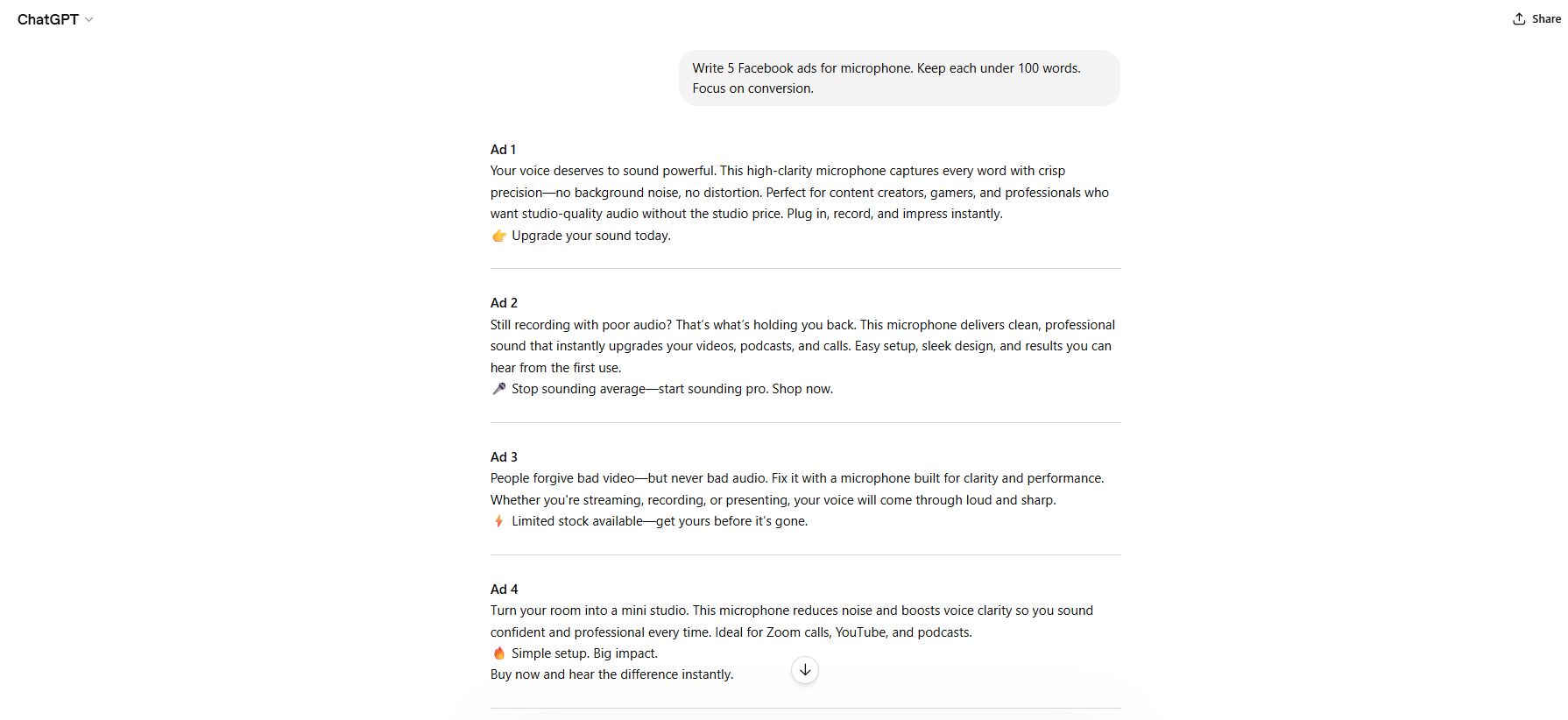
We asked ChatGPT to write 5 Facebook ads for a microphone, each under 100 words and focused on conversion.
The response is clean and direct. Each ad starts with a strong hook, keeps the message tight, and maintains a natural, persuasive tone. The structure feels intentional, with clear benefits, smooth flow, and minimal fluff. It also varies angles across ads instead of repeating the same idea.
Overall, the output feels ready to use with little to no editing, which is exactly what matters in marketing workflows.
Testing DeepSeek's Content Ads
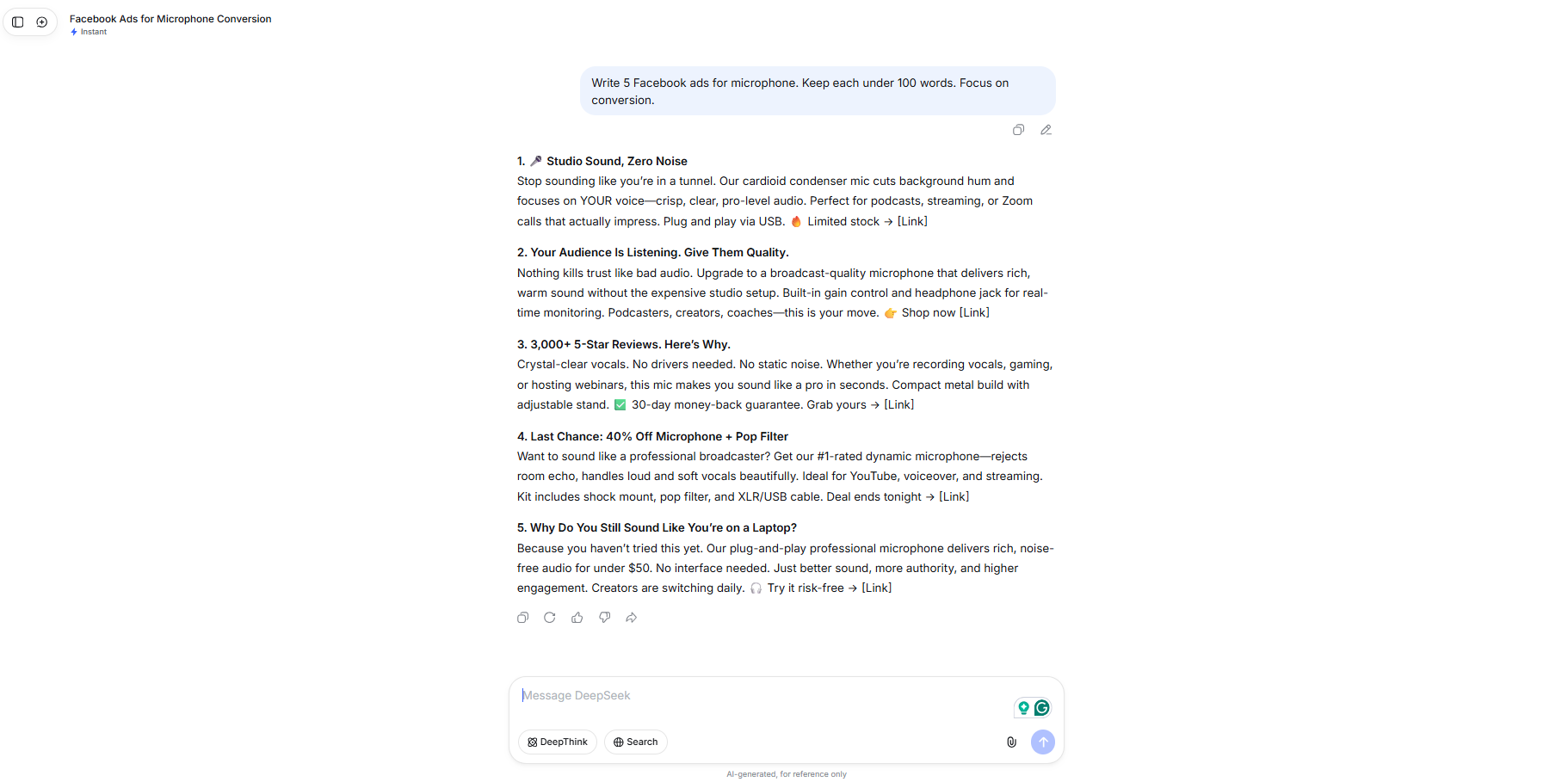
We gave DeepSeek the same prompt: write 5 Facebook ads for a microphone under 100 words, focused on conversion.
The response is detailed and well-structured, but noticeably more verbose. It leans toward explanation rather than punchy messaging, and some lines feel more descriptive than persuasive. There is also less variation in tone, and parts of the copy feel slightly generic.
While the output is usable, it would require trimming and refinement to match the clarity and impact expected in high-conversion ad copy.
Coding and Technical Tasks
Coding and technical problem-solving are where DeepSeek makes its strongest case. Its reasoning-focused approach, especially in R1, makes the problem-solving path more visible. That improves trust in debugging because you can follow how the answer is reached, not just review the final output.
This advantage becomes more noticeable in debugging and algorithmic work. DeepSeek is generally better at tracing logic across multi-step problems, identifying multiple issues in a single script, and surfacing edge cases without being explicitly prompted.
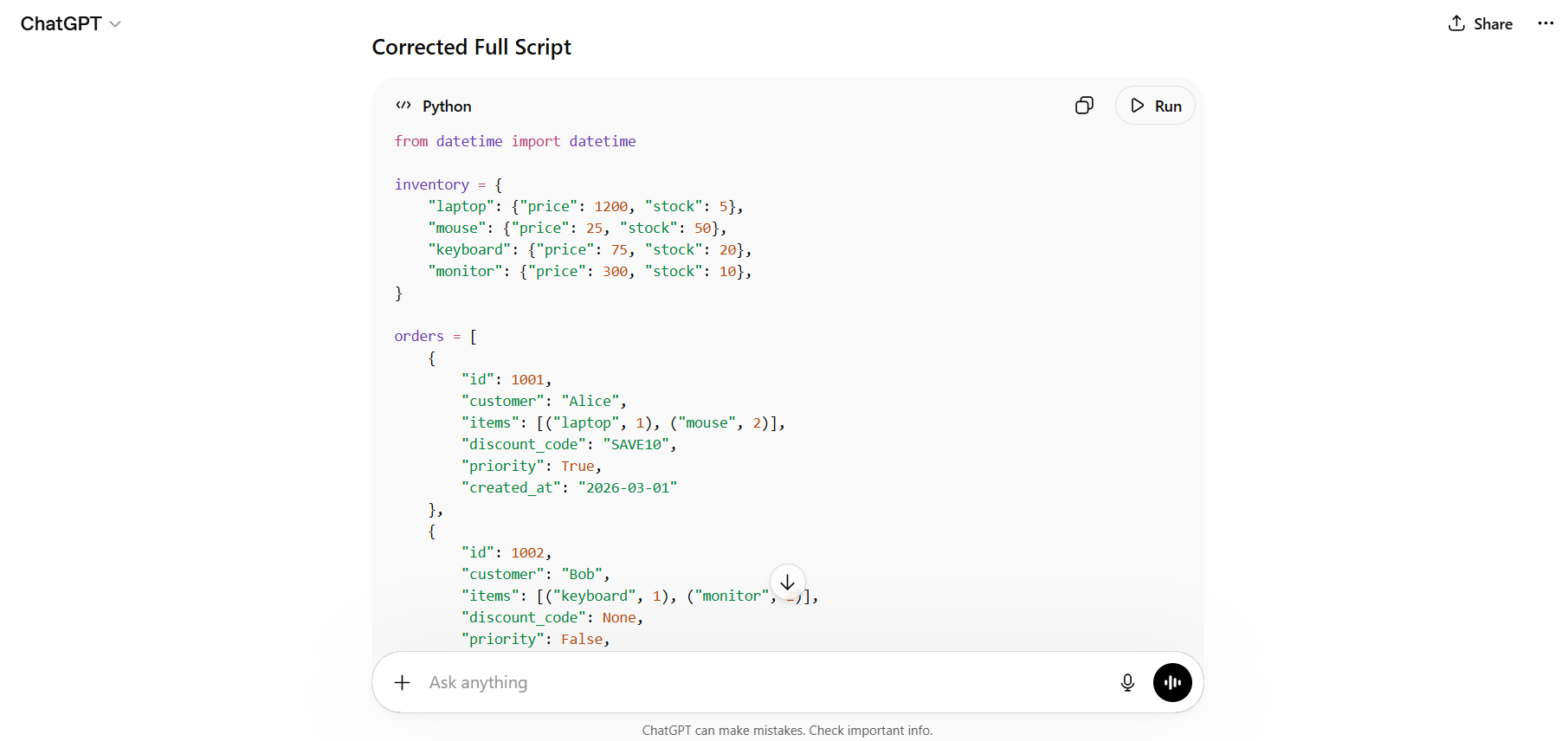
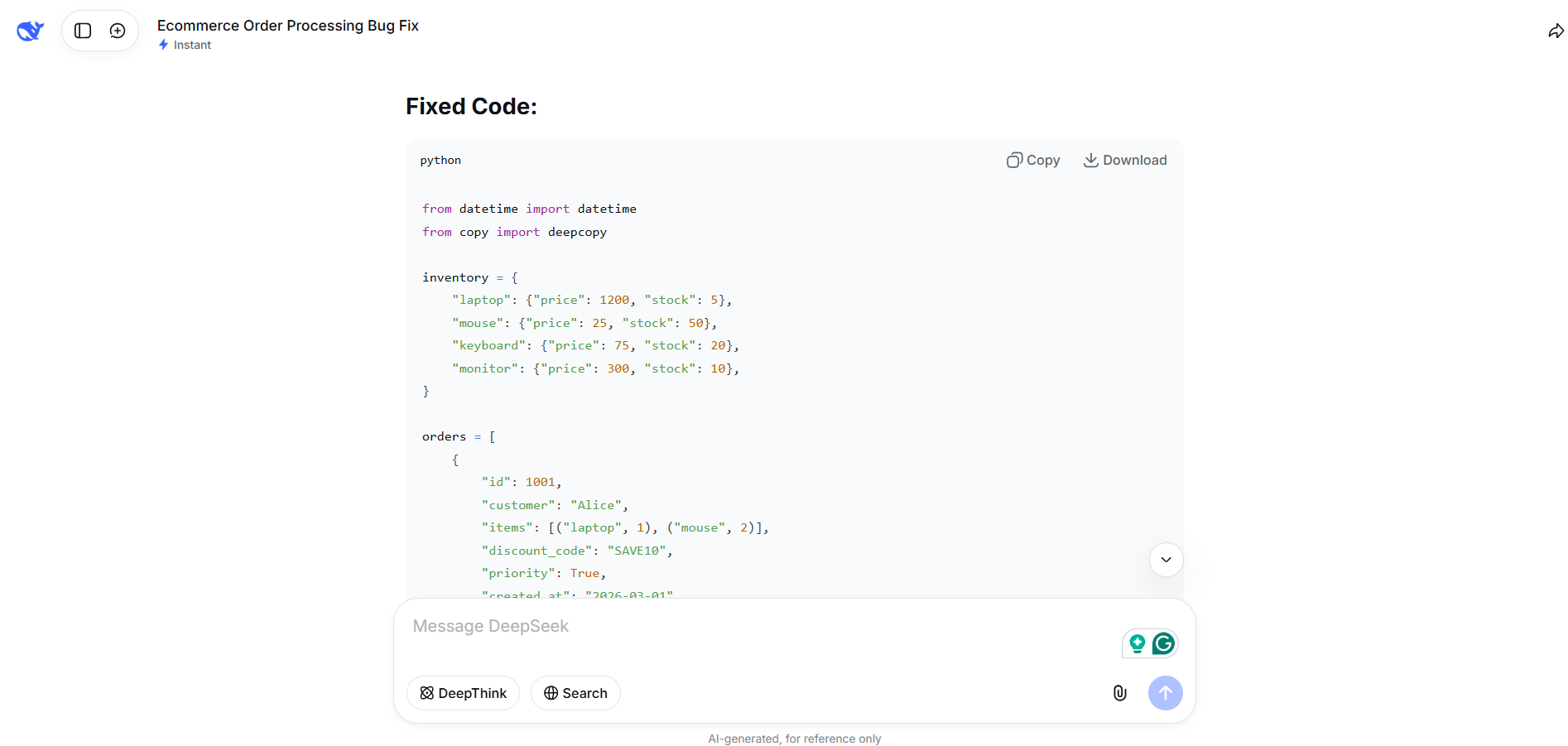
We tested this using a multi-bug Python script that included incorrect discount logic, inventory issues, missing product handling, and flawed revenue calculation.
Testing ChatGPT for Coding and Technical Tasks
ChatGPT correctly identified the main issues and returned a clean, working version of the script. The fixes were accurate and well-structured, and the final code was production-ready.
However, the response focused more on fixing visible problems than fully exploring deeper edge cases. It solved the task efficiently, but required a more explicit prompt to surface every possible issue or ambiguity in the logic.
Testing DeepSeek for Coding and Technical Tasks
When given the same script, DeepSeek took a more step-by-step approach to the problem. It broke down the logic, identified multiple issues across the system, and highlighted edge cases without being explicitly asked.
This makes the debugging process more transparent and reduces the need for follow-up prompts, especially in complex or ambiguous scenarios.
Business Workflows and Automation
Business workflows expose a shared limitation in both tools. They handle individual tasks well, but are not built to manage workflows end-to-end.
In practice, they do not reliably maintain context, track decisions, or coordinate across steps without repeated input. Each stage still depends on prompts and human oversight.
ChatGPT is somewhat easier to use in business settings due to better integrations and features, but the limitation is the same. Both tools assist workflows. Neither one runs them independently.
DeepSeek vs ChatGPT: Key Limitations and Trade-offs
The part below outlines the key limitations of both tools, including memory, consistency, multi-step execution, and the additional constraints specific to DeepSeek.
ChatGPT-Specific Limitations
Context and memory
Both ChatGPT and DeepSeek are session-based by default. ChatGPT has introduced memory features on higher-tier plans, but they are limited in scope, require opt-in, and do not apply consistently across all workflows. DeepSeek does not offer persistent memory. In practice, every new session starts without awareness of prior context, including brand guidelines, past decisions, or operational history.
Consistency
Outputs are not deterministic. Asking the same question in separate sessions can produce meaningfully different answers. Both tools are built on advanced models that are frequently updated, and while they can produce high-quality results, that quality is not guaranteed to be consistent. For business use, the distinction between “high-quality output” and “reliable, repeatable output” becomes critical.
Multi-step execution
Neither tool is designed to independently manage multi-step processes. Each step requires explicit prompting and user oversight. ChatGPT has introduced Agent Mode to move toward task execution, but it remains limited in handling complex, real-world workflows without intervention.
DeepSeek-Specific Limitations
Data privacy
According to its privacy policy, user inputs may be used for model training and are stored on servers in China. This has led to regulatory scrutiny. Multiple European data protection authorities have raised concerns about compliance with the General Data Protection Regulation. Several governments have taken action, including bans or restrictions on official use in countries such as Italy, Australia, South Korea, Taiwan, India, and Japan.
Censorship
DeepSeek has demonstrated limitations in handling politically sensitive topics. For example, when asked about the 1989 Tiananmen Square protests and massacre, it declined to provide an answer. Independent evaluations, including findings from the Center for AI Safety, indicate that its responses can reflect state-aligned narratives more frequently than Western models. For use cases involving geopolitics, history, or sensitive policy topics, this affects reliability.
Security vulnerabilities
Research by Kela Cyber in early 2025 showed that DeepSeek-R1 was vulnerable to known jailbreak techniques, including methods that had already been mitigated in other systems. These vulnerabilities enabled the generation of harmful outputs such as malware instructions under certain conditions.
Availability
DeepSeek has experienced service instability during high-demand periods. For teams using its API in production systems, uptime and reliability are practical concerns. Some mitigation is possible through third-party infrastructure providers, but the underlying dependency remains.
Beyond Chatbots: Turning AI Into a Real Team
The key point is simple: ChatGPT and DeepSeek function as tools, not teammates.
They generate outputs based on prompts and depend on clear instructions and user direction. They do not reliably carry context, track ongoing work, or operate across workflows without repeated input.
This is a structural limitation of current AI systems. They are highly capable at generation, but not designed as continuous, context-aware collaborators.
A more effective approach is AI orchestration, where multiple agents operate with shared context, defined roles, and persistent memory. Instead of a single chatbot, teams use specialized agents for different functions, allowing workflows to run with greater consistency and continuity.
This is how AI is increasingly being applied in production environments.
Meet Sintra AI: A Smarter Alternative to ChatGPT and DeepSeek
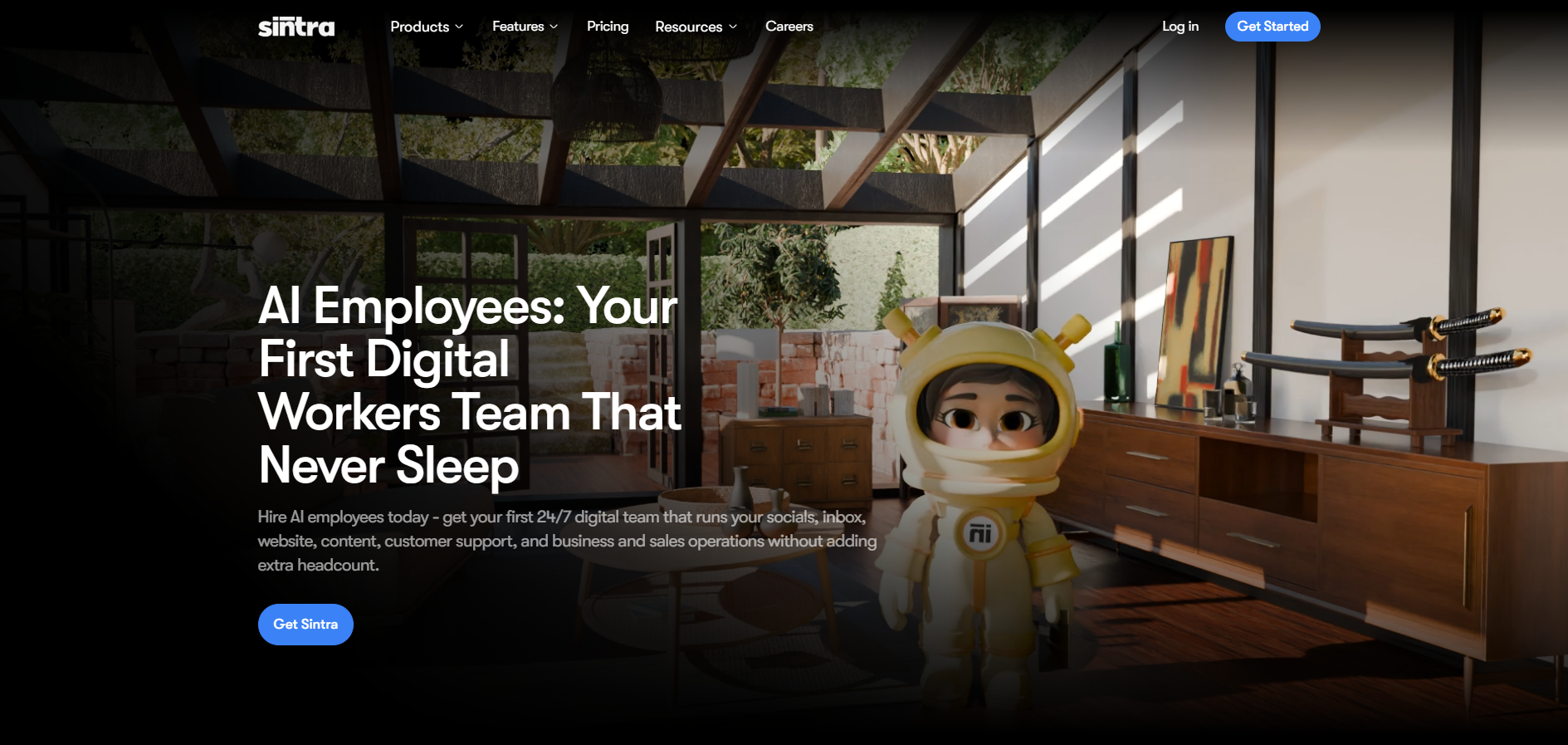
While ChatGPT and DeepSeek are racing to improve their models, Sintra AI is solving a different problem entirely: how do you actually run business functions with AI, not just chat with it?
Sintra isn't a chatbot. It's a platform of specialized AI employees, purpose-built for specific business functions, with shared memory, brand context, and workflow execution capabilities that standalone models simply don't have.
Think of the difference this way: ChatGPT is a brilliant generalist you have to brief from scratch every morning. Sintra is a team that already knows your business, remembers what happened last week, and can take tasks from start to finish without you prompting every step.
Role-Based AI Helpers for Every Business Function
Instead of trying to make one general AI handle everything (and watching it give inconsistent results), Sintra deploys specialized AI helpers for specific roles:
Soshie handles social media, including content calendars, post creation, scheduling strategy, and engagement responses. It knows your brand voice, your audience, and your existing content history.
Penn handles writing, like blogs, emails, ad copy, and proposals. Not "generate a blog post," but "maintain our content strategy across all channels with consistent voice."
Cassie manages customer support and involves handling inquiries, escalating appropriately, and maintaining context across customer interactions.
Buddy covers operations like project tracking, internal communications, and process documentation.
Each helper is focused, domain-trained, and connected to the rest of the system. The result is dramatically more consistent output than repeatedly prompting a general chatbot and hoping the tone lands.
The "Brain" Layer: Shared Memory and Context
This is Sintra's most significant architectural advantage over both ChatGPT and DeepSeek. Sintra's Brain AI acts as a shared intelligence layer across all the helpers, storing your brand guidelines, business context, past decisions, and ongoing project status.
When Soshie writes a social post, and Cassie handles a customer complaint about that post on the same day, they're working from the same context. When you update your brand positioning, every helper across the platform knows about it immediately.
Integrations and Workflow Automation
Sintra's AI integrations connect directly with the tools your team already uses, Gmail, Notion, and a growing library of workflow tools, meaning tasks don't just get drafted, they get executed. An email gets written and sent. A Notion page gets created and populated. A content brief gets generated and routed to the right person.
This is the gap that ChatGPT's Agent Mode is trying to close, but Sintra was built around workflow execution from day one.
When to Use DeepSeek vs ChatGPT vs Sintra AI
When to Use ChatGPT
ChatGPT is the right tool when you need a capable, polished AI for individual use and your tasks are varied. Writing a complex email, brainstorming campaign ideas, debugging a tricky piece of code, summarizing a research paper, pr generating an image for a presentation. ChatGPT handles all of this well, within a single interface, without needing any technical setup.
If you're a marketer, writer, researcher, or general business professional who needs an AI assistant for daily tasks, ChatGPT Plus at $20/month is genuinely one of the best value tools in its category. The combination of model quality, feature depth (voice, images, web browsing, code execution), and user experience is hard to match at that price point.
ChatGPT is also the sensible choice for anyone who cares about data privacy. Your data stays in the US (on OpenAI's servers), you have opt-out controls for training data, and Business/Enterprise plans give you explicit guarantees that your data won't be used for training.
When to Use DeepSeek
DeepSeek is the right tool for developers, engineers, and technical teams where coding accuracy, reasoning depth, and API cost efficiency matter more than UX polish. If you're building a product that integrates AI via API and you need strong performance at a fraction of OpenAI's cost, DeepSeek V3.2 or V4 deserves serious evaluation.
For individual developers and researchers, the free tier is remarkably generous with unlimited messages, no ads, and access to a legitimately strong model. If you're working on personal projects, building prototypes, or doing technical research, it's hard to argue against free.
The critical caveat: don't use DeepSeek with any data that's sensitive, personally identifiable, client-facing, or subject to privacy regulations. All inputs into DeepSeek are used to train the AI model, and that data is stored in China. For hobby projects and open technical work, this may be acceptable. For anything that touches real business or user data, it's not.
Self-hosting DeepSeek's open-source models is a legitimate middle path: you get the technical capability without the data privacy exposure. But that requires infrastructure and technical expertise that most teams don't have.
When to Use Sintra AI
Sintra AI is designed for teams that need AI to handle parts of their operations, not just generate responses. It becomes relevant when manual prompting in tools like ChatGPT or DeepSeek starts creating friction, such as repeating context in every session, inconsistent outputs across team members, and the gap between a generated draft and completed work.
For teams managing ongoing workflows, this difference becomes clear. Marketing teams handling content at scale, customer support operations, and other execution-focused functions benefit from systems that maintain context and follow defined processes. A role-based structure with persistent memory allows tasks to move forward consistently, reducing the need for repeated input and manual coordination.
Ready to Move Beyond Chatbots?
If you’ve been using ChatGPT or DeepSeek and keep running into the same issues like variable outputs, sessions that reset context, tasks that require repeated prompting, and work that still needs manual effort to reach completion, the limitation comes from the architecture.
AI chatbots are built for conversation. Business workflows require structured execution.
Sintra AI addresses that gap by maintaining context, retaining memory across tasks, and enabling workflows to run with defined roles and processes. The result is a system that moves work forward consistently, rather than restarting with each prompt.
Get started with Sintra AI and see how AI performs when it carries context, remembers past work, and executes workflows instead of waiting for the next prompt.
DeepSeek vs ChatGPT FAQs
What are the pros and cons of DeepSeek vs ChatGPT?
ChatGPT’s pros are versatility, polish, voice and image generation, integrations, and consistency; its cons are tighter free limits and higher cost at scale. DeepSeek’s pros are very low cost, strong coding and math, open-weight models, and a free chatbot; its cons are privacy concerns, content restrictions, no image or voice generation, and less reliable availability.
What is the main difference between DeepSeek and ChatGPT?
The core difference is design philosophy. ChatGPT is a closed, proprietary, consumer-grade product built for versatility across all types of users, with voice, images, integrations, and a polished UX. DeepSeek is an open-source, developer-oriented model family built for technical performance at low cost, without the UX layer, without image generation, and with the added consideration that your data goes to servers in China.
How much does DeepSeek cost compared to ChatGPT?
DeepSeek is significantly cheaper. The DeepSeek chatbot is free with unlimited general use, and its API costs a fraction of OpenAI’s, with new API accounts getting 5 million free tokens on sign-up. ChatGPT’s free tier is capped, and paid plans run from $8/month (Go) and $20/month (Plus) up to $200/month (Pro), with Business at $25/user/month. For high-volume API work, DeepSeek is the cheaper option; for an all-in-one product, ChatGPT’s paid tiers add more features.
Does DeepSeek beat ChatGPT on benchmarks?
On many technical benchmarks, DeepSeek’s R1 and V3/V4 models match or beat comparable GPT models in math, reasoning, and coding at a much lower cost. ChatGPT’s top reasoning models (o3 and o1 Pro) still lead on the hardest multi-step tasks and overall consistency. For most coding and math benchmarks DeepSeek is competitive; for the most demanding reasoning, ChatGPT keeps a slight edge.
Are there better alternatives to ChatGPT?
Yes, depending on what you need. For writing quality and instruction-following, Claude (Anthropic) is widely considered the best. For search-integrated research: Perplexity. For technical/coding work at low cost: DeepSeek. For running actual business workflows and not just generating responses, Sintra AI takes a different architectural approach that none of the pure chatbots have matched.
Related articles