Jasper AI vs ChatGPT: Which AI Tool Is Better?

Table of Contents
Quick Answer: Jasper AI vs ChatGPT
Jasper AI is built for structured marketing content. It's the stronger pick for brand voice, campaign copy, and content that needs to follow one format across a team. ChatGPT is built for flexibility. It handles brainstorming, research, coding, summarizing, and general productivity work better than Jasper does.
Neither tool is the right fit for a business that needs AI support across many departments at once. Jasper AI vs ChatGPT isn't really an either-or question. It's a question of what job you're hiring the tool to do.
Put Jasper AI and ChatGPT side by side, and one thing becomes obvious fast: they're not fighting for the same title. Jasper was raised on marketing, built to churn out blog posts, ads, emails, and social captions that still sound like your brand. ChatGPT never picked a lane. It writes, codes, researches, and plans; whatever task you throw at it, it will get done.
That difference matters more than most comparisons let on. A business that only needs marketing copy might do fine with Jasper. A business that needs support across research, coding, customer questions, and content all at once will find that neither tool covers the whole picture.
This guide breaks down where Jasper AI and ChatGPT differ, where they overlap, and what that means for how you work. For businesses that need AI employees to handle more than just writing tasks, we'll also look at what a broader AI system can offer.
What Are Jasper AI and ChatGPT?
Both tools sit within the same wave of AI adoption that is reshaping how people write and research online. But they were shaped by different goals from the start.
One was built with marketing teams in mind. The other was built as a general-purpose assistant that anyone could use for almost anything.
AI tool adoption among marketers has grown fast enough that using some form of AI is now close to standard practice, not the exception. HubSpot's 2026 State of Marketing Report found that 86.4% of marketers now use AI tools, especially for content and media creation. That backdrop is part of why tools like Jasper and ChatGPT get compared so often. Both are trying to serve a market that has already decided AI belongs in the workflow.
Here's a quick overview before we go further into the details.
What Is Jasper AI?
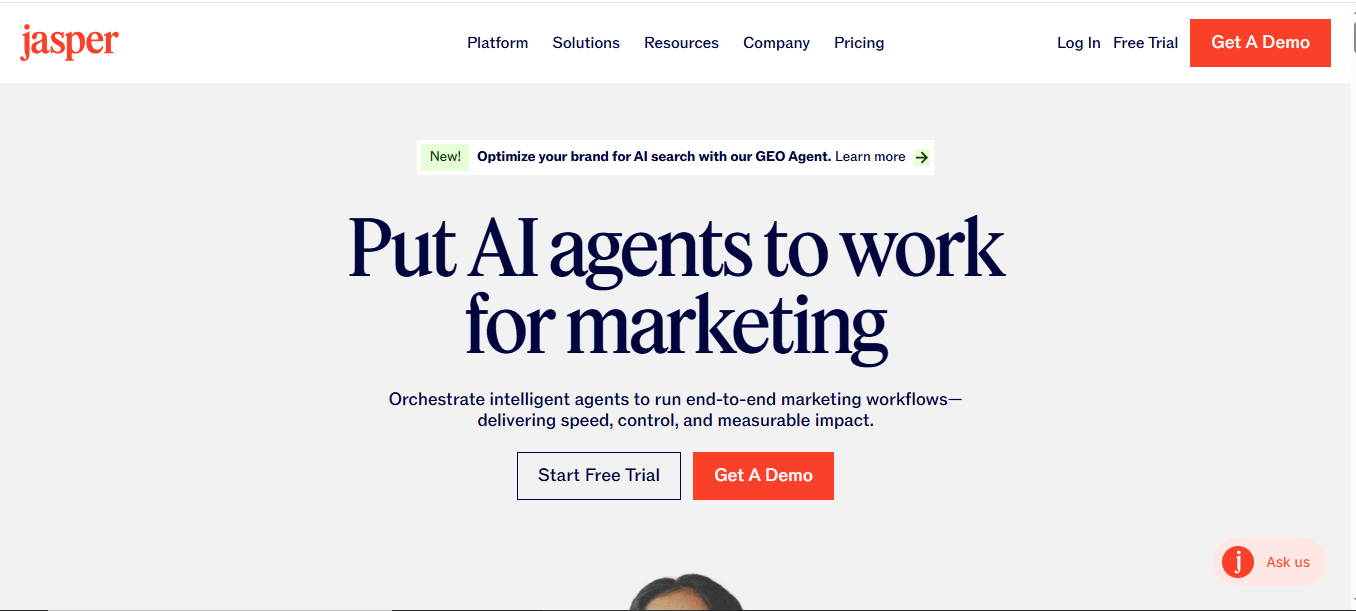
Jasper AI started as a tool for marketers who needed to produce content faster without losing brand consistency.
It grew out of a real gap. Businesses wanted AI help with writing. But they also needed that writing to sound like their brand every time, not like a generic chatbot response.
That's why Jasper leans so heavily on templates, brand voice settings, and campaign-focused workflows. It's built around one idea: marketing teams repeat the same types of content over and over, so the tool should make those repeats faster and more consistent.
This positioning has made Jasper a common choice among marketing departments, agencies, and content teams that produce a lot of branded material.
What Is ChatGPT?
ChatGPT was developed by OpenAI. It was released as a conversational AI assistant capable of handling a wide range of tasks via natural back-and-forth chat.
It wasn't built for a single department or a single type of work. It was built to be broadly useful, whether someone needed help drafting an email, working through a coding problem, or researching a topic they knew nothing about.
That broad design is a big part of why ChatGPT has been adopted so widely across industries. Students use it. Developers use it. Small business owners use it. Marketing teams use it too, just not exclusively.
It's less a tool for one job and more a tool for whatever job shows up that day.
The Main Difference Between Jasper AI and ChatGPT
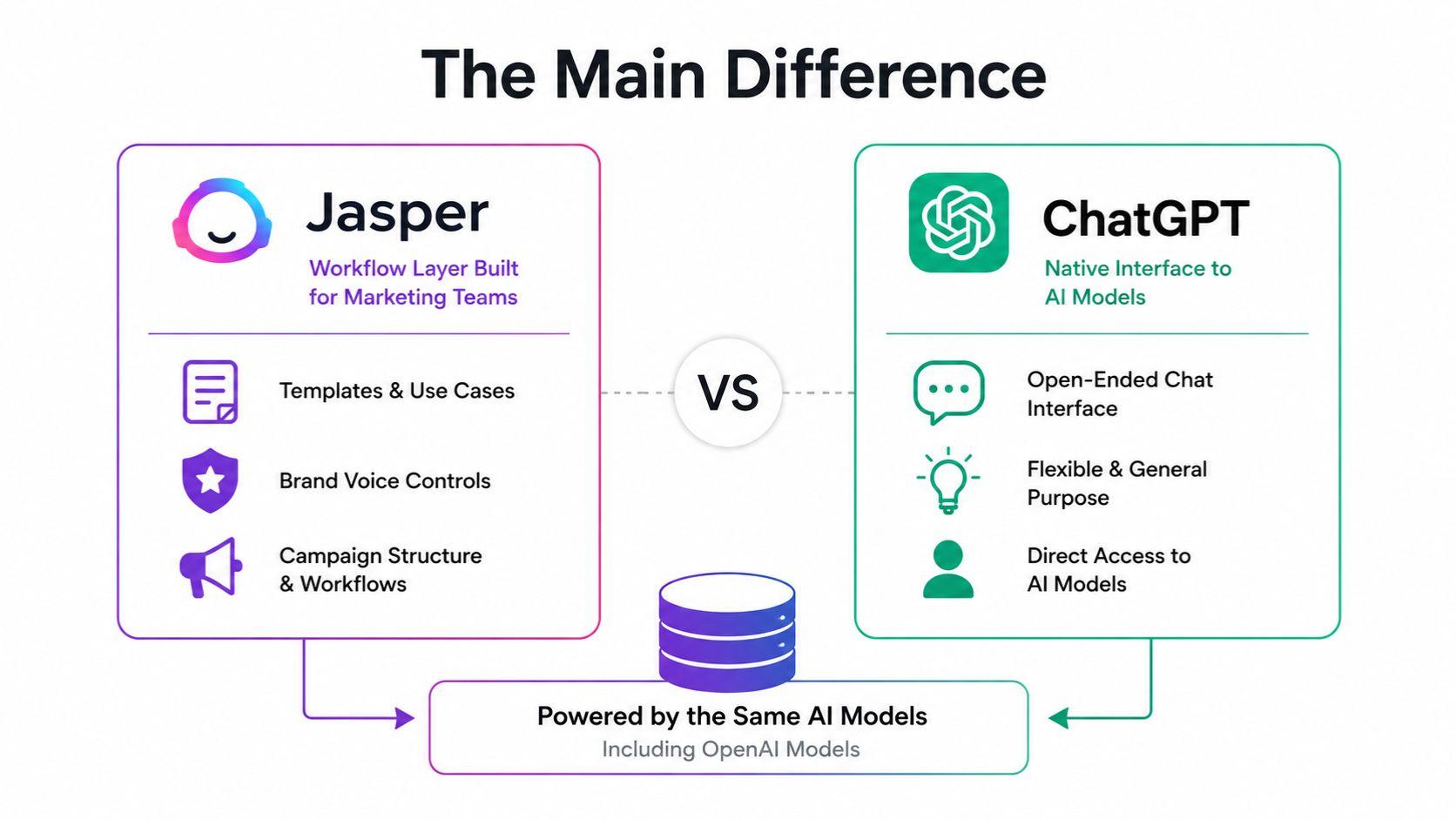
Here's the part that explains why these two tools can produce such similar-sounding output despite being marketed so differently.
Jasper AI is built on top of third-party AI models, including models from OpenAI. It isn't running its own independent intelligence underneath.
ChatGPT, on the other hand, is the native interface to those models, built and maintained directly by the company that trains them.
That's why a Jasper-generated blog post and a ChatGPT-generated blog post can end up sounding fairly close in quality. The real difference isn't in the raw intelligence powering each tool. It's in the workflow layer built on top of it: the templates, brand-voice controls, and campaign structure that Jasper adds, versus the open-ended chat interface that ChatGPT offers.
With that groundwork out of the way, it's worth looking at how these two approaches actually perform, feature by feature.
Jasper AI vs ChatGPT: Feature Comparison
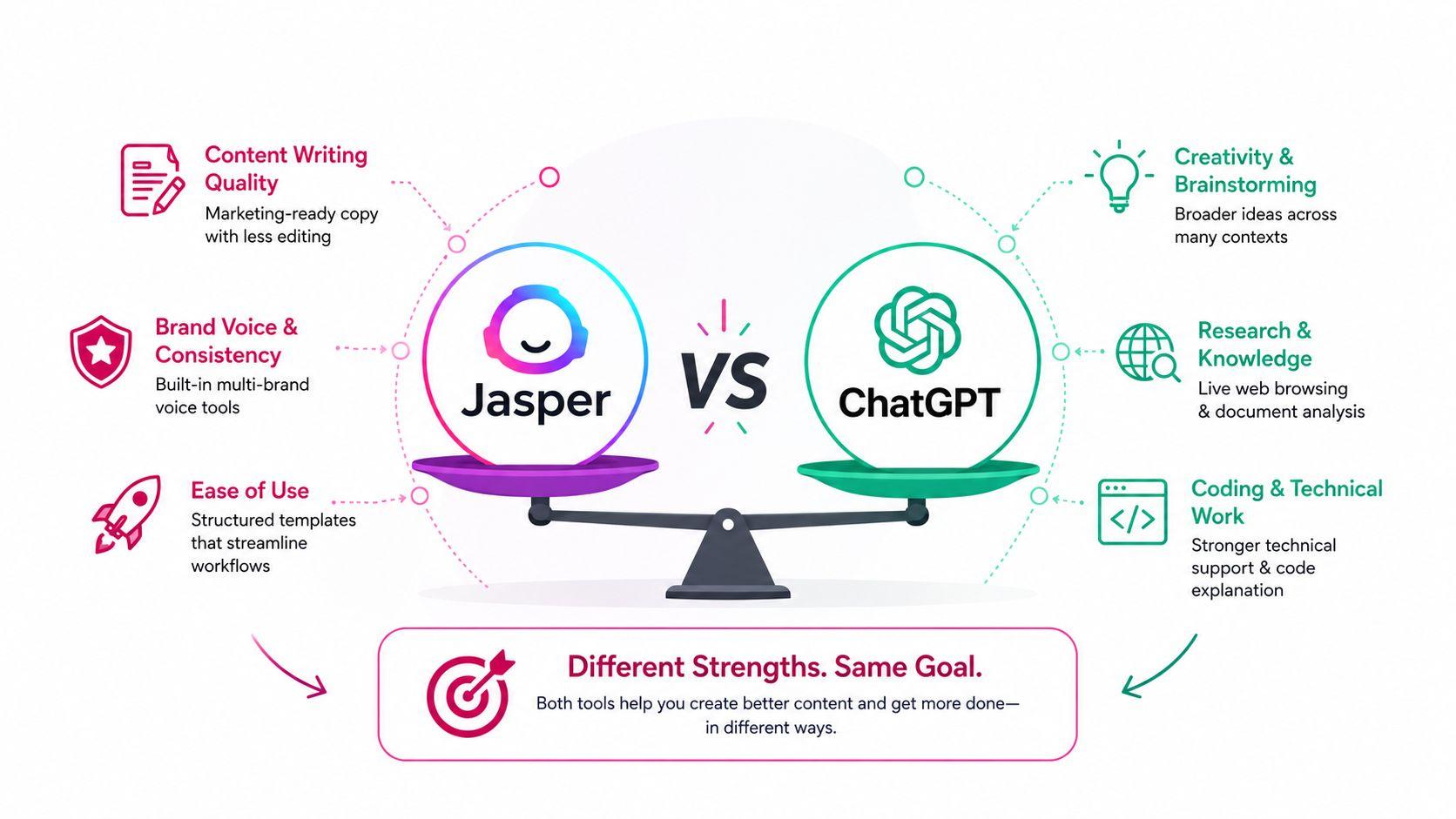
Jasper AI and ChatGPT overlap in some areas. But they were built with different priorities, and that shows up clearly once you compare them side by side.
Content Writing Quality
Think blog posts, landing pages, emails, product descriptions, ad copy, and social captions. Jasper AI tends to produce content that's closer to publish-ready with less back-and-forth, since Jasper's templates streamline marketing content creation from the first draft onward.
That's largely down to its template system. A marketer picks a content type, fills in a few fields about the product or campaign, and Jasper builds a structured draft around that input. Jasper has native add-ins for Google Docs and Microsoft Word, so a finished draft can move straight into the document that a team already works in.
ChatGPT can produce similar quality. But it depends more on the person writing the prompt. Getting the same depth from ChatGPT usually means writing detailed custom instructions or setting up a system prompt that spells out the tone, structure, and what to avoid. Even so, ChatGPT enables flexible, varied content generation, which is why it holds up across so many different formats.
A marketing team pumping out twenty product descriptions a week will likely move faster with Jasper's templates. A solo founder writing a single landing page might not mind the extra prompt work that ChatGPT requires.
Brand Voice and Consistency
Businesses running multiple campaigns with different contributors need writing that sounds like one brand, not five different people.
Jasper AI has a native Multi-Brand Voice feature built for exactly this. Teams can set up separate voice profiles for different brands or product lines, and every piece of content pulls from that saved profile.
ChatGPT handles this differently. It relies on Custom GPTs or saved Memory settings to hold onto tone and style preferences across sessions.
This can work well, but it takes more manual setup. It's also easier for the voice to drift if the person prompting isn't consistent about referencing those settings. For a team that needs several contributors to write in the same voice with minimal oversight, Jasper's built-in approach tends to hold up better over time.
Ease of Use
A first-time Jasper user has to learn the template system. They need to figure out which content type fits their needs and how brand voice settings apply to each draft. That learning curve got shorter recently, since Jasper's interface resembles ChatGPT after a recent update, giving new users a chat window they already recognize.
ChatGPT's interface is a chat box. Type a request, get a response, ask for changes. ChatGPT has a super-easy chat-style interface, and that simplicity means new users can be productive within minutes.
The quality of what they get back still depends on how well they can describe what they want. Someone experienced with prompting will get more out of ChatGPT faster than a total beginner. Jasper's structure removes some of that guesswork, at the cost of a steeper initial setup.
Integrations add another layer of convenience for both tools. Jasper integrates with third-party marketing tools via Zapier, connecting campaign content to the platforms a team already uses. ChatGPT supports custom GPTs and integrates with Zapier as well, giving it similar reach into outside apps.
Both tools automate workflows through Zapier integration, though neither is built to unify that automation across an entire business the way a dedicated operations platform would.
Creativity and Brainstorming
For generating a wide range of ideas, ChatGPT tends to offer more variety. Think marketing angles, product names, content topics, or business strategy directions.
It isn't boxed into marketing-specific templates, so it can draw on a much wider range of contexts and framings.
Jasper can brainstorm, too. But its suggestions tend to stay closer to marketing use cases since that's what it's built and tuned for. If someone is stuck on a campaign angle and wants five marketing-specific directions, Jasper works fine. If someone wants to explore an idea from 10 different angles beyond marketing, ChatGPT usually provides a broader range to work from.
Research and Knowledge Tasks
This is one of the clearest gaps between the two tools. ChatGPT has advanced data analysis features and live web browsing. That means it can pull in current information, analyze uploaded documents, and summarize raw data directly inside a conversation.
That makes it far more useful for research, whether that's digging into a competitor's website or making sense of a spreadsheet.
Jasper wasn't built with this kind of research function as a priority. It can help organize ideas and summarize information that a user provides. But it doesn't have the same document analysis or live browsing depth.
Whatever tool is used for research, the output should always be checked against reliable, current sources before it's used in a business decision or published anywhere.
Coding and Technical Work
For writing code, debugging, explaining programming concepts, or working through technical problems, ChatGPT is the stronger option by a wide margin.
It was built with broad technical capability in mind, and developers use it regularly for exactly these tasks.
Jasper doesn't really compete here. It wasn't designed for technical or developer workflows. Its strengths sit firmly in the marketing content space. A marketing manager who occasionally needs a spreadsheet formula explained might lean on ChatGPT even if their main content work happens in Jasper.
Jasper AI vs ChatGPT Pricing and Value
Pricing for both tools changes fairly often. It's worth checking each platform's current plans before making a decision.
Jasper typically prices around team and business use, with plans built for multiple seats and brand voice management. ChatGPT offers individual plans as well as team and enterprise tiers, with pricing that scales based on usage and required features.
The question that comes up most: Is Jasper AI still worth paying a premium over ChatGPT Plus or ChatGPT Team? The honest answer depends on the team size and the level of collaboration involved.
A single person writing occasional content might not see enough value in Jasper's team features to justify the extra cost over an individual ChatGPT subscription. A marketing team of five or more people, producing content daily and needing a consistent brand voice across every piece, is more likely to get their money's worth from Jasper's structure.
This lines up with where marketing budgets are actually heading. Content Marketing Institute's B2B Content and Marketing Trends: Insights for 2026 report found that AI-powered marketing tools top the list of planned 2026 investments, at 45%. The return on a tool like Jasper shows up in collaboration and consistency at scale, not in the price tag alone.
Pros and Cons of Jasper AI and ChatGPT
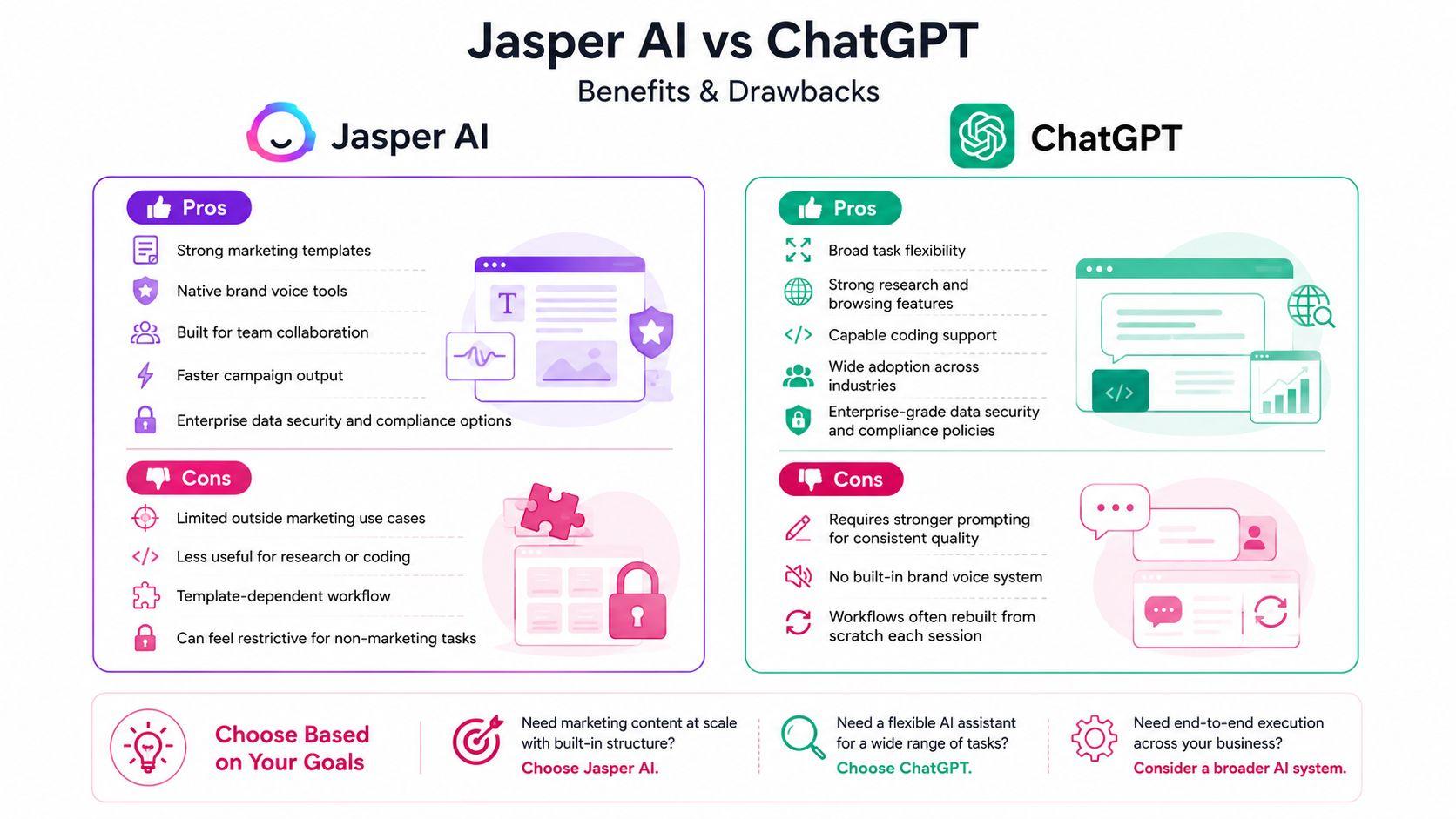
Jasper AI Pros and Cons
Jasper's templates and brand voice tools start paying off once a team is producing marketing content at real volume. Think multiple blog posts a week, ongoing ad variations, or email campaigns running across several product lines. At that point, the time saved by not rebuilding structure and tone from scratch adds up fast.
The limits show up when a team's needs stretch past marketing. If the same group also needs research support, technical assistance, or general business assistance, Jasper won't cover those areas. They'll end up reaching for a second tool anyway.
Recognizing which of these situations describes your team matters more than any single feature on a list.
ChatGPT Pros and Cons
ChatGPT's flexibility is a real advantage for varied, one-off tasks. Research support, coding help, brainstorming sessions, and quick summaries: ChatGPT handles all of these well without requiring a dedicated tool for each.
The trade-off arises when the same tasks need to be performed repeatedly and consistently across a team. Output quality depends heavily on who's writing the prompt, so two people asking for the same type of content can get noticeably different results.
Workflows also tend to be rebuilt from scratch in every new chat unless someone carefully sets up saved instructions. For an individual, that's manageable. For a team trying to run consistent processes, it takes real oversight to make ChatGPT behave like a dependable business system rather than a flexible but inconsistent assistant.
Which Tool Should You Choose?
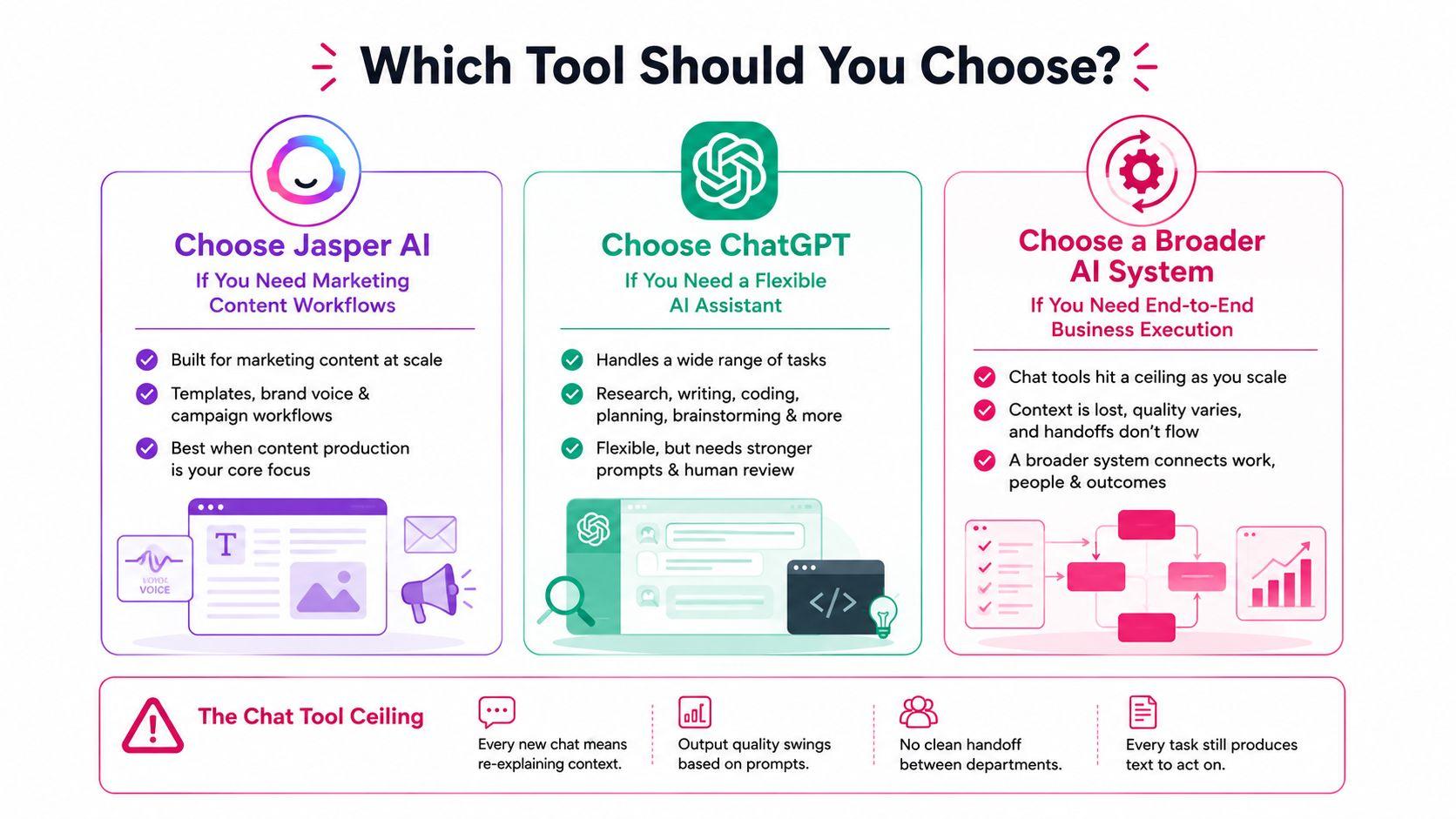
The right answer depends less on which tool is "better" overall. It depends more on what you actually need it to do, how big your team is, and how much structure you want built in.
Choose Jasper AI If You Need Marketing Content Workflows
If your main priority is producing marketing content in a structured, repeatable way, Jasper is the better fit. That includes campaign copy, blog drafts, landing page text, email sequences, ad variations, and a consistent brand voice.
Jasper works best when content production is the core business need, not when a team also needs support across research, technical work, or other departments.
Choose ChatGPT If You Need a Flexible AI Assistant
If you want one AI tool that can handle a wide range of tasks, not just marketing content, ChatGPT is the stronger choice. It covers research, drafting, editing, planning, coding, brainstorming, and general problem-solving.
That flexibility comes with a catch. Getting consistent, business-ready output usually requires stronger prompts, saved instructions, and a human to check the work before it goes out.
Choose a Broader AI System If You Need End-to-End Business Execution
Even with the right tool picked between these two, most growing businesses eventually hit the same wall.
- Every new chat means re-explaining the context that should already be known.
- Output quality swings depending on who's writing the prompt that day.
- There's no clean way to hand off work between departments.
- Every task still produces text that a person has to pick up and act on.
That ceiling is where a different category of tool starts to make more sense.
Why Sintra AI Is the Better Alternative to Jasper AI and ChatGPT
Sintra AI takes a different approach entirely. Instead of one AI assistant trying to do everything, or one AI writing tool focused on marketing alone, Sintra provides a team of specialized AI team members.
They support marketing, sales, customer support, operations, business development, and creative work, each through role-specific workflows built around shared business context.
This kind of setup fits where AI use is already heading inside companies. McKinsey's State of AI report found that organizations most often use generative AI in marketing and sales, product and service development, service operations, and software engineering, meaning the businesses getting the most value are the ones applying AI across several functions at once, not just one writing task in isolation.
While Jasper AI and ChatGPT hand you text and leave execution to you, Sintra is built to help ongoing work actually get done across departments, not just generate a draft and stop there.
Sintra AI Gives Businesses Specialized AI Helpers
Instead of relying on one general chatbot to handle every request, Sintra AI gives each business function its own dedicated helper.
- Soshie manages social media.
- Penn handles copywriting.
- Cassie handles customer support conversations.
- Buddy supports the business strategy.
- Vizzy works on visual content.
Each helper is built for its specific role, so the work fits naturally into day-to-day operations rather than needing constant adjustment. A business can delegate ongoing tasks to the helper best suited for that job, rather than squeezing every request through one assistant meant to do a bit of everything.
That kind of specialization tends to lead to steadier, more consistent output as a team scales up.
Brain AI Keeps Brand and Business Context Consistent
Brain AI works as a shared memory that every Sintra helper can pull from. It holds onto brand knowledge, customer details, business goals, and communication style, so each helper works from the same understanding of the business rather than starting fresh every time.
This matters most for teams that produce content, respond to customers, or coordinate across multiple departments at once.
Jasper AI focuses on brand voice specifically for writing tasks. Brain AI covers more ground than that. It extends consistent context across every function a business runs, not just the content it publishes.
Sintra AI Integrations Support Real Business Workflows
AI tools become much more useful when they connect to the platforms a business already relies on daily. AI integrations let Sintra's specialized helpers work directly alongside tools like Gmail and Notion, so AI becomes part of an existing workflow instead of one more separate step someone has to manage manually.
These integrations reduce repetitive manual work. They reduce the constant switching between tools and tabs and support workflows that run reliably across departments.
That's a different kind of value from what standalone AI conversations offer, where every task starts and ends in a single chat window, with no connection to the tools running the rest of the business.
Move Beyond AI Writing With a Full AI Team
Jasper AI and ChatGPT both do their jobs well within their own lanes. But neither one was built to run a business's day-to-day operations from end to end.
Get started with Sintra AI if what you actually need is time back, work that stays consistent without constant oversight, output that scales without adding headcount, and tasks that get carried through to completion instead of landing as one more draft someone still has to act on.
Jasper AI vs ChatGPT FAQs
Is Jasper AI better than ChatGPT?
It depends on the task. Jasper AI is better for structured marketing content and keeping a consistent brand voice. ChatGPT is better for flexible, broad tasks like research, coding, and brainstorming that go beyond marketing.
What is the main difference between Jasper AI and ChatGPT?
Jasper AI is built around marketing workflows, using templates and brand voice tools to produce campaign-ready content. ChatGPT is a general-purpose assistant designed to handle a much wider range of tasks across many industries.
Can Jasper AI replace ChatGPT?
Jasper can replace ChatGPT for certain marketing tasks, especially ones tied to brand voice and campaign content. It isn't built to handle broad reasoning, coding, in-depth research, or the kind of general productivity work ChatGPT covers.
Is ChatGPT cheaper than Jasper AI?
It depends on the plan type, team size, and how the tool is used. Pricing for both platforms changes, so it's worth checking current plans directly before deciding based on cost alone.
What is the best alternative to Jasper AI and ChatGPT for business workflows?
Sintra AI is a strong alternative for businesses that need more than a writing tool or a single chatbot. It offers specialized AI helpers, shared business memory through Brain AI, and integrations that support real workflows across marketing, sales, support, and other departments.
Related articles