Meta AI vs ChatGPT: Which Is Better in 2026?

Table of Contents
Quick Answer: Meta AI vs ChatGPT, Which Is Better in 2026?
Meta AI vs ChatGPT in 2026: ChatGPT is the stronger all-round tool for professional work, while Meta AI is better for quick, social, everyday chats. ChatGPT is a productivity-focused AI that handles data analysis, content creation, and coding. Meta AI is a social-focused assistant, built into Instagram, WhatsApp, and Messenger, that gives fast conversational answers. Choose ChatGPT for serious writing, analysis, and code; choose Meta AI for casual conversations inside Meta apps.
AI apps are changing every moment, with industry giants investing billions of dollars. Meta AI’s in-house app and OpenAI’s ChatGPT officially hit the one-billion-user milestone in 2025.
This left many questioning "Meta AI vs ChatGPT: which is better?" The answer lies in your requirements. while Meta AI excels... ChatGPT is a go-to productivity partner for many executives.
Here is a detailed comparison of both Meta AI and ChatGPT based on their model training, expertise, capabilities, and use cases. So, dive right in.
Here is a side-by-side Meta AI vs ChatGPT comparison table.
Meta AI vs ChatGPT at a Glance (2026)
Meta AI vs ChatGPT: which is better for your unique requirements? Before we dive into features and capabilities, let’s first understand what they are and what they deliver. This Meta AI vs ChatGPT comparison for 2026 breaks down the differences that matter. Whether you frame it as Meta AI vs ChatGPT differences or a ChatGPT vs Meta AI comparison, it comes down to depth versus everyday convenience.
Meta AI
Released in 2023, Meta AI is Meta’s in-house AI chatbot, developed to improve user experience on Meta-supported platforms: WhatsApp, Instagram, Facebook, and Messenger. Unlike conventional chatbots that function as standalone tools, this AI is directly built into social media platforms, making it a crucial part of your everyday social interactions.
Meta AI uses LLMs developed by Meta (Llama 4 Herd, Muse Spark, etc). Through this, the AI generates conversational responses, gives content suggestions, and assists with various social media tasks, including image generation, visual animation, and more. Not as advanced as ChatGPT or Gemini, it excels in social connectivity and interactions.
ChatGPT
OpenAI launched ChatGPT in November 2022. Since then, it has become a leading AI model for content creation, automation, and personal or professional productivity. Unlike Meta AI, which has an ecosystem centered on social media interactions, ChatGPT offers diverse use cases. Executives and corporate officials use it to brainstorm ideas, summarize documents, write emails, and debug code.
OpenAI’s own GPT (Generative Pre-Trained Transformer) model family powers this AI chatbot. The latest version is GPT-5.5, released in April 2026, an advanced LLM that enables multi-step, complex reasoning, horizon workflows, and autonomous task executions. Unlike competitors, it learns from user interactions and native memory and crafts personalized responses.
Meta AI’s Models and Ecosystem Strengths
Yes, Meta has its own AI, called Meta AI, and it runs on Meta’s own models rather than OpenAI’s. Meta launched its latest model, Muse Spark, in April 2026. And, the industry is divided about its capabilities and potential. Let’s find out more about how it compares with the previous Llama framework, performance benchmark, and ecosystem.
LLaMA Models, Muse Spark, and Core Technology
As of April 8, 2026, Meta AI released Muse Spark, the latest AI developed by Meta Superintelligence Labs (MSL). Muse Spark is a native multimodal reasoning AI model, capable of interpreting text, visuals, and audio within a single architecture. It also supports multi-step reasoning using the chain-of-thought.
Muse Spark offers three different interaction modes, including
- Instant is the default mode for casual queries. This mode does not require extended reasoning and does exactly what a standard chatbot can.
- Thinking mode uses extended chain-of-thought reasoning. You will find that this mode takes more time, works through hard problems in intermediary steps, and resolves them accordingly.
- Contemplating uses multiple reasoning agents that are working in parallel. And then, it combines their outputs into a single answer. Unlike GPT-5.4 Pro, which thinks for longer, Muse Spark thinks wider.
Earlier, Meta AI used Llama 4 Herd, released in April, 2025. Unlike the previous models, Llama 4 featured native multimodal capabilities. What does this mean for users? They could upload images and documents for data analysis and interpretations in the prompts. Llama 4 Herd offers three different variants, including
- Llama 4 Behemoth (16 experts).
- Llama 4 Maverick (128 experts).
- Llama 4 Scout (16 experts).
All three Llama 4 models use a mixture-of-experts (MoE) architecture. Within this architecture, experts are sub-networks that specialize in a domain. In layman’s terms, let’s say Scout has one expert for writing, another for coding, and so on.
The latest Muse Spark is not open-source like Llama 4 Herd. It is also not yet accessible via an API. Meta AI has not announced whether it will make the Llama 4 series accessible via the main Meta AI chat or for download via Llama.com.
Performance and Real-Time Responsiveness
Meta’s AI models, both Muse Spark and Llama 4, work on the principle called “speed of access”. Simply put, this means the AI answers queries where you already are: Facebook, WhatsApp, or Messenger. However, their reasoning and response time differ.
For instance, the older Llama 4 Herd version was built around the speed and not the depth of the query. Once you ask the question, it gives near-instant, real-time answers, regardless of the complexity of your request.
How does it work?
Within the Llama 4 Herd MoE, a gating network selects which experts are best for the requested task. For instance, if you have a query about gene cycling, Scout will answer you by activating only its biology expert and some shared experts. So, the models are not using all of their parameters at once. This balance makes them faster. For reference, Llama 4 Scout activates 17B parameters of its total 109B parameters at once.
However, the newer Muse Spark from Meta AI has somewhat transitioned to balancing speed and reasoning. This native multimodal reasoning model has both contemplative and instant modes.
In the contemplating mode, the AI runs multiple agents to interpret and resolve a problem. Its visual chain of thought helps the AI reason step-by-step via visual information. Accompanied by the “instant mode” that gives you immediate answers, Meta is giving users the freedom to choose between speed and efficiency.
Another key detail about the Muse Spark is its thought compression. During its reinforcement learning, the model is rewarded for the right answers yet penalized for the time it takes. The result: the AI does more without excessive output tokens.
For context, Muse Spark scores 52 on the Artificial Analysis Intelligence Index, sitting ahead of Claude Sonnet 4.6 and Grok 4.2. Similarly, it also demonstrated token efficiency for its intelligence level. Muse Spark used 58M output tokens to run the Intelligence Index, compared to Claude Opus 4.6 (157M tokens) and GPT-5.4 (120M tokens).
Native Integration Across Meta Platforms
The biggest advantage Meta AI has over ChatGPT is the platform distribution strategy. Rather than asking users to log in to a separate tab, this AI is built directly into the Meta platforms, including Facebook, Instagram, Messenger, and WhatsApp. You don’t have to deal with extra downloads, new accounts, and friction.
Unlike AI chatbots that require intent, Meta AI intervenes in your everyday moments. This could be a WhatsApp group planning a hike or an Instagram search for a product. Using it is as easy as prompting an AI inside a group chat to develop a trip plan. This passive accessibility gives Meta AI access to billions of users every day.
In 2025, Meta AI also launched a standalone app for mobile and web. This app gives you everything in one place, so you can easily navigate tools that would otherwise show up contextually: texts, images, and video tools.
Social and Creative Use Cases
Meta AI’s creative toolkit is built directly into your everyday social platforms. So, whether it is posting memories, messaging others, or simply browsing, Meta AI helps you with almost everything. Here are a few common Meta AI use cases.
- Caption Writing - Meta writes captions for your stories and posts directly within Facebook and Instagram. It even lets you try out different SEO-friendly hooks without leaving the post composer section.
- AI-Generated Images Inside Your Chats - Meta AI’s reimagine feature lets you create and modify images within group chats on Instagram. Just produce a first draft and ask your friends to give creative input to get exactly what you want.
- AI-Driven Replies - A new update on WhatsApp, Writing Help, now generates AI-powered replies based on your conversations. It also helps you rephrase, proofread, and rewrite your messages in minutes.
- Photo Editing Inside Your Chats - You can also use Meta AI to touch up your photos directly from WhatsApp. Ask it to remove objects from the images, apply a new theme, or change the background.
- Content Discovery within Your Feed - Meta AI connects to the web and pulls information for you. Whether wondering about what to wear, where to buy it from, or how to get started on a room makeover, it has a answer for everything.
Limitations in Depth and Customization
While a useful free social AI, Meta AI also has some tradeoffs, especially for someone who wants an AI that goes beyond routine social interactions. These gaps become reality as soon as you dig deeper into professional business tasks or academic research. Here are a few things you should keep in mind in the “Meta AI vs ChatGPT” comparison.
OpenAI’s mature multi-step reasoning models (especially the Series 5) can execute business tasks, produce structural analysis, and solve complex queries. Meta AI can’t. The Muse Spark’s contemplating model might have narrowed this gap somewhat, but it still lacks analytical depth.
Meta AI has its own dedicated ecosystem, unlike ChatGPT. With this AI, you don’t have the freedom to connect your work tools or use custom GPTs to handle workflows. As soon as you go beyond socials and tap into work platforms like Slack, Notion, or Salesforce, Meta AI becomes redundant.
Meta AI’s free access has certain restrictions. For instance, you can not use its generated images for commercial purposes, which limits its use for content directors, marketers, or even businesses.
ChatGPT’s Models and Capabilities Explained
Unlike Meta AI, OpenAI has not taken a long break between models. The company has released over a dozen models since 2025 alone, which means constant advancements in features and capabilities. Today, it stands at parity with competitors like Claude and Gemini. Let’s find out more about ChatGPT’s AI model evolution and capabilities.
GPT-4 and GPT-5: Model Evolution and Advanced Performance
For starters, GPT-4 is a large language model with native multimodal capabilities, meaning it can interpret images and text. It was released in March 2023 as an extension of GPT-3.5 with improved accuracy, multimodal capabilities, larger context handling, and web browsing. Its standout features include
- Advanced language understanding, meaning it can handle complex queries with context across long conversations.
- Performs better in maths, logic, and calculation queries than GPT-3.5.
- Reduces forgetfulness in longer conversations.
- Executes tasks across domains, including text summarization, sentiment analysis, code generation, and creative writing.
Almost two years later, in August, 2025, OpenAI launched GPT-5. The company claimed that this version is a unified system that combines multimodal inputs with deeper multi-step complex reasoning. One notable advancement in this model is that it can decide when to respond instantly and when to think longer for a request. Its standout improvement from GPT-4 includes:
- Expanded context window, meaning it can process and remember more text in a single conversation.
- Better reasoning accuracy that enables the AI to perform better in technical, legal, and analytical domains.
- Faster and more efficient. It is built with reduced latency and better speed on smaller devices.
- Multilingual capabilities make it ideal for global applications.
- Better instruction following, meaning its outputs are closely aligned with user prompts.
Here is a complete description of the GPT series 4 and series 5 newer iterations.
Lightweight Models and Efficiency Use Cases
Over the years, OpenAI has built an entire lineup of lightweight models that primarily focus on high-speed and cost-effective outputs. These models reduce latency and operational cost. Newer iterations of GPT lightweight models include
GPT-5.4 Mini / GPT-5.4 Nano
Both GPT-5.4 Mini and GPT-5.4 Nano are the smallest and most affordable versions of GPT-5.4. These variants excel at tasks where speed and cost are primary factors, including data extraction, data classification, and lightweight coding. Here is a side-by-side performance benchmark comparison of GPT-5.4 with its Mini and Nano variants.
Mostly, these performance benchmarks showed a 4-8% difference, which may sound intimidating, but it’s not, at least for most real-world tasks. Let’s say you are writing basic code, answering questions, and summarizing PDFs. Thankfully, you won’t even find a difference.
For maximum efficiency, you must know when to use which model variant. For instance,
GPT-5.4 Mini truly shines in
- Conversational queries
- Lightweight coding assistance (debugging, code reviews)
- Multimodal tasks (data analysis, summaries, image interpretations).
Whereas GPT-5.4 Nano excels at
- Repetitive structured jobs (classification tasks, including tagging, keyword extraction, spam detection).
- Large-scale data processing (bulk document analysis, data extraction, summaries).
Multimodal Capabilities and Tooling
ChatGPT has come a long way. Today, it is a native multimodal reasoning system that takes inputs in different formats. GPT-5 reads your inputs, observes data, and understands intent within diagrams, documents, snaps, and more.
You can ask it to interpret an image with greater precision, cross-reference multiple data forms in a single query, and synthesize complex files. For businesses and executives, these multimodal capabilities mean maximum productivity. So, when you upload an image, it isn’t necessarily reading it; rather, it extracts patterns and meaning from it.
Moreover, what really sets ChatGPT apart from Meta AI is its tooling. Here are some things it can do beyond basic capabilities.
- Agent mode that executes multi-step tasks on your behalf.
- An advanced voice mode that carries real-time audio conversations with camera awareness.
- Custom GPTs, trained for specific business use cases.
- A canvas feature that lets you collaborate with the AI and edit documents.
- Scheduled tasks to set recurring AI queries automatically on a schedule.
- Atlas is a web browser built directly into ChatGPT for native AI-browsing.
- Codex, an advanced coding agent for autonomous workflows.
Structured Output and Task Execution
ChatGPT is more than an answer-based engine. With multi-step, complex reasoning and context handling, ChatGPT produces structured responses that follow your instructions, adapts to your style, and stays close to the context.
- Instruction Understanding: ChatGPT understands instructions in the inputs using NLP. It compares your requests with its massive database to predict your requirements and produce relevant responses. A step further: it uses custom instructions to remember your style preferences and tone for personalization.
- Multi-Step Reasoning: GPT-driven models use a chain-of-thought. Simply put, they break down your prompts into shorter sections and process them chronologically to reach an in-depth conclusion.
That’s not it. ChatGPT also offers an open ecosystem for automated task execution. The GPT models connect to external apps using triggers, APIs, and scheduled tasks. With these automations, you can leave the repetitive tasks to ChatGPT, be it organizing emails or generating marketing content, supporting your customers, and more.
Limitations and Trade-Offs
Like Meta AI, ChatGPT also has a few trade-offs.
For starters, the biggest drawback of ChatGPT is the “hallucination” factor. In an attempt to stay relevant to the intent of your request, ChatGPT can sometimes quote outdated or fictional data in responses. To such an extent that it can even make up sources. The worst part: it appears confident, and you won’t even realize it.
Another limitation of ChatGPT is its sensitivity to prompt phrasing. It is reactive in approach, meaning the answers will depend on how you phrase your request. For instance, if you ask for the same task but rephrase a prompt, chances are, the outcome will be different. This is especially damaging to teams that rely on ChatGPT for business tasks like drafting emails, analyzing data, and creating content.
Moreover, ChatGPT lacks emotional awareness and common sense. It often answers with emojis, reassurances, and bullets. But the reality is, humans don’t converse like this. Through these responses, it is only copying empathy and not really understanding it. Similarly, if it does not understand anything in your prompt, rather than asking clarifying questions, it will simply assume and give you the most likely answer.
That’s not it. In long conversations, ChatGPT struggles with memory loss. It leans toward forgetting previous instructions or context, which leads to inconsistent answers. Plus, when you are in a free version and overstep the message cap for the advanced model, ChatGPT silently switches to a lower-tier model. This makes answers inconsistent.
Meta AI vs ChatGPT Features: Which AI Does More?
Now that we know what goes behind the scenes for both Meta and ChatGPT, it’s time to dig deeper into their features and capabilities. Here is a direct Meta AI vs ChatGPT comparison for anyone confused about which AI to choose. On Meta AI vs ChatGPT capabilities, ChatGPT covers more ground across coding, analysis, and research.
Best for Writing and Content Creation
Meta AI vs ChatGPT: who writes better? The answer: both, but for different purposes.
Powered by Muse Spark, Meta AI focuses on balancing speed, convenience, and efficiency. Naturally, you will find it inclined towards social media content, thanks to its native platform integration. It can write social media captions, brainstorm quick content ideas, and generate casual replies. The best part: it is almost instant in writing content.
On the contrary, ChatGPT excels at in-depth and structured professional content. It excels at writing long-form blog posts, research essays, professional emails, and polished website copy. You will find its output more refined and polished. And, it adapts to your writing style and tonality.
Real Test
To be fair in assessment, we tested both ChatGPT and Meta AI on an email and a social media caption.
For the email, our test prompt was: ”Draft an email to extend the deadline of our ongoing quality checks to ensure thorough testing. Do not be apologetic and sound polite yet professional.”
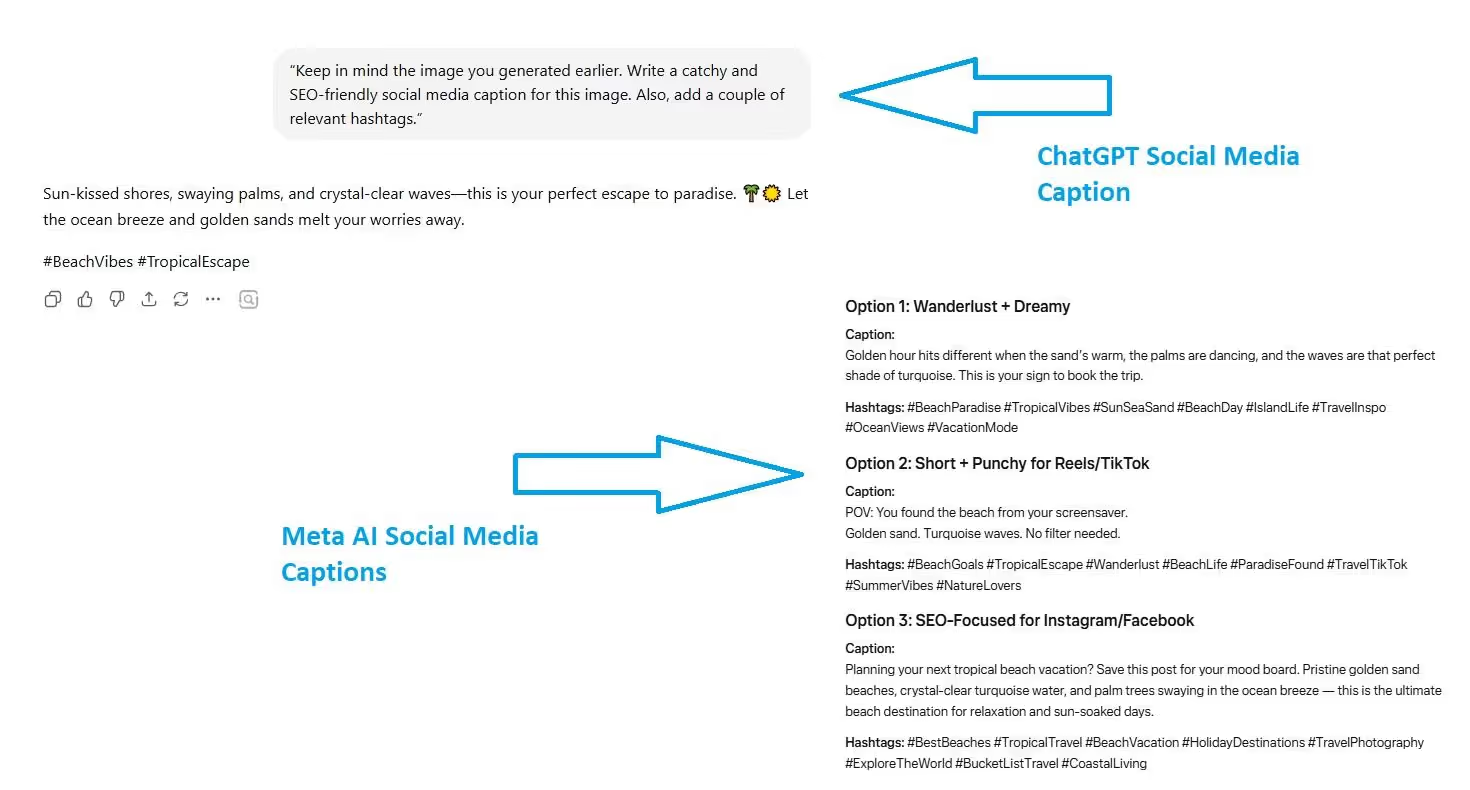
For the social media caption, our test prompt was: “Keep in mind the image you generated earlier. Write a catchy and SEO-friendly social media caption for this image. Also, add a couple of relevant hashtags.”
Winner: ChatGPT for Versatility and Adaptability
In email writing, ChatGPT stands out. It explained the reason with clarity and confidence. It politely requested the deadline extension. Whereas the email Meta AI generated couldn’t be sent directly and needed heavy editing. Instead of requesting an extension, it clearly announced “we are extending the deadline” and “notify me by, so we can realign”.
Here is a side-by-side comparison.

In the social media post caption, both tools delivered well. However, Meta AI stands out. It wrote three different versions: a general caption, one for TikTok, and the last for Facebook/ Instagram. It was catchy and interactive. ChatGPT generated one caption. But it was also engaging and catchy. Plus, it had the relevant hashtags.
Here is a side-by-side comparison for anyone wondering if Meta AI is better than ChatGPT.
Best for Coding and Technical Tasks
Coding is one area where ChatGPT clearly distinguishes itself from Meta AI.
With the release of Muse Spark and the introduction of multi-step reasoning capabilities, Meta AI might be catching up. Meta claims that this version excels at multi-step instruction following, making it competitive with models like GPT-5.4 on coding benchmarks, such as HumanEval. Moreover, among all, Meta’s Llama 4 Scout has a roughly 10M-token context window, which is ideal for analyzing the entire codebases in a single conversation.
That said, ChatGPT still stands superior on performance benchmarks, thanks to its step-by-step contextual and complex reasoning across long conversations. GPT-5.5 and GPT-5.4 have a higher coding index (59 and 57, respectively), compared to Muse Spark, which lies around 47. It also beats Muse Spark on Terminal-Bench 2.0 and SWE-bench verified.
Real Test
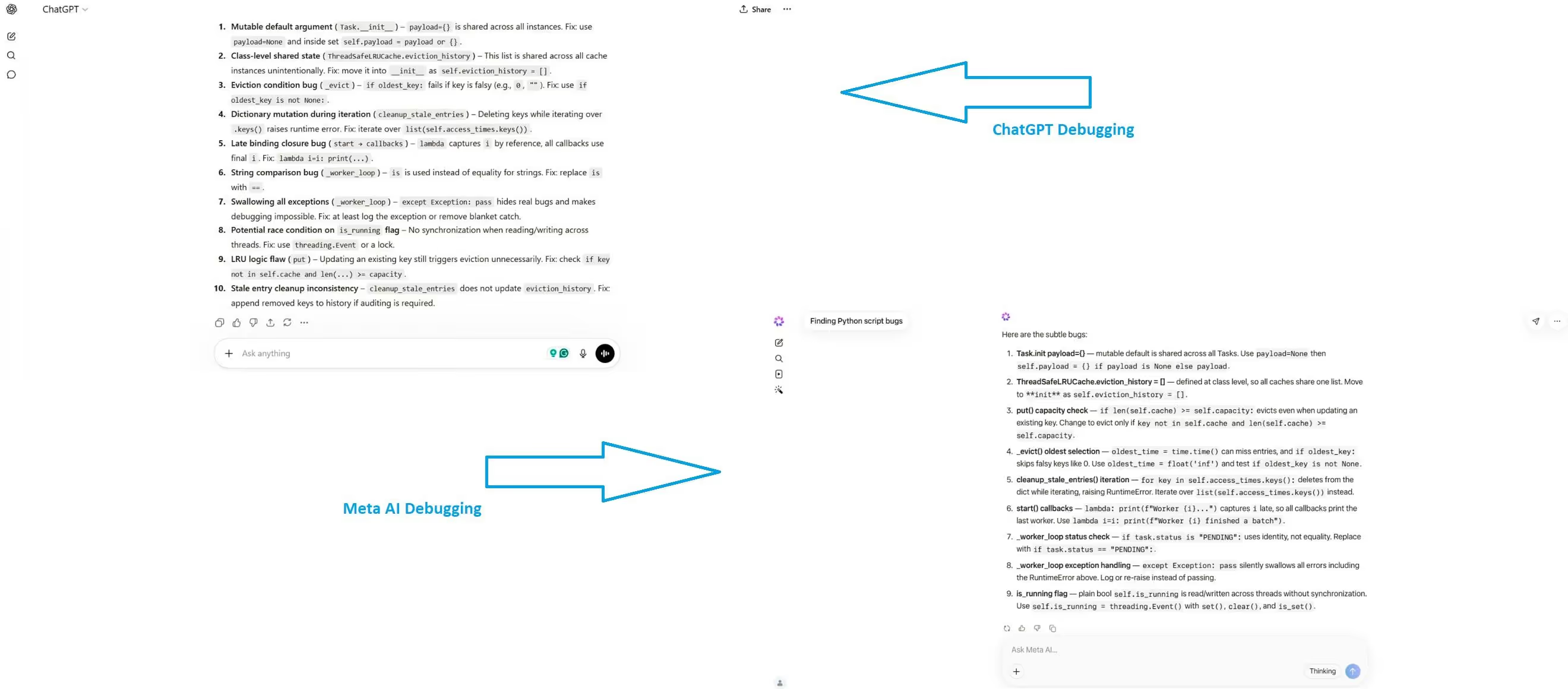
We did a Meta AI vs ChatGPT debugging test using the following code. As Meta has not yet released the Muse Spark API, we used the chat interface for this test.
For this test, we used a Python simulation of a Multi-Threaded Task Processor backed by a custom Thread-Safe LRU (Least Recently Used) Cache. Simply put, the code does two things: Cache (stores tasks and automatically evicts the oldest ones when it gets full or becomes stale) and Workers (spins up multiple background threads that currently grab tasks from the cache and process them). It was a specifically curated stress test for the two AIs, intentionally packed with hard-to-find Python gotchas and multi-threading traps to see which AI could handle production-level debugging.
Test Code:

Tie Between ChatGPT and Meta AI for Complex Debugging
Both models, GPT and Muse Spark, found the six bugs we had planted in the code. They both caught 100% of the fatal bugs planted in the code. However, ChatGPT listed 10 issues, compared to Meta, which only listed 9 issues. Beyond debugging, both models also modified the logic to make the overall code better and more production-ready.
Best for Image Generation and Creative Output
Meta vs ChatGPT: which is better for creative projects? Both platforms let you generate images, but if you are on a free plan, Meta AI definitely gets more done.
For starters, ChatGPT uses GPT-Image-2.0 for image generation, which consistently ranks at the top alongside the infamous Gemini model. Hence, its visuals are naturally hyperrealistic and nuanced. However, with a free plan, you can only get a few images per day. And, the editing tools feel limited to only replacing and removing objects
In comparison, Meta AI uses Muse Spark as of April 2026 to power image generation. The first appeal to this platform is that it’s free. You can generate as many images as you like. Beyond generation, the Meta platform has an image editor. With this, you can restyle and reprompt until you get what you desire.
However, using Meta AI for image generation also has tradeoffs. It is extremely sensitive about realistic AI images and copyright. We once mentioned a stock photo in the prompt, and it clearly ignored our instructions.
Real Test
We tested both Meta and ChatGPT’s image generators using the following prompt.
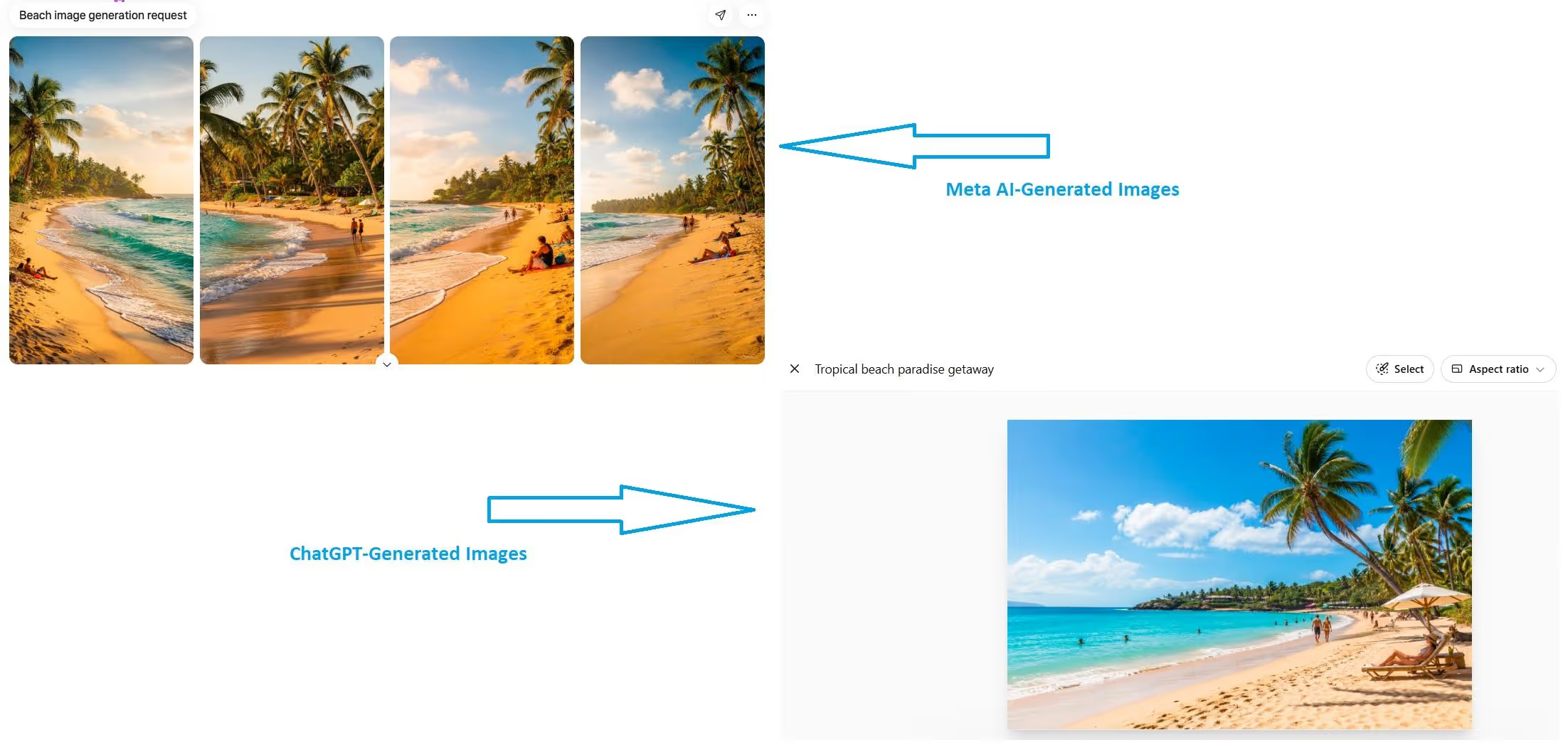
Test Prompt: “Generate an image of a beach on a sunny day with golden sand, palm trees swaying in a light breeze, and turquoise waves. Show a relaxed atmosphere with a few people enjoying warm sunlight”.
Tie Between Meta AI for Additional Features and ChatGPT for Realistic Output
The ChatGPT-generated image was quite realistic with the exact details I mentioned in the prompt. It stands among competitors like Gemini Nano Banana Pro for complex, text-dense, and narrative-driven images. In comparison, Meta produced four different variants from a single prompt, each with a different arrangement of objects. Though it lacked realism, Meta AI compensated for it with touch-up features (restyling, themes, etc).
Here is a side-by-side comparison of both.
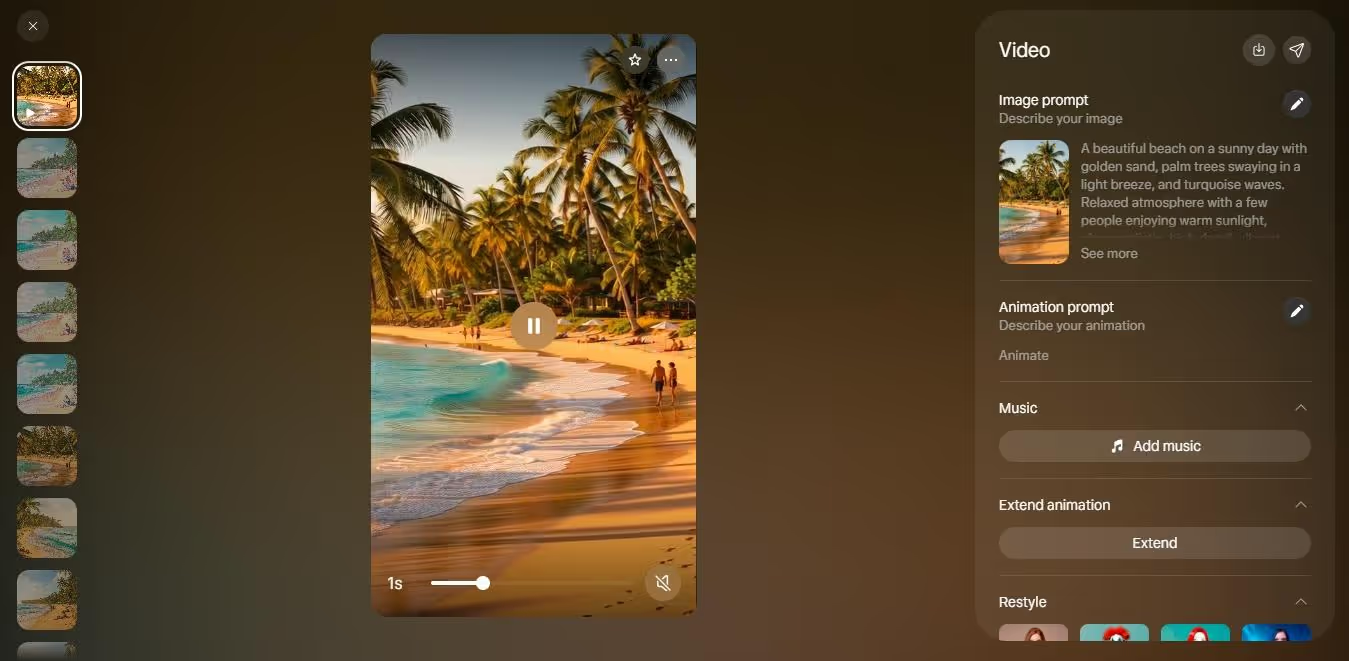
Moreover, Meta AI provides an animation button for every generated image. We clicked it, and it turned our visual into a small clip.
Best for Voice and Conversational Experience
Both Meta AI and ChatGPT have a voice mode. But each is developed for a different purpose.
For instance, Meta AI offers low-latency conversations directly within your social platforms. It works best for instant, hands-free interactions concerning social scenarios or basic queries. The Meta AI voice mode features over ten unique voices, including celebrities like Judi Dench and Keegan-Michael Key.
In comparison, ChatGPT’s voice mode is advanced and more formal. It gives you emotionally intelligent and nuanced responses. You will find that it picks up visual cues and sentiments and keeps the conversation flow naturally.
Real Test: Scott Hilse Voice Mode Test
The only limitation is that Meta AI voice mode is not available to all due to regional restrictions. It may not be available in your supported language or country. For this reason, we were unable to conduct a real Meta AI vs ChatGPT voice mode test.
YouTuber and content creator Scott Hilse recently did a podcast, “The Simplified Podcast,” with both ChatGPT and Meta AI. In this test, he focused on having full-length conversations with the two AIs to evaluate their context handling, understanding, and emotional intelligence.
Winner: ChatGPT for More Advanced, Contextually-Driven Conversations
In the ChatGPT episode, Scott found that the assistant could dig deeper into philosophical concepts. It carried a nuanced and structured conversation. Mostly, it felt like talking to an AI with deeper reasoning capabilities.
However, in the Meta AI episode, Scott was frequently cut off mid-sentence. This is understandable as Meta is trained to provide instant responses. But he also found that the AI would repeat most things when addressing a specific point.
Both AIs were equally conversational, but ChatGPT’s voice mode stood out for its analytical depth.
Best for Browsing and Real-Time Information
An AI chatbot is as good as its information base. Thankfully, both Meta and ChatGPT offer real-time web browsing that gives you up-to-date information. However, their approaches completely differ in implementation and speed.
For starters, ChatGPT relies on Bing to pull real-time data. Its Deep Research mode goes through numerous authoritative websites (whitepapers, news articles, research reports) and takes time to make sense of this data. Only then do you get a response. Meaning, it offers analytical depth for academic and business research.
Another thing that makes ChatGPT better is the canvas space. Let’s say you are not completely satisfied with the output and need to edit it to your preferences. Canvas lets you import all the information from ChatGPT research and fine-tune it by asking more questions, deleting unnecessary data, and making manual edits.
Conversely, Meta AI also relies on Bing and Google for real-time data access. However, its research is limited to casual and social interactions. And, this is why getting an answer from Meta only takes a few seconds.
Real Test
We tested both ChatGPT and Meta’s information retrieval.
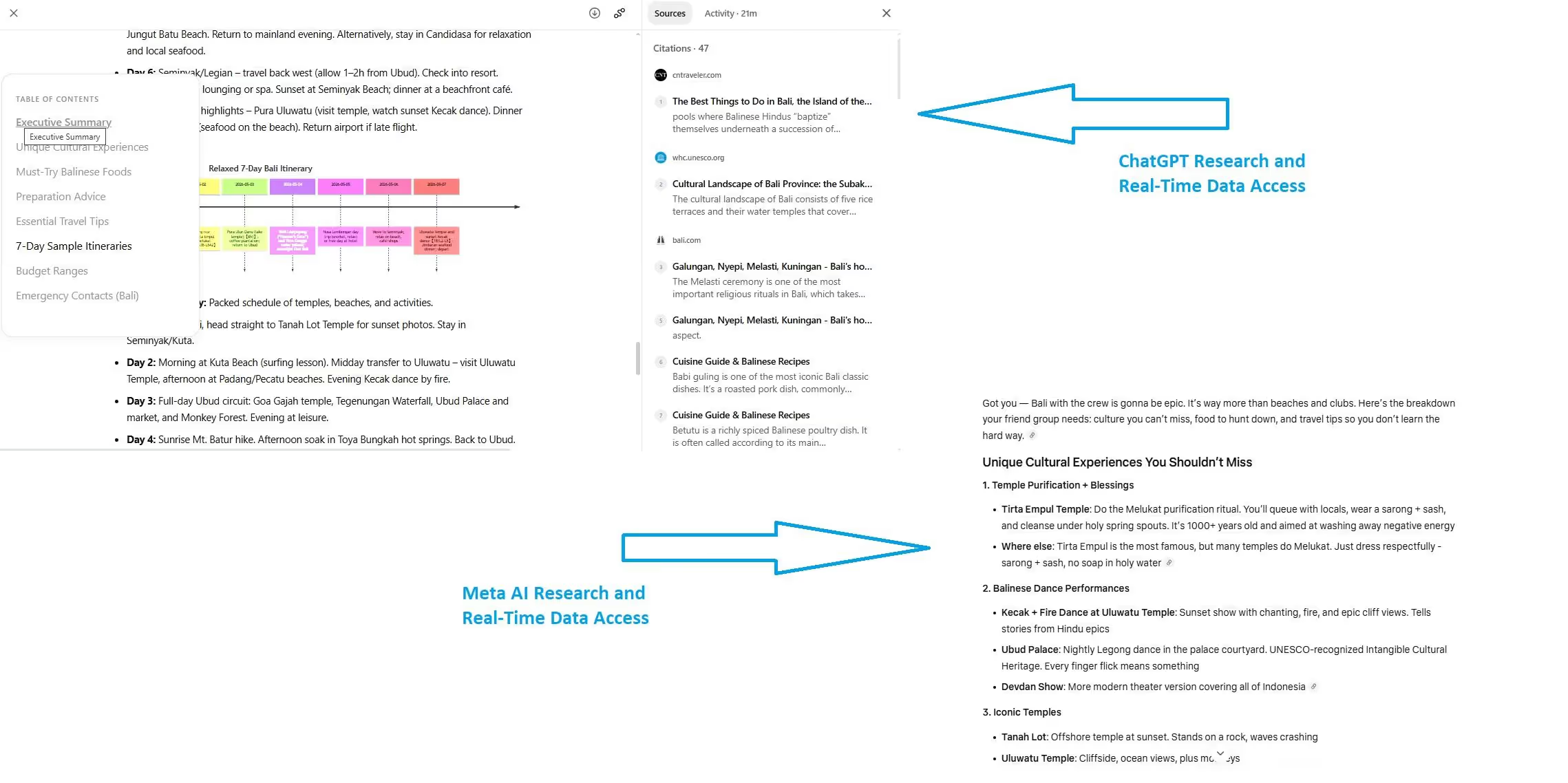
Test Prompt: “Our friend group is planning a trip to Bali and wants a guide to the unique cultural experiences we shouldn’t miss and the must-try local foods. Also, give us preparation advice and essential travel tips for our stay.”
Winner: ChatGPT for Analytical Depth and Deep Research
Meta AI took less than a minute to check a few travel blogs and social media posts to write an answer. It was good but not well-sourced.
In comparison, ChatGPT took 20-25 minutes to check all the authoritative sites (47) and build a detailed report with timelines, comparison charts, and graphics. It even included details we forgot in the prompt, such as budget ranges and emergency contacts. Plus, you get all the sources and citations in the right-side panel.
Here is a side-by-side comparison of both platforms.
Best for Integrations and Workflows
One area where you see a clear distinction in Meta AI vs ChatGPT is the integration and workflow fit. Both platforms are developed to deliver different needs.
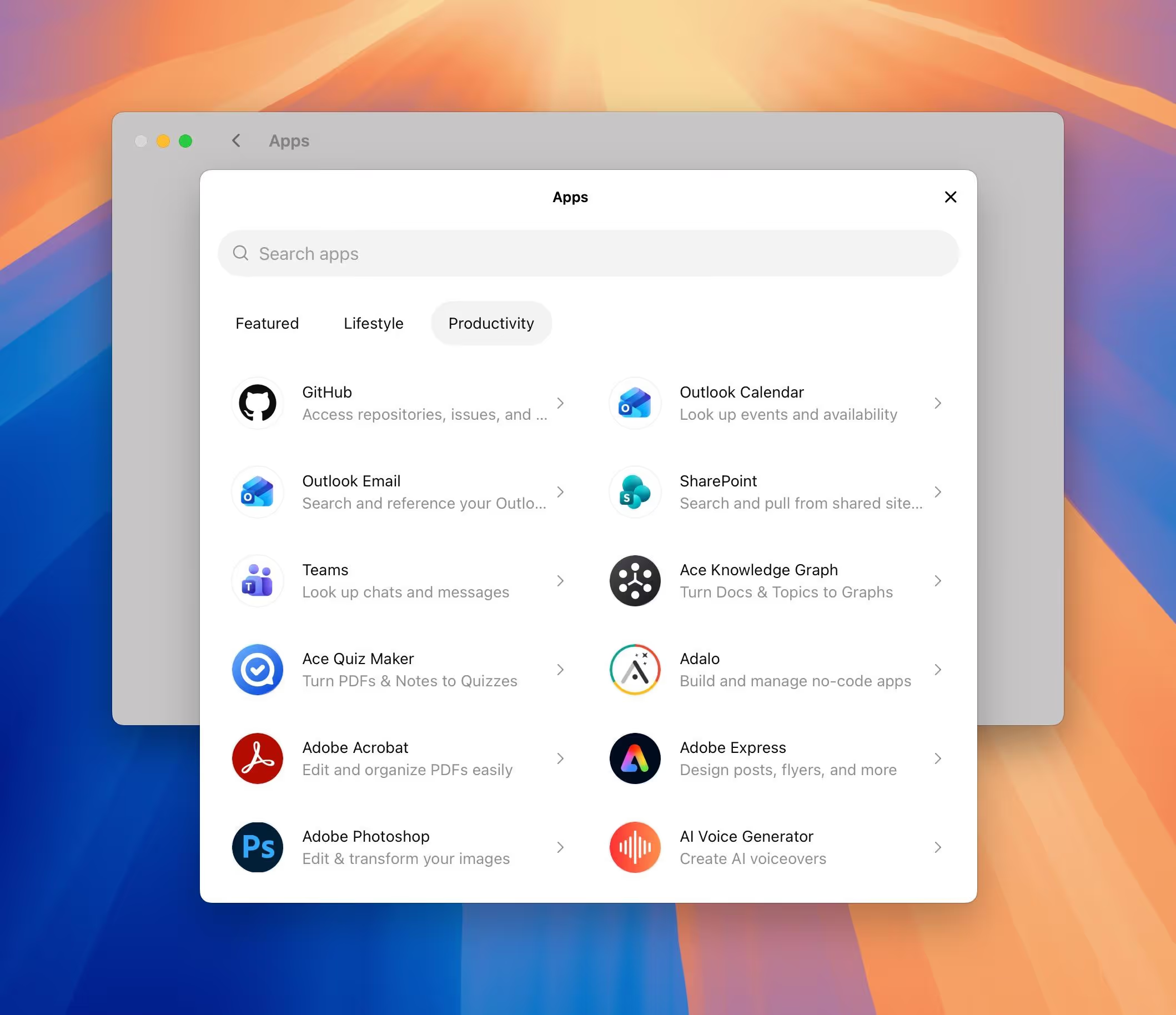
Meta AI has its own native ecosystem. It offers controlled integrations within the Meta platforms (Facebook, WhatsApp, Messenger, and Instagram). Beyond casual social interactions, these integrations are ideal for businesses with customers already on these platforms. Outside the Meta ecosystem, you only get access to Gmail, Outlook, Google Calendar, and Outlook Calendar. So, limited workflow building or flexibility.
Winner: ChatGPT for Mature and Open Ecosystem
ChatGPT, however, offers an open and extensive ecosystem. For starters, it connects directly to your lifestyle and productivity tools, including Google Workspace, Jira, Slack, Notion, Canva, Adobe, and more. ChatGPT also has a marketplace from which non-tech Plus and Enterprise users can build custom GPTs. These GPTs are specialized assistants to help businesses with routine tasks, such as customer support, data entry, and more.
That’s not it. ChatGPT’s agent mode also helps business convert their general-purpose chatbot into an autonomous agent. In this mode, ChatGPT takes over your business’s complex tasks and executes them independently.
Use Cases: When to Use Meta AI vs ChatGPT?
Meta AI vs ChatGPT: which is better for you? The most logical way to choose between these two platforms is to look beyond features and evaluate their capabilities against your unique requirements. Ask yourself what your role is, what you want to do, and how much depth the task actually needs. Here is a quick Meta AI vs ChatGPT use cases rundown for anyone still confused about which AI to use.
Use Meta If
- Social Media Content: Meta AI lives inside your social ecosystem. It helps content creators and regular users write captions, post new ideas, share instant comments, and generate reel hooks, all within seconds.
- Small Business Marketing: Whether catchy ad copy, detailed product descriptions, or response suggestions, Meta AI supports billions of customers every day on social platforms. This means a marketing funnel for small businesses that can fit their daily marketing workflows within Meta AI.
- Messaging Assistance: Meta AI is your conversation partner, the one that helps you draft replies, clarify tone, and respond faster. It lives inside your chats, shares images, tags others, and helps you make chats fun.
- Quick Brainstorming: Meta AI excels at ideation. Marketers and content creators use it to brainstorm campaign ideas, visual themes, story concepts, and more. The contemplating mode unravels different angles of the same topic, making it perfect for practical brainstorming workflows.
- Instant Media Edits: Meta’s native styling toolkit lets you transform your images and videos in seconds. Be it background changes, restyling, or short animations, it helps you with almost everything directly from the chat.
Use ChatGPT If
- Business-Grade Content Creation: ChatGPT excels at refined writing jobs, including cover letters, research summaries, long-form content, emails, and client proposals. It even lets you verify sources within the generated content.
- Advanced Coding/ Technical Tasks: ChatGPT’s advanced coding model, Codex, is a great answer for delegating complex tasks, including reading files, running tests, and refactoring. Its agentic capabilities suit any developer who invests most of their day running code, modifying files, or debugging loops.
- Document Analysis: Unlike Meta AI, with limited file upload functionality, ChatGPT handles documents quite well. ChatGPT extracts key findings from lengthy reports, spreadsheets, and research papers, and other files, summarizes their content, and visualizes them in charts or graphs.
- In-Depth Academic/ Business Research: ChatGPT’s deep research mode connects to the web and synthesizes dozens of sources to produce structured reports you can use for professional and academic research.
- Realistic Image Generation: GPT-Image-2.0 is renowned for producing realistic visuals, and businesses can use these images for marketable assets.
Looking for a Third Alternative: Why Sintra AI Stands Out?
Both Meta AI and ChatGPT are great for answering your questions and having fun with images. But executing routine personal productivity tasks with them means constant context switches and juggling between tasks. Rightfully so, they are not built for either executive productivity or running a business.
Want to go beyond the basic Meta AI vs ChatGPT debate and tap into autonomous AI capabilities that help you run businesses on auto mode? Try Sintra AI, a team of AI employees. Here is why AI employees help you do more in less time.
From Chatbots to Execution: What Makes Sintra AI Different?
Meta AI and ChatGPT are answer-based AI assistants. You ask them a query, they interpret it, and resolve it accordingly. The quality of answers largely depends on your prompt. How well have you communicated the problem? How well has the context been delivered?
Sintra works differently. Instead of just answering your query, it executes the job. Unlike other AI assistants that use a few AI models across domains, this platform has specialized role-based AI employees.
Each of these employees has a unique AI model. It uses Claude-4.5 Haiku for website generation, GPT-4.1 for data analytics, and Gemini-2.5-Flash for image generation, among others. Plus, each helper has a defined role and expertise that helps them act on your behalf and execute tasks, not just describe them.
For instance, you ask ChatGPT to draft an outreach email for your campaign. It will use templates to write one. In comparison, Sintra’s email assistant does not rely on formulaic options. Rather, it understands your business, personalizes the email on your behalf, and sends it directly to your leads.
Role-Based AI Helpers for Every Business Function
Now, let’s talk about the AI team of twelve role-based helpers. Each of these helpers specializes in a business domain. For instance, here are a few.
- Emmie for Email Assistance - Keeps your inbox clean and moves campaigns forward with personalized replies and outreach messages. It summarizes email threads, generates reports, and categorizes emails however you want.
- Soshie for Social Media Management - Understand your audience segments, create ready-to-publish content, and publish it directly across your social media channels. It makes smart decisions about your marketable content, so your team can spend time strategizing.
- Penn for Copywriting - Generates ad copies, scripts, social media captions, website copies, and product descriptions. It writes three times faster than its competitor AIs and with intent.
- Buddy for Business Strategies - Built to strategize for your business growth. It converts your business data into valuable insights and actionable opportunities.
- Seomi for SEO Optimization - creates intent-driven and SEO-ready content in minutes and tracks performance on search engines. It manages your business growth across pages, without adding extra complexity.
- Cassie for Customer Support - Supports your customers, responds to their queries, suggests products, and helps your team resolve tickets without any manual effort. It generates FAQs, manuals, and other user-focused documentation resources.
- Gigi for Personal Assistance and Productivity - Helps you plan your professional and personal day. It organizes your calendars, communicates on your behalf, schedules meetings, plans meals, and much more.
The best part: these employees communicate and collaborate, so no more context switches. Plus, any team member can ask it to execute a task. It runs on context, not the skill set of the one giving the prompt.
Brain AI and Consistent Brand Memory
Both ChatGPT and Meta AI have a problem with random and inconsistent memory. Though both tools store information, it’s mostly conversational, personal, and automated (which means ChatGPT decides which information to save and which to discard). Such memory is inadequate to run coordinated businesses that rely on millions of data points across departments.
Brain AI solves this. It is a digital business memory that stores every single detail about your brand, including project documents, objectives, goals, audience segments, client guidelines, and more. Every time you interact with the AI employees, they connect to this memory and pull context to execute the task however you like.
With this memory, Soshie does not produce generic visuals but consistently builds on-brand, marketable videos and images. Cassie resolves user queries using business resources. And, Penn writes ad scripts that resonate with your business messaging.
What’s better: it never stops learning. As you interact with the helpers and complete system-generated surveys, it learns about your business and personalizes accordingly. So, unlike Meta AI and ChatGPT, it stays consistent and coherent throughout.
Built-In Workflows and Automation
That’s not it. Sintra also offers third-party AI integrations for lifestyle, productivity, and other work tools. So, you do not have to deal with context switches. Instead, the tools your business runs on, from Slack to Notion, Google Workspace, Outlook, and more, come to you. Simply connect them to your Brain AI and leave the rest to your AI employees.
With these integrations, your AI helpers work independently yet in sync. Everything is taken care of: content creation, follow-ups, planning, and research. How does this look for your business? While Soshie is busy planning and scheduling this week’s social media content, Emmie runs an outreach campaign, and Cassie takes the load of resolving customer queries: all at the same time.
In your digital workspace, you can also find use cases. These use cases are repeated business operations, such as summarizing email threads, generating client proposals, or analyzing incoming leads data. With these use cases, you do not have to enter any prompts. Simply enable them and get the output in seconds.
When is Sintra AI the Better Choice?
With Sintra AI, you no longer have to copy and paste output. Let’s say you ask ChatGPT to write client proposals. It will guide you on how to do it. But when you ask the same from Dexter (data analytics), it will do it without manual intervention. When AI is smart enough to handle your workload without constant validation, your team can better focus on growth and sustainability. And Sintra does exactly that.
Ready to move beyond chatbots?
There you have it: all about Meta AI vs ChatGPT’s features, capabilities, AI models, and use cases. Meta AI’s convenience is unmatched. It gives you an AI companion for content creation, message assistance, and photo touch-ups, directly within your social platforms. Whereas ChatGPT excels in professional or business tasks: data analysis, research, coding, and more.
But if you really want to go beyond AI chatbot models, get into the autonomous AI employees space. These AI employees behave proactively, execute business operations, and make decisions on your behalf. Get started with Sintra AI: it is a no-code AI team
Meta AI vs ChatGPT FAQs
What is the main difference between Meta AI and ChatGPT?
The primary difference between Meta AI and ChatGPT is their purpose. Meta AI offers convenient integration with Meta-supported social apps for users to generate visuals, brainstorm creative ideas, and write catchy content. In comparison, ChatGPT is an all-purpose professional tool for data analysis, content creation, and coding.
Is Meta AI the same as ChatGPT?
No. They are separate products from different companies. Meta AI is built by Meta and runs on Meta’s own models (currently Muse Spark), and it lives inside Meta’s apps. ChatGPT is built by OpenAI and runs on GPT models. They answer similar questions but are not the same tool.
Which AI tool is better for business use?
Meta AI vs ChatGPT: neither’s free version is appropriate for running a business. If you want an AI for personal or executive productivity, the ChatGPT Plus or Enterprise version might help you. It has more capable reasoning models and features like Canvas, Deep Research, Agent Mode, agentic coding, and scheduled tasks.
Does Meta AI use the same models as ChatGPT?
No. Meta AI is powered by a newer model, Muse Spark, developed by Meta Superintelligence Labs. It is a natively multimodal and multi-step reasoning model. This model replaced Meta’s earlier Llama 4 Herd. In comparison, ChatGPT runs on the GPT family. Currently, its latest version is GPT-5.5.
What is the best alternative to Meta AI and ChatGPT?
Well, the best alternative to Meta AI and ChatGPT depends on your role, your skill set, and the tasks you want to execute. For instance, Gemini is a good option for ecosystem integration and image generation, whereas Perplexity AI excels at academic, source-backed research.
Related articles