What Is Sales Pipeline Analysis & 5 Ways AI Can Help

Table of Contents

What Is Sales Pipeline Analysis Quick Answer
Sales pipeline analysis is the process of evaluating every stage of your sales pipeline to spot bottlenecks, measure performance, and improve forecasting. You look at where deals are moving, where they're stalling, and why. The goal is simple: turn raw pipeline data into decisions that actually increase revenue.
AI makes this faster and sharper. Instead of manually digging through spreadsheets, AI-powered sales pipeline analytics automatically surface patterns, flag deals at risk, and recommend next steps. It cuts the manual work down to almost nothing, so your team spends less time analyzing and more time closing.
Most sales teams track their pipelines. But is simple tracking enough? A pipeline full of data means nothing if no one uses it to make decisions. Your team needs information like which deal needs your immediate attention, which prospects are getting cold quietly, and which stage is leaking revenue every month. Sales pipeline analysis is supposed to answer these questions.
Gartner predicted that by 2026, 65% of B2B sales organizations will shift from intuition-based to data-driven decision-making. And this shift is already happening because most teams have the visibility, but cannot close the gap between tracking sales pipelines and analyzing them to make decisions. This is where AI jumps in.
AI tools don't let data sit in the pipeline; they use it all to make informed decisions and follow-up processes. It doesn't just flag that a deal is stalling; it drafts the follow-up, updates the CRM, and sends outreach within minutes. That's exactly the kind of execution AI employees from Sintra are built for. They don't just analyze your pipeline; they work it, closing the gap between what your data says and what your team actually does about it.
What Is Sales Pipeline Analysis and How Does It Work?
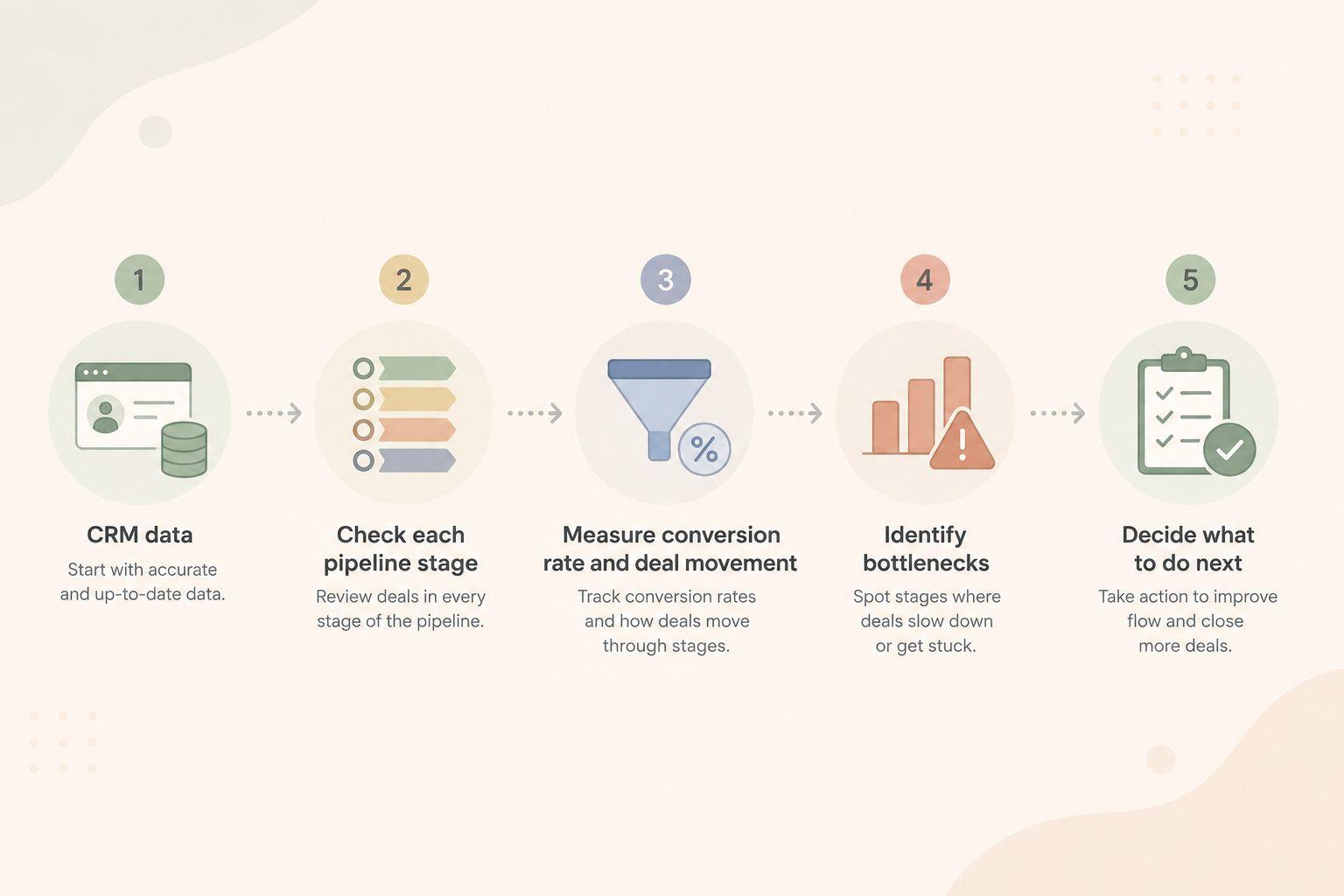
Sales pipeline analysis is the process of reviewing your sales pipeline to see how healthy it actually is, from the moment a lead enters to the moment a deal closes (or dies). In simple terms, you're checking whether deals are moving the way they should, and if not, why.
Here's what that looks like in practice:
- Start with your CRM data: This is where every stage, deal, and interaction lives, so it's the foundation for everything else.
- Check each pipeline stage: How many leads make it from "prospecting" to "qualified"? How many qualified deals actually reach "proposal"?
- Measure conversion rates and deal movement: Track how fast (or slowly) deals move between stages.
- Identify bottlenecks: These are the stages where deals pile up and stall instead of progressing.
- Decide what to do next. Reassign a deal, adjust your CRM and pipeline management process, or coach a rep on follow-up timing.
Bear in mind that this isn't a one-time report you glance at during a quarterly review. Sales pipeline analysis works best as an ongoing habit. Done properly and regularly, it sharpens your forecasting, helps you prioritize the opportunities most likely to close, and pushes conversion rates up over time.
AI speeds up every part of this. It scans CRM data continuously, finds patterns a person might miss (like a specific stage that quietly slows down every quarter), and turns those patterns into clear next steps instead of just another chart to interpret.
It's less about looking backward and more about deciding what to do next.
Why Sales Pipeline Analysis Matters
Sales pipeline analysis matters simply because guesswork is expensive. Without regular analysis, you're making revenue decisions based on gut feeling instead of what's actually happening in your pipeline. It might work. Or not. Either way, the cost is too high to compromise.
Here's what you gain when you make it a habit instead:
- Stronger sales visibility: You know exactly where every deal stands, not just a vague sense of "things are going okay."
- More accurate revenue forecasts: When you understand real conversion rates and deal velocity, your projections stop being wishful thinking.
- Better resource planning: You can see which reps, regions, or deal types need more support before quarter-end panic sets in.
- Faster detection of stalled deals: A deal that's been sitting untouched for three weeks gets flagged immediately, not discovered during a pipeline review a month later.
- Improved pipeline performance overall: Small, consistent fixes compound into a healthier sales pipeline over time.
Let's take a look at what this looks like in practice.
A team runs their monthly sales pipeline management review and notices that most deals stall right after the demo stage. Nobody caught it before because it just looked "in progress" on the dashboard. Once they dig in, they find reps are waiting too long to send follow-up emails, and the messaging is generic.
Now, this may not look like a lot of issues, but that is exactly where bottlenecks form. Once they tightened the follow-up window to 24 hours and sharpened the messaging to address objections raised during the demo, conversions improved within a month.
That's the value of the analysis: it doesn't just describe the problem; it points straight at the fix.
Sales Pipeline vs. Sales Funnel
Most people use these terms interchangeably, but they really should not. A sales pipeline and sales funnel look at the same deals but from two different angles.
Your sales pipeline is your team's view. It tracks the actions your reps take to move a deal forward, stage by stage, from first contact to closed deal. It's an entirely process-focused affair. When you're doing sales pipeline management, you're asking: what does my team need to do next to move this deal along?
On the other hand, the sales funnel is the customer's view. It tracks how a buyer moves through their own decision-making journey, from first becoming aware of a problem to actually making a purchase. It is highly behavior-focused as it asks "where is the customer in their journey, and what's influencing their decision?"
Check out the comparison table below for a quicker understanding:
A compact table works well here — sales pipeline vs. sales funnel is a common enough comparison for people to skim visually rather than read as prose. Here's how I'd add it right under the H3 explanation:
Here's why the distinction matters. The pipeline tells you what your sales team is doing. The funnel tells you why customers are (or aren't) responding to it. Use the pipeline when you want to measure rep activity, deal velocity, or forecast revenue. Use the funnel when you want to understand drop-off points in the buyer's journey, like why prospects vanish after seeing the prices.
5 Ways AI Can Improve Sales Pipeline Analysis
Sales pipeline management used to mean spreadsheets, manual updates, and a rep trying to remember which lead needed a follow-up. Soon, it evolved into dashboards, better visibility, and cleaner reports.
Today, it means something more: sales pipeline analysis that doesn't just show you what's happening; it does something about it as well.
An AI team doesn't stop at analyzing data. It automates the repetitive work, catches opportunities sooner than a person scanning a spreadsheet ever could, and improves execution at every stage of the pipeline.
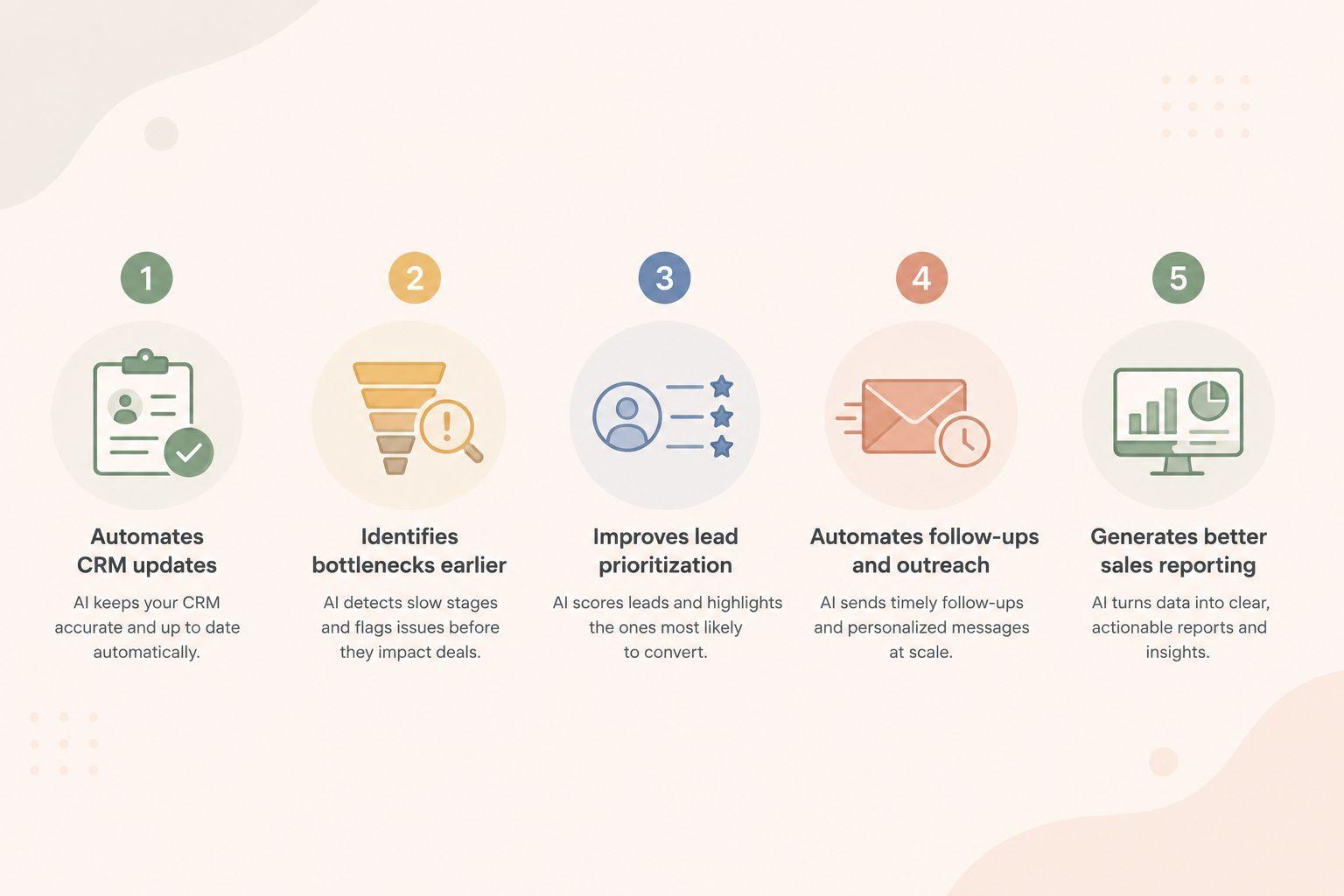
Here's how AI does all that specifically:
1. Automates CRM Updates
Manual CRM updates eat more time than most reps admit. A typical rep would have to jot down a note for every call, log in to every email, record every change in a stage, and repeat it all for every active deal in the pipeline.
AI removes this layer of admin work entirely. It listens to or reads call transcripts and emails, then automatically logs the interaction, updates the deal stage if the conversation signals a change (like a prospect confirming budget or asking for a contract), and fills in missing fields like company size or decision-maker names pulled from the conversation itself.
It also cleans up duplicate or outdated records, something most teams never get around to doing manually. The result: your CRM reflects reality in real time, not whatever a rep remembered to type in three days after the call.
2. Identifies Bottlenecks Earlier
Most bottlenecks are invisible until they show up in a monthly report, by which point you've already lost weeks of momentum on affected deals. AI catches them while they're still forming.
It works by continuously monitoring deal velocity, how long deals typically take to move from one stage to the next, and comparing current deals against that baseline. If a deal is sitting in the "proposal" phase for a long time, AI immediately flags it instead of waiting for a human to notice.
AI also tracks conversion rates stage by stage, so if your "demo to proposal" rate quietly drops from 40% to 25% over a few weeks, that shows up as an alert, not something buried in a spreadsheet nobody opens until quarter-end.
This is what makes AI-driven sales pipeline analysis different from a static dashboard: it's watching for the trend, not just displaying the numbers.
3. Improves Lead Prioritization
Not every lead in the pipeline is worth equal attention. But the problem lies in identifying which leads deserve the time and effort. And without proper data, it usually comes down to gut feeling, which may or may not be accurate.
AI tools replace the guesswork with a real prioritization model. It looks at engagement signals (email opens, website visits, how quickly a prospect responds), compares the current lead against historical deals with similar characteristics that did or didn't close, and factors in behavioral patterns, like whether the prospect is engaging with pricing pages or just downloading generic content.
From this, it generates a ranked list of opportunities by likelihood to close and potential deal value. That means reps spend their limited time on the leads statistically most likely to convert, instead of splitting attention evenly across a pipeline where 80% of the value sits in 20% of the deals.
4. Automates Follow-Ups and Outreach
Deals rarely die because a prospect said no. They die because nobody followed up in time. A rep gets pulled into back-to-back calls, a lead goes three days without a response, and by the time someone circles back, the prospect has already moved on to a competitor or lost urgency.
AI employees close this gap directly. They draft follow-up emails based on the specifics of the last conversation, schedule those follow-ups at the optimal times, and summarize previous conversations so context isn't lost.
This matters most in deal pipeline management, where a single missed touchpoint can be the difference between a deal moving forward and one that quietly stalls. AI ensures every opportunity gets a timely, relevant touch, not because a rep remembered to, but because the system doesn't forget.
5. Generates Better Sales Reporting
A week-old report tells you a version of your pipeline that no longer exists. Deals have moved, some have died, and new ones have entered. Yet most sales reporting still runs on a weekly or monthly cadence because building it manually takes real time.
AI changes this by generating reports continuously, pulling live data straight from the CRM rather than a snapshot someone took last Tuesday. More importantly, it doesn't just hand back raw numbers. Good sales pipeline analytics tools convert that data into actionable summaries.
That means a sales manager can walk into a Monday meeting already knowing where the risk is, instead of spending the first twenty minutes of the meeting trying to build that picture from scratch.
Key Sales Pipeline Metrics to Track
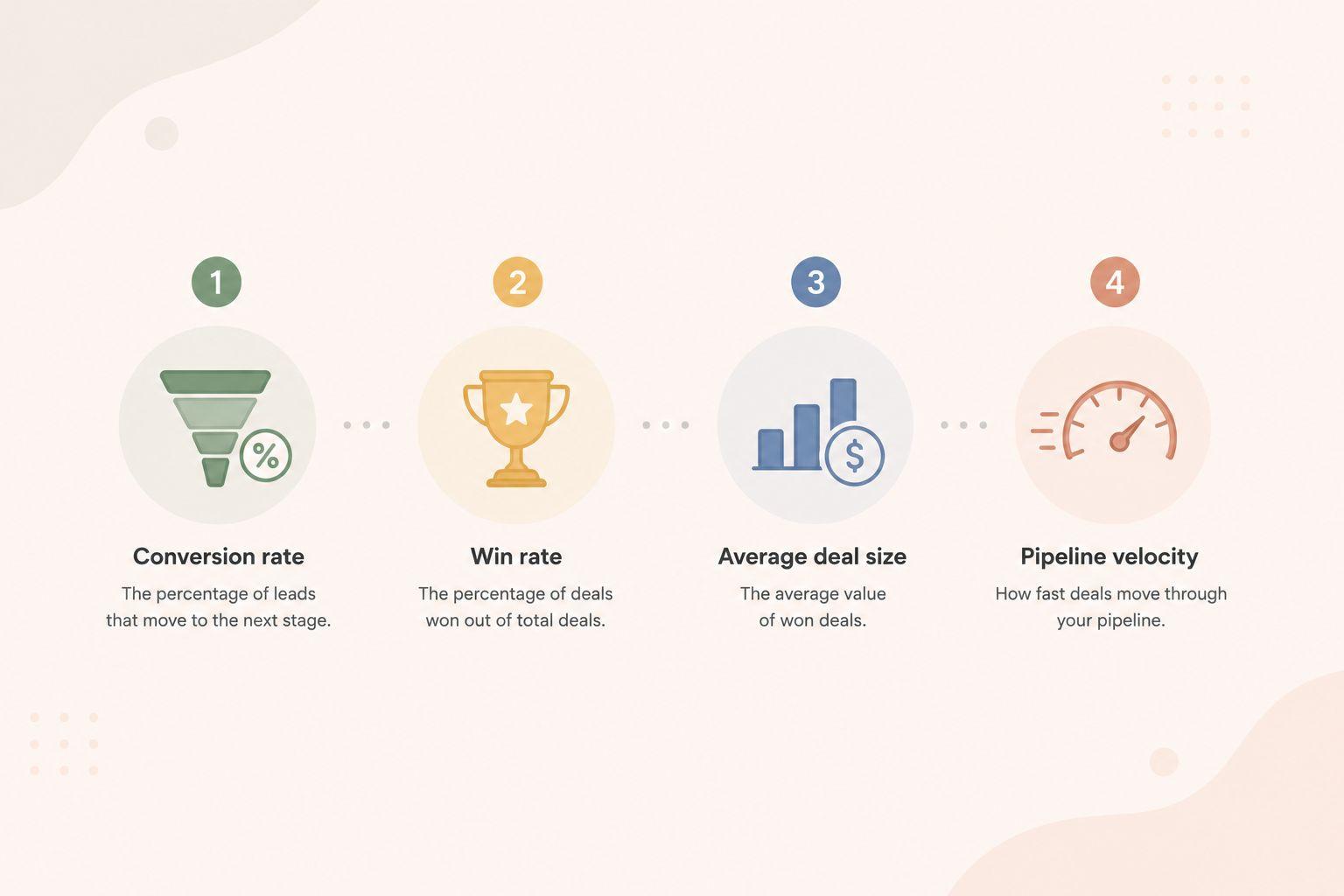
Sales pipeline metrics tell different stories, and not all of them matter equally. Some tell you about deal quality, whether the opportunities in your pipeline are actually worth pursuing. Others tell you about speed; how fast revenue is actually moving from first contact to closed deal.
The metrics below give you the clearest read on both: how deals move, how often they close, how much revenue they represent, and how fast that revenue actually shows up. Track these four, and you'll have a genuinely accurate picture of pipeline health without drowning in vanity numbers.
Let's get started:
Conversion Rate
Conversion rate measures how many leads or opportunities move from one pipeline stage to the next. Here's how it's calculated:
(Number of deals that moved to the next stage ÷ Total deals in the current stage) × 100
Let's say 100 deals enter your "demo" stage and 40 make it to "proposal." That's a 40% conversion rate for that stage. The real value here is stage-by-stage tracking, not just an overall pipeline conversion number.
When you measure conversion rate at each stage, weak points become obvious fast. If conversion from "qualified lead" to "demo" is healthy at 60%, but "demo" to "proposal" drops to 20%, you know exactly where the problem lives.
That's far more useful than a single blended conversion rate that hides which stage is actually leaking deals.
Win Rate
Win rate measures how many opportunities actually turn into paying customers. You can calculate it by the following formula:
(Number of deals won ÷ Total number of closed deals, won and lost) × 100
If you closed 50 deals in total this quarter, and 15 of them were wins, your win rate is 30%. Most B2B sales teams see win rates somewhere between 20% and 30%, though this varies heavily by industry and deal complexity.
Win rate is actually a report card on everything upstream of the close: lead quality, sales messaging, objection handling, and overall sales effectiveness. A low win rate usually doesn't mean your reps are bad at closing. More often, it means the leads entering the pipeline weren't well-qualified to begin with, or the messaging isn't resonating during earlier stages.
Average Deal Size
Average deal size shows the typical revenue value of your closed deals. Here's how it is measured in numbers:
Total revenue from closed-won deals ÷ Number of closed-won deals
If you closed $500,000 in deals across 25 customers, your average deal size is $20,000. This number matters for two reasons. First, it feeds directly into revenue planning: if you know your average deal size and your win rate, you can calculate how many opportunities you actually need in the pipeline to hit a revenue target. Second, it's a prioritization tool for deal pipeline management.
When two opportunities are competing for a rep's limited time, average deal size (compared against the specific deal's value) helps decide which one deserves more attention right now.
Pipeline Velocity
Pipeline velocity measures how quickly revenue actually moves through your sales pipeline, from first contact to closed deal. You calculate it by:
(Number of qualified opportunities × Win rate × Average deal size) ÷ Sales cycle length (in days)
This is the metric that ties everything else together. It already accounts for deal volume, win rate, and average deal size, so there's no need to track sales cycle length separately.
Here's why velocity matters more than any single metric on its own: two pipelines can have identical revenue potential on paper, but if one closes deals in 30 days and the other takes 90, the first is generating three times the revenue per month.
A high win rate or large average deal size doesn't matter much if deals take six months to close. Pipeline velocity is the number that tells you how efficiently your entire pipeline is actually converting opportunities into revenue. This makes it one of the most useful sales pipeline analytics metrics for spotting whether the whole system, not just one stage, is working.
Common Challenges in Sales Pipeline Analysis
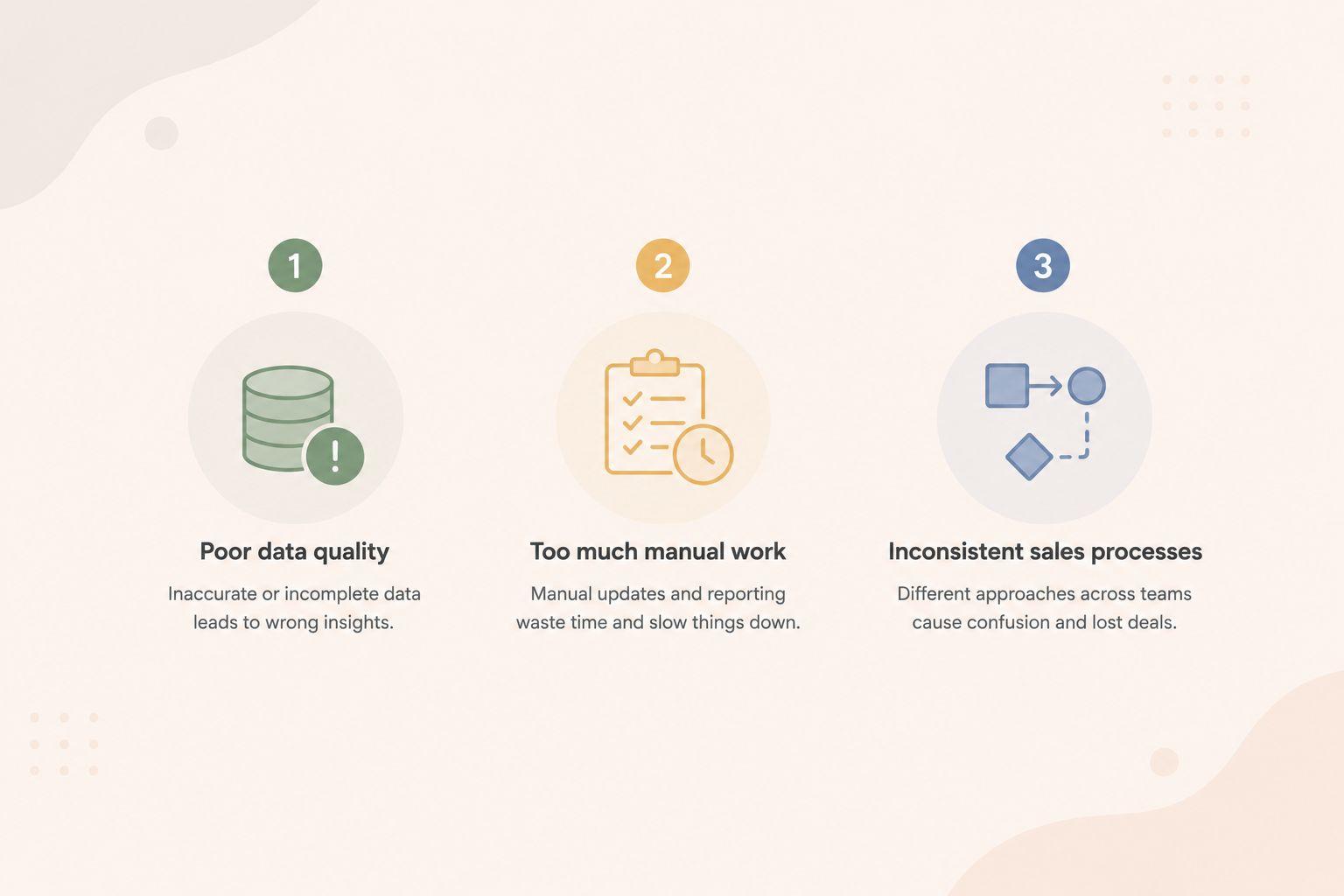
Sales pipeline analysis is only as good as what feeds it. Even the most sophisticated analytics setup produces bad conclusions if the underlying data and process are shaky. And most teams doing pipeline management run into the same handful of issues: outdated CRM, ambiguous sales stages, inefficient follow-ups, and prolonged reporting.
None of these problems are dramatic on their own. But together, they quietly wreck forecasting accuracy, bury real opportunities, and slow down decisions that should take minutes, not days. Let's take a look at some of the most common challenges while dealing with sales pipeline management.
Poor Data Quality
Sales pipeline analysis runs directly on CRM data. If that data is wrong, every conclusion built on top of it is wrong too, no matter how good your analysis process is.
The problems show up in familiar ways:
- Deal values left blank or estimated so loosely they're meaningless.
- Closing dates that were set three months ago and never updated.
- Duplicate records for the same account
- Opportunities sitting in "negotiation" for two months when the prospect actually went dark after the first call.
Individually, these look like small oversights. At scale, across hundreds of deals, they create a pipeline that looks healthier (or worse) than it actually is. Forecasts built on bad data miss. Reps chase deals that are effectively dead. And nobody notices until revenue falls short of what the pipeline "showed."
Too Much Manual Work
Good sales pipeline management requires current data, but keeping data current usually falls on reps who are already stretched managing their own deals. Updating stages, logging call notes, pulling numbers into a spreadsheet for the weekly pipeline review; it all takes time away from actually selling.
The bigger issue isn't just lost hours, it's what manual work does to accuracy. When updates depend on someone remembering to do them, some of them will surely be missed. Here's what else happens:
- Data entry gets rushed or delayed, by which point, details get fuzzy.
- Reports built by hand are prone to copy-paste errors, outdated pulls, or numbers that don't match.
- Pipeline reviews often happen less often than they should.
This delay alone means problems get caught later than they need to be. And all this because there are a lot on reps that could have been avoided if manual tasks were automated using AI tools.
Inconsistent Sales Processes
Pipeline data only means something if everyone's using the same definitions. When one rep considers a lead "qualified" after a single email exchange and another requires a full discovery call before marking it "done", the resulting data isn't actually comparable.
This inconsistency shows up across the board;
- Different qualification bars,
- Different follow-up habits, and
- Different interpretations of what belongs in "proposal" versus "negotiation."
The result is pipeline data that looks uniform on a dashboard but means something different depending on which rep entered it.
For deal pipeline management, this is a real problem. Reports built on inconsistent inputs give a distorted view of what's actually happening. Deal prioritization suffers, since a "hot" deal from one rep might not mean the same thing as a "hot" deal from another.
Sales Pipeline Management Best Practices With AI
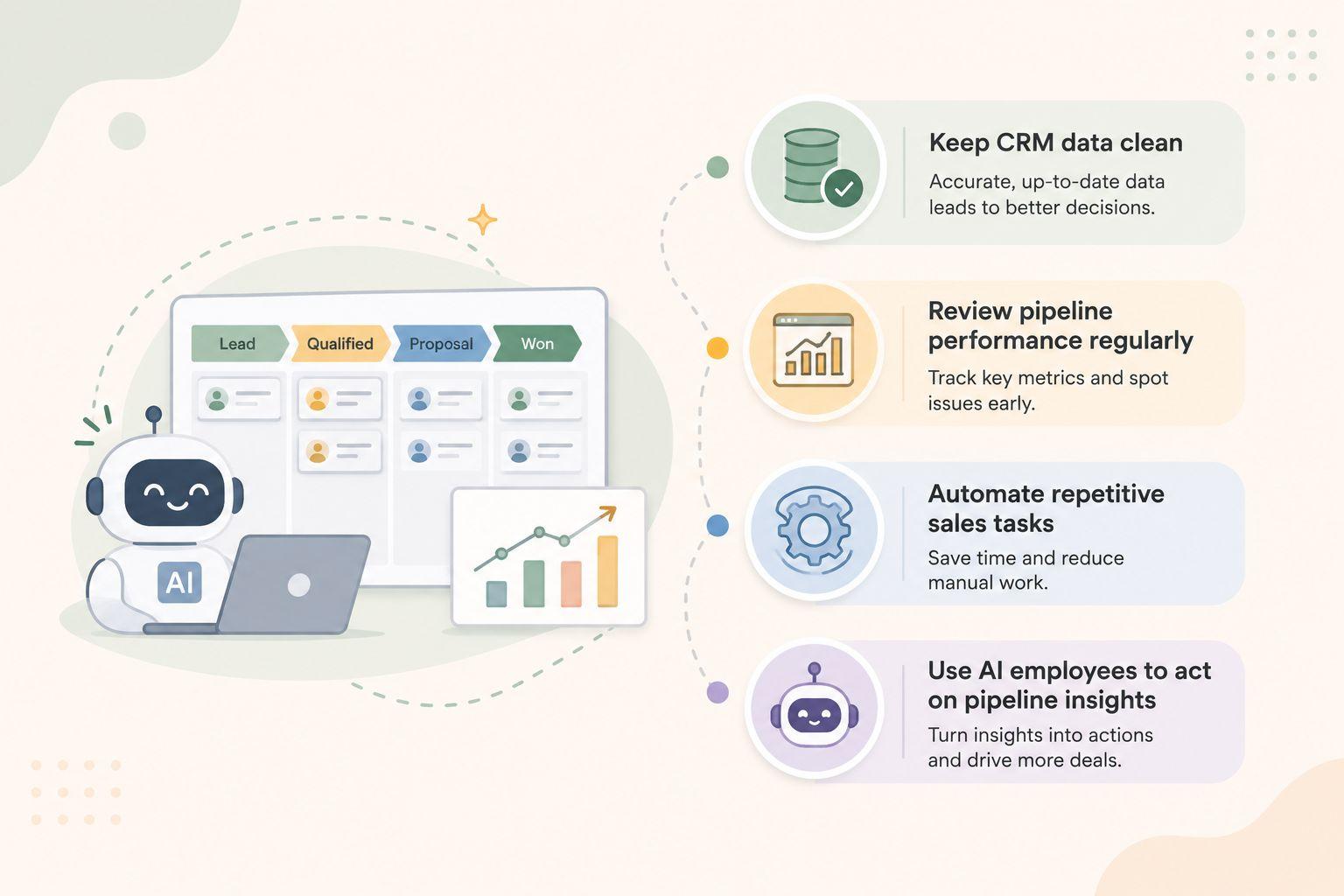
Good sales pipeline best practices haven't really changed. What's changed is how much of that work AI can handle now. The businesses getting the most out of sales pipeline management aren't just following good habits; they're pairing those habits with AI that keeps CRM data accurate, flags problems early, and turns pipeline insights into action. And they are getting the most out of their sales by using tools like Sintra's Brain AI.
Let's take a look at those boring old practices and how AI can entirely enhance them:
Keep CRM Data Clean and Consistent
By now, one thing should be super clear: every best practice related to pipeline analysis depends on your CRM data being accurate. If deal stages are stale, close dates are guesses, or lead details are half-filled, no amount of analysis fixes that. Garbage in, garbage out applies here more than almost anywhere else in the business.
Strong CRM and pipeline management simply mean deal stages reflect reality, close dates get updated as soon as they change, and follow-up notes actually capture what happened on a call. When this doesn't happen, every report built on top is wrong.
This is exactly where an AI sales agent, like Sintra AI's Milli, earns its keep, keeping records current in real time so your data reflects what's happening in the pipeline, not what a rep remembered to type in three days later.
Review Pipeline Performance Regularly
If you review your pipeline once every quarter, it is basically a postmortem at that point. The deals affected are long gone. Weekly or biweekly reviews catch issues while there's still time to act. It could be a stalled deal, a stage with dropping conversion, or a forecast that's drifting off target.
But here's the actual challenge: manual reviews take real prep time, which is exactly why they get skipped or pushed back when things get busy. AI removes that friction. It can summarize pipeline activity automatically before the review even starts, highlighting which deals need attention and what the next best action is for each one.
This turns a pipeline review from a dreaded hassle to a neat stack of what changed and what needs attention. Sales pipeline analysis stays consistent because it no longer depends on someone finding the time to build the report from scratch.
Automate Repetitive Sales Tasks
Every hour spent on manual admin is an hour not spent moving deals forward. These tasks are necessary, but none of them require a rep's judgment to execute well.
AI automation changes the math on the best sales pipeline practices. It takes over the tasks that used to eat into a rep's day:
- No more manually updating the CRM after every call; it happens automatically as the conversation wraps.
- A rep doesn't need to remember to circle back in three days; the reminder (or the follow-up itself) is already handled.
- What used to take twenty minutes per lead now happens in the background before a rep even picks up the phone.
And because good AI integrations connect directly into the tools your team already uses, pipeline management improves without anyone having to change how they work day by day.
Use AI Employees to Act on Pipeline Insights
You may adopt an efficient analysis plan, but if it doesn't lead to action, it's as good as nothing. Sintra's AI employees are built to close this gap. They don't stop at flagging that a deal needs attention; they can draft the outreach, update the CRM, coordinate with marketing on a re-engagement sequence, or pull together the report a manager needs for Monday's meeting.
And because Brain AI keeps brand context and workflow memory consistent across every task, the follow-up email sounds like your company wrote it, and the next action taken lines up with what happened in the last one. That's the difference between a tool that shows you your sales pipeline management problems and one that actually helps fix them.
Ready to Build a Smarter Sales Pipeline?
Analysis tells you where the problems are. Execution is what actually closes deals, and that's where most teams fall short. Sintra's AI employees close that gap. They handle follow-ups, CRM updates, reporting, and research that your team doesn't have time for. In short, nothing stalls and nothing gets missed.
Get started with Sintra AI and turn your pipeline insights into action for a better sales team.
Sales Pipeline Analysis FAQs
What is sales pipeline analysis?
Sales pipeline analysis is the process of reviewing every stage of your sales pipeline, from first contact to closed deal, to measure performance, spot bottlenecks, and improve forecasting.
How often should you analyze your sales pipeline?
Weekly or biweekly. Monthly reviews catch problems too late; weekly reviews let you act on stalled deals and shifting trends while there's still time to fix them.
Which sales pipeline metrics are the most important?
Conversion rate, win rate, average deal size, and pipeline velocity. Together, they show both deal quality and how fast revenue moves through the pipeline.
How does AI improve sales pipeline analysis?
AI automates CRM updates, flags stalled deals and declining trends earlier, prioritizes high-value leads, and turns pipeline insights into executed follow-ups instead of static reports.
What is the difference between sales pipeline analysis and sales forecasting?
Pipeline analysis looks at what's happening right now: deal movement, stage health, and conversion rates. Forecasting uses that data to predict future revenue.
Related articles