AI Agents Pricing Strategies Models Guide

Table of Contents

Quick Answer: What is the Best AI Pricing Model?
The right AI pricing model depends on what you use the AI for, how you measure its value, and what your budget is. For instance, subscription-based models and per-user pricing favor everyday assistants and copilots. In comparison, outcome-based pricing and hybrid models help you with multi-step autonomous task execution.
The global AI agent market is expected to grow to $294.66 billion by 2035 from $11.55 billion in 2026. This shows how AI adoption is gaining momentum exponentially. Businesses across industries are using these agents to handle practical workflows.
But their success in your team depends on how you see their value. AI agent pricing is not like traditional SaaS. These systems do not sit inside your dashboards, waiting for you to access the tool and take action. They plan, make API calls, execute tasks, and make decisions.
Once you approach them like digital employees, the old pricing does not justify the value and breaks down as you add maintenance costs and hidden fees. The moment you pick the wrong pricing structure, the results are unpredictable bill spikes, low adoption, and scalability issues.
To save you from these issues, here is a detailed guide on AI agent pricing, common tiers, and how to choose the right pricing model. So, dive right in.
What Is AI Agent Pricing and Why Does It Matter?
An AI agent pricing tells you what agents' customers pay for and how that bill scales with usage, performance, tokens, and team size. AI agents are built to access your business data, connect to your work tools, and execute complex, end-to-end multi-step task sequences. Unlike traditional SaaS, the AI agent pricing comes in different tiers, including assistant copilots (ChatGPT), workflow-specific agents (Sintra AI), and custom enterprise solutions (Notion).
Whatever the tier of the AI pricing model is, it has two layers. And once businesses get them both right, it helps them derive value from customer gains, costs, and revenue. These layers include
- Pricing architecture refers to how the plan is structured. This includes the AI pricing model, add-ons, contract terms, and so on.
- Value metric is the unit that determines what the buyer will pay. This can be tokens, users, activity, outcomes, or capabilities.
How Does AI Agent Pricing Differ From Traditional SaaS Pricing?
As businesses are moving from standalone AI assistants and copilots to autonomous AI agents, there is a decline in SaaS solutions. This is because both systems bill customers on different parameters.
SaaS pricing is mostly focused on access. A SaaS provider may bill you for who has login authority, how many teams a team uses, and which tier of AI they are using for everyday tasks. AI agents work differently. They don’t live inside your dashboards. Rather, these agents are proactive, meaning they execute tasks and make decisions. Hence, they bill you for value.
This is also why the AI agent pricing depends on factors like computational requirements, model inferences, orchestration steps, API calls, and workload volume. Think of them as digital AI employees rather than standalone software features. So, the pricing must reflect activity, output, and value, and not simply access.
Why Are AI Agents Changing Software Monetization?
As businesses are moving from traditional SaaS, it is also changing how they see AI pricing. Meaning, how they plan budgets, manage governance, and measure revenue has also been modified.
Simply put, AI workloads are no longer consistent and predictable. A basic workflow can have multiple reasoning steps, big data inputs, several API calls, and communication between agents. A subscription-based fixed fee cannot accommodate these processes, as they oversimplify pricing, do not account for value, and underestimate complex ones.
Older AI pricing models were not built for these operational changes. They cannot track real-time usage, translate agent activities into invoices, or remain transparent about hidden fees.
Therefore, AI agentic systems have modern pricing systems, such as outcome-based, hybrid, and consumption-based. These account for hidden fees, constant maintenance, and persistent value.
The Most Common AI Agent Pricing Models
You will find different AI pricing structures in the market. Some bill customers on consumption, others on users’ demands, and so on. So, the right AI pricing model depends on your unique requirements and budget. Here are a few common pricing options explained in detail.
Subscription Pricing
Subscription pricing means customers pay a fixed annual or monthly fee to access an AI service or an AI agent. It targets non-technical users who don’t want to be bothered by tokens, consumption, and requests. The characteristics of the subscription AI pricing model include
- Fixed payments at scheduled intervals
- Tiered pricing plan for varying access (standard, professional, enterprise, etc).
- Offers bundled features and access to future capabilities.
Subscription is the most common AI pricing model and works best for predictable workflows. Teams that follow the same tasks every day, such as email drafting, data summaries, and code completions, favor this pricing. The consumption is predictable enough for flat pricing.
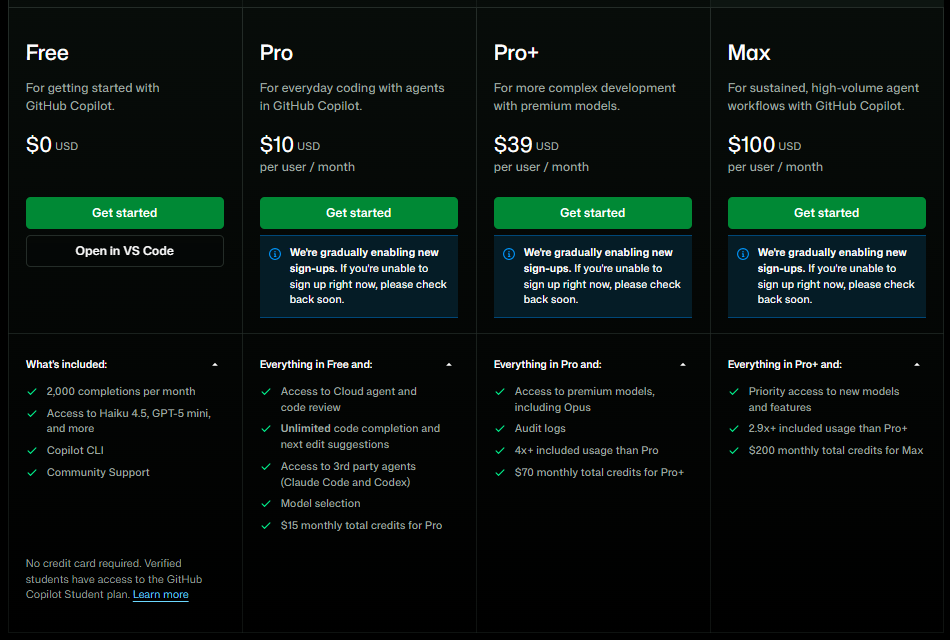
GitHub Copilot is the best example of a subscription AI pricing platform. It has flat individual pricing of $10 per month and enterprise pricing of $39 per month for each user. Likewise, their average API fee is $15-$20 per user. Other companies like Grammarly and Notion also follow this pricing.
Advantages
- Offers ease for procurement approval
- Has a stable revenue for AI providers
- Simple, easy to calculate, and predictable for customers.
- Has a low operational overhead for billing teams.
Trade-Offs
- Does not suit a heavy computing workload.
- Requires usage caps to save margins.
- Can be hard to predict among heavy and light users.
Who Uses Subscription Pricing?
Subscription AI pricing works best for departmental copilots, assistive agents, and recurring everyday tasks with stable and predictable activity. It helps you draft, brainstorm, write, research, and so on.
Usage-Based Pricing
Also known as consumption-based pricing, usage pricing involves paying for what you are using the agent for. The consumer pays a token for each discrete task, action, conversation, API call, tagging, routing, and retrieving information.
Simply put, usage-based pricing means pay-as-you-go. As the cost is directly dependent on your activity, usage-based pricing targets workflows involving compute-driven AI and variable-volume agentic tasks.
Think of LLMs. They favor token-based pricing, as the computational cost is directly linked to the data processed and responses generated. The more complex your query is, the more tokens it consumes, and the higher the cost.
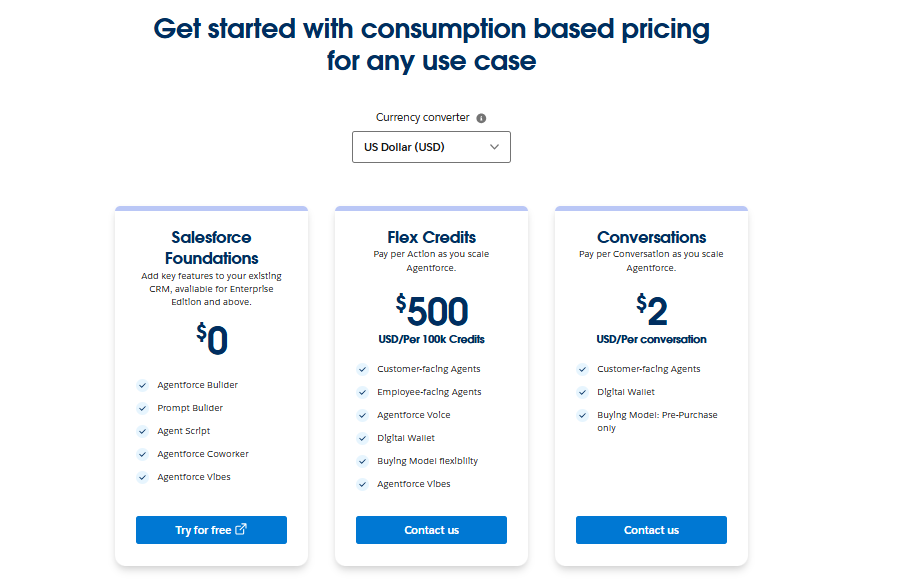
The consumption-based model is best for unpredictable businesses where consumption looks different, depending on workload. For instance, Salesforce’s Agentforce Flex Credits work on this principle. Within this pricing, the standard action requires 20 credits, which cost around $0.10, and voice actions demand 30 credits, which cost around $0.15.
Advantages
- Offers better alignment between cost and value.
- Scales naturally as your team and demand grow.
- Has low entry barriers for businesses wanting early adoption.
- Works best for unpredictable and fluctuating workloads.
Trade-Offs
- Customers find it challenging to predict spending.
- Requires strong governance and metering.
Who Uses Usage-Based Pricing?
Businesses use consumption-based pricing for variable volume workload, unpredictable task sequences, and BPO (business process outsourcing) replacements.
Outcome-Based Pricing
The outcome-based pricing ties the payable cost directly to the defined outcome. Meaning, customers pay for the results. These results look like
- A ticket resolved,
- A meeting booked,
- A lead qualified,
- A fraud case flagged,
- A churn prediction validated
Such a type of AI model pricing works best for value-aligned business impact. Instead of paying for usage or access to the AI, businesses are paying for measurable, pre-defined goals. The result: as the provider earns revenue only when their AI achieves the desired outcome, there is little to no risk of customer-to-AI-provider (financial exposures, cost unpredictability, and so on).
For the outcome-based pricing to work, the AI provider and customers must agree on what the “successful outcome” looks like and how they will measure it (via KPIs).
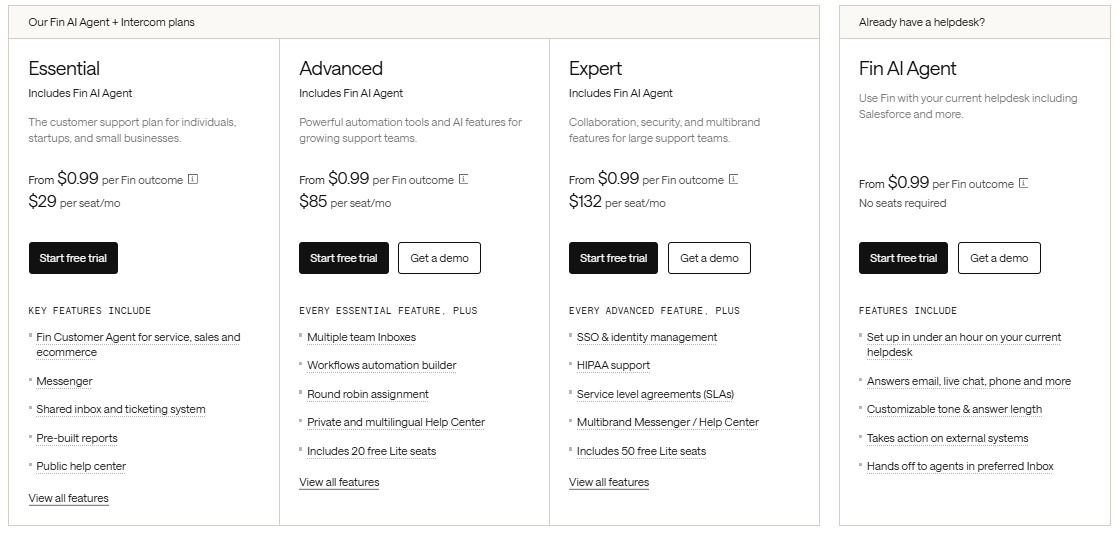
A good example of outcome-based pricing is Zendesk and Intercom’s chatbot support. Instead of paying for every conversation and API call, they only pay when a ticket is resolved successfully. Other examples include financial companies using AI to detect fraud or sales teams using AI to qualify leads.
Advantages
- Has lower upfront risk for customers.
- Supports premium-category pricing when the outcomes are clearly defined.
- Works best for teams with strong data tracking.
- Value-driven approach for business impact.
Trade-Offs
- Requires shared rules, definitions, and baselines.
- Has longer procurement cycles because of the complexity of the contract.
- The AI provider may face a higher performance risk.
Who Uses Outcome-Based Pricing?
Outcome-based pricing is an excellent choice for workflows with defined, measurable outcomes in processes where agents control most of the work. This includes retention efforts, underwriting, and fraud detection.
Hybrid Pricing
A hybrid pricing model combines multiple models to balance predictability, value, and risk. Typically, it has a fixed baseline fee with a varying layer that depends on usage, output, and performance. AI providers are turning to hybrid models because they offer
- Recurring revenue
- Customer budget comfort
- Monetization over computing usage
How does this work? The AI provider sets a monthly subscription fee for fixed activity, token, and outcome. Once the team uses AI beyond the allowance, they are billed for the extra tokens or activity. This makes sense in protecting the margin when power users exceed the fixed allowance.
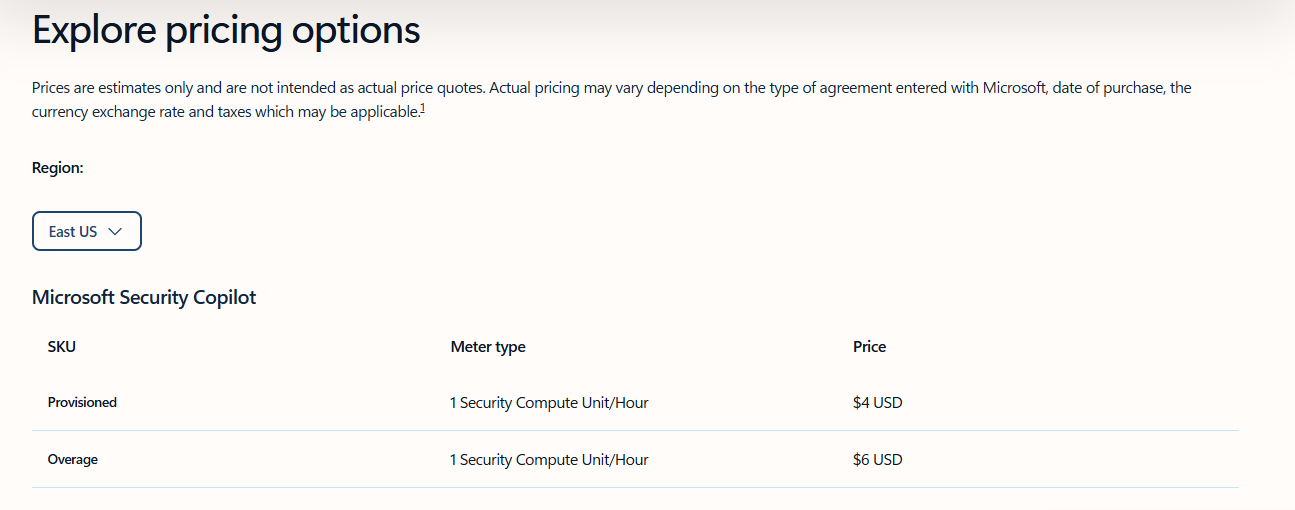
A good example of hybrid pricing is Microsoft Security Copilot. It has a fixed hourly rate for customers to access SCUs (Security Compute Units). Once the customers exceed the provisioned access, the overage price protects the margins, making it easy to predict economics. Adobe Firefly, Zendesk, and Genesys also use a hybrid pricing model for flexibility.
Advantages
- Offers predictable baseline charges for cost-sensitive workflows.
- Has the flexibility to accommodate fluctuating demands.
- Works across use cases, especially agentic.
- Balances cost and revenue for both customer and provider.
Trade-Offs
- Can be complex to manage, especially for non-technical teams.
- Demand a clearly defined contract and rules.
- Need better governance and guardrails to avoid unexpected overages.
Who Uses Hybrid Pricing?
Hybrid pricing works best for enterprises that have mixed workloads. For instance, their workflows are steady with seasonal spikes. Such a pricing model also accommodates agentic workflows operating across teams.
Seat-Based Pricing
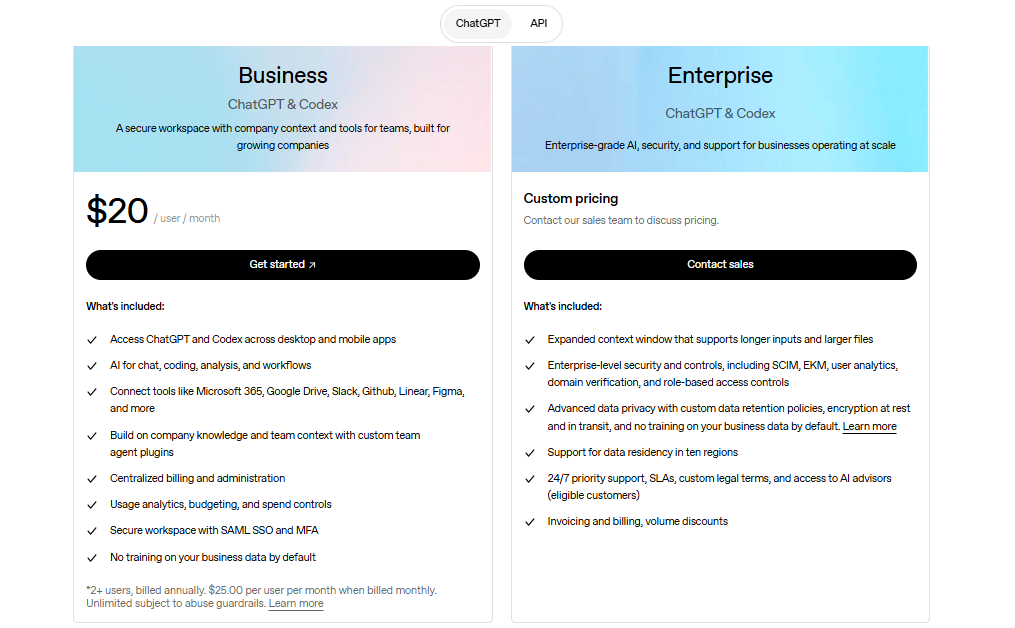
In seat-based pricing, customers pay a fixed fee for each active user in their department monthly. Simply put, instead of everyone, customers are billed for individual users with access. This pricing fits products and tools that are scattered throughout the organization via individual tasks, such as writing, research, sales bots, and so on.
Via per-seat pricing, AI providers try to simplify billing. It also makes pricing predictable for customers, especially for tools where they expect consistent engagement from a specific user. Businesses favor this AI pricing model, as the license fee is constant regardless of how much the user communicates with the AI.
Such a model works best when companies want to derive value from AI agents via collaboration among users, instead of raw compute power and API calls. Companies wanting to encourage broader adoption prefer this so that users do not worry about exceeding the usage limit. OpenAI’s ChatGPT Plus offers per-seat pricing with a flat monthly fee for individual users.
Advantages
- Easy to calculate and familiar to customers.
- Embeds directly into the company's existing SaaS contracts.
- Offers predictable pricing for teams with named users.
- Promotes broader AI adoption across the organization with unlimited access.
Trade-Offs
- Does not offer heavy computation power for multi-agent workflows.
- A few power users can distort the economics.
- Does not fit agents with autonomous task execution capabilities.
Who Uses Seat-Based Pricing?
Per-seat pricing works best for small internal copilots and productivity helpers who need AI to support individuals rather than entire operational processes. This model is designed for a lightweight assistant helping everyday users and not autonomous agents.
How Businesses Choose the Right AI Pricing Model?
Choosing an AI pricing model is not a random decision. It is a strategic call. It helps you make financial decisions, shapes AI adoption, and decides how teams rely on agents. Here is a step-by-step process on how businesses can choose the right AI pricing model.
What is the Job of Your AI?
The first step in deciding your AI pricing model is deciding what the AI will help you with. Discuss with your team and decide the main job of your AI agent. Is it for claiming, onboarding, ticket triage, audit prep, or reconciliation?
Typically, agentic workflows have the following scope of work.
- Task scope - The AI takes one action: answer, summarize, tag, classify, and so on. For such tasks, per-token and per-activity pricing works best.
- Process scope - The AI is responsible for running multi-step workflows. This includes triage, qualify, route, and reply to queries. For such processes, per-activity, per-output, and hybrid pricing work well, depending on what drives value for your workflow.
- Goal scope - The AI achieves an outcome. This can be a resolution, close, or complete. For such goal-focused workflows, per-outcome pricing is a good choice.
Understand Workload Patterns
Once you have decided on the job of the AI, it’s time to understand what your workload looks like. For this, you need to ask a few questions.
- Does AI usage correlate with value?
- Does your AI usage correlate with cost?
- Does your workload look spiky?
- How frequently do you run the AI tasks?
- What are your computing requirements?
Once you answer such questions, the right AI pricing models become easy. For instance, if your team has power users who drive more value, consumption-based models fit best. In comparison, if your approximated cost scales with activity, usage-based and hybrid pricing are better choices.
Set Your Key Success Metrics
Once you have a good idea of what pricing model suits your workflow, it’s equally important to decide how you will measure the success of your selected AI agents. The answer: KPIs or Key Performance Index. It’s better to pick a single metric. This can be a workflow, output, user, agent, outcome, and so on.
A good way to prove it worked is through the level of attributions.
- Diffuse attribution - the AI helps you with an outcome, which is influenced by different factors.
- Medium attribution - the AI helps you move the outcome, but does not own it. A base metric helps you measure the contribution, and a variable component adds to the scores.
- Direct attribution - the AI owns the outcome, which is defined and measurable.
Double-Check Your AI Pricing Model
It’s time to run internal financial checks to see if your new pricing structure aligns with your margin and productivity goals. While you are doing so, also add guardrails, such as caps, tiered usage, commitments, spending alerts, and throttling, to further modify your pricing model. These supplementary controls help you keep the price transparent, reduce financial risks, and prevent overruns.
Run a Pilot with Real Data
Finally, run a pilot with selected use cases. Think of it as a stress test of your AI services. While it is running, track communication, failure rates, customer behavior, ROI, cost per workflow, and so on. This will help you understand how the AI agents behave at scale. With this information, you can modify and tune the long-term pricing structure.
Common Challenges When Pricing AI Agents
Pricing mistakes are more common than you think. Often, the price metrics stop tracking value and become a commodity. Here are some things you must be mindful of when pricing AI agents.
Balancing Customer Value With Operating Costs
AI pricing must not center around the cost. It should give you the tell in a defined and measurable outcome: saved time, ROI, or task completion. And the pricing should justify it. Inferring the AI exactly to compensate for the computing cost means you are undermining the value it is adding to your team. Likewise, ignoring hidden costs can make you lose money.
For instance, some hidden costs involved in agent pricing include
- Implementation and integration - the agent should connect to your information center, CRMs, legacy tools, and other work platforms.
- Workflow redesign - removing unnecessary steps and checkpoints from an agent’s autonomous processes means constant maintenance.
- Ongoing tuning - changing your information (prompts, guardrails, performance checks, etc) depending on policy shifts, data updates, and market trends.
- Data preparation - cleaning and restructuring the data from unstructured information (emails, contracts, proposals, project documents, and so on).
- Governance and user control - strong governance helps you deal with ethical and overage issues.
The problem is not that the AI providers have not reserved a fixed flat fee. The issue is that the price, both computational and inference, varies depending on the complexity of the task and model. And ongoing expenses mean constant add-on expenses.
The only solution is to build pricing models that have margin buffers and measurable outcomes, rather than just raw usage. The pricing should never be static once set, as it becomes unprofitable within a few payment cycles.
Building Transparent and Scalable Pricing
You must be clear about what you are using the AI for and why. Transparent pricing models with stated hidden fees, per-token fees, overage charges, and unpredictable add-ons. If this hidden fee is not mentioned in the pricing structure, it creates distrust and churn, regardless of the agent’s characteristics and capabilities.
That said, the pricing must also not scale suddenly. It should always grow sustainably. A model that suits 100 users can break down if your margin compresses or the inference cost outpaces the revenue. Especially, if you are estimating an agentic product, the usage is not just the number of users but how capable it is and how much work it gets done.
Other Common Challenges
- Never price AI in units that the customers don’t understand. Always use terms that are closest to the customer’s value description.
- Don’t overcomplicate pricing. Add-ons, multiple tiers, and variable pricing delay business decisions. Always begin with a basic pricing model that fits your customers and gradually adds complexity.
- Flat pricing with extreme usage differences can be a recipe for disaster. If your power users consume twenty times as much as regular employees, the price estimates will be incorrect.
- Never ignore pricing structures. If a pricing model feels intuitive but does not capture power user requirements or high-cost usage, it will get a blow as you scale.
How Is AI Agent Pricing Evolving?
When you are considering the AI pricing models, it is equally significant to understand the changing trends in the automation industry. So, dive right in.
From AI Models to AI Agents
Businesses usually prefer implementing AI across their organization as standalone models, such as copilots and support bots. These chatbots help them answer questions or assist in everyday tasks like summarizing, classifying, writing, and brainstorming. That’s no longer a common practice.
Today, businesses want autonomous agents that can plan, decide, and execute multi-step processes on their own. Today, people don’t have to perform the work or supervise the AI. This transition from AI models to AI agents is shaping the AI industry.
Hence, naturally, it affects the AI pricing. Think of how license-based tools replaced SaaS by changing delivery from physical to cloud-based subscriptions. Today, AI agents are doing the same to SaaS. They are changing the value for customers. Previously, it was about assisting humans; now, businesses are more focused on AI that runs independently.
Pricing Based on Business Value
Now that AI agents are taking over the AI landscape, per-seat or usage-based pricing no longer makes sense. Imagine one customer support agent taking the workload of ten sales reps. In this case, a per-seat price will undervalue the AI. This is why companies prefer outcome-based and hybrid pricing.
This is visible across use cases. Intercom Fin bills $0.99 per resolution, a procedural handoff, and a disqualification. Likewise, Zendesk AI agents cost around $1.5 per automated resolution on a committed volume. The logic behind outcome pricing is quite straightforward. Cost scale once the AI starts generating value for the business. Hence, there is a balance between expenses and revenue.
Why Is Sintra a Strong Example of Modern AI Agent Pricing?
Sintra AI is a reflection of a modern AI agentic pricing system. It does not charge you for raw model access or random use, but rather helps businesses delegate routine operations. Hence, the output feels like hired labor, which is consistent, improves over time, and acts inside your practical workflows. Let’s learn more about this advanced agent pricing model.

Specialized AI Employees Instead of a Single AI Assistant
Sintra is different from standalone AI models. It has an AI team of role-based AI employees that specialize in a business domain. For instance, Cassie answers your customer queries; Seomi repurposes your content to be visible for search engines; Penn builds marketable assets.
Each helper is trained on data points and expert knowledge. So, two different helpers handle customer queries and sales outreach messages, instead of a single copilot that handles both. What’s better is that it does not require lengthy prompting and operates on use cases. Once you activate a use case, it executes the entire task sequence accordingly.
This design removes the friction between workflows and communication. The employee doesn’t have to know how to write an effective marketing prompt.
The Sintra AI specialization is what supports its pricing structure. As each helper has a specific output rather than generic answers, the value for businesses shifts from only having “access to the AI” to “delegated business tasks”. Think of it like replacing your entire team with an AI that is easy to maintain and costs less.
Brain AI Creates Shared Business Knowledge
Standalone AIs forget everything you told them as soon as you sign out of the session. Meaning, you will have to re-explain everything, including business documents, project papers, context, brand voice, and so on. The solution: Brain AI. It is a digital business knowledge space that stores all your business details and acts on them.
Brain AI also removes repetition, which is one of the biggest pain points in AI work. All twelve AI helpers share this memory layer and draw context to execute the required task. When all the agents have the same context, the output is consistent and on-brand across workflows and departments.
Integrations Turn AI Into an Operational Workspace
A standalone AI that requires you to manually feed information every time you log in and then copy the output to the relevant tool means poor functionality. Such an AI does not offer actionable labor. However, Sintra AI is different. It turns your AI labor into actionable employees that connect to your business tools and act independently.
The better part is that they are no-code, easy-to-use AI integrations. Choose the right platform (Google, Gmail, Outlook, Shopify, Notion, Slack, etc), click connect, and enter your login details. You can leave the rest to the AI employees. These integrations also enable use cases or pre-built automation tasks. Meaning, less back-and-forth and more sustainable growth.
Ready to Build Your AI Team?
There you have it - all about AI agent pricing models. Whatever you choose, be mindful of your unique requirements: what does the agent do, how do you measure success, and what is your budget? In modern times, if your desired AI plans and executes tasks autonomously, a good choice would be Sintra AI.
It is an advanced business solution with twelve specialized AI employees, a centralized knowledge space, and AI integrations. Combined, these employees turn your AI setup from static to proactive, delivering value, consistency, and cost efficiency. Get started with Sintra AI today and see how it works for you.
AI Agents Pricing Strategies Models Guide FAQs
What is the best AI pricing model for AI agents?
The industry is moving toward hybrid pricing and value-based pricing models, including outcome-based and usage-based systems. However, the right AI pricing model for AI agents depends on your unique requirements and what your agent does. For instance, usage-based pricing works best for single-action tasks, whereas outcome-based solutions help automate multi-step workflows.
How do AI agent pricing models differ from traditional SaaS pricing?
AI agents differ from traditional SaaS pricing, as both charge for different things. SaaS bills companies for software access using per-seat pricing. In comparison, AI agents charge you for executing the tasks and getting work done. Agents are developed to execute end-to-end autonomous multi-step workflows.
What factors should businesses consider when choosing an AI pricing strategy?
When building your AI pricing strategy, businesses must consider the customer behavior toward AI adoption, value (time saved, ROI, overhead replaced, etc), infrastructure cost, hidden charges, and pricing model. It’s also important to make sure the AI strategy aligns price and value.
Why are more AI companies moving toward outcome-based pricing?
AI companies are shifting toward outcome-based pricing to align their cost and value. Simply put, the modern AI agents autonomously execute workflows, meaning they are charging for completing the work and not accessing the AI or assisting humans with standalone copilots.
How does Sintra's AI workforce pricing differ from traditional AI chatbot subscriptions?
Sintra AI workforce includes specialized virtual employees, a digital business knowledge space, and pre-built automation tasks. Meaning, for the pricing, you get an entire workforce that acts as your skilled labor and executes tasks autonomously. Businesses can get flexible plans, depending on their unique requirements.
Related articles