AI Agent Orchestration: How It Works in Modern Business

Table of Contents
Quick Answer
AI agent orchestration refers to the act of coordinating several AI agents using a central orchestration layer. You may consider it an AI traffic controller that coordinates the movement of tasks between various agents, keeps them updated, and makes their outputs consistent across systems.
Rather than using one chatbot or an independent automation tool, AI orchestration platforms enable multiple AI agents to collaborate. Such agents are able to exchange context, synchronize their activities, and act as a single system. The outcome is a streamlined workflow, quicker performance, and more dependable results, which provide businesses with a definite edge in the modern, fast-paced digital world.
Most companies already use AI, but their tools rarely work together. Your marketing team might use an AI writer, support may rely on a chatbot, and operations might run analytics with another model.
The problem? These systems often sit in silos, so teams still move information manually between tools. AI orchestration fixes this. It connects models, agents, and data through a coordinated platform, so the AI agents can work together. Think of it like a conductor guiding an orchestra so every instrument plays in sync.
Platforms like Sintra already make this possible. Sintra’s bots take context from the same memory so that you do not lose the relevance and context; as a result, the bots collaborate on tasks and automate workflows. This shift toward collaborative bots is becoming vital for modern businesses, with the AI orchestration market expected to reach $82.15B by 2035.
Let’s understand the main reasons for this shift, how AI agent orchestration works, and why businesses are adopting it.
What Is AI Agent Orchestration?
To get a better idea about it, consider the way traditional orchestration was done. Previously used orchestration tools were capable of automating processes and linking systems, but they were not intelligent. AI orchestration goes a step further to bring intelligent agents that can reason, act, and cooperate.
Rather than one AI model that does all the tasks, there are several specialized agents that do various tasks. A single agent can collect information, another can process it, and another can produce responses or actions. The orchestration layer controls the interactions between these agents, directs tasks between them, maintains a shared memory, and enforces the workflow to follow the proper order.
This integrated strategy enables AI systems to deal with more complicated processes than a single model could deal with independently.
What Is Orchestration in Technology?
Orchestration in technology is simply a matter of coordinating various systems or workflows automatically to make them work together. It is the process of linking tools together in a coordinated manner, ensuring that every step occurs at the appropriate time. The pace of progress makes this increasingly urgent - agents' ability to automate complex tasks is doubling every three to seven months, meaning the systems you orchestrate today could be 16x more powerful within a year.
Suppose you have a number of applications: your CRM, your email system, your inventory tracker. They operate in silos without orchestration. They communicate with one another, obey instructions, and go through multi-step procedures without a manager with an orchestration platform. This is the reason why orchestration is taking center stage in cloud computing, enterprise IT, and digital business.
The Core Definition of Orchestration
Orchestration is not just automation. Automation is a one-to-one robot, such as an email sent when a form is filled in. Orchestration is similar to a conductor operating the entire performance, with several automated activities occurring in the correct sequence.
As an example, cloud infrastructure provisioning includes the spinning of servers, database connections, and networking. The orchestration tools perform all these tasks, ensuring that the whole process is efficient and nothing fails.
Orchestration vs. Automation
Automation is task-oriented, such as an automatic invoice. Orchestration combines several automated activities and connects them into a seamless workflow. Consider the case of a new employee: automation could configure their email, IT account, and software access one by one. Orchestration makes all these occur in the correct order, and there is no conflict, which makes the experience smooth.
Types of Orchestration in IT
There are various types of orchestration. Firstly, there is IT orchestration, which is the management of servers, networks, and cloud infrastructure. Then there is process orchestration, which is concerned with business processes such as approvals or HR processes. Application orchestration connects software applications, and they communicate with each other appropriately.
The development of modern orchestration platforms became more complex as businesses embraced cloud systems, microservices, and distributed applications. Thus, it became easier to manage everything under a single roof.
The Role of an Orchestration Layer
The orchestration layer is at the core of orchestration. Think of it as a control hub. It deals with the sequencing of tasks, dependencies, and the proper communication of various systems. This layer ensures that workflows are consistent, predictable, and efficient instead of having humans to ensure that things are on track. It is the brain that makes all the moving parts work together without letting anything slip through the cracks.
Why Orchestration Became Essential in Modern Systems
When businesses began to utilize cloud services, microservices, and distributed apps, complexity went out of control. In the absence of orchestration, teams would waste excessive time in manually coordinating their activities, which would expose them to errors and delays. To handle this complexity, orchestration platforms were necessary to offer centralized control, scaling, and a route to intelligent orchestration, which today is found in AI ecosystems.
How an AI Orchestration Platform Works
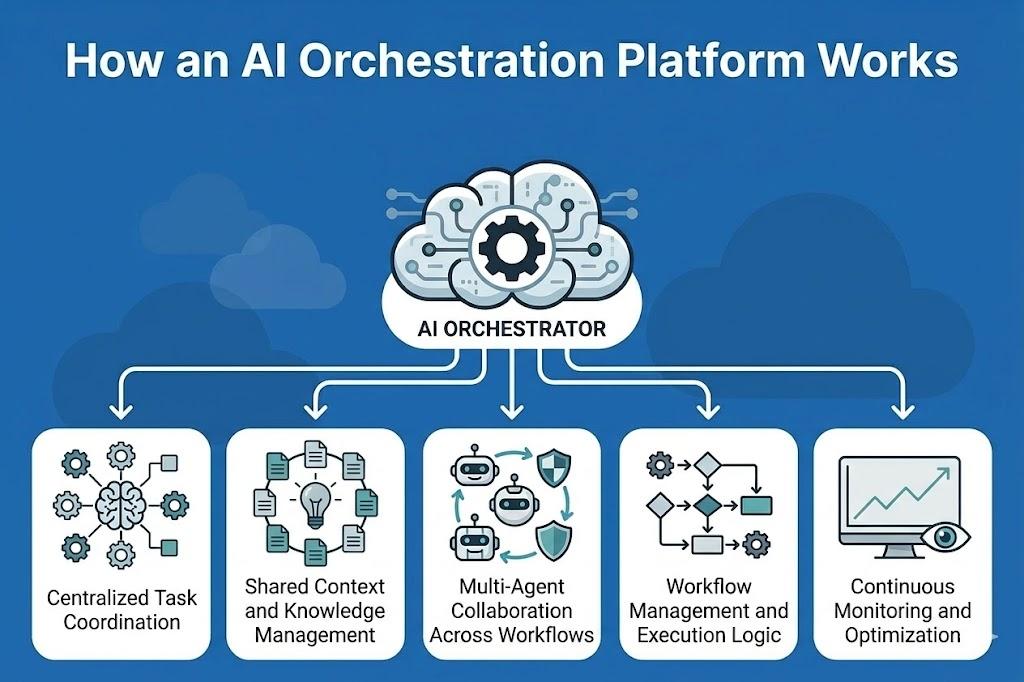
This is where the fun begins. An AI orchestration platform can be described as a smart hub that coordinates all your AI agents. It receives inputs, calculates what should be done, delegates, and makes all the agents work in harmony. The orchestration layer ensures that the output of one AI is a smooth input into the workflow of another.
It is not magic; it is a well-organized coordination that makes isolated AI tools a high-functioning ecosystem. Practical platforms, such as Brain AI, provide organizations with an effective means of controlling this orchestration, linking agents, data, and workflows effectively.
Centralized Task Coordination
The orchestration platform is the decision-maker in this arrangement. It is aware of what the agent does and does not cause duplication or conflict. As an illustration, when two agents have the capability of responding to the same customer query, the platform will make sure that only one agent responds.
That is why AI orchestration is not only about doing things but also about organizing them in a way that your business will run smoothly.
Shared Context and Knowledge Management
Shared memory is one of the most interesting aspects of AI orchestration. The orchestration layer links agents with historical data, internal documents, brand guidelines, and so on. This makes all AI agents operate within the same context, yielding similar results.
It is either marketing, customer services, or operations, but everyone is on the same page literally, and this makes it smarter and quicker to collaborate.
Multi-Agent Collaboration Across Workflows
Several AI agents can collaborate with each other. The output of one agent is the input of another. An example is that your marketing AI writes, your SEO AI optimizes, and your analytics AI measures performance. The orchestration layer makes this handoff occur in a seamless manner, creating interlinked workflows that operate automatically without human intervention.
Workflow Management and Execution Logic
The orchestration platform deals with task order, dependencies, and logic of execution. This implies that processes are automatically run without a person having to check each step. In contrast to the older automation systems, AI orchestration is responsive to changing circumstances and can coordinate various agents to ensure that everything is running on time.
Continuous Monitoring and Optimization
AI orchestration is not a set-and-forget. Platforms track agent performance, optimize outputs, and adjust workflows as time goes by. Businesses experience visible advantages: reduced time wastage, reduced errors, and scalability. The system is constantly being enhanced, learning to provide better results and release human beings from repetitive control.
Role-Based AI Agents in an Orchestrated System
Similar to a human team, every agent has a position or role: marketing, customer support, analytics, or operations. Role allocation guarantees efficiency, consistency, and scalable workflows. Organizations employ intelligent orchestration to allow specialized agents to work together under a single system rather than using a single AI tool to perform all tasks.
What Are Role-Based AI Agents?
Role-based agents are specialized AI helpers designed for a role. An AI marketing agent generates content, an AI support agent manages tickets, and an analytics AI agent crunches numbers. In contrast to a general chatbot, every agent possesses a distinct ownership, minimizing mistakes and enhancing responsibility. This is precisely how companies achieve predictable and quality outcomes.
Why Specialization Improves AI Performance
Sharing of duties among agents is similar to sharing of work among human beings. The agents specialize in what they do best and deliver better outputs. It also streamlines workflows, as the orchestration platform coordinates all people, so that no one does the same task and no data is lost.
Collaboration Through a Shared Orchestration Layer
The orchestration layer is used by specialized agents to share context and follow sequences. This ensures brand consistency, integrated interpretation of data, and coordinated implementation. For example, your marketing and support agents can use the same product documentation to make sure that they use the right and consistent messages.
Example: Marketing, Support, and Operations Working Together
Consider a marketing agent writing campaign content, a support agent answering customer questions with the same campaign content, and an operations agent monitoring campaign performance. The orchestration platform connects all three of them, making sure that the handoffs are smooth, the messages are consistent, and the efficiency gains are measurable.
Practical Example: AI Agent Orchestration Inside a Business

An actual case of AI orchestration is the e-commerce companies that operate their stores on Shopify. The online business is growing, and its marketing, customer support, and analytics are frequently organized with the help of a systematic AI orchestration platform. Rather than individual automation tools managing individual tasks, several specialised agents interact via a common orchestration layer.
Every agent has a role, like responding to customer inquiries, developing marketing content, or managing campaign data. These tasks are then linked together into a coordinated workflow by the system.
This type of smart coordination enables teams to react more quickly, launch campaigns more swiftly, and monitor outcomes within a single environment. Companies with integrated AI systems tend to shorten the response time and enhance inter-team consistency.
Customer Support Example: Unified Chat and Email Handling
Live chat is usually the beginning of customer inquiries that are managed by AI for customer service. This agent provides responses to general queries through product documentation and company policies. In case the problem needs a more extended response, it is transferred to the AI Email Assistant.
This agent writes elaborate responses with the context of the entire conversation. They both run within the same AI orchestration platform and have a single orchestration layer, which avoids conflicting responses and maintains consistency in communication.
Marketing Execution Example: Content Creation to SEO Optimization
The marketing content may start with the aid of an AI Copywriter that writes landing pages, product descriptions, and campaign emails. The orchestration platform then forwards the content to the AI SEO Agent to align the content to the keywords and optimise the search. These tasks occur sequentially without manual handoffs through intelligent orchestration. The teams transition to optimised content at a higher rate.
Campaign and Performance Feedback Loop
An AI Data Analyst analyzes metrics after campaigns have been launched. In the AI orchestration platform, the AI orchestrator collects insights and drives them into the marketing and support processes. Since application orchestration tools concentrate data within the same orchestration layer, teams receive more insightful and quicker optimisation.
The Unified Outcome: Coordinated AI Agents Working as One System
Marketing, support, and analytics remain interconnected when specialised agents are used within a single orchestration platform. This smart coordination allows quicker implementation, uniform communication, and enhanced data transparency throughout the business.
Benefits of AI Orchestration for Growing Teams
In the case of small and mid-sized teams, AI orchestration simplifies and streamlines work. AI agents automatically perform the routine work instead of people jumping between tools and repeating the same tasks. This is time-saving and assists teams in concentrating on ideas, strategy, and key decisions. The more a company expands, the more difficult it is to control numerous tasks and tools.
Orchestration holds all the things together and in the proper sequence. It also assists teams in maintaining their brand voice and workflow across projects. Managers can have a better view of what is going on and make smarter decisions faster with increased visibility of tasks and processes. Simply put, AI orchestration assists teams in developing at a quicker pace without becoming more intricate.
Other benefits include:
- Automates repetitive and time-consuming tasks
- Reduces duplicated work across different tools
- Maintains consistent brand voice and processes
- Helps teams scale without hiring more staff
- Provides clear visibility into workflows and performance
- Supports faster and smarter decision-making
AI Orchestration Platforms vs Traditional Automation Tools
Conventional automation tools adhere to set rules. They cause actions to be taken when a condition is fulfilled. These systems are applicable in simple workflows and repetitive tasks. Nevertheless, the current AI orchestration systems are not just simple automation.
They organize several intelligent agents capable of analysing data, adjusting to changes, and collaborating. This provides a more adaptable working environment. AI-driven process orchestration tools, unlike conventional orchestration tools, enable dynamic decision-making. They adapt tasks depending on the context and actual inputs. This transformation is an indication of the development of enterprise IT and workflow automation.
How Traditional Automation Tools Work
The older automation was based on fixed triggers and linear processes. It is like process and orchestration tools and IT orchestration tools that deal with predictable activities such as invoice processing or CRM updates. They are good at simple work but not at dynamic and complex work.
How AI Orchestration Platforms Differ
Modern AI orchestration systems handle various intelligent agents. They contextualize, adjust to new information, and organize workflows. The orchestration layer provides the collaboration, making individual tools a unified ecosystem.
Static Workflows vs Adaptive Decision-Making
Rule-based workflows provide a set of steps and work within a pre-defined set of conditions. They are productive in work that is repetitive, but fail when there is a change in situations. Conversely, AI orchestration systems constantly analyze real-time information and modify execution paths on an as-needed basis.
This is adaptive decision-making, which enables the business to react more quickly to evolving conditions, streamline processes automatically, and construct a more flexible, efficient, and intelligent operation in the long run.
Scalability and Cross-Department Collaboration
Conventional tools tend to work alone without any outside assistance. AI orchestration allows a common context and centralized control in marketing, support, and operations, allowing businesses to scale without additional manual control.
When to Use Automation vs AI Orchestration
Conventional automation suits routine and foreseeable tasks in which the procedures are seldom altered. It is structured and follows set guidelines, executing processes effectively without necessarily needing decisions made every time. AI orchestration, in turn, is more applicable to the complex workflows that require a set of steps, tools, or teams.
These systems are capable of reasoning about tasks, deciding among agents or systems, and changing when the conditions vary. The decision of which to adopt depends on how complicated your working process is, how much flexibility you need, and what the long-term objectives of your team or organization are.
Besides, define clear evaluation criteria such as task variability, need for judgement, and system integration before choosing. Low-variation tasks fit automation, while dynamic, multi-step workflows suit AI orchestration. Support the decision with internal data and credible references to ensure it is practical and reliable.
How to Evaluate an AI Orchestration Platform
The selection of the appropriate AI orchestration platform is a matter of consideration. The businesses ought to concentrate on platforms that are easy to use and yet have high control and visibility. The solution must be reliable to support secure, scalable, and well-integrated AI operations.
- Shared knowledge layers that allow agents to access consistent information
- Multi-agent coordination for managing complex AI workflows
- Strong integration ecosystem with existing tools and systems
- Clear data governance, transparency, and proper documentation
- High security standards with scalability for future growth
Ready to Implement AI Agent Orchestration?
As businesses move beyond basic automation, AI orchestration becomes a practical step towards handling complex, evolving workflows with greater control and efficiency. An AI orchestration platform enables role-based agents to collaborate, adapt, and execute tasks across systems without constant oversight, making operations more scalable and resilient. Solutions like Sintra reflect this shift in a grounded way, offering a clear example of how an effective AI Orchestrator works in practice.
FAQs
What is AI agent orchestration in simple terms?
It’s the coordination of multiple specialized AI agents through a shared orchestration layer, ensuring tasks are done efficiently, outputs are consistent, and workflows run smoothly.
How is AI orchestration different from automation?
Automation executes individual tasks using fixed rules. AI orchestration coordinates multiple agents, adapts to new information, and manages multi-step workflows collaboratively.
What does an orchestration layer do in AI systems?
It’s the central hub that manages task assignments, shared context, workflow sequencing, and communication between AI agents.
What are AI orchestration platforms used for?
They manage AI agents across marketing, support, analytics, and operations, connecting systems and data for seamless workflow execution.
Can small businesses benefit from AI orchestration?
Yes. AI orchestration reduces manual work, centralizes control, and allows small teams to scale operations without hiring more staff.
Related articles

.avif)