AI Agents vs SaaS Chatbots: Key Differences Explained

Table of Contents
Quick Answer: AI Agents vs SaaS Chatbots
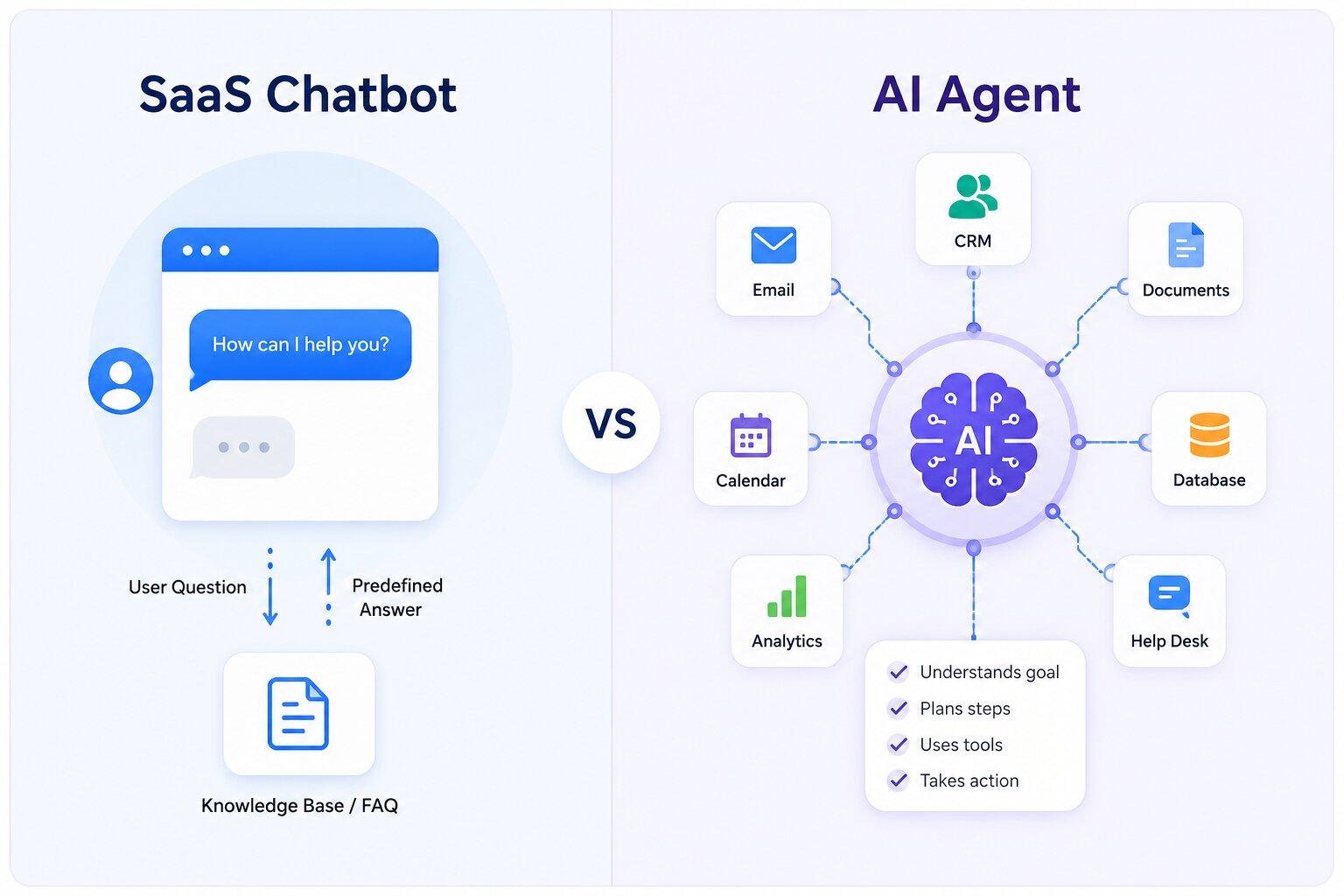
SaaS chatbots reply from a fixed script and stops at the conversation. AI agents or AI chatbots take a goal, use your tools, and complete the task end-to-end. For businesses that want real automation instead of just chat, AI assistants are the stronger choice. Chatbots still work for high-volume basic questions, but the heavier work is shifting to agents like the AI employees in Sintra AI.
If you've ever asked a website chatbot about your order status or typed a question into a support widget, you've used a SaaS chatbot.
Chatbots answer common questions and route people to the right place. But their scope is narrow. Ask one to plan next week's campaign or update your CRM, and it will tell you that's outside its scope.
An AI agent operates differently. It works within your workflow and completes tasks end-to-end, from drafting the follow-up to updating the record. An agent grounded in your company's own data can take on real work across your team, not just field questions. Sintra AI does this with a team of AI employees built for exactly that.
Since both tools respond to you conversationally, it's reasonable to ask where the chatbot ends, and the agent begins. We'll break down how AI agents and chatbot tools differ, where each one fits, and why more teams now choose agents.
What Are SaaS Chatbots and AI Agents?
Many people use the terms interchangeably, but chatbots and AI agents are built for different jobs. Here's what each one is:
- A SaaS chatbot is a cloud-based chat tool that runs on preset rules, decision trees, and scripted replies. You subscribe, connect it to your website or help desk, and it starts handling conversations by matching user messages to its knowledge base. This model lets you rent a hosted tool rather than build one yourself, with the provider handling updates and maintenance.
- An AI agent is a goal-driven system built on a large language model. You give it an objective, and it interprets what you actually mean, breaks the goal into steps, and uses your connected tools to carry out the work. Because an AI chatbot draws on your own business data, like your CRM records, documents, and past conversations, its output reflects how your company works rather than a generic script.
What SaaS Chatbots Usually Handle
Most live chat tools cluster around the same set of jobs:
- Run website live chat and answer FAQs
- Suggest help center articles and resources
- Route tickets to the right queue
- Walk new users through basic onboarding
- Qualify leads before a rep steps in
- Hand off to a human when a request falls outside their scope
These tools are built around user messages and fixed support flows. They perform best on high-volume, repeatable questions where a consistent answer matters more than a tailored one.
That focus is what makes them efficient. SaaS chatbots can resolve up to 90% of customer queries on their own, which takes a large share of routine work off your team and reduces operational costs. They also offer 24/7 support across multiple channels, and handle customers worldwide with support for over 70 languages.
What AI Agents Usually Handle
AI agents take on work rather than only fielding questions. Common jobs include:
- Drafting content and marketing copy
- Sending customer follow-ups
- Planning and sequencing tasks
- Summarizing data into clear takeaways
- Updating CRM or workspace records
- Preparing support replies for review
- Triggering actions across your connected tools
The reason they can do this comes down to design. AI assistants are built around goals, memory, instructions, and tool access- a different foundation than AI chatbots built mainly to reply. That foundation lets an agent pick up a task and run it to completion instead of waiting for the next prompt.
AI Agents vs SaaS Chatbots: The Main Difference
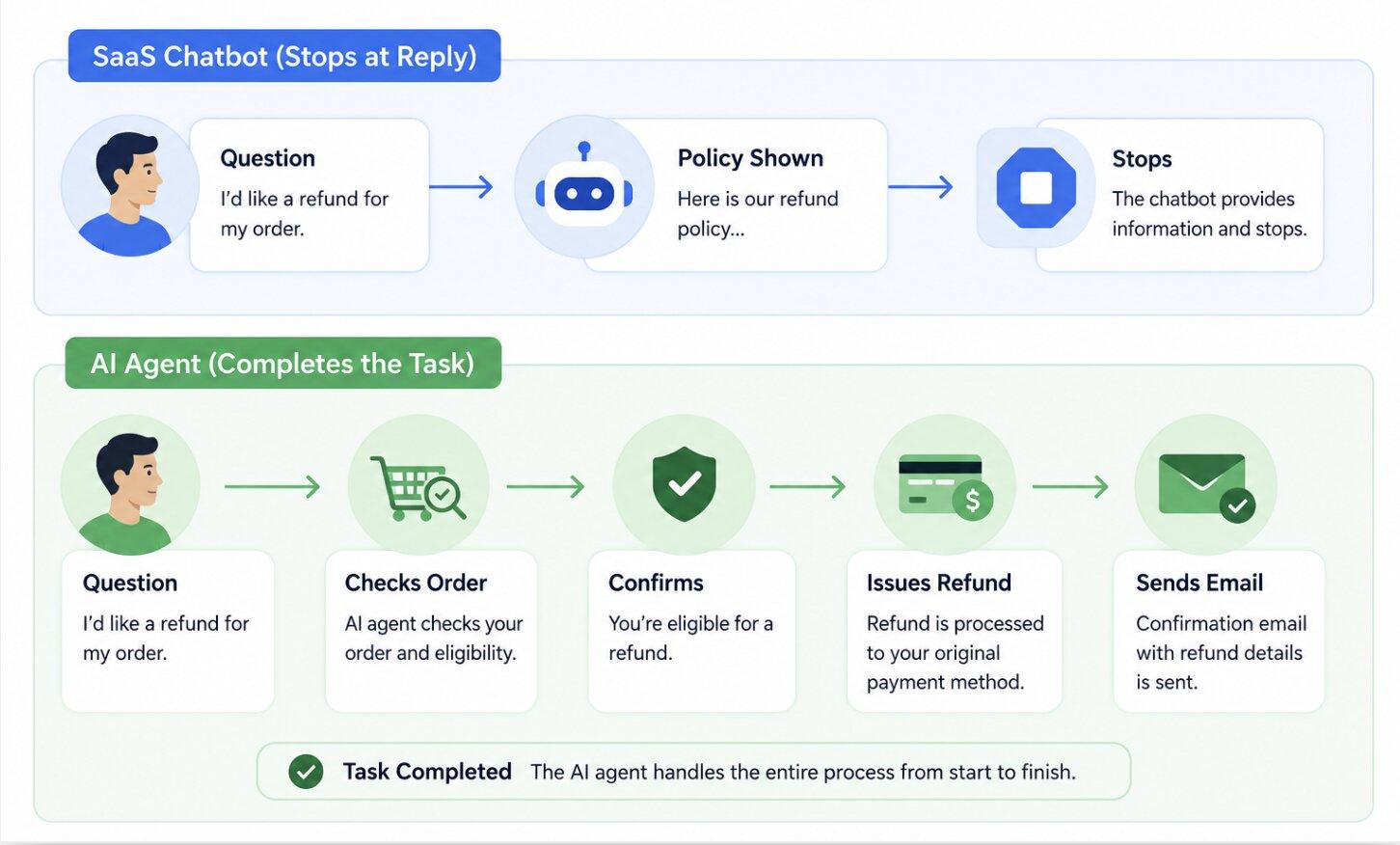
The gap between the two comes down to a single question: what happens after the AI understands you? A chatbot's job ends at the conversation reply. An AI chatbot job starts there. That one distinction shapes how each handles memory, tools, scale, and the kind of work you can hand it.
For example, say a customer asks for a refund. A chatbot reads the question, finds your refund policy, and posts it in the chat. The customer still has to file the request themselves. An agent takes it from there. It checks the order, confirms the customer qualifies, starts the refund in your system, and drafts the follow-up email for your team to review. Same question, and a very different outcome for the customer and your team.
The rest of this section breaks down where that difference actually shows up, from how they use memory to how they scale.
AI Agents vs SaaS Chatbots Comparison Table
This table gives you a quick side-by-side view across practical business categories.
SaaS Chatbots Focus on Conversation
Most chatbots run on scripted flows or decision trees. Under the hood, they leverage Natural Language Processing and machine learning to match a user's message to the right response. A user picks a path or types a keyword, and the bot follows the branch it was trained on.
In support, when a customer asks something off-script, the bot replies that it will connect them to an agent. In sales, a live chat widget captures a name and email, then stops. During onboarding, it follows fixed steps but can't adjust when a user's setup is unusual. Good AI chat agents handle these flows smoothly. They stay inside them.
AI Agents Focus on Execution
Agents work through a task instead of answering a single message. They break a goal into smaller steps, call your tools or APIs mid-task, hold context across the whole session, and keep moving without a fresh prompt at each step.
For example, say you ask an AI chatbot to run a small campaign. It drafts the copy, pulls last month's data to sanity-check the offer, then updates the record so the rest of the team can see the plan.
That's a chain of connected actions, and it's the piece a chatbot can't replicate. This is where conversational AI software crosses into real execution.
Chatbots Work Session by Session, AI Agents Retain Context
A chatbot handles each session on its own. It can hold context within a single conversation, but once that chat ends, it usually doesn't carry anything over to the next one. A returning customer often starts fresh.
An AI chatbot keeps context across tasks. It holds onto your brand voice, customer history, company rules, and what it did on earlier work. For example, an agent that drafted a proposal last week can pull the same terms and tone when the client follows up, without you re-explaining the background. That continuity keeps output consistent as the work adds up.
Chatbots Work Within Support Tools, AI Agents Connect Across Your Stack
A chatbot usually runs inside your support tools: website chat, help desk, or inbox. It reads messages and replies, and some connect to a knowledge base or ticketing system. What it generally can't do is access your CRM or calendar and change anything.
An AI agent connects across your stack. It uses APIs, the bridges that let software talk to each other, to update records, send emails, or move a task between apps. For example, an agent can log a new lead in your CRM, add a follow-up to your calendar, and send the intro email, all from a single instruction. That access is what lets it act instead of only respond.
Chatbots Scale Conversations, AI Agents Scale Output
A chatbot scales conversations, adds more traffic, and answers more questions at once, which keeps support wait times down. Its ceiling is still conversation, though. More volume means more replies, not more kinds of work.
An agent scales output. For example, one agent that handles social posts today can take on email campaigns and reporting next month, without you hiring or buying another tool. As your needs grow, the same system stretches across more of the business instead of maxing out at chat.
Key Benefits of SaaS Chatbots and AI Agents
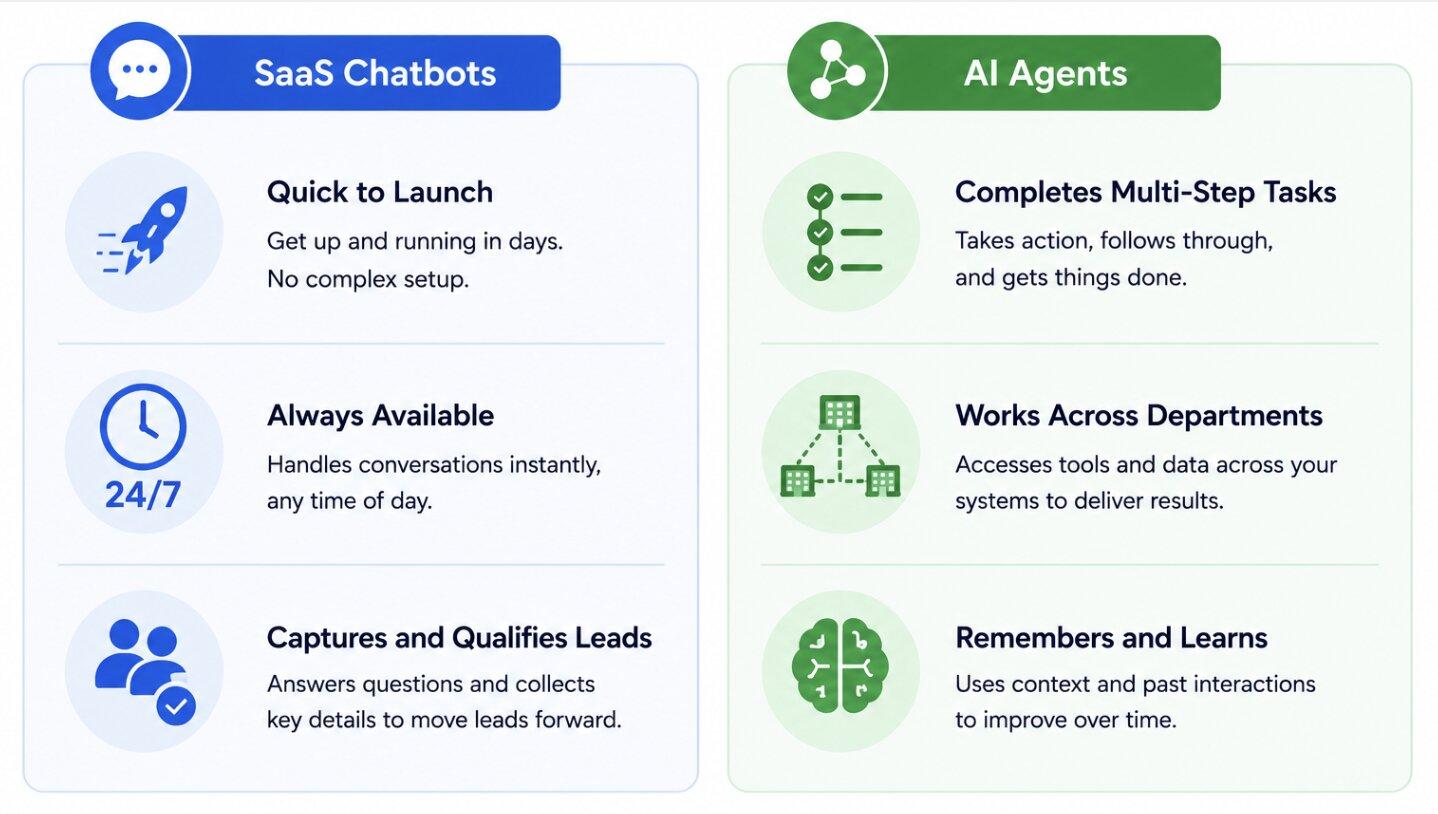
Both tools earn their place, so it's worth being fair about what each one gives you. A chatbot pays off in speed and consistency. An agent pays off in the work it takes off your plate.
The sections below cover what you get from each, and where agents pull ahead for businesses that want more than chat:
SaaS Chatbots Help With Fast Support and Lead Capture
The main benefit of a chatbot is response time. It answers common questions the moment they come in, day or night, so customers aren't waiting on a rep. That alone lifts satisfaction and cuts the load on your support team.
On the sales side, a chatbot can engage visitors while their interest is still high. For example, when someone lands on your pricing page at 11 p.m., the chatbot can answer a quick question, collect their contact details, ask a few qualification questions, and pass the conversation to your sales team for follow-up the next morning.
SaaS Chatbots Reduce Repetitive Support Work
Beyond speed, chatbots take the repetitive volume off your team. FAQs, password resets, order tracking, basic troubleshooting, all the questions that come in hundreds of times a week get handled without a person stepping in.
In fact, AI chatbots can automate up to 90% of onboarding queries, walking new users through step-by-step setup instructions and linking them to tutorials along the way. Over time, analytics from those chatbot interactions help you identify customer trends and pain points.
AI Agents Can Complete Multi-Step Tasks
The benefit of an AI assistant is that it finishes work, not just starts it. You hand over a goal, and it carries the task through the steps instead of handing each one back to you.
For example, after a sales call, an agent can draft the follow-up email, log the notes in your CRM, and schedule the next touchpoint, all from one instruction. That's hours of small admin work that would otherwise sit on someone's list. The payoff is real time back in your week and fewer tasks stalling because everyone's busy.
AI Agents Can Support Many Business Functions
The bigger benefit is reach. The same underlying AI can work across departments, each with its own kind of judgment, so you're not buying a separate tool for every team.
- Marketing: Decides how a message should land for a given audience and adjusts tone accordingly.
- Sales: Prioritizes which leads deserve attention first based on signals in the pipeline.
- Support: Weighs when to resolve directly and when a case needs a human.
- SEO: Coordinates keyword focus against what the site already ranks for.
- E-commerce: Balances product positioning against stock and demand signals.
- Data: Chooses which numbers actually matter for a given question.
- Operations: Sequences recurring work so nothing stalls waiting on a handoff.
That breadth is the payoff. Fewer tools to manage, one fewer bill for each function, and output that stays consistent because everything runs through the same system.
AI Agents Can Use Memory and Context
An agent's output gets better when it remembers your business. Feed it your brand voice, customer details, company rules, and past work, and the quality improves with each task rather than resetting each time.
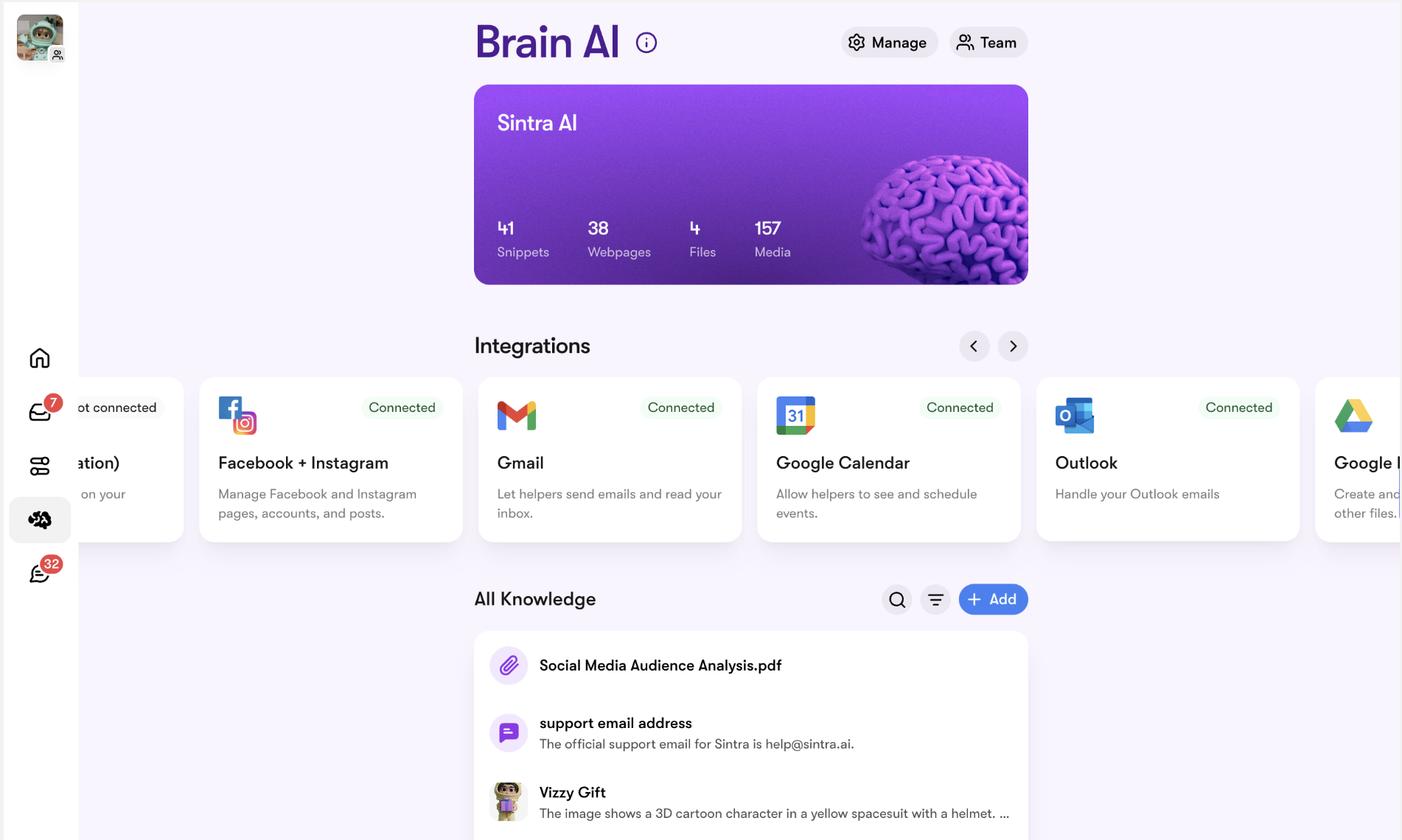
This is where shared memory changes the game. For example, Sintra's Brain AI stores your brand guidelines, company knowledge, and preferences in one place, so every AI assistant works from the same context. Your social posts sound like your emails, which sound like your support replies.
When Should You Use a SaaS Chatbot?
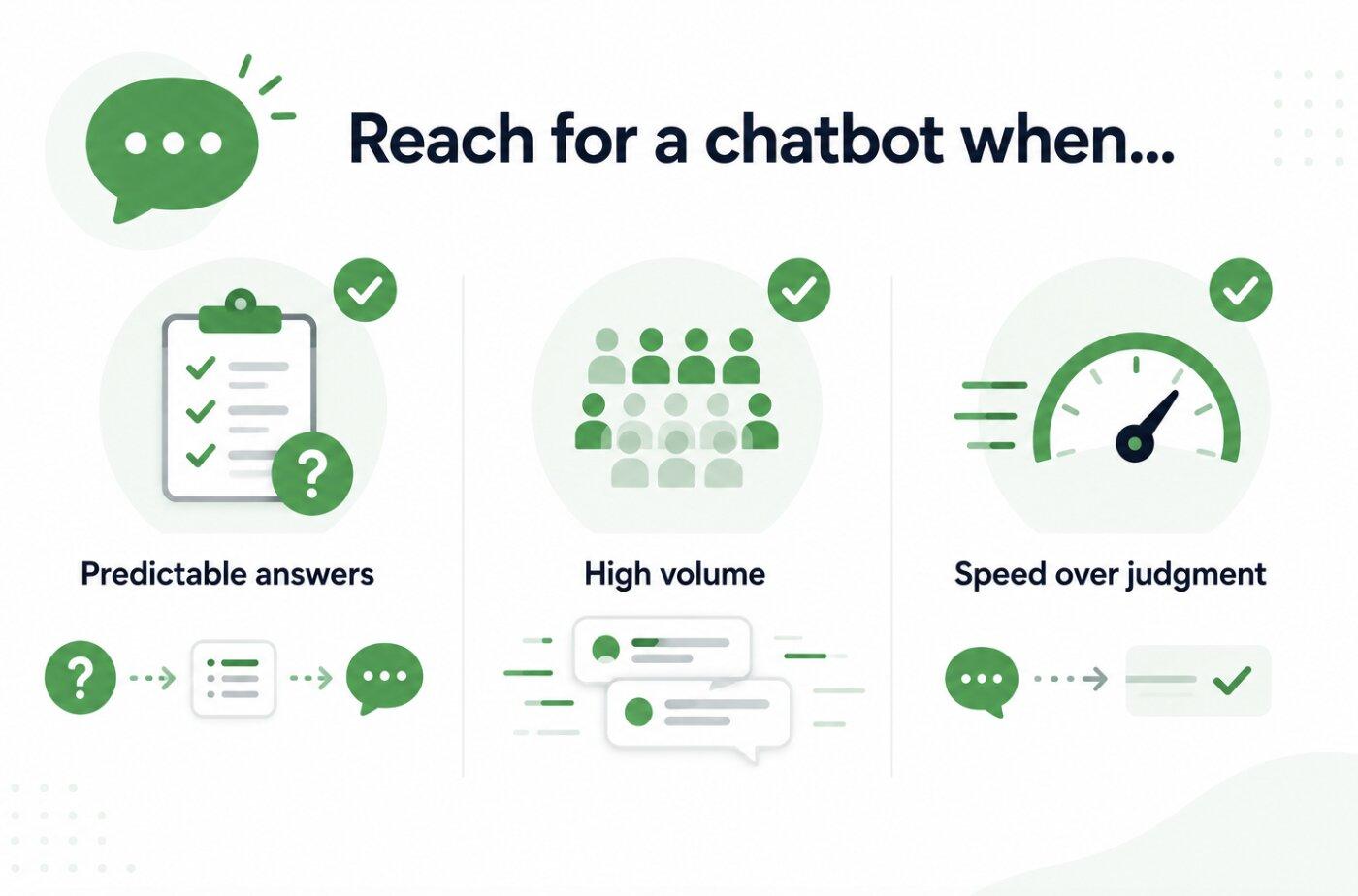
A chatbot is a good fit when your answers are predictable, your volume is high, and the goal is a fast reply rather than a judgment call.
For example, a small ecommerce store fielding shipping questions has the same handful of answers on repeat: tracking links, delivery windows, and return steps. Chat agents handle that volume instantly, at any hour, without a person stepping in.
The same holds for a SaaS company buried in pricing FAQs. When "what's the difference between your plans?" comes in 50 times a day, a live chat widget answers each one in the same clear way, and your team never touches it.
When the work is structured and repeats like that, an AI chatbot saas tool is the efficient call, and there's no need for the extra power of an agent.
When Should You Use AI Chatbots?
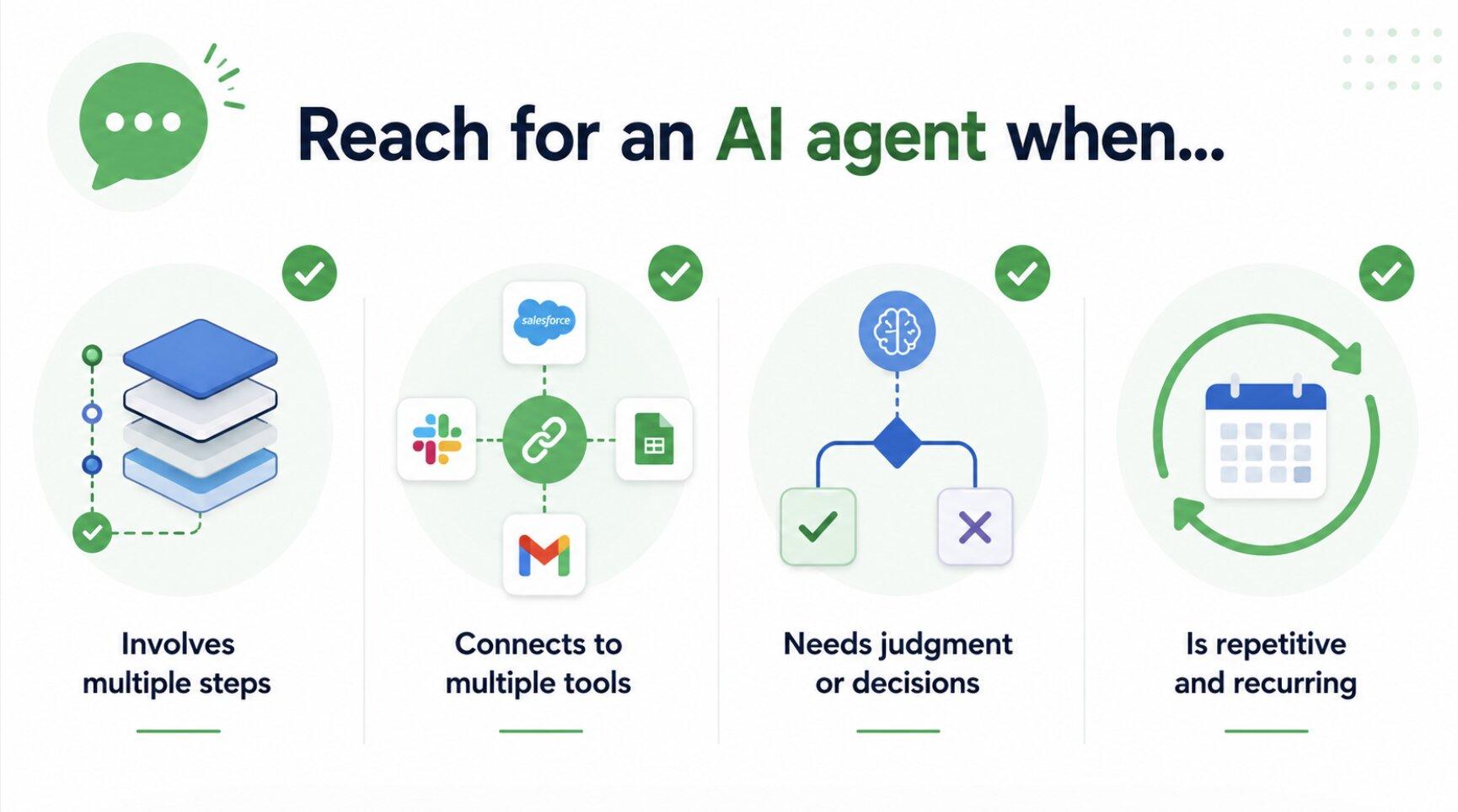
The question here is timing, so watch for a few signals. Any one of them means a task has outgrown what a chatbot can do:
- The work takes several steps, not a single answer
- It needs to connect to other tools or systems to finish
- It calls for some judgment or prioritization, not a fixed script
- It repeats often enough that handling it by hand wastes real time
For example, onboarding a new client touches all four. It spans multiple steps, pulls from your CRM and calendar, requires judgment about what each client actually requires, and happens often enough that doing it manually eats up hours every week.
That's an agent's job, and setting it up usually means giving the agent access to your other systems, which is where AI integrations come in.
Here's the simple test. If your business is asking "should this be automated," and the answer touches any of the signals above, an AI agent is the better fit than a chatbot. For a single fixed reply, stick with AI chatbots. For anything with moving parts, an agent wins.
Are AI Agents Replacing SaaS Chatbots?
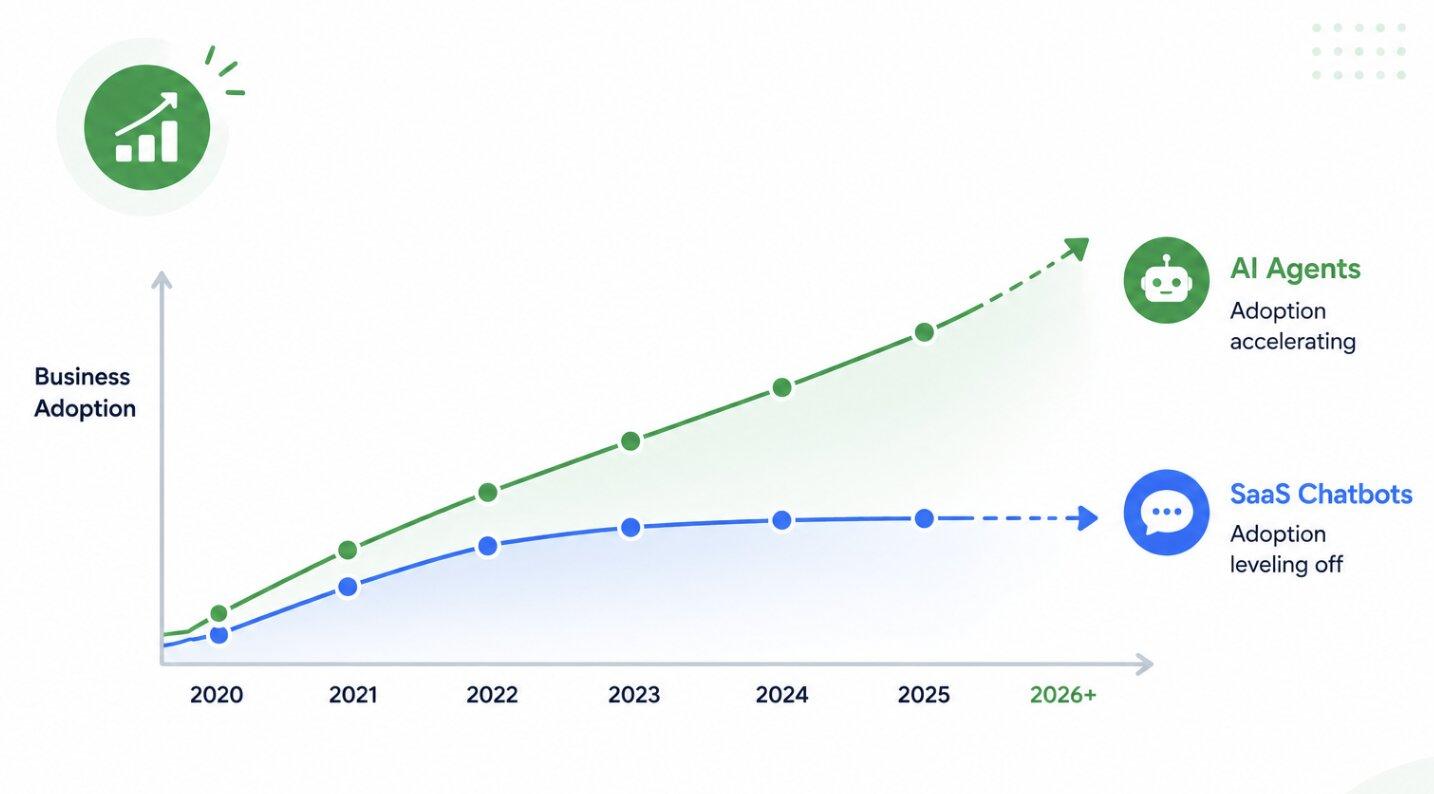
Chatbots aren't going away, but the market is clearly shifting toward agents. The useful question is where things are heading, and the direction is easy to see.
One likely path is for chatbots to become a feature within agent platforms. The chat window stays, but it runs inside a bigger system that can also take action. Another path is for businesses to move to an AI assistant as their main tool and keep a chatbot only for basic customer-facing chat.
A few things are driving this:
- Switching tools is expensive, so teams want fewer platforms that do more.
- Buyers don't want to pay for a separate app for every function.
- AI keeps getting better at handling messy, open-ended requests
Chatbot tools will stick around, but most of the new spending and product development is going into agents.
Chatbots Still Have an Important Role
A chatbot is still useful for customer support, website chat, lead qualification, onboarding, and repetitive questions. It gives fast, consistent answers and improves the customer experience without costing much to run.
If your needs stay inside structured conversations, a chatbot is a solid, proven choice. A live chat tool keeps doing its job well inside those workflows, and that use case isn't disappearing.
AI Agents Represent the Future of Business Automation
Most of the momentum is with agents. Businesses want AI that can take a goal, use their company data, integrate with their tools, and complete tasks on its own.
That's what agents do. They go beyond answering questions to write content, run workflows, coordinate across teams, and handle daily operations. As companies automate more of their work, AI assistants are becoming the obvious next step past traditional conversational software, and that's where most of the investment is going.
Why Sintra AI Is the Best AI Agent Platform for Modern Businesses
Running a business means juggling tools. One app for email, another for social, a chatbot for support, a separate tool for content. Each one works on its own, but they don't talk to each other, and you're the one copying work between them. Add more functions and the tool sprawl gets worse, not better.
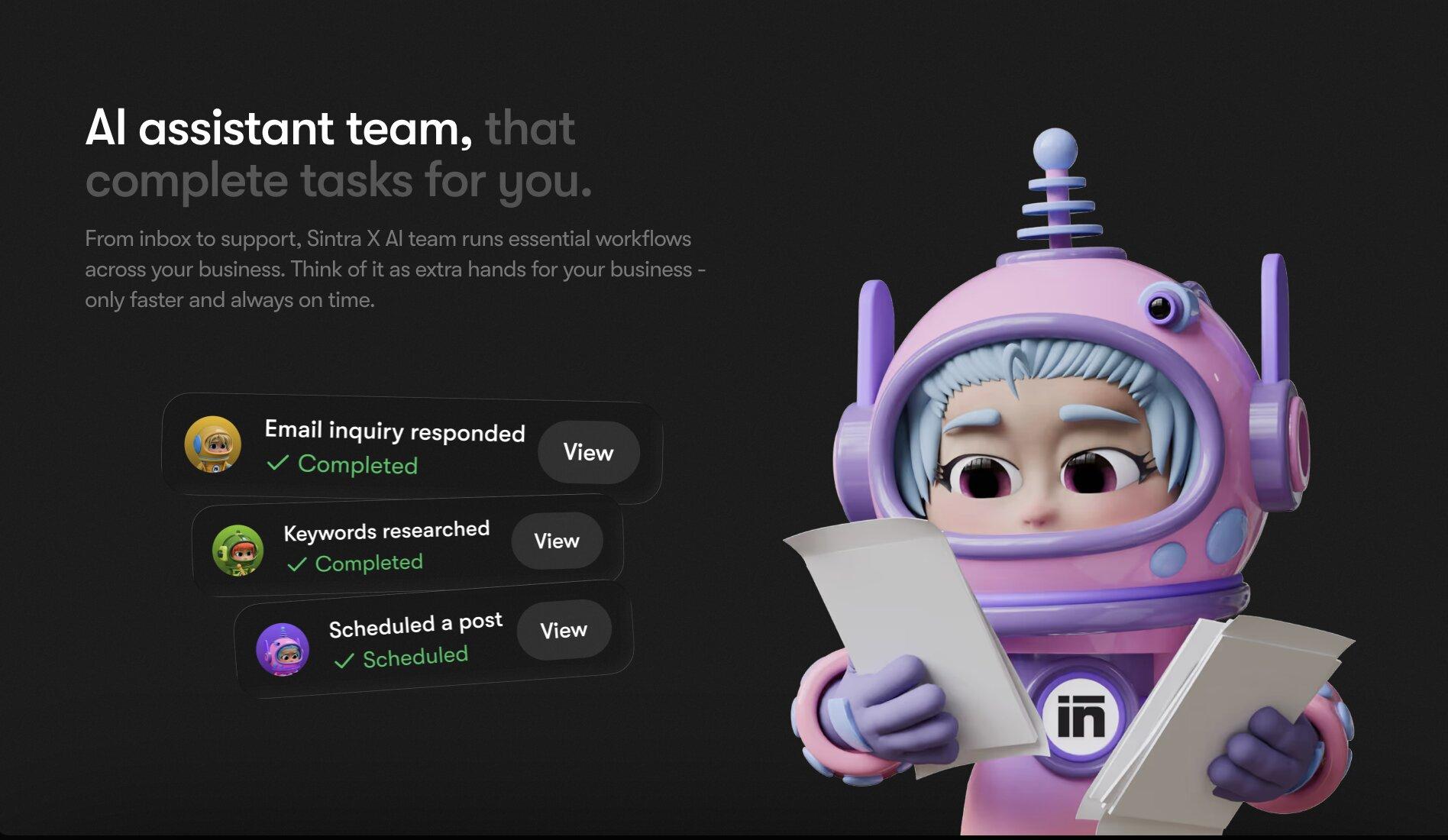
Sintra AI takes a different approach. It's an AI team that handles work across your business from one place. Instead of a single chatbot or a pile of disconnected apps, you get specialized AI employees, shared memory, automations, and integrations with the tools you already use.
Here's how that works and why it holds up better than a chatbot over time:
A Team of Specialized AI Employees Instead of One Generic Chatbot
Sintra runs on dedicated AI employees. Each one is set up for a specific role rather than a single general bot stretched across every task. You get Soshie for social media, Penn for copywriting, Cassie for customer support, Buddy for business strategy, and Vizzy for creative work, among others.
You get better output this way. An AI employee focused on one job gives you more relevant, consistent results than a single chatbot doing everything. For example, a copywriting employee already knows your tone and format, so you spend less time fixing the same things on every draft. That's the advantage these AI assistants have over a generic chatbot.
Built to Execute Work Across Your Entire Business
Work moves between employees without you switching platforms. Shared workspaces, AI integrations, and a shared task history let one employee hand off to another or pick up where a task stopped.
For example, your AI copywriter drafts a batch of posts, and your AI social media manager schedules them across your channels. No copy-paste between apps, no re-explaining what you wanted. That's what makes it work like a team instead of a set of separate tools.
Brain AI Keeps Every AI Employee Working From the Same Knowledge
A regular chatbot can't do this. Brain AI gives every AI employee the same context about your business.
Your brand voice, company details, customer info, preferences, and internal guidelines remain consistent across all workflows.
For example, your social post, your email, and your support reply all sound like the same company, because they pull from the same source. Over time, that shared memory makes your agents more accurate, which stateless AI chatbots can't manage.
Ready to Move From SaaS Chatbots to AI Agents?
A chatbot answers questions. An agent does the work. If you want AI that drafts content, runs workflows, and keeps your output consistent while you focus on the parts only you can handle, that's where your business should be headed.
You get a team of AI employees instead of another chat window, and one workspace instead of a stack of tools that don't talk to each other. Get started with Sintra AI and put your AI team to work today.
AI Agents vs SaaS Chatbots FAQs
What is the difference between AI agents and SaaS chatbots?
A chatbot manages conversations. It answers questions, captures leads, and routes users. An agent completes work. It takes a goal, breaks it into steps, uses your tools, and finishes the task. In short, chatbots reply and agents act.
Are AI agents better than SaaS chatbots?
It depends on the job. For simple, repetitive questions at high volume, a chatbot is fast and cost-effective. For multi-step work that needs judgment and access to your tools, agents are the stronger choice. Many businesses use both and match the tool to the task.
Can AI agents replace live chat SaaS tools?
In most cases, yes, AI agents can handle live chat and then go further by completing the task behind the request. That said, a lightweight chatbot still makes sense when all you need is fast, structured customer conversations.
What is chatbot as a service?
It is a hosted, subscription-based chatbot you rent instead of building. The provider handles setup, hosting, and updates, and you connect it to your site. Most businesses use it for support, lead capture, and other conversational AI tasks.
Why should a business choose Sintra AI instead of a basic chatbot?
A basic chatbot only answers questions. Sintra gives you a team of specialized AI employees that run work across departments, share context through Brain AI, and connect to your tools. So instead of just replying to customers, your AI assistant finishes the work behind those requests.
Related articles