Chatbot App vs ChatGPT: What's the Real Difference?

Table of Contents
Quick Answer: Chatbot App vs ChatGPT
A chatbot app is built on rules. It follows predefined paths, responds to specific keywords, and works best when conversations are predictable, leading to scripted responses. ChatGPT is a generative AI model that creates responses in real time, handles open-ended questions, and adapts as conversations shift.
Neither is built to execute end-to-end business workflows on its own. They're conversation tools, yes, they are useful, but not operational systems. That gap matters when you need AI that actually does the work, not just talks about it.
You search for a tool to handle customer questions. You find two options: chatbot apps and ChatGPT. Both look promising. Both promise to save time. But pick the wrong one, and you're either stuck with a bot that breaks every time someone asks something slightly unexpected, or you're paying for AI muscle you don't actually need.
The chatbot app vs ChatGPT debate comes down to one core question: do you need a tool that follows a script, or one that thinks on its feet?
We've tested both extensively across business use cases, and we're sharing our findings here so you can make this call clearly. And if both end up falling short in running actual business operations, there's a reason we'll get to. An AI team that executes, rather than just responds, is where this conversation eventually leads.
Here's a side-by-side look first:
What Is a Chatbot App and What Is ChatGPT?
Before comparing them, it helps to know exactly what each one is.
Chatbot App
- A software program designed to simulate conversation using predefined rules and decision trees
- Responds only to inputs it's been specifically trained or scripted to handle
- Built for a narrow, focused job, such as order tracking, appointment booking, or FAQ replies
- Standard chatbots are often rule-based, following predefined paths or decision trees
- Fast to set up, easy to manage, low cost to run
- Examples: website support bots, WhatsApp business bots, e-commerce help widgets

ChatGPT
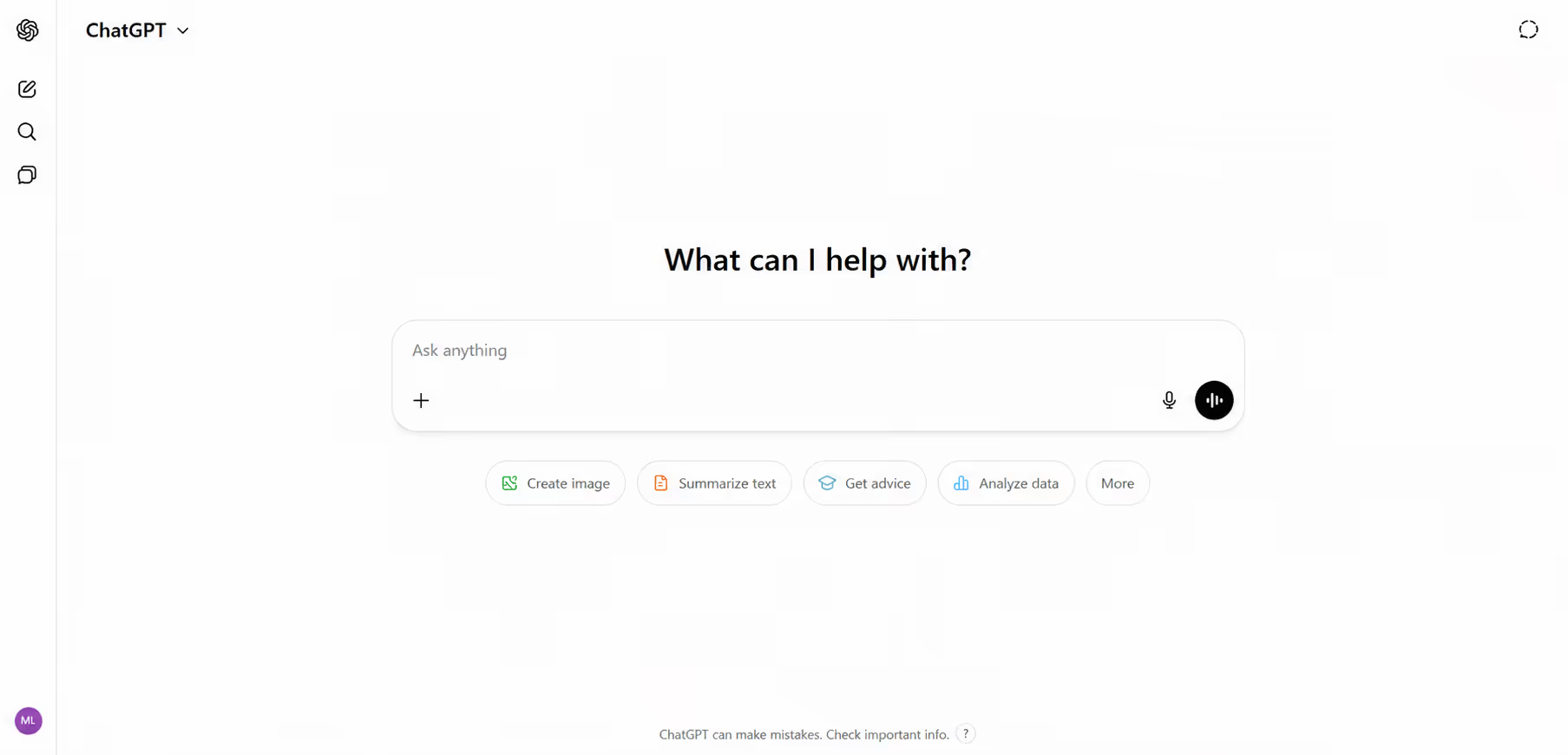
- A generative AI model built by OpenAI, powered by large language model (LLM) technology
- Creates responses from scratch in real time; no script, no fixed paths
- Can hold a natural conversation on almost any topic
- Understands context, tone, and nuance within a session
- Used for writing, research, customer engagement, brainstorming, and more
- Available via OpenAI's platform or through the API for custom integrations
The simplest way to tell them apart: a chatbot app reads from a playbook. ChatGPT writes a new one every time.
Chatbot vs ChatGPT: Key Differences
Understanding the difference between ChatGPT and Chatbots is not as complicated as it may sound. People confuse these two because both involve chat interfaces and automated responses. But underneath, they run on completely different engines. One reads from a scripted manual. The other writes its answers from scratch.
Here's what that actually means for your business.
How Chatbot Apps Work vs How ChatGPT Works
Rule-based chatbots operate by matching user input to predefined sets of responses, functioning like a flowchart in conversation. A user types a question. The bot scans it for keywords. It finds a match and returns a preset answer.
Think of it like a phone menu: "Press 1 for billing, press 2 for support." It works perfectly, until someone asks something the menu doesn't cover.
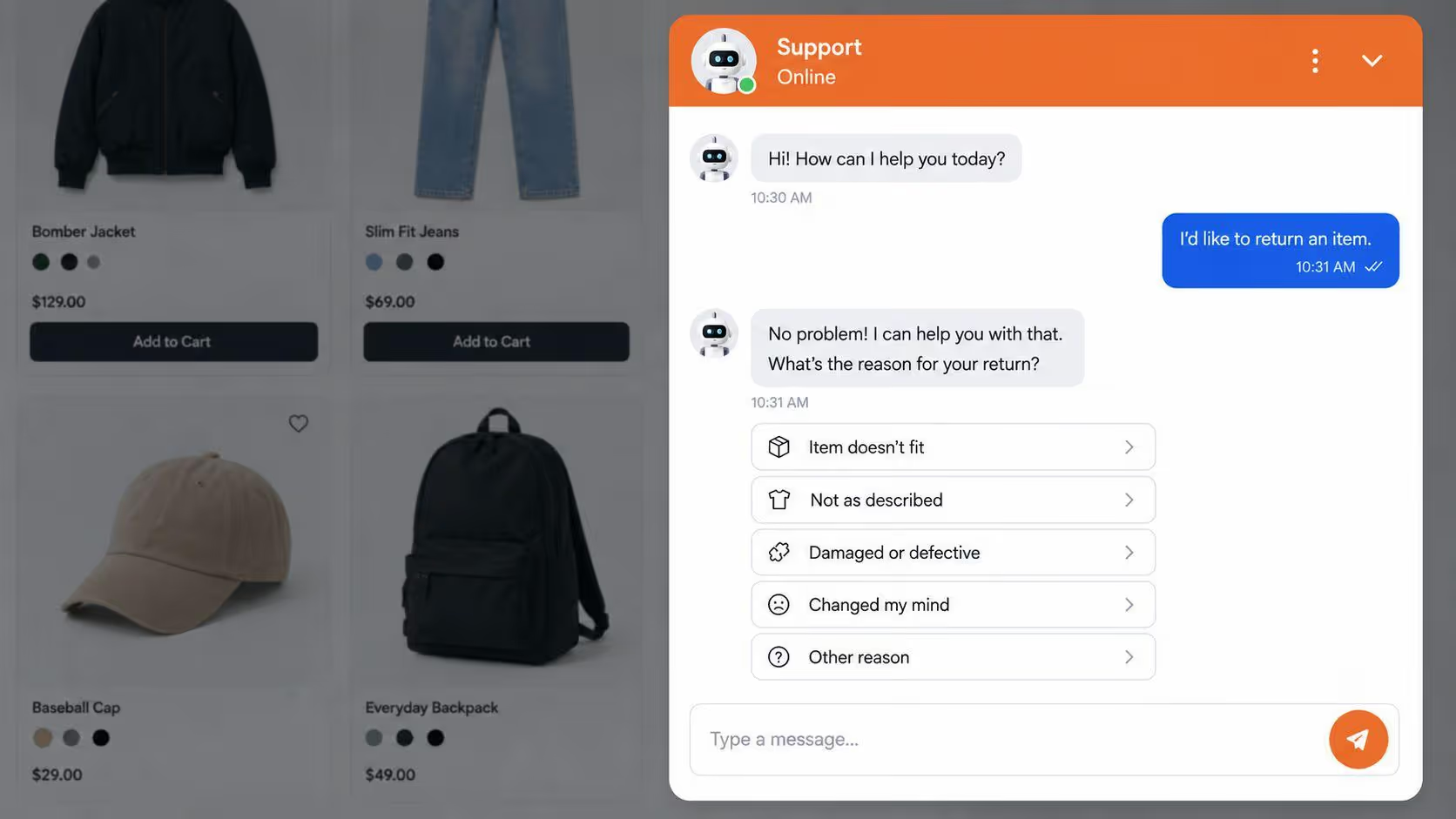
ChatGPT works differently. Generative chatbots, such as ChatGPT, generate responses from scratch using large language models, enabling them to handle a wide range of topics and engage in human-like conversations. There's no script. It generates every reply based on patterns learned from enormous amounts of text data.

A quick way to picture it:
- A chatbot app is a trained customer service rep reading from a manual.
- ChatGPT is a knowledgeable generalist who reasons through questions in real time.
The practical difference shows up fast. A chatbot app handles "What's my order status?" flawlessly every time. ChatGPT handles "I ordered last week, it arrived damaged, and I need to know my options" without breaking a sweat.
Personalization and Learning Capabilities
Chatbot apps can personalize using stored variables, like your name, account type, and past orders. But that's where it ends. The bot doesn't learn from conversations. It doesn't adapt its tone. If you don't manually update it, it stays exactly where it was.
AI-powered chatbots utilize machine learning to understand user intent rather than relying solely on keyword matching, allowing them to interpret variations in user queries. ChatGPT picks up context from earlier in a conversation and shifts its approach accordingly. Ask it to be more concise; it adjusts. Request simpler language; it delivers.
The catch: ChatGPT's memory resets between sessions. Generative AI chatbots like ChatGPT can understand context and adapt their responses based on prior interactions, whereas traditional chatbots typically lack this level of contextual awareness and flexibility. What feels like personalization in ChatGPT is actually session-level context awareness; powerful while the chat is open, gone after it closes.
For ongoing customer relationships, that's a real gap to account for.
Scalability Across Business Tasks
Standard chatbots are excellent for FAQ-style tasks and simple inquiries, and they scale extremely well for that. A thousand customers asking the same question simultaneously? The chatbot handles it without effort.
Scaling to new topics is a different story. Every new use case requires manual scripting. Add a product line, update pricing, move into a new market; the chatbot needs to be reprogrammed from scratch.
ChatGPT scales across task types without needing to be rebuilt. A business using it for customer support can extend it to marketing content creation without any new configuration. The scalability of traditional chatbots is generally easier and less expensive, as they can handle a high volume of repetitive tasks without incurring high additional costs, whereas ChatGPT's scalability may entail higher costs due to its resource-intensive nature.
Bottom line: scalability for volume favors chatbots. Scalability across task types favors ChatGPT.
Here's a deeper breakdown you can reference quickly:
What the research actually shows: Evidence from Verified Industry Sources
Rather than relying on a proprietary study, we've drawn on published data from Gartner, Salesforce, HubSpot, and real-world deployments including Klarna, sources with transparent methodology and independent verification. Here's what the numbers actually say.
How fast businesses are moving toward generative AI
Industry adoption — Gartner, December 2024
In December 2024, Gartner published findings from a survey of 187 customer service and support leaders conducted between July and August 2024. All three stats in this block come from that single press release.
More than 75% of customer service and support leaders said they feel pressure from executive leadership to implement GenAI. The customer service function has a growing level of influence over AI initiatives. This historically people-and-process driven function has evolved into a technology-focused one.
— Kim Hedlin, Senior Principal Research, Gartner Customer Service & Support Practice
Source: Gartner press release, December 9, 2024
One risk Gartner has flagged in its 2025 customer service research is "agent-washing"; products marketed as agentic AI that, under the hood, are still rule-based chatbots. This is precisely the distinction this article addresses, and it's a confusion that Gartner says is making it harder for buyers to evaluate what they're actually purchasing.
Source: Gartner press release, December 9, 2024
What AI is doing to support team output and costs
Workforce impact — Salesforce 7th State of Service Report, 2025
Salesforce surveyed 6,500 service professionals and decision-makers globally between April 25 and June 6, 2025, for its seventh annual State of Service report. The stats below come from two Salesforce-published pages: the official news announcement and the editorial blog summary, both of which are linked directly under each figure.
Source: Salesforce State of Service 2025 — news.salesforce.com
Source: Salesforce State of Service 2025 — salesforce.com/blog
AI agents go beyond predictions and automation; they can understand context, take action, make decisions, and adapt in real time. That shift gives human reps more space to focus on what they do best: solving high-stakes, complex problems and building trust with customers.
— Kishan Chetan, EVP and General Manager, Salesforce Service Cloud
Source: Salesforce State of Service 2025 news announcement, November 13 2025
The data makes the operational split clear: traditional rule-based chatbots continue to handle password resets and order status lookups. Generative AI in the form of AI agents is taking on nuanced judgment calls, complex exceptions, and multi-part issues. The 20% time savings reported above apply only to reps using AI agents, not to reps using rule-based bots.
The most documented generative AI customer service deployment on record
Real-world deployment — Klarna, February 2024
Klarna launched a generative AI support assistant built on OpenAI's GPT-4-class models in February 2024. Results were published in Klarna's own official press release, cross-confirmed by an OpenAI case study, and later verified in Klarna's Q1 2025 earnings reporting. All stats below are sourced individually from their original documents.
Klarna — Global payments platform, 150M active users
✓ Official press release + OpenAI confirmation
Within one month of global launch, the AI assistant handled two-thirds of all Klarna customer service conversations; the equivalent workload of 700 full-time agents, operating 24/7 across 23 markets in more than 35 languages.
- 2.3M conversations handled in the first month alone
- 11 min → under 2 min average resolution time drop
- 25% fewer repeat inquiries filed by customers
- 35+ languages supported across 23 markets, 24/7
- CSAT scores are on par with human agents throughout
- $40M estimated profit improvement for 2024 from avoided hiring costs
All stats above: Klarna official press release via PR Newswire, February 27 2024 · Cross-confirmed by OpenAI case study
Source: eMarketer reporting on Klarna Q1 2025 earnings, May 2025
Important context for 2025: By early 2025, Klarna reintroduced human support capacity for complex, emotionally sensitive, and compliance-sensitive cases. CEO Sebastian Siemiatkowski acknowledged that cost had been "a too prominent evaluation factor" in cutting human support. The lesson Klarna drew, and that this article reflects, is that generative AI handles volume and speed exceptionally well, but human judgment remains necessary for the hardest 20% of conversations.
Day-to-day time saved per service professional
Productivity gains — HubSpot 2024 State of Customer Service
HubSpot's 2024 State of Customer Service report surveyed over 1,500 customer service leaders. All three figures below are from that same report, published in HubSpot's official PDF and confirmed in their customer service statistics roundup. Each links to its source.
Source: HubSpot 2024 State of Customer Service
Taken together, the Gartner, Salesforce, Klarna, and HubSpot data all point to the same pattern. AI tools (whether rule-based or generative) improve efficiency on structured, repetitive tasks. The performance gap widens significantly on complex, open-ended interactions, where generative AI consistently outperforms scripted chatbots. The 2.2 hours per day of reclaimed time is most meaningful in that context: it's not time saved on simple FAQs, it's time returned to agents for the conversations that actually need human judgment.
Use Cases: When to Use a Chatbot vs ChatGPT
There's no universal right answer here. The choice depends on the task, the amount of variation in user input, and the level of flexibility the conversation actually needs.
We've tested both across customer support, marketing, and internal operations, and what we've learned is that the right tool shifts depending on what you're asking it to do.
Customer Support and FAQs
Standard chatbots excel at structured tasks such as order tracking, store hours lookups, password resets, and basic troubleshooting. Fast, consistent, zero error rate within their programmed scope.
Where they fail: Standard chatbots can frustrate customers if not programmed to handle specific queries. The moment a user phrases something differently than expected, or combines two issues into one message, the bot either fails or sends them into a loop they can't escape.
ChatGPT handles ambiguity well. A customer with a multi-part issue gets a coherent, contextual response instead of a dead end.
For high-volume, predictable support → chatbot.
For nuanced, multi-part service issues → ChatGPT.
Lead Qualification and Sales Conversations
Standard chatbots are often rule-based, following predefined paths or decision trees. In lead qualification, this means collecting contact details, answering fixed qualifying questions, and routing hot leads forward. Works well for structured funnels.
The moment a prospect asks something off-script, for example, "How do you compare to your competitors?" or "Is this right for a company our size?", a rule-based bot has nothing useful to offer.
Generative AI chatbots like ChatGPT excel in providing context-aware, dynamic responses and can handle complex, open-ended queries, making them ideal for engaging customer interactions. In sales, that translates into real discovery conversations that adapt to what the prospect reveals.
Content Creation and Marketing Tasks
Chatbot apps weren't designed for content creation. At best, they pull from template libraries. At worst, they produce generic outputs that need complete rewrites.
Traditional chatbots are best suited for simple, repetitive tasks and structured, rule-based interactions, making them budget-friendly and easy to maintain. Here, content creation is neither simple nor structured.
ChatGPT handles blog posts, email drafts, social copy, ad variations, and product descriptions from short prompts. Marketing teams we've worked with saw drafting time drop significantly with ChatGPT-assisted workflows, and the output quality required only light editing.
Internal Productivity and Daily Tasks
Chatbot apps rarely touch internal workflows beyond simple IT or HR queries. They weren't built for it.
ChatGPT fills that gap for teams. Common uses we've seen:
- Research summaries and briefing documents
- Drafting internal communications and meeting agendas
- Reviewing and analyzing documents
- Brainstorming and strategy prep
ChatGPT can handle open-ended queries and generate responses in real time, which makes it ideal for personalized interactions, whereas traditional chatbots are limited to scripted responses and may struggle with unexpected questions. For internal productivity, that flexibility is the whole point.
Complex Conversations and Problem Solving
This is where rule-based bots hit their ceiling fastest. A user walking through a technical issue with multiple steps, follow-up questions, and evolving context will get dead ends from a chatbot almost immediately.
AI-powered chatbots utilize machine learning to understand user intent rather than relying solely on keyword matching, allowing them to interpret variations in user queries. ChatGPT tracks what was said earlier in the conversation and uses it to build coherent, layered answers.
For anything requiring multi-step reasoning or open-ended problem-solving, there's no real contest.
Key Takeaway: Choosing the Right Tool for the Job

Traditional chatbots follow predefined rules and provide predictable answers, making them suitable for straightforward tasks, while ChatGPT generates dynamic responses, allowing for more complex and engaging conversations.
Use a chatbot when the task is predictable. Use ChatGPT when the conversation needs to breathe.
The pattern is clear: structure vs. flexibility, speed vs. depth, volume vs. nuance. Recognize which category your use case falls into, and the decision makes itself. What we've found is that most businesses actually need both for different tasks, not the same ones.
Limitations of Chatbots and ChatGPT
Both tools are useful, but neither is a complete solution. Once you see where they stop, the gap is hard to ignore.
Chatbot app Limitations
- Breaks on unexpected inputs; anything outside the programmed script fails
- Every new topic or use case needs manual scripting and testing
- Standard chatbots may lead to customer frustration if not programmed for specific queries
- Standard chatbots offer better data privacy controls compared to public AI models, but that advantage doesn't fix the inability to adapt or learn
- Can't execute tasks. They answer questions, period.
ChatGPT Limitations
- No persistent memory; every session starts fresh
- Generative models may confidently provide incorrect information, known as hallucinations, in sensitive industries. This requires human review
- While traditional chatbots are cost-effective for handling predictable inquiries, ChatGPT requires more advanced infrastructure and can incur higher operational costs due to its dynamic response generation capabilities
- Can write an email, but can't send it. Can suggest a strategy, but can't execute one.
Both are conversation tools. When your business needs AI to run operations, not just respond to questions, means you need something else entirely.
How Sintra AI Goes Beyond Chatbot Apps and ChatGPT
The limitations above point to the same gap: chatbots respond, ChatGPT responds, but neither executes. Sintra AI fills that gap by functioning as an AI team; a system where specialized AI Helpers handle specific business functions and complete actual work.
AI Employees and Role-Based Helpers
Sintra AI assigns specialized AI employees to specific functions, like marketing, support, analytics, and more. Each operates as a domain expert, not a generalist catching whatever lands in the queue.
A hybrid chatbot solution combines traditional rule-based chatbots with generative AI like ChatGPT to enhance customer interactions by leveraging the strengths of both systems, and Sintra takes that concept further by adding role-based accountability. Tasks don't just get answered; they get completed by an AI built specifically for that job. A support Helper handles full support workflows. A marketing Helper executes campaigns.
From Conversations to Execution
The gap between responding and executing is the most important distinction in this entire comparison.
ChatGPT can write a follow-up email. Sintra's AI assistant writes it, sends it, tracks it, and reports back on performance, without someone manually moving work from step to step.
Using a hybrid approach allows businesses to utilize traditional chatbots for predictable inquiries while employing generative AI for more complex, nuanced conversations, improving overall customer service efficiency. Sintra moves past the hybrid model by making execution the default, not an add-on.
Brain AI and Shared Business Memory
One of ChatGPT's real limits is its tendency to forget. Every new session starts from zero.
Sintra's Brain AI solves this with a centralized memory layer. Every Helper draws from the same business context: your tone, customer history, product details, and past decisions. Integrating both traditional chatbots and generative AI can help businesses maintain response accuracy while providing dynamic, engaging interactions, thereby enhancing the user experience. Brain AI makes that consistency possible at scale, across every function, over time.
Seamless Integrations With Your Existing Tools
An AI that can't connect to your actual tools is a productivity ceiling, not a solution. Sintra's AI integrations connect with email, CRMs, calendars, and social platforms. That connectivity is what allows it to move from generating output to delivering it.
Choosing the right AI depends on a business's specific needs; traditional chatbots are effective for predictable inquiries, while generative AI chatbots are better for nuanced conversations that require human-like understanding, and Sintra handles both while extending into execution territory that neither chatbots nor ChatGPT can reach.
Real Business Use Cases and Results
What we've seen businesses actually do with Sintra AI:
- Marketing automation: AI Helpers manage social content calendars, write ad copy, and schedule posts.
- Email outreach: Personalized sequences sent, tracked, and followed up automatically.
- Customer support: Full resolution workflows that pull in account data, draft responses, and close tickets without manual hand-offs.
- Analytics: Summarized reporting delivered proactively, not just available on request.
Teams that moved from a ChatGPT workflow to Sintra reported eliminating hours of daily coordination. Choosing the right AI depends on a business's specific needs. For businesses that need results rather than responses, the answer is clear. Sintra's AI email assistant is one practical example of what that looks like in action.
Why Sintra AI Is the Best Choice Beyond Chatbots and ChatGPT
Chatbot apps are reliable within their limits. ChatGPT is powerful within its conversational scope. Sintra AI goes beyond both by treating AI as a workforce, not a feature.
Role-based Helpers with domain expertise. Persistent business memory. Native integrations that enable real execution. For solopreneurs, small business owners, and growing teams that need AI to move work forward, not just respond to it, Sintra is built for exactly that.
The Future Beyond Chatbots and ChatGPT
Chatbot apps answer the questions they were programmed for. ChatGPT answers questions it wasn't programmed for. Both are valuable, and everything we've tested confirms each has a clear role to play.
But for businesses that need AI to move work forward rather than just respond to it, the next step is operational AI. Tools like Sintra AI represent that shift: from chatting to executing, from generating suggestions to completing tasks.
The cost of using conversation-only tools shows up in the hours spent on follow-through that AI should handle. The benefit of moving to operational AI shows up in what your team gets back.
Get started with Sintra AI and see how much further your operations can go.
Chatbot App vs ChatGPT FAQs
What is the main difference between a chatbot and ChatGPT?
A chatbot app follows predefined rules and scripts; it can only respond to questions it's been programmed to handle. ChatGPT is a generative AI that creates responses in real time using a large language model, allowing it to handle open-ended, complex conversations without a pre-written script.
Can ChatGPT replace chatbot apps?
For most structured business tasks, no. Standard chatbots offer high reliability and accuracy on specific company policies, something ChatGPT can't always guarantee. ChatGPT handles dynamic conversations better, but chatbot apps are faster, cheaper, and more predictable for high-volume FAQ-style interactions. Most businesses benefit from using both for different tasks.
Are chatbot apps still useful in 2026?
Absolutely. Standard chatbots excel at structured tasks like order tracking and remain the most cost-effective solution for handling repetitive, high-volume queries. The key is knowing their limits, using them where scripted responses work, and supplementing with generative AI where conversations get complex.
Which is better for customer support: chatbot or ChatGPT?
It depends on your support workload. Traditional chatbots are best suited for simple, repetitive tasks and structured, rule-based interactions, making them budget-friendly and easy to maintain. ChatGPT is better at answering multi-part or ambiguous questions that require real reasoning. A hybrid setup, a chatbot for tier-one support and ChatGPT for escalations, works well for most support teams.
How is AI evolving beyond chatbots and ChatGPT?
The evolution is from conversation to execution. Chatbots answer, and ChatGPT generates. The next wave is represented by platforms like Sintra A, which automate tasks, run workflows, and integrate with the tools businesses already use. The shift is from AI that helps you think to AI that helps you do.
Related articles

.avif)