OpenAI vs ChatGPT: What’s the Difference?

Table of Contents
Quick Answer: OpenAI vs ChatGPT Key Differences
The difference between OpenAI and ChatGPT is their creator-product relationship. OpenAI is the AI research company that released its flagship AI conversational chatbot, named ChatGPT, among other technologies, including generative AI models and AI experimentation platforms. ChatGPT, however, is the consumer-focused AI assistant with multimodal, image generation, and deep research capabilities, among others.
You will find many people using OpenAI and ChatGPT interchangeably. However, they don’t mean the same thing.
OpenAI is an AI research company, the infrastructure and vision that stands behind ChatGPT, its flagship product, a conversational chatbot for non-tech users to improve their everyday productivity. But that’s not the only thing you will get from OpenAI.
Over the years, the company has invested in its generative models, including GPT, DALL-E, and Whisper. Developers and businesses seeking AI solutions tweak these models to their requirements using API keys and Playground.
Confused? Don’t be. We have curated this in-depth OpenAI vs ChatGPT guide with model comparison, accessibility, scalability, pricing, and more. So, dive right in.
Here is a side-by-side comparison of both OpenAI and ChatGPT.
What Is OpenAI and What Is ChatGPT?
Before we dig deeper into the OpenAI vs ChatGPT debate, it’s important to know what they actually are.
OpenAI
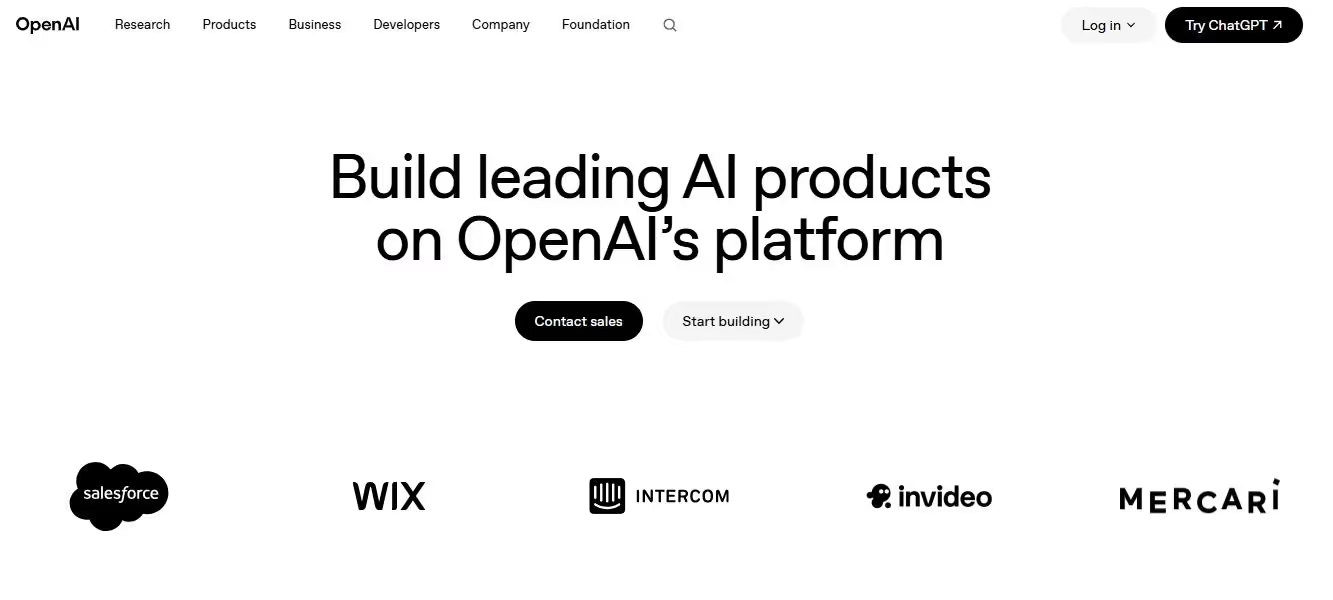
OpenAI is a US-based research and deployment organization that stands behind the development of AI technologies, including ChatGPT (the renowned AI chatbot), generative models like GPT and DALL-E, and Playground.
This company was founded in 2015 as a non-profit AI company by a group of entrepreneurs, including Sam Altman, Elon Musk (who exited in 2018), and John Schulman. Today, it acts as a for-profit subsidiary to secure funding.
The mission of OpenAI is to ensure that AI benefits humanity across the globe. The leaders at the company intend to build AI systems that are highly autonomous and outperform humans at economically viable work. The research areas of OpenAI include machine learning, deep learning, and reinforcement learning.
In May 2026, OpenAI announced three audio models in the API. With these models, developers can build voice experiences that sound natural and respond intelligently. These models include,
- GPT-Realtime-2 with GPT-5 class reasoning, meaning it can handle complex requests and carry natural conversations.
- GPT-Realtime-Translate is a translation model with 70+ input languages and 13+ output languages.
- GPT-Realtime-Whisper is a streaming speech-to-text model that transcribes your speech as the speaker talks.
ChatGPT
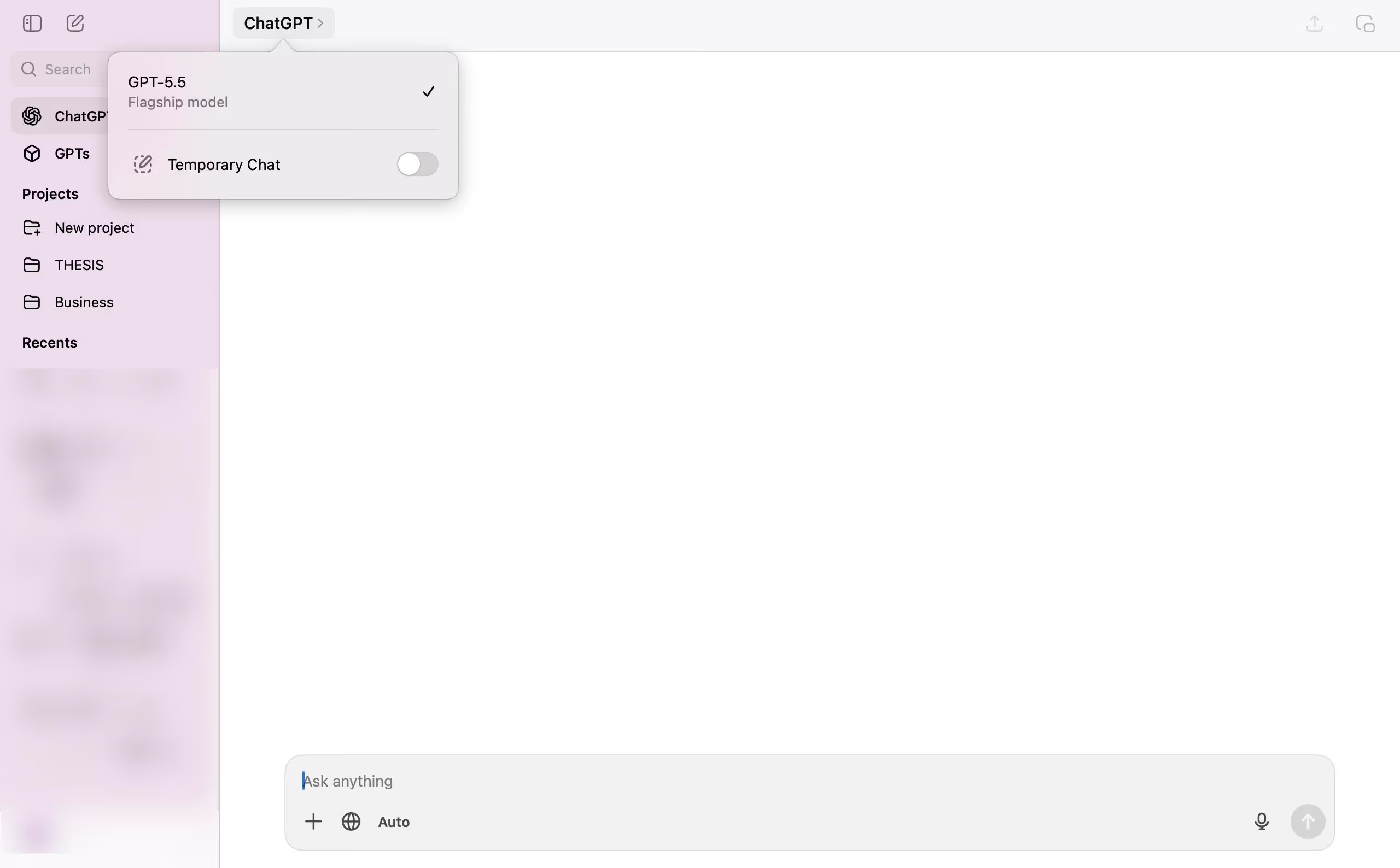
ChatGPT is a generative AI chatbot developed by OpenAI as a flagship product. This chatbot is built on large language models from the GPT (Generative Pre-Trained Transformers) family (GPT-5, GPT-5.4, GPT-4, GPT-3, etc). ChatGPT was officially released in November 2022 as a part of a research preview prototype.
It was among the pioneers and fastest-growing AI chatbots. Today, it has multimodal, deep research, and agentic capabilities. Professionals across fields use ChatGPT to draft emails, write content, generate visuals, analyze data, and summarize documents. However, it’s reason-to-fame still remains its NLP abilities that help ChatGPT mimic a human voice and carry out lengthy conversations.
As of 2026, ChatGPT runs on various GPT models, the latest being GPT-5.5. This highly capable model is focused on autonomous agentic workflows, meaning it acts independently to execute complex, multi-step tasks. Moreover, it has shown improvements in long-context and deeper reasoning, making it effective at scientific, maths, and legal tasks.
OpenAI vs ChatGPT Features Compared
Here are some common differences between OpenAI and ChatGPT you must be mindful of before making a decision.
API vs Interface
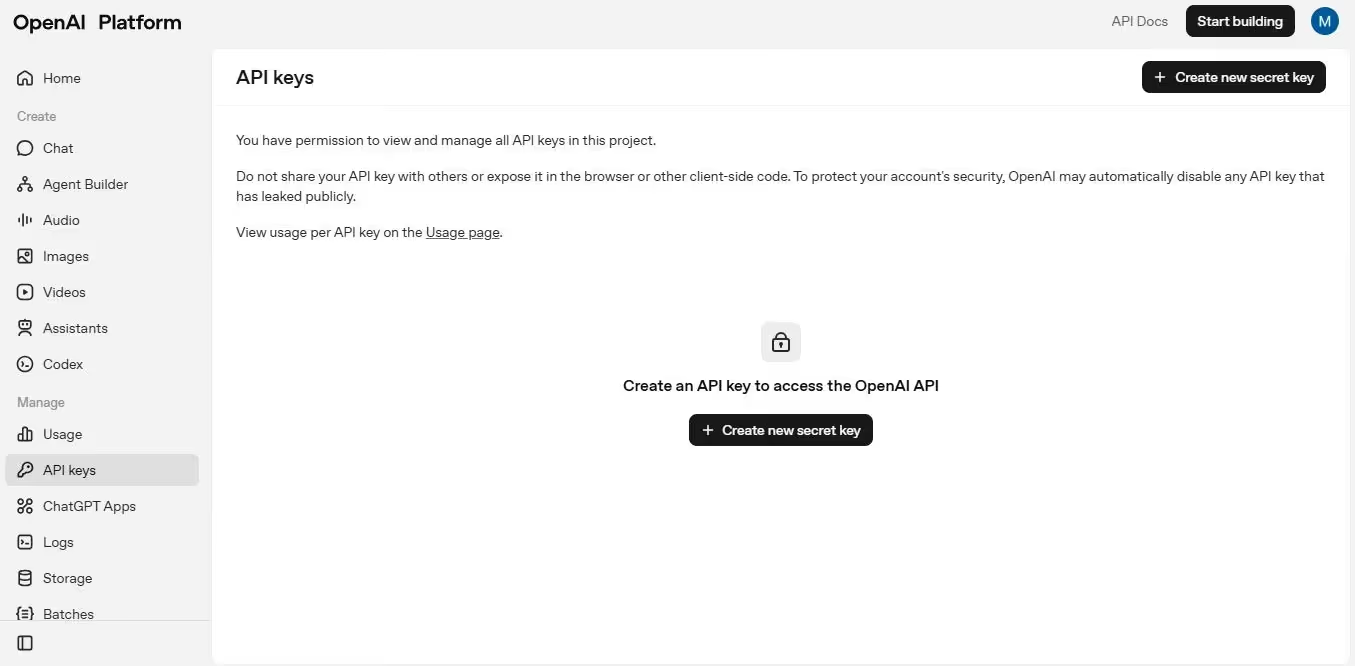
The OpenAI platform, unlike ChatGPT, uses OpenAI APIs (Application Programming Interface). Think of these APIs as a developer interface that offers users access to OpenAI's advanced pre-trained models (GPT-5.5, DALL-E, Whisper, and more).
With these APIs, developers can integrate specific models and their capabilities into their websites, apps, products, and even workflows. So, instead of spending years developing and training AI models from scratch, businesses obtain an API key, authenticate it, send requests through client libraries, and fill the gap between OpenAI’s sophisticated AIs and their apps.
Let’s say you are building a legal tech startup and have an in-house developer. This developer can use the OpenAI APIs to automate audio transcriptions and contract summaries, with no supervision. You control everything from input to output - how you want it to fit your unique system.
In comparison, ChatGPT is designed for regular non-tech people - content creators, project managers, executives, corporate officials, and so on. It’s a ready-made, chat-based interface built inside the ChatGPT app. You ask it a query in human language, and it uses NLP (Natural Language Processing) to understand it and respond accordingly.
Upload your project report and request ChatGPT to summarize it. It immediately returns the extracted points and a shorter version of the text. Add details about your product in the search tab and ask the AI chatbot to write a description or copy, and that’s it. The experience with ChatGPT is instant, flexible, and convenient.
Customization and Control
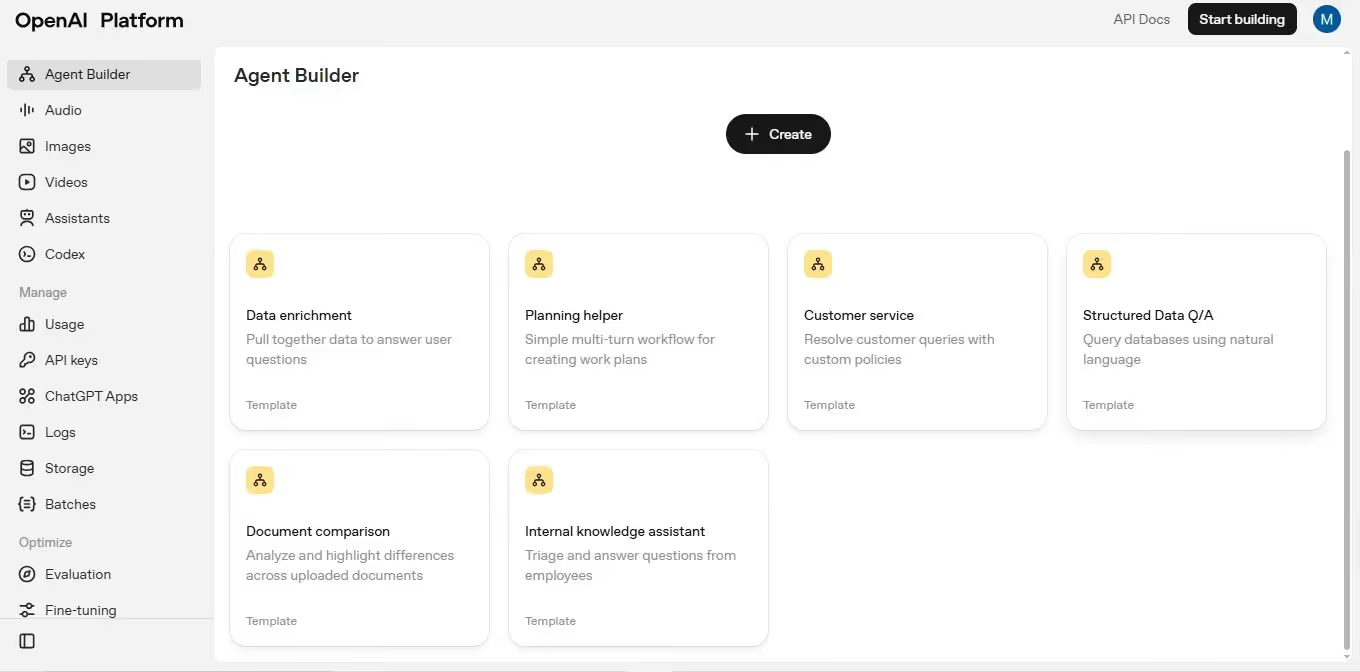
OpenAI vs ChatGPT: Which is more flexible? To answer this question, we will focus on another obvious difference between OpenAI and ChatGPT, which is how they behave and influence your work.
With OpenAI APIs, the control is in your hands, thanks to fine-tuning support. Through fine-tuning, developers in your company customize the pre-trained OpenAI models to suit your unique use cases. Here, they give model instructions about its role, tone, and how it would interact overall before any user logs into the system.
Imagine a startup developing a customer support tool. It can instruct the APIs to answer queries only related to their products, use a formal language when interacting with customers, or never discuss competitors when answering, and so on. The result: the model will follow these instructions for every conversation, at scale, automatically.
But, how does it compare with ChatGPT? The answer: ChatGPT offers customizations, but within certain limits. When you start a conversation with ChatGPT, it is already trained on hidden system messages that tell models how to behave. For example,
- Always answer in complete sentences.
- Be a polite and helpful AI and resolve user queries.
- Refuse or avoid unsafe requests.
- Do not respond to prompts involving sensitive terms.
These hidden instructions shape ChatGPT’s depth, tone, and style. Users cannot alter these established behaviors. Beyond this, users with a paid or enterprise plan may customize it through the following.
- Memory - Stores preferences, facts, and conversation history, and implements them across responses.
- Custom GPTs - Special customized ChatGPT versions tailored for specific tasks (writing, customer support, data analysis, etc).
However, these are only surface-level controls for individual productivity. For instance, a content writer finds the memory effective for maintaining a consistent tone and style across writings. But for an entire marketing team, it does not do much.
Plus, unlike APIs that work across your products and apps, you can only enable ChatGPT customizations within the ChatGPT-native chat interface.
Use Cases and Applications
The best thing to see if ChatGPT or OpenAI better suits your workflow is to look at who’s actually using the tool and what they are using it for.
For starters, OpenAI APIs act as the foundation of applications. When you see an app that schedules your interview or an automated agent that responds to customers' queries, there’s most likely an API behind it - executing the task at scale. Here are some common use cases of these APIs.
- Chatbots and Virtual Assistants: The most common application of OpenAI APIs is chatbots. These bots generate human-like responses to your queries. They can help businesses with a wide variety of tasks, from scheduling interviews to providing customer service, and more.
- Gaming and Reinforcement Learning: Businesses can fine-tune models to interact in gaming environments. This could be to allow players to participate autonomously, or assist players in making decisions, etc. OpenAI’s Dactyl model learned to solve a Rubik's Cube using reinforcement learning.
- Image Recognition: Models like CLIP can learn visual concepts from natural language descriptions. This means their APIs can be deployed to detect objects and classy images in healthcare and security setups.
- Sentiment Analysis: Retail businesses can use these APIs to analyze customers’ feedback from social media comments, surveys, and other textual data. It helps them improve toward customer satisfaction.
- Content Automation: OpenAI APIs can automate content management workflows. These workflows handle every step, from drafting blog posts to writing product descriptions and publishing them on your website. You can also instruct the models to adapt to your brand voice and style.
- Automation Workflows: These APIs can also streamline repetitive tasks, such as data extraction, routing support tickets to sales reps, processing invoices, and documenting procedures.
- Code Assistants: Developers can customize OpenAI models for debugging, writing code snippets, converting code between languages, and explaining complex logics. This speeds up development work and reduces errors in software.
In comparison, ChatGPT is the assistant you use when you need something done right now - generating a visual, summarizing a document, or writing an email. Here are some things professionals use this chatbot for.
- Content Writing: ChatGPT can generate ideas and drafts for social media content, long-form blog posts, website copy, and other marketable content.
- Document Analysis: Professionals can use ChatGPT to extract meaningful insights from lengthy documents, summarize data, and identify trends. It can also visualize numeric data in charts and graphs.
- Formal Writing: You can ask ChatGPT to draft emails, respond to customer queries, and communicate within the team.
- Image Generation: ChatGPT can help you generate realistic visuals for product promotions, social media, and more.
- Brainstorming: ChatGPT helps professionals and casual users with ideation. It generates new ideas, refines existing ones, and executes creative projects. Once you add more context and nuances to your prompts, it becomes your thinking partner.
- Language Learning: ChatGPT’s voice and text mode can help you practice speaking and writing in a foreign language of your choice. You can also ask it to give feedback on grammar and vocabulary.
- Personal Productivity: ChatGPT can manage calendars, set important reminders, sort to-do lists, and keep an eye on events on your behalf.
OpenAI Playground vs ChatGPT
Like APIs, OpenAI also has a Playground platform for AI experimentation and business automation. It is not a language model like ChatGPT. Rather, the Playground is a web-based tool for experimenting with machine learning models. Here is all about OpenAI Playground vs ChatGPT in detail.
What Is OpenAI Playground?
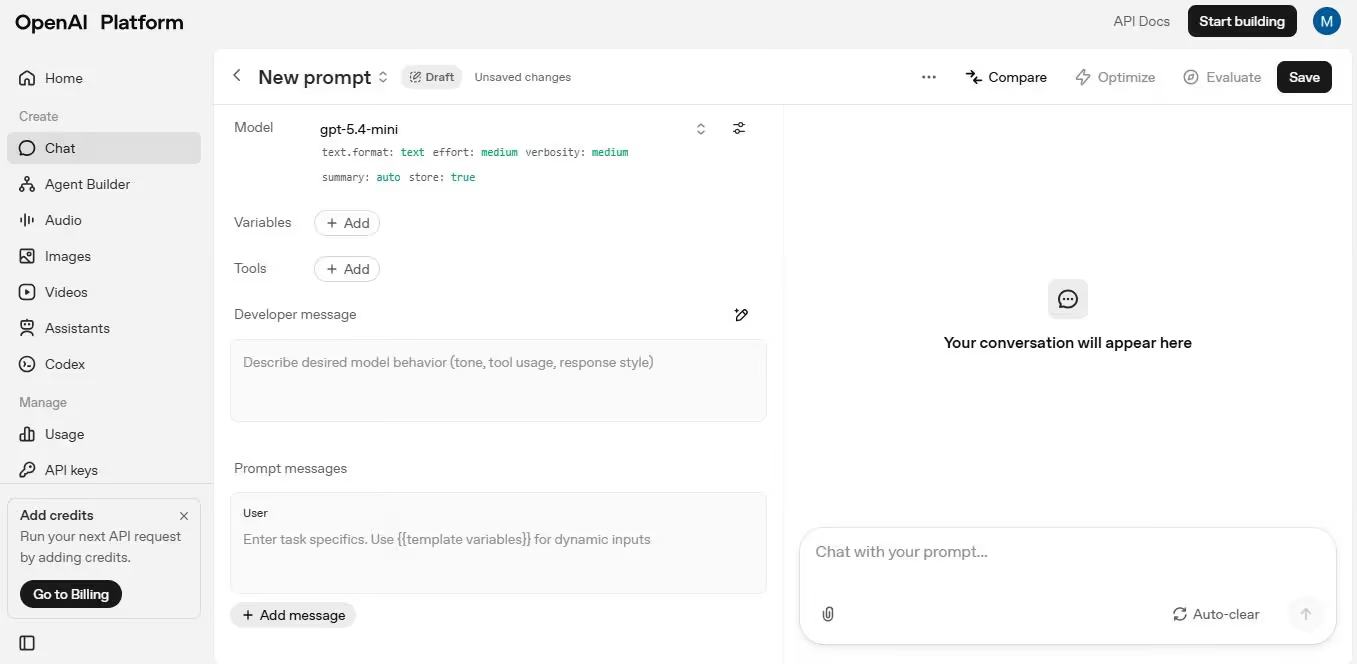
OpenAI’s Playground is a specialized web-based tool that lets you test and customize OpenAI’s sophisticated models. Unlike ChatGPT, which runs conversations in a chat interface, Playground has multiple options and settings. With these settings, developers explore the behavior of different models, their size, their output, etc.
Simply put, Playground is a sandbox for AI experimentation. Developers mostly use it to
- Choose between various versions of GPT, DALL-E, Whisper, and more to see how they respond to the same instructions.
- Adjust parameters to track performance, including temperature, response length, response time, randomness, etc.
- Upload business data to fine-tune models so they speak in your brand voice and understand the domain effectively.
Playground vs ChatGPT: Key Differences
When it comes to OpenAI Playground vs ChatGPT, the decision lies in what your strategy is for using AI. Here is an in-depth comparison between both tools so that you know which is better for your productivity.
Usability and Interface
ChatGPT is intentionally designed to be simple and easy to use. Rightfully so, it is for regular users to boost productivity. It has a chat interface that responds to all your queries in a straightforward language. All the tools are easily available on a single dashboard. And, onboarding won’t take more than a few minutes.
In comparison, OpenAI Playground has a more complex UI naturally because of its wide variety of options and settings. Having multiple AI models can intimidate a non-tech person with no prior experience with AI. But for more advanced users, this interface offers flexibility to adjust it to your use cases. Overall, the interface is organized with clearly labelled sections.
Customization
ChatGPT has an established interface. Yet within this interface, you can fine-tune its few features to serve your needs. For instance, you can save details such as your profession, tone, style, and other preferences in memory for personalized responses. Moreover, it also keeps previous conversations in mind for future reference.
OpenAI Playground, however, is built for customization. It lets you tweak AI models, their outputs, behaviors, and instructions to see how they perform in real time. That’s not it. Once selected, developers can also tailor their preferred model (context window, output, text completion) to unique requirements.
Adaptability to New Data
ChatGPT is trained on adaptability. It learns from previous interactions and improvises future conversations accordingly. This is crucial for a conversational chatbot to improve accuracy, relevancy, and consistency. However, this can also introduce biases and stereotypes in opinion-based answers.
Likewise, OpenAI Playground also learns from and adapts to your data. However, its approach is a little different. With Playground, users tailor their model using their business data during the fine-tuning process, so it reflects in its responses. Yet, Playground has its limitations in processing large data applications.
Types of Responses
For starters, ChatGPT produces easy-to-digest, high-quality responses, even to basic prompts. This is because the AI has already been trained on textual data, which gives it better language understanding. That said, ChatGPT’s training data also has inconsistencies, errors, and repetitions. These inconsistencies can lead to nonsensical and repetitive outputs.
On the contrary, Playground is developed to experiment with different techniques and machine learning models. Users can fine-tune these models to get responses however they like.
Quick Recap: OpenAI Playground Vs ChatGPT
Here is a quick recap of OpenAI Playground vs. ChatGPT.
Which One Should You Use?
To anyone asking if OpenAI is the same as ChatGPT, it’s not. That’s because, though they have similar toolkits and capabilities, the distinction becomes obvious when you apply them to real-world cases. For instance, both ChatGPT and OpenAI Playground can respond to customer queries, but OpenAI Playground does it at scale, which ChatGPT cannot.
Here, we have explored some ways these tools can help you improve productivity.
ChatGPT Use Cases
- Drafting emails, documenting reports, or writing code.
- Asking everyday questions or having a back-and-forth conversation.
- Generating visuals and animations directly within the chat.
- Browsing the web for current, up-to-date information about a topic.
OpenAI Playground Use Cases
- Prototyping a system prompt before integrating it into an app.
- Testing how different AIs respond to the same input.
- Setting up an assistant to deliver to your unique use cases (customer service, content creation, audio transcription, etc).
Limitations of OpenAI and ChatGPT in Real Workflows
OpenAI vs ChatGPT, both tools are powerful and highly capable for your productivity. However, some tradeoffs come with using these tools. You must be mindful of these limitations before picking any for your business.
Manual Prompting and Repetition
ChatGPT or OpenAI cannot remember what decisions you took yesterday or how you interpreted the client proposal. Every session starts from zero. And when you have to explain everything from scratch, the problem intensifies. Repeatedly setting up the stage costs businesses time and resources.
With ChatGPT, the memory gap does not appear in one-on-one conversations. The problem occurs when you shift to teamwork. This memory feels personal and conversational. It may remember that you work in marketing, but not how you tweaked the procedures or what decisions you took regarding the workforce.
For instance, a content writing team has to produce long-form and social media content for an entire week. But whenever they log into the tool, they have to re-explain everything - client guidelines, brand preferences, style, tone, and more.
That’s not the entire problem. When different people prompt the AI, the result shows inconsistencies. One person might include all the details, while the other may forget the tone or length.
The API does not have this problem. Developers can reduce these inconsistencies by training their AI on brand data. However, they have to tweak the models constantly, as requirements change. This includes a lot of work, resources, and effort.
Lack of Workflow Automation
Both these tools are answer-based models. They respond to your queries and help with tasks. However, the gap between the output and actual execution remains unaddressed, despite the structural difference between OpenAI and ChatGPT.
Imagine a business workflow. A marketing manager asks ChatGPT to research prospects and draft a personalized outreach message. It does everything you tasked it to. However, ChatGPT does not connect with your CRM. Hence, it cannot trigger the follow-up sequence; enter the prospect into the CRM, update the pipelines, and schedule a send. The employees have to copy and paste the output, manually log the prospect into the CRM, and send the email.
API closes this gap, but not entirely. A developer can fine-tune the AI to log into the CRM or send an email. But despite this, if the task sequence has ten steps, the API cannot handle all ten. Anytime there is a small change in workflow, a developer has to build a connection. Unfortunately, most businesses do not have in-house developers.
No Shared Business Context
Both ChatGPT and OpenAI APIs lack in-depth enhanced memory. They cannot anticipate your business needs until you tell them. This lack of business memory creates a consistency problem.
Imagine two departments of the same business using ChatGPT for work. The marketing team asks it to write emails, draft copy, produce content, and more. Whereas the support team requests draft responses to customer queries. Both teams are using the same technology, but on different prompts. The marketing company may define your product as “enterprise-ready”, while the sales rep describes it as “simple to set up.” Neither is wrong, yet it creates a conflict in AI’s system.
Is ChatGPT the same as OpenAI APIs? The answer: No. Developers can feed their AI model business context via code. But the code is maintained by one person. And, anytime the company changes its focus or product pricing, this person has to update every prompt in every workflow, which is quite challenging. Until then, your AI runs on outdated context, which reflects in workflows.
Why OpenAI and ChatGPT Aren’t Enough for Running a Business?
Now that we’ve covered OpenAI and ChatGPT’s limitations, it’s only wise to look beyond their comparison into persona-based AI teams. Here is all you need to know before jumping into choosing one.
From Chatbots to AI Employees
AI assistants like ChatGPT are designed to wait for your input. You open them, give a prompt, and they react. It naturally has no context for your business, no active participation in it, and no ability to trigger the follow-up sequence. At all times, it is waiting for humans to initiate the process. That’s not a critique. It’s not just structurally designed for proactivity.
If you expect it to do that, it’s you who is in the wrong. This is where you should distinguish between AI chatbots and AI employees. AI employees are role-based agents (like those from Sintra AI) that specialize in a business role - customer service, marketing, sales, e-commerce, etc. Each agent is an expert in its domain. The marketing agent does not wait for your prompt to write weekly content. It manages your brand content within the broader campaign.
A business using these agents does not have to constantly re-prompt, re-explain, and re-tweak the AI. Rather, it automates an entire task sequence with a single go-ahead signal. It’s like you are delegating a task to a human employee who can take care of everything in between.
How Brain AI Maintains Context Across Tasks?
Unlike ChatGPT, which has no in-depth active memory of your business, these AI agents run on context. For this, they have a centralized knowledge layer called Brain AI. Think of Brain AI as your business’s digital mind that stores almost every detail, from brand deals to client guidelines, customer feedback, objectives, goals, and more.
Whenever you interact with the agent (let’s say, ask the marketing agent to write outreach messages for individual leads), it pulls context from the Brain AI and executes the task. You don’t have to clarify anything. This not only helps with context but also maintains consistency. When the sales, marketing, and writing agents are all run on the same context, it helps your decision quality over time.
This is a great convenience feature for growing businesses. Scaling means a wider audience and more workflows running in parallel.
Built-In Integrations for Real Workflows
That’s not it. These role-based agents also fill the gap between a great output and task execution, thanks to AI integrations. With these AI integrations, businesses connect their AI employees to tools your work runs on, including the CRM, content calendar, emails, productivity tools, and more. Once connected, all agents execute the tasks independently.
In practice, this means that if the sales agent captures a lead on your website, it will trigger the sales agent to find details about the prospect. Then, the email assistant writes an outreach email for this lead and sends it accordingly. Next, the virtual assistant enters this lead into the CRM. Throughout the entire sequence, human reps are not required at any step.
When to Choose Sintra AI Over ChatGPT or OpenAI?
Once you are clear about why you want AI, how you want it to improve your productivity, and what your budget is, the choice (OpenAI vs ChatGPT vs SIntra AI) becomes clear.
For instance, if you need quick one-off task assistance (emails, summaries, data analysis, or writing), ChatGPT is the right tool. If you have an in-house developer and the resources to customize APIs for your business products and apps, APIs are the way to go. Both these solutions will help you work faster while having humans in the loop.
However, if your goal is full automation workflows with no human intervention, Sintra AI might be the better choice. It is developed for businesses with fewer human employees, with the aim of scaling in the future, and the objective is to streamline repetitive tasks. With manual tasks taken care of, employees can better focus on strategizing the future course.
Build Your AI Team Today?
There you have it - all about OpenAI vs ChatGPT. OpenAI is the company that develops technologies like GPT, APIs, and Playground. Whereas ChatGPT is a product (an AI assistant that helps you with everyday tasks) from OpenAI. Businesses and professionals can choose whatever technology they think most effectively delivers in their workflows.
However, if your goal is to move beyond pre-trained AI models from OpenAI and enter into the role-based AI teams, Sintra AI might be a better choice. It has specialized AI employees that train on various AI models (Claude Sonnet, GPT-5, Claude Haiku, etc.) and execute business tasks more efficiently. Get started with Sintra AI to see how it goes for you.
OpenAI vs ChatGPT FAQs
Is OpenAI the same as ChatGPT?
No, OpenAI is not the same as ChatGPT. ChatGPT is an AI chatbot developed by OpenAI to help professionals with everyday productivity. In comparison, OpenAI is the AI research company that builds AI technologies, including Playground, GPT models, and chatbots.
What is the difference between OpenAI and ChatGPT?
OpenAI is a tech company that focuses on researching and developing AI technologies. ChatGPT is one of its flagship products, a conversational AI assistant that helps you with one-off business tasks. It can write messages, answer queries, generate visuals, and summarize documents.
What is OpenAI Playground used for?
OpenAI Playground is a web-based tool built for developers to experiment with different AI models and fine-tune them to suit their business workflows. Unlike conversational ChatGPT from OpenAI, Playground has advanced settings and parameters, such as temperature, randomness, context window, and response length.
Should I use ChatGPT or the OpenAI API?
Well, it depends on what you are trying to accomplish with the AI. For instance, ChatGPT is a general-purpose productivity assistant that helps you with conversational tasks. This can be writing, brainstorming, summarizing, and web searching. In comparison, APIs help developers build custom AIs for unique apps and workflows, such as chatbots for customer service.
What is a better alternative to ChatGPT for business use?
There are several alternatives to ChatGPT for business use, depending on use cases. For instance, Microsoft Copilot and Gemini excel at workspace integration, and Claude and Perplexity help businesses with long-context research and reasoning. Motion and Sintra AI tap into the automation space and streamline everyday repetitive tasks.
Related articles