Claude vs ChatGPT vs Gemini: Which AI Model Is Best in 2026?


Table of Contents
Quick Answer: Claude vs ChatGPT vs Gemini
Claude, ChatGPT, and Gemini are the top LLMs in 2026; however, their focus differs. ChatGPT is a versatile AI assistant for routine productivity tasks, such as agentic automation, creative writing, and structured data analysis.
Gemini excels at multimodal interactions, real-time research, and mixed-media inputs directly within the Google Workspace. In comparison, Claude is built for advanced coding, in-depth data interpretations, and nuanced creative writing jobs that need complex, multi-step reasoning.
A few years ago, choosing an AI assistant meant checking a few demos and falling for the market hype.
Now, there’s more.
Powerful LLMs like Claude, ChatGPT, and Gemini are more mature and specialized today, with broader and growing capabilities, distinct core functionality, and enterprise-ready features.
However, these developments have also puzzled professionals about which AI to choose: Claude vs ChatGPT vs Gemini.
But no worries.
In this article, we have broken down what each AI has to offer, how its output compares with others, and its real applications. So, dive right in.
Here is a side-by-side Gemini AI vs ChatGPT vs Claude comparison.
What Are Claude, ChatGPT, and Gemini?
Claude, Gemini, and ChatGPT are three powerful Large Language Models built to help users with productivity tasks: writing, coding, data analysis, and research.
Claude
Claude by Anthropic is an easy-to-use conversational AI with a strong emphasis on coding, safety, and deep reasoning. Its strength lies in long-form, nuanced writing and in-depth document analysis. Claude has advanced hybrid reasoning and a massive context window, meaning it excels at providing tonal and explanation consistency.
Recently, in April 2026, Anthropic released Claude Opus 4.7. As compared to the previous 4.6 variant, it has better instruction-following, advanced coding capabilities, and agentic workflows. Moreover, it also significantly improved visual reasoning. Now, it can interpret dense visual data with great attention to detail.
ChatGPT
Built by OpenAI, ChatGPT is another productivity-first AI chatbot. Its reason for fame is versatility across use cases and a mature ecosystem. You can deploy it to write, code, brainstorm, analyze data, generate images, and answer in multiple formats. Plus, its wide plugin ecosystem enables ChatGPT to connect with the work tools and speed up operations.
OpenAI also released its latest AI model, GPT-5.5, in May 2026. This model is built to be more conversational, factual, and independent. A highly specialized variant, GPT-5.5, is trained for agentic workflows, such as coding, computer use, and long-task persistence. Now, it acts as an autonomous agent, breaking down workflows and executing them through work tools.
Gemini
Google’s native AI model, Gemini, focuses on real-time data access and deep integration with the Google Workspace. Its core functionality lies in its compatibility across Google platforms, helping teams already running within the ecosystem. This AI can also write, code, analyze data, and produce images from prompts.
Gemini 3.1 Pro is the latest model by Google’s DeepMind, released in February 2026. It has native multimodal capabilities, meaning it can interpret texts, videos, audio, and images. Moreover, this version has a Three-tier thinking system that allows users to switch between low, medium, and high compute modes (low being fastest and cheapest, and high being slower but with deeper reasoning).
Feature Comparison: ChatGPT vs Gemini vs Claude
All three AIs have a similar toolkit and capabilities. However, their approaches and focus differ. Here is an in-depth ChatGPT vs Gemini vs Claude's core features comparison with tests and trials.
Content Creation and Copywriting
Writing is an area where you will notice the fastest gap among Claude, Gemini, and ChatGPT.
For starters, Claude is built for human-like writing. When you give it a complex prompt with specific formatting instructions, word count, and edge cases, it strictly follows them. It runs on Claude Opus 4.7 with a 1-million token context window. With this massive context awareness and in-session memory, Claude changes its sentence structure, adapts tone naturally to the prompt, and does not repeat phrases.
ChatGPT, in comparison, has more structure in writing. The free version runs on GPT-5.4 and GPT-5.3 variants, perfect for professional formal writing. These AI models are trained on datasets to predict and generate almost template-driven, formulaic writing. It’s well-structured and grammatically correct, but you will notice overused phrases and a lack of emotional depth. The quality dips when you ask it to craft long-form content that feels like a real person.
Whereas Gemini’s 3.1 Pro has an explanatory and conversational style that excels in research-backed, Google-embedded writing. Its outputs are accurate, data-driven, and well-structured; however, you will have to go back and forth with it. Professionals prefer it for technical reports, procedural documents, and summaries, within Google Docs.
Real Test
We wanted to test all three AIs on a single prompt, without it being biased to any one’s strengths. For this Claude vs ChatGPT vs Gemini writing test, our test prompt was,
“Write an article (around 700-900 words) titled, “Why Most Corporate Workers Are Burning Out”. This article should explore what the data says about professional burnout and recovery. It should start with a human narrative hook, transition into an analysis in the middle section that refers to relevant stats and research, and close with actionable suggestions in a conversational style. The article should resonate with the audience emotionally while being factually correct.”
This test prompts checks our AI tools
- Range - how well it handles versatility.
- Length and coherence - how consistent it remains while writing in-depth content
- Data accuracy - how factually grounded it is.
For the hook part, all three AIs came up with a scenario of a corporate worker in different spaces. Interestingly, both Gemini and Claude used the same character name. However, Claude was slightly better at conveying the emotional dilemma and exhaustion.
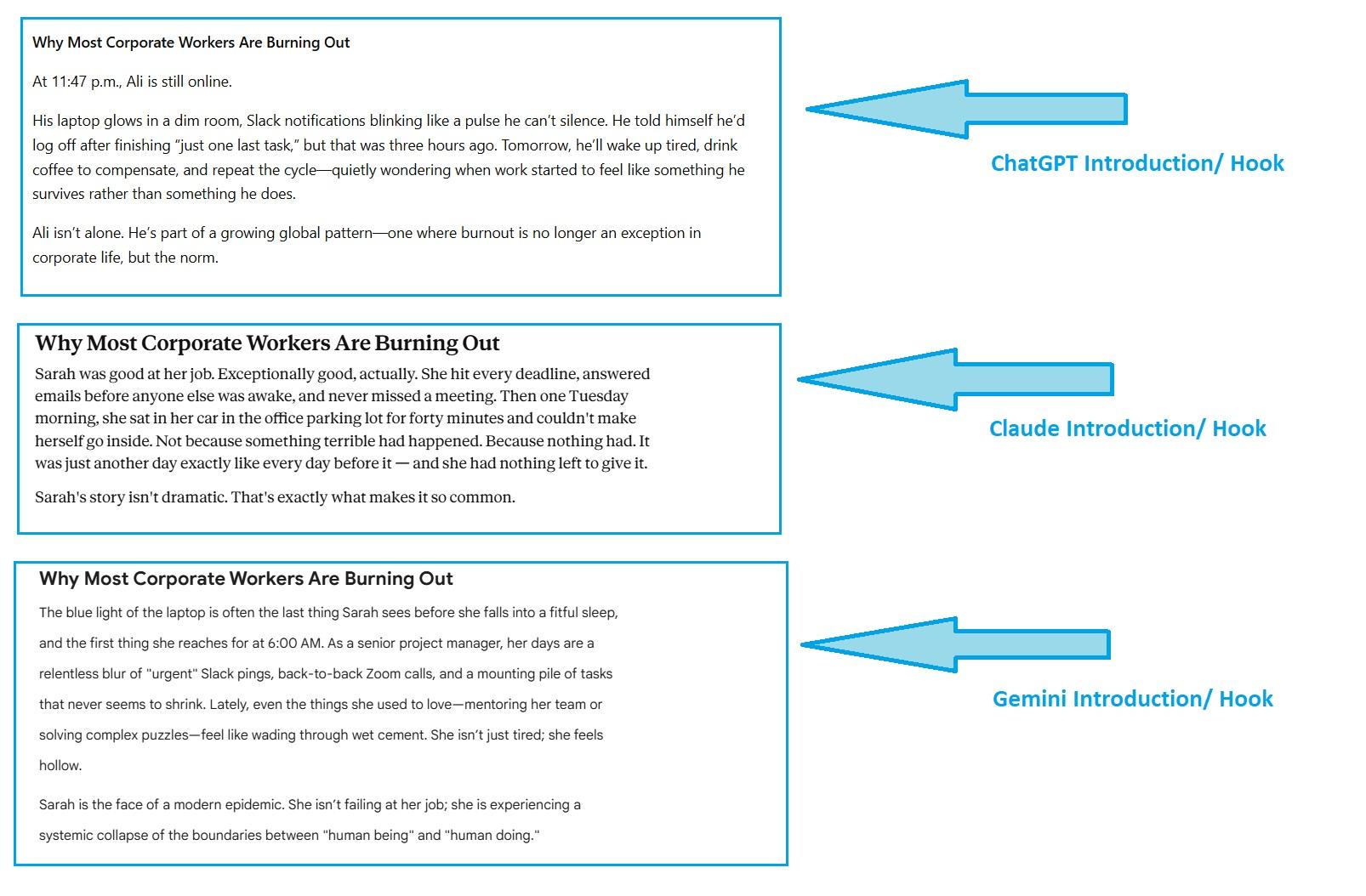
Similarly, all three AIs were capable of maintaining the flow across the article. ChatGPT often switched between analytical and emotional tones. This made the transitions feel almost mechanical. In comparison, Claude’s tonal consistency deserves a mention. It seamlessly transitioned from storytelling to analysis to suggestion, without changing the gist of the topic.
Gemini had a competitive edge in the statistical part, where the AI was to refer to recent research. It searched Google Scholar studies (from WHO and Mind Share Partner), which adds credibility to the article.
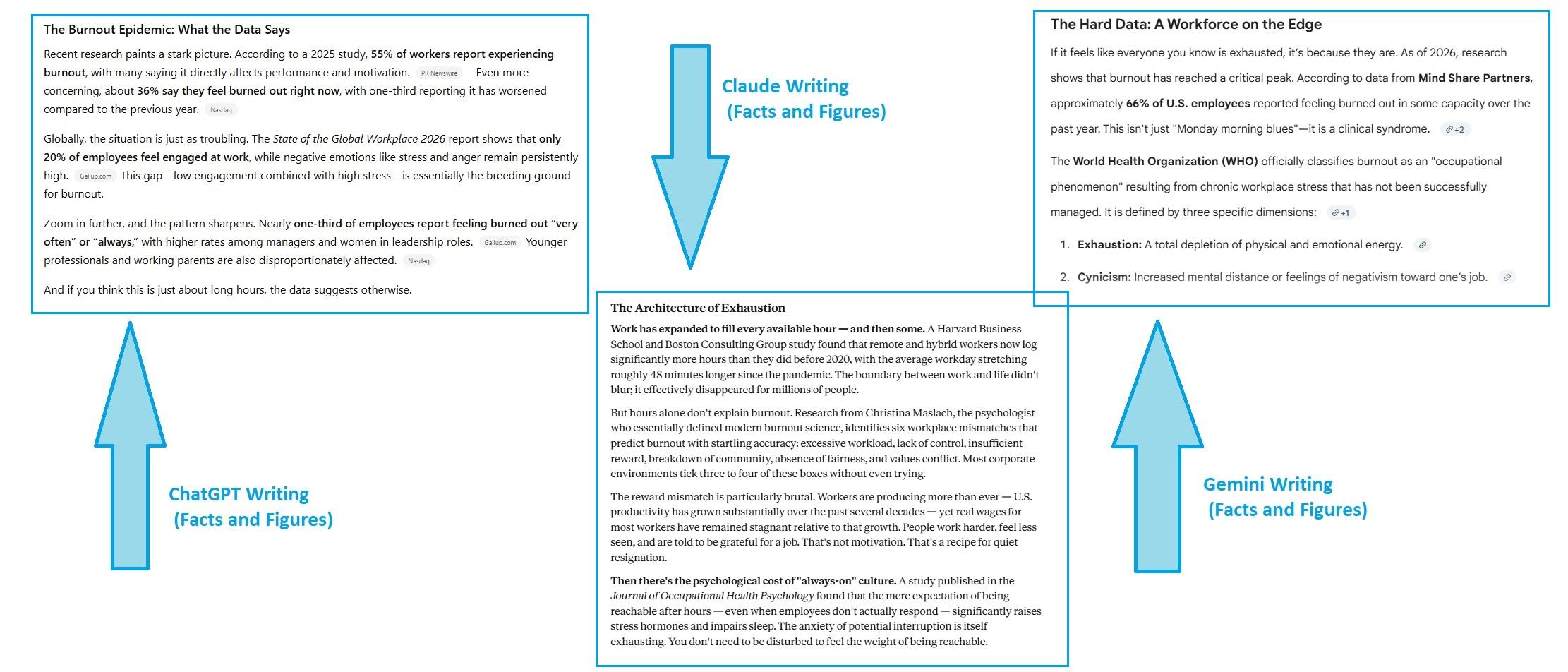
Finally, the closing remarks were quite similar. Claude and ChatGPT maintained a human-like end to the narrative journey with CTA. Claude’s advice clearly tied back to the start. Gemini’s ending was well-organized, but it didn’t possess the warmth we specifically asked for in the prompt.
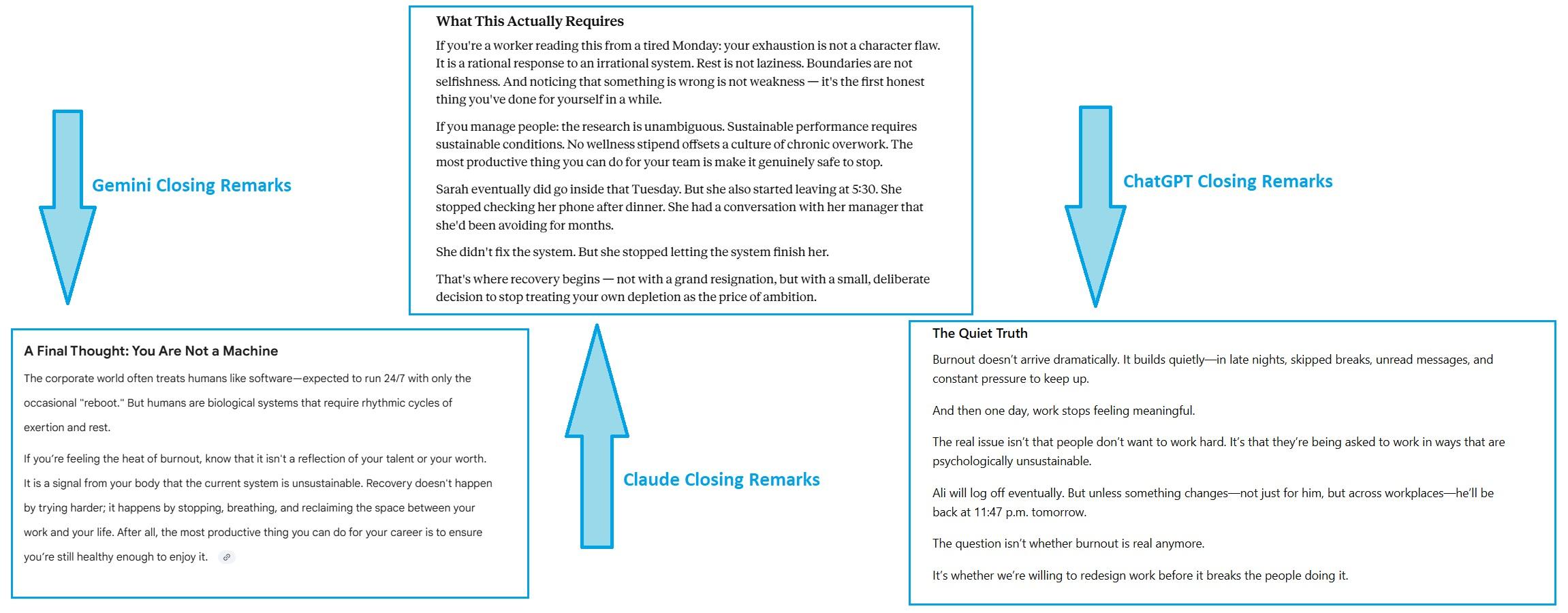
Verdict: Which AI is Best at Writing?
Here is a side-by-side comparison of ChatGPT, Claude, and Gemini's writing capabilities.
Claude is a better option if you want to write long-form, narrative text where coherence and human touch are crucial. Conversely, ChatGPT excels at structured content like emails and communication, where consistency is more important than coherence. Gemini, however, is best for data-driven writing.
Data Analysis and Research
When it comes to interpreting data and summarizing documents, each AI (among Gemini, ChatGPT, and Claude) brings a different approach to the table.
Claude is slightly more capable at interpreting and summarizing data, especially in extensive documents. Its latest model, Claude Opus 4.7, has a 1M-token window, which means it can read through 750,000 words and roughly 1000-2000 pages of text once. This context awareness gives Claude a competitive advantage in business use cases.
Imagine a management consultancy wants to do due diligence before an acquisition. They can feed an entire database, from financial statements to operational documents, and contracts, to Claude for a coherent and relevant summary.
ChatGPT’s reasoning models, especially the o-series and GPT-5.5, approach data analysis in a structured way. Similar to Claude, it breaks down complex prompts into logical steps, effectively synthesizing financial reports, interpreting surveys, and more. Its standard context window is 128K, which can go through 300-400 pages of text at once.
Whereas Gemini’s competitive advantage does not reside in document volume but rather in its ecosystem access. Gemini 3.1 Pro pulls data in real time from Google-driven sources, such as Google Search and Google Scholar. Let’s say a marketer has to tap into the emerging industry trends. Gemini can help them get valuable insights from up-to-date sources, cross-reference them, and present results in an easy-to-digest summary.
Real Test
We tested all three AIs for data handling. With this test, our goal was to evaluate their summarization, interpretation, and research capabilities via a single prompt. Hence, we curated a business intelligence scenario with a realistic but incomplete dataset to check which AI flags the gaps, which fills them, and which one relies on external sources.
Test Prompt: “Act as a business analyst. I have attached the summary of quarterly performance data from a mid-sized HR-Tech SaaS company.
The company leaders are worried about the fourth quarter drop and are preparing for the board meeting. You have to do the following.
- Summarize the full-year performance in 100-150 words for non-tech people.
- Interpret the quarter 4 data. What does the drop in numbers mean for the company, and what could be the two to three root causes?
- Research the recent external market conditions in the HR-tech industry (for the previous 12 months). Go through contemporary industry trends, macroeconomic factors, and competitors to explain the drop.
- Suggest an improvement area the company should look into before the meeting.”
With the first factor, summary, we tried to understand whether the AI just compresses the information or prioritizes it. Thankfully, all three models explicitly mentioned the Q-4 drop. But Claude was slightly better at pointing out the knitty gritties. ChatGPT offered a structured summary like Gemini. The only difference was that Gemini used a lot of jargon.
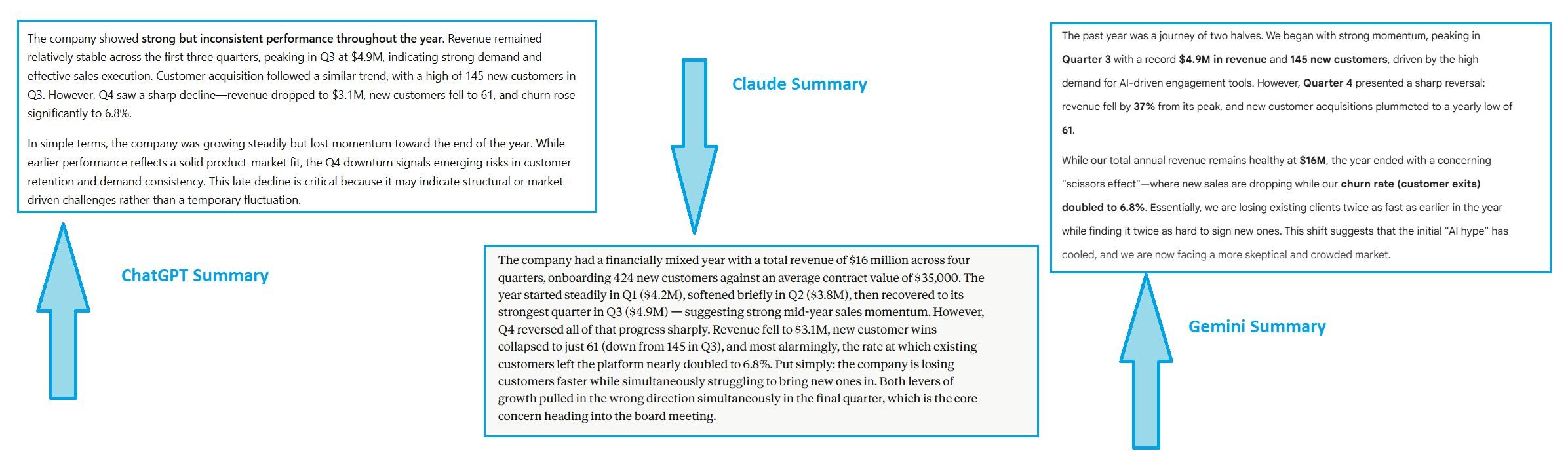
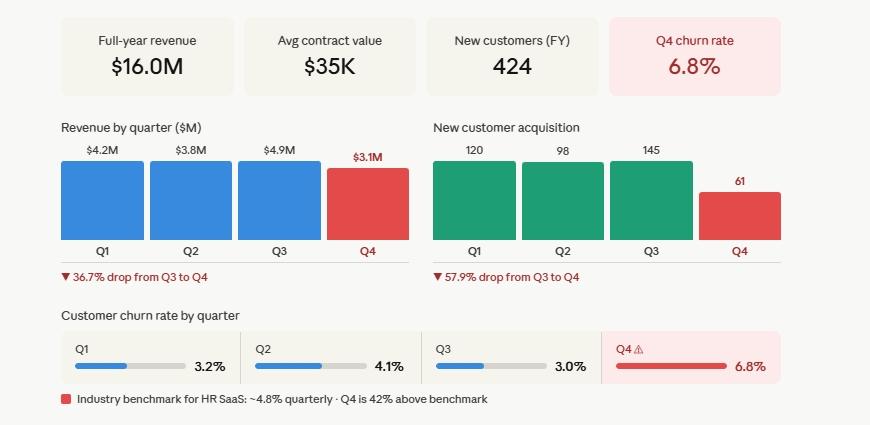
Claude was also the only AI to include a proper data dashboard before answering any of the questions. It is more like a visual overview of the full-year performance.
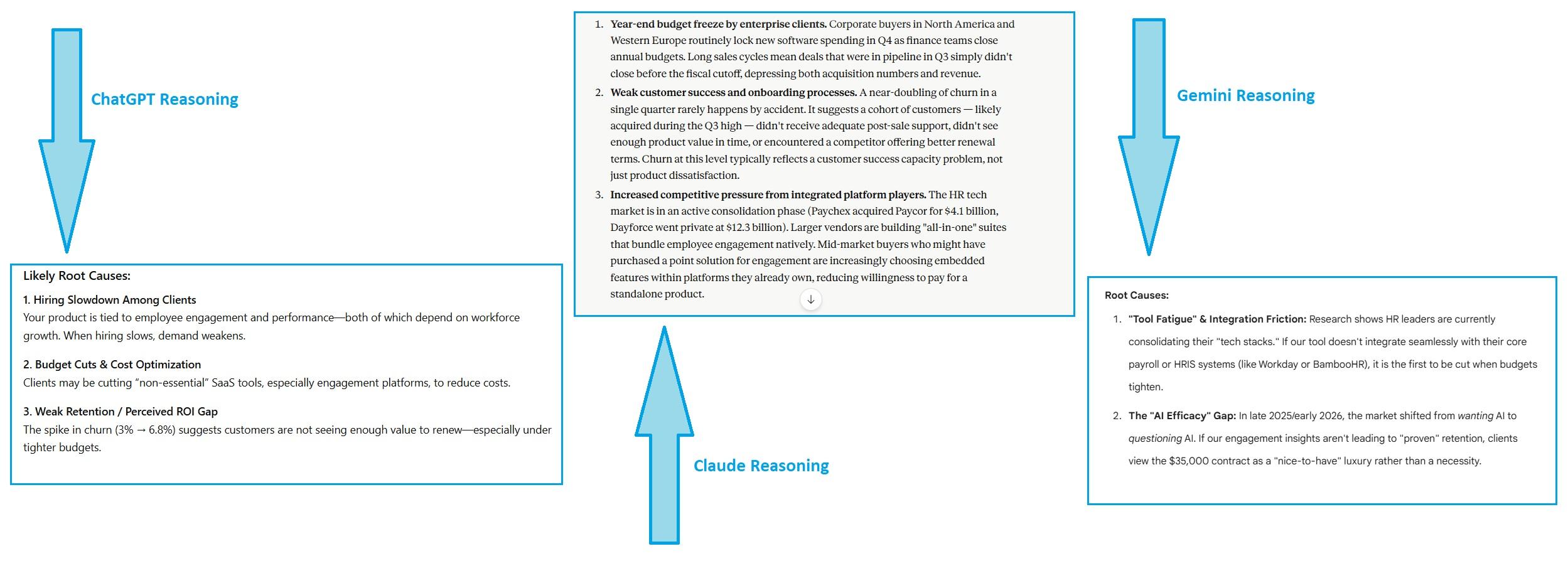
To test the data interpretation capabilities, we asked the AIs to give two to three root causes for the low revenue and churn in the fourth quarter. Here, ChatGPT and Claude stand out. Their reasons were grounded in context and logic. They broke down the data into simpler patterns and decided the underlying reasons for the drop. Gemini, however, relied on external sources and even cited them.
Next, we wanted the three tools to do external market research. Here, the clear winner was Gemini. It checked competitor sites, news, and surveys to give a holistic picture of the industry. ChatGPT and Claude also connected with relevant news and general SaaS knowledge sources to give an overview of the HR-tech industry.
Finally, in suggesting an improvement, Claude offered a contextually grounded response. It didn’t immediately assume the reason like Gemini and ChatGPT. But rather, clearly mentioned that focusing on one area might not be right, and the company should conduct interviews and churn analysis to diagnose the issue correctly.
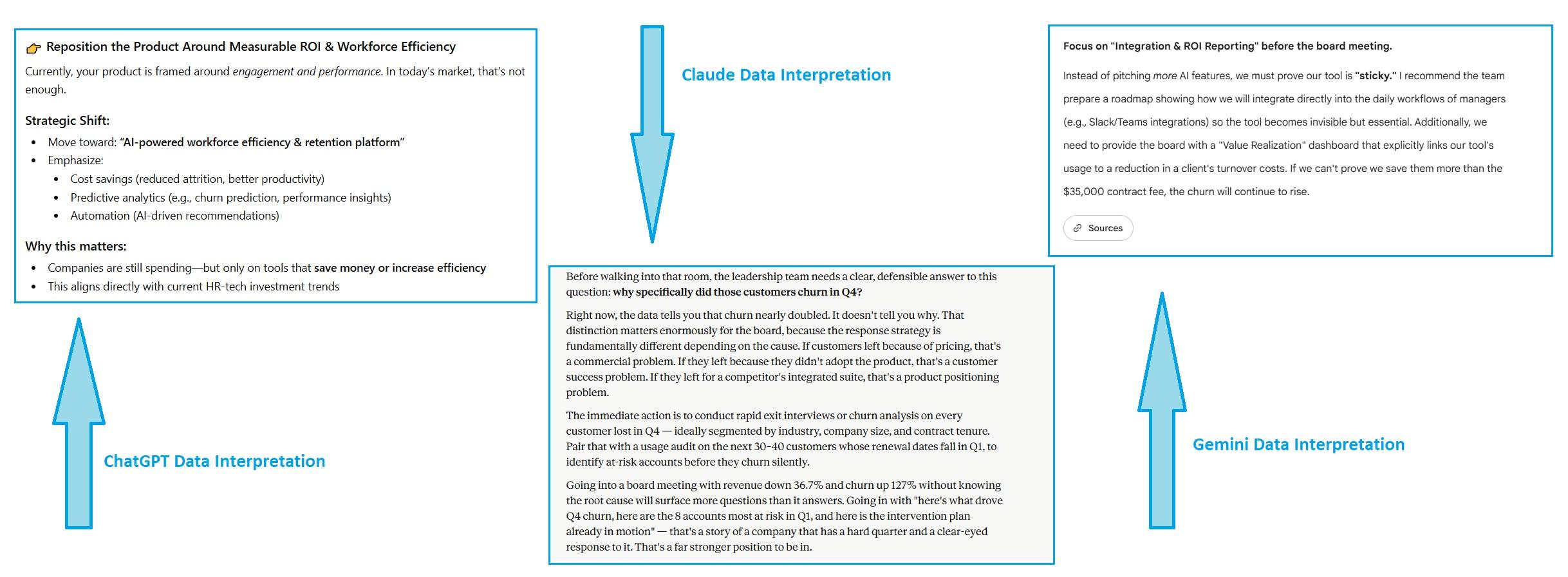
Verdict: Which AI is Best at Data Analysis and Research?
Gemini vs ChatGPT vs Claude: which AI handled data best? Here is a side-by-side comparison of all three.
If you are working with large proprietary documents and making crucial business decisions, Claude is inarguably the most reliable alternative. ChatGPT works best in offering a structured, step-by-step analysis. However, if you work inside the Google ecosystem and need live industry updates, Gemini is the way to go.
Coding and Technical Tasks
ChatGPT vs Gemini Vs Gemini: which is better at coding and technical tasks? The answer: it depends on which AI fits naturally into how you actually work. For instance, coding accuracy matters as much as the ability to explain why your code components broke or how your code is structured.
GPT 5.5 is inarguably the most versatile AI for coding. It handles almost any programming language, including Python, JavaScript, SQL, Rust, and GO, with consistency and provides quick solutions. Unlike previous models, GPT 5.5 shows reasoning improvements, meaning it does not just auto-complete your code but also thinks through the problem before writing it. So, you are getting faster yet practical results.
Claude’s advantage does not lie in the volume of its output or speed, but rather, in the explanation quality and complex reasoning. It acts as a careful thinker who explains what the code does, how it is structured, and why it is structured that way. Hence, it is naturally effective for code reviews and edgy cases. Developers prefer it for flagging credibility issues, pointing out architectural mishaps, and recommending improvements. Plus, its massive context window can analyze the entire codebases in a single prompt.
In comparison, Gemini's coding strength is in its Google-native ecosystem. So, if you are doing any development work in Firebase, BigQuery, Apps Script, or Google Cloud Platform, Gemini is a better alternative. Moreover, it is fast and has a 1M-token standard context window. With this, you can process huge codebases and entire repositories in a single prompt. Though it occasionally writes messy code.
Real Test
We tested all three AIs on debugging. Here is how it goes.
Think of a teacher who has a list of students and their exam scores. She wants a program that can help her do three things,
- Calculate the average score of each student.
- Allocate a grade to them (A, B, C, …)
- Find out the topper.
We wrote code for it. It seemed clean and logical. Once you read it, nothing seems unusual. But there were four real problems hidden in the data, including a few that would completely crash the program and others that would only produce incorrect answers. However, the second category is dangerous because it acts quietly, and you miss it.
Just to give you an idea, here were the four problems hidden in this code.
- The Empty List Crash: One student (let’s say X) has no exam score in her column. The program calculated each student’s average score by dividing the total score by the scores of that student. As her score was zero, the result was a mathematical error. The result: the program crashes entirely, as soon as it reaches X’s name (in the middle).
- The Disappearing Students: There were two students with the same name in the prompt (let’s say, Sarah). The first Sarah in the list was a brilliant student, with higher scores (95, 100, and 98). However, the second Sarah was an average student with mediocre scores (65, 55, and 70). The code processed Sarah’s scores first (the brilliant one). It was like usual. But once it reached the second Sarah (the average one), the program processed it as a replacement of the first Sarah and wrote the second Sarah’s scores in the first Sarah’s column. And the original scores of the first Sarah were completely removed. The program had no idea what went wrong.
- The Incomplete Winner: The program was supposed to find the topper, with all their details (name, average score, grade, etc.). But it was written in a way that it could only process the topper’s name (Sam). Once you ask about their grade or score, the program cannot answer.
- Messy Numbers: The program calculated averages as mathematical results (Sarah got 86.33333… while Sam got 97.45). A proper program would’ve rounded these numbers (86.4 or 97.5). But this code never did. All the scores averaged looked unprofessional and extensive.
We asked each of the AIs (Claude, Gemini, and ChatGPT) to process the code and find the bugs.
Verdict: How Each AI Performed at Coding and Technical Tasks?
Here is a complete account of how each AI performed at coding and technical tasks.
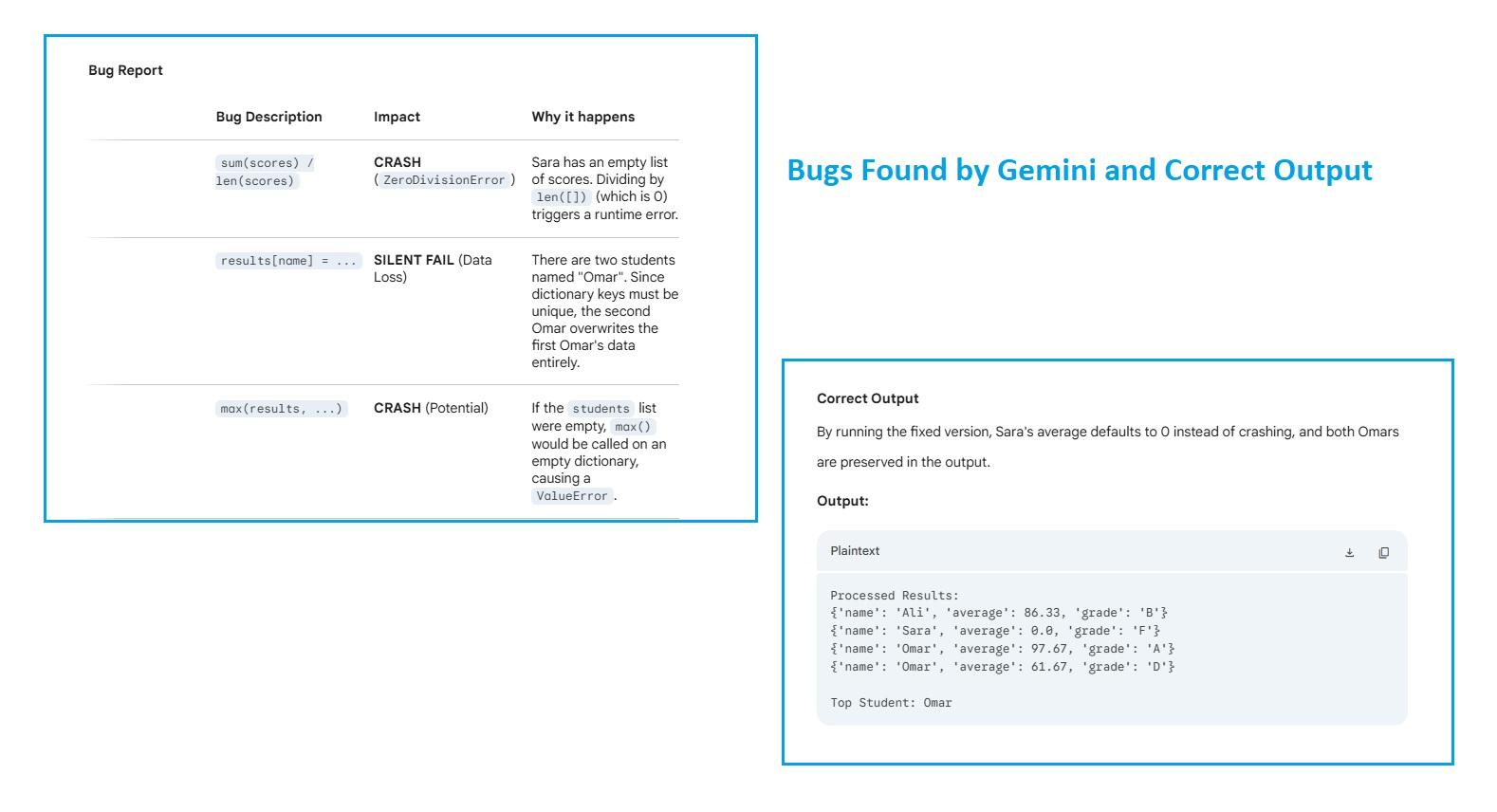
Gemini
Gemini gave a structured response. It gave us explanations that were sorted in a clean table and were easy to read. It found Alex’s crash problem and Sarah’s duplication issue. However, they were the most visible bugs, so finding them was not really surprising.
What was interesting was that Gemini invented a bug that did not previously exist. It said, “If students' lists were empty, the program would crash”. It is technically true. But the list we fed the AI was not empty.
For the last two bugs (the incomplete winner and messy number), Gemini just fixed them without flagging them as bugs.
Here is how it responded to our dataset.
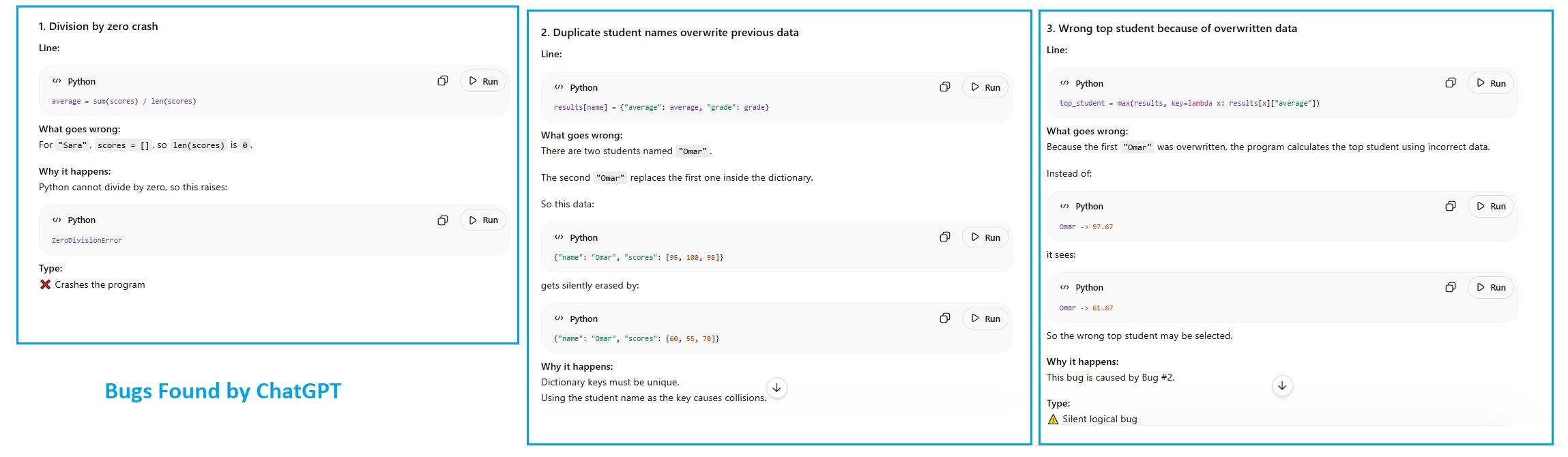
ChatGPT
ChatGPT was better than Gemini. It found Alex’s crash and Sarah’s duplication issue, as expected. One step further, it also labelled them as a crash and a silent failure, which is important, as both problems offer different types of dangers.
Quite surprisingly, it also connected the two bugs. ChatGPT noticed that once Sarah’s grades were removed, the winner calculations were working on the wrong data all along. This influenced the topper’s result. Gemini completely missed this point.
However, ChatGPT also missed the messy number problem altogether and didn't point out the incomplete winner as a separate bug. In the output, we could still see the displayed marks as (86.3333). Overall, its fixes were the cleanest of all three AIs. They were simple, readable, and didn’t change the data structure.
Here is how it responded to our dataset.
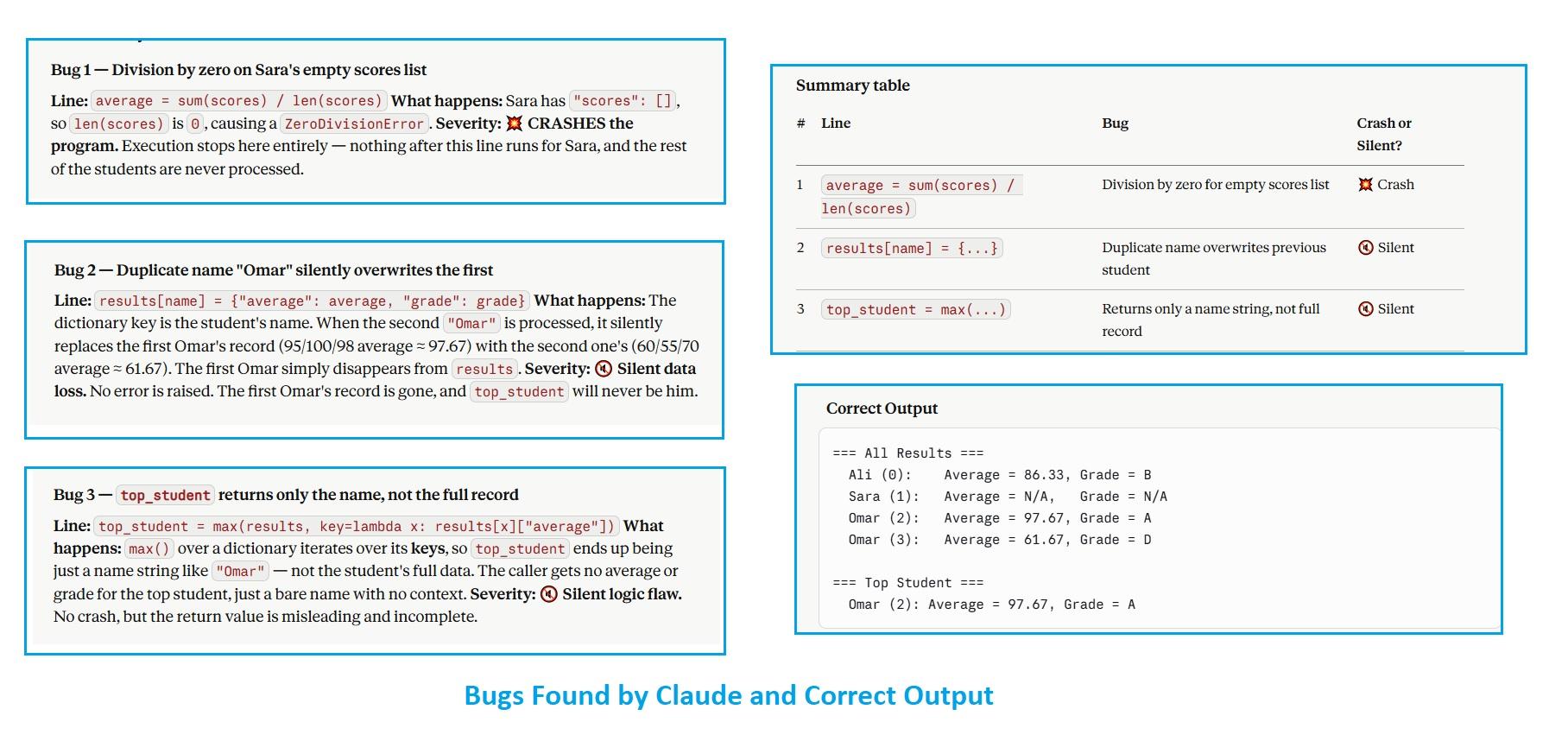
Claude
Claude’s explanations were the most detailed, and the AI found the most bugs. For starters, it didn’t just spot Alex’s crash problem. Claude noticed that after the crash, every student following Alex on the list also never gets processed. Hence, it not only affected Alex but also killed the entire operation from that point. That’s a deeper understanding of a code.
Claude was also the only AI that identified the incomplete winner as a separate bug. It explained why it mattered and then fixed it with transparency, unlike the other two AIs that secretly fixed it without even mentioning it.
Although Claude didn’t mention the messy numbers as a bug, it does round numbers, clear labels, and shows both Sarah separately. It also included details of the top student (grade, name, scores, etc.).
However, there was an issue with Claude’s fixes. To resolve the duplication issue, Claude required you to add extra information to the original data (a number index for each student). Meaning, the AI changed your data sequence. The Other two AIs were good in this matter. They switched to a list that naturally showed duplicate names.
Here is how it responded to our dataset.
Verdict: Which AI is Better at Technical Tasks?
All three AIs had their merits, but Claude was inarguably successful in fixing all three problems. Gemini excels at pointing out the most obvious flaws with clarity. ChatGPT has the advantage of connected reasoning, but it is not fully transparent. That said, all three AIs didn't label messy numbers as a bug, though Claude fixed it.
Integrations and Ecosystem
Ecosystem and integrations are areas where the biggest gaps lie between the three tools.
For starters, ChatGPT has a mature and open ecosystem. Today, it offers native Terminal Access via GPT-5.5, making it truly agentic to execute independent coding workflows for developers.
For businesses seeking automations, ChatGPT’s marketplace has custom GPTs. These GPTs can be trained in specific business domains, including customer support, sales, and HR. Beyond this, GPT has built-in connectors that connect to external apps, including Canvas, Zapier, Slack, and more, directly from the chat interface.
Whereas Claude offers more specialized integrations for coding and enterprise automations. It has API driven connectors that allow you to interact with external apps like Slack and Notion. Also, it has native partners where Claude is directly embedded into their products.
When it comes to Gemini, it is deeply integrated into the Google ecosystem. If your work resides in Gmail, Google Docs, Google Sheets, Google Scholar, or any other native platform, Gemini will help with routine productivity. Similar to custom GPTs, Gemini has Gems that act as a personal assistant for specific tasks: coding, brainstorming, and more.
As of now, Google is working on its Project Astra, focused on building towards its native computer use capabilities.
All three of these tools are marketed as enterprise-ready solutions. However, the lack of structured workflows, frequent context switching, heavy reliance on manual prompting, and scaling limitations make them inadequate to run coordinated businesses.
Gemini Vs Claude Vs ChatGPT for Integrations
Here is a side-by-side Gemini vs Claude vs ChatGPT ecosystem comparison.
Claude vs ChatGPT vs Gemini: Key Differences
Now that we’ve done a key feature comparison, here are a few differences you must be mindful of when choosing the right AI assistant.
Reasoning and Problem-Solving
ChatGPT, Gemini, and Claude are all capable of multi-step thinking. However, their approach to solving problems differs. And, these differences clearly show up in real business applications.
Claude clearly takes the lead in complex reasoning. It uses an advanced hybrid reasoning model that combines specialized extended thinking and fast, intuitive answers. It’s thinking mode uses a chain-of-thought, meaning it breaks down complex problems into simpler sections, and thinks it through with you. Hence, it naturally excels at nuanced problems.
In comparison, ChatGPT’s reasoning is advanced as well. Though it also breaks down complex problems into smaller parts, it is more of a completion model. Through this, the AI predicts the best output based on a combination of the prompt’s semantics and logic. Hence, it may produce faster results that are logical, but not always detailed or nuanced.
Gemini also has Deep Think Mode, but they might not be as well-equipped as the other two. The latest variant, Gemini 3 Deep Think, explores multiple hypotheses at once, often combining multiple ideas to produce a response. Overall, it can connect the dots and make factual claims, especially when reasoning requires current information.
Accuracy and Reliability
Hallucinations are a major part of using AIs. And, even powerful solutions like ChatGPT are not resistant to them. For starters, it is a state in which your AI model claims something factually incorrect, but with utmost confidence.
Among all, Gemini benefits most from its real-time Google Search integration. It pulls up-to-date, most current data insights by default. So, it makes factually incorrect claims that are less than those of Claude or ChatGPT.
Claude Sonnet and Haiku are also superior to ChatGPT in hallucinating and making false statements. It's widely known for being conservative and cautious, which is why it is favored for legal and academic research. A lot of it goes back to its deep reasoning and extended thinking.
ChatGPT, while powerful, struggles with hallucinations. It naturally has a tendency to try to fulfill users’ requests at all costs, which leads to these inaccuracies. Users often call it out for being a people pleaser.
Ease of Use and User Experience
Today, the convenience gap between ChatGPT, Gemini, and Claude is narrower than it was. Still, depending on who’s using them, you will notice meaningful distinctions.
For starters, ChatGPT has the most polished and open interface. It has a single dashboard with voice mode, image generation, and plug-in buttons that even non-tech users can navigate. Anyone with no AI experience can get started.
Claude’s interface is also clean, but more focused. It’s ideal for power users and knowledge workers whose routine work is text-dense. For instance, the Projects feature, though slightly difficult to navigate, is a great space to collaborate. Some features, such as connectors, are hidden, so it will take time to get familiar with them.
Gemini, among the three AIs, is the easiest to use. It sits directly in your Google Docs, Gmail, and Sheets. Meaning, you don’t really have to spend time with a new tool. But rather, press a few buttons and see how the AI functions. Its standalone app interface is also functional and similar to the other two tools.
Pricing Comparison: Claude, ChatGPT, and Gemini
Claude, ChatGPT, and Gemini, all three AIs, have flexible pricing plans. However, when it comes to choosing one, it’s not a matter of who charges more, but rather what you actually get in each tier and whether it adds value to your routine work. For instance, many AI tools offer a pay-as-you-go model for API access, meaning it allows businesses to pay based on their usage rather than a flat monthly fee, which is more cost-effective for different workloads.
For starters, all three have a similar pricing pattern: a free plan, a standard plan for power users, and a pro plan for enterprises and teams. Here is an in-depth comparison of what you get in all three free plans.
Once you outgrow the free plans, these AIs progress to comparatively expensive standard plans: ChatGPT Plus ($20 per month, Claude Pro ($20 per month and $17 per month when paid annually), and Google AI Pro ($20 per month). Here is an in-depth comparison of all three standard plans.
After the standard plans, all three AIs progress to enterprise and team subscriptions. These pro plans include ChatGPT Pro ($200 per month), Claude Max ($100 per month for 5X usage and $200 per month for 20X usage), and Google AI Ultra ($249.99 per month). That said, Enterprise pricing for AI tools often varies based on the size of the organization and specific needs, with many companies providing custom quotes rather than fixed pricing.
Here is an in-depth comparison of all three pro plans.
Limitations of Standalone AI Models
Whenever a business seeks AI, their question is something like, “Is Claude better than ChatGPT, or vice versa?" The problem: such questions are wrong to begin with. These AI models are highly capable of producing output. However, they are not systematic solutions for your business.
Manual Prompting Slows Down Workflows
Claude vs ChatGPT, or Gemini, using standalone AI models always starts with a prompt. And, the first prompt never generates usable or meaningful results. For the first prompt, you explain what you need; the second may refine the output; the third corrects the tone, and the process goes on until you are satisfied.
Businesses using these models experience this every day. They do not have any idea about your business, what it serves, or how you want to communicate with your audience. The result: the AI cannot handle any edge case, and every session starts from zero.
If a content writer produces five articles every week, he will have to re-explain everything every time he logs into an AI. The AI will have no memory of the brand voice, client guidelines, or tone preferences. Employees who use generative AI tools spend half their time on prompt iteration rather than on the task. Still, there is no guarantee of consistency and coherence in the writing.
Lack of Persistent Memory and Context
ChatGPT vs Gemini vs Claude; all three suffer from the lack of persistent context in some way.
For starters, ChatGPT has a functional memory across conversations, while Claude’s memory is limited to in-session conversations. However, there is more to it than meets the eye.
You get ChatGPT’s enhanced memory on the Plus tier, and it saves your preferences across sessions. But the reality is that it is only surface-level. The AI may remember that you prefer bullet points, or that you write in a specific tone, or that you work in marketing. As soon as you upload a 50-page brand strategy or 20-page client guideline document, the memory fails.
Claude has a similar problem. It has an in-session memory. This memory shines in lengthy conversations and multiple extensive documents, but as soon as you exit the conversation, everything is forgotten. No evolving business context that a human employee learns over time while working inside the company.
Imagine a marketing team is using AI for outreach to potential leads. The manager needs the AI model to understand everything about its leads. Let’s say lead A is risk-averse and needs evidence to convert, while lead B is a founder who wants directness.
The person using the AI spends hours teaching the AI these details. Yet, it accomplishes nothing. Every time you write an email or proposal, you will have to repeat the briefing. And, once the person behind the prompting changes, the impact is immediate, and your business suffers inconsistency.
No Task Execution or Automation
All three tools, Gemini, Claude, and ChatGPT, are built for conversation. You ask a query, and they react. So, it’s not viable to treat them as systems built to execute business tasks independently. You cannot ask them, “Log into my project management tools, write a summary of the progress, and send it to my manager every Friday”.
They are not structurally designed to do this. You can describe the scenario to ChatGPT, and it will tell you how to do it. Ask Gemini to summarize an extensive Google Sheets document. Or, request Claude to write a long-form blog post for your website. The next step does not just follow up; you experience a lot of context switching, time investment, and inconsistencies.
Think of yourself as a content writer. Here is what writing and publishing a blog post with these standalone AI tools will look like.
- You open ChatGPT and prompt it to generate an outline.
- Once you approve the outline, you open ChatGPT again and generate the first draft. There is a lot of back-and-forth until you get a satisfactory draft.
- You copy it to Google Docs and format it according to client guidelines.
- Finally, direct it to the SEO expert who checks whether the writing is optimized for the search engines.
- Once done, you paste it into the CMS and publish.
That's multiple tools just to execute one task, and the AI handles only one or two steps. Everything else is handled manually by the employees at every stage. The process breaks, and so does the momentum. These standalone AI chatbots are great at producing outputs, but they are not inherently structured to execute business-grade tasks.
Why AI Models Struggle to Scale With Your Business?
ChatGPT vs Gemini vs Claude: AI models have another limitation. They are individual-focused. Once you go from one person using AI to a group, the problems are automatically magnified. With no common memory, no contextual learning over time, and no space to communicate across departments, the system naturally fails.
Any employee using ChatGPT or Claude starts from zero: a lengthy prompt, including client guidelines, brand objectives, customer focus, and more. Still, it does not remember anything. Plus, employees adding prompts to the AI have different tones and styles. Meaning, you get a different output every time, depending on who asked the question and how well they communicated the requirements.
In such a scenario, scaling becomes irrational.
Use Cases Where AI Agents Outperform Chatbots
Here are a few use cases where AI autonomous agents outperform chatbots like Gemini, Claude, and ChatGPT.
Marketing and Content Automation
Claude vs ChatGPT: which AI is better at marketing? The answer is both on a surface level, but none in real application. Using these standalone AI models for content management means executing every step and managing outputs manually. You ask ChatGPT for an idea, review it, ask it to draft content, and edit it. That’s not it. A lot of back-and-forth goes into refining the content, adjusting the tone, optimizing it for the search engine, and more.
And when you have to produce content at scale, it just does not happen. The solution: independent AI agents that run the entire content pipeline, from planning to publishing, without needing human interference. How does it look in practice?
Imagine a writer who produces weekly content in one go. He asks the AI agent to automate content generation for a week. The AI agent pulls the schedule from Content Calendar, connects to the business knowledge space to draft a post that aligns with your brand values and SEO targets, and waits for human validation. Once you approve, it pushes it directly into the CMS and schedule for publishing. No re-prompting, no back-and-forth, and no context switching.
Customer Support and Communication
Handling customers via AI chatbots is also a structural mistake many businesses make. When a customer sends a message, it’s time for a brand to shine and build loyalty. Everything matters from here: the response time, the tone, and the accuracy.
Let’s say you employ standalone tools like Gemini or Claude for ticket resolution. Despite them drafting replies, you have to read the ticket manually and ask the AI to include a few specific details. And once it’s done with the reply, you have to review it and send it manually. The process does not bring value in high-volume, high-stakes situations.
Now, let’s replace our AI chatbot with the customer support agent. It is already running across channels: emails, website support, and social media, waiting for a customer query. Here is how it handles these queries.
- FAQs for routine inquiries - The agent writes replies for the most common questions about pricing, order status, and policy questions.
- Multi-channel consistency - The agent responds across channels with the same tone and same accuracy. This is possible, thanks to the shared business space that helps the agent get details about your company’s policies and products.
- Escalation - The AI agents know when the situation needs human judgment. Once such an edge case appears, the agent flags it, gives the human rep an update, and directs it to the right person.
Sales and Lead Generation
Sales happening at scale need constant follow-up. Let’s say a sales rep has spotted a good lead, he sends them an outreach message, and that’s it. The pipeline is static, thanks to fifty other leads you are trying to manage. The result: opportunities slipping through the cracks.
Using AI chatbots can save you on outreach. They can personalize messages and provide you with a lead prospecting strategy. However, you still have to follow up with every sequence manually. It does offer assistance, but only once or twice through the sequence.
In comparison, AI agents take ownership of your entire pipeline, from outreaching to nurturing efforts, and data entry into CRMs. Here’s how it plays into a real workflow.
- The agent connects to the shared business knowledge space to draft personalized outreach messages for individual leads.
- Sends these messages to each lead.
- If a lead does not respond, the agent sends a follow-up message with a different message.
- It tracks the results, spots improvement opportunities, and continues until the sequence ends or there is a response.
- Once the lead interacts, the agent marks an activity in the CRM.
- If the lead is not ready to make a purchase, the agent does not lose contact. It keeps sending useful content at logical intervals to nurture it.
How to Choose Between Claude, ChatGPT, and Gemini?
Claude AI vs ChatGPT or Gemini: which AI is better? Well, there is no objective answer, and the best model is one that serves your unique requirements. Here is a step-by-step guide to help you find the right solution for your productivity.
Step 1: Define Your Primary Use Case
Start by deciding your primary use case before you get into the features and capabilities. Jumping directly into a generic AI model would do more harm than good. Here are some common use cases.
- Content management: long-form writing, editing, proofreading, documenting procedures, and summarizing lengthy documents.
- General Productivity: Planning work activities, drafting emails, managing projects, sorting calendars, among others.
- Research workflows: In-depth topic coverage, document editing, citations, data interpretations, file analysis, and more.
Step 2: Match AI Capabilities to Your Workflows
The next step is matching your use cases to each model’s strengths.
For instance, a writer might find Claude helpful at handling lengthy and unstructured text. It has a massive context window and in-session memory. This helps professionals draft legal documents, procedural reports, and marketable content that needs to stay consistent across pages.
Similarly, ChatGPT is a versatile general-purpose solution. It has a broad plugin ecosystem that helps corporate officials and power users connect to external tools and speed up routine work. You can ask it to keep track of your workday, add daily activities to the calendar, respond to emails, and more.
Finally, Gemini’s advantage is its real-time data access and deep integration with the Google Workspace. Any team that communicates through Gmail, edits their documents in Docs, and manages their data in Sheets might find Gemini effective in reducing friction.
Step 3: Consider the Budget and Integration Ecosystem
While selecting the right AI for your requirements, it's important to also factor in your budget and integration requirements. For this, you need to look beyond free tiers, as meaningful differences clearly show up in the paid versions. A developer will naturally lean toward using Claude, whereas ChatGPT is a logical choice for executives.
Step 4: Test and Validate
Do not stop here. Benchmarks alone do not decide whether an AI will suit your workflow. It's always a great idea to test and trial, and then decide. Take one task you do every week. It can be documenting a procedure, summarizing the research report, or writing a basic code. Run this test on your top two selected AI candidates and evaluate the output quality. Only once you are completely satisfied, upgrade to the paid version.
Why Claude, Gemini, and ChatGPT Are Not Enough for Businesses?
The integration of AI into business processes can significantly reduce the time required for data analysis and decision-making, allowing teams to focus on strategic initiatives. However, by structural design, standalone AIs like Claude, Gemini, and ChatGPT are not meant to facilitate growing businesses. And here is why you should move beyond them.
From AI Tools to AI Employees
All three AI models work as answer-driven AIs. You ask them a query, and they respond. The responsibility of using that output is on you. It's still fine for an individual. But, for businesses trying to scale, it's a recipe for disaster.
Hence, it's always a good idea to go beyond the “ChatGPT vs Gemini vs Claude” debate and tap into all-in-one automation solutions like Sintra AI. It has role-based AI employees that specialize in a business domain (customer support, sales, writing, and marketing). As part of a multi-agent setup, these employees are proactive and independent in task execution.
So, instead of opening a chat window and asking the AI to help you draft the outreach email like usual, you delegate the entire task sequence to these employees.
- Connect to the business data to retrieve details (preferred tone, client guidelines, customers’ data, and more)
- Write a professional outreach email that resonates with your individual leads.
- Once the output is validated, connect to the company’s Gmail and send it to the respective lead.
- Track any follow-up over two to three weeks.
- Enter the data into the company’s CRM.
In this multi-step task sequence, AI handles each stage independently, and you do not intervene at any level.
How does it look in practice?
You do not ask Claude to summarize customer feedback every time someone makes a purchase. Instead, Sintra’s sales agent monitors it constantly in the background, flags consistent patterns, and adds insights into weekly performance reports.
Instead of manually prompting Gemini to conduct competitor research, you ask the AI business strategist. It proactively tracks the competitive landscape and industry updates and includes them in a strategy document.
Memory and Context with Brain AI
Standalone AI tools like Gemini AI vs ChatGPT do not have persistent memory. With them, you always start from zero. Tell them about client preferences, brand guidelines, and project objectives every time. For one-off personal productivity tasks, that still makes sense. But businesses can’t afford to lose this time in prompt iteration.
The solution: a centralized business knowledge space called Brain AI. This space stores all your company details, including mission statements, goals, objectives, client guidelines, tone of voice, and more. Once set up, every AI helper from the team pulls context from this shared space to execute a task. No re-explaining and no re-prompting.
With this context, your AI copywriting assistant does not generate a generic copy. It writes words that resonate with your brand voice, avoid angles you’ve already tested in previous campaigns, and focus on conversions. With less time managing the AI and better output quality, your business grows exponentially.
One System, Multiple AI Models Working Together
Unlike standalone AIs like Claude, ChatGPT, and Gemini that have specific models, Sintra AI brings multiple models into a single system. Through this, it aims to automatically direct specific tasks to the model best suited for the task and its complexity.
For instance,
- Claude 4.5 Haiku for web generation and memory extraction from conversation.
- GPT-4.1 Mini for email summaries, web analysis, and file format conversions.
- GPT-4o Transcribe for audio transcriptions.
- Gemini-2.5 Flash for image generation and Imagen-4 Preview Ultra for high-quality image generation.
The efficiency of this multi-model setup is no longer only about speed, but also about removing the compromises that come with using a single model.
Built for Real Business Workflows
However capable an AI tool is, if it sits outside your existing tools, it still creates friction. You get the output, paste it into another platform, and trigger the next step. This constant context switching and juggling between tools becomes a burden for businesses aiming to scale.
Sintra AI builds directly into your work tools, thanks to AI integrations. Whether it's a CRM, email platform, project management tool, or any other communication system, setting up these integrations takes seconds. All you need to do is click connect and log in with your details.
Next time, you do not have to summarize a report and write an email about it. The AI employees connected to your work tools do both automatically. They upgrade your business from surviving to thriving mode.
Ready to Scale Beyond AI Tools?
There you have it - all about Gemini AI vs ChatGPT vs Claude. All three AIs can brainstorm, write, reason, interpret data, and reason across tasks. However, they differ in their ecosystem depth, approach toward tasks, safety, and core functionality. So, the right choice depends on your unique use cases.
That said, none of these three is adequate for running growing businesses. So, if you are a startup seeking scalability, a good idea is to go into the automation AI teams. These teams have AI employees that act as your workspace and execute tasks on your behalf. Looking for one but don’t know where to begin? Get started with Sintra AI; it’s a no-code solution for non-tech workforces.
Claude vs ChatGPT vs Gemini FAQs
Is Claude better than ChatGPT for writing?
Yes, Claude is generally considered better at writing long-form, contextually-driven content than ChatGPT, which focuses on faster, high-volume drafts. Its latest model, Claude Opus 4.7, and huge context window, produce natural, human-like outputs that follow tonal consistencies and have a better writing flow.
How does Gemini compare to ChatGPT?
Gemini and ChatGPT are powerful AI models with different strengths. ChatGPT is a general-purpose productivity partner for executives. It excels at creative writing, coding, data analysis, and complex reasoning. Whereas Gemini, with a similar toolkit, has a structural advantage of integrating with your Google Workspace (Docs, Gmail, Drive).
What are the main differences between Claude and Gemini?
The major difference between Claude and Gemini lies in their focus. Claude is built for multistep reasoning, nuanced writing, and advanced coding. Gemini excels at multimodal prompts, real-time research, and handling queries within the Google ecosystem.
Which AI model is best for business use?
The best AI model for business use depends on your primary use case and unique requirements. For instance, ChatGPT is an executive-focused tool that helps you with routine work activities like data interpretation, writing, and coding. Claude enterprise features mostly focus on deep reasoning and advanced coding workflows. Whereas Gemini helps teams already working in the Google Workspace.
Can you use multiple AI models together?
Yes, of course. You can use multiple AI models together, and this practice is generally known as AI orchestration. Platforms like Poe and Sintra AI act as these multi-model setups that either let you choose the right AI model for the task or automatically choose one for you.
Related articles


.avif)