Agentic AI vs Generative AI: What Is the Real Difference?

Table of Contents
The debate around Agentic AI vs Generative AI is taking center stage more than ever. But asking which one is more powerful is the wrong question. Generative AI creates content. It responds to prompts with text, images, code, or summaries. Agentic AI executes. It takes a goal, breaks it into steps, uses tools, and completes workflows across systems.
This isn't just a theoretical upgrade. According to McKinsey, organizations shifting to agentic workflows are seeing operational cost reductions of up to 30% and productivity gains of 60% compared to standalone generative tools.
So which one wins? Neither. Both. The difference is not intelligence. It is execution. One produces outputs. The other drives outcomes. And at scale, that distinction changes everything.
Quick Answer
Generative AI is a type of machine learning model that generates content. It is a predictive model that uses prompts and patterns to predict outputs, which are trained on large datasets. Multi-step workflows are planned and implemented by agentic AI towards a goal. It makes decisions under constraints, has memory, and integrates with external systems.
In simple terms:
- The email is written by generative AI.
- It is sent by Agentic AI, which monitors responses, updates the CRM, and arranges follow-ups.
When comparing Generative AI and LLMs, people tend to explain the technology in layers. The AI model is an LLM that produces language. It can be employed in agentic systems, which overlay planning, memory, and the use of tools. On the other hand, the Generative AI generates responses.
What Is Generative AI?
Generative AI is a category of artificial intelligence that produces novel content by inferring patterns from training data. That content can include:
- Text
- Images
- Audio
- Code
- Product descriptions
- Summaries
The distinction between AI and Generative AI is that Generative AI is more narrowly focused on creating new outputs rather than merely analyzing or categorizing data.
Current Generative systems are mostly based on Generative AI and LLM architectures for text-based tasks. They do not perform workflows independently. Moreover, they respond promptly when prompted. That difference is imperative. Generative AI does not get up and choose to fill in your monthly reporting. It waits to get input, produces output, and halts.
How Generative AI Works?
Generative AI operates on the idea of learning patterns from large datasets and applying them to generate new content. In our prompt-giving process, the system takes the input and predicts the most likely next word or pixel, then continues to construct the response one step at a time until it produces a complete output. This is a probability-based mechanism that a Generative AI LLM uses.
Most text-based generative tools are built on LLMs trained to predict word sequences. Conversely, the LLM is not really aware of goals; it merely foresees probable extensions. This is why timely clarity is important, since the quality of the output is determined by the quality of the task specification.
Generative AI assists in writing copy, paraphrasing, brainstorming, conceptualizing, and translating languages more quickly. Nevertheless, it halts when producing the output and fails to handle real-world execution tasks. Trust and governance remain real hurdles as the technology evolves - 51% of enterprises have significant concerns about bias and fairness in agentic AI, 53% cite data privacy as a top concern, and only 1 in 5 companies has a mature governance model for autonomous agents.
Scenario: Consider a customer care department that gets 300 calls a day with the same question ‘how to track my order’. Generative AI can write responses immediately, rather than the agent taking three minutes to type the same explanation. A human agent then intervenes when the problem requires judgment, empathy, or complex decision-making. That way, AI eliminates repetitive tasks and allows individuals to engage in meaningful communication rather than mechanical labor.
The Role of Large Language Models (LLMs)

Large Language Models are neural networks that are trained using large volumes of text to produce human-like language by predicting sequences of words.
The discussion between Gen AI and LLM tends to confuse the two despite the fact that they are not identical. LLMs and Generative AI are related but not synonymous since Generative AI systems can contain prompt interfaces, guardrails, context windows, and fine-tuned instructions over the model.
Comparing Generative AI vs LLM, it is worth remembering that the latter deals with language generation as opposed to workflow management, goal execution, or system integration. An LLM has the capability to summarize a support ticket; however, it cannot automatically create a ticket in a CRM, send notifications to the team, or escalate the issue in case it remains unresolved. It is that gap in operations that agentic systems come in handy.
Understanding the difference between LLM and generative AI is crucial because while an LLM is the underlying engine, generative AI is the broader application that uses that engine to create diverse media.
Real-life situation: A client calls the support requesting to know about the annual subscription refund policy. One of them responds that they can get a refund within 30 days without any questions, another one mentions that the manager has to approve the refund, and it can be processed in 5-7 working days, and the third one explains that annual subscriptions are not refundable at all. The customer gets confused not due to the lack of clarity in the policy but because the answers given by the agents are not consistent.
Common Business Applications of Generative AI
Generative AI is applied in practice to accelerate knowledge work in businesses. We see teams using it to:
- Draft blog posts
- Write marketing emails
- Generate social captions
- Conversation summarization with customers.
- Develop product descriptions.
- Outline proposals
These capabilities are sometimes sold as Generative AI agents, an incorrectly used term. A majority of these systems are prompt-driven systems and not autonomous actors. Here, the difference between Gen AI vs AI or AI vs Gen AI can be seen. Generative AI improves communication and content generation. It enhances the throughput of writers, marketers, and analysts.
It does not stand alone in running a marketing calendar or organizing a campaign launch. When applied appropriately, Generative AI saves time on writing and editing. It gives teams leverage. Nonetheless, it has to be orchestrated by humans.
Limitations of Generative AI in Operational Workflows
Generative AI generates outputs and does not finish workflows. A simple example is as follows: A marketing team requests a Generative system to write a newsletter. It delivers strong copy. What happens next?
Someone must:
- Copy the copy into an email tool.
- Format it
- Select a list
- Schedule distribution
- Track engagement
- Report performance
This limitation is observed when comparing Generative AI vs AI in operational contexts. Generative AI assists. It does not own outcomes. That is why the debate between agentic AI and Generative AI has escalated. It is not just about improved drafts that businesses desire, but the finished processes. Generative AI makes tasks more productive, with the goal of agentic AI being to automate the workflow.
What Is Agentic AI?
The term agentic AI is used to describe AI systems capable of planning, decision-making, and performing multi-step actions towards a specific goal with minimal human involvement. The agentic definition focuses on autonomy within limits. Gartner estimates that by 2026, 40 percent of enterprise applications will include built-in task-specific AI agents, which is a huge increase compared to less than 5 percent in 2025.
Also known as agentive AI or referred to as advanced gen AI agents, these systems go beyond content generation. In case Generative AI provides answers, agentic AI does work. The difference between agentic AI and Generative AI is not mere skin deep. It changes how teams operate.
Core Characteristics of Agentic AI
There are several characteristics that agentic systems have:
- They act on organized goals and not on solitary stimuli.
- They break down complicated activities into a series of activities.
- They store pertinent information between steps, sessions or interactions.
- They are independent but observe prescribed regulations, limitations, and levels of approval.
- They are linked to the external systems to perform actual actions.
Autonomy is the point of division between agentic AI and Generative AI. Generative tools generate responses, while the processes are coordinated by agentic systems. This ability changes AI into an assistant and not an operator.
How Agentic AI Works in Practice
An agentic system typically follows an execution loop:
- Receive a defined goal.
- Interpret the objective.
- Break it into smaller tasks.
- Retrieve relevant information.
- Select appropriate tools.
- Perform actions.
- Evaluate results.
- Iterate if needed.
According to Zendesk research, 70 percent of consumers think that there is currently a distinct divide between those companies that apply AI successfully to address problems and those that use it to engage in simple communication. Consider a customer support situation. Target: SLA resolved tickets.
The distinction between agentic AI and Generative AI is stark. The reply is drafted by a Generative tool. The entire interaction is handled by an agentic system. This operational ownership is the factor that can make or break when businesses consider AI vs Generative AI.
Agentic AI vs Traditional AI Systems
The conventional AI systems tend to work within a set of predetermined limits. They are rule-based automation, which is based on predetermined instructions, predictive analytics models, which predict the results based on previous data, and classification algorithms, which group information into categories. The distinction between AI and Generative AI can help us understand the scope, although the distinction between classical AI and agentic AI is equally relevant when we consider actual automation.
Rule-based systems are not very adaptive to the change of situations since they need to be updated manually each time new conditions emerge. The way agentic AI works differs because it dynamically understands goals, modifies actions based on feedback, copes with uncertainty, and coordinates actions across multiple tools.
Unlike prediction or pattern matching, agentic systems are a combination of machine learning and execution logic. It is that hybrid design that enables real workflow automation within the business operations.
Business Applications of Agentic AI
The agentic AI is useful in repetitive work. It handles inbound support tickets through to resolution, handles content publishing across platforms, follows and modifies marketing campaigns, updates CRM records following sales conversations, and monitors inventory to automatically initiate restocks. These are not one-off prompts but continuous obligations.
Role-based AI can own specific tasks within a business and on platforms that provide structured AI helper systems, including an AI helper to automate workflows. In this case, agentic AI works within actual tools, not only chat interfaces.
Where Generative AI agents focus on content generation, agentic systems focus on execution. That difference is decisive as companies demand measurable automation rather than small productivity gains.
Agentic AI vs Generative AI: Similarities and Differences
We cannot simplify the comparison when comparing agentic AI vs Generative AI. They are not opposites but collaborate in most systems. They both are based on contemporary machine learning. Both may use language models. Both are able to enhance productivity. The actual distinction is observed when we consider quantifiable autonomy, level of execution, and operational influence. We shall have this out properly.
Similarities Between Agentic and Generative AI
Key Differences Explained
The difference becomes clear when you look at how each system is designed to operate in real scenarios. Generative AI focuses primarily on content creation, responding to direct prompts by producing text, visuals, code, or summaries in a structured and linear manner. It depends on human guidance, so when errors appear, users must refine prompts and steer the output manually.
Agentic AI is built for goal execution instead of simple responses. It accepts high-level objectives, breaks them into structured actions, interacts with software tools and APIs, corrects errors through iterative planning loops, and maintains long-term state management to complete multi-step workflows independently, much like systems such as Brain AI that are designed to operate beyond basic prompt-driven outputs.
Agentic AI vs Generative AI: Which Should Businesses Use?
Here is the direct answer. Generative AI is enough in case your main objective is to enhance the speed of writing, ideation, and efficiency in communication. In case you want to automate repetitive processes in tools and teams, agentic AI will be required.
According to a study, although most organizations are still in their pilot stages, 62% of the companies are currently experimenting with AI agents, with 23% already scaling them to full business functions.
When Generative AI Is the Right Choice?
Generative AI is most effective when we require assistance with a particular task, rather than with an entire process. We write blog posts with it, summarize meetings, brainstorm campaign angles, craft AI sales emails, and tidy up internal documentation. It accelerates our thinking and writing, but does not compel us to reconstruct the way we work.
The workflow is already available in such cases. We only wish we could get along with it more quickly, and when comparing Generative AI vs. LLMs, people typically only use LLM-powered tools to improve outputs, not to redesign processes.
Generative AI is reasonable when we remain in charge, when the task is creative or analytical, when integrations are not crucial, and when we do not require profound automation. It supports decision-making, but it is not a substitute for execution.
When Agentic AI Becomes Necessary?
Friction manifests itself expeditiously as we scale. We begin to copy-paste between tools. Follow-ups slip. Handoffs go untracked. Coordination eats time. That is when agentic AI becomes not only interesting but also necessary.
Prompt-based tools will be hindered in case our workflows require multi-step implementation, cross-platform application, enduring context, less manual coordination, and explicit ownership of the results. They are the cause of responses, but they do not drive processes.
The notion of agentic systems means that their tools are interconnected directly, and this provides AI workflow automation with a reality rather than a hypothetical value. Structured AI integrations to execute cross-systems are supported on platforms; such platforms demonstrate that autonomy is dependent on interoperability.
In the larger agentic AI vs Generative AI debate, everything is determined by the depth of execution. When we devote more time to process management than to creating content, agentic AI becomes essential.
A Practical Framework for Deciding
We recommend evaluating four factors.
1. Task Complexity
Single-step creative tasks favor Generative AI. Multi-step workflows favor agentic systems.
2. Task Volume
Low-frequency tasks can remain manual. High-frequency, repeatable processes justify automation.
3. Human Oversight Requirements
If constant review is required, Generative AI assistance may suffice. If oversight can be reduced through rules and boundaries, agentic AI adds leverage.
4. Integration Needs
If the task spans multiple tools, prompt-based systems will create friction. Agentic AI can unify execution.
Most businesses begin with Generative AI tools. Over time, they adopt structured gen AI agents or full agentic systems to manage recurring workflows. The shift is gradual, not abrupt.
How Teams Move from Generative Outputs to Autonomous AI Execution?
In our experience, teams rarely start with agentic systems. They start with Generative AI, as it is available. It feels immediate. The value is realized in a few minutes. However, as dependence increases, coordination gaps emerge. The shift towards automating workflows with the help of AI is a familiar trend.
Stage 1 - Using Generative AI for Isolated Tasks
At first, teams use Generative AI for focused activities:
- Drafting emails
- Writing blog posts
- Summarizing documents
- Generating product descriptions
Some tools brand themselves as Generative AI agents, but the underlying model remains prompt-response driven. In early comparisons of Generative AI vs. LLMs, teams often focus on output quality rather than execution capabilities. At this stage, Generative AI provides productivity gains without structural change. However, outputs still require manual follow-through.
Stage 2 - Identifying Workflow Bottlenecks
Inefficiencies manifest themselves with time. There is a faster creation of content, and publishing still needs to be coordinated. The support replies are written within a short time, and the logging and escalation are still manual. Teams start mapping work processes across departments to identify areas of friction. That is where discussions about automating AI workflows become heated. Rather than the question, Can AI write this? The question changes to, "Will AI be able to cope with this process? The idea of agentic AI serves as a remedy for reducing repetitive handoffs.
Stage 3 - Introducing Goal-Driven AI Systems
The second step entails the implementation of systematic systems that work in a specific direction to produce specific results. Instead of giving commands, teams give goals. An example of this is: "Attend incoming customer inquiries within SLA. An agentic system divides this into jobs, finds required data, prepares responses, submits them, updates records, and escalates where needed.
Applications that provide role-based automation, like the AI helper for structured task ownership, are examples of how prescribed duties transform AI into an assistant instead of an operator. Here is where the difference between agentic AI and Generative AI would be tangible. Response generators compose a response. Ticket resolving is done by agentic systems.
Stage 4 - Integrating AI Across Tools and Data Sources
Autonomy is only effective when the system can literally access the tools we use on a daily basis. If we want our agentic AI to perform workflows, we must link it to our CRMs, marketing platforms, internal documentation, communication tools, and analytics dashboards in real time. Without that access, it would not be able to go beyond suggestions since it has no place to respond.
Once the right connections are established, AI workflow automation will be feasible. The system can access information, initiate processes, modify records, and maintain operations that will continue without oversight. Operational execution through structured AI Integrations can enable teams to coordinate across multiple systems instead of managing tools that are not connected.
Now, AI not only helps us work faster, but gets integrated into the day-to-day running of the business.
Stage 5 - Deploying Role-Based AI Employees
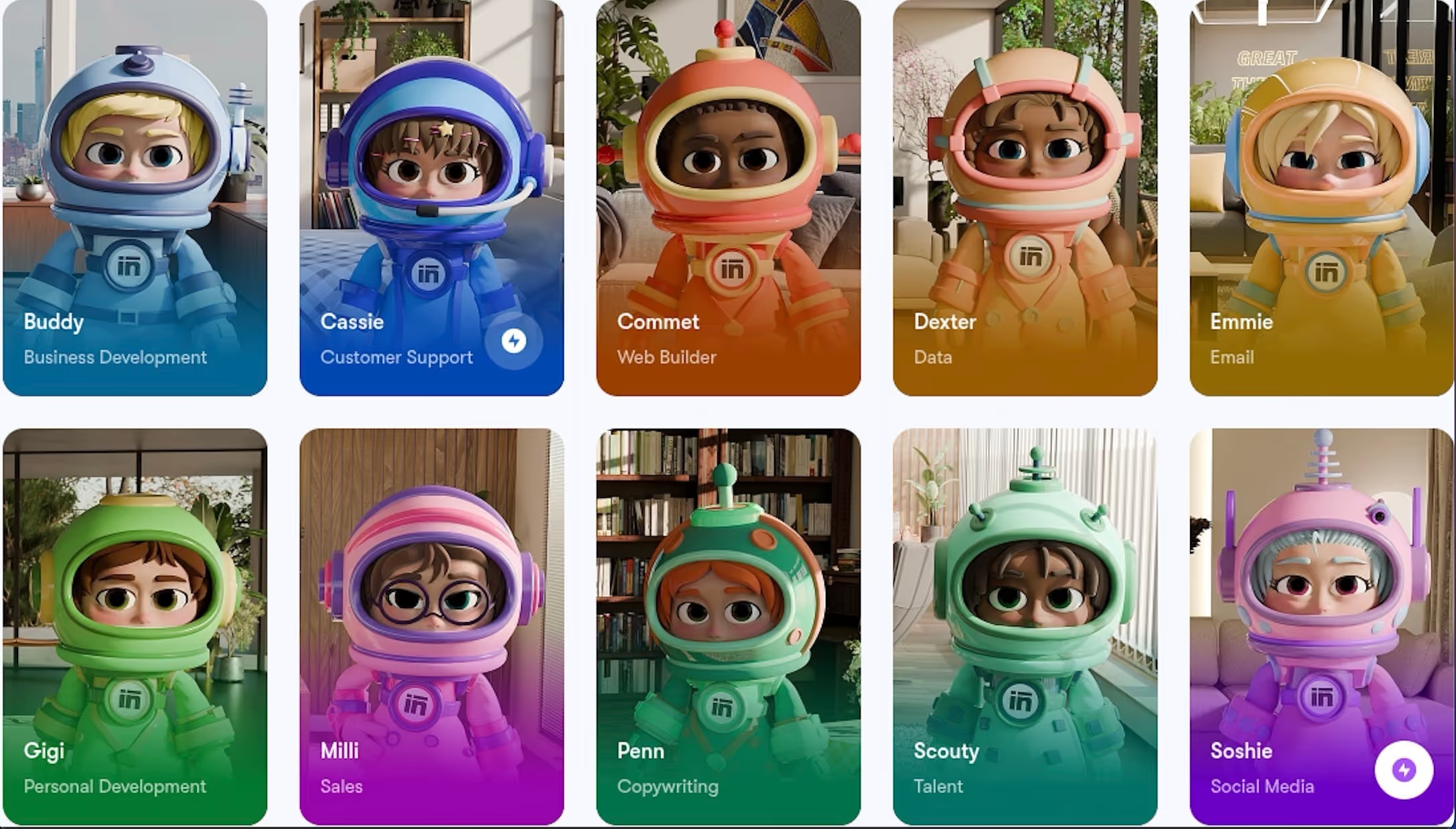
When our systems are interconnected, we no longer consider AI an assistant; instead, we give it actual responsibility within workflows. Rather than requesting assistance with marketing or writing predetermined responses, we use AI to post content, monitor performance, and respond to customers directly within specified limits.
This is where agentic AI begins to work like a virtual labor force, as opposed to a writing instrument. These systems take inputs, perform repetitive tasks, remember, and report outcomes, unlike generative AI agents.
Role-based design enhances reliability, which is demonstrated through platforms that facilitate organized collaboration, like an integrated AI team to own the workflow. This change in the context of the larger Agentic AI vs. Generative AI comparison is one of the shifts toward work ownership and quantifiable performance.
Stage 6 - Measuring Performance and Scaling Execution
Only in the case we monitor system performance within actual work processes, autonomous execution is enhanced. With the implementation of AI workflow automation, we measure time saved, response speed, workflow completion rate, error reduction, frequency of escalation, and cost efficiency since outcomes are of more importance than the quality of output.
In contrast to generative tools, whose output is assessed by the quality of the content, agentic systems can be assessed by outcomes: did the tickets get resolved, did the campaigns go live at the right time, and were the CRM records updated accordingly?
Continuous learning is made possible through structured intelligence layers like brain AI as contextual workflow memory, which allows information to be stored and to perform better with time.
Automation generates compounding value as the business grows in size because each workflow will eliminate the manual coordination. In an expanded Agentic AI vs. Generative AI debate, execution is what defines ROI since performance is a result of working, not merely of creating.
From Generation to Execution: The Strategic Shift
The majority of organizations are going the same way. These organizations begin with Generative tools since entry is not high and the process of drafting is enhanced. Furthermore, there is an increase in productivity at the individual level. Nonetheless, coordination is manual, and at one point, the question turns to be: How can AI accelerate our creation? to: "What is the way AI can make us work better? That is the strategic shift.
The difference between an agentic AI and Generative AI becomes a model of maturity in the current debate. Generative AI generates products, while the processes are finished by agentic AI. When we pose AI vs Generative AI, we are in fact posing the question as to whether we seek help or murder. In the case of scaling businesses, execution is a winner.
Ready to Move Beyond Content Generation?
If your team is still using AI primarily for writing, brainstorming, or summarizing, you are capturing only a fraction of its potential.
Modern Agentic AI systems allow teams to automate marketing workflows, manage customer support, coordinate operations, and execute recurring tasks without constant supervision.
Unlike basic Generative AI agents, role-based AI employees operate inside structured boundaries, integrate across tools, and deliver measurable results.
At Sintra, we built our platform around this execution-first philosophy. Our AI employees do not just generate text. They manage defined responsibilities across marketing, support, and operational workflows. The difference in AI vs Generative AI becomes tangible when AI moves from assistant to operator.
If you are ready to shift from isolated outputs to full workflow automation, you can get started with Sintra and deploy structured AI roles inside your organization. Content generation is helpful. Autonomous execution changes how teams scale.
Agentic AI vs Generative AI FAQs
What is the difference between Agentic AI and Generative AI?
The difference between Agentic AI vs Generative AI lies in autonomy and execution. Generative AI produces content in response to prompts. Agentic AI plans and completes multi-step tasks toward defined goals.
Are large language models considered Generative AI?
Yes. Large Language Models are a core component of Generative AI systems. They generate language by predicting word sequences based on training data.
Can Generative AI become Agentic AI?
Generative AI can be embedded within an agentic framework. On its own, it remains prompt-driven. When combined with planning logic, memory, integrations, and decision boundaries, it can function as part of an agentic system.
How do LLMs relate to agentic systems?
LLMs often serve as the reasoning engine inside agentic systems. They interpret goals, generate intermediate outputs, and evaluate results. However, the agentic layer adds planning, execution loops, and tool interaction.
Is Agentic AI better for business automation?
For simple drafting tasks, Generative AI is sufficient. For recurring, multi-step, cross-platform workflows, agentic AI is more effective. It reduces manual coordination and enables structured AI workflow automation across departments.
What is the difference between AI and Generative AI?
Artificial Intelligence is a broad field encompassing predictive analytics, automated systems, recommendation engines, and more.
Related articles