



15 Most Popular AI Visibility Tools for SEO in 2026

Table of Contents

ChatGPT now handles over 2.5 billion questions every month, contributing to the surge in global AI search traffic. Experts predict AI-driven traffic will pass traditional search by 2028.
Focusing only on SEO rankings is no longer enough. Brands must also measure their AI visibility tracking in platforms like ChatGPT, Perplexity, Google AI Overviews and understand how solutions like AI sales enablement tools are evolving alongside AI-driven search and automation. The landscape is shifting fast - only 2.5% of newly published web pages are pure AI content with minimal editing, but nearly three-quarters contain AI-generated content in some form, and 54.5% of Google AI Overview citations now come from organically ranking pages, up from 32.3% just 16 months earlier.
To make it easier, I’ve rounded up 15 of the most popular AI visibility tools for SEO in 2026. These tools track mentions, measure citations, and keep your brand visible as search moves into the AI era.
Quick Answer: Best AI Visibility Tools for SEO
As search shifts toward AI platforms like ChatGPT and Perplexity, tracking your "AI visibility" is as crucial as traditional rankings. For a complete solution, Sintra AI stands out with its dedicated SEO agent, Seomi, which monitors brand mentions across AI engines while helping you optimize content for AI citations.
Other leading tools focus on specific niches: AIclicks.io provides real-time analytics on who is citing your brand, Clearscope and Surfer AI are industry standards for on-page content optimization, and SEMrush AIO offers an enterprise-level visibility index. By using these tools to track mentions and sentiment, you can ensure your brand remains a trusted source that AI models proactively recommend to users.
Best AI Visibility Tools: Quick Comparison
| Chatbot | Best For | Key Features | Pricing |
|---|---|---|---|
| Sintra AI | Teams that want AI assistants for SEO, marketing, content, and business support in one platform. | Seomi AI SEO helper, Brain AI knowledge hub, SEO audits, keyword research, backlink monitoring, AI visibility tracking across ChatGPT, Gemini, and Perplexity, plus content and workflow support. | From $39/month |
| AIclicks.io | Brands that need real-time AI visibility analytics, citation tracking, and GEO optimization insights. | Prompt-level tracking, citation intelligence, competitor benchmarking, GEO audit workflow, source discovery, actionable recommendations, brand configuration tools, and GA4 integration for AI traffic reporting. | Custom plans |
| Clearscope | Content teams improving article quality and discoverability in search and AI answer engines. | Real-time content scoring, keyword and NLP suggestions, competitor content analysis, content inventory tracking, and integrations with Google Docs and WordPress. | From $189/month |
| Surfer AI | SEO teams that want fast content optimization using live SERP and on-page signals. | AI content editor, live scoring, keyword clustering, SERP analysis, search intent insights, internal linking suggestions, and fast optimization workflows. | Tiered plans |
| MarketMuse | Companies building long-term topical authority and advanced content strategies across large sites. | Topic modeling, content gap analysis, AI-generated briefs, authority and difficulty scoring, content inventory tracking, and SERP X-Ray competitor analysis. | Custom pricing |
| SEMrush AIO | Enterprises tracking brand presence across both traditional SEO and AI-driven search environments. | AI Visibility Index, sentiment and mention tracking, source monitoring, missing prompt discovery, and integration with SEMrush's broader SEO toolkit. | Enterprise pricing |
| BrightEdge Prism | Large marketing teams that want AI-driven content intelligence and enterprise search strategy insights. | Real-time visibility alerts, prompt research, content intelligence, customer journey mapping, AI-driven recommendations, and enterprise SEO data integration. | Custom pricing |
| Writesonic GEO Suite | Teams that want AI visibility tracking combined with content creation and optimization workflows. | Prompt tracking, citation gap analysis, AI content generation, competitor benchmarking, AI search visibility monitoring, and traffic insight features. | Higher-tier plans |
| Conductor | Enterprises managing SEO, content, and AI visibility from one unified platform. | AI search monitoring, topic authority mapping, website monitoring, SEO and AI analytics, gap analysis, and AI-assisted content creation tools. | Enterprise plans |
| XFunnel | Brands mapping AI discovery journeys and finding citation opportunities across answer engines. | Prompt simulations, citation tracking, AI discovery path analysis, optimization playbooks, GA4 integration, and AI traffic monitoring. | Free audit + enterprise |
| Rankscale | Teams tracking AI citations and sentiment at prompt level. | Prompt-level monitoring, citation tracking, sentiment analysis, AI visibility scoring, and CMS/API integrations. | From ~$20/month |
| Otterly.AI | Brands auditing AI visibility and GEO readiness. | 25+ GEO audit checks, citation tracking, AI answer benchmarking, competitor analysis, and AI search monitoring across multiple engines. | Custom pricing |
| Hall | Marketing teams analyzing AI share-of-voice and brand sentiment across multiple AI engines. | Generative answer monitoring, citation insights, share-of-voice tracking, sentiment analysis, and multi-engine AI visibility monitoring. | Contact for pricing |
| Athena | Companies running competitive GEO and AI visibility strategies. | Prompt analytics, share-of-voice dashboards, citation intelligence, source analysis, and AI-powered recommendations for improving visibility. | From $270/month |
Benefits of using AI visibility products
AI visibility products help you understand how your brand appears inside AI-generated answers, not just in traditional search rankings. Instead of tracking only keywords and backlinks, these AI visibility tools measure mentions, citations, sentiment, and share of voice across platforms like ChatGPT, Perplexity, and Google AI Overviews. This gives you a clearer picture of whether AI systems trust your content enough to recommend it.
They also turn insights into action, shaping AI employees and workplace culture by automating tasks and changing how teams collaborate. By identifying citation gaps, missing prompts, and competitor advantages, AI visibility tools help you adjust your content strategy, improve on-page structure, and strengthen third-party references. The result is stronger brand presence in AI search environments and a measurable path from visibility to traffic and conversions.
Top 15 AI Visibility Products for SEO in 2026
Below, we review 15 of the major AI engines for measuring SEO presence, improving visibility, monitoring brand mentions, and adopting competitive AI strategies.
1. Sintra AI – Best for AI Visibility Monitoring & Multi-Assistant SEO Support
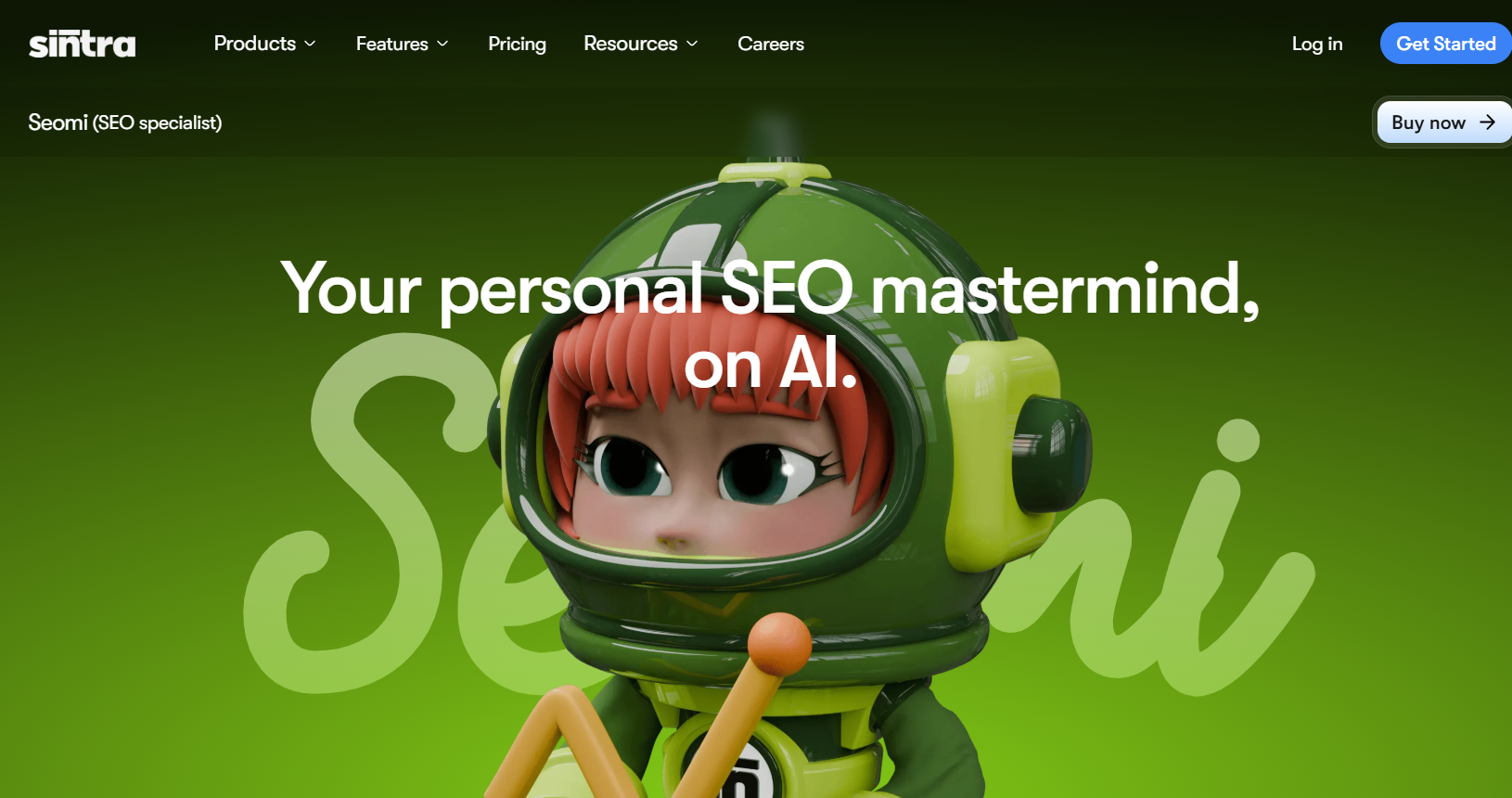
Sintra AI is one of the most popular AI visibility products for SEO in 2026. Its edge comes from using specialized AI “helpers” that focus on SEO, content, social, sales, and more.
For AI visibility, Sintra offers a dedicated AI SEO agent called Seomi. Here are some key capabilities of Seomi:
- Write SEO blog posts that boost rankings and attract more traffic
- Run SEO audits to spot and fix visibility issues
- Research keywords to uncover the best terms for your market
- Optimize web pages so they perform better in search results
- Monitor backlinks to keep your link-building strategy strong
- Improve site structure for better indexing and user experience
With Sintra, you get both visibility monitoring and content support in one platform, making it a strong candidate for AI visibility and GEO optimization.
Strengths
- Multiple assistants tailored for SEO, content, marketing, and more
- Brand memory via Brain AI keeps content consistent and context-aware
- Integrations with Google Analytics, social platforms, and other tools
- Real-time visibility monitoring across AI search engines like ChatGPT, Gemini, and Perplexity
- GEO scoring and reporting that show how your brand performs in AI-driven results
- Dashboards that make it easy to track SEO performance
- Scalable setup that works for both small teams and large enterprises
Weaknesses
- Slight learning curve for first-time users
Sintra Pricing
Sintra offers single-assistant plans (e.g., just Seomi or copywriter AI) starting at $39/month. To unlock all 12 assistants, Brain AI, and advanced features, the Sintra X bundle is priced at $97/month. A 14-day money-back guarantee is included.
2. AIclicks.io - Best for Real-Time Analytics & Optimization
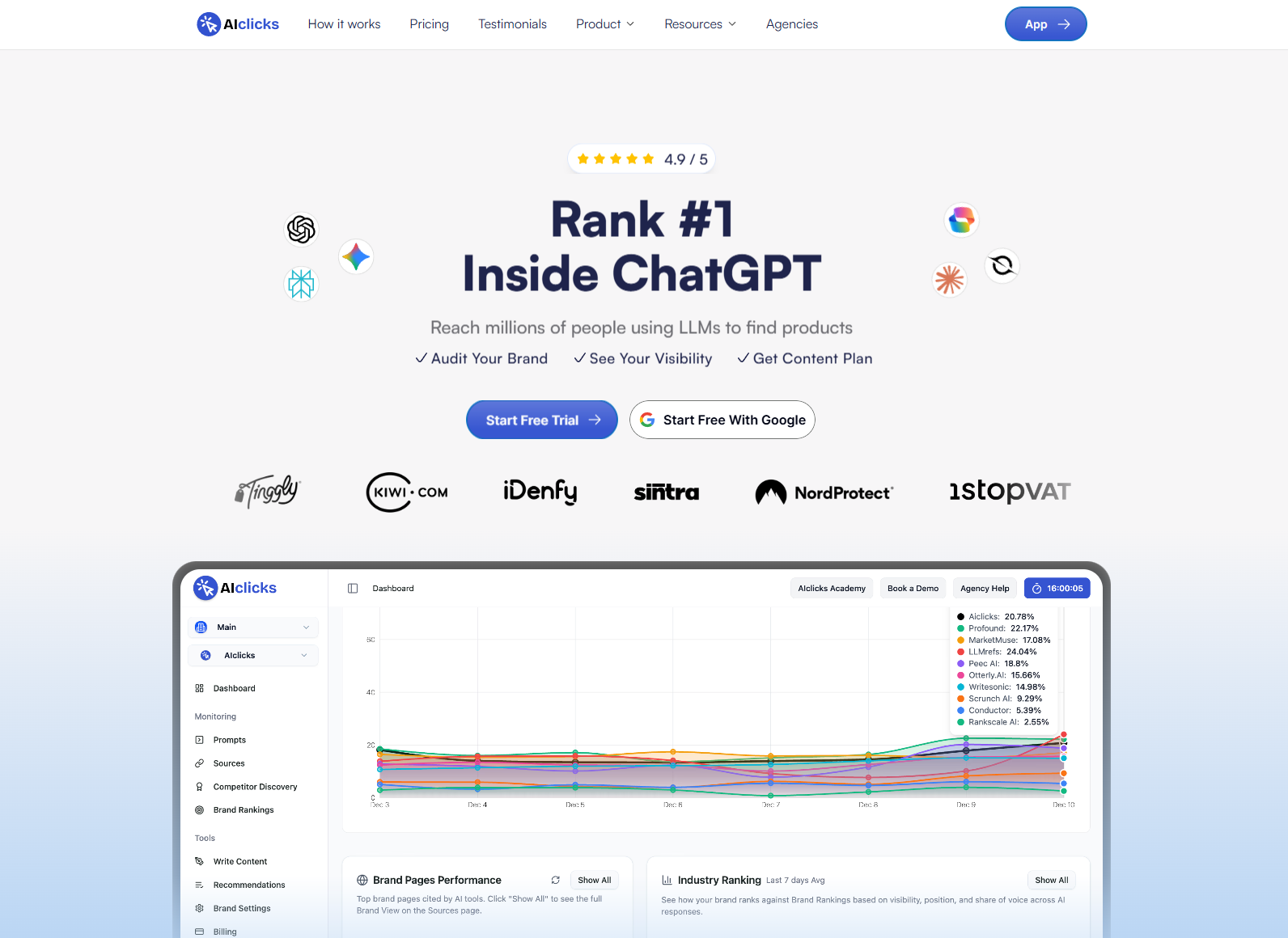
AIclicks is an AI visibility platform that tracks where your brand shows up in AI-generated answers and which prompts and sources drive those mentions. It helps you measure share of voice by prompt and model, compare competitors, and spot the exact third-party domains you need to win to increase citations and recommendations.
Its GEO Audit workflow makes it easy to see what you are winning, what you are losing, and what to fix next, whether that is improving “liftable” on-page structure or getting referenced in the sources LLMs actually cite.
Strengths
- Real-time visibility analytics that update as prompts are run, so you can spot mention and citation changes fast
- Citation intelligence revealing which domains AI models trust and reference most
- Competitor benchmarking to understand who is dominating key prompts
- Actionable recommendations like adding LLMs.txt files or creating Wikipedia pages to boost citation likelihood
- Brand configuration tools to align AI-generated mentions with your tone and positioning
- Google Analytics integration that aligns AI visibility data with GA4 segments for end-to-end reporting, showing real-time visitors, purchases, and traction from leading LLMs
Weaknesses
- You still need a solid prompt library and regular refresh as models and outputs change
- Not a replacement for full technical SEO crawlers or backlink-specific tooling
- Can feel “too advanced” if you only want basic rank tracking vs prompt SOV and citations
AIclicks Pricing
AIclicks offers multiple tiers with monthly and yearly plans, typically scaling by how many prompts you track, which AI models you monitor, and team needs.
3. Clearscope – Best for AI Content Optimization & Discoverability

Clearscope is an AI-powered content optimization platform that improves content relevance and helps your site gain brand visibility in both traditional SEO and AI environments, such as ChatGPT and Google AI Overviews.
Its system analyzes top-performing pages in your niche and provides a content score, keyword discovery, and term recommendations to maximize your chances of being cited in AI answers.
Strengths
- Real-time content scoring and optimization feedback as you write
- Keyword discovery tools that surface related terms and NLP suggestions
- Competitive analysis tools to see what your rivals cover and identify content gaps
- Content inventory to monitor how existing pages perform over time
- Smooth integration with writing platforms (Google Docs/WordPress)
- Helps your content become part of the AI answer engine citations
Weaknesses
- Price is on the higher side, which may be expensive for small teams
- Focuses mostly on content, lacks deep site auditing or backlink tracking
- It doesn’t replace seo tools for technical or backlink needs
Clearscope Pricing
Clearscope plans typically start around $189/month, with higher tiers offering more reports, keyword credits, and team features
4. Surfer AI – Best for AI-Driven SERP & Content Signals
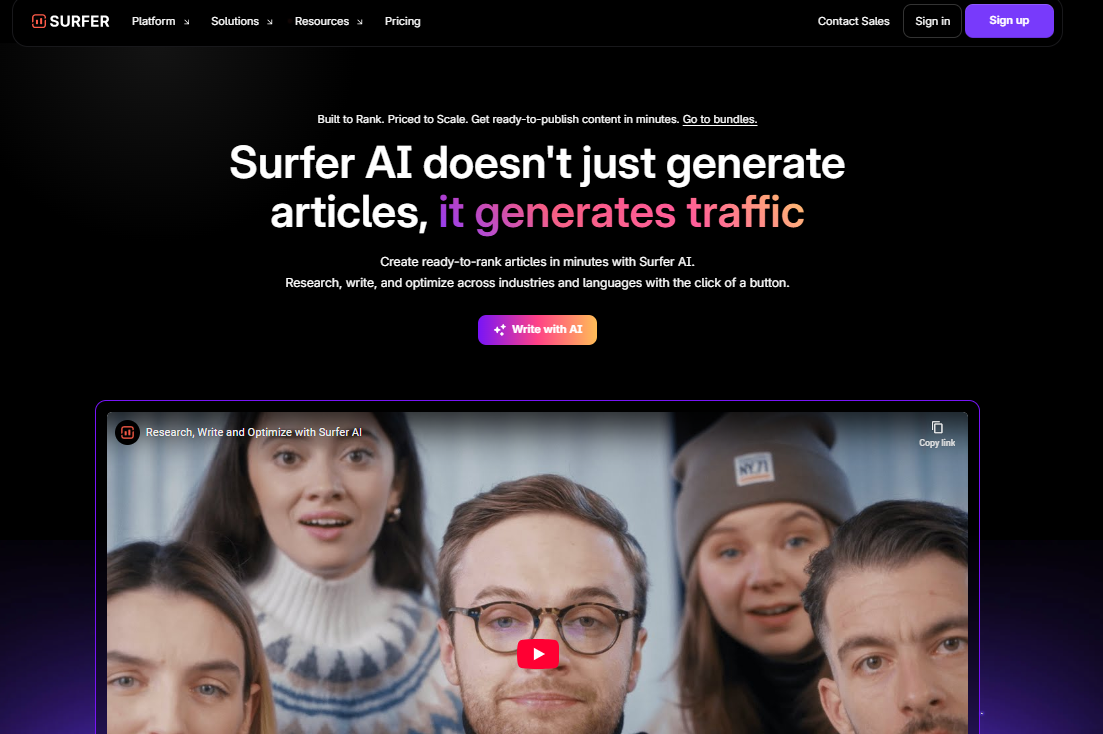
Surfer SEO is a popular tool for on-page optimization. Its AI module, known as Surfer AI, helps improve AI search visibility by aligning content with AI engines’ ranking signals. The tool provides SERP analysis, keyword clustering, and content scoring so your pages can perform well in both search engine results and AI answers.
Surfer AI is built for teams that want quick results: you enter a topic, it gives you a score, suggests improvements, and shows how your content compares to competitors. It also includes search intent analysis and internal linking tips.
Strengths
- Combines keyword planning, SERP insight, and on-page recommendations
- Content editor with live scoring to show how content stacks up
- Clusters related keywords to broaden coverage
- Internal linking suggestions to boost site structure
- Works well for day-to-day content production and rapid optimization
- Help with AI visibility tracking by aligning content to AI visibility cues
Weaknesses
- Doesn’t dig deeply into AI crawlers or prompt-level visibility
- Keyword research is solid, but not as advanced as dedicated tools
- Lack strategic planning tools for large content portfolios
Surfer Pricing
Surfer’s pricing is tiered (Essential, Scale, etc.), typically based on how many pages you track, how many content reports you run, and how many contributors.
5. MarketMuse– Best for In-Depth Topic Strategy & Content Intelligence
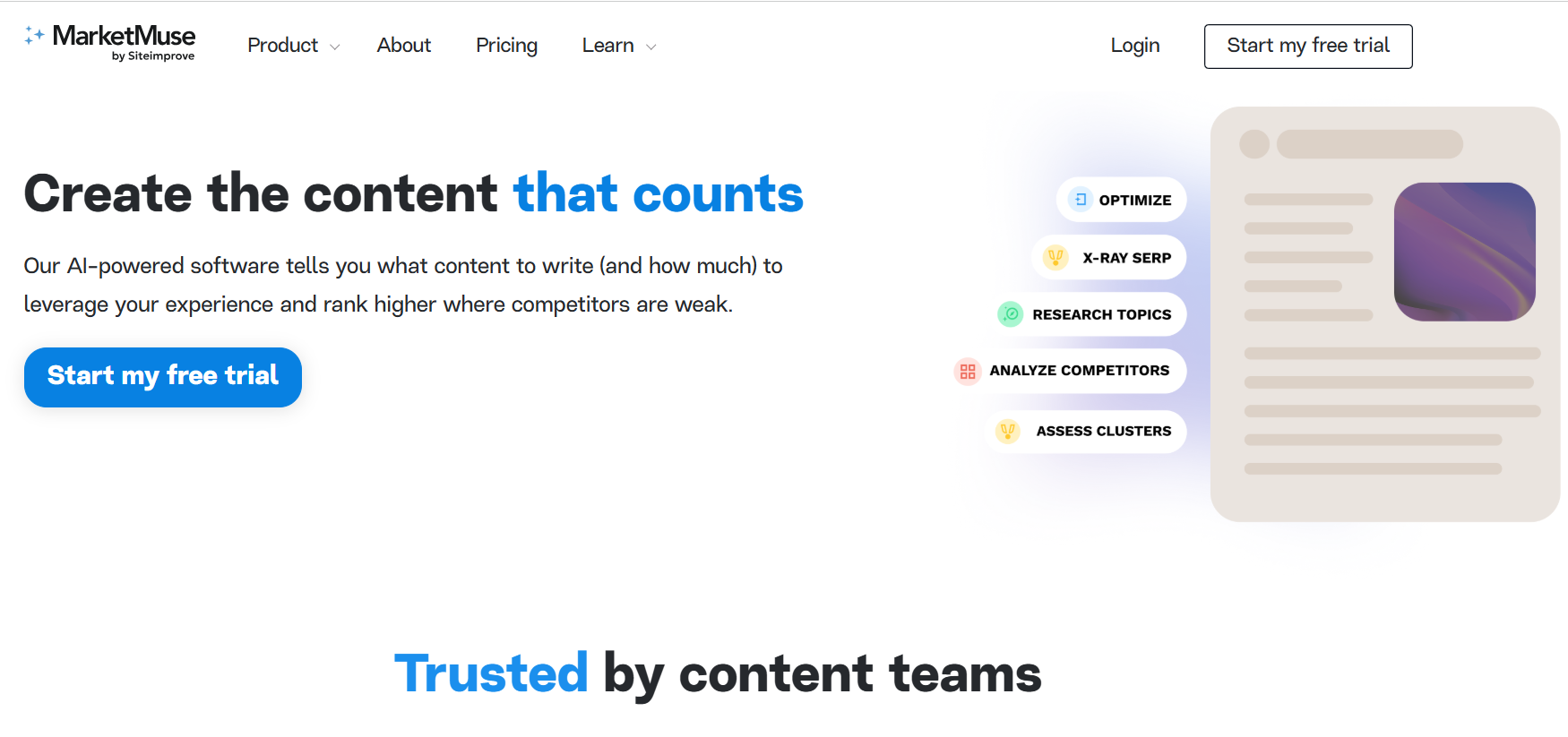
MarketMuse is built more like a content intelligence engine than a mere on-page optimizer. It gives you a holistic view of your content landscape, letting you plan, audit, optimize, and monitor across large sites.
Its strength lies in generating content briefs, topical authority models, difficulty and authority scoring, and SERP X-Ray tools. It’s especially useful when you try to shape competitive AI visibility strategies, using deep analysis.
Strengths
- Topic modeling and clustering that shows content gaps and opportunities
- Custom content briefs to guide writers on what to include
- Difficulty/authority scoring to prioritize effort
- Content inventory + monitoring to track performance over time
- SERP X-Ray and heatmap views to analyze competitor coverage
- Useful for aligning seo strategy with AI presence over a large site
Weaknesses
- Learning curve for teams new to strategic content planning
- Higher cost when scaling for many topics or pages
- Feel heavyweight for small sites needing only content tweaks
MarketMuse Pricing
MarketMuse offers multiple pricing tiers, from mid-level plans to enterprise packages, which unlock features like unlimited briefs, API access, and advanced analytics
6. SEMrush AIO – Best for Enterprise AI Visibility Index & Brand Monitoring
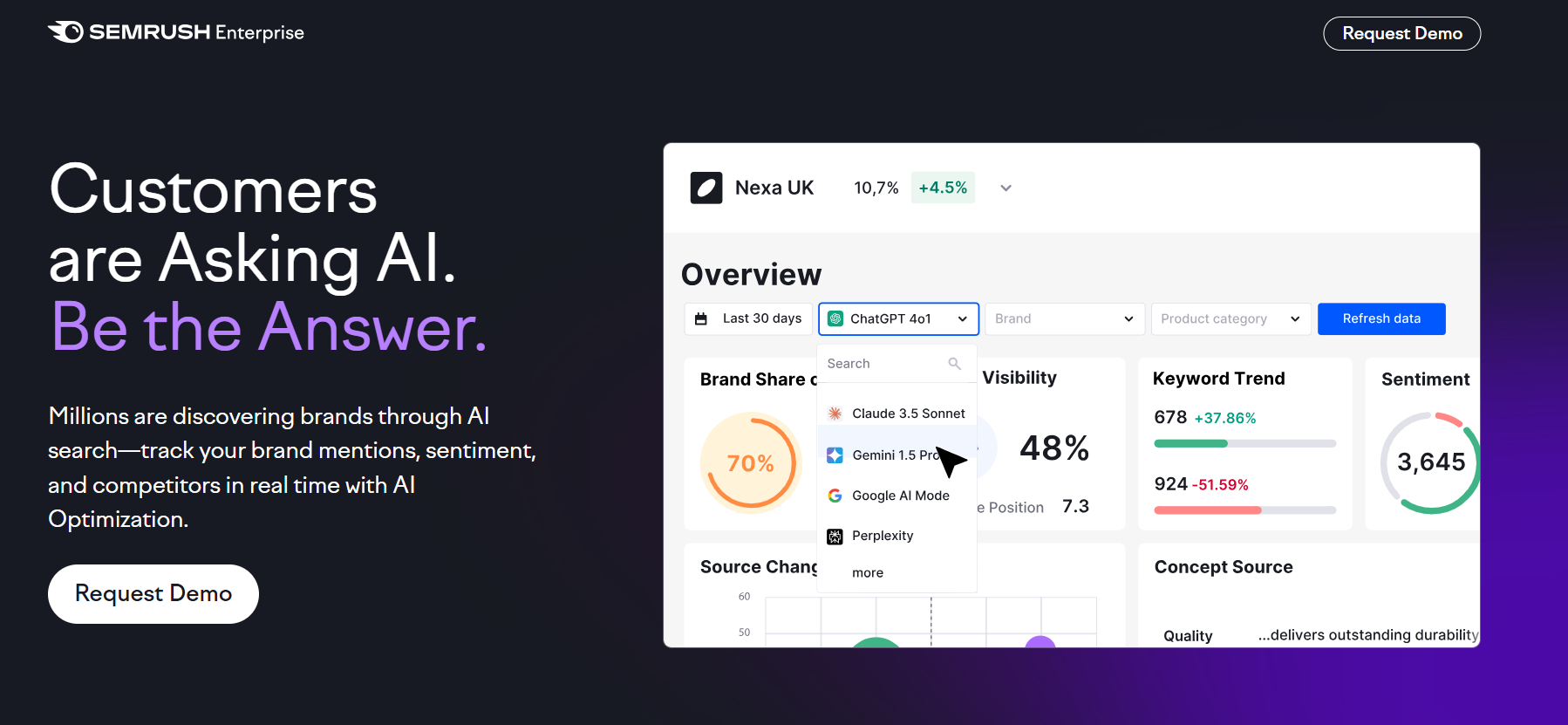
SEMrush’s new AI Optimization (AIO) is their enterprise layer built to help brands control how they show up in AI search engines.
It features an AI Visibility Index that tracks mentions, sentiment, and sources across ChatGPT and Google AI Overviews, giving you a benchmark for brand visibility in AI search.
With AIO, you get visibility into how your brand is recommended by AI, plus alerts and prompts to improve how AI represents you. It’s built to complement traditional SEO optimization practices and tools while bringing AI visibility tracking into your broader SEO strategy.
Strengths
- AI Visibility Index that benchmarks your brand across AI engines
- Tracks sentiment, mentions, and sources from AI responses
- Identifies “missing prompts” where competitors show and you don’t
- Integrates with SEMrush’s existing SEO toolset (linking AI and traditional search data)
- Useful for enterprise-scale and cross-domain brand monitoring
Weaknesses
- Likely expensive and intended for mid-large enterprises
- Deep analytics focus may require setup and training
- Doesn’t itself generate content or handle backlinking
SEMrush AIO Pricing
AIO is part of Semrush’s Enterprise offerings; exact pricing requires contacting SEMrush for enterprise plans.
7. BrightEdge Prism / AI Catalyst – Best for AI-Driven Content Intelligence & Strategy
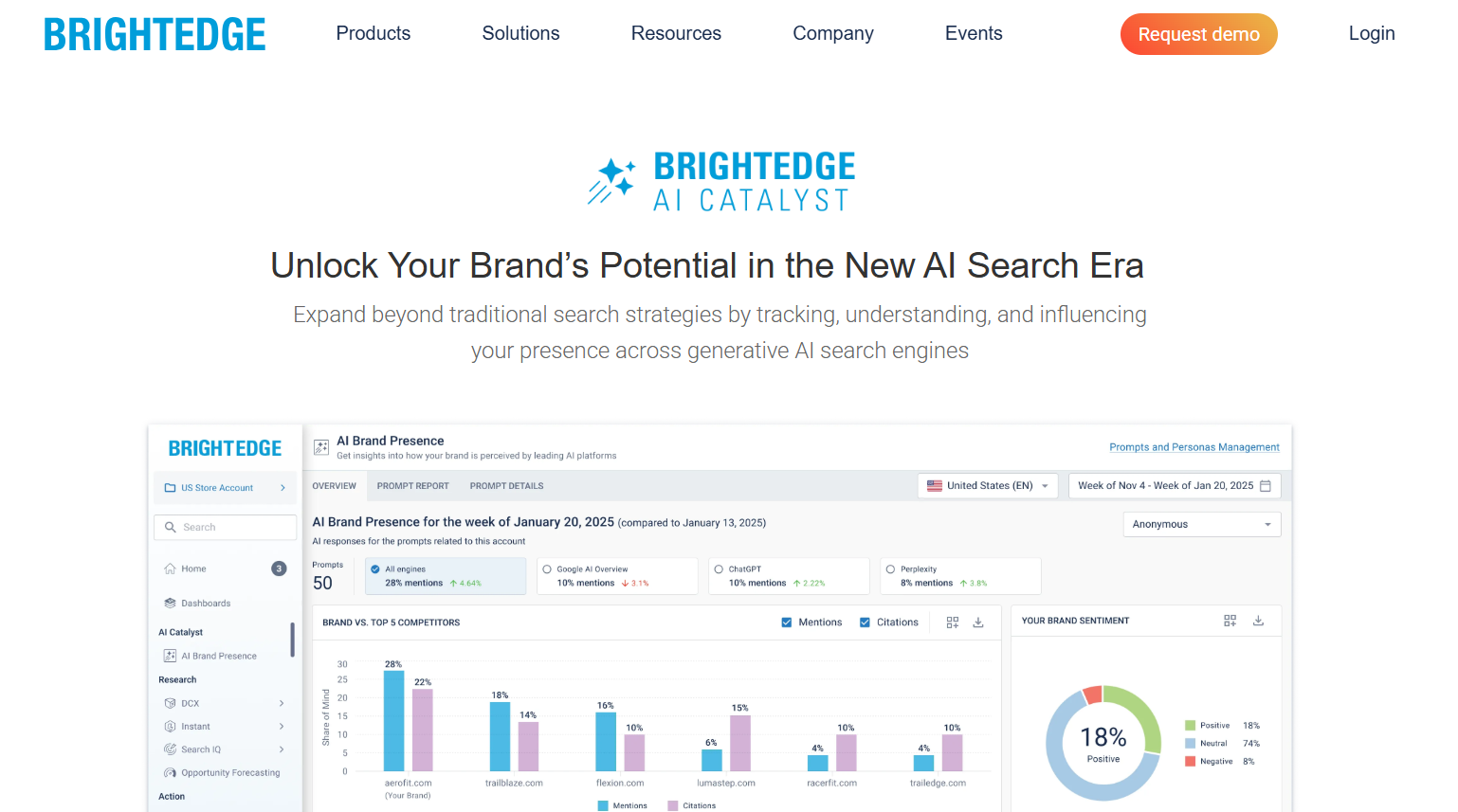
BrightEdge’s AI Catalyst (aligned with their Prism/AI content intelligence stack) helps marketers map how AI search evolves and how content should respond.
It provides real-time intelligence, prompt research, and journey mapping. So, you can adapt your content and strategy to AI search traffic trends as they shift.
This means you're not just optimizing for search engines, but for AI-powered search engines and AI-overview style responses.
Strengths
- Real-time data and alerts to respond to AI visibility shifts
- AI-driven prompt and content suggestions to improve AI citations
- Mapping of AI-influenced customer journeys to see where AI interacts with your brand
- Integration with existing SEO data (so SEO strategy + AI visibility can align)
- Scalable for enterprise-level sites and content teams
Weaknesses
- Steeper learning curve given advanced content intelligence features
- As part of a broad platform, AI-specific features might be less fine-tuned than niche GEO tools
BrightEdge Pricing
BrightEdge is high-end enterprise software; pricing is custom-based on scale, usage, and modules.
8. Peec AI– Best for Real-Time AI Visibility Alerts & Brand Mention Tracking
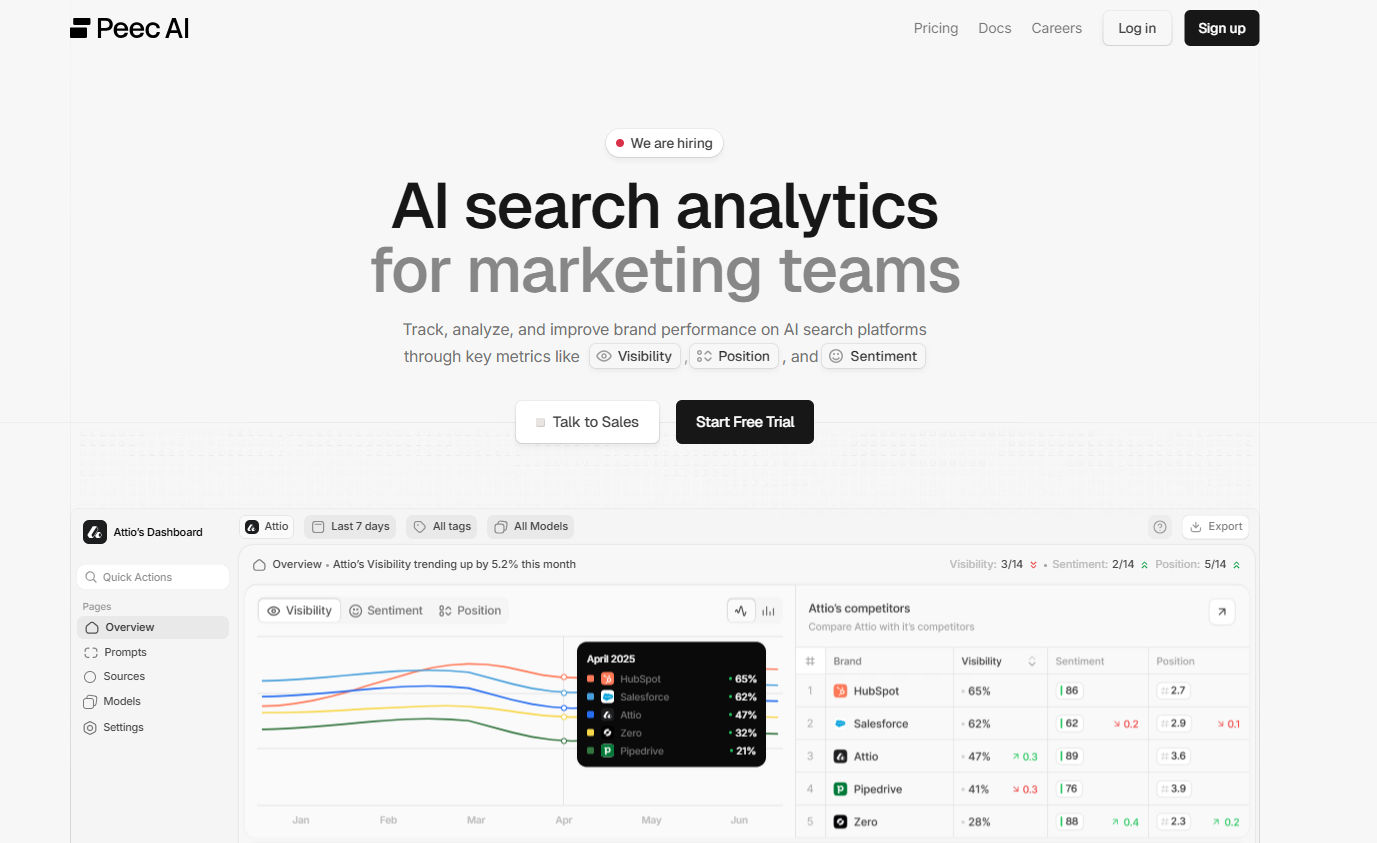
Peec AI is a more focused tool built for AI brand monitoring, visibility alerts, and competitive benchmarking. It helps marketing teams see how their brand appears in ChatGPT, Perplexity, Claude, and Gemini in real time.
Unlike deeper GEO tools, Peec AI’s strength is in alerting and tracking brand mention activity across AI answer engines, with prompt-level visibility and competitor comparison built in.
Strengths
- Real-time visibility alerts when your brand is mentioned
- Multi-platform tracking across top AI systems
- Easy setup and use, minimal overhead for visibility monitoring
- Prompt-level insights to check queries that mention your brand
- Competitive benchmarking of AI visibility against rivals
Weaknesses
- Limited actionable optimization
- Less depth than enterprise GEO platforms
- Fewer tools for content creation, SEO, or backlink tracking
Peec AI Pricing
Peec AI is marketed as a visibility/analytics tool; detailed pricing isn’t clearly published. It’s often positioned as a lighter, lower-cost option relative to full GEO tools.
9. Writesonic GEO Suite – Best for Full-Cycle AI Search Visibility & Content Workflow
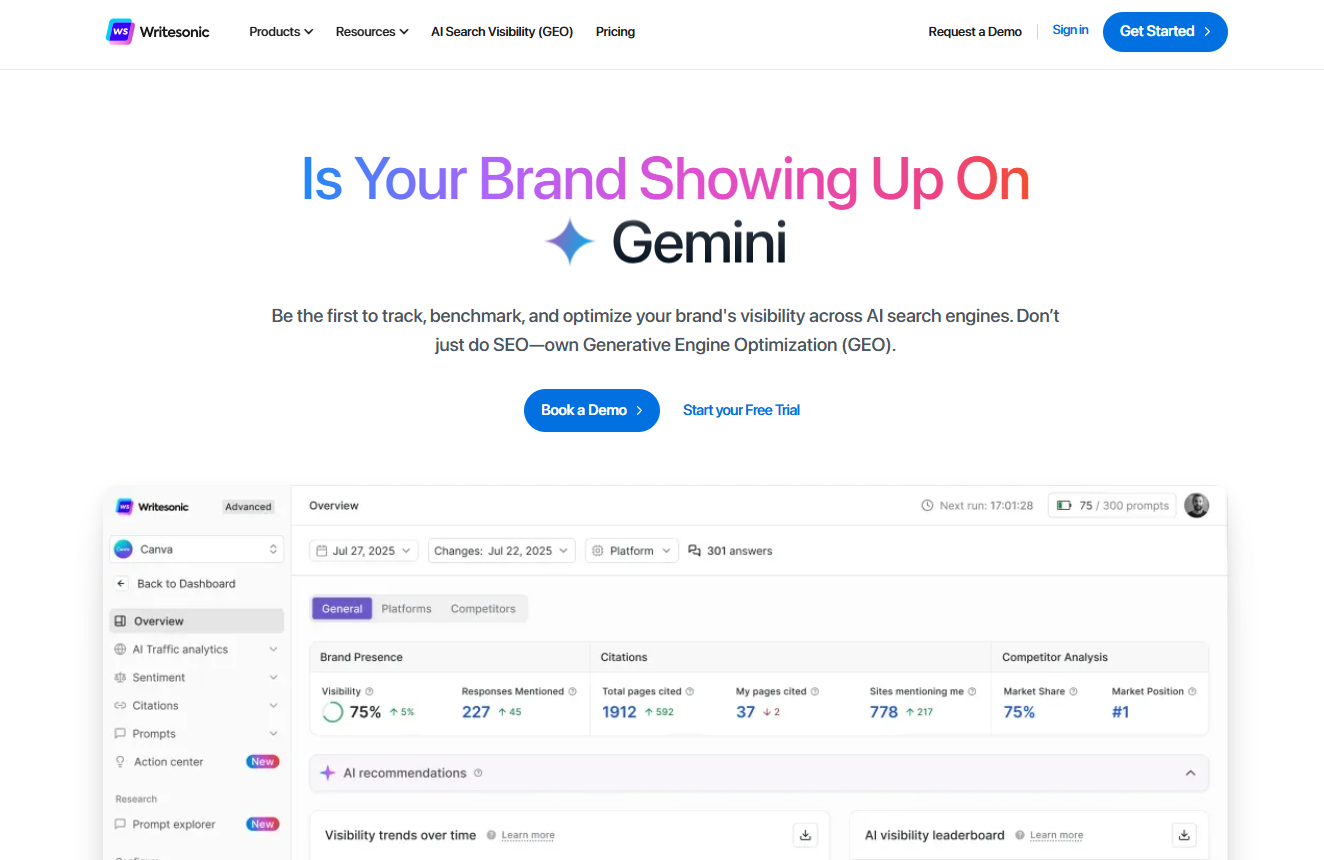
Writesonic originally built AI writing tools, but now its GEO Suite is a full-fledged Generative Engine Optimization platform.
It helps brands not only track AI visibility across ChatGPT, Google AI Overviews, Claude, and Perplexity, but also generate content, fix citation gaps, and benchmark against competitors.
Writesonic’s strength lies in linking visibility tracking (which mentions, citations, and prompt-level results you appear in) with actionable suggestions for content strategies. They call this “owning GEO” instead of just doing traditional SEO.
Strengths
- Monitors brand presence across major AI tools (ChatGPT, Perplexity, Claude, Google AI Overviews)
- Shows prompt-level AI search results and citation gaps you didn’t know existed
- Built-in content generation & optimization tools tied to visibility data
- Traffic analytics that attempt to capture AI crawler visits (i.e., non-human AI search traffic)
- Competitive benchmarking (share-of-voice in AI answers compared to rivals)
- Automated suggestions and “Action Center” routes to fix visibility issues
Weaknesses
- GEO capabilities are newer; coverage and accuracy can vary by platform
- Might not replace deeper traditional SEO tools (backlinks, technical audits)
- Some metrics or dashboards may feel opaque until fully explored
Writesonic Pricing
Writesonic offers demos and free trials. The GEO/AI visibility portions are often tied to higher tiers or add-ons.
10. Conductor– Best for Unified SEO + AI Visibility Platform
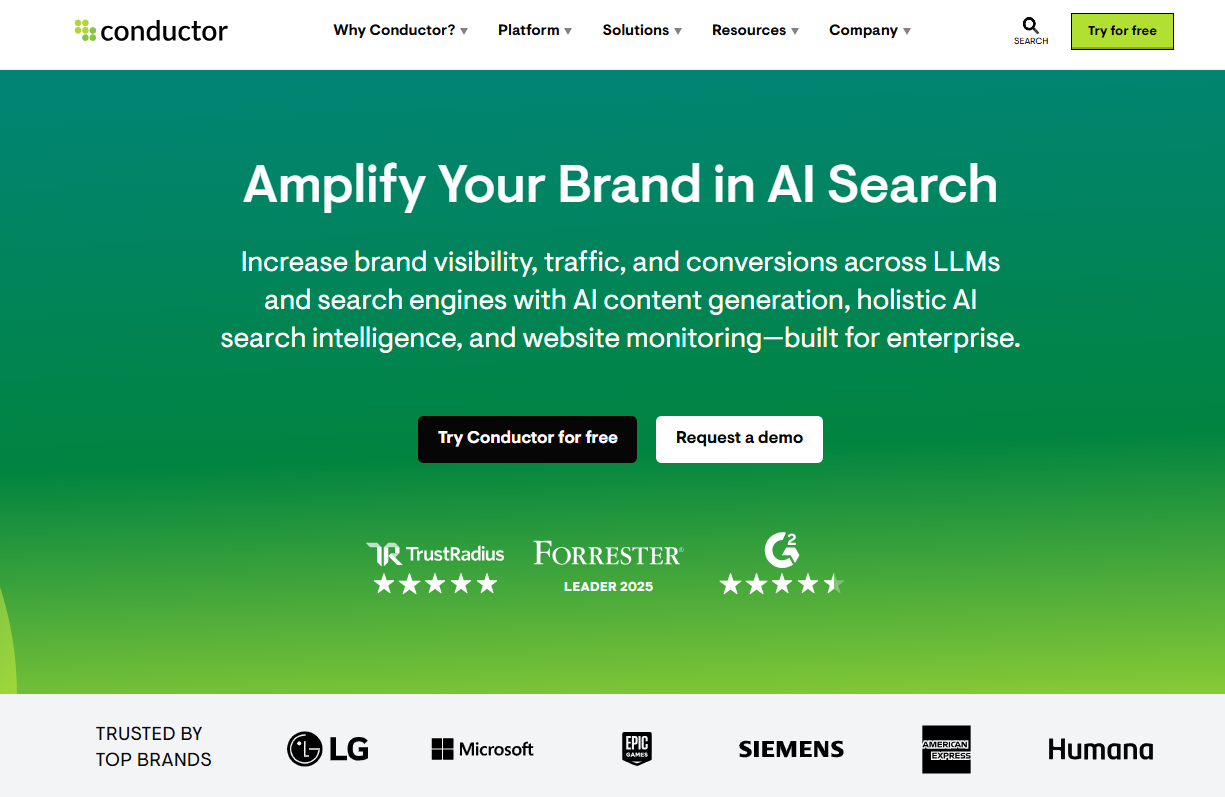
Conductor is upscaling its platform to cover both traditional SEO and AI visibility in one interface.
With Conductor AI, they now support answer engine optimization (AEO), track brand visibility across AI search engines, and unify content creation, monitoring, and analytics.
It’s designed for enterprises that don’t want separate tools for SEO and AI search. Instead, Conductor lets you build content meant to perform in both the “blue link” world and the “AI answer” world.
Strengths
- Tracks AI search performance and how your brand is cited in AI answers across multiple platforms
- Unifies traditional SEO data (Google Search Console, rankings) with AI visibility signals
- Real-time website monitoring to flag issues before they damage visibility
- AI content generation/copilot features to speed up content creation, tailored for AI visibility
- Gap analysis and topic authority mapping
Weaknesses
- High cost and enterprise focus, less ideal for smaller teams
- Because it does many things, some AI-specific tools may still beat it in depth
- Steep learning curve due to broad functionality
Conductor AI Pricing
Conductor AI is priced via custom enterprise plans, based on volume, domain count, and modules.
11. XFunnel– Best for AI Customer Journey Mapping & Citations
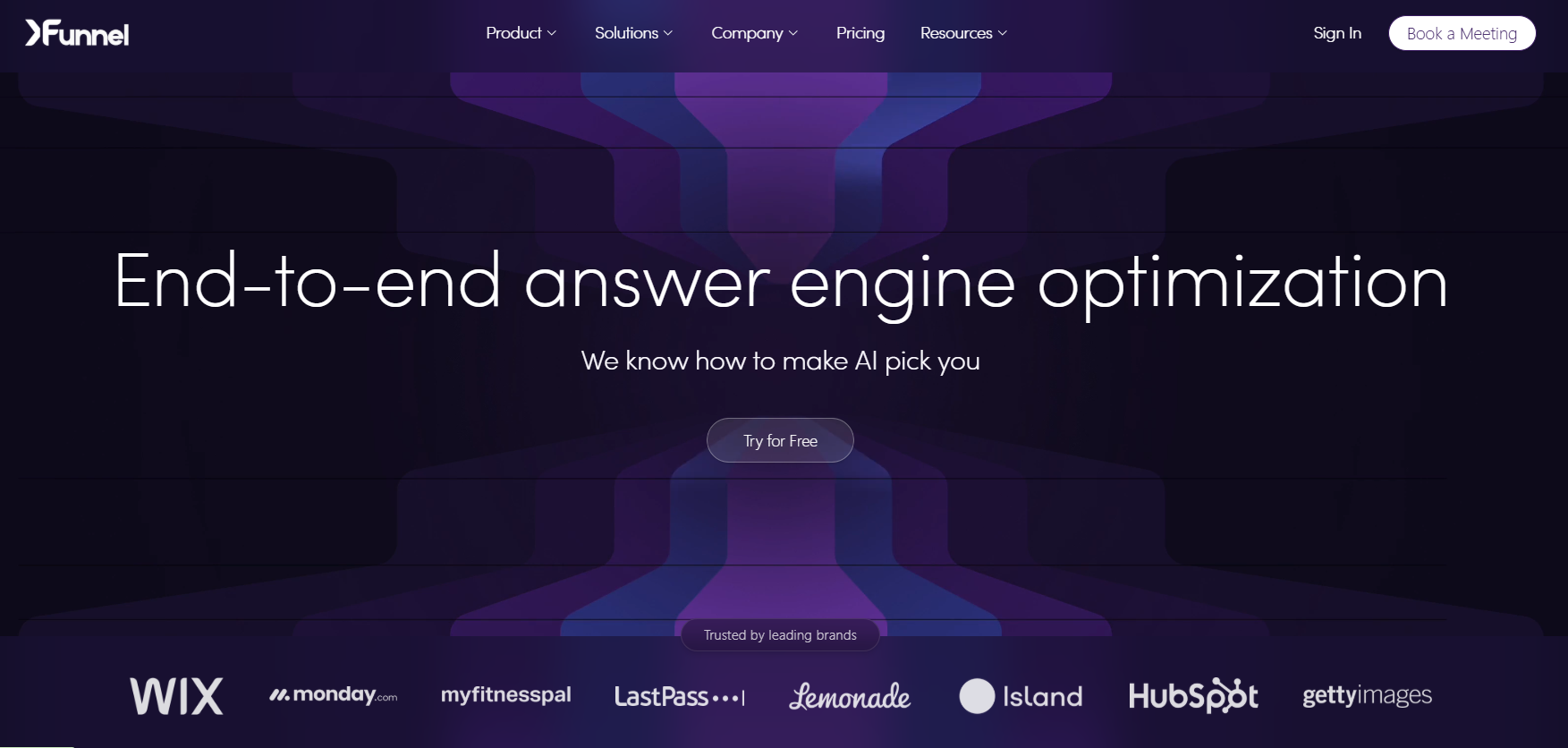
XFunnel is a Generative Engine Optimization (GEO) platform that helps brands map AI discovery paths, track citations, and optimize for how users find them through AI search engines.
XFunnel lets you simulate real queries, discover prompt gaps, and measure how often your brand appears in AI answers. It also provides playbooks for optimizing toward those gaps and integrates with Google Analytics to track AI search traffic to your site.
Strengths
- Citation tracking and prompt gap analysis to spot missed opportunities
- AI-first content optimization suggestions & playbooks
- Integration with GA4 for tying AI search referrals to site behavior
- Bot/AI crawler traffic detection to see how AI systems discover your content
- XFunnel provides analyst-backed optimization plans
Weaknesses
- Newer platform; coverage might be less mature than older GEO tools
- Focus mostly on citations, less on full-blown site auditing or backlink work
- Some metrics may require calibration or validation
XFunnel Pricing
XFunnel has a free starter audit and custom Enterprise plans. Its published pricing tiers include daily monitoring for AI prompt frequency and citation tracking.
12. Rankscale– Best for Prompt-Level Visibility Tracking & Citations
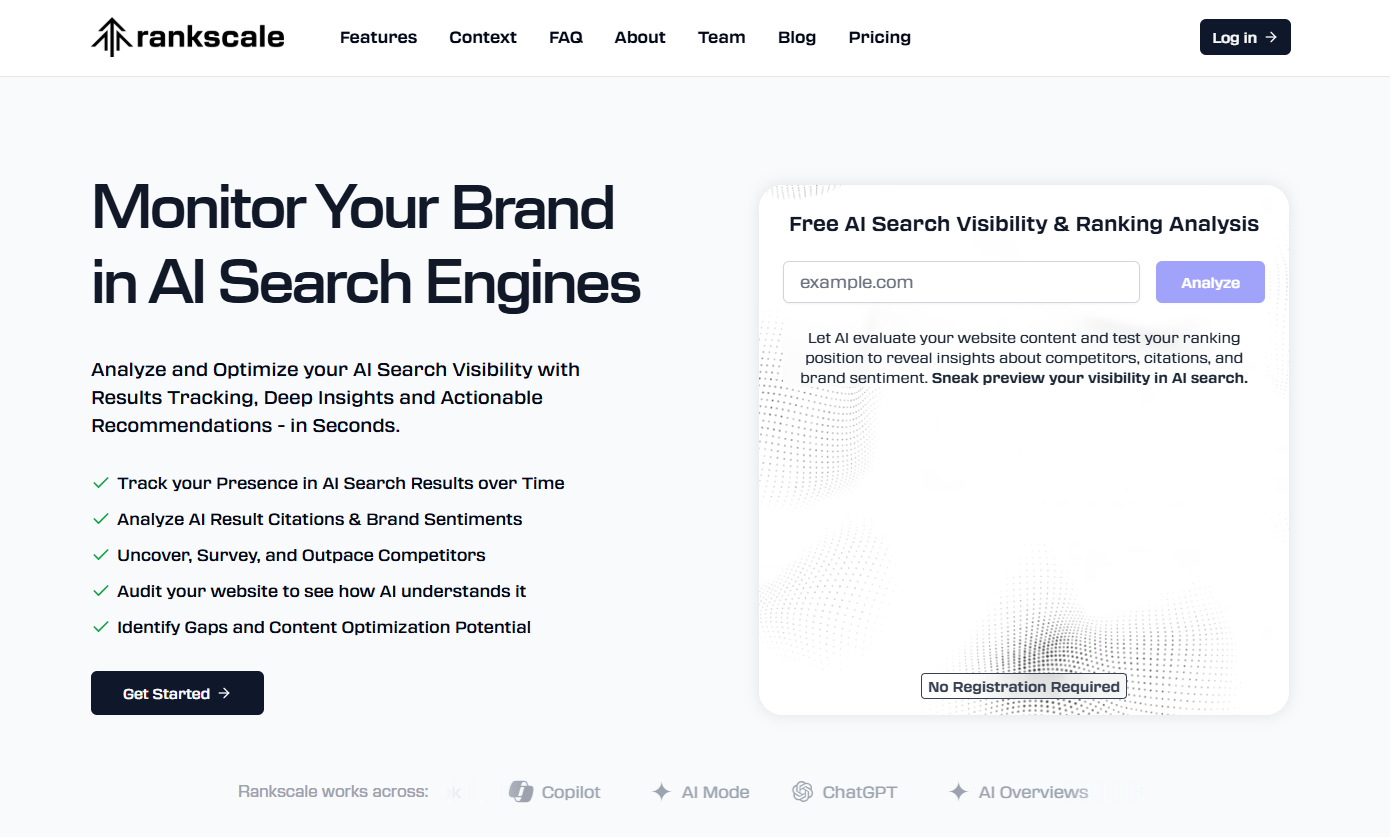
Rankscale.ai is a GEO tool built in Vienna that deeply tracks how your content, brand, and competitors appear in AI search results. It focuses heavily on citation tracking, prompt-level visibility, and sentiment of AI mentions.
It simulates prompts across ChatGPT, Perplexity, and Google AI Overviews to see which responses cite your pages, how often, and with what sentiment.
Strengths
- Prompt-level tracking of AI citations and brand visibility
- Sentiment & source analysis of AI-generated mentions
- Visibility scoring across multiple prompts and domains
- Audit tools to measure the AI-readiness of pages
- API / CMS integration for automating insights
Weaknesses
- Doesn’t deeply analyze AI crawler behavior or full site infrastructure
- More insight than execution, you may still need content or SEO tools
- For large sites, prompt tracking volume may get costly
Rankscale Pricing
Rankscale offers starter plans (some reports say as low as ~$20/month) with prompt tracking and citation features. Enterprise tiers scale upward with more prompts, pages, and domain coverage.
13. Otterly GEO (Otterly.AI) – Best for GEO Audits & AI Citation Visibility

Otterly.AI is a newer AI visibility monitoring tool that recently launched a GEO Audit Tool. It’s a structured framework to audit, benchmark, and improve your AI search presence across major AI platforms.
Their GEO Audit Tool examines 25+ on-page factors that influence whether AI engines will cite your content. It tracks brand and content citations across ChatGPT, Perplexity, Gemini, and Google AI Overviews, and also benchmarks performance against competitors.
Strengths
- Structured GEO audit checklist for systematic improvement
- Citation and brand mention tracking across AI platforms
- Benchmarking that shows where your AI visibility is weak
- Focus on bridging traditional SEO and AI visibility audits
- Up-to-date on evolving AI search models to keep audit criteria relevant
Weaknesses
- As a newer tool, it lacks depth in certain AI engines or citation coverage
- More audit and insight, less content generation or backlink tools
- Don’t yet integrate deeply with other SEO stacks
Otterly Pricing
Otterly’s exact pricing isn’t fully public; they position it as a professional-grade audit + monitoring tool with custom pricing for deeper features.
14. Hall– Best for AI-Driven Share-of-Voice & Citation Analytics
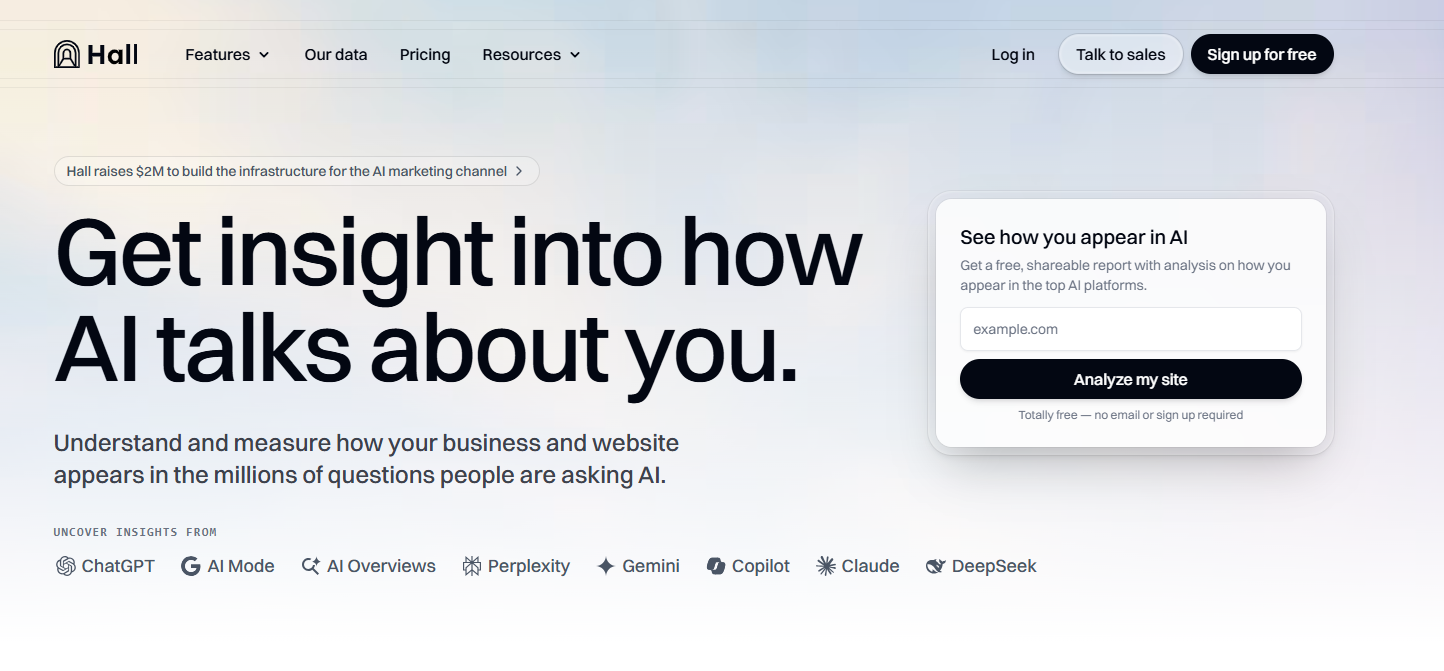
Hall is an AI visibility platform focused on measuring how AI engines (ChatGPT, Gemini, Perplexity, Claude, Copilot, and even Google AI Overviews) talk about your brand.
It tracks generative answers, AI citations, sentiment, and share-of-voice so you can see how AI answers represent your brand. It also spots opportunities to improve AI search visibility.
Strengths
- Generative-answer insights to see how your brand appears in AI conversations across major AI platforms.
- Website citation insights that reveal which pages AI answer engines cite (with prompt context).
- Share-of-voice and sentiment tracking for brand visibility benchmarking
- Multi-engine coverage (ChatGPT, Gemini, Perplexity, Claude, Copilot, Google AI Overviews).
Weaknesses
- Insight-heavy; you’ll still need traditional SEO tools for deep technical fixes. (Inference based on feature scope.)
- Newer AI visibility metrics may require internal education for stakeholders. (Inference.)
Hall Pricing
Hall promotes free analysis to preview your AI search presence; full pricing is typically contact-based for comprehensive visibility tracking across engines.
15. Athena – Best for GEO Competitor Intelligence & Actionable Recommendations
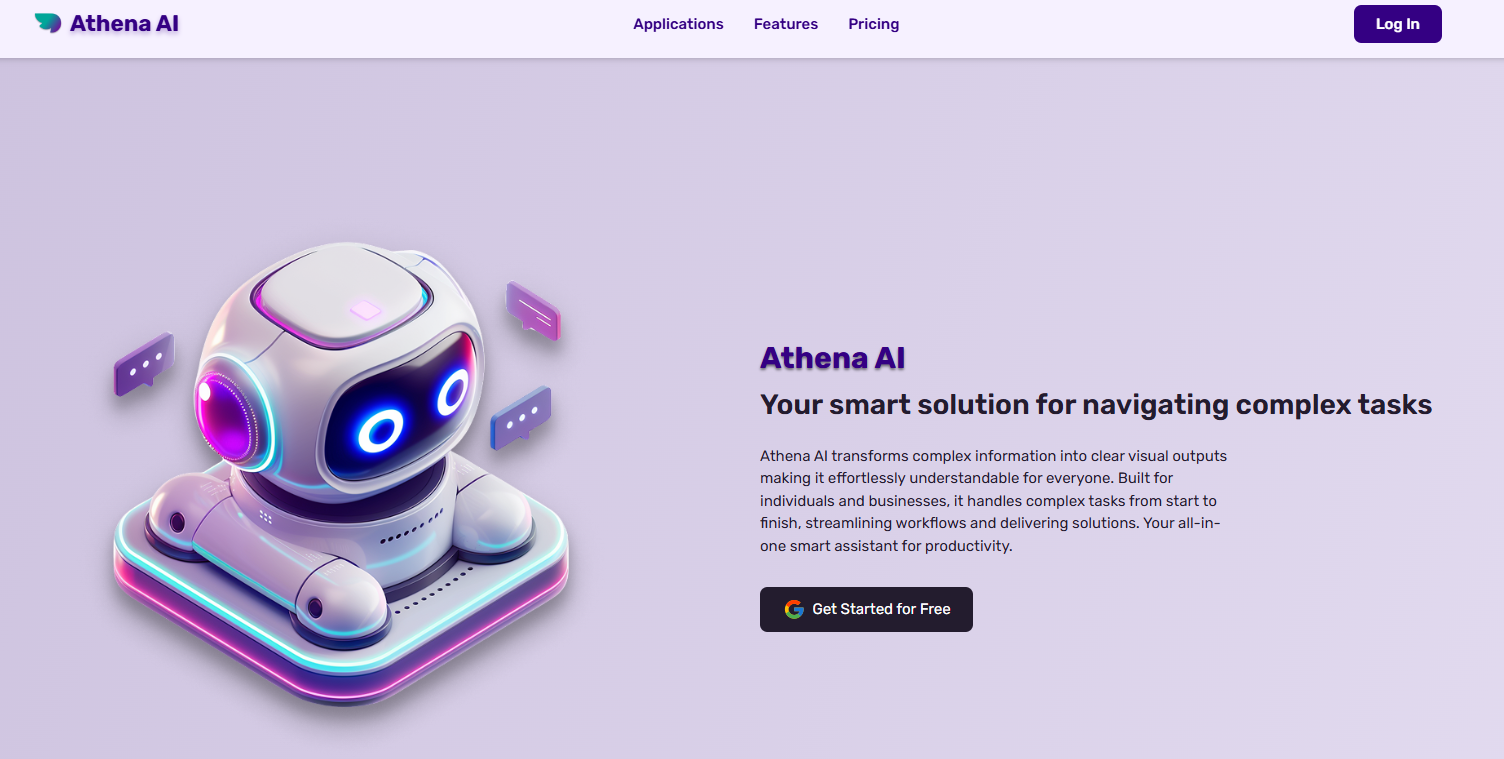
Athena (AthenaHQ) positions itself as a Generative Engine Optimization platform built for competitive AI visibility strategies.
It combines prompt analytics, share-of-voice dashboards, sentiment analysis, and a recommendations “Action Center” that tells you how to improve AI search results and win more AI citations across multiple AI platforms (ChatGPT, Claude, Perplexity, and more).
In a published 30-day test comparing Athena, Profound, and Peec.ai on 1,000 simulated buyer questions, Athena reports a 45% net gain in answer share, highlighting its emphasis on measurable uplift in AI presence.
Strengths
- Olympus-style dashboard for brand visibility tracking, share-of-voice, and AI presence comparison tools
- Prompt analytics and source intelligence to see which topics and pages drive the AI answer engine citation.
- AI-generated Action Center converts insights into content changes and keyword suggestions.
- GEO education resources that explain how websites influence AI responses and why AI optimization matters.
Weaknesses
- Premium pricing; targets mid-market and enterprise teams
- Feature-rich interface may feel complex at first
Athena Pricing
Public comparisons list plans around $270/month (Lite), $545/month (Growth), and custom Enterprise tiers.
How to Measure AI Visibility Success?
Success in AI search visibility means knowing how your brand shows up in AI answers and whether AI systems trust your content enough to cite it.
Unlike traditional SEO practices, it’s about tracking mentions, citations, and how your brand is represented across AI-powered search engines like ChatGPT, Perplexity, and Google AI Overviews.
Track Brand Mentions and Citations
The first step is to see how your brand is mentioned in AI search results. Good tools can scan AI answer engines and show when your site is named.
It’s also important to track citations, not just mentions. A citation means the AI system is pointing to your site as a trusted source. This is a strong signal of brand visibility in AI search.
Watch for AI Overviews and Snapshots
Google now shows AI Overviews at the top of search results. Other platforms also give short AI answers to user queries.
If your content appears in these overviews, it shows strong AI visibility. Even if users don’t click, your brand is still seen, which builds trust and authority.
Compare Against Competitors
Measuring your success also means checking how you perform next to your competitors. AI presence comparison tools let you see which brands appear most in AI answers.
This helps you spot gaps. If a competitor shows up where you don’t, you know where to improve your content strategy.
Check Sentiment and Accuracy
Not all mentions are good. Many SEO tools may present your brand in the wrong way, or even include mistakes (hallucinations).
Tracking sentiment tells you if your mentions are positive, negative, or neutral. Checking accuracy helps you make sure the context is correct.
Blend SEO and AI Metrics
Traditional SEO tools still matter. High-ranking pages in search engines appear in AI answers too. Metrics like keyword suggestions, meta tags, and Google Search Console data are still useful.
By blending these classic metrics with AI visibility tracking, you get a full picture of your performance in both old and new search systems.
Measure Conversions and ROI
The final goal is to see how AI visibility translates into results. Track traffic from AI-powered search engines separately, and connect it to conversions or sales.
Some tools now include revenue tracking capabilities, making it easier to prove the ROI of your AI visibility strategy.
Refresh Your Benchmarks
AI systems change fast. What works this month may not work next month.
Review your visibility, citations, and competitor comparisons regularly. This keeps your AI optimization efforts on track and aligned with how AI engines represent brands over time.
What’s the Best AI Visibility Tool for SEO in 2026?
The best AI visibility tool for you depends on your goals and the size of your business. Some tools help you track mentions, others improve your content, or monitor brand visibility across AI platforms. Here’s a quick look at the top AI visibility tools in 2026.
- Sintra AI: Best all-in-one tool for SEO visibility, audits, and content support
- AIclicks.io: Great for real-time content scoring and optimization
- learscope: Helps improve SEO content and AI search performance
- Surfer AI: Useful for content scoring, keyword clustering, and SERP insights
- MarketMuse: Focuses on content planning, topic gaps, and SEO strategy
- SEMrush AIO: Tracks AI visibility, mentions, and sentiment across platforms
- BrightEdge AI Catalyst: Shows AI trends and how your content performs
- Peec AI: Simple tool for real-time brand mentions and AI visibility alerts
- Writesonic GEO Suite: Monitors AI visibility and helps fix content gaps
- Conductor AI: Combines SEO data and AI visibility in one place
- XFunnel: Tracks citations, prompt gaps, and AI-driven traffic
- Rankscale: Measures how often your brand appears in AI results
- Otterly GEO: Audits AI citations and compares visibility with competitors
- Hall: Tracks brand share-of-voice and sentiment in AI-generated answers
- Athena: Great for competitor insights and GEO recommendations
Pick the one that fits your workflow and helps your brand stay visible in AI search results.
FAQs
What is the best AI for SEO content?
The best AI for SEO content is one that not only writes text but also understands search intent, suggests strong keywords, and helps improve rankings. Sintra’s SEO assistant called Seomi can research keywords, create optimized blog posts, run site audits, and help boost visibility in search engines. Other strong tools include Surfer AI, Clearscope, and Semrush’s AI SEO Toolkit, but Sintra stands out for combining visibility monitoring with content creation.
Is AI content good for SEO?
AI content can be good for SEO when it’s tailored to user intent and optimized with relevant keywords. Always review and adjust AI content to ensure quality, accuracy, and relevance for your audience.
Does Google like AI content for SEO?
Google doesn’t reward content just because it was written by AI. It cares about usefulness, relevance, and quality for humans. If AI content meets those standards, it can rank well, just like human written content.
How to optimize SEO with AI?
Start with an AI topic generator, use it to research keywords, then use tools to check readability and SEO scores. Optimize titles, headings, and meta descriptions with data from SEO platforms like Semrush or Surfer SEO. Always edit for accuracy and user value before publishing.
Ready to Improve Your AI Visibility?
The shift from traditional SEO to AI-powered search engines is already here. Brands that act now will lead in AI visibility, while others risk being left behind.
Explore these AI visibility tools, test their features, and find the right fit for your SEO strategy. The sooner you start, the sooner your brand’s AI visibility can grow across ChatGPT, Perplexity, and Google AI Overviews.
If you want a simple starting point, Sintra AI is a great option to begin monitoring and improving your visibility across multiple AI platforms.
Related articles






Copyright © 2026 PlayOS, Inc. All rights reserved