


10 Top Must-Have AI Resume Screening Tools

Table of Contents
The ugliest truth: a single job advertisement brings hundreds of resumes to the table, along with a painful, never-ending recruitment process. Reviewing them all manually not only slows down the recruitment process, but it also frustrates candidates waiting for answers.
What if all these sluggish tasks were handed over to someone who could perform them super fast, in a more manageable way? That’s where AI resume screening tools come in as a saviour for recruiting teams.
These systems can scan resumes more quickly than any human viewer. It identifies the most qualified candidates and frees recruiters to discuss candidates rather than spend all day sorting through paperwork.
These modern screening tools use machine learning and natural language processing to consistently evaluate experience, skills, and fit against job requirements.
The best part of these AI tools is that all the repetitive tasks from resume parsing to data extraction to candidate ranking, etc, are all done by AI employees. AI resume screening doesn’t mean replacing human recruiters; instead, human decision-making is still required in the most sensitive areas. This actually speeds up the process of achieving improved hiring results.
Companies adopting such tools also report shorter time-to-hire, better candidate fit, and fairer candidate screening - and the data backs this up. AI cuts the average time-to-hire by 50%, and 75% of recruiters say AI tools speed up resume screening and candidate matching. The technology has grown beyond keyword matching, with front-office-level systems that interpret context, discern transferable skills, and predict the likelihood of a successful candidate.
Quick Answer: Top AI Resume Screening Tools Shortlist
Here are the top AI resume screening tools for recruiters:
- Sintra AI (Scouty) – Best early-stage resume screening without ATS
- Pesto Tech – Best auto shortlisting of candidates in growing companies
- HireVue – Best Enterprise-level screening and video interview analysis
- HireEZ – Best AI-based sourcing and data enhancement for proactive recruiting
- Affinda – Best large-scale parsing of resumes and extraction of structured data
- Sovren (Textkernel) – Best enterprise semantic matching and parsing technology
- Endorsed AI – Best biased candidate evaluation skill-based
- X0PA AI – Best matching and screening automation using analytics
- Arya (Leoforce) – Best AI talent intelligence with comprehensive screening capabilities
- Ideal (Dayforce) – Best optimized workflow with recruiter productivity
Every platform is used in different hiring situations. Best AI tools for candidate screening depend on your team size, hiring volume, and workflow preferences.
Best AI Resume Screening Tools You Must Try
We have compared these platforms based on accuracy, integration flexibility, user experience, and compatibility across team sizes. Our AI resume screening tools comparison focuses on practical functionality rather than marketing claims.
How do we find the best AI resume screening tools? It is based on the tool’s efficacy in resume parsing, the clarity of its scoring, ease of integration with current HR systems, and scalability across startups and enterprises. We also looked at the cost structure, implementation complexity, and candidate-matching quality.
Not all tools perform equally in all situations, nor are all made equally for all people to handle. The resume screening AI tools listed below represent the strongest options we've tested for different recruiting scenarios. Find the perfect one for your unique requirements.
1. Sintra AI – Best for Solo Recruiters & Startups
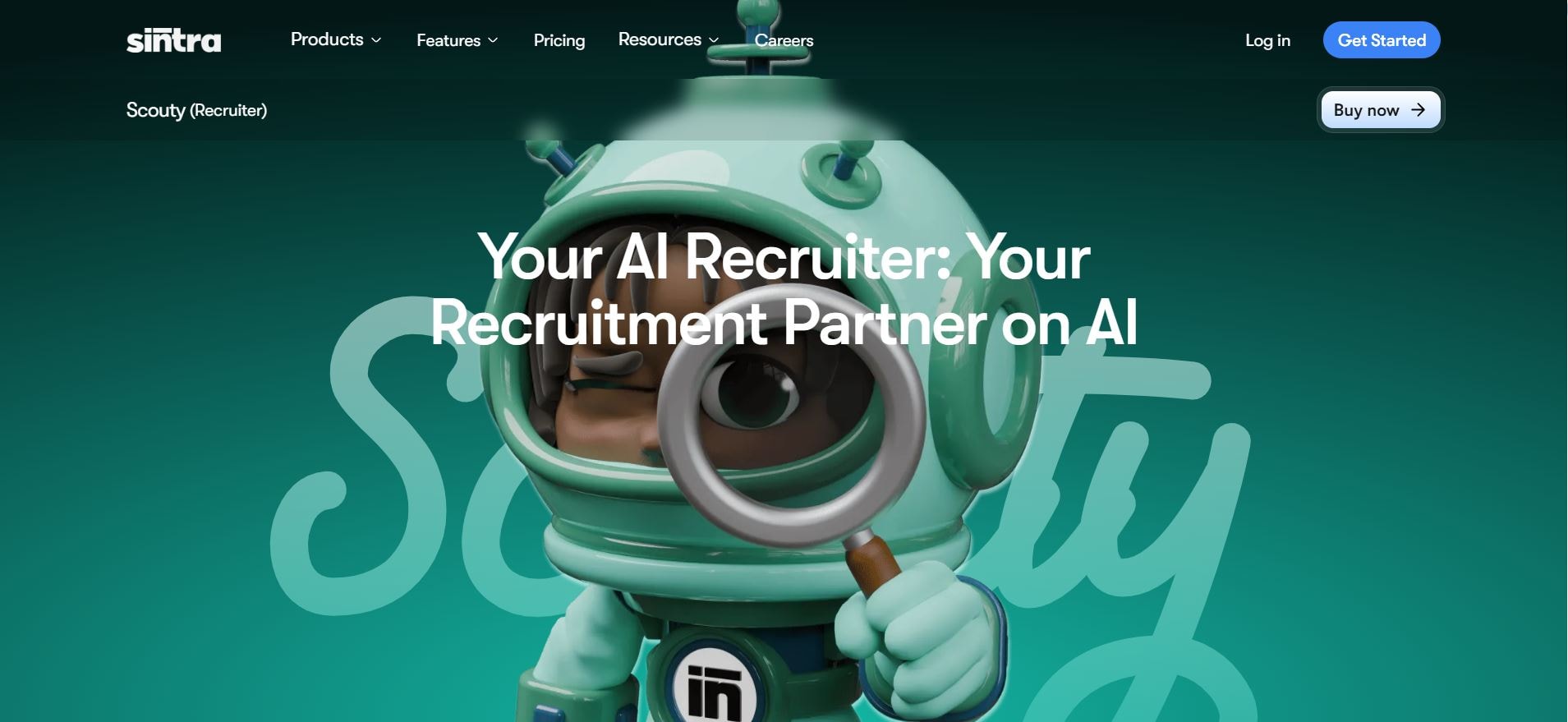
Are you tired of operating complex ATS systems with complex features that take weeks to configure and enforce strict workflows? Scouty approaches it differently. It works as a scalable AI assistant that performs resume analysis and initial screening without the overhead.
Post resumes on Scouty that scan and retrieve skills, experience, and qualifications. The platform matches candidates to the job criteria you specify, identifies top profiles, and produces summaries that help you complete initial screening quickly. This matters for teams that want AI screening capabilities without committing to enterprise software that reshapes their entire hiring process.
What works?
- Quick deployment without complicated onboarding.
- Adaptability in incorporating into current recruitment processes.
- Easy-to-understand candidate profiles that speed up the hiring process.
- Scalable across different team sizes
- Brain AI stores job specifications and company knowledge to ensure consistent screening.
What doesn't work?
- Not a complete ATS replacement.
- In some cases, requires a manual resume upload.
- Learning curve for teams new to AI delegation.
- Ideally applicable in screening at an early stage, not end-to-end hiring.
Pricing
The Sintra AI pricing plans include a 1-month plan at $38.80/mo, a 12-month plan at $15.60/mo, and a 3-month plan at $23.60/mo.
2. Pesto Tech - Best for Tech Talent Outsourcing
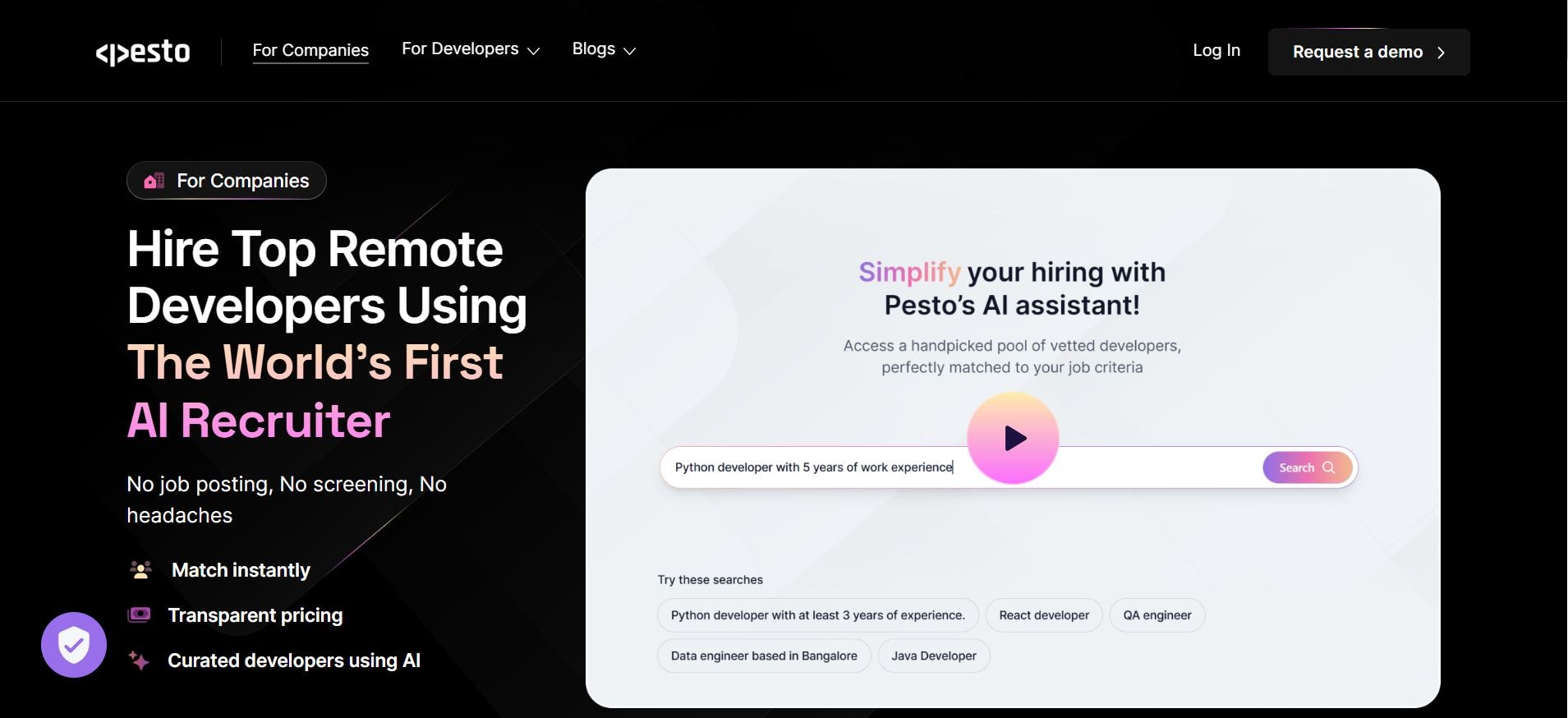
Have you ever had your hiring pipeline freeze because you couldn't sift through applications? PestoAI automates resume screening and candidate shortlisting, reducing manual review time. Applications that come in are analyzed, and candidates are ranked based on job fit, and the best matches are brought to the attention of recruiters.
The system effectively manages large volumes of applications, helping fast-scaling businesses maintain hiring momentum without increasing the size of their recruitment teams. AI tools for candidate screening, like Pesto Tech, prioritize speed and consistency.
What works?
- Eliminates much of the manual screening work.
- Manages high-volume hiring situations.
- Rapid shortlisting and ranking of candidates.
- Appropriate for an expanding organization.
What doesn't work?
- May need adaptation towards a niche or specialization.
- Limited customization
- Training of teams that do not know the AI-based workflow.
- Best in jobs that have specific qualification criteria.
Pricing
Pesto Tech does not charge upfront fees for hiring; it charges only on a month-to-month basis after a successful hire.
3. HireVue - Best for High-Volume Video Intelligence
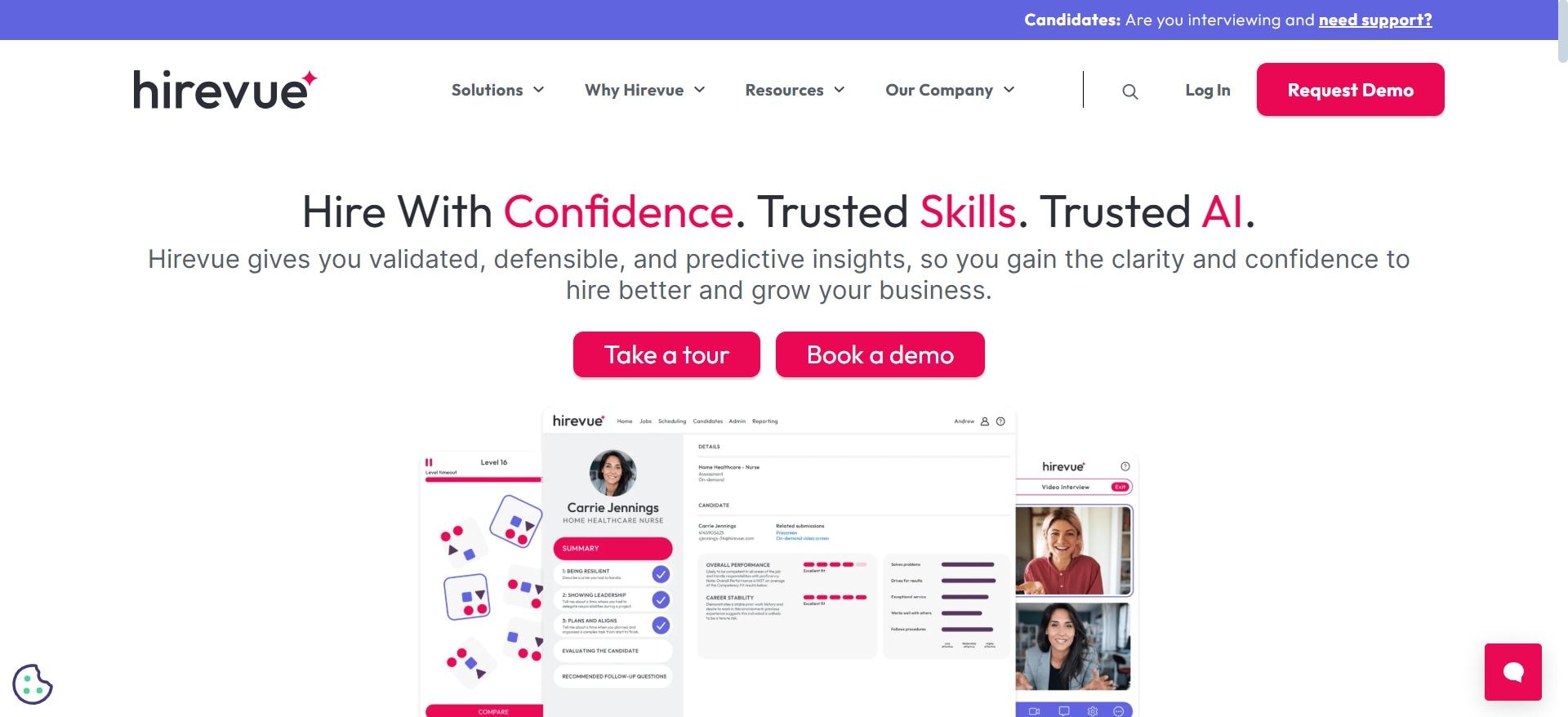
HireVue combines automated resume parsing and AI video interview analysis to assess soft skills such as communication and problem-solving. The platform suits organized, enterprise-level recruitment processes in which consistency and compliance are of importance.
HireVue is an interview machine-learning application that evaluates candidates' responses in video interviews, offering behavioral insights to recruiters in addition to resume information. AI candidate screening tools with video analysis capabilities add depth to traditional resume screening.
What works?
- Detailed evaluation of candidates beyond the resume information.
- Soft skills evaluation using video interview analysis.
- Strong enterprise features and compliance support
- Organized workflow of large-scale hiring programs.
What doesn't work?
- Higher cost compared to simpler screening tools
- The complexity of implementation demands specific resources.
- Video analysis can be intrusive on some candidates.
- Needs human intervention on edge cases that need empathy.
Pricing
Custom enterprise quotes; entry-level annual packages typically start around $35,000.
4. HireEZ - Best for Proactive Outbound Sourcing
SeekOut and HireEZ include built-in AI ranking and diversity filtering to passively source talent. But among the two, HireEZ is our favorite. Because it provides data enrichment and AI-based candidate screening to proactive recruiting teams. The platform scrapes LinkedIn, portfolios, and other sources to create comprehensive candidate profiles, not just their resumes.
The system assists recruiters in learning about potential employees who do not actively seek employment but are well-suited to the job requirements. AI tools candidate screening capabilities extend to active sourcing rather than just application review.
What works?
- Multisource data enrichment
- Good at passive candidate sourcing
- The ability to filter diversity
- Active recruiting services outside of applicant pools
What doesn't work?
- A bit difficult to learn and implement
- Smaller teams may have higher costs than the budget
- Needs continuous data quality control
- Most effective in organizations that have dedicated sourcing functions
Pricing
Starter Plan at ~$169/user/month; Professional Plan at ~$199/user/month (Billed annually).
5. Affinda - Best for High-Accuracy Data Extraction
Having difficulties sorting through hundreds of unorganized resumes that require input by hand? Affinda is a resume parsing and structured data extractor, capable of processing high-volume hiring situations with high precision and speed. The site transforms unformatted resume information into structured candidate profiles that can be easily integrated into the current ATS or HRIS.
Resume screening AI tools like Affinda excel at processing large applicant pools quickly. These automated systems can achieve accuracy rates of around 95%, compared with manual screening at around 70%.
What works?
- Accurate resume parsing
- Quick response to high numbers of applicants
- Extraction and structuring of clean data
- Good integration capabilities with existing systems
What doesn't work?
- Only resume parsing, not complete screening processes
- May needs more candidate ranking tools
- Technical installation is required to perform well
- Most effective in organizations that already have ATS
Pricing
Consumption-based; starts at $800/year for 6,000 pages ($0.20/page for pay-as-you-go).
6. Sovren (Textkernel) - Best for Multilingual Semantic Matching
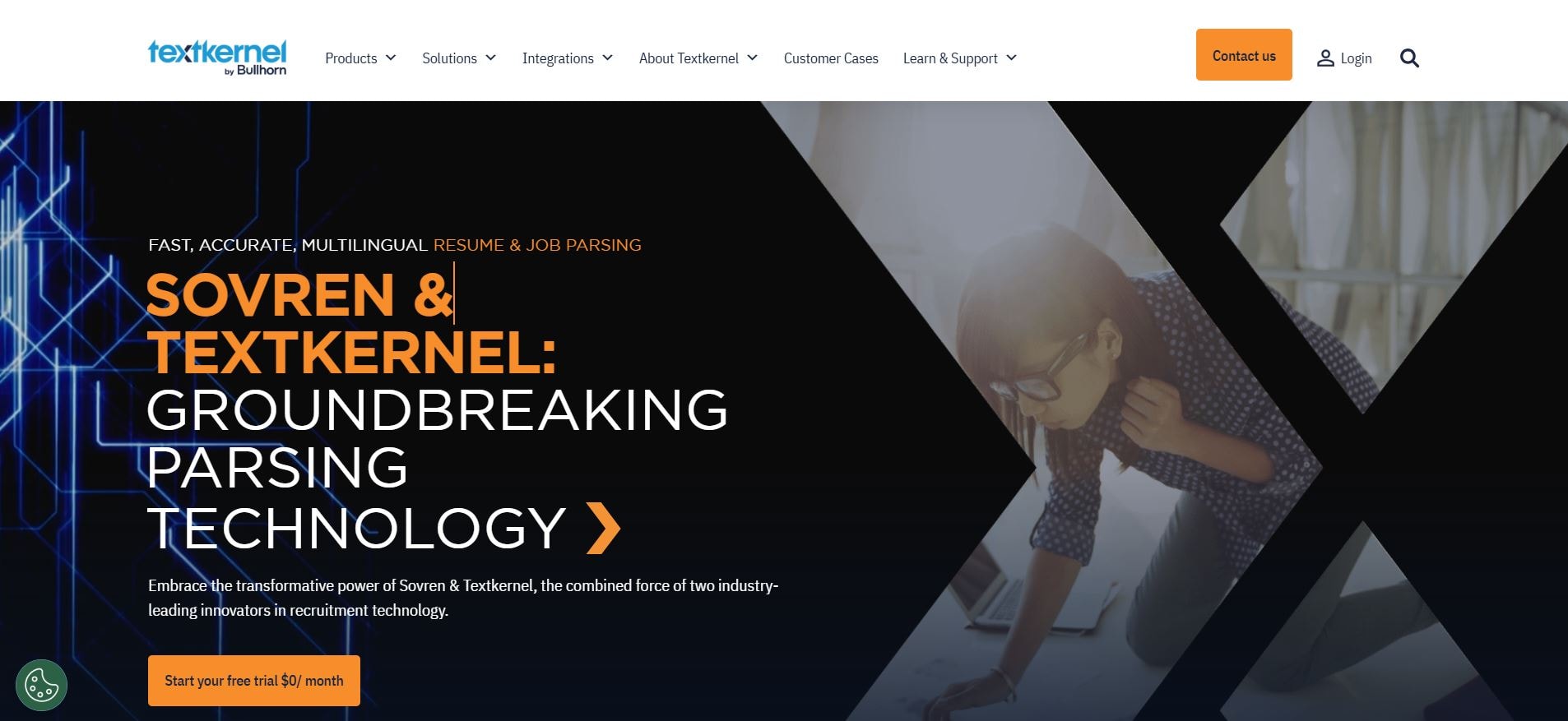
Sovren offers semantic matching and resume parsing technology on an enterprise level. The platform understands context and synonyms, so the difference between “managed” and “led” means similar leadership experience, or that some job titles can represent the same role.
Its advanced NLP enables AI to learn about synonyms, industry-specific words, and transferable skills, not just the frequency of the keywords. This feature helps Sovren surface candidates who meet the job specifications, even when they use different terminology. AI resume screening accuracy improves when systems understand meaning rather than just matching exact phrases.
What works?
- Advanced semantic matching functions
- Accuracy and reliability on the enterprise level
- Context-based resume analysis
- High endorsement of advanced, expert jobs
What doesn't work?
- Increased price and positioning points are geared towards the enterprise buyer
- It requires technical skills to implement
- Small hiring groups may find it difficult to operate
- Needs human intervention in highly specialized or new job roles
Pricing
Standard plans start at $99/month; high-volume enterprise API plans start at ~$2,000/year.
7. Endorsed AI - Best for Bias-Free Skill Validation
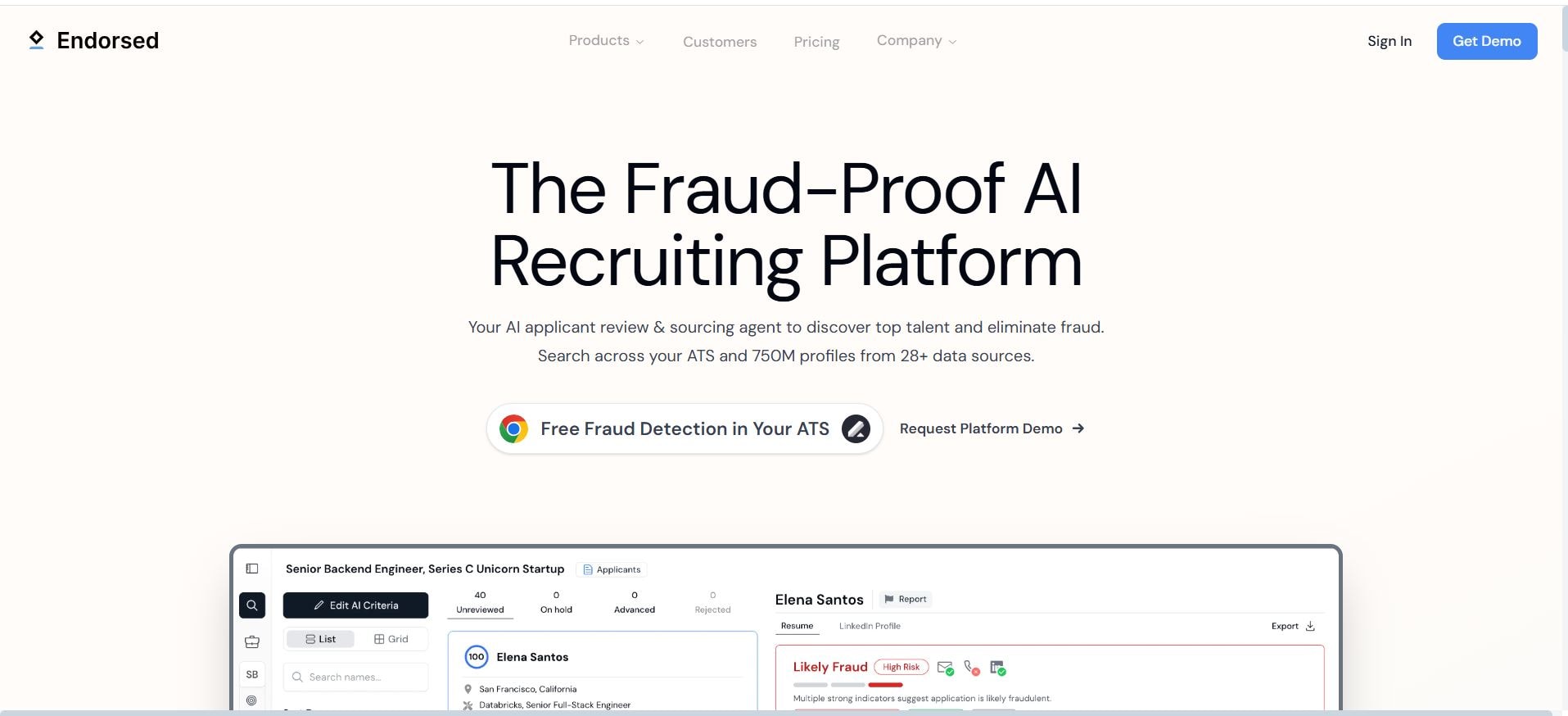
Does your team have problems with unconscious bias intruding into the hiring process? Endorsed AI is based on bias-aware and skills-based candidate screening. The platform relies less on job titles, qualifications, or years of experience, which might introduce bias, and instead uses demonstrated competencies to evaluate candidates.
AI resume screening tools can reduce bias by applying consistent scoring and can anonymize resumes. Endorsed AI takes this principle to the systematic level, enabling organizations to create more diverse candidate pools. AI screening technology that prioritizes skills over traditional markers can uncover strong candidates who might otherwise be overlooked.
What works?
- Skills-based appraisal minimizes conventional bias
- Equal scoring of all applicants
- Brings forward non-traditional candidates
- Promotes diversity and inclusion
What doesn't work?
- Needs a clear definition of the skills required for that job
- May require revision to credential-sensitive positions
- Learning curve for teams used to traditional screening
- Better suited to companies that believe in skills-first hiring
Pricing
Skill-based evaluation and bias-auditing tools are priced on a volume-based, custom contract basis.
8. X0PA AI - Best for Predictive Performance Analytics
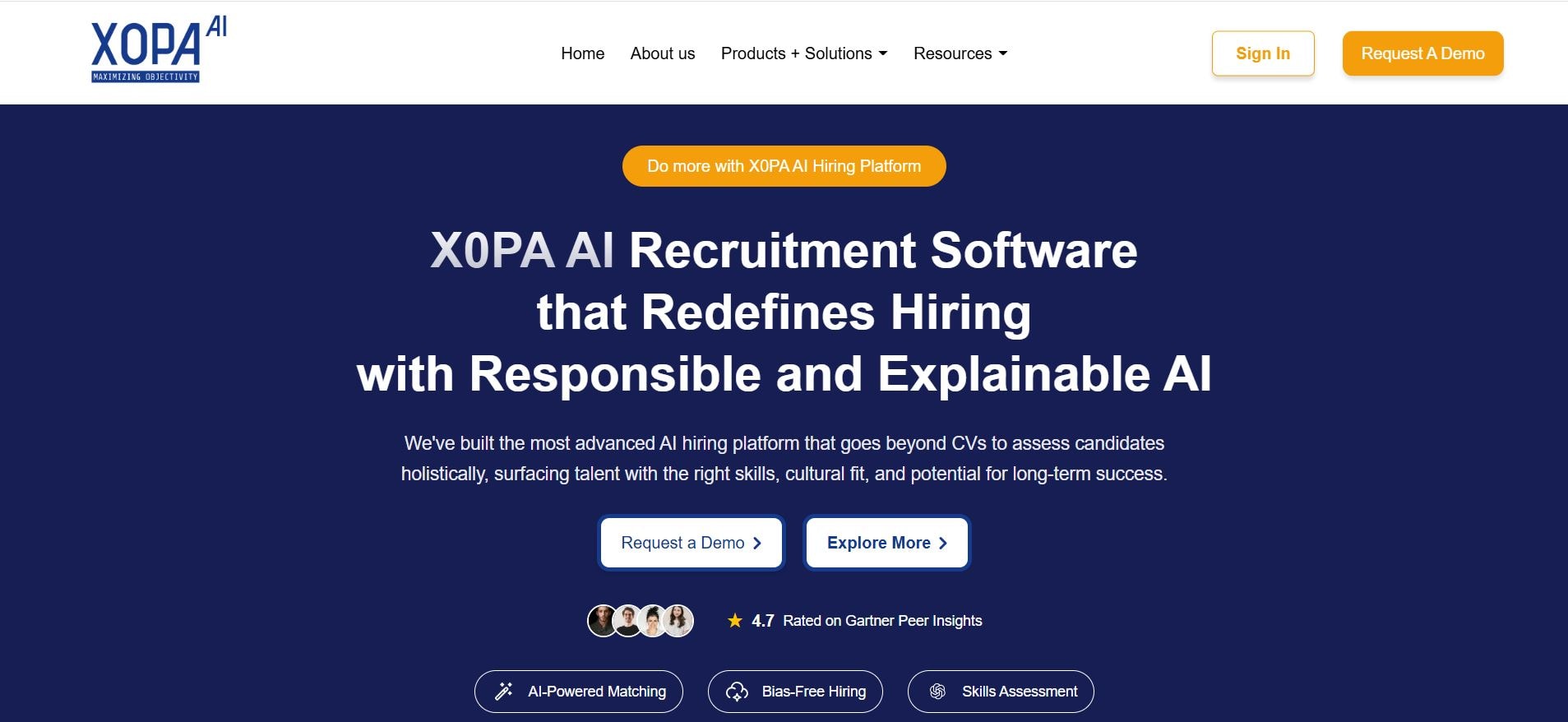
X0PA AI provides automated candidate matching and analytics screening. AI models assign a fit score to candidates based on how well their abilities align with job requirements.
X0PA AI converts these scores into a transparent, actionable format that helps recruiters spend their time wisely. AI tools for candidate screening improve hiring efficiency when they provide clear, justifiable rankings.
What works?
- Clear candidate fit scores
- Support decision based on analytics
- Automated matching greatly helps to minimize manual work greatly
- Scaleable with various levels of hiring
What doesn't work?
- May demands company culture calibration
- The transparency of scoring varies by implementation
- Most appropriate in jobs with definitive qualification criteria
- Needs continuous improvement of the corresponding algorithms
Pricing
AI Recruiter Core starts at $28,000/year (5 seats included); RPO plans start at $89/user/month.
9. Arya (Leoforce) - Best for Talent Intelligence
Arya is an AI talent intelligence software that provides an end-to-end resume screening service. The platform examines the skills, experience, and career paths to determine candidate success.
Machine learning models used in AI resume screening can forecast a candidate's future performance and retention risk. AI candidate screening tools with predictive capabilities add strategic value beyond basic qualification matching.
What works?
- Candidate success predictive analytics
- Transferable skills identification
- Extensive talent intelligence
- Prospective employee screening
What doesn't work?
- Small teams may be bogged down by complexity
- Needs significant data on candidates for accurate results
- A lot to learn to implement its features fully
- Most appropriate for organizations with advanced hiring policies
Pricing
Arya Pulse (Pay-per-job) starts at $100–$599 per job; Enterprise plans are subscription-based.
10. Ideal (Dayforce) - Best for Large-Scale Workflow Efficiency
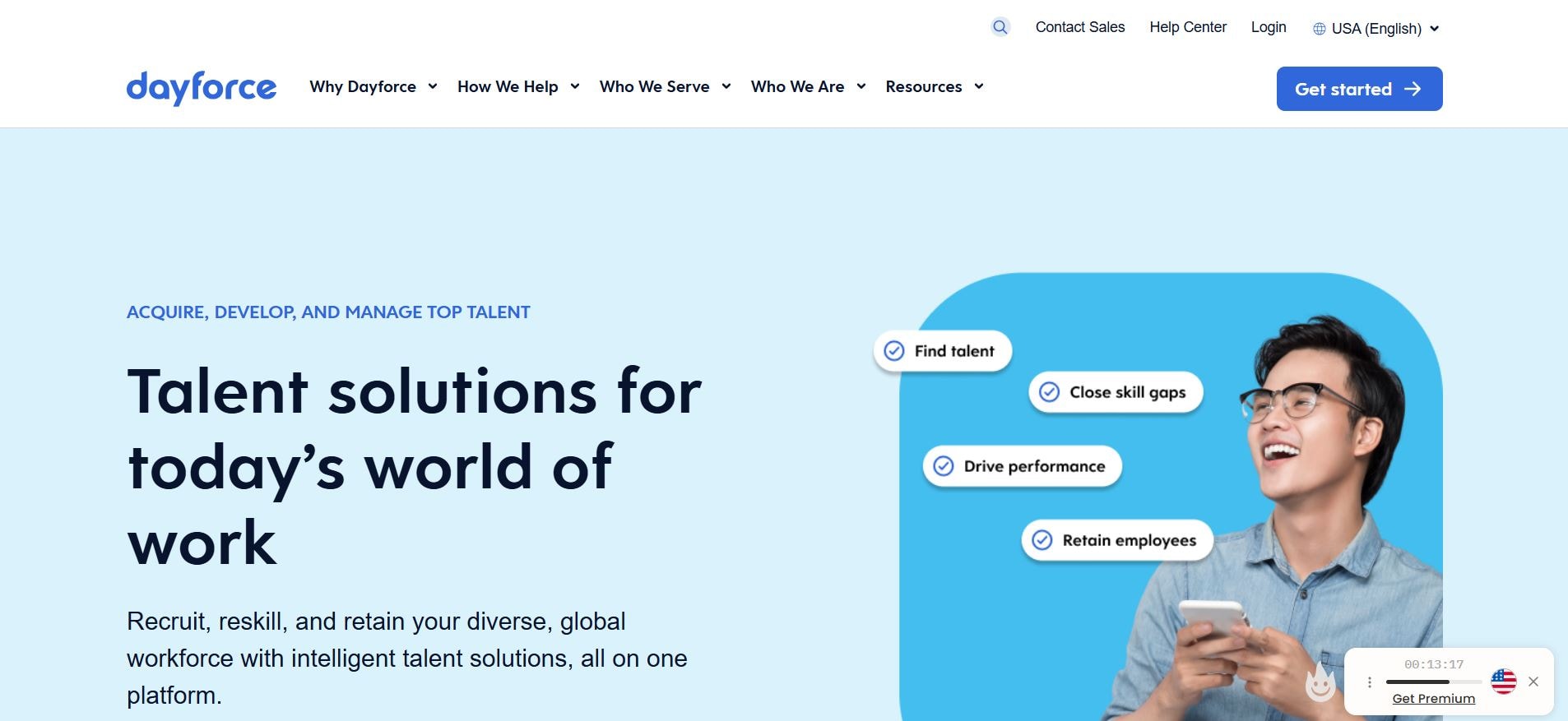
Ideal is an automation-oriented tool that focuses on resume screening and optimizing recruiter workflows. Repetitive screening processes are automated, and recruiters focus on candidate interaction and interviews.
Best AI tools for candidate screening remove bottlenecks rather than just speeding up existing processes. A significant increase in AI efficiency will help reduce the time spent on initial resume screening by 75-80%.
What works?
- Huge time saved on manual screening
- Maximum-efficiency automation-first design
- Real-time workflow optimization in the hiring process
- Scales effectively for high-growth companies
What doesn't work?
- Some candidates may find heavy automation personal
- Needs process discipline to achieve the best outcome
- The initial setup requires time investment
- Teams have to go under an intense automation-based workflow
Pricing
Approximately $22–$31 Per Employee Per Month (PEPM), plus a one-time implementation fee.
What Are AI Resume Screening Tools?
AI resume screening tools are software solutions that use artificial intelligence to automate and enhance the review and evaluation of job candidates' resumes. The platforms seek to match job requirements with candidates by analyzing various aspects of their resumes, including skills, experience, and education.
How the Technology Works
AI resume screening tools use machine learning, Natural Language Processing (NLP), and algorithms to analyze, rank, and parse applications based on skills, experience, and keywords.
You post resumes or link the tool to your application source. The AI analyzes resume data and combines it with data from platforms such as LinkedIn and portfolios to create structured candidate profiles. It then compares these profiles with your job posting, generating scores and rankings that help you quickly find the best candidates.
Beyond Keyword Matching
Today's systems do not limit themselves to the number of keywords. AI resume screening tools increasingly use recommendation-led matching to surface candidates with promising growth patterns even without prior specific job titles.
In contrast to conventional applicant tracking software, AI systems develop their algorithms as they learn and improve with time. The more candidate suggestions recruiters approve or reject, the smarter the AI becomes at identifying what constitutes a good fit for particular positions.
Skills-First Evaluation
AI resume screening tools have evolved to analyze 'skills-first' data to identify top talent. They can highlight technical and soft skills in a user-friendly view, helping recruiters focus on capabilities rather than credentials alone.
Why Do You Use AI for Resume Screening?
Have you ever found yourself lost in hundreds of applications, unsure how to go through them all? The delays caused by manual screening cost you good candidates who get offers elsewhere as you continue to sift through your stack.
Speed Wins Top Talent
AI can screen hundreds of resumes in minutes, with one study showing a 35% reduction in hiring time. This acceleration reduces time-to-hire and increases access to talent in competitive markets. AI resume screening can significantly reduce the time spent on manual resume evaluations, allowing recruiters to invest more energy in relationship-building and interviewing.
Massive efficiency gains from AI can reduce initial resume screening time by up to 75–80%. The resume summary generator shows that AI helps simplify the hiring process, but does not override human judgment.
Accuracy Beats Guesswork
Automated systems have an accuracy rate of about 95%, compared with a manual screening accuracy rate of about 70%. Increased accuracy will lead to fewer qualified applicants falling through the cracks and fewer poor fits consuming valuable interview time.
Human reviewers have good and bad days, which can inadvertently affect their decision-making. Prejudices creep in unconsciously. Fatigue affects judgment. AI also reduces the unconscious biases based on other factors, including gender or age, as AI is only interested in qualifications and experience. A candidate profile is evaluated in the same manner, irrespective of when it is entered into the system.
Scale Without Breaking
AI tools can adapt and learn from data, continuously improving screening capabilities as applicant pools grow without increasing the time spent reviewing the data in proportion. Have you noticed that manual screening slows down as application volumes grow? AI resume screening tools can compile a list of quality candidates much faster than human recruiters.
Candidates Appreciate Speed
Automation in hiring enables faster response times and personalized feedback at scale, boosting candidate engagement. Hiring automation can also provide quicker response and scalability of the hiring process, as well as hire-specific feedback, increasing engagement with the hiring process. Job hunters like prompt recognition and clear communication, rather than waiting weeks for screening feedback. Artificial intelligence can speed up the hiring process and enable faster interviews to fill vacancies.
How to Choose the Best AI Resume Screening Tool?
When choosing an AI resume screening tool, consider customization, scalability, user reviews, and the tool's ability to meet your specific recruitment needs.
Match Tool to Volume
Does your team recruit for a couple of specialized positions or handle high-volume hiring across numerous positions? A tool that is effective with 10 monthly hires can fail with 100 applications. Enterprise platforms designed for thousands of applications often bring unnecessary complications for smaller teams.
Integration Breaks or Makes a Workflow.
Does it integrate with your current ATS, HRIS, or communication systems? AI resume screening tools can help employers focus on high-potential candidates and optimize job postings only when they fit smoothly into broader systems.
Demand Transparent Scoring
AI resume screening tools can generate scores for each candidate, reflecting how well their skills and experience match the job requirements. These scores must not be black boxes, but must be explainable.
Calculate Real Costs
There are websites that charge per user, per candidate screened, or on a hybrid model. Add up all costs based on the anticipated hiring volume, not just the advertised base rate.
AI Resume Screening ROI: Cost vs. Time Savings for Your Hiring Team
Time Savings Per Hire
The hidden killer for a recruiter is manual resume screening. When a recruiter with an annual salary of $72,800 takes 5 minutes to handle a resume during primary screening, you are paying about $ 2.92 per resume. On a 500-resumes pipeline, that means 40 hours of billable recruiter time.
AI flips this equation entirely. Companies implementing AI resume screening cut screening time from 60 hours to 8 hours per role, filling first-round interview slots within 10 days instead of 45. AI-powered screening tools can reduce the time spent reviewing resumes by up to 75%. That is not incremental: that is transformational!
Cost Per Candidate Processed
In cases where companies screen 500 candidates each month, and each candidate costs $1 to run through AI, they save $2,300 to $3,000 in direct recruiter costs. In short, it's 82-86% cost savings of $27,600 to $36,000/annum, including 75-85 hours per month of recruiter time saved.
To put this into perspective: assuming that the time of a recruiter costs $50/hour, AI will save approximately 6-8 hours of manual screening per role, which would save up to $1,500 per role, depending on the hourly rates of a team.
Payback Period & ROI Timeline
Most businesses do not have to wait months before they realize returns. A majority of companies achieve positive ROI within 3-6 months, and larger organizations tend to recover costs within the first month through volume savings.
Teams claim to have reduced cost-per-hire by 20-40% when AI handles all screening and scheduling. To put this into perspective, the average cost per hired individual is about $4,700, and even a small-scale implementation of AI will reduce costs by thousands of dollars per position.
Hidden Benefits Beyond Direct Savings
Reducing time-to-shortlist from 7-10 days to 1-2 days translates into 4-8 days faster time-to-hire overall, and in competitive talent markets, winning the speed race often means securing your first-choice candidates.
Quality improves, too. When recruiters are not flooded with resumes, they can focus on relationship-building, deeper candidate assessment, and strategic sourcing, thereby enhancing the quality of hires and reducing turnover costs.
Calculating Your Specific ROI
The formula is simple: (Hourly recruiter rate × hours saved per month) - monthly tool cost = your monthly ROI.
For example, a team with one recruiter at $50/hour saving 20 hours monthly on screening, minus a $200 tool fee, realizes $800/month in net savings. That's $9,600 annually; enough to justify the investment within weeks.
Your exact savings depend on hiring volume, team size, and current screening time. The key insight: if you're processing more than 50 candidates monthly per recruiter, the numbers almost always work.
Why Choose Sintra AI?

Costly ATS systems require weeks to set up. You require screening assistance, but do not intend to change your whole recruitment process. Sound familiar?
Scouty is an AI agent from Sintra that performs resume analysis and candidate comparison without coercing you into a strict enterprise software solution. Upload the collected resumes or connect your application source directly. Scouty will match pertinent skills, experience, and qualifications to your job requirements and provide concise summaries to successful candidates in a couple of minutes. It is that simple!
AI tools for resume screening are not a substitute for human interventions; recruiters are still required, without straining them. The platform serves small startups and emerging businesses, as well as larger companies that review hundreds of applications every month.
Have to create job descriptions? The job description generator quickly creates attractive job ads. Ready to extend offers? The offer letter generator handles that. AI candidate screening tools will be worth using when they can adjust to your workstyle.
Food for Thought
Conventional ATS systems enforce workflows rather than adapting to the current hiring process. You set up fields, develop templates, and educate teams on a given process that might or might not be how you actually hire.
By the end of 2026, approximately 70% of businesses are expected to use AI in their hiring processes, with 82% relying on it to sift through resumes. This shift is increasingly toward flexible, composable services rather than monolithic ones.
Brain AI is a repository of company knowledge, job requirements, and hiring preferences that guides screening decisions across every hiring. AI integrations link screening tools with communication, calendar, and collaboration systems to enable the automatic flow of candidate data.
AI has the potential to reduce unconscious bias by focusing on candidate information and qualifications rather than other factors. Textio applies AI to optimize job descriptions for inclusivity and to identify unconscious bias in recruiting messages.
Ready to Try Scouty?
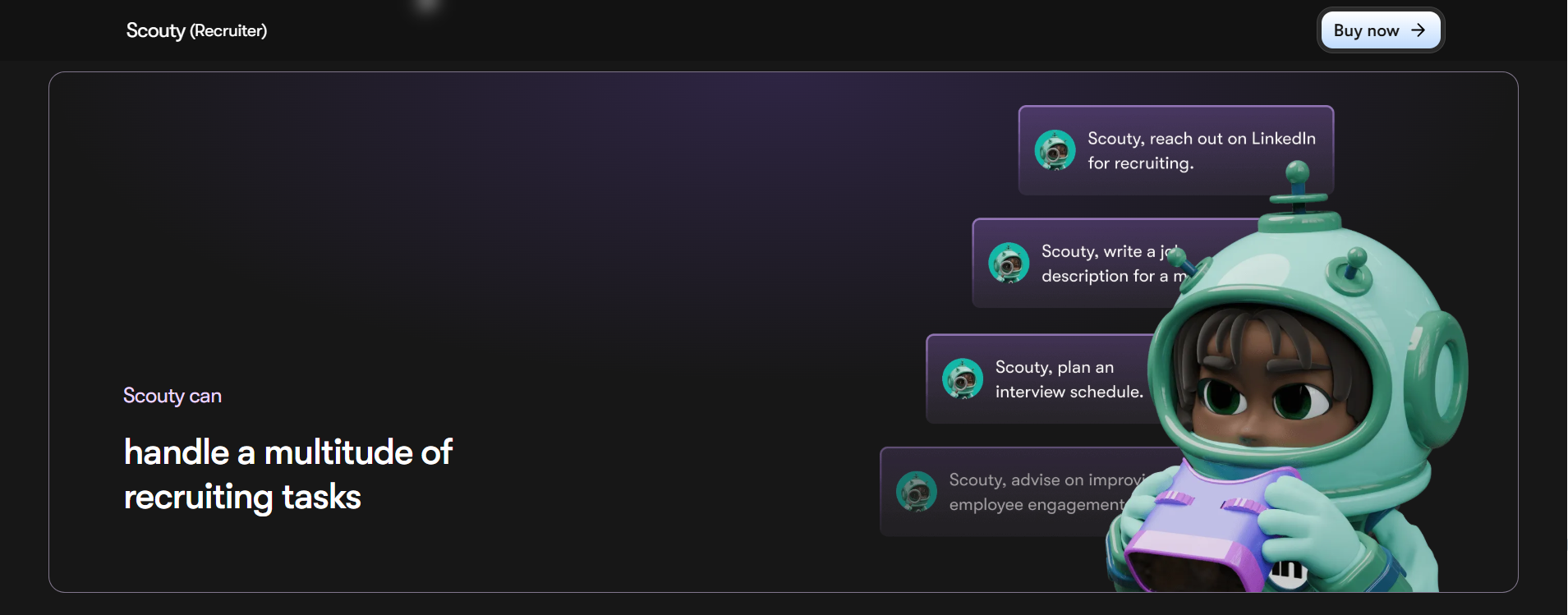
AI resume screening tools can generate a list of high-quality candidates much more quickly than a human recruiter. Scouty uses this potential without being too bulky or intimidating.
Post resumes for an open position and watch Scouty work to present the right options, identify possible matches, and help you prioritize interviews. Check out Sintra AI's pricing to see the plans. Or plan a full AI team to automate the recruiting process, not just screening.
Resume Screening FAQs
How does AI help in reducing bias in recruitment?
AI can eliminate unconscious bias by focusing on candidate data and qualifications rather than demographic factors. AI resume screening tools can reduce bias by applying consistent scoring and can anonymize resumes. Companies implementing AI for resume screening have reported a 16% increase in workforce diversity.
Can AI screening tools integrate with existing HR systems?
Yes. Most modern AI resume screening tools offer integration with popular ATS platforms, HRIS systems, and communication tools. AI resume screening tools extract information from resumes and integrate data from sources like LinkedIn and portfolios to create structured candidate profiles that flow into existing systems.
Is AI in recruitment a trend that will continue to grow?
Yes, AI in recruitment is expected to continue growing. AI resume screening tools can compile a list of quality candidates much faster than human recruiters, and as the technology becomes more accessible, more organizations will adopt these solutions to solve hiring bottlenecks.
Are AI resume screening tools suitable for small businesses?
Yes. AI resume screening tools are now available to organizations of all sizes. Small teams benefit from efficiency gains. AI resume screening can significantly reduce the time recruiters spend screening resumes, allowing small HR departments to compete for talent despite limited staffing.
Can AI tools replace human recruiters entirely?
No. AI resume screening tools can provide recruiters with the best-fit candidates, but human judgment remains necessary for cultural fit assessment, nuanced evaluation, and relationship-building.
What are the risks of using AI for candidate screening?
Resume screening AI can be biased because it may have been trained on historical data that indicates discriminatory trends. Systems can also struggle with highly specialized or emerging roles that lack sufficient training information. Excessive use of automation may overlook great candidates who do not conform to stereotypes. Given these risks, human supervision is still needed.
Related articles





Copyright © 2026 PlayOS, Inc. All rights reserved