Generative AI for Sales

Skip ahead
Generative AI for Sales – How It’s Reshaping the Future of Selling
Sales teams don’t fail from a lack of sales effort. They fail from wasted time. Account Executives and Sales Development Representatives spend hours chasing weak leads, writing outreach that goes unread, and updating CRMs instead of selling.
Generative AI changes this. It finds the right prospects, writes personalized outreach in seconds, and gives salespeople the insights they need before every call. Instead of drowning in admin, they can focus on building relationships and closing deals.
And it works. Salesforce found that 83% of sales teams using AI grew revenue, compared to 66% without it.
This guide shows where AI drives real results in the sales process, how to use it, and what to watch out for as you scale.
What is Generative AI for Sales?
Generative AI for sales refers to AI systems that create content, insights, and recommendations to support the sales process. Unlike basic automation, which only speeds up tasks, generative AI can draft personalized outreach, summarize customer interactions, and highlight opportunities based on data.
It’s designed for:
- Sales reps who need to save time on manual tasks
- Sales managers who want pipeline visibility
- Sales leaders aiming to improve sales performance and forecasting
- Business-to-business (B2B) teams looking to scale outreach without losing personalization
The impact shows up in everyday work. Marketing teams spend less time on data entry, repetitive follow-ups, and writing sales scripts. Instead, they get personalized content, real-time customer insights, and data-driven guidance that helps them focus on revenue growth.
Types of Generative AI Tools for Sales Pros
Generative AI for sales is evolving fast, with new tools and features appearing almost daily. At the core are large language models (LLMs), advanced systems based on natural language processing, which power most sales AI platforms. For sales professionals, these tools generally fall into two categories: offline and online.
Offline Language Models (LLMs)
Offline LLMs act like on-demand writing assistants. They generate sales scripts, outreach templates, and follow-up drafts based on prompts.
For sales reps, this means faster content creation and less time spent on repetitive writing. These tools are most useful for preparing personalized messages, proposals, or internal sales materials.
Online Language Models (Real-Time AI Tools)
Online LLMs connect with live data sources to provide up-to-date insights. They can surface market trends, customer signals, or competitive movements in real time.
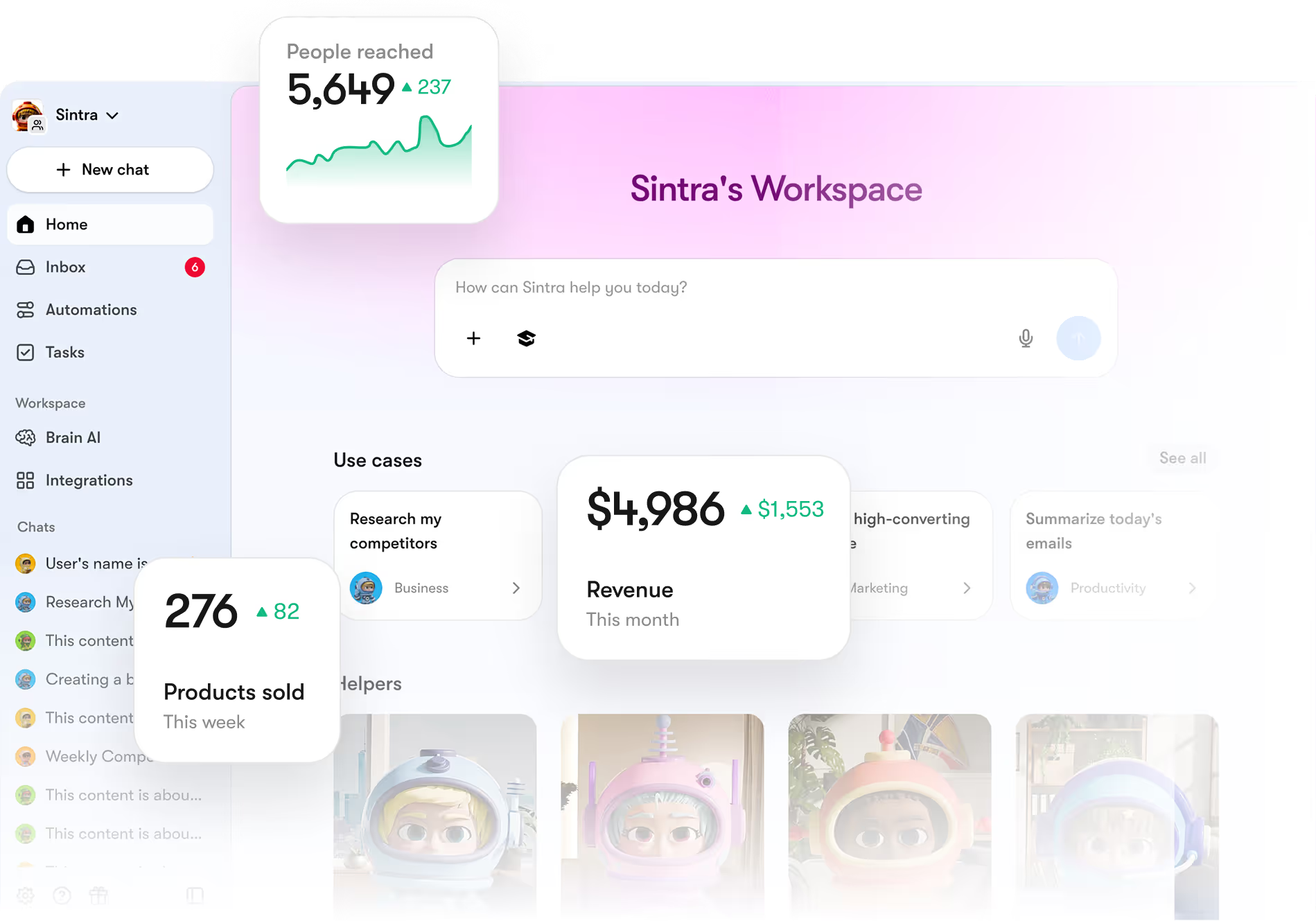
For sales managers, this means forecasts and meeting prep are based on relevant information, not outdated reports. Generative AI Solutions like Sintra AI build on this model, integrating directly with CRM systems and customer interactions to deliver real-time support throughout the sales cycle.
Generative AI for Sales – Top Use Cases
Gen AI tools has already moved beyond hype. Top sales teams are applying it across the funnel, and seeing real gains. A recent Bain report suggests AI can free up a significant portion of reps’ time for selling
AI-Powered Prospecting and Lead Research
Prospecting is one of the areas where Generative AI makes the biggest impact on the sales process. For most sales reps, it means sorting through long lists, checking LinkedIn, and hoping to find the right lead. It takes time and leads nowhere.
Instead of manually scanning hundreds of company profiles, Generative AI can analyze data, enrich contacts, and flag high-intent leads. In practice, sales teams using AI for prospecting report that they identify better leads 55% more effectively.
For example, if a mid-market finance company raises new funding, the AI system updates the record in your CRM, tags the right decision makers, and alerts the sales agent to reach out immediately.
Intelligent Sales Chatbots & Virtual Assistants
In sales, teams face repetitive early-stage interactions, such as answering FAQs, qualifying leads, or scheduling meetings. These tasks take time, slow responses, and distract sales reps from higher-value conversations.
Vizzy of Sintra solves these challenges with AI-powered chatbots and virtual assistants. It engages prospects in real time, captures customer information, and routes them toward the right action.

The chatbot works like a virtual sales assistant, guiding prospects through structured interactions and adapting based on their responses.
For example, when a prospect asks about pricing, Vizzy can ask follow-up questions like:
- What size is your team?
- Are you evaluating specific features?
- Do you want to see a demo?
Based on the answers, Vizzy qualifies the lead, schedules a meeting with the right sales rep, and records the full conversation for context before the call.
Personalized Communication at Scale
When reps send dozens or hundreds of emails, it’s easy to fall back into generic templates.
Many buyers now expect outreach that feels familiar. This reflects their recent activity, needs, and customer preferences. Yet for most sales professionals, crafting such messages for every lead is unrealistic.
Generative AI helps by combining customer data, CRM systems, and past interactions. It generates outreach (emails, LinkedIn notes, proposals) that respect the brand’s voice and adjust tone based on customer sentiment.
Preparing for Meetings and Negotiations
Walking into a sales call with only surface-level info is risky. You can miss objections or fail to connect with what matters most to the customer.
Generative AI tools scan past interactions, competitive signals, and customer insights to prepare tailored talking points. Instead of manual research, reps start meetings with relevant data.
The system can highlight:
- Key details from previous interactions
- Recent company updates or market news
- Customer needs and potential objections
- Competitive comparisons that influence decisions
Some tools act like copilots during meetings, surfacing snippets or competitor benchmarks in real time. This reduces prep time and gives reps confidence in every conversation.
Predictive Analytics & Forecasting
Recent studies show AI forecasting can reduce errors by more than 30 percent compared to traditional methods.
Many B2B managers say they trust forecasts more when they come from data, not gut feel. Forecasting based on intuition leads to surprises and missed targets.
“Generative AI improves accuracy by analyzing the full sales funnel, historical data, and customer behavior, delivering more reliable forecasts without sacrificing quality. It predicts which deals are most likely to close and when, giving sales leaders clearer visibility into the pipeline.
AI-Driven Sales Training and Coaching
Many sales managers struggle to coach every rep well. They lack time. They can’t listen to all calls.
Generative AI fills that gap. It listens to recorded calls and chat transcripts. It spots weaknesses, like weak messaging, pacing, or missed objections, and gives tailored feedback. Some systems even offer on-demand role-playing and simulations.
Here’s why this approach works well:
- AI coaching is always available, helping reps improve any time
- It pulls insights from all interactions, not just ones managers hear
- Teams using AI coaching report gains in win rates, consistent skill development, and more scalable training.
How to Integrate Generative AI into Your Sales Strategy?
Generative AI adds value when it becomes part of daily sales workflows. The goal is not more tools, but more efficient prospecting, outreach, forecasting, and coaching.
Many teams now treat these systems as AI employees that handle repetitive work so reps can focus on customers and closing deals.

The steps below show how to integrate AI into your sales process:
Step 1 – Connect Gen AI with Your CRM
Your CRM already holds your most valuable asset, customer data. Connecting generative AI to it means your AI doesn’t start from zero. It learns from your real interactions, deal history, and account signals.
AI-powered CRMs can analyze data, enrich records, and automate mundane tasks like data entry, freeing reps to sell.
To do this well:
- Map which data fields AI will read and write (e.g., contacts, deal amounts)
- Enable secure APIs so AI and CRM can exchange data
- Add human review in early stages to avoid errors
- Test on a small segment before full rollout
Once your AI shares the same data foundation as your team, you can score leads, write outreach, and forecast work faster and smarter.
Step 2 – Automate Personalized Emails & Follow-Ups
Sales leaders know that reps waste hours rewriting emails and chasing replies. The problem isn’t sending messages. It’s doing it at scale without losing relevance.
Integrating generative AI into your CRM and email tools fixes this. Instead of juggling templates, the system drafts personalized outreach directly inside the platforms your team already uses.
Triggers like “new lead created” or “no reply in three days” launch the sequence automatically.
To make it work in practice:
- Connect your AI tool to CRM fields that store customer data and past interactions.
- Build a set of reusable frameworks that the AI can adapt to account-specific details.
- Decide which steps run without approval and which require rep review.
- Track engagement in real time and refine the rules when open or reply rates drop.
With this setup, follow-ups happen consistently in the background, a major driver of sales productivity. Reps don’t waste time on manual outreach. They step in only when a customer interaction moves the sales conversation forward.
Step 3 – Enhance Lead Scoring & Deal Prioritization
Generative AI applies predictive analytics to lead scoring. It uses historical sales data, behavioral signals, and conversion patterns to rank leads by likelihood to buy.
AI models spot trends in past wins and surface accounts that match those traits. To integrate this well:
- Standardize your data. Remove duplicates and ensure fields like “company size,” “industry,” and “engagement behavior” are structured.
- Train the AI model using your past won-lost deals. This helps it learn your sales cycle and customer behavior.
- Define thresholds for “sales-ready” scores so only high-potential leads reach reps.
- Build dashboards and alerts for sales managers when lead scores cross thresholds or change dramatically.
- Continuously monitor model performance and adjust. Re-evaluate which features (behavioral metrics, firmographics, intent data) drive conversions.
With this setup, sales reps know which leads to pursue. Sales managers gain clarity over pipeline focus.
Step 4 – Deploy AI Chatbots Across Channels For Sales Calls
AI chatbots let sales teams engage prospects on websites, apps, and messaging tools. The key is connecting them to CRM and marketing systems so every interaction updates customer records.
Start by defining the chatbot’s role. Some teams use it to qualify leads, others to schedule demos or answer pricing questions. With clear goals, integration ensures the chatbot supports the sales process instead of sitting on the side.
The chatbot should handle routine questions but know when to pass a conversation to a sales rep. Training it with past chats, support tickets, and call transcripts improves accuracy.
Performance tracking is essential. Monitor:
- Completion rates
- Qualified leads
- Drop-offs
This helps refine responses and decide when to scale. Used this way, the chatbot removes repetitive tasks and makes sure sales reps enter conversations with context.
Step 5 – Measure ROI and Optimize Continuously
To know if your AI is worth it, you must measure sales outcomes.
Start by establishing a baseline before AI deployment. Track metrics like average deal size, conversion rates, response times, and rep time spent on outreach.
After rollout, capture gains from automation:
- Hours saved per rep
- Uplift in conversion or win rates
- Reduction in lost leads
Also include costs: software, training, maintenance, and data infrastructure.
Use a simple formula:
ROI = (Gains − Costs) ÷ Costs
For AI in sales, organizations report ROI multiples of 10 to 20 percent in the first year. Don’t forget to combine quantitative and qualitative feedback. Ask sales reps what works and what feels off. Use their insight to improve your AI integration over time.
Challenges and Considerations When Using Generative AI in Sales
Even with strong use cases and integration steps, deploying generative AI in a sales org isn’t risk-free. These are the real pitfalls leaders and sales professionals must plan for.
Hallucinations and Inaccuracies
Generative AI can confidently generate false or outdated data. These “hallucinations” misrepresent customer info or competitive insights. Models trained on stale or incomplete data tend to make more errors. If reps act on bad data, trust with prospects suffers.
Data Bias & Fairness Issues
If your training or input data carries bias, the system can perpetuate it, favoring certain customer segments or skipping valid leads. You’ll need to audit training data, detect bias, and correct it.
Transparency & Explainability
Many generative AI models are black boxes. It’s hard to trace why a lead was scored or why a message was generated a certain way. Sales managers and legal teams will demand clarity and accountability.
Intellectual Property & Data Leakage
Using external AI systems or third-party models introduces risk around IP. AI might generate content that mirrors proprietary data or leak confidential info. You’ll need rules around what the model can access and produce.
Integration & Workflow Misalignment
An MIT report finds 95% of generative AI deployments yield no measurable profit impact, often due to poor integration. Many AI projects fail because they don’t align with real sales workflows or existing tools. If reps see AI as extra work, adoption will stall.
Cost & Resource Constraints
Running generative AI (hosting, fine-tuning, GPUs, inference) comes with significant computing costs. Also, the ongoing cost of monitoring, retraining, and supporting the system can be larger than expected.
Model Staleness & Drift
AI models degrade over time if they aren’t updated. Market trends, customer behavior, and sales strategies shift. Without regular retraining, your predictions and content get outdated.
Over-reliance & Loss of Human Judgment
If reps blindly trust AI, they may lose strategic thinking or miss signals that the AI didn’t catch. AI should augment, not replace, human judgment. Always keep a “human in the loop,” especially for complex or high-value deals.
Ethical, Compliance & Regulatory Risks
Depending on your industry (healthcare, finance, etc.), AI output may run into regulatory or compliance issues. You need policies to ensure AI doesn’t violate privacy, security, or fairness rules.
Future Trends of Generative AI in Sales
The next wave of generative AI in sales won’t just assist, it will act.
Gartner predicts that by 2027, most seller research will start with AI. Instead of just providing suggestions, future systems will execute tasks like drafting proposals, scheduling meetings, and routing deals automatically.
- One major shift is the rise of AI agents. These are autonomous tools that can decide and act with minimal input.
- Another trend is multimodal intelligence. AI will combine text, voice, visuals, and market data to deliver deeper customer insights.
- Integration will also get easier. Generative AI will be built directly into CRM systems and collaboration platforms rather than added as separate tools.
As adoption grows, trust and transparency will matter more. Sales leaders will want to know why AI made a recommendation. Controls around bias, privacy, and compliance will be essential.
Looking ahead, sales teams will treat AI like a teammate. Those who learn to guide and collaborate with AI helpers will have the edge in building relationships and driving revenue. Explore AI Helpers.
What’s the Best Generative AI Tool for Sales?
The best Generative AI tool for sales depends on your team’s size, workflow, and goals. Some tools help with prospecting, others with training or forecasting. Here’s a quick look at the top AI tools in 2025 that are changing how sales teams work.
- Sintra AI: All-in-one AI assistant that handles outreach, lead scoring, and deal support
- Gong: Great for sales calls, meeting insights, and coaching
- Drift: AI chatbot for qualifying leads and engaging prospects 24/7
- Mindtickle: Focused on sales training, onboarding, and coaching
- HubSpot Sales Hub (AI Features): Ideal for small and mid-size teams using HubSpot CRM
- Clari: Best for forecasting and pipeline management
- Driftrock: Combines marketing and sales automation for smoother outreach
Each platform has different strengths: some help reps save time, others give managers better insights or automate daily tasks. Choose the one that fits your workflow and helps your team close more deals.
Ready to See Generative AI in Action?
Your team doesn’t need another sales tool. They need a system that takes work off their plate and helps them focus on closing deals. That’s exactly what Sintra AI’s Milli does.
Milli connects with your CRM, automates prospecting, personalizes outreach, and gives managers the data-driven insights they need to hit targets. Sales professionals spend less time on admin and more time with customers.
Get started with Sintra today and give your team the advantage of an AI Sales Manager built for modern B2B sales.
FAQs About Generative AI for Sales
How can generative AI be used in sales?
Generative AI supports sales by automating repetitive tasks and improving decisions. Sales teams use it for prospect research, outreach, meeting prep, forecasting, and training.
Instead of manual data entry or writing sales scripts, reps get insights and ready-to-send communication. This frees time for building relationships and closing deals while improving sales efficiency.
Is there an AI for sales?
Yes. Generative AI tools are built for sales workflows. They integrate with CRM platforms to automate prospecting, qualify leads, personalize interactions, and track performance.
Some work as AI assistants, others as AI sales managers who help sales teams streamline workflows and improve results. Sintra AI’s Milli is one option for B2B teams focused on efficiency and sales outcomes.
Can I use AI to generate sales leads?
Yes. AI analyzes historical sales data, customer behavior, and market trends to identify high-quality leads. Instead of guesswork, managers get ranked accounts most likely to convert.
AI also enriches customer data with details like company size or recent activity, so reps approach leads with context.
Can AI replace salesmen?
No. Generative AI handles tasks like research, scheduling, and follow-ups. This gives reps more time for sales conversations and customer relationships.
Complex customer needs still require human judgment, negotiation, and trust-building. The future of sales is not AI replacing professionals, but sales professionals using AI to deliver better customer experiences.


.jpg)
.jpg)
.jpg)