How to Use AI for Qualitative Data Analysis

Table of Contents

To use AI for qualitative data analysis, apply tools that read, categorize, and summarize text so you turn interviews, surveys, and open-ended feedback into clear insights faster than manual review. AI can tag themes, detect sentiment, and surface patterns without you reading every response.
Manual qualitative analysis is slow, inconsistent, and harder to scale as data grows. Traditional methods require lots of time and human judgment, which can introduce bias and delay decisions. AI accelerates the process, highlights trends across large datasets, and helps teams focus their interpretation where it matters most. The gap between power users and average users is telling - the top 5% of AI users send 6x more messages than the median, and in data analytics specifically, they use the data tool 16x more than the median worker.
This article shows how to leverage AI for qualitative analysis, which tools and techniques work best, and how to structure your workflow so you get accurate, actionable insights from unstructured data. If you're also curious about the infrastructure behind it all, our guide on what is an AI data pipeline is worth reading alongside this
Quick Answer: Can You Use AI for Qualitative Data Analysis?
Yes — AI can be used to facilitate the analysis of qualitative data by automating transcription, clustering responses, and quickly surfacing candidate themes. People continue to justify, interpret, and report on circumstances.
It’s best suited to business feedback, customer interviews, and open-ended surveys. In cases of academic-grade coding or more sophisticated methodologies, such as grounded theory, AI expert QDA tools, and strict human oversight should accompany qualitative data analysis.
What Is Qualitative Data Analysis?
Qualitative data analysis is the art of interpreting non-numerical data —such as interviews, open-ended questions, focus groups, and observations — to identify patterns, themes, and insights. In contrast to quantitative analysis (counting and measuring), qualitative research investigates the cause and effect of behaviours and opinions (why and how).
This traditionally required manually reading transcripts, tagging themes, and sorting insights, which could take weeks. AI also accelerates preprocessing and first-pass structuring, yet humans verify the accuracy of the meaning, context, and interpretation.
Why Use AI for Qualitative Data Analysis (Business Value)?
Qualitative data analysis powered by AI not only speeds up the work but also accelerates the shift from data to decisions.
Here is what you get:
✅ Time saved on transcription and notes – The work that was done for several hours is now done in several minutes.
✅ Consistent first-pass coding – The AI uses the same logic for all responses, making fewer mistakes than humans.
✅ Scale to massive datasets – Whether it’s 500 interviews or 10,000 survey responses, you can manage without getting lost in spreadsheets.
✅ Faster reporting – Extracting the themes and sharing them with others takes days instead of weeks.
A caveat: AI is not so good at nuance. For instance, it can hardly ever identify sarcasm, cultural context, or subtle changes in emotion. So, always verify the parts of the material you have used with AI with your source material.
Real-world example: A product team that is analysing 50 customer interviews can convert raw transcripts into a structured theme report in 34 hours rather than two weeks—without depth being compromised.
How AI Qualitative Data Analysis Works
AI qualitative data analysis works by processing large volumes of unstructured text, such as interviews, surveys, and feedback, and turning them into structured insights through automated cleaning, summarization, theme detection, coding, and sentiment analysis. Instead of manually reading every response, AI identifies patterns, clusters similar ideas, and highlights trends across segments in minutes. Humans then review, refine, and interpret these outputs to ensure context, nuance, and strategic relevance are preserved.
Core Workflow: Qualitative Data Analysis with AI (Step-by-Step)

The following is your step-by-step guide for qualitative data analysis with AI. All the steps are actionable, and you have specific prompts and tools that you may apply today.
Step 1 - Centralize Sources in a Knowledge Base
Put all your research in one place before you start to analyze anything. Transcripts, open-ended responses, and focus group notes—all must reside in a centralized place.
Why? Because scattered data gives scattered insights. Brain AI is your research hub, where transcripts, brand documents, and research context are stored to ensure consistency in the project analysis. Once your AI helper knows all the information, it will be able to identify links that you would not have noticed working file-by-file.
Step 2 - Clean & Normalize Text Before Analysis
Sloppy data produces sloppy results. Clean up the text before you analyse. Eliminate unnecessary and filler words like (um, uh, like), standardize the formatting, and correct apparent errors.
Garbage in, garbage out. When your transcripts are riddled with mistakes and contradictions, your themes will be as well.
AI tools can automatically do this for qualitative data analysis, and the text is ready to analyze. Clean text implies reduced errors and increased theme accuracy. Consider it like cutting ingredients before cooking; cleaner inputs produce cleaner outputs. Isn’t it great?
Step 3 - Summarize and Surface First-Pass Themes
After cleaning, extract the main points and propose potential themes using AI. This is not the final report, but only the first step.
Request the AI to identify frequent concepts, highlight suspicious responses, and propose a way to organize them. Qualitative data analysis AI tools can generate summaries that provide a quick overview. Always cross-check these summaries with the underlying data available to you, because AI is good at identifying patterns, but can oversimplify too.
Sample prompt: Summarize the key themes of these 30 customer interviews in 5-7 bullet points, and provide 2 sample quotes of each theme.
Step 4 - Code, Tag, and Cluster Iteratively
The next step is the actual work: coding. AI can generate coded responses and becomes sharper as patterns emerge.
You can take two approaches:
Deductive coding - begin with a list of themes that you are familiar with and label responses with those, such as ("pricing concerns" or "feature requests")
Inductive coding allows themes to emerge from the data themselves and to continue refining them as you proceed.
AI does this heavy sorting and clustering itself, but the code definitions and the selection of what matters are left to humans. AI tools for qualitative analysis are skilled at this back-and-forth process—clusterizing similar responses and proposing new codes as patterns emerge.
Sample prompt: Mark these responses with these five themes: [list themes]. Indicate any reactions that do not fit well.
Step 5 - Quantify Mentions, Sentiment, and Subgroups
Qualitative data analysis with AI not only dissects themes but also quantifies them. Record the frequency of each theme, sentiment (positive, negative, neutral), and compare across customer groups.
You are fed up with hearing reports of “several customers saying this” when stakeholders want to know how many customers—and what kinds—are most interested.
Sintra’s Dexter confounds text and numbers. Some of the questions that you can ask include: “What theme did enterprise customers mention most often? Or how does sentiment vary between new users and long-term customers?”
Real-life example: A SaaS company considered feature requests in other areas. They found that European users discussed privacy controls three times as often as North American users. This fact helps establish their roadmap.
Step 6 - Draft Insight Reports and Shareables
It’s not analyzed until it is shared. Qualitative data analysis with AI tools will enable you to quickly transform raw themes into refined reports.
The Sintra’s Power-Ups, such as Support Report Creator and FAQ Generator, convert the final outputs, which include summaries, key themes, supporting quotes, and subgroup differences, into files that can be utilized by the team. It’s essential always to include quote-level citations to build trust. Nobody is interested in a report that merely states that “customers are frustrated” without explaining why.
Pro tip: Prepare a one-pager containing 3-5 top themes, sentiment breakdown, and 1-2 quotes per theme. Executives prefer brief, concise information.
Using Sintra AI Assistants & Power-Ups
Sintra’s various AI assistants and Power-Ups act as a research team, with each one of them dealing with a different aspect of qualitative data analysis:
Brain AI keeps all your transcripts, brand context, and analysis guides in a single secure location, so your work is consistent across projects and team members. Means no more lost files or conflicting versions.

Dexter (AI Data Analyst) is your analytical powerhouse. It’s a mixture of qualitative text and quantitative patterns, where new themes can be identified, differences between customer segments can be spotted, and even simple forecasting can be performed based on feedback trends.

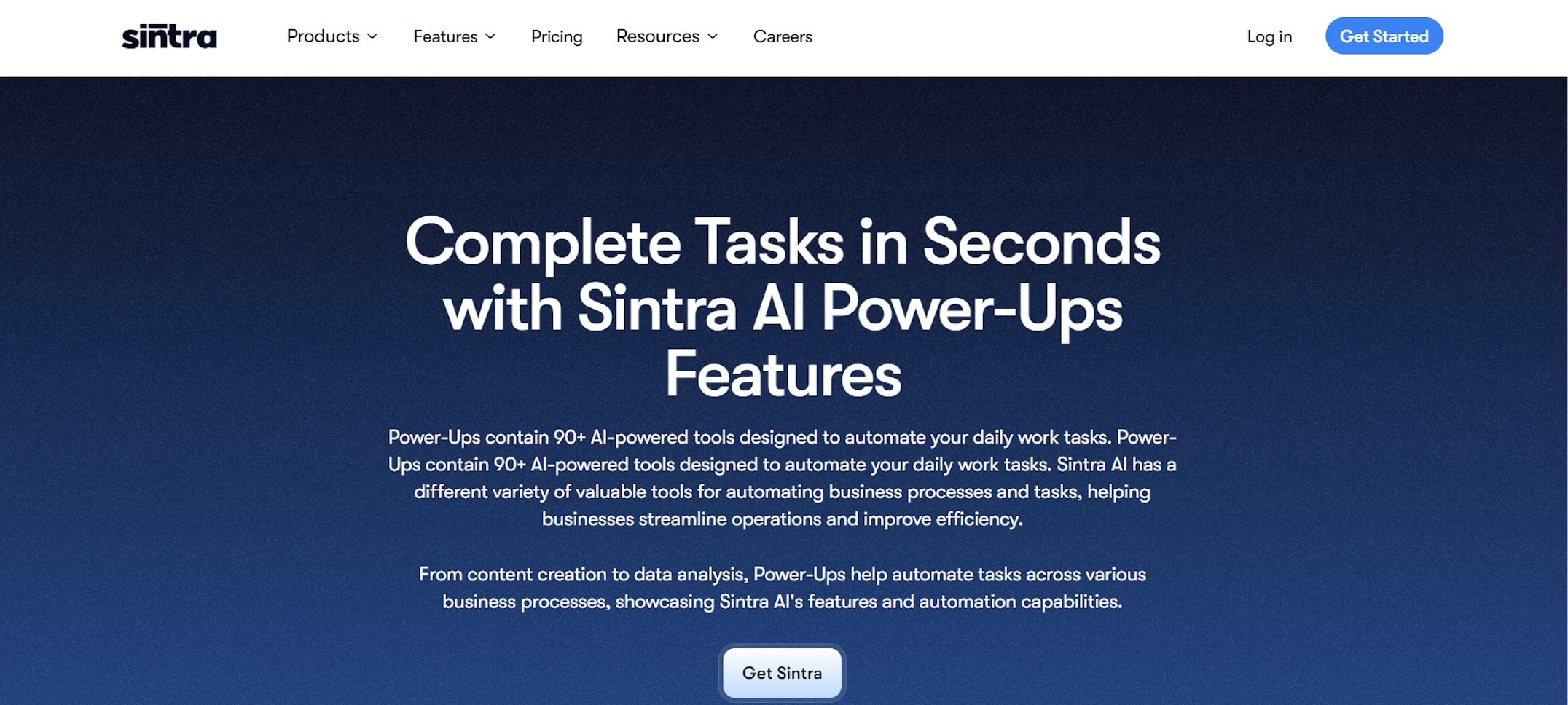
Power-Ups are your shortcut to structured outputs. The Support/Meeting Notes, Competitor Analyser, FAQ Generator, and Target Audience Analyser features can quickly transform raw qualitative data into refined, actionable insights.
One potential exception: If your academic coding is very specialized or your approach is very rigorous, such as grounded theory or discourse analysis, you might still need to combine Sintra with specialist QDA software, such as NVivo or ATLAS.ti.
Sintra AI vs. Traditional QDA & Point Tools
Unsure about which tool best suits your needs? Here is a simple comparison:
Sintra AI:
- Best for: Business groups, short-term projects, cross-functional workflows.
- Strength: Integrates multiple assistants to create a complete workflow, converts feedback/interviews/surveys into reports quickly.
- Use when: You want speed, simplicity, and integrated tools.
Qualitative Data Analysis (QDA) Software (NVivo, ATLAS.ti, MAXQDA, Dovetail, Looppanel):
- Best for: Academic research, granular coding, methodological rigour.
- Strengths: High level of control over coding frameworks, which have been designed for researchers who require auditing and documentation.
- Use when: You want academic standards, extensive methodology support, or ultra-detailed programming.
Point tools (transcription services, note-takers):
- Best for: Single tasks like transcription or meeting notes.
- Strengths: Capable of doing one particular job well.
- Use when: You just want one piece of the puzzle, not an entire workflow.
Pick your tool based on what you want to achieve, your data sensitivity, and your team's capabilities. The choice between speed and integration usually favours business teams; research scientists generally need depth and methodological control.
Data Security, Privacy, and Ethics
The responsible use of qualitative data is not a choice, but a necessity. People believed in what you said. Don't break that trust.
❌ Do not use public bots on sensitive information - Do not enter customer names, emails, or sensitive feedback into ChatGPT or other public tools.
✅ Work in secure workspaces privately - Tools such as Sintra have controls over access, encryption, and audit trails.
✅ Permission to document - Assure the participants that their data could be processed using automated tools.
✅ Retention of original data - Track insights to real quotes to be transparent and trustworthy.
✅ Check compliance requirements - Ensure that your tools comply with GDPR, SOC2, or HIPAA standards.
Quick security checklist:
- Remove or anonymize PII before uploading anything.
- Use SOC2/GDPR certified tools.
- The use of document automation in your research methodology.
- Maintain access logs of who accessed and when.
- Confirm all outputs using source material.
Prompts & Checklists You Can Reuse
Below are copy-paste prompts; you can save them and make use of them again and again for every step for qualitative analysis:
Theme discovery:
"Propose eight candidate themes using these transcripts with two exemplar quotes each. Ask me to confirm or merge overlapping repeating themes."
Sentiment analysis:
“Label each answer as positive, negative, or neutral. Visualize the distribution of sentiment and point out the most extreme cases of each.”
Subgroup comparison:
“Compare between [Group A] and [Group B]. Which group talks more about what? In what respects are they alike, and in what ways do they disagree?”
Quote extraction:
“Identify 3-5 strong quotes that can best describe [Theme Name]. Add some background information on the quote, including who said it, when, and why it is important.”
Quick QA checklist for bias and traceability:
- Did I test whether I was being biased in my choice of theme?
- Do all major themes occur in proportion to their frequency of occurrence?
- Can I find each theme in specific quotes?
- Did I take into consideration outlier views and minority views?
- Did I actually capture how automation was applied in this analysis?
Limitations of AI in Qualitative Analysis (Where Humans Still Win)
AI is not magic, but it’s powerful. This is where human beings and specialized tools continue to excel, even the best AI for qualitative data analysis:
Deep interpretive theming - Automation is good at seeing patterns on the surface, but not for multiple layers with complex meanings, metaphors, and cultural backgrounds that change everything.
Overlapping codes - In cases where answers can be assigned to more than one theme or lie between the cracks, human beings are better readers of the nuance and contradiction.
Memoing and reflection - In a program, you cannot memo-track your developing thoughts, research intuition, or those “aha” moments that happen at 2 am.
Grounded theory workflows - The tools available do not support the iterative theory-building process of grounded theory methodology.
Discourse analysis - The interpretation of power relations, implicit meaning, and rhetorical formulas — is a problem that still demands profound human insight and critical thinking.
If your work requires academic rigour, peer-reviewed standards, or sophisticated methodology, use NVivo, ATLAS.ti, or MAXQDA with AI qualitative analysis tools.
The best practices for qualitative data analysis of materials using AI involve knowing when to do the grunt work yourself and when it’s more appropriate to rely on automation.
Who Should Use AI for Qualitative Data Analysis?
AI qualitative data analysis is ideal for product teams, marketers, UX researchers, customer support leaders, and business analysts who work with interviews, surveys, and open-ended feedback at scale. It’s especially valuable for fast-moving companies that need to turn large volumes of qualitative input into clear decisions without waiting weeks for manual coding. Academic researchers can also benefit, but typically alongside specialist QDA tools and structured oversight. If your goal is to move from raw feedback to actionable insight faster, AI can significantly streamline the process.
Ready to Turn Months of Analysis Into Days?
Test Sintra AI and find out how quickly you can transform raw data into actionable insights that your team can implement. Need to research the pricing? Learn more about pricing.
Conclusion
Learning how to use AI qualitative data analysis does not mean mastering complex software or replacing your expertise. It’s about saving time and energy so you can focus on what matters.
You did not become a researcher, product manager, or business head to mark up transcripts in spreadsheets, but to find insights, make decisions, and get results.
AI handles the boring stuff — transcribing, first-pass coding, and clustering themes — to get to interpretation, planning, and action. It is not corner-cutting, but a matter of smarter working.
The rapidly moving firms are not necessarily the ones with the most considerable research and development teams. These are the ones who understand when to let the automation do the heavy lifting and when it’s best to rely on human judgment.
Those transcripts are hiding your next significant insight. The question is: how long will you take to find it?
AI Qualitative Data Analysis FAQs
Can AI really do qualitative data analysis?
Yes, but they have some limitations. AI can transcribe, perform initial coding, identify themes, and analyse sentiment. They can process vast amounts of data quickly, something a human would struggle with.
Nonetheless, they experience difficulties with deeper meaning, cultural detailing, and context. Consider them a speedy helper who will handle repetitive tasks so you can focus on interpreting, generating insights, and planning.
How does Sintra AI code interviews without losing nuance and context?
Sintra does not substitute your judgment; it aids it. It keeps your research context, brand guidelines, and project goals in mind, ensuring the coding is always focused on what you want to know.
Dexter suggests themes and codes by patterns that it finds, but they are checked, refined, and finalized by you. With the speed of automation and your supervision, you can discover patterns quickly without missing the subtle, powerful, and credible details that qualitative research offers.
Are there any risks of uploading transcripts to AI tools?
Yes, mainly if your transcripts include personal information, medical records, or business records. Do not post the unredacted names of customers, their email addresses, addresses, or other sensitive information on open-source websites such as ChatGPT.
Work with tools that have private workspaces, have strong access controls, and are certified on compliance (SOC2, GDPR, HIPAA). Sintra provides business-safe and private environments. Anonymize your information prior to uploading and map out its application in the research protocols.
Can AI help with inductive coding and theme discovery, or only deductive codebooks?
They both work well with these systems. In deductive coding, you provide themes first; responses are tagged by software quickly and consistently. In inductive coding, the tools can extract candidate themes by grouping similar responses.
You refine, merge, or split such themes as patterns become clearer. The best AI qualitative data analysis tools help create a repeatable process for identifying themes independently and refining them as you explore further.
How do I verify AI-generated themes and avoid bias or hallucinations?
Compare results with the original data each time. Read a random sample of real responses under each theme to ensure that they fit. Be careful of confirmation bias—admitting only familiar themes.
Check coverage- were there any system outliers, contradictory or minority views that are of interest? Record in detail how you refined suggestions. These tools provide a point of departure rather than a solution. Critical thought combined with knowledge of the subject makes automated suggestions credible.
When should I use specialist QDA tools instead of (or alongside) AI?
You should use specialist software, such as NVivo, ATLAS.ti, or MAXQDA, to ensure academic rigour and adherence to peer-reviewed standards, or to employ complex methods (such as grounded theory, phenomenology, or discourse analysis). Such systems provide greater control, richer annotation, and better method alignment than general automation.
In business use cases such as customer feedback, user interviews, support analysis, and market research, Sintra delivers speed, integration, and simplicity. In high-speed and/or highly specialized academic projects, use a combination of automation and specialized QDA software to ensure rigour and speed.
Related articles