



The Future of SEO: Will AI Replace SEO


Table of Contents
AI will not replace SEO, but it will change how SEO works by shifting focus to intent, quality content, structured data, and user experience. Successful SEO in 2026 uses AI to research keywords, optimize content, generate metadata, and analyze performance faster and more accurately. The data confirms traditional and AI search are deeply connected - Google's AI Overview citations overlap 85.79% with top organic results, confirming that ranking in traditional search still strongly predicts AI citation.
Search has evolved from matching keywords to understanding meaning and context. Traditional SEO tactics alone no longer deliver predictable rankings because search engines reward relevance, authority, and satisfaction. AI helps teams uncover what users truly want and tailor content that meets those needs.
This article explains how AI is transforming SEO, what roles humans still play, and how to use AI tools to improve research, content creation, technical SEO, and analytics without sacrificing strategy or originality.
Quick Answer: Will AI Kill SEO?
AI will not kill SEO. It’s changing how we do it.
AI automates repetitive SEO tasks like keyword research, performance tracking, and draft creation. But strategy, creativity, and brand expertise still need people.
AI tools can analyze data faster and suggest optimizations, yet they lack judgment and context and that's the crux of the will AI replace data analysts debate. Human marketers connect insights to audience needs and business goals. That's what keeps SEO more focused.
So instead of asking “will AI replace SEO writers?” the better question is how humans and AI can work together to create content that ranks, resonates, and converts.
How AI is Transforming SEO?
AI is moving SEO from a manual task into a strategic system. It speeds up core workflows and surfaces data that humans couldn’t easily process before.
- As of 2025, over 56% of marketers use generative AI in their SEO workflows.
- Businesses using AI in SEO reported up to a 45% increase in organic traffic and a 38% lift in conversion rates.
- A recent study by SEMrush found that AI-search visits could surpass traditional search visitors by 2028 if current trends continue.
Keyword Research & Topic Discovery
AI tools scan millions of keyword combinations, user intents, and SERP patterns in seconds. You AI-generated topic ideas, clustering options, and intent signals faster than before. Now, you use that output to pick what matters, rather than just gathering ideas.
Predictive Analytics & Personalization
AI models forecast shifts in user behavior and adapt content accordingly. For example, they can identify queries likely to show in AI Overviews. You use those models to target topics that deliver visibility in both traditional and AI-driven results.
AI-Powered Content Creation
Tools like Surfer, SEMrush, and Ahrefs integrate ML-based suggestions for headings, keywords, and structure. Your job shifts to refining the briefing, enriching it with brand insights, and ensuring your content meets EEAT standards.
The Limitations of AI in SEO
AI has made SEO faster, but it hasn’t made it self-sufficient. Tools can analyze data, predict trends, and even generate content, but they still depend on human strategy, creativity, and credibility.
To understand what the future of SEO will be, it’s important to recognize where AI stops adding value and where human expertise becomes essential.
AI Lacks Real-Time and Cultural Awareness
AI models operate on stored data; they don’t understand cultural shifts, emerging language, or market context as it happens. This delay leads to generic keyword suggestions and content that can feel outdated before it’s even published.
How to fix it: Combine AI’s data-driven insights with real-world monitoring tools like Google Trends or social listening platforms. Human input bridges the timing gap between prediction and reality.
Hallucinations and Accuracy Risks
AI systems can misrepresent facts, cite non-existent data, or interpret information incorrectly — known as “hallucination.”
This problem directly affects SEO because incorrect stats or false claims damage brand credibility and EEAT (Experience, Expertise, Authority, Trustworthiness).
A recent report found that Google’s AI Overviews caused up to a 40% drop in referral traffic for some news publishers, highlighting how inaccurate or overgeneralized AI answers can harm visibility.
How to fix it: Always run fact checks. Use Brain AI to maintain tone consistency while human reviewers verify accuracy and ensure every claim is sourced.
Dependence on Search Engine Indexes
AI doesn’t crawl or index the web in real time. It summarizes existing data pulled from search engines and publisher content.
When indexes change or new pages appear, AI can’t instantly update, meaning its recommendations may already be outdated.
How to fix it: Continue manual SERP checks, competitor tracking, and human keyword validation. Use AI to accelerate research, but keep humans responsible for final keyword prioritization.
Limited Understanding of Brand Voice and Intent
AI can generate grammatically correct sentences, but it doesn’t understand your brand’s mission, customer emotion, or tone. It writes based on probability, which leads to content that reads fine but feels empty.
How to fix it: Train AI with brand guidelines, tone samples, and approved messaging. Always have human editors refine emotion, flow, and examples before publishing.
Overreliance Can Limit Innovation
When teams depend solely on AI, they risk repeating ideas instead of creating new ones. This stagnation can make content predictable, even if it’s optimized.
How to fix it: Use AI for efficiency, not originality. Encourage your team to inject new insights, proprietary data, and first-hand experience into every piece.
Human Expertise Still Defines Trust and Authority
Search engines and AI models both prioritize EEAT. That means experience, expertise, and authenticity still outweigh algorithmic speed. AI can summarize, but it can’t live through an experience, test a strategy, or provide a real opinion.
How to fix it: Attribute authorship clearly. Include quotes, examples, or mini case studies to prove human involvement.
Case Study – Sintra AI as a Real-World Example
The best way to understand how AI fits into SEO is to see it in action. Sintra AI shows how AI can handle repetitive SEO work while humans lead strategy, creativity, and brand direction.
It proves that the future of SEO is augmentation, not automation.
AI for SEO Experts – From Intent to Optimizations
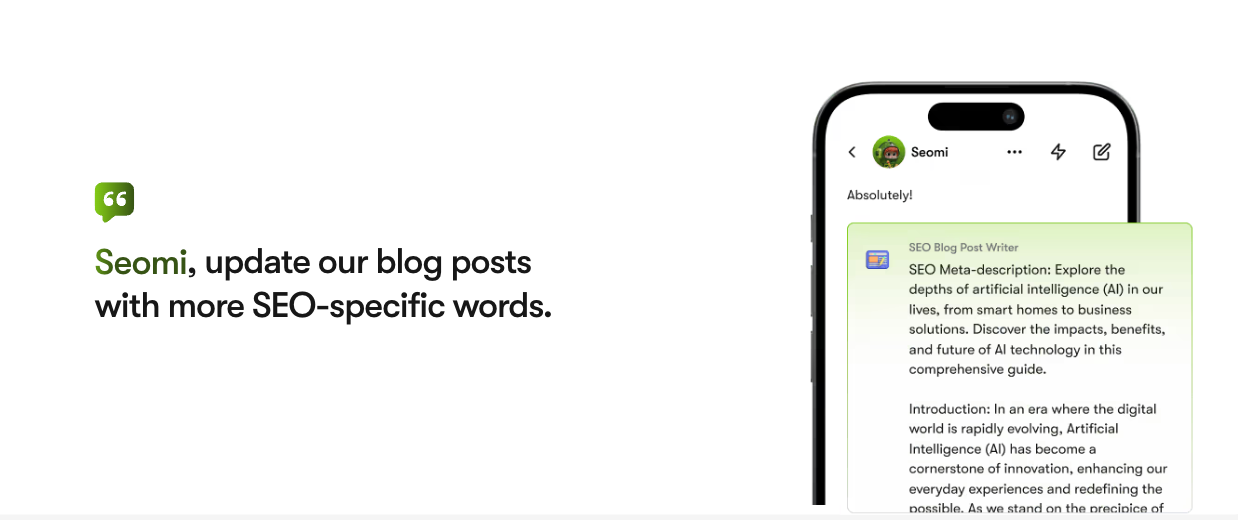
The AI SEO Expert (Seomi) helps teams move from research to implementation in half the time. It analyzes keywords, search intent, and competitor gaps to recommend optimization opportunities that align with ranking patterns and audience behavior.
Here’s how it fits in a workflow:
- Upload a content URL or draft.
- Seomi scans SERPs and identifies missing schema, metadata, and keyword depth.
- It generates quick on-page suggestions: updated meta titles, FAQs, and content structure.
- The SEO team reviews and approves changes that match the brand tone and intent.
AI removes repetitive analysis so strategists can focus on creative differentiation, what humans do best.
AI Copywriter – Drafts That Match Intent and Brand Voice
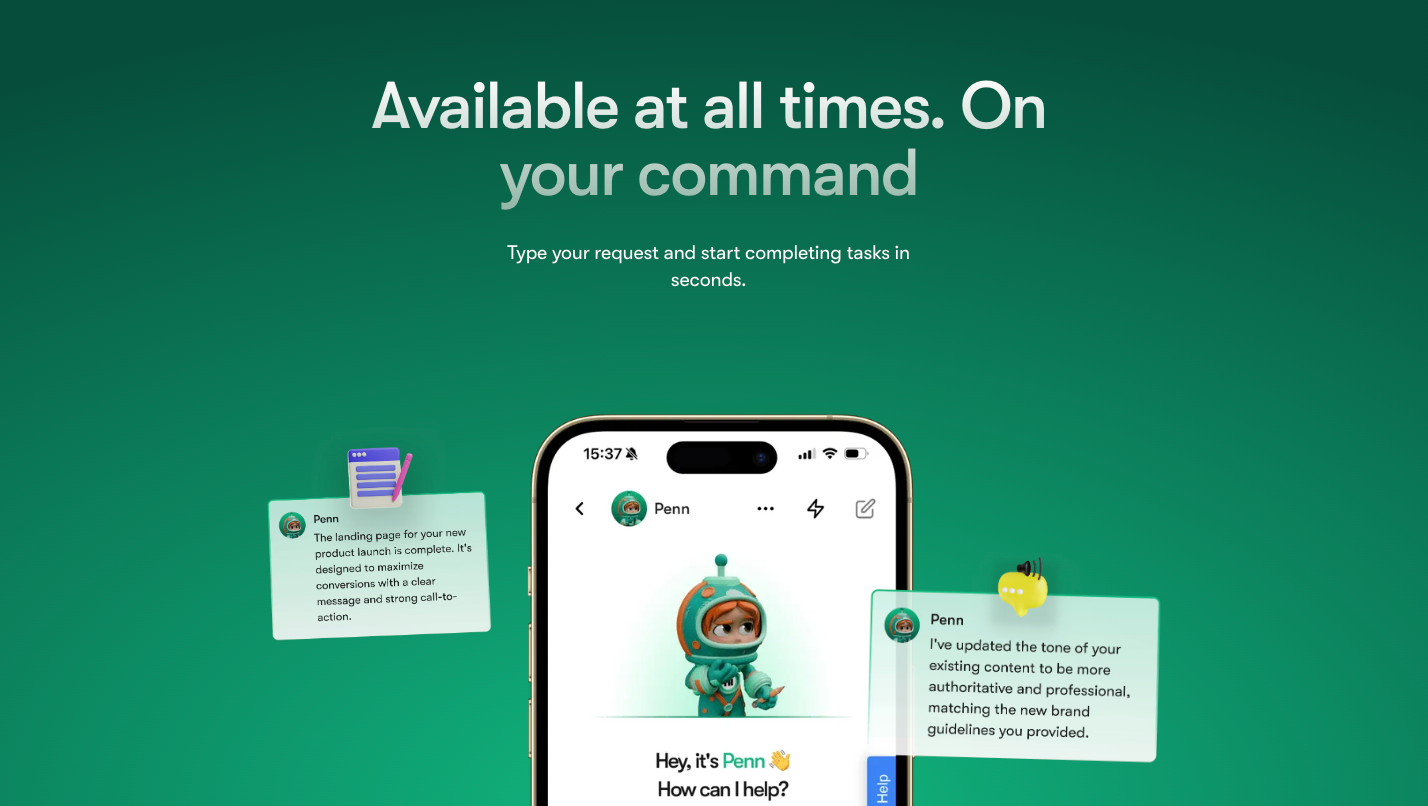
The AI Copywriter (Penn) converts briefs into structured, keyword-rich drafts that reflect intent and tone. It ensures every piece of content aligns with your topic clusters and user goals while remaining easy to scan and read.
In practice:
- SEO managers input the brief and primary keyword cluster.
- Penn generates a clean, well-structured first draft.
- Human editors then refine examples, add expertise, and ensure alignment with EEAT standards.
This process helps writers produce high-quality content at scale, faster but still human-led. It answers the question “Will AI replace SEO writers?” clearly: No, it makes them more efficient, not irrelevant.
AI Data Analyst – Insights to Guide Next Iterations

The AI Data Analyst (Dexter) turns performance data into actionable next steps.
It tracks rankings, CTR shifts, and engagement signals, identifying where your content performs well and where it needs improvement.
A typical workflow:
- Pull ranking and traffic data directly into Dexter.
- Review patterns, keyword drops, CTR declines, or engagement spikes.
- Get automated suggestions for what to refresh or expand next.
- Use human judgment to decide which updates align with strategic priorities.
Teams no longer need to dig through endless analytics dashboards. Dexter condenses insights into a list of actions that save hours each week.
The Combined Impact of AI and Human Collaboration
When used together, Sintra’s AI Helpers form a connected SEO system that enhances speed, quality, and insight.
- AI handles the heavy lifting: research, auditing, data interpretation, and drafting.
- Humans refine and direct: tone, authority, and brand perspective.
This model keeps SEO teams agile. They move faster, make decisions with data, and publish content that both readers and AI systems trust. The result? SEO workflows that scale without losing accuracy, voice, or control.
How SEO Professionals Can Stay Relevant in the AI Era?
The most valuable marketers will be those who know how to combine automation with judgment, data with creativity, and AI speed with human strategy.
The question isn’t “will AI replace SEO?” but rather “who can lead in a world where AI is standard?” Here’s how to stay competitive:
Shift from Execution to Direction
The future of SEO belongs to those who guide systems, not those who perform repetitive tasks. AI now handles keyword research, clustering, content scoring, and basic copy generation. Your role moves from doing to directing.
Practical next steps:
- Build a prompt library for recurring tasks like meta tag writing, content clustering, or schema generation.
- Learn how to feed structured context into AI tools
- Treat AI tools as junior analysts. You’re the strategist reviewing and approving their work.
Teams that adopt this director-level mindset will produce higher-quality results faster.
Develop an AI-Integrated Workflow
Modern SEO requires an integrated stack where AI tools work alongside analytics, CMS, and creative systems.
AI can automate reporting, alert you to performance changes, and flag new keyword trends before they peak.
How to build it:
- Use AI for real-time auditing (site speed, crawl issues, and schema health).
- Integrate predictive tools that forecast topic trends or CTR shifts.
- Automate content republishing when engagement drops below target thresholds.
When AI runs diagnostics in the background, SEO professionals have more time to focus on brand growth and storytelling.
Focus on Human-Level Strategy
AI tools deliver patterns and probabilities, but only humans understand audiences, emotion, and competitive context. Your advantage lies in interpretation. Here’s where to focus:
- Deepen your understanding of search intent and user psychology.
- Learn to translate AI data into real business actions (content pivots, new audience segments, or product opportunities).
- Evaluate how AI overviews, summaries, and featured snippets are affecting brand perception.
The most effective SEOs will combine emotional intelligence with analytical depth.
Build Cross-Functional, Hybrid Teams
SEO no longer stands alone. AI connects it to product marketing, PR, data science, and content strategy, just as AI in sales connects prospecting, forecasting, and customer insights into one system. Forward-thinking teams are adopting hybrid models that balance automation and expertise.
Team design ideas:
- Pair strategists and content leads with AI helpers for research and writing.
- Assign human editors to review AI output for accuracy, tone, and compliance.
- Use modular helpers from the AI employee team to scale resources without increasing payroll.
Master Continuous Learning and Adaptation
AI evolves monthly. Tools update faster than traditional SEO training can keep up. To stay relevant, professionals need continuous learning habits.
How to stay sharp:
- Follow updates from Google, OpenAI, and major AI-search platforms.
- Test one new AI workflow each quarter and measure ROI in time saved or content performance.
- Document learnings in internal playbooks and share them across teams.
Adapting quickly will be the single biggest competitive advantage in the next five years.
Strengthen Your EEAT Edge
Experience, Expertise, Authoritativeness, and Trustworthiness (EEAT) still drive rankings and visibility. AI can assist with optimization, but only people can demonstrate lived expertise.
Reinforce EEAT by:
- Publishing under verified author profiles.
- Including real examples, quotes, and case data in your content.
- Review and get content approved by subject-matter experts.
Search engines and users both reward brands that prove their authority with evidence, not automation.
Predictions for the Future of SEO and AI
The future of SEO marketing is already unfolding. AI has changed how content is discovered, summarized, and presented. It’s also creating new opportunities for more human-led marketing.
To understand the future of SEO with AI, look at three time horizons: short-term (1–2 years), medium-term (3–5 years), and long-term (5+ years). Each phase shows how search is shifting from algorithms to intelligence systems.
Short-Term: The Rise of AI-First Search Engines
Over the next two years, search behavior will evolve from “queries” to “conversations.” AI-first search engines like Google Gemini, Bing AI, and Perplexity are already blending web results with generative summaries, creating what many call the “zero-click era.”
Key trends to expect:
- Fewer clicks, more citations: AI will surface content directly in summaries, rewarding brands that prioritize structured, factual, and concise information.
- Higher value on credibility: Brands with strong EEAT signals and clear author expertise will dominate citations.
- Shift in content format: FAQs, comparison tables, and how-to guides will outperform long opinion pieces that lack data.
What does it mean for SEO teams? You’ll spend less time chasing keywords and more time structuring information for AI understanding. Hierarchy, entity relationships, and schema markup will be your new foundation.
Medium-Term: The Era of Generative Engine Optimization (GEO)
Between 2026 and 2028, Generative Engine Optimization will become a defined discipline. Instead of optimizing for search engines alone, marketers will optimize for how AI models generate answers.
What GEO will involve:
- Training signal optimization: Making your content easier for LLMs to summarize and cite.
- Attribution visibility: Structuring text so your brand name, author, and URL appear in AI-generated outputs.
- Performance metrics beyond clicks: Teams will track “AI citations,” “generative impressions,” and “response inclusions.”
Example
A company’s how-to guide could appear as a cited answer in ChatGPT or Gemini, even if users never visit the page, yet the brand earns awareness and authority.
Here’s what to prepare:
- Add named entities, brand consistency, and contextual schema.
- Track how your content surfaces in AI responses manually and through new analytics integrations.
- Update reporting dashboards to measure visibility across both web and AI layers.
Long-Term: The Shift Toward Autonomous Search and Decision Systems
Looking ahead five years or more, AI will evolve from assistance to autonomy. Generative systems will not only summarize but recommend, guiding users through purchases, setups, or business choices.
What this means for SEO:
- Instead of visiting your site, users complete actions through chat-based AI interfaces.
- Optimizing for voice, video, and image-based AI searches will become critical.
- AI will rely on verified, high-quality sources for safety and compliance. Brands that maintain accuracy and transparency will gain preferential inclusion.
To future-proof your strategy, maintain a public knowledge base with verified facts, case studies, and product documentation. You can also use structured markup to make your content easily retrievable by AI systems.
Ready to Get Started with AI-Enhanced SEO?
The future of SEO is not about replacing people with AI. It is about working smarter. AI tools help your team research, write, and optimize faster while keeping full control of strategy.
Sintra AI brings every helper into one workspace. Its connected AI integrations automate audits, keyword analysis, and performance reviews. You save time, reduce manual work, and create consistent results across all campaigns.
Here is how to start improving your workflow:
- Use Seomi to run an SEO audit and find technical issues.
- Use Penn to rewrite one low-performing page for clarity and intent.
- Use Dexter to review engagement and ranking data.
- Use Brain AI to keep tone and brand voice consistent.
Get started now with Sintra and build an SEO system that grows with you.
FAQs
Will AI replace SEO?
No. AI will automate tasks like keyword research and reporting, but it still needs human strategy and creativity. SEO will evolve into a mix of automation and human insight, not a replacement.
Can AI tools like ChatGPT replace SEO writers?
AI can create drafts and outlines quickly, but it lacks brand understanding and emotional depth. Writers who use AI as a co-pilot will produce faster and more consistent results than those who don’t.
How will AI change the role of SEO professionals?
AI will shift SEO from manual execution to strategy, analysis, and creative direction. Professionals will focus on interpreting data, optimizing user experience, and maintaining brand trust.
How can businesses use AI for SEO safely?
Use AI tools for scale, but keep humans in charge of accuracy, tone, and fact-checking. Combine automation with editorial review to protect your rankings and credibility.
What will be the future of SEO in an AI-driven world?
SEO will become more about quality, structure, and trust signals that AI systems can recognize. Brands that publish factual and authoritative content will lead in AI search visibility.
Related articles





Copyright © 2026 PlayOS, Inc. All rights reserved