What is AI Customer Engagement: Use Cases, Benefits & Setup

Table of Contents
Quick Answer: What Is AI Customer Engagement?
AI customer engagement is the use of machine learning and automation to deliver personalized, timely interactions across multiple communication channels. This AI-powered customer engagement allows businesses to provide tailored experiences at any scale without an increase in headcount. By leveraging automated support, brands can proactively meet customer needs while maintaining high-quality service 24/7.
AI customer engagement is the practice of using smart technology to handle, personalize, and grow your relationship with your customers. This engagement happens across your website, social media, and email; all at the same time.
Think of AI customer engagement as giving your business a digital brain that never sleeps. Traditionally, customer engagement meant waiting for a person to be available to answer a chat or send an email. For a large business, this means hiring a massive team to keep up.
Instead of plainly responding to people, customer AI looks at patterns to understand what someone needs before they even ask. AI customer engagement tools are widely used by businesses to automate customer support without adding headcount. AI teams help you scale your brand's personality to reach thousands of people without losing that helpful, human-to-human feel.
How AI Customer Engagement Works?
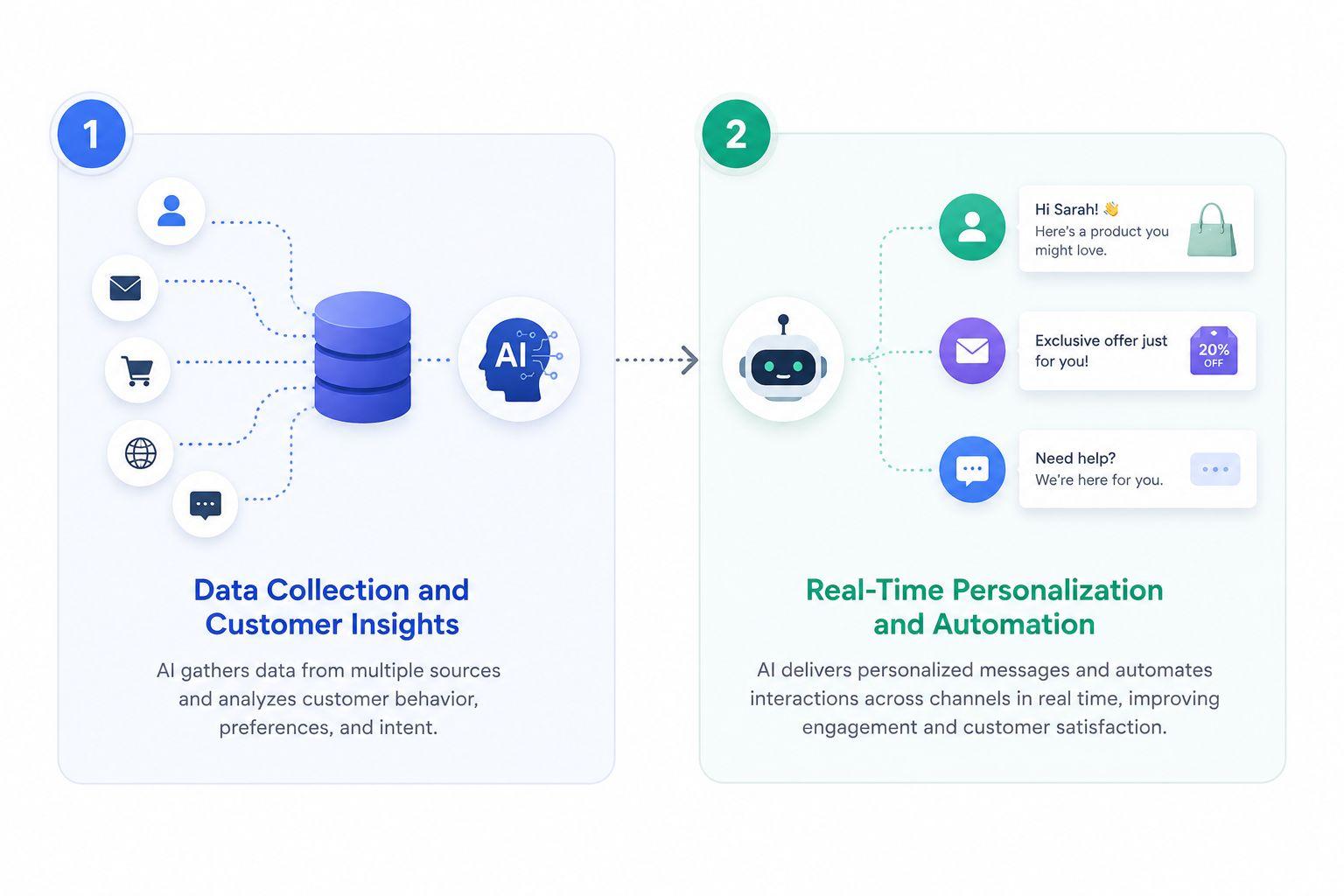
Consider AI-powered customer engagement as a feedback loop that gets smarter every time a customer clicks a button. It starts with data collection; the system gathers bits of information from every touchpoint. These can be a visit to your website, a comment on social media, or a support ticket.
Next, the AI steps in to analyze that data. It looks for patterns to figure out exactly what the person is trying to do and how they are feeling. Once it identifies the intent, it triggers automation to deliver a personalized response in real-time.
Since your AI is connected to your CRM and email tools, all these systems share one memory, meaning the more people interact with your brand, the more accurate and helpful the AI becomes.
For example, imagine a customer looks at a specific pair of hiking boots on your site but leaves without buying. Within minutes, the system recognizes the behavior and automatically sends a friendly follow-up email with a quick video on how to size those specific boots correctly. It’s timely, relevant, and feels like you’re reading their mind.
Let's take a more detailed look at the AI customer engagement automation process:
Data Collection and Customer Insights
To create an effective customer engagement automation system, you need AI tools like Sintra's Brain AI, which acts like a central hub and pulls information from every corner of your business. These tools track website behavior, email opens, support tickets, and purchase history, and unify these details into one, clear customer profile. This ensures that the response is always highly contextual and feels personal rather than generic.
But AI doesn't stop just at collecting data; it can very well predict what the customer will need next. By analyzing a person's past historical data pattern, it can flag certain items as "high intent" for that person. The system triggers a personalized outreach sequence next and sends follow-up measures.
For example, if a visitor browses your pricing page three times in one hour but doesn't buy anything, the outreach sequence gets into action by offering a quick demo or a specific discount. This helps your customers make a confident decision before they even have to ask for help.
Real-Time Personalization and Automation
Once the data is collected, AI uses those insights to act instantly through automated customer engagement. Instead of waiting for a human to ask for help, the system triggers immediate chatbot replies, personalized emails, or product recommendations the second a customer interacts with your brand.
AI tools can even analyze when customers shop and which items they buy together to present relevant offers in the moment. This ensures the experience stays consistent and helpful, whether it’s the customer’s very first visit or their fifteenth interaction.
The real breakthrough in how AI can improve customer experience is relevance at scale. AI algorithms can efficiently analyze vast amounts of customer data to deliver personalized experiences to thousands of people simultaneously. This allows teams to focus on more complex issues while every customer feels like they are getting your full attention.
Key Benefits of AI Customer Engagement
Shifting to AI customer engagement solutions isn't about purchasing cool tech; it's about driving measurable business outcomes that actually show up. By using AI tools, you transform your operations from a slow, manual process into a high-speed engine that thrives on efficiency and scalability.
Instead of teams getting burnt out by repetitive tasks, customer engagement automation allows you to handle a massive volume of interactions while actually lowering your overhead. These systems turn theory into practice by delivering deep personalization and significant cost reductions, all while making sure no customer is ever left waiting. Here is how that impact looks on the ground:
1. Faster Response Times and 24/7 Availability
Let's face it - customers don't have all day to wait for a response from your team. They expect immediate answers. The "we'll get back to you in 24 hours" has gotten old at this point. Automated customer engagement removes this bottleneck by keeping your business open 24/7.
AI-powered chatbots provide immediate answers to common questions even when your human team sleeps. This adoption has been shown to reduce average inbound call handling time by 38% for businesses that have fully adopted the technology.
This "always-on" support drastically improves customer satisfaction by eliminating long wait times and frustrating delays. For example, an automated chat system can handle customer queries about a product, track orders, and take login assistance requests at the same time. And there won't be any lag in the processes. This speed ensures that your customers feel supported the moment they reach out, making your brand feel more reliable and responsive.
2. Scalable Customer Interactions Without Extra Cost
Customer support agents are known to get frustrated and tired during peak traffic hours. As a result, many queries go unanswered, while others get rude replies. AI-powered customer engagement solves this by allowing your systems to manage thousands of conversations at once.
Every person gets an immediate, high-quality response even during peak hours. This scalability means your business can grow its revenue and reach without a proportional increase in headcount. Your brand stays efficient and reliable, and you're able to handle more volume and improve your sales while keeping operational costs lean.
3. Personalized Customer Experiences at Scale
Every customer wants to feel special, and while that is possible outside rush hours, it can get insanely difficult during peak hours. Customer AI tools make that possible without you having to write every single message by hand.
By analyzing massive amounts of data, like what someone previously bought, how they browse your site, and even their current location, the system creates a "unique" experience for every visitor. This is often called intelligent customer engagement, where the AI acts as a personal shopper or assistant for thousands of people at the same time.
The real beauty here is that these interactions happen automatically and stay highly relevant. Whether it's suggesting the perfect accessory for a recent purchase or sending a "welcome back" greeting, AI ensures your message hits the mark.
4. Reduced Operational Costs
Typically, scaling your support and marketing departments means hiring more people to handle the manual workload. But with AI customer engagement, you actually cut operational costs. By leaning on customer engagement automation, you can automate repetitive tasks, like updating CRM systems after a call or sorting through email threads, which eliminates hours of manual data entry for your team.
This revolution doesn't just save money; it optimizes your entire operation. Because AI can provide immediate answers to common queries. IBM reports that chatbots can handle 80% of the manual workload while cutting costs by 30%. This efficiency allows humans to take a breather and save their energy for more meaningful things.
5. Improved Customer Retention and Loyalty
Happy customers are more likely to return to your business than those who had to wait for your team's response. By delivering relevant messages exactly when they are needed, you show customers that you understand their needs, which significantly boosts their loyalty and trust in your brand.
When engagement stays high-quality at every touchpoint, it leads to much better retention rates and long-term business growth. AI tools can even analyze customer data to identify early signs that someone might stop at your website. This allows you to reach out proactively with a special offer or a helpful reminder.
By staying one step ahead and consistently providing value, you turn one-time buyers into lifelong fans without even tracking their behavior manually.
Top Use Cases of AI Customer Engagement

With AI, customer engagement is no longer limited to first interactions and allotting tickets. It now spans the entire customer journey, from the first interaction to long-term retention. By automating customer engagement, businesses can deliver faster, more relevant, and consistent interactions at scale.
Most successful companies combine multiple AI-powered customer engagement applications into a single, connected workflow. This ensures that every aspect, whether it's a marketing email, a support chat, or a product recommendation, is informed by the same real-time data.
Let's explore some of the practical, real-world applications where AI is making the most significant impact on the business-customer relationship:
AI Customer Support and Chat Automation
One of the most basic ways of implementing AI in customer engagement is by using chatbots. These bots act as a high-speed first layer of support, answering common questions and resolving simple tasks. They can instantly check an order status or update an account, without the need for a human agent.
If a situation gets too complicated, the chatbots don't crash; they intelligently route the conversation to a human agent, providing them with a full summary of the interaction so customers don't have to repeat themselves.
What makes this truly powerful is the "omnichannel" approach, meaning your AI customer service agent can provide a consistent experience across all platforms. You can clearly see this efficiency in your website chat, email, and social messaging like WhatsApp or Instagram.
For example, a bot can handle hundreds of basic FAQ inquiries simultaneously but instantly escalate a sensitive billing dispute to your finance team. This results in a massive boost in speed for the customer and a significantly lighter workload for your team.
Email and Outreach Automation
Let's face it, older methods of email outreach were annoying and often ended up in spam folders. Instead of sending the same promotional email to your entire list, AI tools track down how users interact with your brand. It monitors sign-ups, or periods of inactivity, and then sends the right message at the exact moment when it's most likely to be read.
AI email assistants like Sintra's Emmie allow these campaigns to run in the background, adapting follow-ups based on whether a lead is just browsing or ready to buy. This level of automation ensures that your outreach is always relevant to the user’s current stage in the sales funnel.
For example, if a potential client downloads a specific industry resource from your site, the AI can instantly trigger a tailored sequence that provides deeper insights related to that exact topic. The trick here is to balance timing and relevance exactly when it matters the most for your customers.
Social Media Engagement
You cannot scale up your brand without a strong social media presence. But managing multiple social accounts and being active for all the queries can be overwhelming. Intelligent customer engagement tools solve this by acting as a 24/7 command center for your social identity.
The AI tools can monitor every comment, direct message, and mention of customers in real-time. It uses sentiment detection to instantly understand the "mood" of the audience under a post.
Tools like AI social media manager, like Soshie, help schedule content at optimal times and handle routine interactions, ensuring your brand stays active and responsive. The real advantage is how these systems prioritize your workload based on urgency and intent.
For example, if a customer comments with a specific purchase question, the AI can immediately provide a helpful public reply and move the conversation to a private DM to close the sale. On the other hand, it can flag negativity or serious complaints and refer the post to a human agent for review. This ensures that your feed remains professional.
How to Set Up AI Customer Engagement
Setting up a successful system starts with strategy, not just expensive software. To truly understand how AI can improve customer experience, you must first identify the specific friction points in your current journey. These can be slow response times or inconsistent follow-ups.
By defining your goals before selecting your tools, you ensure that the technology and customer engagement combined solve real business problems rather than adding complexity. These AI integrations work within your stack and take over the mundane tasks. Over time, you will see significant improvement in customer experience and ease in scaling your business.
Let's take a look at the step-by-step approach for implementing a successful AI system for your customer service.
Define Customer Journey and Goals
Setting up an effective AI strategy requires a clear roadmap of how people interact with your brand. By understanding the path of a stranger who turns into a loyal customer later, you can identify exactly where AI customer engagement will have the most significant impact:
- Map the Landscape: Before deploying any technology, visualize the entire customer engagement cycle, from the initial website visit and sign-up to the final purchase and post-sale support.
- Identify Friction Points: Use this map to pinpoint exactly where delays happen or where manual workflows are slowing down your team’s ability to respond.
- Set Targeted Goals: Establish clear objectives for each stage, such as reducing initial response times to under 30 seconds or increasing conversion rates through automated follow-ups.
- Build a Strong Foundation: Focus on these strategic outcomes first to ensure that your AI tools are solving specific business problems rather than just automating inefficient processes.
Starting with these strong foundations ensures that your AI tools are targeted at solving real problems, leading to a much more effective and cohesive strategy.
Choose the Right AI Tools
Selecting the right tools is about finding a balance between your current business size and future growth plans. Rather than buying the most popular or expensive apps, look for flexible solutions that can handle multiple functions like support, marketing, and outreach within a single environment.
This approach allows your AI employees to work across different departments with a consistent voice. When evaluating AI customer engagement tools, prioritize the following:
- Scalability: Ensure the platform can handle an increasing volume of interactions as your business grows without requiring a massive jump in cost or complexity.
- Ease of Use: Choose tools that feature intuitive interfaces, allowing your team to deploy automation quickly without needing a deep technical or coding background.
- Unified Workflow: Select solutions that treat customer engagement as a single, connected journey rather than a series of isolated tasks.
- Customization: Look for platforms that allow you to tailor the AI's persona and logic to match your specific brand identity and customer needs.
Integrate and Optimize Workflows
Your customer support tools shouldn't be working in isolation. To achieve total perfection, your AI must be deeply integrated with your existing CRM, email, and social platforms. This connectivity allows the AI to trigger specific actions based on real-time behavior, like sending a follow-up email the moment a customer clicks a specific link or flagging a high-value lead for a sales call.
- Connect Systems: Use AI integrations to sync data across your entire tech stack, ensuring every tool has the most up-to-date customer context.
- Behavior-Based Triggers: Design workflows that respond instantly to user actions, such as sign-ups or support queries, to keep the momentum of the customer journey moving forward.
- Test and Refine: Regularly analyze performance data to identify where automation is excelling and where a human touch might still be needed.
- Continuous Learning: Treat your AI as an evolving asset that improves its accuracy and tone with every interaction, leading to more personalized experiences over time.
By focusing on integration and optimization, you transform individual tools into a unified, self-improving engine that scales alongside your business.
The Future of AI Customer Engagement
What once started as a reactive support has quickly turned into a proactive, connected ecosystem. AI customer engagement solutions are no longer optional tools for big firms; they have become the industry standard for delivering the high-speed, relevant experiences that consumers now expect.
The next era of engagement is defined by three transformative shifts:
- Hyper-Personalization at Scale: Moving beyond simple name tags, AI now uses real-time behavioral data and historical context to make every interaction feel uniquely tailored. By 2026, nearly 45% of major global organizations are expected to use AI to nudge customers toward novel experiences that improve brand loyalty.
- Unified Intelligent Ecosystems: Future solutions are breaking down data silos to create a single, 360-degree view of the customer. This allows for "memory-rich" AI that remembers past interactions across all channels, ensuring a seamless journey whether the customer is on social media, email, or a mobile app.
This evolution signifies that AI is no longer a mere competitive edge but a fundamental requirement for business survival. Companies that successfully integrate these intelligent systems will be the ones to foster lasting trust and deep customer relationships.
Ready to Automate Your Customer Engagement?
Transitioning from traditional customer support to an automated system doesn't have to be a complex overhaul of tools. It is about choosing a system that grows with you. Sintra AI provides a comprehensive ecosystem of customer engagement tools that are designed to work in perfect harmony.
Sintra AI moves customers seamlessly through your funnel without anything slipping through the cracks. AI helpers like Cassie, Emmie, and Soshie collaborate to streamline your operations while maintaining a deeply personalized touch.
These are your signs to stop managing fragmented tasks and start building a high-performance, AI-powered customer engagement engine that works around the clock. Get started with Sintra AI today and transform how your business connects with the world.
AI Customer Engagement FAQs
How can AI improve customer engagement?
AI enhances experiences by providing 24/7 instant responses, personalizing content based on real-time behavior, and predicting customer needs. It ensures consistency across all channels while freeing human teams to handle high-value, complex interactions.
What are the best AI customer engagement tools?
Effective AI customer engagement tools offer multi-functional capabilities across support, marketing, and social media. Leading options include specialized AI employees like Cassie for support, Emmie for email outreach, and Soshie for intelligent social media management.
Is AI customer engagement suitable for small businesses?
Yes. Modern AI customer engagement solutions are designed for scalability and ease of use, making them ideal for small businesses. They allow smaller teams to compete with larger enterprises by automating routine tasks and maintaining high engagement without increasing headcount.
How do you implement AI in customer engagement?
Start by mapping the customer journey and defining specific goals. Select flexible tools that integrate with your existing CRM and email systems. Finally, build automated workflows and continuously optimize them based on performance data.
What are examples of AI in customer engagement?
Common examples include chatbots resolving FAQs, automated email sequences triggered by user downloads, and social media AI flagging negative feedback. These systems handle high volumes.
Related articles

.avif)