What is a Digital Employee?

Table of Contents
Quick Answer: What is a Digital Employee?
A digital employee is an AI-powered worker designed to take ownership of real business tasks. It can manage ongoing work across marketing, sales, customer support, operations, HR, ecommerce, and more without needing constant direction. Unlike a chatbot, it works in a specific role instead of simply responding to prompts. Platforms like Sintra provide multiple digital employees that share business knowledge and work together as a team.
Businesses are starting to use AI for more than answering questions or generating content. Today, AI can manage real tasks, from replying to customers and creating marketing campaigns to organizing projects and handling repetitive work. Microsoft's latest Work Trend Index describes a shift toward AI agents that can execute work while people focus more on directing and overseeing it.
As this shift continues, digital employees are becoming a common part of the workplace. PwC found that 79% of companies are already adopting AI agents, and 66% report measurable productivity gains from using them. They help teams save time by taking over repetitive work and supporting day-to-day operations.
Platforms like Sintra take this a step further by offering multiple specialized digital employees that share business knowledge and work together as one coordinated team instead of separate AI tools.
What Makes a Digital Employee Different From a Chatbot
The main difference is that a chatbot is built to answer questions, while a digital employee is built to get work done. The following comparison table breaks this down clearly:
Digital Employee vs Digital Worker: Is There a Difference?
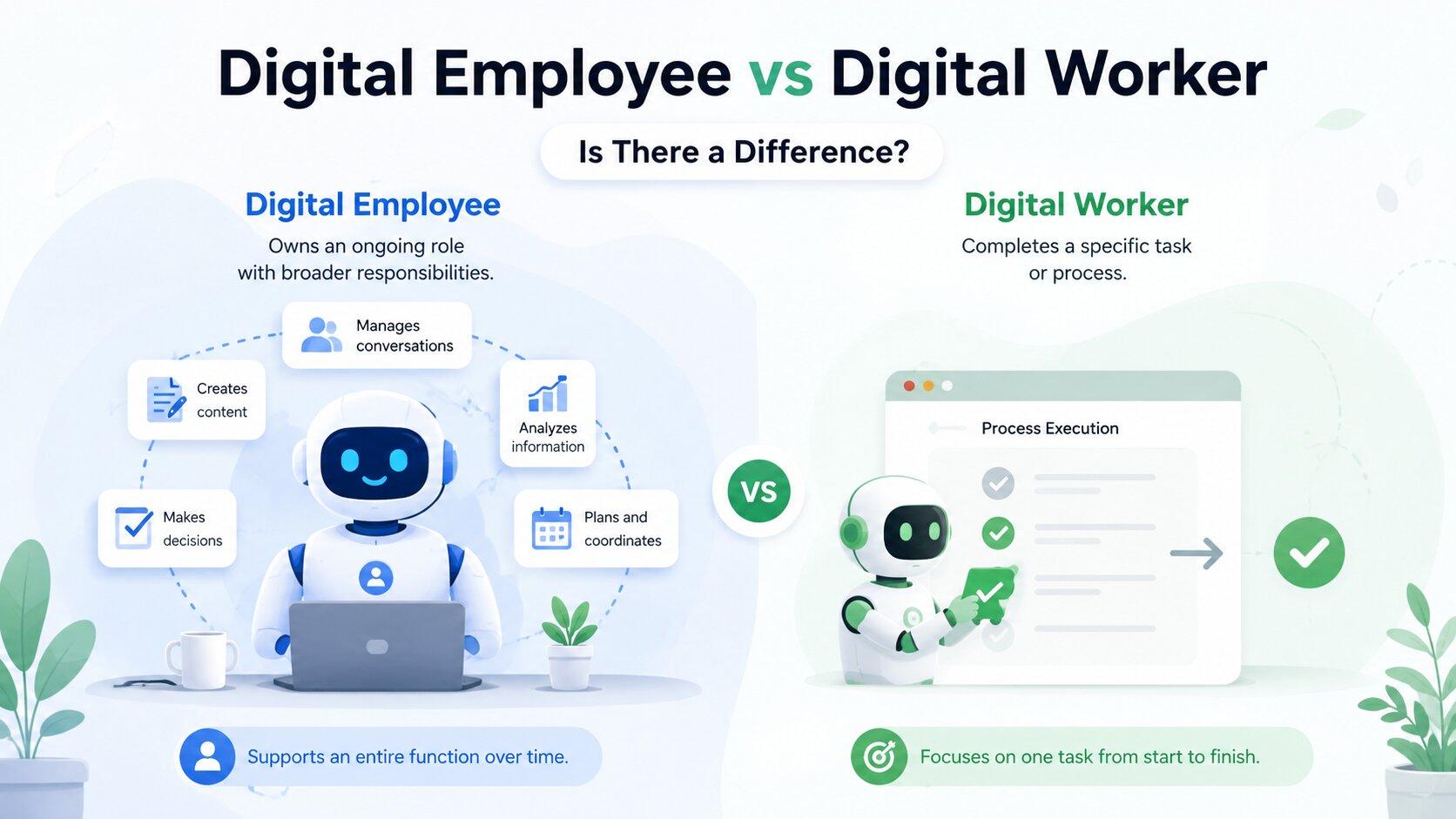
The terms digital employee and digital worker are often used interchangeably, but they describe different types of AI. A digital worker performs a specific task or process, while a digital employee handles a broader role with ongoing responsibilities, similar to a human employee. Knowing the difference helps businesses choose the right AI solution.
Why the Terms Are Often Used Interchangeably
The confusion mostly comes from how AI products are marketed. Many vendors use the term digital employee because it sounds more capable, even when their product mainly works like a digital worker.
The two terms also come from different software categories. RPA (robotic process automation) platforms usually use a digital worker because they focus on task automation. AI platforms built on large language models are more likely to use digital employees because they support a wider range of business responsibilities.
There is no shared industry standard for either term. As a result, companies often use them differently, so the confusion comes more from inconsistent branding than from the technology itself.
What Makes a True Digital Employee
A true digital employee has an ongoing role within a business. It keeps track of context across interactions, uses business knowledge to make better decisions, and works alongside people or other AI employees as part of larger workflows. This also creates a better digital employee experience, since employees don't have to repeat the same information or switch between disconnected AI tools. This is the key difference between the two.
A digital worker completes a specific task or process. A digital employee supports an entire business function by handling different responsibilities over time, whether that's managing customer support, creating marketing content, or coordinating operational work.
The distinction comes down to responsibility. A digital employee owns an ongoing role, while a digital worker focuses on a single task or process.
How Digital Employees Work

Digital employees use several AI technologies to complete real work instead of simply responding to prompts. They combine powerful AI models, shared business knowledge, integrations with everyday tools, and automation to understand context, make decisions, and complete tasks across different systems.
Each of these parts plays a different role. Together, they allow digital employees to work more like team members than standalone AI tools.
AI Models That Understand Business Context
Digital employees use advanced AI models to understand requests, analyze information, create content, and make recommendations. These models can handle everything from writing emails and reports to answering customer questions and planning marketing campaigns.
Traditional automation tools follow strict, rule-based instructions. Digital employees go much further by understanding business context. They use information like your brand voice, products, company goals, customers, and previous interactions to produce more accurate and relevant results that fit your business.
Shared Business Knowledge with Brain AI
Digital employees work better when they share the same business knowledge instead of working independently. With Brain AI, every AI employee can access the same company information, making it easier to stay consistent across different tasks and departments.
This shared knowledge helps AI employees use the same brand voice, remember important business details, and build on each other's work. For businesses using brain AI, this creates a more connected AI team instead of a collection of separate assistants. It is one of Sintra's specialties because every AI employee works from the same source of knowledge.
Integrations That Allow AI Employees to Complete Work
Digital workers need access to the tools your business already uses to complete real work. Through AI integrations, they can connect with platforms like Gmail, Notion, Google Calendar, Google Drive, and other business applications.
These connections let AI employees find information, update records, reply to customers, organize documents, and automate workflows without switching between different systems. Instead of acting as standalone assistants, they become part of your everyday business operations.
How Digital Employees Can Help Your Business
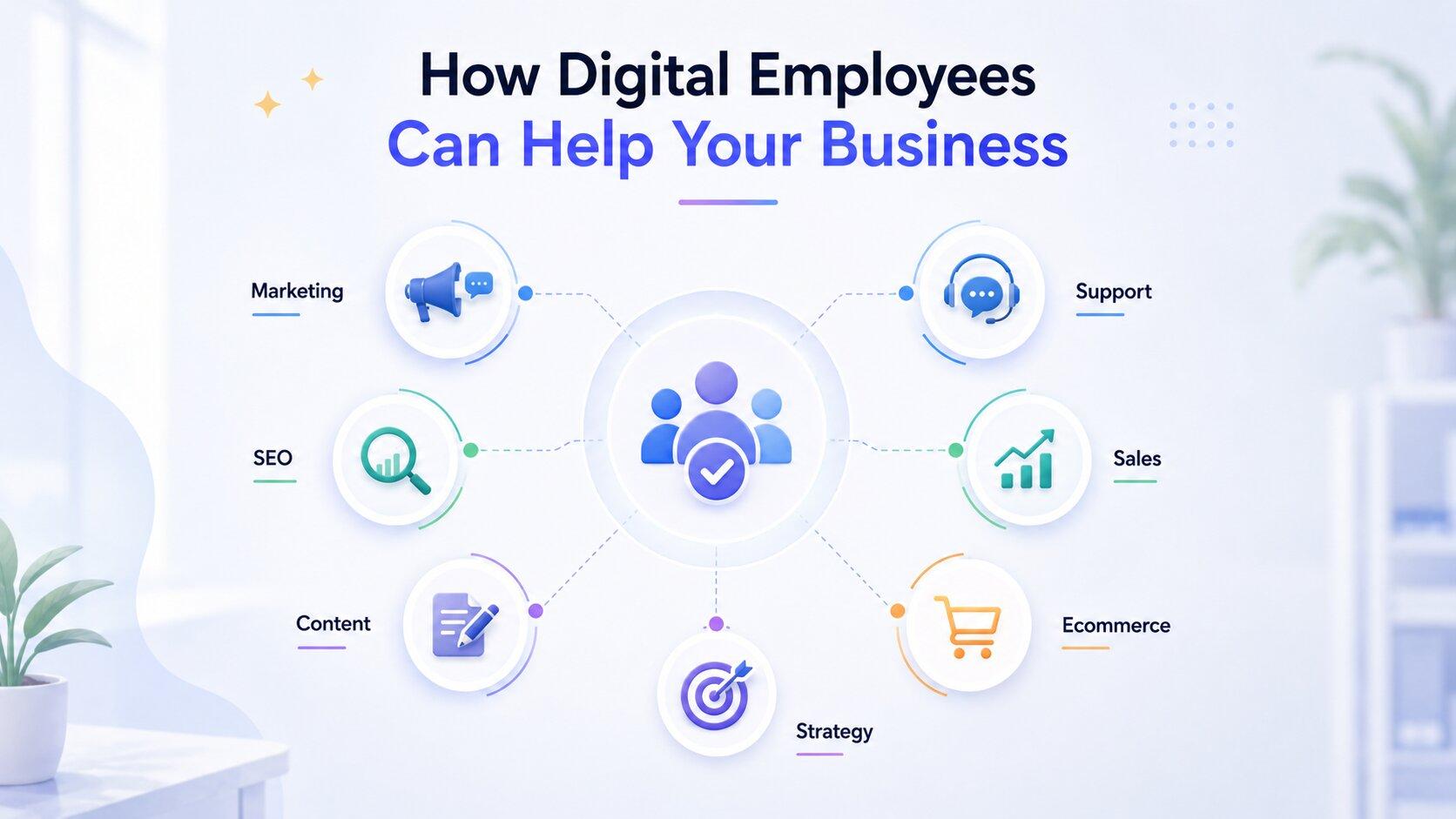
Digital employees can support nearly every business function. They can qualify leads, automate operational workflows, analyze business data, assist with hiring, manage e-commerce tasks, and help with strategic planning.
From marketing and customer support to sales, HR, and operations, digital employees help businesses save time, keep work consistent, and grow without increasing headcount. Modern digital worker solutions give each AI employee a clear job, making it easier to automate work across the business.
Marketing and Social Media
Digital employees can help marketing teams stay consistent and publish content faster. They can plan campaigns, generate content ideas, write social media posts, schedule content, and monitor performance across different platforms.
They also help maintain a consistent brand voice, so every post matches your business. An AI social media manager can handle much of the daily content work, allowing your team to focus on creative ideas and marketing strategy.
SEO and Content Optimization
SEO involves many repetitive tasks that digital employees can complete much faster. They can research keywords, identify content opportunities, improve existing pages, optimize on-page SEO, and recommend ways to increase organic visibility.
An AI SEO agent also helps marketers make data-driven decisions by turning SEO data into clear recommendations. This speeds up optimization while helping teams focus on long-term growth.
Copywriting and Content Creation
Digital employees can create blogs, landing pages, product descriptions, email campaigns, ads, and website copy. They adjust the writing for different audiences while keeping the messaging consistent across every channel. With an AI copywriter, businesses can produce more content without sacrificing quality or their brand voice.
Customer Support
Digital employees can answer customer questions, help website visitors, draft support replies, and create help center articles and FAQs. They provide fast, consistent support across multiple channels, improving response times and customer satisfaction. For example, an AI customer service agent can also work alongside your support team by handling routine requests, leaving complex conversations to human agents.
Sales, Operations, HR, Ecommerce, and Strategy
Modern AI employee platforms provide specialists for different roles instead of one general-purpose assistant. They can assist sales teams with lead generation, personalize outreach, qualify prospects, automate business processes, and support departments across the organization.
Instead of relying on one general AI assistant, modern platforms provide specialists for each role. An AI sales agent can personalize outreach and help move prospects through the sales pipeline, while an AI recruiter can write job descriptions, screen candidates, and support hiring decisions. Together, these specialists help businesses scale more efficiently across every department.
Why Businesses Are Adopting Digital Employees

More businesses are using digital employees because they do more than automate individual tasks. They help teams work faster, keep processes consistent, and support growth across multiple departments. As AI becomes part of everyday operations, companies are investing in role-based AI employees that can improve productivity while working alongside human teams.
The sections below explain the biggest reasons businesses are adding digital employees to their workforce.
Scale Without Increasing Headcount
As a business grows, the amount of work grows with it. Digital employees help companies handle more work without immediately hiring more people. They can take care of repetitive, time-consuming tasks like creating content, answering routine questions, updating records, and processing information.
This allows businesses to increase their output while keeping operating costs under control. Rather than replacing employees, digital employees give teams extra support so people can focus on work that benefits most from human skills.
Free Teams to Focus on High-Value Work
Many employees spend a large part of their day on administrative work that adds little strategic value. Digital employees can take ownership of these routine tasks, giving people more time to focus on creative thinking, problem-solving, customer relationships, and business planning.
The result is a more productive team. Instead of spending hours on repetitive work, employees can concentrate on the projects that have the biggest impact on the business.
Create More Consistent Business Processes
Consistency is important as businesses grow. Digital employees follow the same instructions, business rules, and brand guidelines every time they complete a task. That means emails, content, customer responses, and internal processes stay aligned across teams.
This reduces manual errors, improves the quality of work, and creates a more reliable experience for both employees and customers. Teams also spend less time reviewing and correcting routine work because the process stays consistent from start to finish.
Keep Work Moving Around the Clock
Unlike traditional teams, digital employees can continue working outside normal business hours. They can respond to customer inquiries, generate content, organize information, and complete automated workflows whenever they're needed.
This helps businesses reduce delays, improve response times, and keep important work moving even when employees are offline. Instead of waiting until the next business day, routine work can continue in the background, helping the entire organization move faster.
What Is Digital Employee Experience?
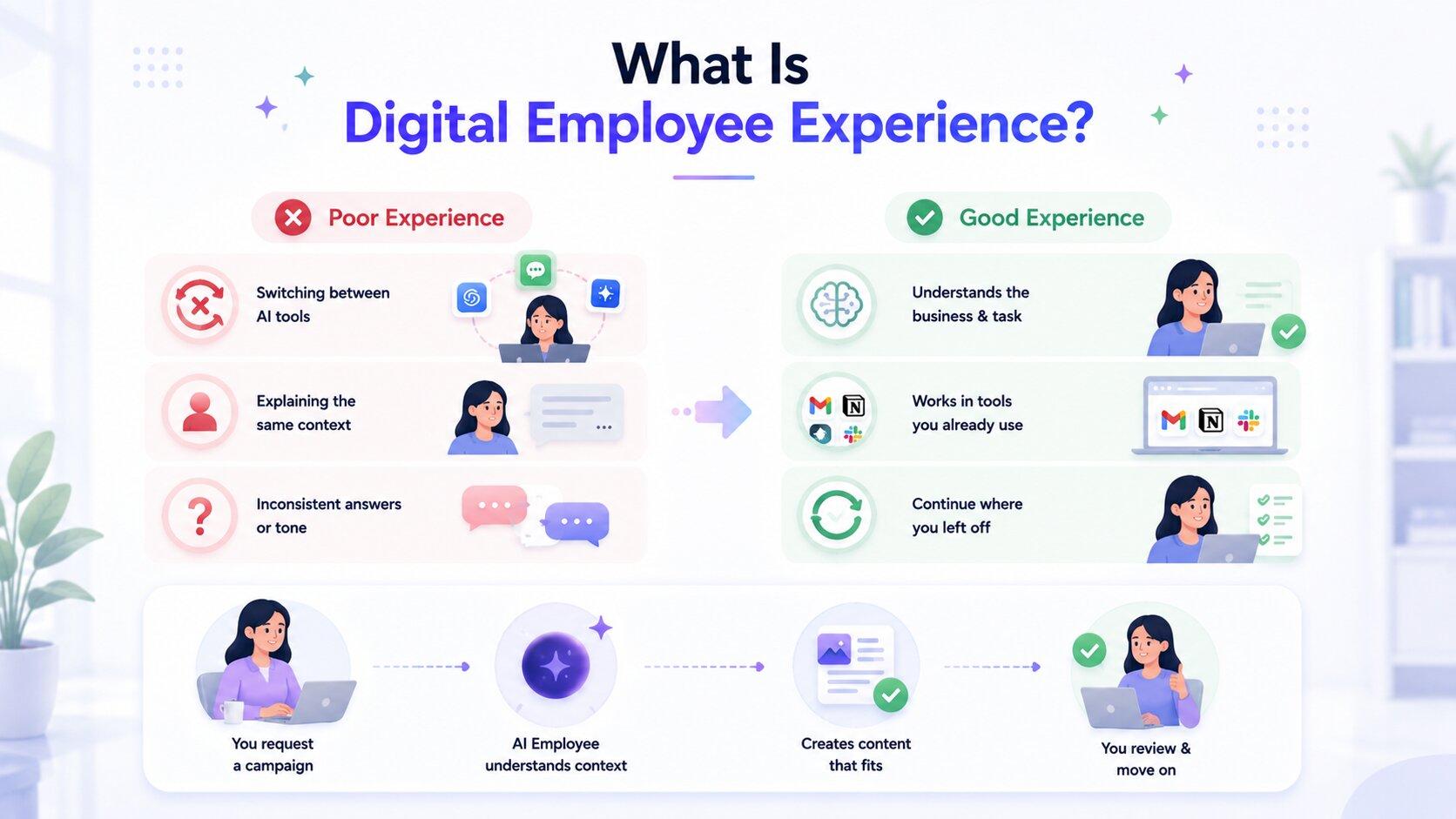
This describes how easy and natural it is for employees to work with digital employees during their everyday jobs. It isn't about what digital employees can do. It's about how well they fit into existing workflows and whether they help employees complete work with less effort. This idea builds on the broader concept of Digital Employee Experience (DEX), which focuses on how workplace technology supports people throughout the workday.
A poor digital employee experience might look like this:
- Employees switch between disconnected AI tools.
- They have to explain the same context every time they start a new conversation.
- The AI gives different answers or uses a different tone each time.
A good digital employee experience feels much smoother:
- Digital employees already understand the business and the task.
- They work inside the tools employees already use.
- Employees can continue where they left off instead of starting from scratch every time.
A simple digital employee experience example is a marketing manager asking an AI employee to create a campaign. Instead of re-explaining the company's brand voice, target audience, and previous work, the AI already understands the context and creates content that fits the business. The manager can review the work and move on to the next task without starting over.
Why Sintra Is One of the Best Digital Employee Platforms
Many AI tools can generate text or answer questions, but running a business requires much more than that. Sintra is designed as a complete digital employee platform, giving businesses a team of role-based AI employees instead of one general-purpose assistant. It also serves as employee experience technology by helping AI and human teams work together more smoothly.
Each AI employee has a specific role, but they don't work in isolation. Sintra combines specialized AI employees, shared business memory through Brain AI, integrations with everyday business tools, and ready-to-use workflows in one platform. This makes it practical for daily business work instead of occasional AI conversations.
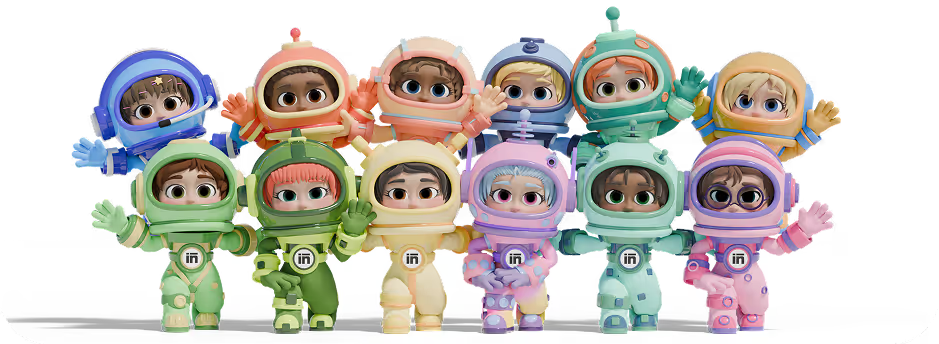
Twelve Specialized AI Employees
One of Sintra's biggest strengths is that every AI employee has a dedicated role. Rather than relying on one AI to handle everything, businesses can assign work to a specialist designed for that job.
For example:
- Buddy helps with business development and planning.
- Commet supports e-commerce businesses.
- Emmie focuses on email marketing and communication.
- Vizzy acts as a virtual assistant for scheduling and administrative work.
- Penn specializes in copywriting.
- Seomi focuses on SEO.
- Soshie manages social media.
- Scouty, Milli, Cassie, Dexter, and Gigi each bring expertise to their own business roles.
Because every AI employee is built for a specific responsibility, businesses can delegate work more naturally instead of asking one general AI to switch between completely different tasks.
AI Employees That Work Together
Having specialized AI employees is useful, but they become much more valuable when they share the same understanding of your business.
Sintra's Brain AI gives every AI employee access to the same business knowledge, including your brand voice, products, documents, company guidelines, and important business details. That means different AI employees can produce work that stays consistent, even when they're handling different tasks.
Instead of working like separate AI tools, Sintra's AI employees work from a shared source of knowledge. This shared intelligence is one of the platform's biggest advantages because it helps every AI employee understand your business before starting a task.
Ready-to-Use Workflows
Getting started with AI often takes time, especially when businesses have to build prompts, workflows, and automations from scratch. Sintra reduces that setup by providing ready-to-use workflows, templates, automations, and integrations that help businesses start working faster.
Whether you're creating content, planning marketing campaigns, responding to customers, or organizing daily operations, much of the setup is already in place. Businesses can connect their existing tools, add their company information, and start assigning work to AI employees within minutes instead of spending days building custom systems.
Ready to Build Your AI Team?
Digital employees are quickly becoming an essential part of modern businesses. Instead of relying on one general AI tool, companies are adopting AI employees that can take ownership of specific roles, automate daily work, and support teams across the business.
Sintra brings all of these capabilities together in one platform. With 12 specialized AI employees, Brain AI for shared business knowledge, built-in automations, and integrations with the tools you already use, it gives businesses a practical way to put AI to work every day instead of using it only for occasional tasks.
If you're ready to spend less time on repetitive work and more time growing your business, get started with Sintra AI and build an AI team that's ready to work alongside you from day one.
Digital Employee FAQs
What is a digital employee?
A digital employee is an AI-powered worker that helps with everyday business tasks. It works in a specific role, such as marketing, customer support, sales, or HR, and can complete ongoing work instead of only answering questions.
What is the difference between a digital employee and a digital worker?
A digital worker is designed to automate one specific task or process. A digital employee has a broader role and manages different responsibilities over time, much like a member of your team.
Can digital employees replace human employees?
No. Digital employees are built to support people, not replace them. They take care of repetitive and time-consuming work so employees can spend more time on creative thinking, decision-making, and building customer relationships.
What tasks can digital employees automate?
Digital employees can automate many everyday business tasks, including content creation, social media management, SEO, email marketing, customer support, sales outreach, HR tasks, administrative work, and e-commerce operations. Many platforms can also connect with your existing business tools to automate workflows.
Why is Sintra a good digital employee platform?
Sintra brings everything together in one place. It includes 12 specialized AI employees, Brain AI for shared business knowledge, integrations with popular business tools, and built-in automations. This allows businesses to manage marketing, sales, customer support, HR, and other daily work from a single platform.
Related articles