How to Stop Context Switching and Build Deep Focus with an AI Team

Table of Contents
Quick Answer: How to Stop Context Switching and Build Deep Focus with an AI Team
The most effective way to reduce context switching is to minimize the number of tools, decisions, and manual coordination steps required to complete work. Every interruption forces the brain to disengage and reorient, and research from the University of California, Irvine found that it takes an average of 23 minutes to fully regain focus after a distraction.
Improving focus is therefore less about willpower and more about reducing operational friction.
By centralizing workflows and automating repetitive execution across apps, an AI team reduces the constant task switching involved in managing updates, searching for information, and coordinating work. That creates longer uninterrupted work sessions and makes deep focus easier to maintain.
Harvard Business Review recently found that the average office worker switches between different apps and websites nearly 1,200 times every day. That is roughly one toggle every 24 seconds. We all know what this feels like. You check an email, reply to a Slack message, glance at a spreadsheet, and open another tab. Suddenly, four hours have gone by, and you have almost nothing to show for it.
This is context switching, and it is a massive productivity killer.
Shifting your attention between different tasks and tools before finishing what you started feels like multitasking, but it actually causes severe mental friction. That constant jumping quietly drains your energy, lowers your accuracy, and kills your motivation.
In this guide, we break down what a context switch is and the real cost of this constant shuffling. We will look at why standard workplace tools often make the problem worse, and how building a centralized AI team can eliminate the friction so you can finally get back to real deep focus.
What Is Context Switching and Why Does It Hurt Productivity?
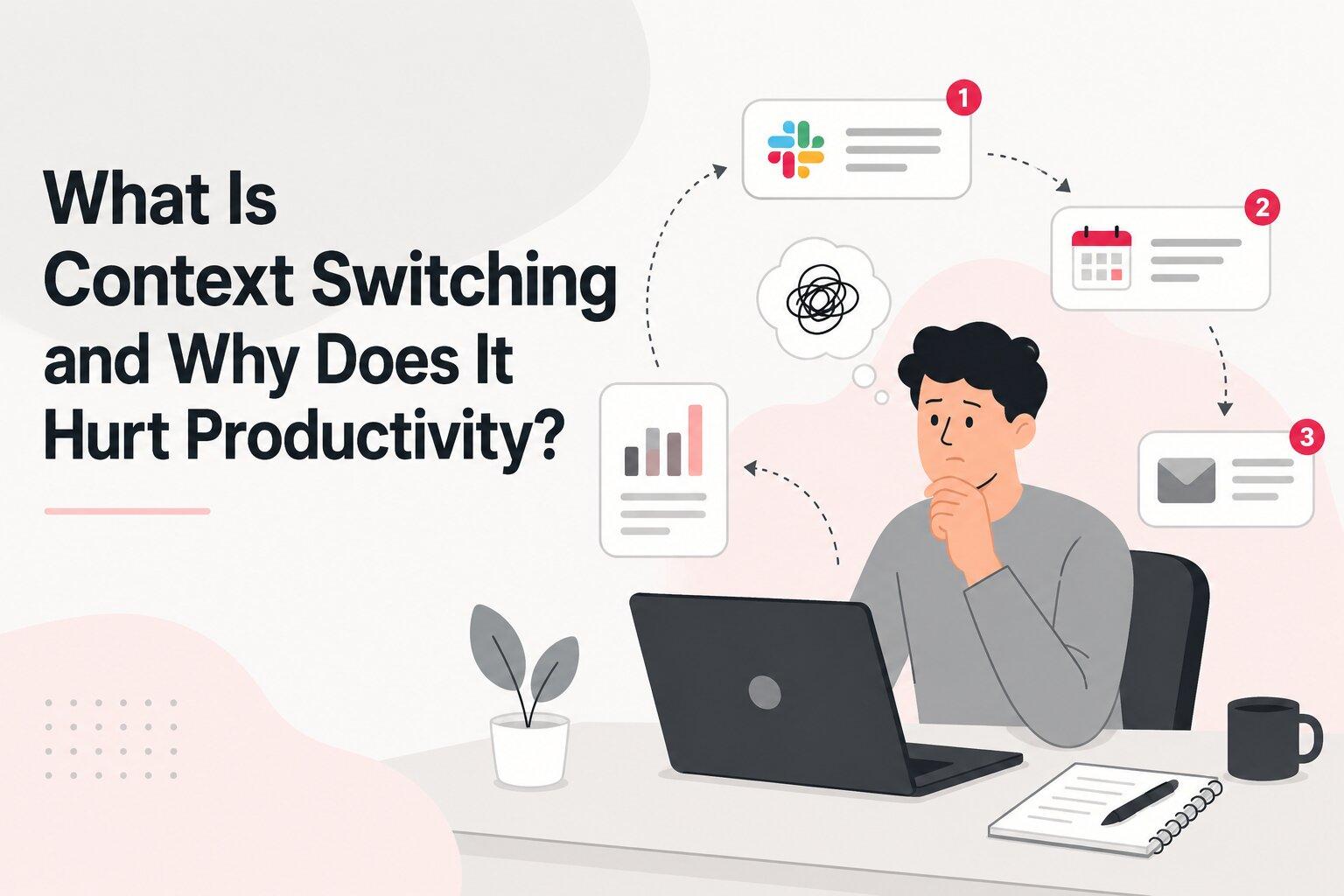
Context switching means you stop working on one task to pick up another before you have actually finished the first. It happens dozens, or even hundreds, of times every single day.
The human brain cannot actually multitask when it comes to complex work. What feels like juggling is just rapid, back-to-back switching between tasks. Each switch triggers what researchers call a cognitive load. This means your brain has to pause, store what you were doing, and reload the next task. That constant transition has a massive cost in both time and mental energy.
A simple example most of us know is writing a report when a Slack message pops up. You stop to respond, then a calendar notification fires, so you check that next. By the time you return to the report, you have lost your train of thought entirely. You were not actually doing three things at once. You were just doing none of them properly.
How to Reduce Context Switching in Your Daily Workflow
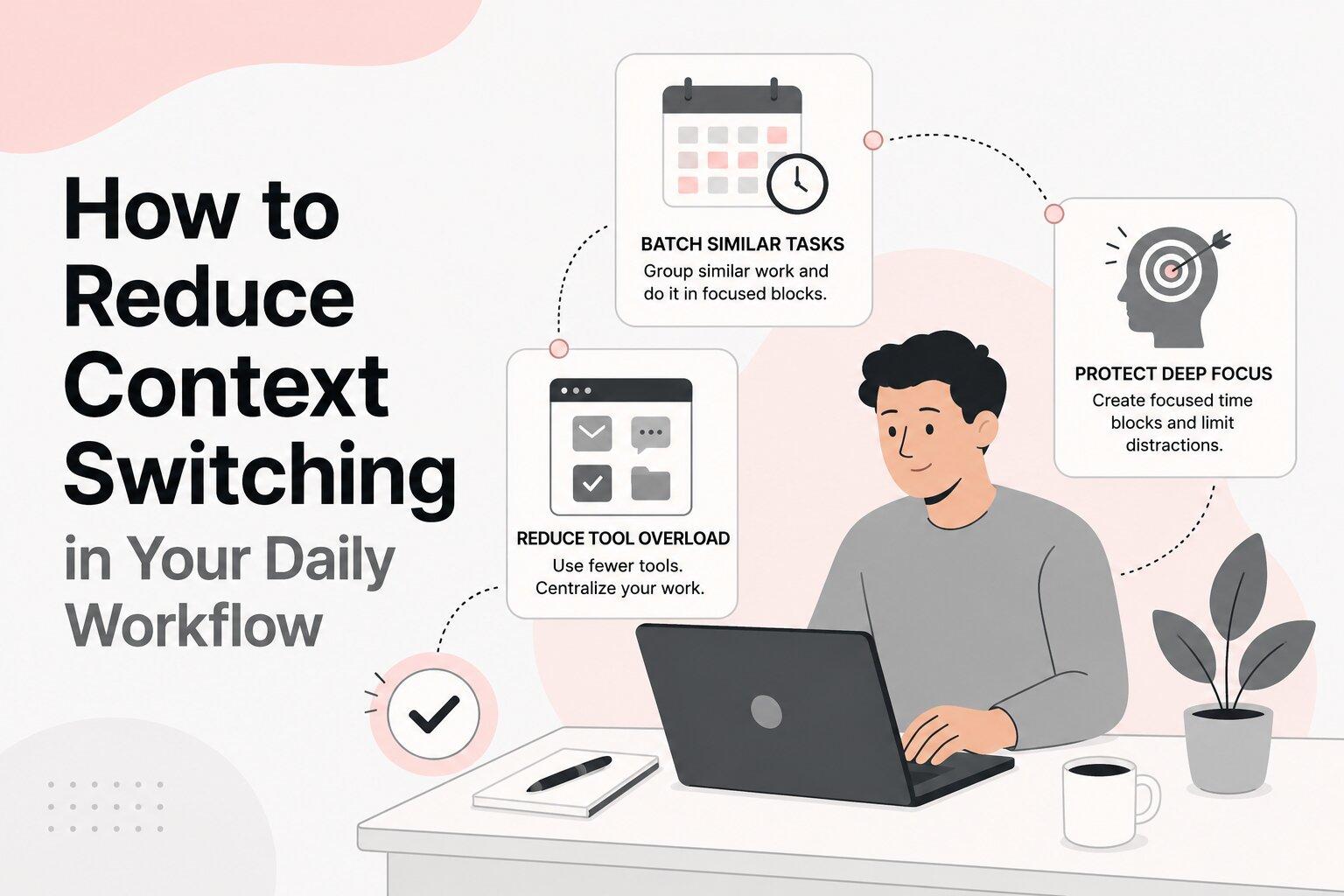
Reducing context switching is not a discipline problem. It is a design problem. Most people try harder to focus without changing the environment that distracts them.
The real fix is intentional workflow design. You can achieve this by grouping similar tasks together, using fewer tools, and building a setup that protects your attention instead of competing for it. Delegating execution to AI employees is one of the most powerful levers available today.
Batch Similar Tasks to Minimize Mental Reset
One of the most effective ways to reduce context switching is task batching, which means grouping cognitively similar work into dedicated time blocks. Writing all your emails in one go, handling all your content creation in one sitting, and scheduling all your meetings back-to-back keeps your brain in the same mode for longer.
Switching between similar tasks is far less taxing than jumping from deep analytical work to creative writing to client communication. For a practical example, instead of checking email constantly throughout the day, set two fixed email windows. You can schedule one in the morning and one mid-afternoon. Everything else gets blocked.
This simple change alone can meaningfully improve your daily productivity because you stop paying the mental reloading cost dozens of times a day.
Reduce Tool Overload by Centralizing Work
Tool sprawl is one of the biggest drivers of context switching at work. Most teams use separate platforms for communication, project tracking, content creation, data analysis, and customer management. Each of these platforms has its own interface, login, and logic.
Every time you move between them, you are not just changing windows. You are changing your context, mental mode, and workflow state. Managing context switching gets dramatically easier when you consolidate work into fewer systems. The goal is not to find more tools. The goal is to use fewer of them better.
Build Systems That Protect Deep Focus
Deep focus does not happen by accident. It is the result of protecting your attention by design. Time-blocking, no-notification periods, and predefined daily workflows all reduce the number of decisions your brain has to make throughout the day, which means fewer opportunities to drift.
For example, you can block the first 90 minutes of your workday as a no-meeting, no-Slack, heads-down work session. Define in advance what you will work on so you do not spend mental energy deciding in the moment. Over time, these structured blocks become automatic, and the quality of work produced during them is noticeably higher than anything produced in fragmented, interrupted sessions.
The Hidden Cost of Context Switching
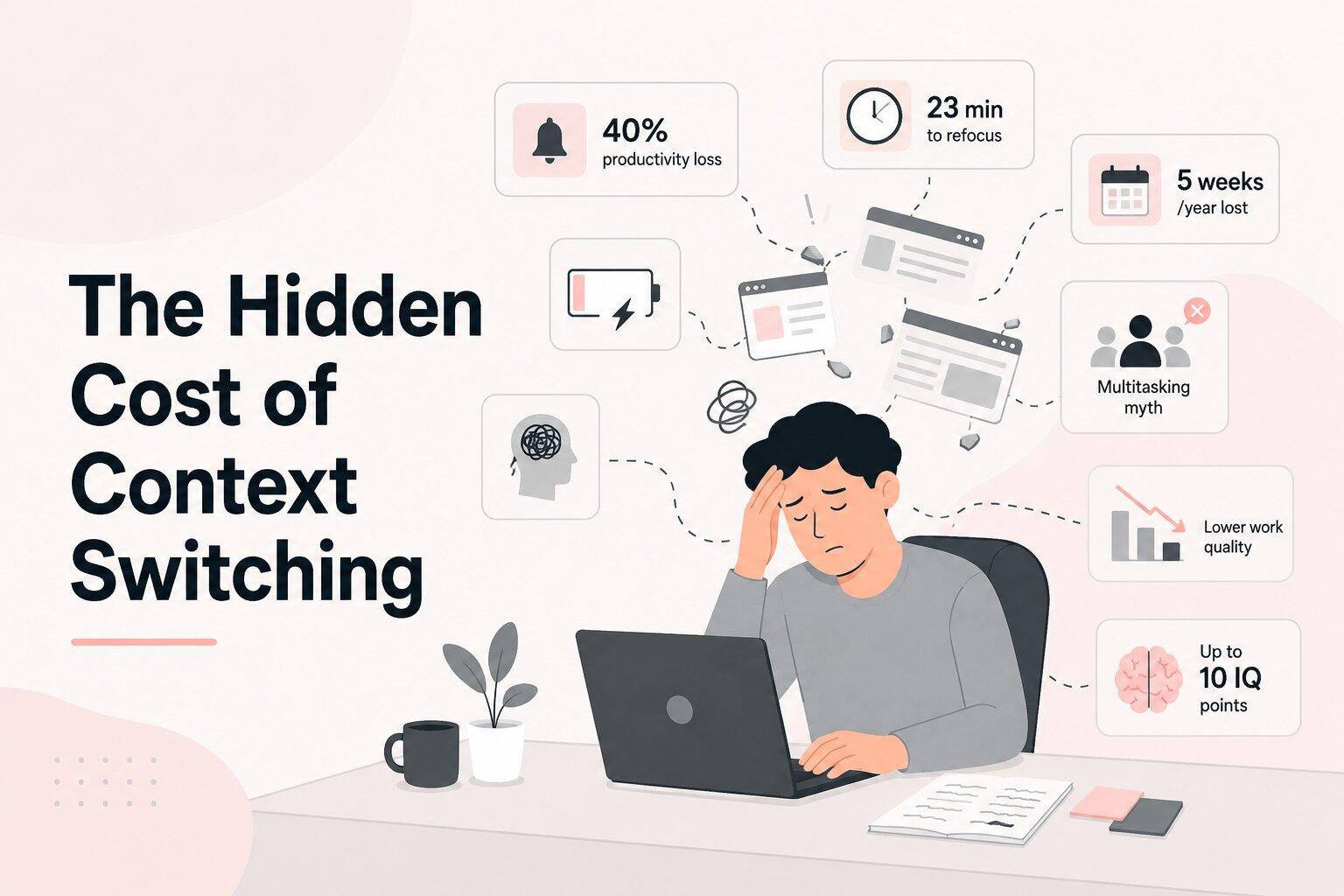
The cost of context switching is far higher than most people realize, and it is not just about lost time. Context switching can reduce productivity by up to 40%. For a standard eight-hour workday, that represents about three hours of lost productivity every day. Multiply that across a team of ten people, and you are losing the equivalent of 30 working hours every single day just to context switching.
Time Loss Adds Up Faster Than You Think
The true time loss from context switching at work is not the switch itself. It is the recovery time. After an interruption, employees need an average of 23 minutes to fully refocus on their original work. Some studies suggest this extends even longer when you account for additional mini-switches that happen before returning to the initial task.
This constant bouncing between tasks results in a massive loss of focus. Across a single year, employees lose around five full working weeks just trying to reorient themselves. This is not a minor inefficiency. It is a structural problem.
Why Multitasking Is a Myth
What we call multitasking is actually context shifting. It is just rapid, back-to-back task switching that the brain performs one step at a time. There is no parallel processing happening in your head. There is just a very fast switch, repeated over and over, and each switch comes with a cost.
Heavy multitasking can even lead to a temporary drop of up to 10 IQ points. This means constant context switching does not just slow you down. It actively makes you less capable of high-quality thinking in the moment. The illusion of doing more is exactly that, an illusion.
The Impact on Work Quality and Decision-Making
When your attention is fragmented, the quality of your output reflects it. Shallow focus leads to missed details, weaker decisions, and work that eventually needs to be redone. The cognitive load of managing all these switches leaves less mental bandwidth for the judgment, creativity, and strategic thinking that actually move projects forward.
Think about the difference between writing a proposal in one focused two-hour session versus assembling it across six interrupted windows spread throughout a day. It is the exact same time investment, but the quality of thinking and the final output will be completely different.
Mental Fatigue and Burnout from Constant Switching
Every context switch costs cognitive energy, and that energy does not replenish instantly. A study from the University of California, Irvine found that after only 20 minutes of repeated interruptions, people reported significantly higher stress, frustration, workload, effort, and pressure.
The deep focus you need for your best work requires a sustained reservoir of mental energy. When that reservoir is drained by constant switching before noon, the rest of the day runs on fumes. Over weeks and months, this is exactly how burnout builds. It does not happen from doing too much work, but from never being able to finish anything properly.
Why Most Tools Increase Context Switching
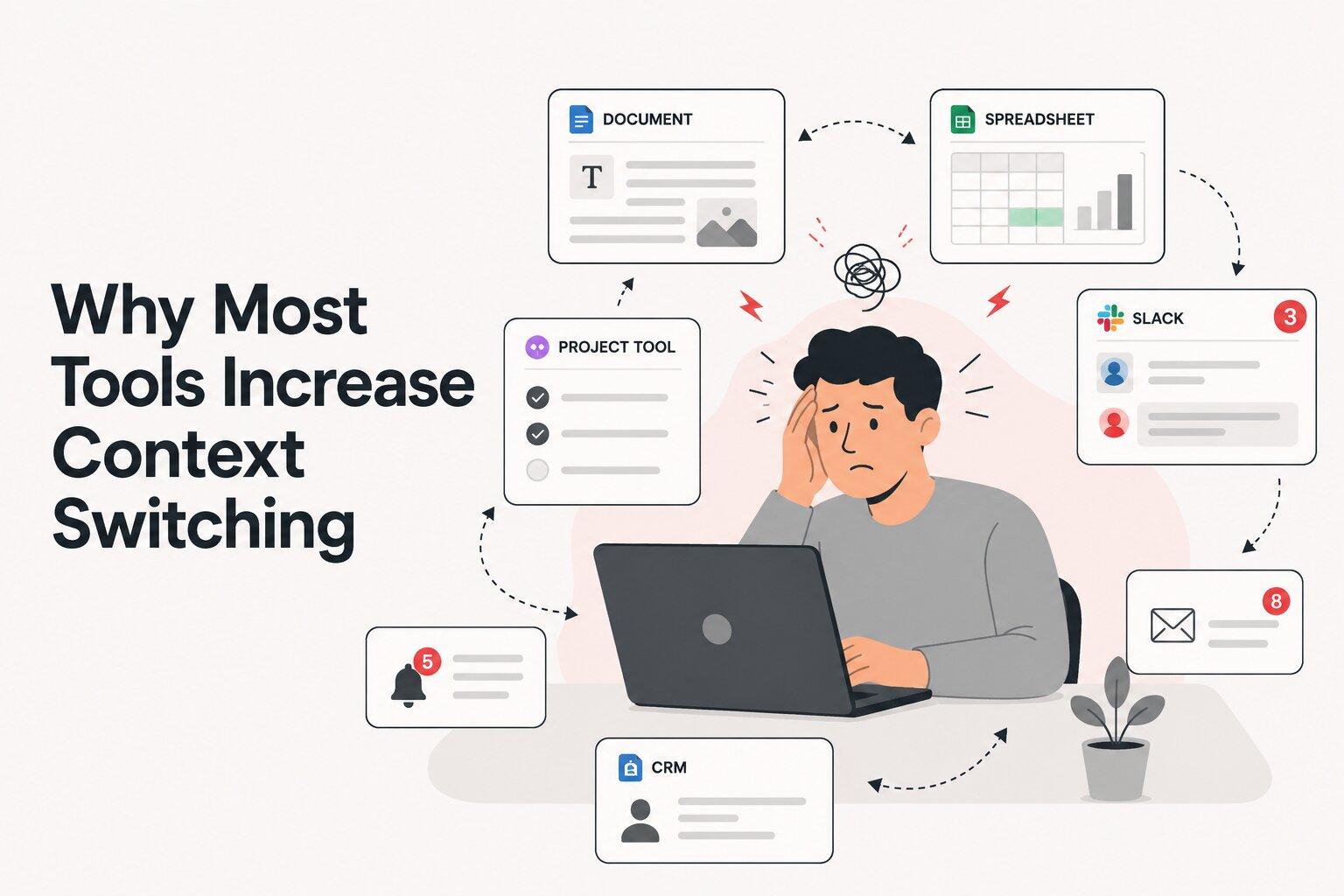
Most productivity tools quietly make context switching worse. Built for single functions, they force constant movement between isolated environments. It is a structural design problem hiding in plain sight.
Every tool added means a new interface, a new notification stream, a new context to load. The solution is AI integration that unifies your work rather than fragments it.
Tool Fragmentation Creates Workflow Gaps
Consider what happens when you complete even a simple task across multiple tools. You draft something in a document, pull data from a spreadsheet, communicate through Slack, track progress in a project tool, and log updates in a CRM. That is five context switches for a single workflow, and each one requires you to mentally bridge the gap between separate systems.
A context-switching example that is painfully familiar is reviewing analytics in one tab, copying numbers to a document in another, messaging a teammate in a third, and checking a task list in a fourth. You never leave your desk, but your attention is scattered across four completely different environments.
Constant Notifications Disrupt Focus
Notifications are engineered to interrupt. Research shows that over 56% of workers feel they need to respond to notifications immediately, which means the moment a message lands, attention is already broken. This creates a reactive work pattern where you are not choosing what to focus on. Instead, you are just responding to whatever pinged last.
The result is constant context shifting with no true deep focus periods. Even when you manage to return to a task, part of your attention remains stuck monitoring for the next interruption.
Switching Between Roles and Interfaces
Different tools do not just require different logins. They require completely different mindsets. A project management platform puts you in manager mode. A writing tool puts you in creator mode. An analytics dashboard puts you in analyst mode. Moving between these systems means shifting your entire cognitive posture, not just your windows.
This amplifies productivity loss because you are not just reloading task details. You are reloading a whole role and its associated mental framework. It is exhausting, and it is largely unnecessary.
How AI Eliminates Context Switching
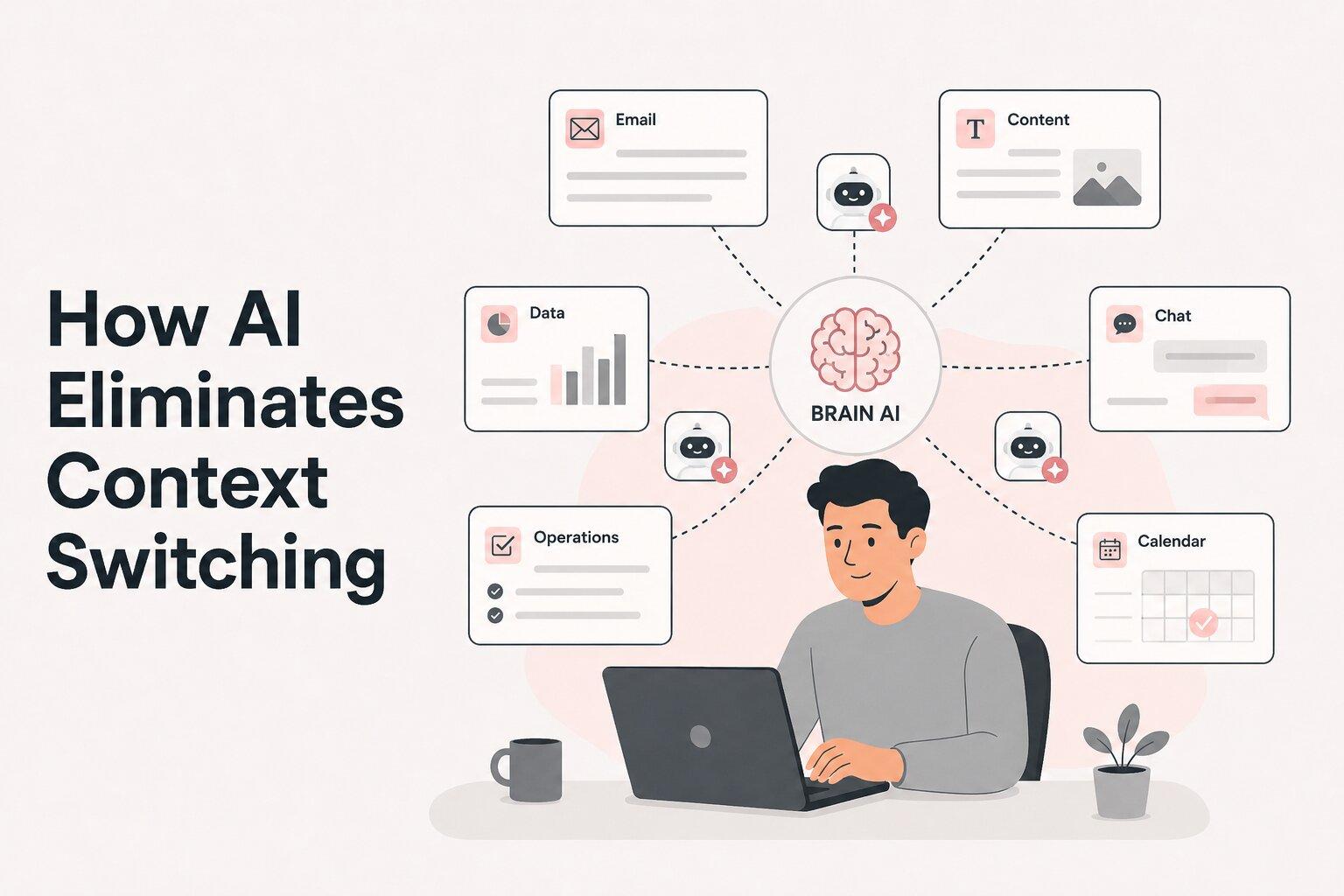
The core problem with context switching is that execution is fragmented across too many tools, decisions, and manual steps. AI reframes this as an execution problem and solves it at the workflow level. Instead of you moving between tools to get things done, AI operates as a centralized layer that handles tasks across systems. This keeps your context intact and your attention free.
Centralized Knowledge with Brain AI
One of the highest hidden costs of context switching is having to re-explain yourself constantly. Every new tool, every new session, and every new team member requires you to reload and re-share context that should already be known.
Brain AI solves this by maintaining a unified knowledge base. It holds your preferences, your business context, your tone, and your workflows, so nothing needs to be re-entered. Tasks continue without interruption because the system already knows what it needs to know. That continuity is what makes it possible to reduce context switching at a structural level rather than fighting it manually.
Execute Tasks Without Switching Between Tools
AI can handle actions across email, content creation, data analysis, and communications without requiring you to open a single additional platform. Instead of you toggling between five tools to complete one workflow, AI executes across all of them from a single point of instruction.
For a real-world example, think about the old way of working. You would write an email in Gmail, pull CRM data from another tab, cross-reference a document, and manually format the output. With AI, you simply describe the task once, and the system executes across those different tools to deliver a complete result. That is how you reduce context switching at a workflow level, not just a personal habits level.
AI Helpers That Handle Parallel Workstreams
Rather than you jumping between different business functions, like handling customer queries now, switching to content next, and then pivoting to operations, AI Helpers can manage multiple workstreams simultaneously. Each Helper operates independently within its own domain, which means parallel progress without the parallel mental load.
This fundamentally changes the dynamic of context shifting at work. You stop being the person who holds every single thread and start being the person who directs outcomes. This is a much more sustainable and productive role.
From Task Switching to Flow State
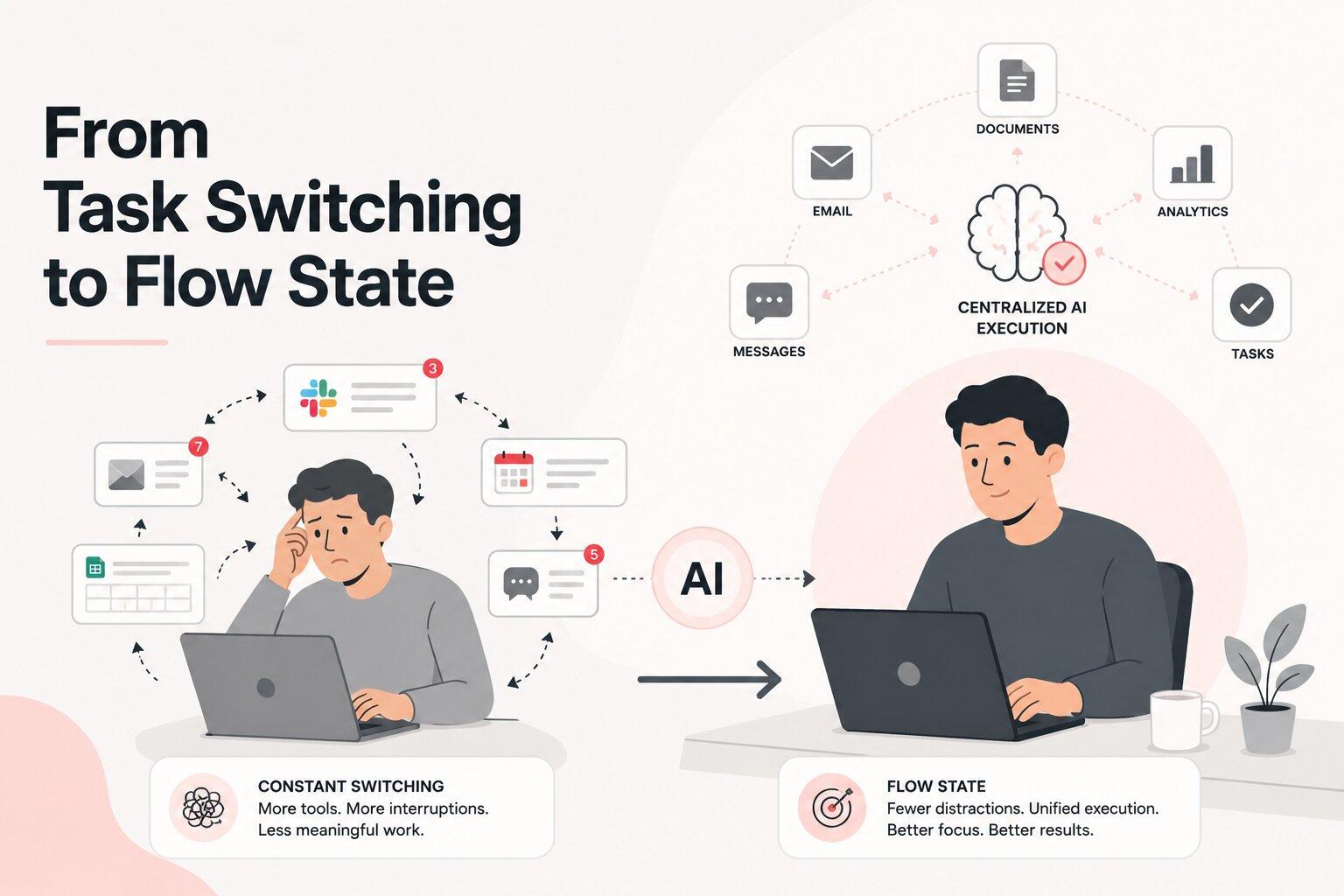
Flow state, the condition where work feels effortless, fast, and deeply focused, is what is on the other side of reduced context switching. It's simply what happens when your environment stops interrupting you long enough for your brain to build real momentum.
According to Asana's research, 60% of a knowledge worker's time is consumed by coordination. This includes communicating about work, searching for information, and switching between apps, rather than doing the actual work itself. That means the majority of a typical workday is spent on the scaffolding around work, not the work itself. If you reduce that scaffolding, the time available for deep, meaningful output multiplies.
Imagine completing a complex piece of work, like a strategy document, a client proposal, or a product brief, in a single uninterrupted two-hour session versus assembling it in fragments across a day of meetings and notifications. The output is different. The quality is different. And critically, the experience of working is different. One leaves you energized, while the other leaves you depleted.
That experience of actually finishing things, thinking clearly, and building real momentum is what becomes possible when context switching is treated as a systems problem and solved accordingly. Structured workflows, centralized tools, and AI execution layers do not just save time. They create the exact conditions you need for your best work.
Ready to Eliminate Context Switching?
If the patterns described here sound familiar, the good news is that context switching is entirely fixable. You do not fix it by working harder, but by redesigning how your work gets done. Reducing context switching starts with centralizing your execution, cutting tool overload, and letting AI carry the operational weight so your attention stays exactly where it belongs.
Sintra AI is built exactly for this. With an AI team that maintains context, executes across tools, and handles parallel workstreams simultaneously, you can protect your deep focus without sacrificing output.
Get started with Sintra AI today to reduce daily distractions, build momentum, and make deep focus your standard way of working.
Context Switching FAQs
What is context switching in simple terms?
Context switching is when you stop working on one task to start another before finishing the first. It happens constantly in modern work, like when you jump from email to Slack to a spreadsheet and back. Each switch costs your brain time and energy to reorient.
How much time is lost due to context switching?
After each interruption, it takes an average of 23 minutes to fully regain focus. Across a full year, this adds up to roughly five working weeks lost to task reorientation alone.
What are common examples of context switching at work?
Common examples include checking email mid-project, responding to a Slack message during deep work, and switching from writing to reviewing data before joining a meeting. Trying to pick up right where you left off after these disruptions is a context switch, and they accumulate fast.
How can I reduce context switching in my workflow?
You can batch similar tasks together, consolidate your tools, block time for uninterrupted focus, and mute notifications during deep work sessions. You can also delegate execution to AI, so fewer tasks require your direct attention in the first place.
Can AI tools help handle context switching?
Yes, and it is one of the most effective approaches available. AI can execute tasks across platforms without requiring you to switch between them, maintain persistent context so you do not have to re-explain yourself, and manage parallel workstreams so your attention stays focused on what matters most.
Related articles