How to Use AI For Sales Prospecting?


Table of Contents

Sales have long been automated. But there is a new player in the game - artificial intelligence.
With this, reps are no longer spending days sifting through the information to qualify leads. Adoption is accelerating fast - 47% of sales reps say cold outreach is one of the worst parts of the job and 47% say their team lacks bandwidth to do it effectively, yet 92% of sales pros with AI agents say AI benefits prospecting, and high performers are 1.7x more likely to use AI prospecting agents.
Sounds helpful, right? You can get the same assistance with AI implementation in your company’s sales processes. So, let’s find out more about how to use AI for sales prospecting.
What Is AI-Powered Sales Prospecting?
AI-powered sales prospecting means using advanced algorithms to automate routine sales tasks. It enhances your productivity and helps you engage potential customers.
But, how does it work? For starters, it uses machine learning, natural language processing, and sentiment analysis to prioritize, quality, and reach out to leads. Unlike traditional prospecting, there is minimal manual search, lengthy delays before closing deals, and measurement errors.
Here are the two main components of AI-driven sales prospecting.
Inbound Prospecting
- Engaging potential prospects at all times to nurture leads.
- Answering customers’ queries, crafting FAQs, and updating data on CRM in real time.
- Scheduling meetings, booking interviews, and more once the lead is ready to interact with the sales reps.
Outbound Prospecting
- Identifying and qualifying leads by using CRM data, customers’ engagement history, and predictive AI insights.
- Crafting personalized content, including cold message scripts, emails, and follow-up responses.
- Optimizing outreach by recommending follow-up actions, such as narrowing down audiences, finding the right time to reach out, etc.
Key Benefits of Using AI for Sales Prospecting
AI in your sales processing has various merits for your workflow.
- Automates routine manual tasks, allowing sales teams to focus on high-impact areas. With AI-driven sales, you don’t have to analyze data, score leads, or answer customers, wasting precious time.
- The natural language processing and predictive analysis enable sales reps to narrow down, qualify, and nurture leads - all with minimal effort.
- AI technology aids you in personalizing outreach campaigns. This way, your customers feel valued and engage with your content.
- With better engagement and outreach, your chances of surviving the saturated market and beating competition grow significantly, contributing to revenue opportunities.
Core AI Use Cases in Sales Prospecting
Let’s get beyond the theory and check out some use cases for AI in the sales funnel. See how AI can completely transform the way a company performs today.
Predictive Lead Scoring and Qualification
Lead Scoring in the sales funnel without AI literally means spending hours sifting through the data. It is neither efficient nor accurate.
Let’s understand how it used to work.
So, typically, a human agent would allocate certain points to a prospect depending on their activities. It can be attending a webinar, watching a video, or even downloading a book.
While the logic stays the same, AI cuts down the time and effort significantly. Smart agents like Dexter use predictive analytics, buyer intent, website visits, and sentiment analysis to rank low-risk prospects. These leads have a better chance of converting and contributing to your revenue stream.
By using such agents, Datamatics streamlined lead filtering. The company implemented a suite of deduplication and validation software to eliminate redundant leads having minimal chances to convert. This kept the sales team focused on nurturing low-risk, high-potential leads.
Personalized Outreach at Scale
Sales professionals prioritize personalization at all costs. They know how tailored customer interactions, be it emails or phone calls, can help close dealers faster and more effectively.
However, crafting messages that resonate with your business and build long-lasting customer relationships is time-consuming. Plus, it’s not the best use of a sales rep’s time.
Thankfully, AI is now capable of reaching out to individual clients at scale. In fact, AI email asistants can write cold emails, scripts, and more, all while understanding the specific pain points of your audience.
Anil Puri from the Profit Coach, an advisory firm, employed Emmie to draft a thorough email marketing strategy. With customer interactions personalized and guaranteed engagement, he saved 5-10 hours per week and focused on bringing sustainable growth strategies to the table.
Data Analysis for Optimal Sales Performance
Making sense of data is a crucial step in the sales funnel. Here, too, AI can help sales teams derive meaningful insights from the customers’ data. AI data analysts like Dexter look into conversion patterns to improve the performance metrics, such as click-through rates, open rates, etc.
Good thing - it’s not limited to just improving performance but also extends to multiple areas, including refining your target audience, knowing when to engage, and optimizing sales messages.
Imagine a smart helper that gets into your workflow and gives you detailed sales forecasts and financial reports. That was Dexter for Click Hive’s Krysztof.
His marketing agency was struggling with a reactive approach and was unable to innovate with high-impact plans. After employing AI, he was able to make fresh and easy-to-digest insights for the creative team. With this, it was easier for Krysztof to find alternate routes.
Workflow Automation for Follow-ups and CRM Updates
Let’s address the elephant in the room. Follow-ups, data entries, and sales calls take most of your sales reps’ time. It keeps them from focusing on higher-value activities and compromises productivity.
The good news - artificial intelligence frees up all this time by automating repetitive tasks.
AI assistants like Vizzy integrate into your workflow and do all for you - scheduling meetings, following up on emails, updating information on CRM, and more. By eliminating repetitive data chasing, sales teams can better engage leads.
As a startup with financial restrictions, Simply Precious Hands was struggling with sales growth. Being in a saturated market with a small workforce, the business decided to employ Vizzy. It helped sales reps craft content, interact with customers, and streamline admin tasks.
Step-by-Step: How to Implement AI Tools in Your Sales Prospecting Process
Say goodbye to manual research and spending hours analyzing historical data. Follow this small tutorial on how to implement AI tools into your sales prospecting process.
Step 01: Define Your Objectives and Ideal Customer Profile (ICP)
Prospecting is not limited to achieving a single goal. Startups might implement AI tools for automating repetitive tasks, others for AI-driven insights, or nurturing qualified leads.
Hence, the first thing sales teams must ensure is clarity of mind. Ask questions,
- What parts of the current sales efforts are most repetitive?
- Are you struggling to find leads, to qualify them, or to nurture them?
- What problem are you going to fix in sales prospecting?
Once done, you need to develop an ideal customer profile. It helps you qualify and nurture the high-potential leads.
But, for this, sales teams must have clarity about their prospects. This includes everything, from your demographics to industry, role, company size, and more. Once documented, your AI knows who to look out for.
A good approach to developing ICP is Brain AI by Sintra. It is your business storage containing all your customer feedback surveys, demographics data, financial reports, purchase history, etc. Having this in the conscious, Sintra’s AI helpers can provide tailored engagement strategies.
Step 02: Select and Integrate AI Sales Prospecting Tools with Your Existing Stack
The next step is to select the right agent.
- Problem: There are tons of AI sales prospecting tools.
- Solution: A checklist outlining all the criteria for selecting this tool as per your desired goals.
Let’s say you want sales prospecting software for lead generation. Your checklist must have things like automation, convenience, integrations, credible user reviews, and more.
Once done, compare all the popular lead generation tools in 2026 and see which one passes all the marks and fits your budget.
If you are just starting, have minimal programming experience, and are not sure where to begin? Try Sintra.ai. It is an advanced prospecting solution with twelve smart AI sales assistants, each specializing in a certain task. You are free to purchase any of these assistants, effectively serving your goals and staying within budget.
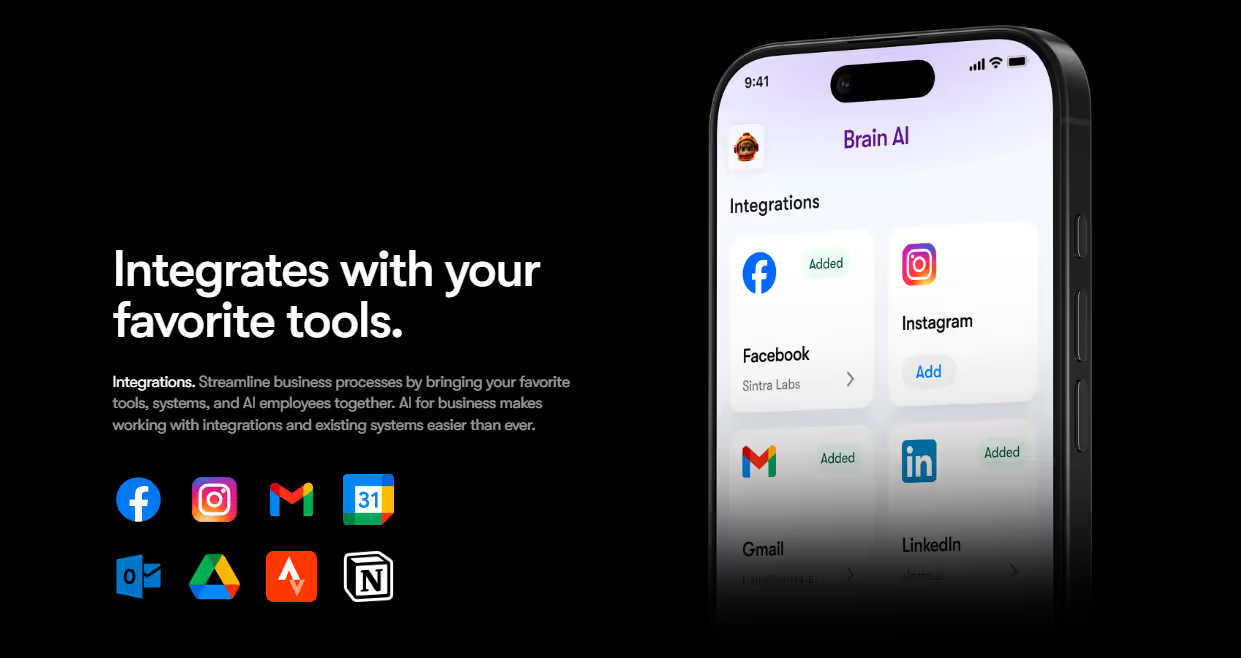
Moreover, while selecting AI systems for automation, never undermine integrations. Once you start using AI for sales leaders, your people are better equipped to perform routine tasks. So, make sure the one you choose is compatible with your CRM, Google apps, etc., accordingly.
Step 03: Personalize the AI Operations
Personalization is the best way to attract potential customers. Whether it is an outreach campaign to boost sales engagement or deriving actionable insights from sales data, AI needs your input.
So, gather all your company’s data from across the platforms - social media, website, e-stores, and more. But that’s not enough. Add all your goals and objectives regarding the future of sales - where you want to go with it.
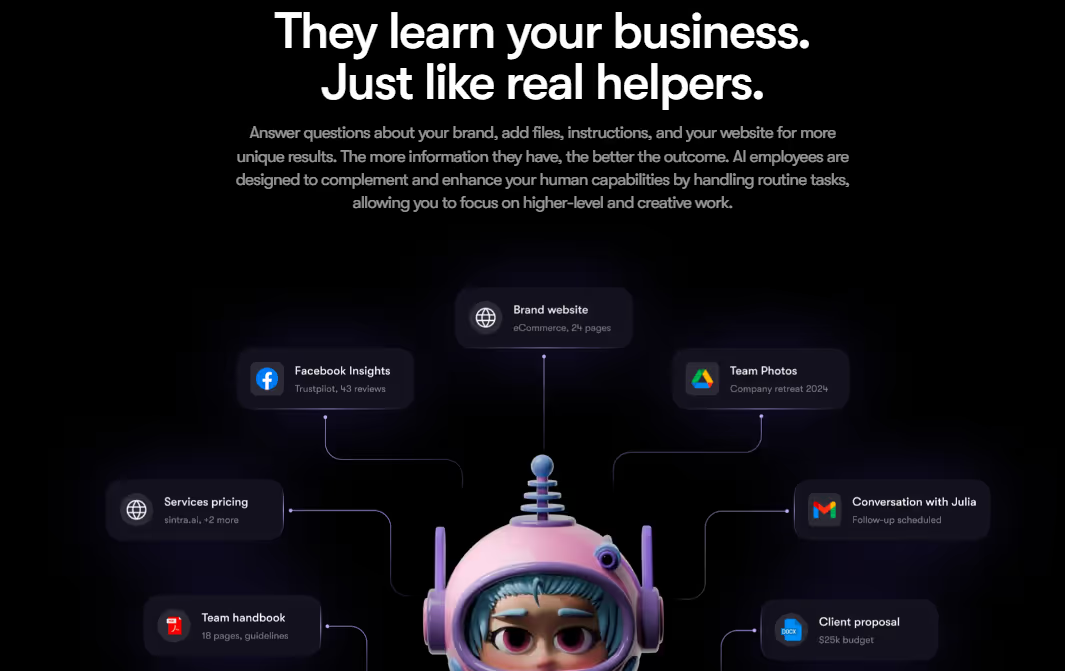
Good thing, centralized knowledge bases like Brain AI do the job. It allows sales teams to add files, media, documents, surveys, and URLs to make the AI systems aware. Once the AI knows all about your business, it can guide the agents to craft content and do other jobs in a way that speaks your voice while resonating with the audience.
Step 04: Train Your Team & Monitor Performance
Finally, we’re on to the implementation. However, don’t go all in.
Rather, select a small team from your workspace and plan a pilot project using training sales teams with AI.
However, before proceeding further, you must do a few things to keep the process seamless.
- Always schedule an onboarding session, even if you are working with a no-code, convenient AI software.
- Decide few key parameters to track performance. It can be click-through rates, sales engagement, intent signals, etc.
- Set up a human rep from your sales team over the AI to check for errors and hallucinations.
Now, implement your AI sales prospecting tool and monitor performance from time to time. See if it was beneficial and whether you like to scale it. You can gradually increase the number of use cases with time, and scale it to however you like according to the budget.
Step 05: Refine and Scale
Don’t stop here. Improvement never ends. Constantly monitor your KPIs weekly or twice a month. Keep an eye on things like response rate, customer satisfaction, accuracy, etc.
As you make your way, improve the scoring by tweaking the prompts, updating the data, and personalizing the outreach campaigns. While you are in the process of AI adoption, never hurry. Take your time and gradually scale from one use case to two, and more.
How Sintra.ai Bots Supercharge Sales Prospecting?
Sintra.ai is a professional sales platform employed by many to improve their revenue streams and engage customers. It has a collection of bots to help you with sales prospecting, from qualifying leads to creating content and reaching out. Here are a few ways it has been delivering in streamlining sales processes.
Saving Time with Vizzy
Sales leaders can cut down their non-productive hours with Vizzy. This smart AI agent takes care of all your repetitive creative and manual tasks. By allowing Vizzy to access work platforms like Google Calendar, CRM, and email, sales professionals can keep track of everything happening around.

Data-Driven Decision Making
Businesses can make the most of their data, thanks to Dexter. It uses predictive and sentiment analysis to identify trends in customer behavior. It then forecasts what customers are going to do next and recommends strategies accordingly. This way, your decisions are informed and well-thought-out.

Adaptive Sales Strategies
The changing market comes with new and unthinkable challenges. And with the existing saturation, things can get at odds. Hence, the only solution is working smart. Fortunately, Gigi and Vizzy help you innovate and stay relevant. These personal coaches dictate each move with a thorough cost-and-benefit analysis.
Personalizing Customer Experience
When you first register on Sintra, it gives you a survey to complete. This way, the Brain AI learns about your business goals, objectives, and target audience. As you prompt it to perform tasks and feed data, it grows context and learn about you. The more it learns, the more personalized and relevant it gets with audience queries.

Achieving More with Power-Ups
Each of these agents possesses unique additional features called power-ups. Think of them as your immediate help - always ready to do work. For instance, with Soshie’s power-ups, you can immediately create a LinkedIn post and schedule to post it accordingly.
Best Practices and Tips for Successful AI-Driven Prospecting
Integrating AI into your sales funnel means automating most of your routine tasks, but here are some important considerations you must look into before going in.
Quality of Data Matters: You cannot leave it all on NLP and predictive algorithms. Such technology is not going to deliver if the data lacks structure and clarity. So, before everything else, you must process customer data coming in from multiple channels. Free it from grammatical errors, unstructured paragraphs, and no headers.
Never Underestimate Training Sales Teams: A study by Harvard Business Review proposed the relationship between the age of employees and their willingness to adopt AI-driven solutions. So, it’s crucial that as a company, you offer hands-on training for the workforce. It not only improves their understanding of the system but also enables the entire sales team to feel empowered.
Prioritize Supervision: AI autonomous sales teams work on their own. Once you set it up, it carries out all the tasks with minimal input. However, monitoring its performance becomes mandatory. You must set up human sales reps to regularly assess the pipeline, revenue growth, and customer response to maintain the health of the system.
Integrate as You Move: While tons of options in the market, not all of them offer your desired integrations. One that is compatible with your CRM and workflow is the one to go for. For instance, Sintra.ai is a sales solution, which means it will work with most sales platforms
Embrace AI with Ethical Concerns: Ethics concerning data privacy have been and will be there as long as AI prevails. So, you must embrace AI while taking a lead in establishing trust with your customers and employees. Be transparent about data usage, set up a cross-functional legal-HR governance to maintain credibility, and comply with the industry regulations for the most part.
Go for Conversational AI: The future of AI-powered sales prospecting is in voice assistance and conversational intelligence. Sales reps and customers today can talk to AI agents in their preferred language, whether it’s requesting activities or data-driven insights. So, it’s high time you invest in it.
Frequently Asked Questions
What types of AI tools are best for sales prospecting?
Well, it depends on your purpose of using AI agents for sales prospecting. But generally, lead qualifiers using predictive analytics, machine learning, automated solutions, and content creation tools work best for improving your sales performance.
How do I ensure my AI-generated outreach is personalized and not spammy?
To ensure your AI-generated outreach is personalized and not spammy, focus on providing specific data, mimicking human conversation, and emphasizing relevance. For this, you can go beyond basic personalization and target specific pain points.
Can AI completely replace manual prospecting?
No, AI cannot completely replace manual prospecting - even if it’s an anonymous system. Human governance and constant monitoring are crucial for staying relevant, accurate, and effective.
What data do I need for effective AI-driven lead scoring?
For effectively scoring leads with AI, you need to document an ideal profile. It contains both your audience’s demographics and behavioral data, from industry to job status, purchasing history, buying signals, and more. Make sure it’s structured and clean.
How does AI integrate with my CRM?
AI solutions like Sintra integrate with your CRM by automating data entry, streamlining prospecting efforts, enabling the sales team to focus on high-impact strategies, and more. It analyzes your customers’ data for qualifying leads and closing deals.
What are the challenges or pitfalls to watch out for?
Like benefits, AI in sales forecasting has a few challenges, including over-automation, privacy concerns, data filled with biases, unstructured data, and integration difficulties. Good thing - all of these are avoidable with the right steps.
How can Sintra.ai bots be customized for my sales workflow?
Definitely. Sintra's AI bots can be customized for your sales workflow via Brain AI. You feed the business data into this centralized knowledge base in the form of URLs, videos, media, and documents. It then better interprets your prompts and performs the task while keeping the context intact.
Related articles