Generative AI for Customer Support: The Complete 2026 Guide


Table of Contents
Generative AI can transform customer support by automating responses, reducing resolution times, and helping teams deliver consistent, accurate answers at scale. The best systems understand intent, suggest replies to agents, and handle routine questions so human support can focus on complex issues. The productivity gains are particularly striking for newer team members - a generative AI chat assistant lifted agent productivity by 14% on average, with novice and low-skilled workers gaining 34%, and agents with just 2 months of tenure performing as well as untreated agents with over 6 months of experience.
Many support teams struggle with high ticket volume, slow response times, and inconsistent service quality. Traditional tools alone can’t process large amounts of feedback or predict customer needs. Generative AI analyzes interactions, suggests improvements, and drives faster, more personalized support.
This guide explains how generative AI works in customer support, shows real use cases, and highlights tools and implementation tips to help your team deliver faster service and better experiences without increasing headcount.
Quick Answer: How to Use AI for Customer Support
Using generative AI for customer support is about shifting from manual ticketing to intelligent automation. You can start by deploying AI assistants like Cassie by Sintra to auto-generate personalized replies based on past interactions and your knowledge base. AI can also assist agents in real-time by suggesting phrasing, summarizing long calls, and identifying recurring FAQs to create self-service articles.
While tools like Salesforce’s Agentforce or Zendesk AI are great for enterprise-level ticket routing, the goal remains the same: let AI handle the repetitive, low-emotion tasks so your human team can focus on complex, high-value escalations. This hybrid approach ensures faster resolutions without losing the empathy customers expect.
8 Use Cases of Generative AI for Customer Support
Generative AI models are no longer a futuristic concept. They are actively transforming how businesses handle customer support. From automating routine tasks to delivering highly personalized responses, AI can address a wide range of customer inquiries and improve efficiency using proven ways to increase customer engagement.
In this section, we'll explore eight of the most impactful use cases of generative AI, showing how companies are applying it to streamline support services, reduce response times, and create a more engaging customer experience.
1. Auto-Generating Customer Replies
Generative AI can instantly generate personalized responses to customer inquiries, reducing handling time and helping support teams focus on other vital issues. By analyzing customer behavior, previous interactions, order history, and customer context, AI ensures generative responses feel relevant and human-like.
It can handle common customer queries, guide users through troubleshooting, and even automatically follow up, improving both efficiency and customer loyalty.
2. Assisting Agents as They Type
An AI reply generator helps support agents gives more accurate answers and reply faster. By offering phrasing options, recommended answers, and relevant resources as they type, agents save time and maintain consistency across interactions.
AI also uses natural language processing (NLP) to learn from corrections, improving itself over time. Companies using this approach see faster resolution, reduced agent fatigue, and a smoother overall customer experience.
3. Automating Note-Taking and Post Call Processing
AI customer service can generate detailed call summaries, capture key action items, and automatically update internal knowledge bases. This reduces the agents' spending on documentation and ensures notes are accurate and structured.
Teams benefit from improved agent performance and productivity, faster onboarding, and a more organized repository of insights for future support planning.
4. Unearthing Customer FAQs and Generating Knowledge Articles
By analyzing customer data, AI can identify recurring questions and automatically produce FAQ responses or knowledge base articles. If your team is also creating blog posts or marketing content, see how AI-assisted writing can speed up that process too. This keeps content relevant and up to date, reducing repetitive tasks like support tickets. It also empowers customers to self-serve rather than wait for a support agent to show up. Businesses see fewer tickets, faster resolution, and a more efficient support system, ultimately leading to increasing customer satisfaction .
5. Efficient Bot Performance and Self-Service Scaling
Generative AI improves chatbot accuracy, tone, and conversation flow. Bots can handle queries without human intervention, adapting responses in real time using conversational AI.
6. Automating Escalations and Ticket Routing
AI can categorize incoming tickets, prioritize them, and route them to the most appropriate agents. By analyzing customer data and historical patterns, it ensures complex issues reach experts quickly. Organizations witness lower agent workload and more organized support workflows by following this approach.
7. Predicting Customer Satisfaction and NPS Scores
AI analyzes customer sentiment from past interactions to predict customer satisfaction and loyalty, even before they submit any feedback. It also gathers data and anticipates the Net Promoter Score (NPS) for a certain product or service. Early detection or at-risk customers allows proactive engagement, personalized follow-ups, and strategic improvements that boost retention and satisfaction.
8. Extracting Insights from Customer Feedback
Generative AI models can transform unstructured feedback - surveys, reviews, or support chats - into actionable recommendations. This helps business value identify trends, improve products, and refine services. For broader workforce applications, companies can explore AI employees.
Best Generative AI Tools for Customer Support Processes
Choosing the right generative AI technologies can transform customer service operations. Generative AI solutions streamline responses, improve personalization, enhance ticket management, and reduce routine tasks.
Here's a closer look at some of the most effective tools used by businesses in 2026, including options that integrate seamlessly with your support workflow:
1. Cassie by Sintra
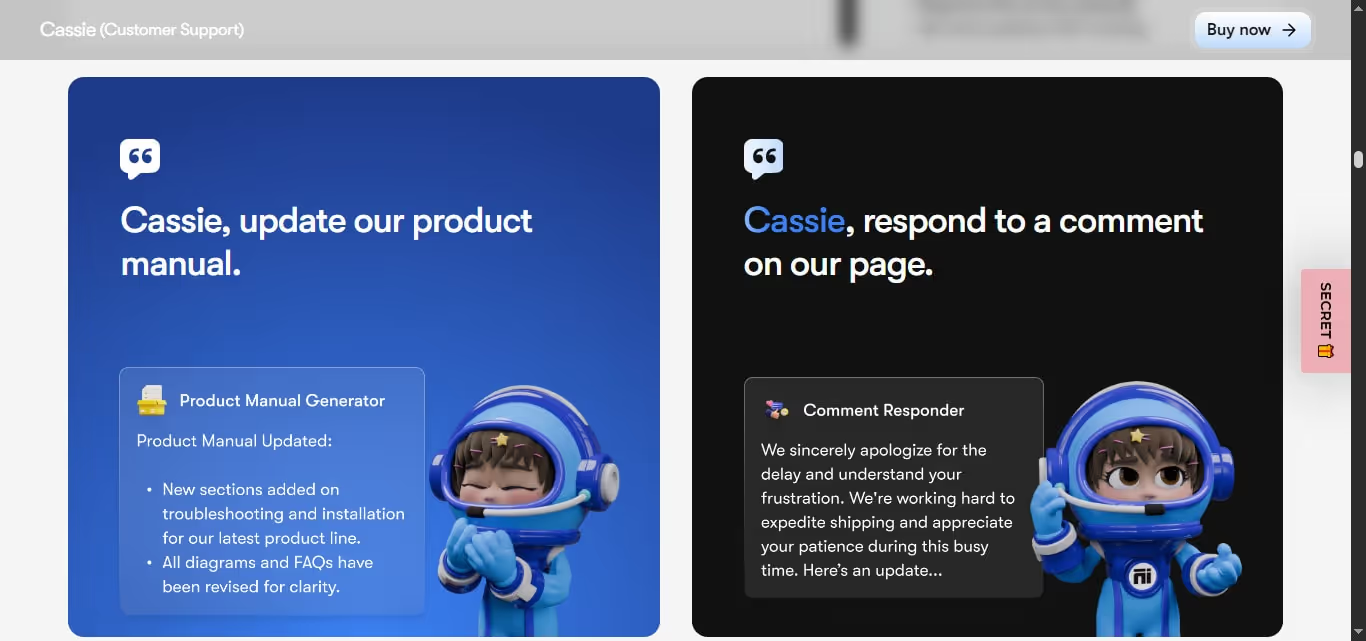
Sintra's Cassie is hands-down a favorite for growing teams who want an "all-in-one" solution. It reads every incoming message, pulls context from past tickets, your knowledge base, and even order history. It then either auto-replies with a perfectly tailored response or drafts one for your agent in seconds.
Users report cutting repetitive tasks by 70-80% and saving 5-10 hours per agent per week. Because it's built on cutting-edge generative models but keeps a human editor in the loop, accuracy stays above 93% even with tricky or sarcastic customer tones. Bonus? It supports 30+ languages fluently and costs a fraction of what enterprise giants charge.
2. Agentforce (Salesforce)
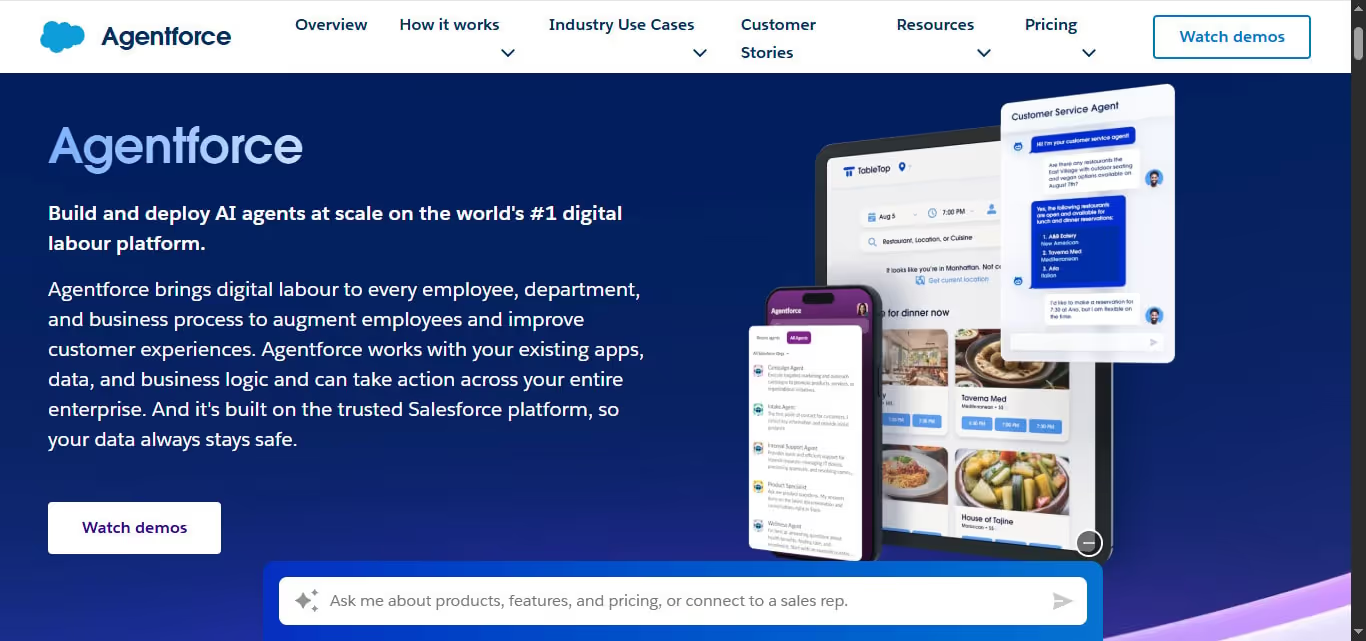
Salesforce changed its game with Agentforce, its autonomous service cloud agent. It's now resolving over 80% of website visitor issues without ever handing off to a human customer service agent. Imagine returns, tracking updates, billing questions, and basic troubleshooting. Companies like Stanley and 1-8000-Flowers cite 40-50% drops in average handle time and a serious boost in CSAT because the bot sounds eerily human and never has a bad day.
3. IBM Watson Assistant
Watson shines when you have massive, complex product catalogs or operate in regulated industries like finance, healthcare, or telecom. Its strength lies in deep contextual understanding, machine learning algorithms, and rock-solid compliance features. Pair it with generative AI capabilities, and it can hold long, multi-turn conversations that feel like chatting with a senior support agent who has memorized every policy document.
4. Google Smart Compose

Google Smart Compose helps live agents reply faster by generating draft suggestions with AI. It maintains a consistent tone across interactions and learns from past customer interactions to improve suggestions over time. This reduces agent workload while increasing resolution rate and providing a smoother customer experience.
5. Zendesk AI
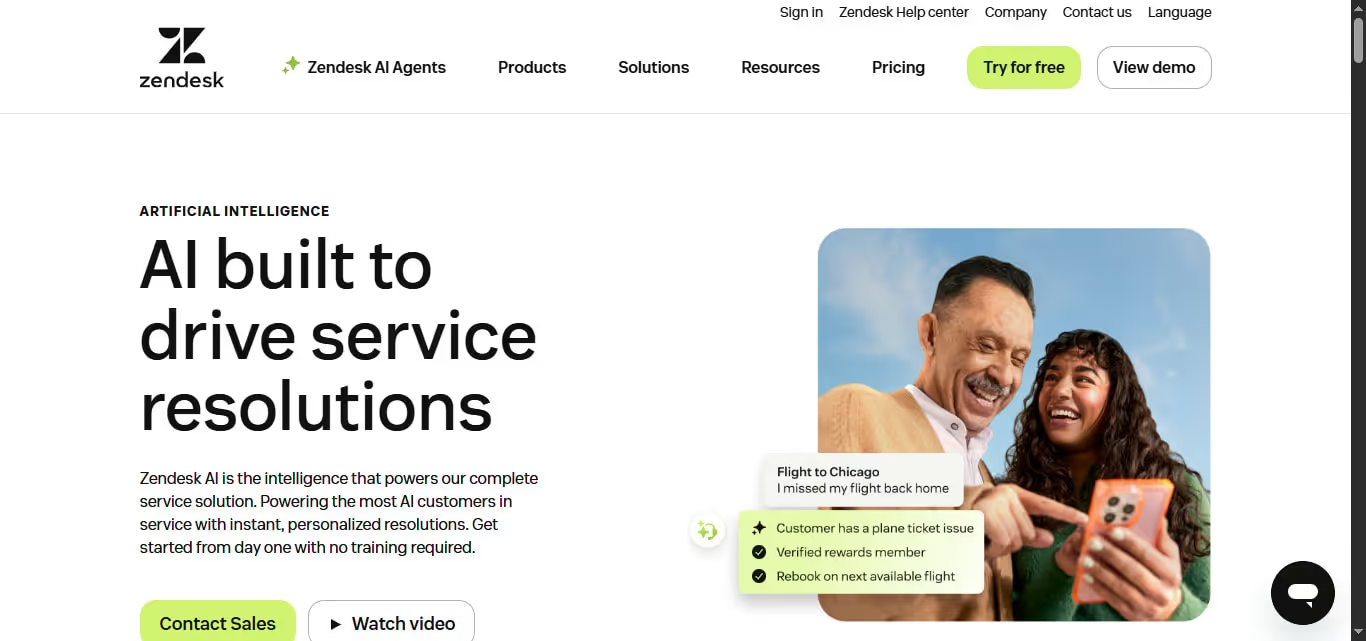
Zendesk's generative layer now handles intelligent ticket routing, sentiment detection, macro suggestions, and even proactive support solutions. It scans new tickets, predicts urgency, and surfaces the exact article or past similar ticket. Large Zendesk shops like Shopify, Tesco, Stanley Black & Decker report 30-40% deflection rates and far fewer "where is my order?" interactions.
For companies exploring a wider range of AI-powered solutions, check out AI Helpers by Sintra.ai. These helpers integrate seamlessly with existing support operations to improve overall customer service teams.
Real-World Examples of Generative AI in Customer Support
Generative AI is driving results for businesses worldwide. Companies across industries are using AI to automate responses, improve personalization, and optimize support agents. Let us explore some real-world examples that showcase how generative AI models are revolutionizing customer support professionals and delivering measurable improvements in efficiency, satisfaction, and overall service quality.
1. H&M Virtual Assistant
Fast fashion meets fast support: H&M's AI-powered virtual assistant is a prime example of generative AI in action. Built on conversational AI, it handles thousands of queries daily, from sizing advice to order tracking, all with hyper-personalized recommendations based on browsing history and preferences.
This isn't rote scripting; the AI generates outfits or alternatives on the fly, mimicking a personal stylist. The result? Reduced pressure on human customer service agents, quicker problem resolutions, and a spike in customer engagement. All this leads to higher sales and fewer abandoned carts. Early adopters report wait times dropping significantly, proving AI can scale empathy in e-commerce.
2. DevRev’s Turing AI
For B2B support, DevRev's Turing AI is like having an extra brain in the team. It scans incoming tickets, understands context via natural language processing, and suggests, or even drafts replies in real-time - complete with accurate info from your knowledge base.
One key win with Turing AI: It simplifies complex queries, like troubleshooting software glitches, by generating step-by-step guides tailored to the user. This has led to faster, more consistent support, with companies noting unparalleled efficiency in their workflows.
3. Salesforce's Agentforce
Enter Agentforce, Salesforce's autonomous AI agent that's redefining enterprise support. It resolves over 80% of visitor issues automatically, from billing disputes to product queries, by pulling real data and generating context-aware responses.
The key metric? It cuts average resolution times by around 40%, sometimes more, allowing agents to focus on high-value escalations. Brands like 1-800-Flowers have seen CSAT scores soar, as the AI customer service handles everything proactively.
4. Sintra's Cassie
Rounding out the list is Cassie by Sintra.ai, an AI specialist focused on precision and savings for growing teams. It automates responses to emails and chats, drawing from your expanded knowledge base to ensure spot-on accuracy.
Users rave about a 93% improvement in response quality, plus saving 5+ hours weekly per agent by handling FAQs and personalization effortlessly. It's like having a tireless professional who learns on the job, making it ideal for Ecommerce or SaaS, where volume spikes unpredictably.
These examples aren't isolated wins; they signal a shift where generative AI in customer service turns support from a cost center into a revenue driver. If your team is drowning in tickets, it's time to plug in and level up.
Challenges of Using Generative AI in Customer Support
Even the shiniest AI tools come with real hurdles. Ignoring them is the fastest way to a failed pilot and a very annoyed team. Here are some of the obstacles companies mention most and how smart teams get past them:
1. Data privacy & security concerns
Customers share everything from payment details to personal details. A single breach or misuse of data can destroy trust overnight. Many teams freeze when they realize that generic public Large Language Models (LLMs) might be trained on conversational AI.
The solution? Choose tools with zero-retention policies, end-to-end encryption, and compliance certifications like HIPAA and SOC 2 Type II. Sintra's Cassie, Agentforce, and Watson all offer private-cloud or on-premises deployments that keep your data within your contact center.
2. Balancing AI vs. human interaction
If you go overboard with automating, you get the "your bot sucks" backlash from the customers, and if you do it under, you're practically back to square one. The middle ground is ruthless prioritization: let AI handle repetitive, low-emotion tasks, and route anything emotional, complex, or high-value to human customer service agents instantly. Modern tools make this integration of generative AI seamless with confidence scoring and sentiment triggers.
3. Integration with legacy systems
Plenty of companies still run on older helpdesks, custom CRMs, or tech stacks. Plugging in an AI cab feels impossible. Reality check: most leading tools now offer pre-built connectors to Zendesk, Freshdesk, Intercom, Gorgias, Salesforce, and even home-grown systems via API. Start with one digital channel and expand once the wins are obvious.
Employee resistance
Agents hear AI and get scared of getting fired. Leadership hears cost savings and lower headcount. Both reactions kill adoption. The antidote is transparency and involvement.
Customer service leaders should initiate agent-coaching programs and demonstrate how AI eliminates their most hated tasks. It should also be made clear that success with AI directly ties to a better work-life balance. Teams that treat agents as co-pilots instead of replacements see excitement, not resistance.
None of these challenges is a deal-breaker; they're just growing pains. By addressing them upfront, you can adopt AI in customer service and turn it into a force multiplier rather than a headache.
Future Trends in Generative AI for Customer Support
In the near future, generative AI won't just be answering tickets; it will run entire customer service teams. Here are the four trends every support operations leader is already preparing for:
1. 24/7 multilingual mastery
Next-generation LLMs are erasing language barriers in real time with near-perfect cultural nuance. Customers in Tokyo, Sao Paulo, or Lagos will message in their native language and get responses that feel local, not translated. Companies like Sintra are already pushing 99%+ fluency across 50+ languages.
2. Emotion-aware AI
Future systems will detect frustration, excitement, or sarcasm from tone, typing speed, and even emoji use. It will then dynamically adjust empathy levels and wording. An angry customer gets a warmer, shorter reply; a delighted one receives playful suggestions. Early pilots show emotion-tuned responses, lifting CSAT by 15-25 points.
3. AI copilots for agents
Imagine AI copilots like Cassie that listen live, pull internal docs, draft replies, suggest de-escalation phrasing, and even book calendar slots for complex cases, all within seconds. The outcome? Senior-level handling at junior-agent speed!
4. Hyperautomation
The perfect merging of generative AI and robotic process automation (RPA). Routine tasks like refunds, address changes, and subscription cancellations will be handled end-to-end with zero human intervention. The AI writes a polite email, updates the CRM, processes the payment, notifies the warehouse, and follows up, significantly reducing operational costs. It also speeds up the pace of software development. Gartner predicts 70% of support interactions will be fully hyperautomated by 2028.
Conclusion: The Future of Generative AI in Customer Support
Generative AI has moved from experiment to necessity. It's no longer about cutting costs; it's about delivering faster, smarter, and more human-feeling support at scale. Companies that embrace it are seeing resolution time plummet, CSAT scores climb, and agents are finally focusing on work that matters.
Tools like Sintra's Cassie make that first step painless. With 93%+ response accuracy, instant personalization, and 5-10 hours saved per agent weekly, Cassie turns overwhelmed teams into high-performing ones almost overnight.
The future of customer support operations isn’t less human; it's superhuman. Get started today, and tomorrow your customers will genuinely thank you. To understand how this shift is reshaping team dynamics, read our article about the rise of AI employees and how they're changing workplace culture.
Frequently Asked Questions
What are the best generative AI tools for customer support?
Top picks in 2026 are Sintra's Cassie (best for growing teams), Salesforce Agentforce (autonomous power), IBM Watson Assistant (for enterprise-grade), Zendesk AI, and Google Smart Compose for speed.
Can generative AI replace human agents?
Not really. It handles 70-90% of routine queries beautifully, but humans remain essential for empathy, nuance, and complex customer support scenarios. The winning model is AI + human, where bots handle volume, agents handle business value.
How do I integrate AI into existing support workflows?
Start simple. Connect the AI to your helpdesk and knowledge base. Most tools offer no-code connectors and go live in days. Test on one channel first, then expand.
Is generative AI safe for handling sensitive customer data?
Yes, but only when you choose a reputable provider. Look for SOC2, GDPR, and HIPAA compliance, as well as on-premises or private cloud options. Sintra's Cassie and IBM's Watson, for instance, encrypt data end-to-end and never train on your customer conversations.
How do I measure ROI from generative AI adoption?
Track for key metrics: tickets deflected, average handle time saved, CSAT/NPS rise, and hours saved per agent. Most teams see a 3-6 month payback.
Related articles