What’s an AI Chatbot?

Table of Contents
What is an AI chatbot, and how is it different from a regular chatbot? It's a question many businesses still struggle with. The key difference is that AI chatbots can understand natural human language and hold conversations that feel closer to speaking with a real agent.
Thanks to advanced programming, a good AI chatbot software can solve user problems in real time with minimal human intervention. They're fast, accurate, and capable of handling multiple queries simultaneously. Real-world results back this up - Oscar Health's AI chatbots answer 58% of benefits questions instantly and handle 39% of benefits messages without human escalation, drawing on member records and past interactions to personalize every response. It makes them indispensable in today's competitive market.
Sintra’s AI tool takes this even further with specialized agents designed to support different business areas. These AI-powered agents automate critical functions behind the scenes. They ensure that your operations remain optimized, efficient, and scalable.
Let’s dive deeper into what an AI chatbot really is, how you can leverage it in your business, and how to choose the best AI chatbot for maximum impact.
Quick answer: What is an AI chatbot?
An AI-powered chatbot is a digital assistant that uses artificial intelligence to understand and respond to user queries in real time. These chatbots rely on natural language processing (NLP) and machine learning (ML) to interpret user questions and deliver accurate, human-like responses.
Sintra’s AI agents take this a step further. They don’t just understand context; they can also take actions, offer suggestions, and assist users proactively. This makes them more advanced than standard AI chatbots.
What is a chatbot?
Chatbots typically fall into two categories: rule-based chatbots and AI chatbots.
Rule-based chatbots are the most basic type. They follow predetermined scripts and decision trees to handle user queries. For example, if you ask a typical rule-based chatbot, “Why haven’t I received my package yet?” it might reply with something generic like, “All packages are delivered within 3–5 working days.”
Conversations with traditional chatbots follow fixed rules, and users often have to click through multiple options before getting the answer they need. This makes them suitable for simple FAQs and basic customer support queries.
However, because rule-based chatbots rely on rigid decision trees, modern users may find them slow and unresponsive. Especially today, when AI chatbots can deliver fast, contextually aware, and human-like responses.
What is an AI chatbot?
AI chatbots are smarter and faster than their traditional counterparts. Unlike conventional chatbots that rely on predetermined rules, AI chatbots use natural language processing (NLP) and machine learning (ML) to understand user queries along with their context and intent, and generate responses that feel natural and relevant.
What truly sets AI chatbots apart is their ability to learn from user interactions over time. With every conversation, they refine their responses for greater accuracy, efficiency, and personalization. From answering customer queries to offering product recommendations and facilitating transactions, AI-powered chatbots can support customers in countless ways.
But their application goes far beyond customer service. AI chatbots can also support internal teams by assisting various business functions. In fact, many modern business tools are essentially chatbots powered by advanced Large Language Models (LLMs).
A great example is Sintra AI, which provides multiple specialized AI agents designed to automate repetitive tasks and complete actions just like a human team member. Tools like Sintra offer an all-in-one solution that makes scaling a business effortless.
What are the use cases for AI chatbots?
AI chatbots can support every aspect of a business, from sales, marketing, customer service, to internal productivity. Here are some use cases of AI chatbot services that show how they transform operations and create scalable growth opportunities.
Data collection
AI chatbots help businesses collect valuable data from customer interactions. They analyze text and voice inputs using NLP to understand:
- Customer intent
- Preferences
- Emotions
Sentiment analysis then helps determine customer satisfaction levels. AI chatbot services also study user behavior through queries, giving sales teams insights into customer pain points, trending topics, product interest, and other important patterns.
With Sintra, this data collection becomes seamless through its centralized knowledge base, Brain AI. All customer data is stored in one place, allowing every business function to access real-time insights and make smarter decisions.
Sales promotion
Online AI chatbot software can automate time-consuming sales tasks while also:
- Engaging website visitors with personalized messages
- Identifying buyer intent
- Capturing and qualifying leads
- Scheduling product demos
- Guiding buyers toward completing purchases
Because they’re powered by conversational AI, these chatbots proactively nurture prospects, answer questions, and educate users about your product or service. This reduces bounce rates and abandoned carts while increasing conversions.
Sintra’s AI Sales Assistant, Milli, works like a digital sales rep, supporting decision-making, nurturing leads, and boosting conversions around the clock.
Autonomous customer service
Customers expect fast, hassle-free support, even during peak hours. AI agent chatbots make this possible by managing customer interactions around the clock, even when human agents are offline. When operating autonomously, they can:
- Diagnose issues quickly
- Eliminate wait times
- Provide instant support
- Personalize responses using user history
- Escalate complex cases to human agents
These autonomous customer service chatbots understand problems, troubleshoot effectively, and recommend solutions. Sintra’s AI customer support agent, Cassie, is a perfect example. It helps businesses deliver fast, consistent, and reliable support at scale.
FAQ responses
AI-powered chatbots can intercept and handle support tickets quickly and efficiently. It frees human agents to focus on customer satisfaction strategies and more complex issues.
More importantly, they help customers find answers instantly by pulling accurate information from knowledge bases and product documents. By addressing FAQs with relevant, context-aware responses, these chatbots significantly reduce repetitive queries and overall support ticket volume, improving both efficiency and customer experience.
Automated employee service
AI chatbot services aren’t just for customers; they support employees as well. These intelligent assistants help with talent sourcing, interview scheduling, and onboarding tasks. Moreover, they also provide 24/7 access to company policies and automate internal processes like request submissions and report generation.
These virtual assistants also handle routine employee queries related to benefits, time-off policies, password resets, and basic technical troubleshooting. This reduces workload for HR and IT teams while ensuring employees get fast, accurate support whenever they need it.
Personalised recommendations
AI-powered chatbots can deliver highly personalized experiences when integrated with business systems like CRMs and marketing automation tools. By accessing customer data, such as purchase history, past conversations, and browsing behavior, they can understand individual preferences and intent.
With these insights, AI chatbots offer relevant product or content recommendations, acting as full-time AI sales funnel generators. These tailored experiences increase engagement, boost conversions, and help users find value faster.
Appointment scheduling
An online AI chatbot can manage appointment scheduling and bookings without any human involvement. It can check availability, book demos or meetings, send reminders, and even handle rescheduling, all directly within the chat window. This level of autonomy ensures customers enjoy a fast, hassle-free booking experience any time they need it.
Sintra’s Auto Schedule Maker takes this even further by organizing tasks, deadlines, and meetings into a clear, structured schedule, making planning effortless for both teams and clients.
Omnichannel customer service
Customers expect businesses to connect with them on an array of channels. From social media platforms to phone and messaging apps, they want conversations to move seamlessly across platforms.
AI chatbot services make this possible by linking interactions across platforms and delivering a consistent, smooth user experience. Whether a customer reaches out via Instagram, an e-commerce chat widget, or email, the AI bot provides the same accurate information and tone.
Sintra’s ecosystem includes an AI social media assistant, email marketer, and ecommerce specialist, all working together to maintain round-the-clock, reliable omnichannel engagement.
What are the types of chatbots?
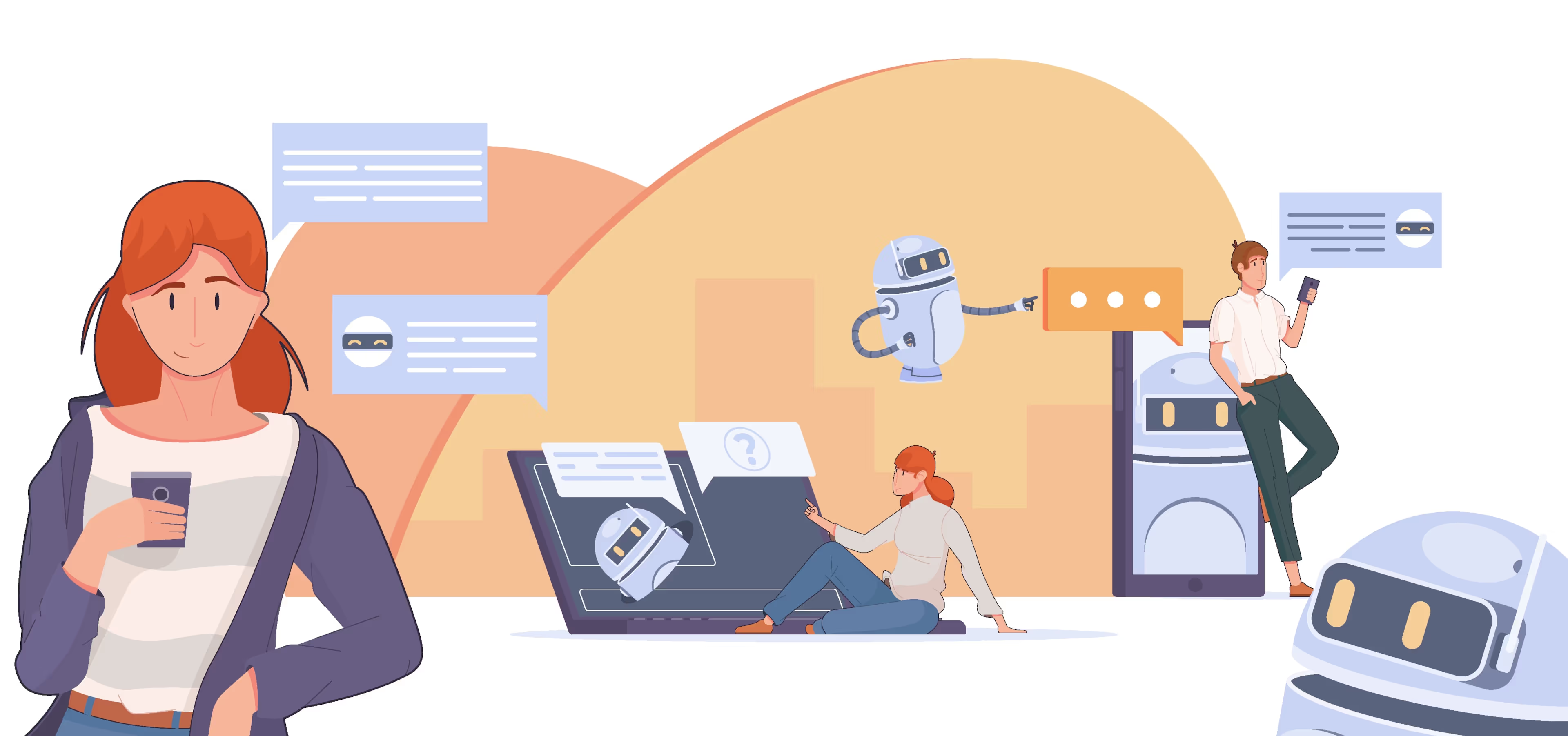
Chatbots come in many forms, ranging from simple rule-based chatbots to advanced AI agent chatbots. Here are the main types of AI chatbot platforms used today.
Transactional AI chatbots
Transactional chatbots handle straightforward tasks like checking order status, booking confirmations, and updating delivery information. They are perfect for simple actions that require fast, structured responses. Their primary purpose is task completion rather than conversation.
Example of a transactional AI chatbot: Domino's Pizza's chatbot, "Dom," helps customers with placing orders, tracking deliveries, and reordering meals, all through chat or voice commands.
Conversational AI chatbots
Conversational AI chatbots use advanced language models to maintain fluid, natural, and human-like conversations. Instead of relying on fixed scripts and decision trees, conversational chatbots answer questions, recommend solutions, and adapt as the conversation evolves.
Example of a conversational AI chatbot: OpenAI's ChatGPT leverages NLP, ML, and RLHF to maintain natural, human-like dialogue across a wide range of topics.
Decision support AI chatbots
Decision support chatbots analyze data, compare options, and offer recommendations to users, allowing them to make informed choices. They interpret data in real-time and simplify complex insights that would otherwise require human guidance.
Example of a decision support AI chatbot: Sintra's AI data analyst, "Dexter," assists businesses with ROI calculations, sales forecasts, and financial reporting, helping them make informed decisions.
Workflow automation AI chatbots
Workflow automation chatbots automatically handle repetitive tasks within a business workflow. They can send follow-up emails, create CRM entries, log support tickets, update customer records, or trigger internal notifications, all without manual effort.
Example of a workflow automation AI chatbot: Zapier's AI chatbot triggers tasks like sending follow-up emails, updating CRM records, or creating tasks automatically when users interact with it.
Informational AI chatbots
Informational chatbots are designed to deliver accurate answers by surfacing knowledge-based articles, documentation, guides, and policy information. They help users find answers quickly, without having to search for the relevant information manually.
Example of an informational AI chatbot: Intercom's Answer Bot surfaces knowledge-base articles, guides, and FAQs, and provides instant answers.
Feedback and survey AI chatbots
These artificial intelligence chatbots conduct automated surveys, capture NPS ratings, request reviews, and analyze sentiment in real time. The insights gathered through these surveys help businesses understand user sentiment around their product or service, helping them address customer concerns and improve user satisfaction.
Example of a survey AI chatbot: SurveySparrow's AI Chatbot engages customers to capture NPS scores, reviews, and satisfaction feedback in a conversational manner.
Problem-solving AI chatbots
Problem-solving chatbots, as the name suggests, are designed to diagnose and resolve customer problems. They guide users through multi-step troubleshooting flows and provide solutions, eventually escalating complex issues to human agents.
Example of a problem-solving AI chatbot: IBM Watson Assistant guides users through troubleshooting flows to diagnose technical issues.
Adaptive learning AI chatbots
Adaptive learning chatbots continuously improve over time by analyzing user interactions and feedback. This adaptability makes them highly reliable for long-term automation and allows businesses to maintain consistent, high-performing chat experiences.
Example of an adaptive learning AI chatbot: Duolingo's AI chatbot learns from user interactions to provide personalized language practice.
Hybrid AI chatbots
Hybrid AI chatbots combine the structure of rule-based logic with the flexibility of generative AI. They are capable of handling routine tasks with precision while still responding proactively to user queries with human-like responses. While the hybrid model offers a balanced solution, it is also costly to develop.
Example of a hybrid AI chatbot: Drift combines rule-based logic for structured workflows like lead qualification with AI-generated responses for natural, human-like conversations.
How do AI chatbots work?
AI chatbots improve business interactions using ML and NLP. This technology enables chatbots to understand and respond to user queries effectively, making customer service more satisfactory and scalable.
Here's a step-by-step breakdown of how AI chatbots work.
Step 1: Interpret Intent: The chatbot analyzes the user's input using NLP to understand what they want.
Step 2: Retrieve Knowledge: It searches internal knowledge bases, previous conversations, or external sources to find relevant information.
Step 3: Generate Responses: Using ML and deep learning models, the AI chatbot formulates contextually accurate and natural-sounding responses.
Step 4: Learn and Improve Over Time: The chatbot learns continuously from user interactions and feedback, storing context and patterns for future conversations.
Sintra's Brain AI adds an additional layer to this process by providing memory and context. It allows all AI agents within the Sintra framework to remember previous interactions and understand workflows seamlessly. The more the Brain AI learns, the more personalized and contextually accurate the agents' responses become.
Machine learning and deep learning
AI chatbots rely on machine learning (ML) and deep learning (DL) algorithms to understand human language and predict responses. ML models extract patterns from historical data, while DL models facilitate a deeper understanding of intent and context. Together, these models enable chatbots to generate human-like responses and improve with interactions.
Neural networks and transformer models
The core technology behind AI chatbots is neural networks. These are computational structures that help chatbots process information in layers, much like the human brain. Transformer models amplify a chatbot's abilities by helping it identify which parts of a conversation are most relevant. This allows the chatbot to generate coherent responses across multiple dialogue turns.
Zero-shot and few-shot learning
Zero-shot and few-shot learning enable chatbots to handle queries with little to no prior examples. Zero-shot learning allows the bot to generalize from prior knowledge to answer entirely new questions. Few-shot learning, on the other hand, uses a few examples to guide the bot's responses. Together, they power a chatbot's flexibility, helping it adapt to new scenarios quickly.
Fine-tuning and domain-specific models
AI chatbots can be fine-tuned to a business's domain, tone, and knowledge. By training the model on internal documents, chat transcripts, product guides, and brand voice, businesses can create AI chatbots that are more accurate, relevant, and aligned with their operations.
What are other technologies related to chatbots?
Many chatbot technologies are transforming business operations in today's dynamic industries.
Voice Assistant
A voice assistant, or voicebot, is a chatbot that understands voice commands and performs actions according to user input. These voice assistants use automatic speech recognition (ASR) with other AI technologies to analyze complex speech patterns and offer natural voice-enabled user experiences.
For example, Alexa is a voice assistant that performs tasks based on voice commands.
AI Search Chatbot
AI search chatbots use LLMs and NLP to understand user queries and offer relevant responses by searching the web or specific knowledge bases. These chatbots can interpret conversational language and generate dynamic, unique answers in real-time. Some AI search chatbots also provide source links for fact-checking and further reading.
Amazon Web Services uses an AI search chatbot, Kendra, to assist users in finding relevant answers across their knowledge bases.
Agentic System
Agentic systems are the next big step in business automation because they can understand, think, and act autonomously. They combine the reasoning power of LLMs with the ability to take action across different platforms and systems. Agentic systems can handle complex problems, execute multi-step workflows, and improve with every interaction.
AutoGPT is an agentic AI agent that can autonomously execute and manage tasks across multiple steps with minimal human intervention.
Virtual Agent
A virtual agent, or virtual assistant, is a smart chatbot that converses with users naturally and helps them solve problems. Virtual assistants are designed to understand emotional nuances, intent, and contextual relevance in conversations.
Sintra offers an AI virtual assistant, Vizzy, that can streamline daily work and help you stay organized.
How businesses use AI chatbots?
AI chatbot services can facilitate collaboration and boost efficiency across multiple workflows. Here's how chatbots can help teams work together seamlessly.
Marketing
- Chatbots interact with website visitors and social media users.
- They capture leads and gather behavior data.
- Qualified leads and insights are passed to the sales team.
Sales
- Chatbots provide personalized product recommendations.
- They nurture leads, answer product questions, and schedule demos.
- Update CRM automatically with user interactions.
- Provide real-time analytics to marketing teams for campaign optimization.
Customer Support
- Chatbots offer 24/7 customer support, answering user queries and FAQs.
- They maintain context from marketing and sales interactions to deliver personalized support.
- Escalate recurring issues to internal operations for product/ service improvement.
HR and Internal Operations
- Chatbots assist new employees with onboarding, policy queries, and internal requests.
- Automate approvals, scheduling, and reminders to reduce manual workload.
AI chatbot platforms like Sintra provide multi-agent AI integrations that allow teams to coordinate seamlessly across workflows. Sintra's agents not only facilitate collaboration but also ensure efficiency in every process, driving overall business growth.
The difference between chatbots, AI chatbots, and AI agents
Chatbots, AI chatbots, and AI agents can all sound like interchangeable buzzwords. However, they differ significantly in terms of their functionality and capabilities. Here's a quick comparison between the three, highlighting how each can be leveraged in business workflows.
Traditional chatbots
These are rule-based chatbots programmed with fixed patterns, rules, and decision trees. They identify specific keywords or phrases in user queries and respond with predefined answers. Traditional chatbots are commonly used to handle customer FAQs and simple requests. But they struggle with natural, unscripted questions as they are outside their programmed scope.
AI chatbots
AI-powered chatbots leverage natural language processing (NLP) and machine learning (ML) to interact with customers. They can manage more complex conversations and tasks compared to their traditional counterparts. AI chatbots can understand human language, interpret context, and communicate in a natural, human-like way — taking the load off human agents.
AI agents
AI agents represent software systems that use artificial intelligence to achieve business goals and complete tasks on behalf of users. AI agent chatbots can think, reason, plan, and retain information.
Most importantly, they demonstrate autonomy. They can make decisions, learn, and adapt on their own. Sintra's 12 assistants are modern AI agents that share a single knowledge base, allowing them to make contextually accurate decisions autonomously.
The challenges of AI chatbots

AI chatbots can significantly improve business performance and boost customer satisfaction. However, this technology has its own set of challenges that organizations must understand and address before integrating it into daily operations.
Hallucinations
AI chatbots can sometimes produce inaccurate or misleading information, especially when they lack proper context or misinterpret a query. These errors, known as hallucinations, can lead to misinformation and negatively impact user trust.
A business can reduce hallucinations by feeding the model verified, up-to-date data through retrieval-augmented generation (RAG), setting strict guardrails, and testing chatbot responses regularly. Continuous monitoring and refining prompts also help keep outputs accurate and reliable.
Data Privacy Risks
AI chatbots collect and process sensitive information, like customer details, payment data, and even confidential internal business insights. This makes data security one of the biggest concerns when adopting AI systems.
To protect this information, businesses should implement strict safeguards like end-to-end encryption, role-based access controls, secure API connections, and private-cloud or on-premise deployments. Regular security audits and compliance checks further ensure that customer and company data remains protected
Bias and Discrimination
AI models inherit patterns from the data they are trained on. So, if that data contains social or cultural bias, it could lead to unfair recommendations, skewed interpretations, or unintentionally harmful stereotypes.
Businesses can reduce this risk by running bias detection tests across different demographics, regularly reviewing chatbot outputs, and training the model on balanced, diverse datasets. Periodic audits ensure the AI continues to perform fairly as it learns over time.
Setup Requirements
While chatbot platforms make deployment easier, advanced systems like conversational AI or AI agent chatbot models still require significant upfront effort. Integrating your data, designing workflows, and teaching the bot how your business operates can be time-consuming and technically demanding.
The best way to manage this challenge is to start with a single, high-impact use case and scale gradually instead of launching every feature at once. This keeps setup manageable and reduces overwhelm.
Misaligned Content Tone
Every brand has a unique identity, and even after training an AI chatbot, its responses may still sound robotic, too casual, or overly formal. When a chatbot’s tone doesn’t match the brand’s personality, it can negatively impact customer sentiment, especially in industries that rely heavily on empathy, expertise, or authority.
Businesses can reduce tone mismatches by creating a clear brand voice playbook for the AI to follow. Using prompt engineering, training the model on high-quality chat transcripts, and continuously refining responses based on customer feedback all help ensure the chatbot communicates with a consistent and on-brand voice.
Selecting the Best AI Chatbot for Your Needs
Choosing the best AI chatbot for 2026 isn't just about picking the most advanced model. You need to compare their features, performance, and long-term value.
Start by asking yourself what you want to achieve with the AI chatbot. Do you want better customer service or automated sales workflows? Once you have a clear idea of what your business really needs, evaluate chatbots across the following criteria:
- Capabilities: Conversational accuracy, contextual understanding, and the ability to perform tasks.
- Integrations: CRM, support platforms, marketing tools, scheduling apps, and internal databases should connect seamlessly.
- Data Security: Look for encryption, access controls, and enterprise-grade privacy protections.
- Guardrails and Accuracy: Check if the platform offers RAG, customizable rules, and safety filters to prevent hallucinations.
- Reliability: Review uptime guarantees, system performance, and support availability.
- Customization: Can you train the chatbot on brand voice, documents, and real interactions?
- Pricing: Compare pricing, usage limits, and automation capacity.
- Scalability: The chatbot should be able to handle increasing volumes of data without compromising performance.
General-purpose vs. specialized platforms
While general-purpose AI tools offer flexibility and scalability, specialized platforms like Sintra with expert AI agents to support sales, customer support, HR, social media management, and more. This all-in-one AI chatbot platform reduces setup efforts and ensures industry-specific accuracy from day one.
Why Sintra AI is the ultimate choice?
While many AI chatbot software options exist, businesses today need a complete, connected AI solution to stay competitive in competitive industries. That’s where Sintra AI stands out.
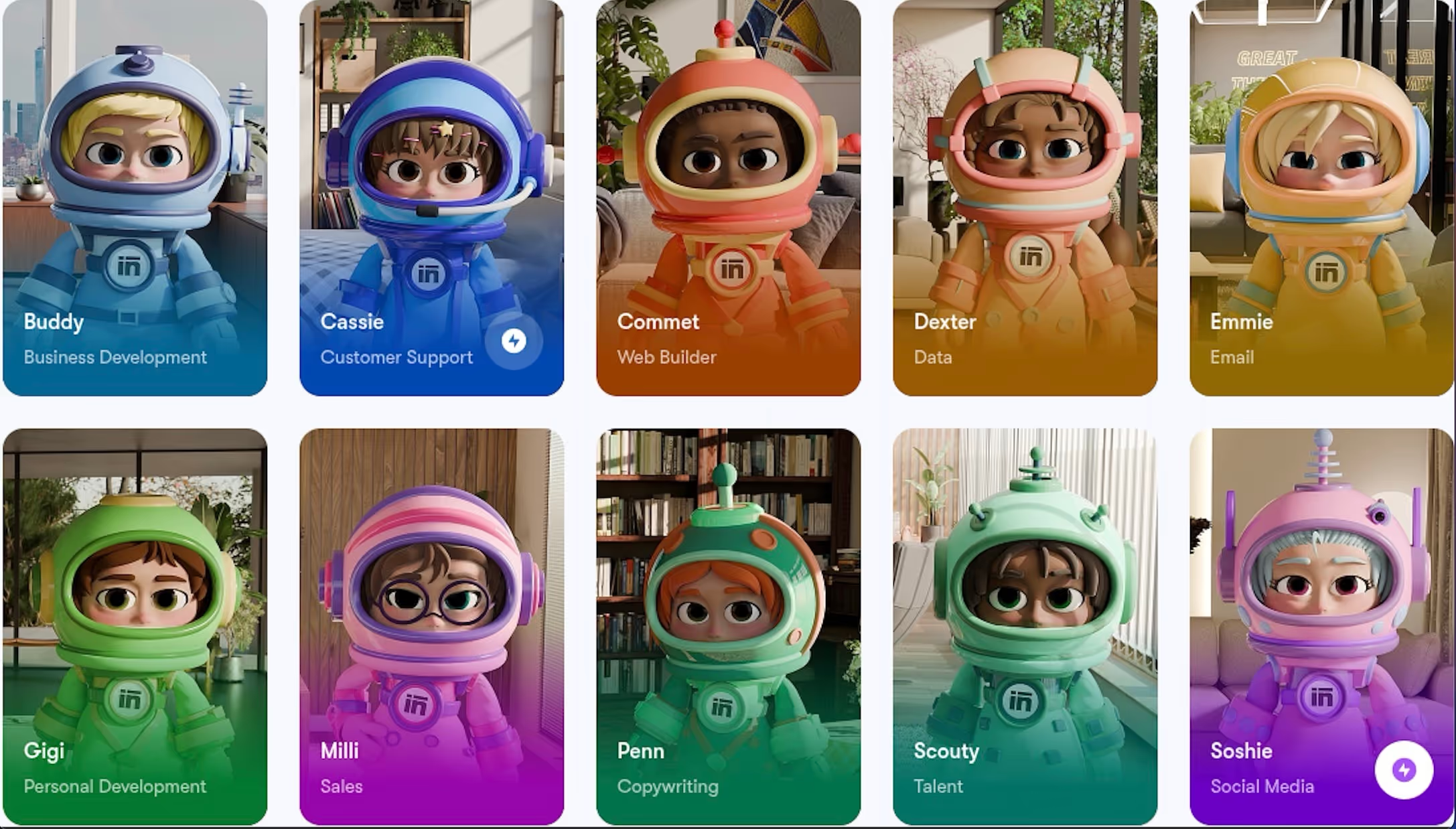
Sintra offers 12 specialized AI-powered chatbots that understand your business, follow complex workflows, and complete tasks autonomously. These assistants aren’t traditional chatbots relying on fixed scripts or decision trees. Instead, they interpret human language, analyze options, and execute the best course of action.
The true standout feature of Sintra is its Brain AI, a shared memory that powers all assistants and ensures every response is relevant, consistent, and contextually accurate. Instead of training separate chatbots for each department, Sintra provides an all-in-one AI system that supports every team and enables real agentic automation.
Here's a quick look at some of Sintra's assistants:
- Buddy - Business Development Manager: Helps with business growth strategies, delivers insights, and excels in AI for marketing.
- Cassie - Customer Support Specialist: Takes care of customer queries while maintaining your brand's unique voice.
- Emmie - Email Marketing Specialist: Crafts compelling emails and manages their scheduling.
- Seomi - SEO Specialist: Streamlines business processes with smart SEO strategies.
- Soshie - Social Media Manager: Automates social media management by generating content, planning strategies, scheduling posts, and more.
- Milli - Sales Manager: Drafts engaging cold call scripts and emails to help sales teams in closing deals.
Try Sintra AI Today!
Getting started with Sintra is simple and fast. Just sign up with your business account, upload your important documents and resources into Brain AI, and instantly give all assistants access to the knowledge they need. You can also connect Sintra to your preferred third-party platforms.
From there, activating just two or three online AI chatbots, such as sales, email marketing, or customer support, can immediately streamline your highest-priority workflows. Within minutes, businesses begin to see real productivity gains as Sintra’s agents handle complex tasks, answer questions, and automate processes autonomously.
Ready to turn AI chatbots into your AI team?
If traditional chatbots save time, Sintra’s AI team takes automation to a whole new level. Instead of simply responding to messages, Sintra’s AI-powered chatbots can think, plan, and execute tasks, unlocking deeper, more powerful automation.
Start your free trial today. Connect your knowledge bases to Sintra, load your documents into Brain AI, and activate your first AI agent chatbot. Think of it as your first step toward smarter, more efficient, fully automated workflows.
AI Chatbot FAQs
What is an AI chatbot?
An AI-powered chatbot is a digital assistant that uses artificial intelligence to understand and respond to user queries in real time. These chatbots rely on natural language processing (NLP) and machine learning (ML) to interpret user questions and deliver accurate, human-like responses.
What is a chatbot used for?
A chatbot is used to automate conversations and tasks between businesses and users. Common uses include:
- Customer support: Answer FAQs, troubleshoot issues, and provide 24/7 assistance.
- Sales and marketing: Capture and qualify leads, offer product recommendations, and guide users through the sales funnel.
- Data analytics: Analyze conversational data and share insights to improve services and strategies.
- Internal operations: Assist employees with HR and IT.
Will AI chatbots replace jobs?
No, AI chatbots are designed to assist human workers, not replace them. While they can automate tasks and handle routine queries, they cannot mimic the creativity, empathy, or complex decision-making abilities of humans.
Which is the best AI chatbot for businesses?
Sintra's business assistant, Buddy, is an ideal AI chatbot for businesses. Buddy is trained on large datasets, allowing it to combine deep market insights with advanced analytics, helping your business operate efficiently and stay ahead of the competition.
How do AI chatbots learn and improve over time?
AI chatbots use machine learning to analyze past interactions and understand user intent. They recognize patterns in conversations and retain context and memory, allowing them to refine their responses and deliver more accurate, relevant, and personalized interactions over time.
Related articles


.avif)