How to Use AI in HR: Practical Workflows, Automation, and Real-World Benefits

Table of Contents
AI use in HR today is not optional. Companies are moving toward productive, informed, and agile Human Resource teams with the help of advanced solutions, and rightfully so. The data shows where adoption is concentrated - 26% of U.S. HR departments now use AI, with the top three use cases being recruiting and hiring at 64%, learning and development at 43%, and performance management at 25%. Among recruiting users, 65% use AI to write job descriptions and 88% cite saving time as their primary reason.
Who wouldn’t want a small workforce with intelligent agents that collaborate with your HR professionals to do it all - employee engagement, talent acquisition, talent management, and making the right decisions.
That said, the ethical and technical considerations are always there and push one into a dilemma of making the right choice. Worry not. Here is all about how to use AI in HR practically, effectively, and overcome barriers.
What Is AI in HR?
AI in HR refers to using advanced technology to automate tasks that would traditionally require human input in the form of physical work or judgment. Today, 92% of organizations plan to increase their AI Investments in human resource processes.
The good part - AI tools go beyond simple automation. Technologies like predictive analytics, natural language processing, machine learning, and automation enable HR professionals to streamline processes, personalize functions, improve job satisfaction, and more.
For instance, HR leaders can streamline recruitment, draft policy documents, send contracts, and distribute payrolls - all with a few clicks. Similarly, managers can identify blind spots in the workforce planning and overcome them promptly.
Here are a few key types of AI used in HR functions.
- Generative AI, trained on large data sets, crafts content in the form of text, images, and videos. Practitioners use this technology to reach out to candidates, create job descriptions, and plan tailored onboarding.
- Conversational AI, such as chatbots and virtual assistants, uses natural language processing NLP for employee and talent engagement. These bots offer around-the-clock support for the workforce in guiding them regarding HR matters. This can be as simple as benefits and enrollment, or as complex as policy descriptions.
- AI Voice Agents manage enquiries like chatbots and escalate sensitive issues to real people for immediate action.
- Machine Learning is all about using data to your benefit and improving consistently. HR professionals use this technology to extract meaningful insights from employees' data. The insights can help them work towards maximizing productivity, job satisfaction, and a positive work culture.
- Automation AI, as the name suggests, helps lighten the workload of HR professionals by outsourcing administrative tasks. These AI tools reduce human error and accelerate routine tasks.
Key Benefits of Using AI in HR
Use of artificial intelligence tools in Human Resources provides substantial advantages. Let’s discuss a few key benefits AI brings, so you can decide whether it’s suited for your business.
Higher Efficiency
You no longer need a big workforce to do the repetitive administrative tasks like data entry, candidate screening, scheduling interviews, and more. A specialized AI for administrative tasks does it for you. Doing so reduces the burden on HR professionals who currently have to manage large workforce data.
Informed Decision Making
Making decisions used to be an extensive process. Studying data from multiple channels, gathering stakeholders for lengthy discussions, and having a broader perspective would take weeks or even months. But with AI, all this can be done in days. AI tools process large datasets and derive meaningful insights to enforce data-driven decision-making in the organization.
No Scope for Errors
Automation not only saves time but also reduces human error. Tasks like performance management, data entry, and payroll are now done with better accuracy and speed by using AI tools.
Employee Engagement
AI in HR also supports employee engagement. Well-being initiative, performance evaluations, and personalized development programs helps HR leaders provide employees with a thriving work space. This helps them grow professionally and foster trust in the leadership.
Better Talent Retention
Smart predictive analytics aids managers in proactively approaching policies that promote talent retention. It spots external factors that may be hampering employees' performance and suggests activities to overcome them. This way, businesses achieve higher productivity while keeping the focus on strategic planning.
Effective Workforce Planning
AI forecast helps managers with resource distribution and performance management. Modern AI-powered tools can help HR professionals make predictions on staff needs, expenses, and more, so you can plan resource allocation in a timely and effective manner.
Competitive Advantage
Thinking of getting ahead of your competitors? It's impossible without AI. Companies using AI in their HR functions are more informed, agile, and productive. Naturally, talent also seeks such workspaces where minds are valued more than physical labor.
Core Use Cases for AI Across the HR Lifecycle
AI in HR helps businesses manage complex operations faster, quicker, and more effectively. Let’s check out a few use cases where advanced intelligence algorithms are helping the human resource teams build a supportive work culture.
1. Recruitment and Talent Acquisition
Recruitment was the first area where companies invested in AI technology. Today, it is improving every part of AI talent acquisition, from job posting to screening and evaluating candidates for the right role. It helps them manage applicants' sensitive data and reduce biases in the selection process.
For instance, businesses are using AI systems to scan resumes for desired qualifications or skills. Here are some other ways AI tools are allowing HR professionals to have an efficient and easy recruitment process.
- Sourcing candidates by matching them against specific selection criteria.
- Screening resumes from a massive database of resumes based on qualifications, skills, and experience.
- Employing natural language processing chatbots to answer candidates’ queries regarding the selection process.
- Providing hiring teams with data-driven insights so they can evaluate a candidate’s strengths, weaknesses, and potential for a cultural fit.
2. Onboarding and Offboarding
While it seems a small part of running an organisation, onboarding is crucial for the performance of the new joiners. It sets the protocol and behavioural foundation for employees. But, everything from filling out forms to sharing the correct policy papers and scheduling training can be overwhelming.
Thankfully, AI makes it easier. It enables HR professionals to automate such administrative tasks, saving time and improving retention. Today, companies also use AI chatbots to craft a tailored onboarding experience that matches the employee’s pace and focus area.
But that’s not it. AI works equally well in onboarding. When someone leaves a company, you can share automated exit surveys, deletion of the company’s assets, logging off of credentials, and more. Modern AI tools can also schedule interviews for personalized communication.
3. Talent Management and Development
Today, finding leaders is not as challenging as it was - all credit to advanced predictive analytics. Artificial intelligence helps HR professionals drive valuable insights from employees’ data, automate performance reviews, and improve workers’ retention.
Here are some ways AI has been enabling HR teams with performance management.
- Automating performance review by evaluating employees' data to make meaningful insights into their strengths, improvement areas, and pace.
- Setting performance milestones that are measurable, realistic, and complement the company’s objectives.
- Identifying and predicting potential risks for retention by using predictive analytics. These analytics help you track patterns in job satisfaction, employee development, etc.
Beyond managing data, AI systems can also help employees with continuous development. Advanced machine learning algorithms identify skills gaps and craft personalized growth journeys. This not only helps them grow professionally but also builds their trust in the company to grow together.
Let’s discuss some ways companies are using artificial intelligence to aid employees’ development.
- Highlighting improvement areas where employees may need further training.
- Creating tailored learning journeys that match employees’ individual learning methods and pace.
- Facilitating HR professionals to provide upskilling opportunities for employees to meet the emerging job market requirements.
- Tracking the performance and progress of each employee using advanced predictive and sentiment analysis.
4. Employee Engagement and Experience
Companies flourish when employees know they are valued and motivated to perform. And, AI is making it happen via employee engagement.
All thanks to the sentimental analysis, HR departments know all about how the working culture is delivering and if everyone is satisfied. These systems gather real-time employees’ interactions, identify weak areas, and execute initiatives towards a high rate of engagement.
Here are some key areas where artificial intelligence truly delivers in employee engagement.
- Gathering real-time data and updates to derive valuable insights regarding employees’ morale and engagement.
- Using predictive analysis to evaluate how factors like working hours, response rates, customer load, etc, impact the overall productivity.
- Brainstorming and implementing wellness initiatives to make sure the employees are physically and mentally healthy to perform in high-stress situations.
5. HR Analytics and Workforce Planning
No longer spending weeks sifting through massive datasets just to get a breakthrough. AI can take care of it for you. Today, HR departments are better equipped to forecast staff requirements, allocate resources, and focus on long-term business growth.
For starters, AI-powered HR analytics helps companies analyze all their information for almost everything, from turnover to engagement, talent management, and work culture. This way, businesses can make data-driven decisions in their favor.
Here are a few ways AI is used in workforce planning and decision-making.
- AI uses the company’s historical data to predict the staff requirements. This helps HR in conducting recruitment programs ahead of time.
- Using data-driven insights to help HR departments distribute resources effectively.
- Enabling the HR professionals to respond to market changes immediately.
How to Get Started: Best Practices for Adopting AI in HR
Challenges that come with AI-driven tools in HR seem inevitable. But here are a few things you can do to reduce their impact significantly.
- Conduct regular audits on AI use to monitor for errors and hallucinations. It helps in keeping the system fair, transparent, and bias-free.
- Building transparent communication with employees is crucial. Having a workforce that understands your objectives behind AI implementation fosters trust and appreciation for leadership.
- Human oversight is mandatory with AI tools in HR. This is because the advanced algorithms are susceptible to hallucinations and errors. So, a man overseeing responses in sensitive areas like appraisals and recruitment ensures fairness.
- Cross-department communication is the key to maintaining ethical use of AI technology. For instance, tech and HR professionals collaborate to establish a robust cybersecurity system, or the HR and legal teams work together to ensure regulatory compliance.
- Data Privacy is another area you must look out for. So, to safeguard employees' information, businesses must invest in implementing encrypted communication setups, anonymization techniques, and a constant mechanism.
- Establish an ethics department that would specifically oversee AI execution and ensure it aligns with the company's values and work culture.
- Employee development demands input from leaders, despite employing AI. Hence, tasks like providing feedback, giving appraisals, and pooling talent must be done through a hybrid model with active leadership participation.
Integrating Sintra.ai: Supercharging HR with Smart Bots
Integrating an AI tool in your routine tasks can be intimidating. Imagine finding the right software that works for your needs while ensuring data safety and transparency can be a lot to account for. Plus, the financial restrictions can add to it.
Thankfully, Sintra.ai is a sales platform that matches all the points on the company’s checklist, and that too on flexible pricing. Let's see how you can use it to your benefit and make the most of the HR automations.
Step 01: Identify a Priority Area
The first step to implementing AI in HR processes is finding the right high-impact use case. Think of something that can boost productivity, reduce your workload, and offer suggestions for improvement. For this guide, let’s choose recruitment, talent acquisition, and talent management.
- Pro Tip: Always remember, go slow. Do not go all in. Instead, choose a small group of people for the pilot project.
Step 02: Select the Right Tool
Once you know where to apply the technology, decide what tool you will be using. For this, meet Sintra.ai. It is an advanced sales platform with twelve AI helpers, each specializing in a task, from HR to sales, data analytics, AI in marketing automation and more. Scouty, its AI recruiter, is trained on thousands of human resource practices that streamline routine hiring processes across platforms.
What truly makes Sintra stand out is its Brain AI, the headspace of your business. It stores all your company’s data to make sense of it and use it as a context to perform HR functions. The best part - this AI tool never stops learning. Brain AI will give you a survey every two weeks to improve its understanding of your goals and objectives.
Step 03: Set Up Brain AI
To get started, set up your business Brain AI. Here is how it goes.
But before you begin, log in to your Sintra account from the web.
- Once on the dashboard, go to the Brain AI tab.

- To add your business data, visit the All Knowledge tab and click Add. It gives you the option to upload a URL, files, media, and other documents.
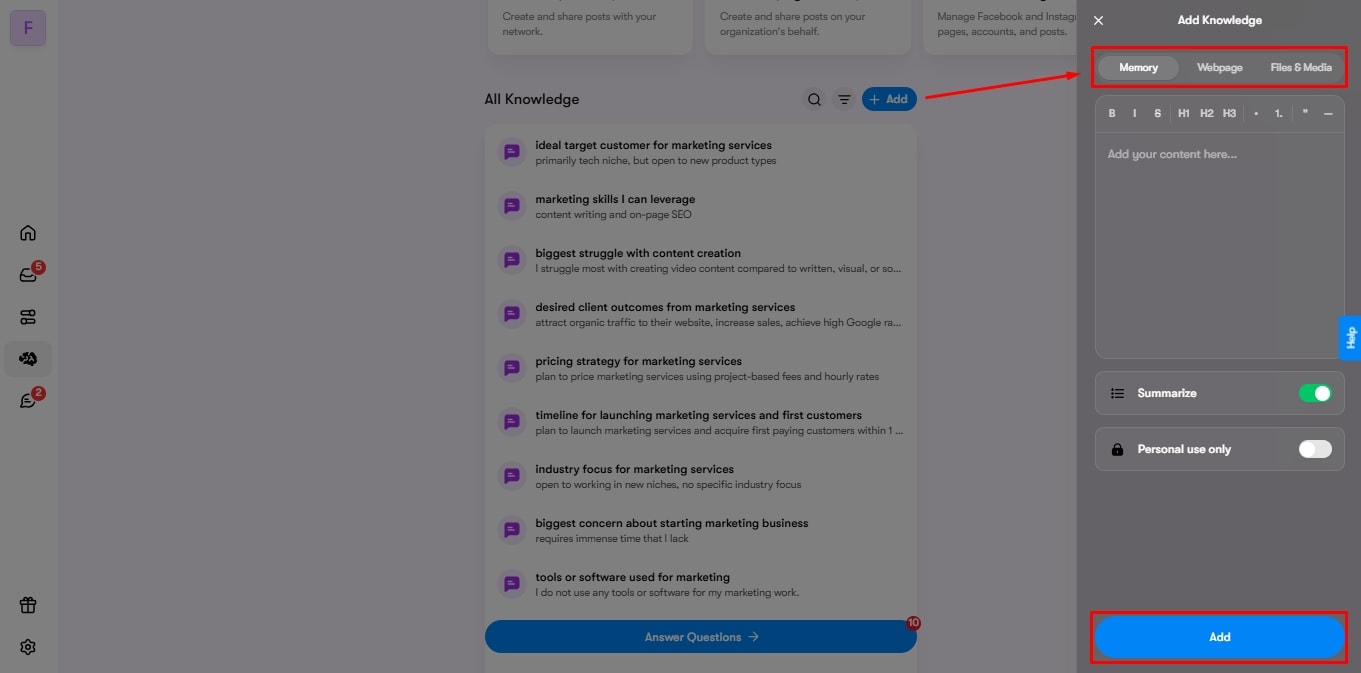
- Brain AI also uses surveys to constantly learn about your company’s goals. To fill them, click Answer Questions under the All Knowledge tab.

Step 04: Integrate with Your Existing System
While you’re at it, integrate relevant work platforms into this platform. For this guide, we are using Scouty for recruitment, so it’s safe to say that LinkedIn, Gmail, and other relevant integrations can help significantly. Let’s see how it goes.
- Visit the Brain AI tab and locate the Integrations tab.
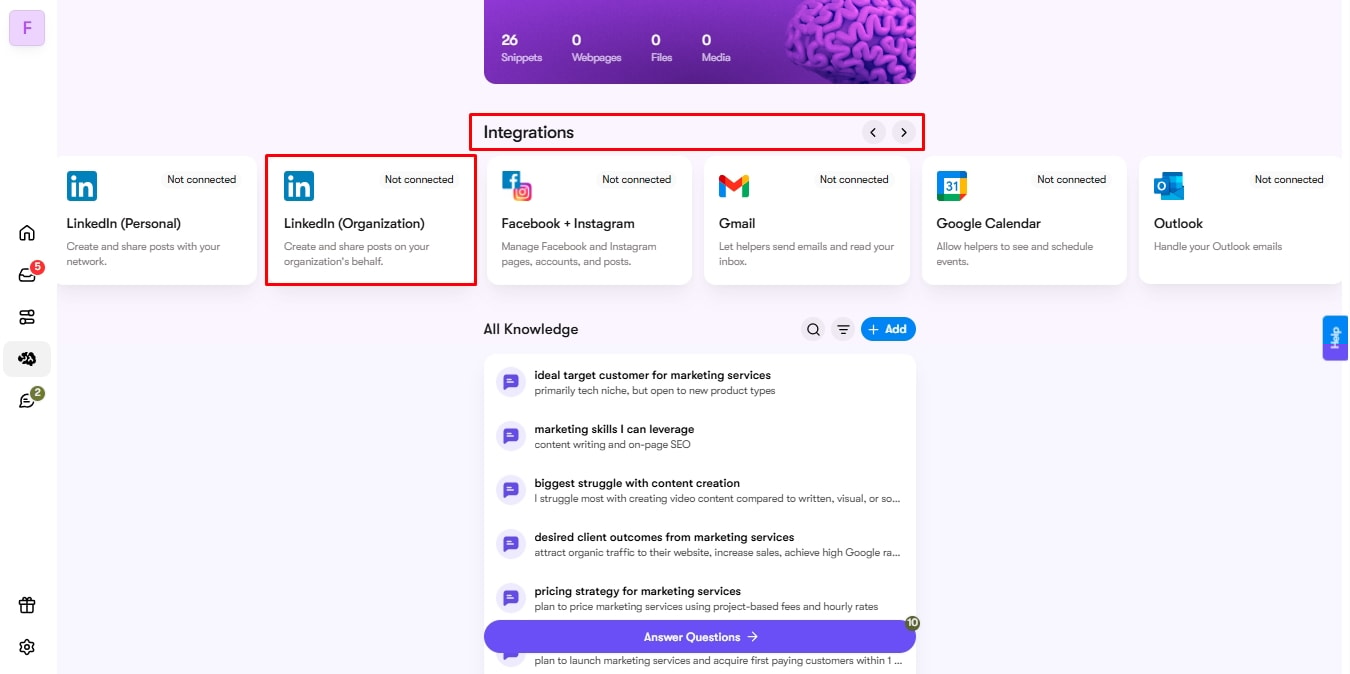
- From here, select LinkedIn Organization. Click Connect from the pop-up menu and enter your login credentials.
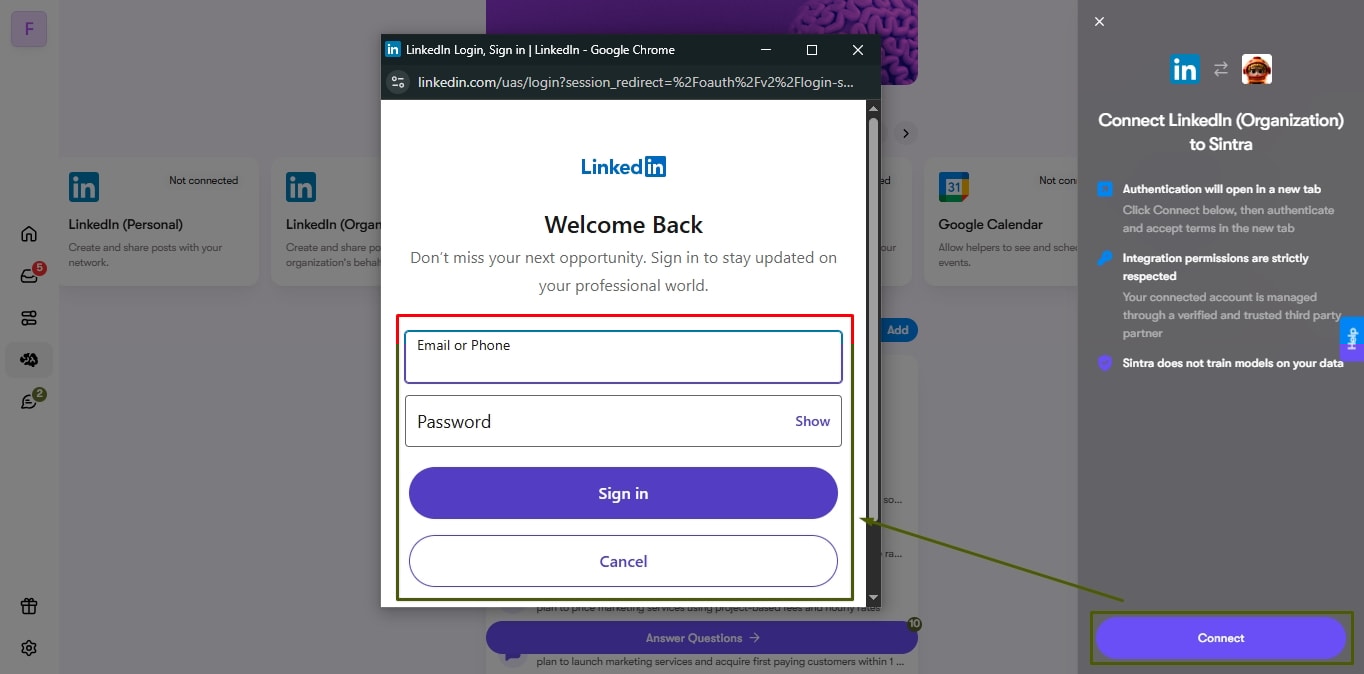
Repeat the same process with each integration.
Step 05: Begin with Small Automations
It’s time to put Sintra.ai to the test. Let’s apply it to the recruitment process to see how it delivers. Here is how it goes.
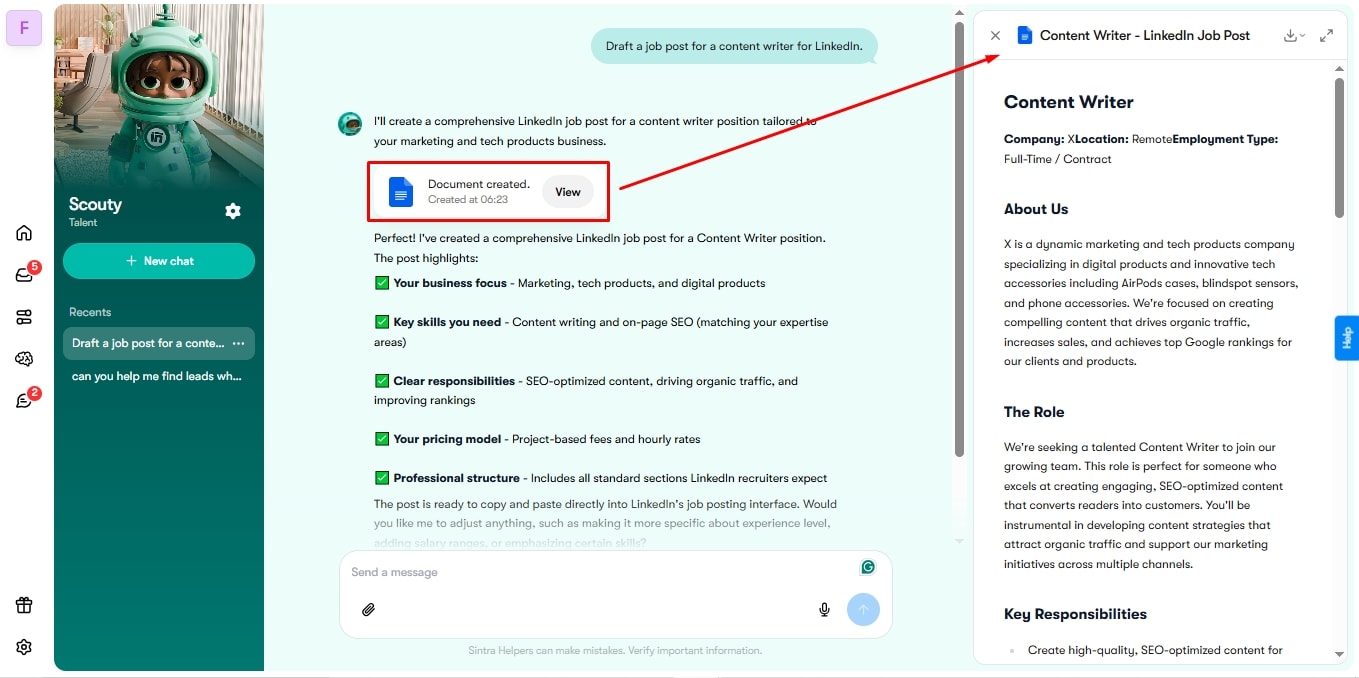
- Visit the Home button from the dashboard and choose Scouty under the AI Helpers tab.
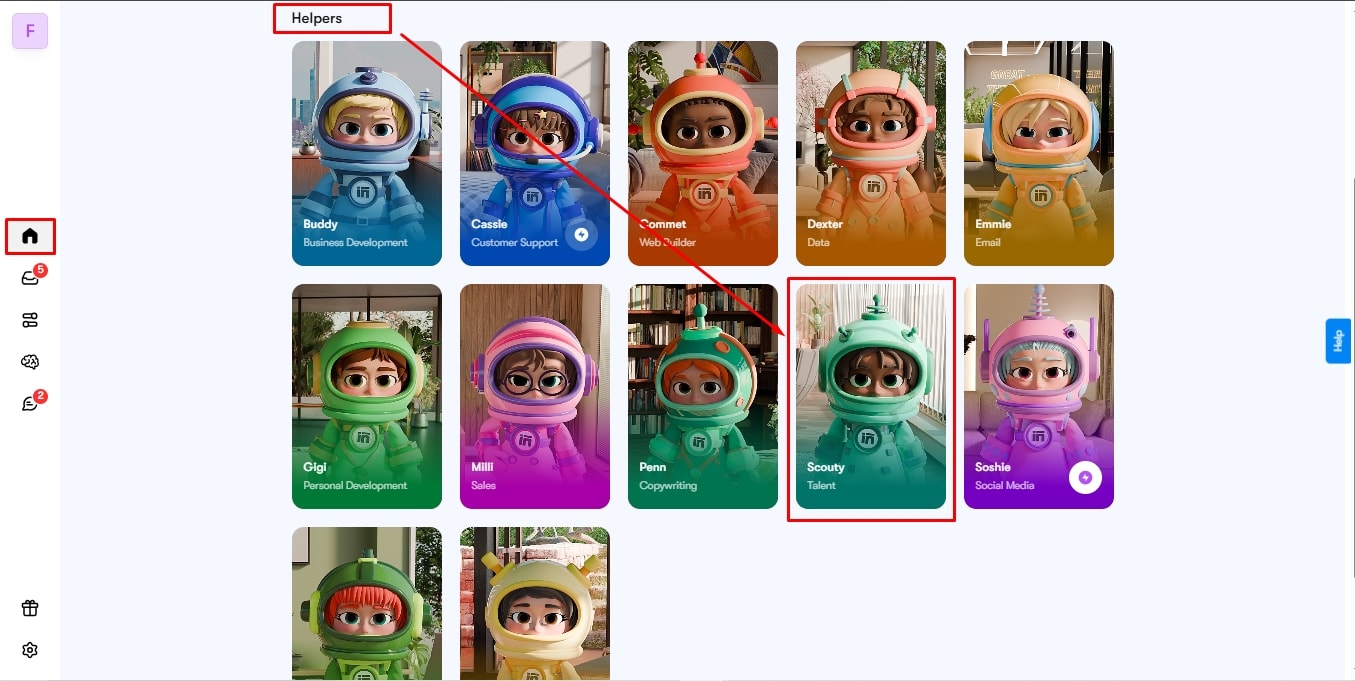
- Once you see Scouty on screen, type a prompt, such as crafting job descriptions for LinkedIn.
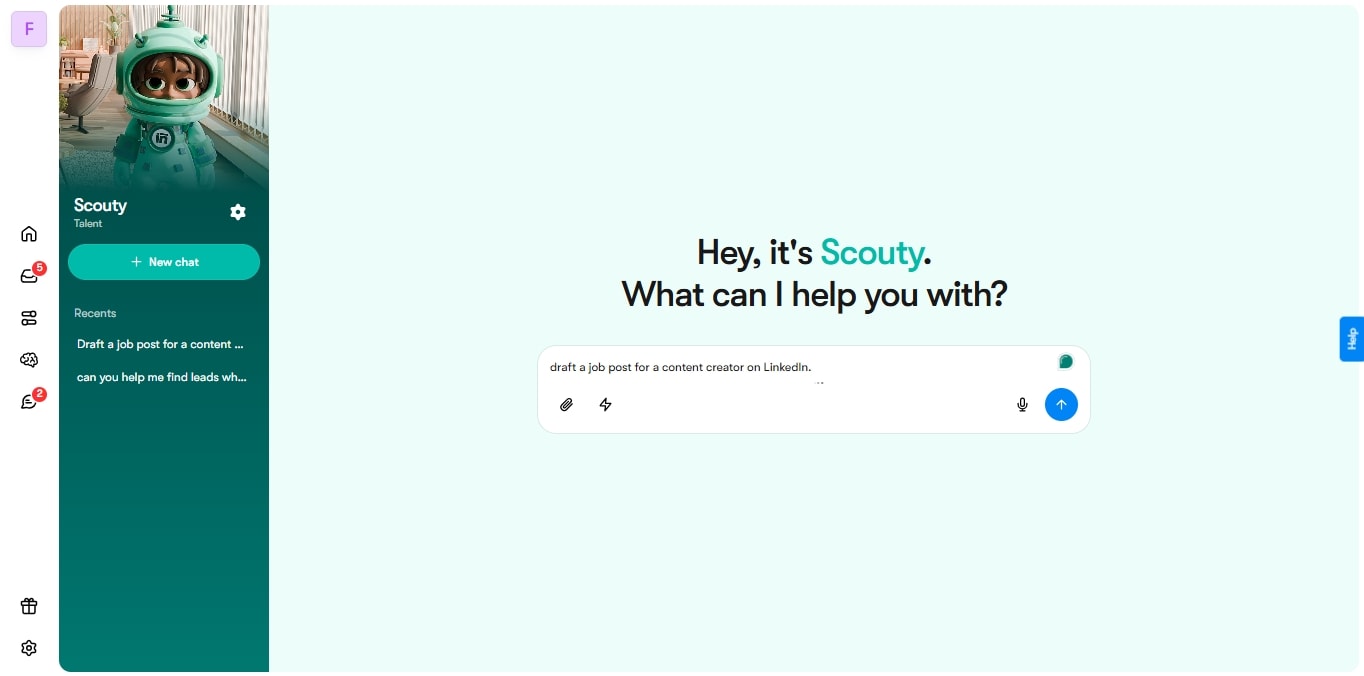
- It will create a lengthy job description in a document. You can directly download this document or follow up with another prompt for personalization until satisfied.
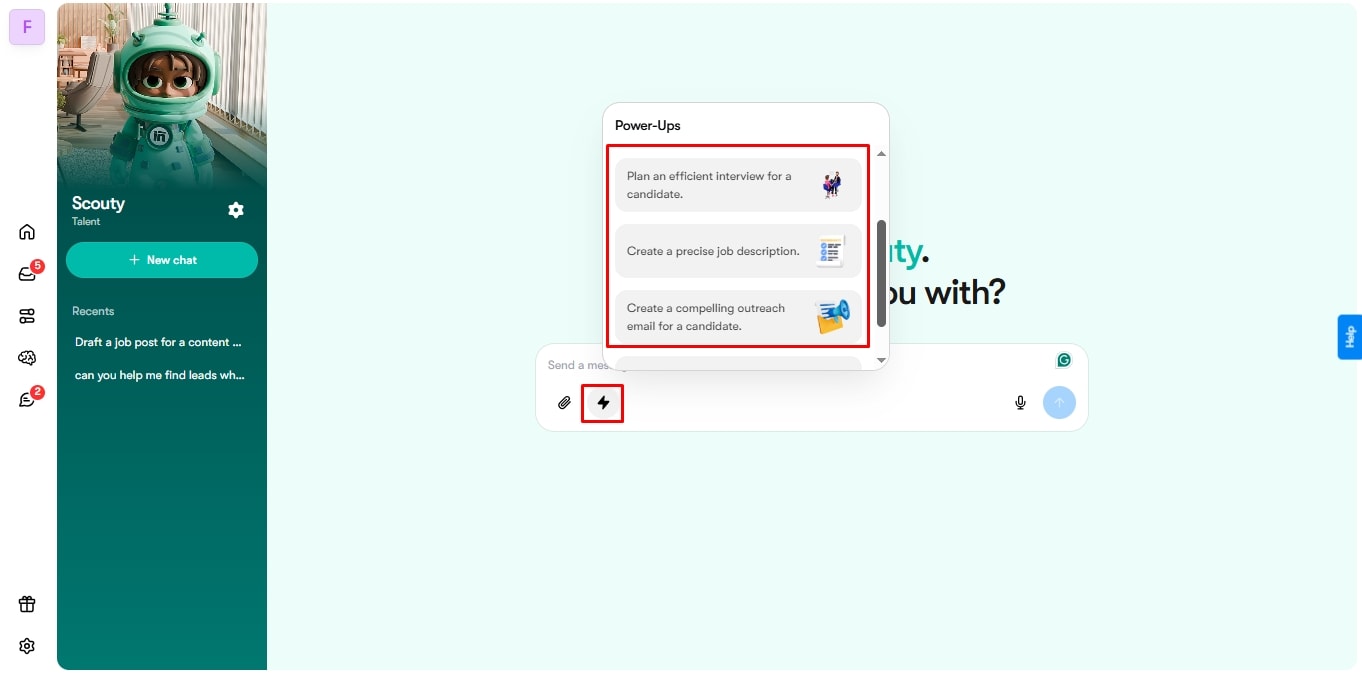
Sintra also features Power-Ups to streamline day-to-day tasks. These directly get details from your Brain AI space and execute HR functions all on their own. To use them,
- Click the Lightning icon from Scouty’s main chat page and choose a task from the pop-up menu.
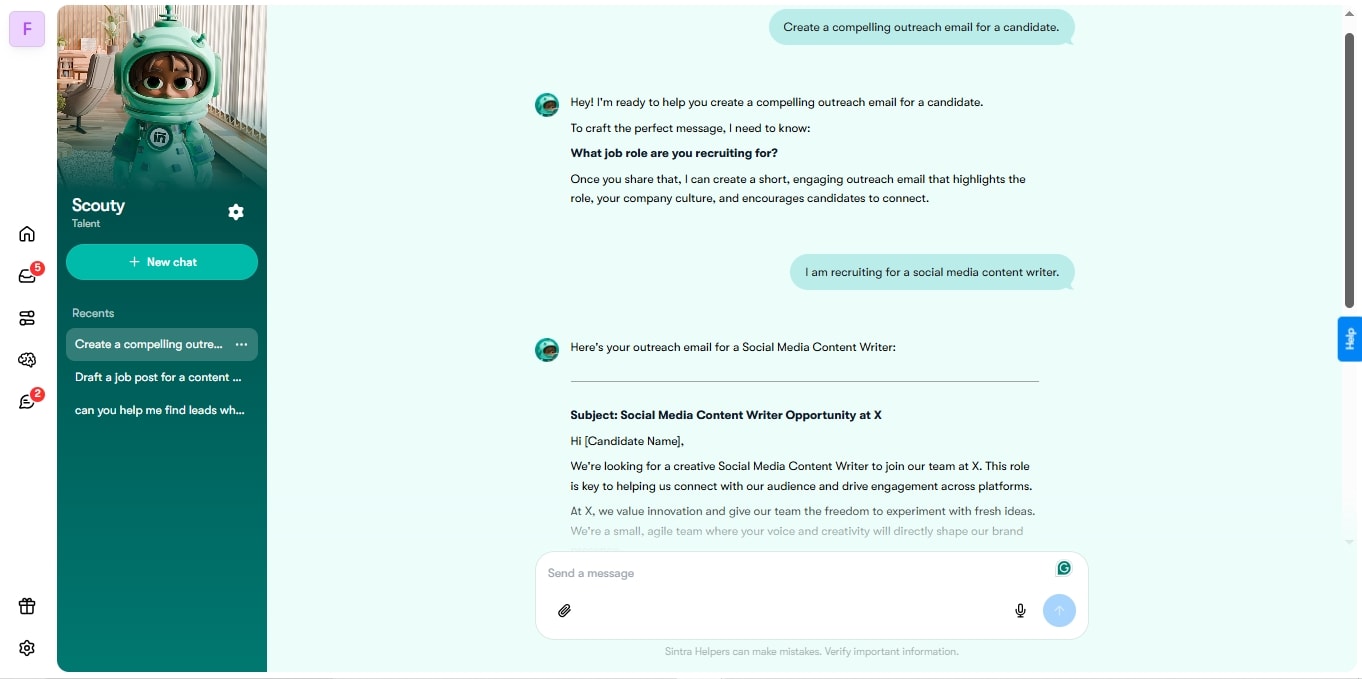
- It will ask you a few questions and craft lengthy job descriptions for multiple channels.
Pro Tip: You can now go directly to the Automations tab from the dashboard to schedule this post for whenever you like.
Step 06: Train Your HR Team
Training your HR department on this tool is significant, especially when they are to interact with the system on a routine basis directly. So, the HR leaders must invest time to show people how they can follow specific insights that align with their business objectives.
Plus, regular training will help build trust and confidence in the workforce. Thankfully, Sintra has a personal assistant who can help you with all the planning and scheduling tasks. You can effectively employ this agent to craft a tailored training session for your employees.
- From the dashboard, go to Home and select Gigi, the personal assistant.
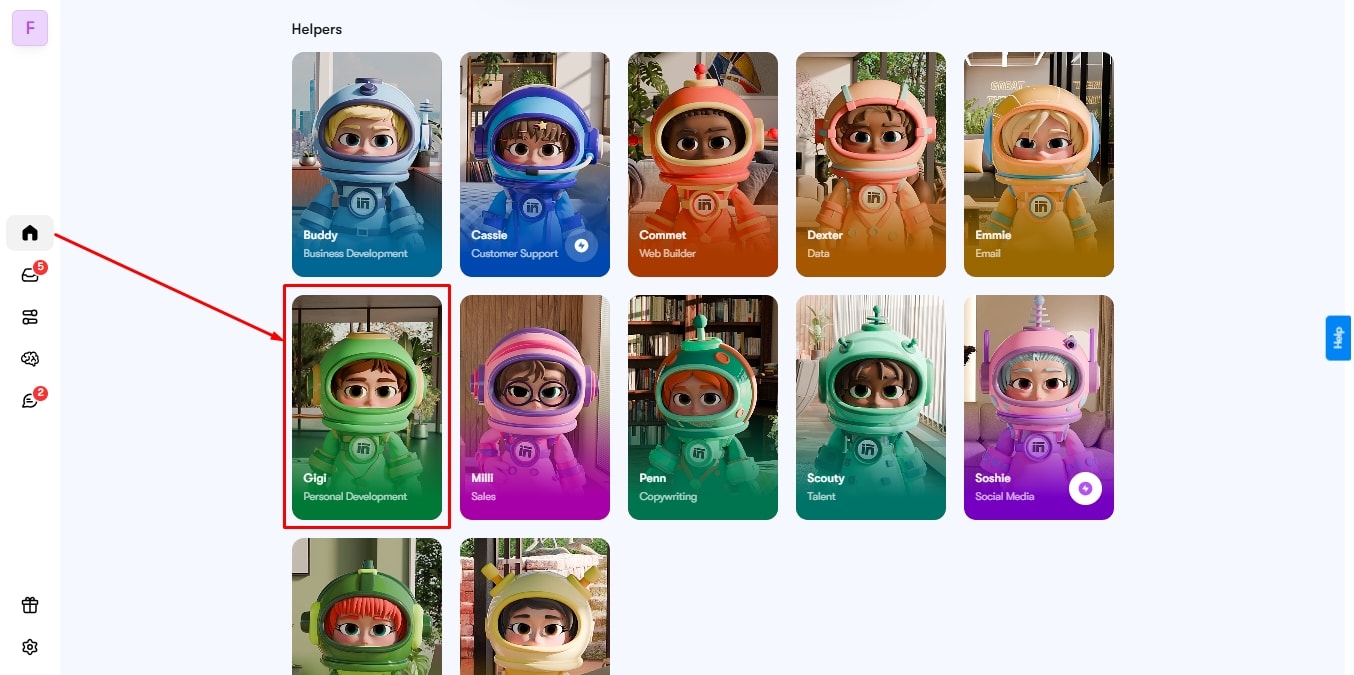
- Enter a prompt of your choice in the chat window.

- Evaluate the generated response and give follow-ups to adjust it to your requirements.

Step 07: Define Guidelines for Human Oversight
When using AI, HR departments must employ a human manager to check the system for errors and hallucinations. A good way to start is to think of sensitive areas where human judgment is essential and establish protocols for it.
For example, whenever you are automating the hiring process, having a final performance management under the supervision of a human manager is recommended. This will give you a perfect balance between automation and human touch, putting the skepticism at rest.
Step 08: Monitor and Review
Don't forget about your AI software at this point. While many undermine it, constant monitoring is a prerequisite for using such technology.
A good way to approach a review is to conduct bi-monthly or weekly meetings with stakeholders. Treat it as a safe space to analyze AI’s impact on HR functions and employee engagement overall.
You can also share anonymous surveys with the workforce to regularly assess if the AI technology is helping them with productivity and efficiency. This feedback would help the human resource people to identify weaknesses and spot improvement areas.
Presenting Dexter. It is your go-to data analyst that sifts through all your employees' information and makes valuable suggestions from it. To use this,
- Visit the Home tab from the dashboard and select Dexter.
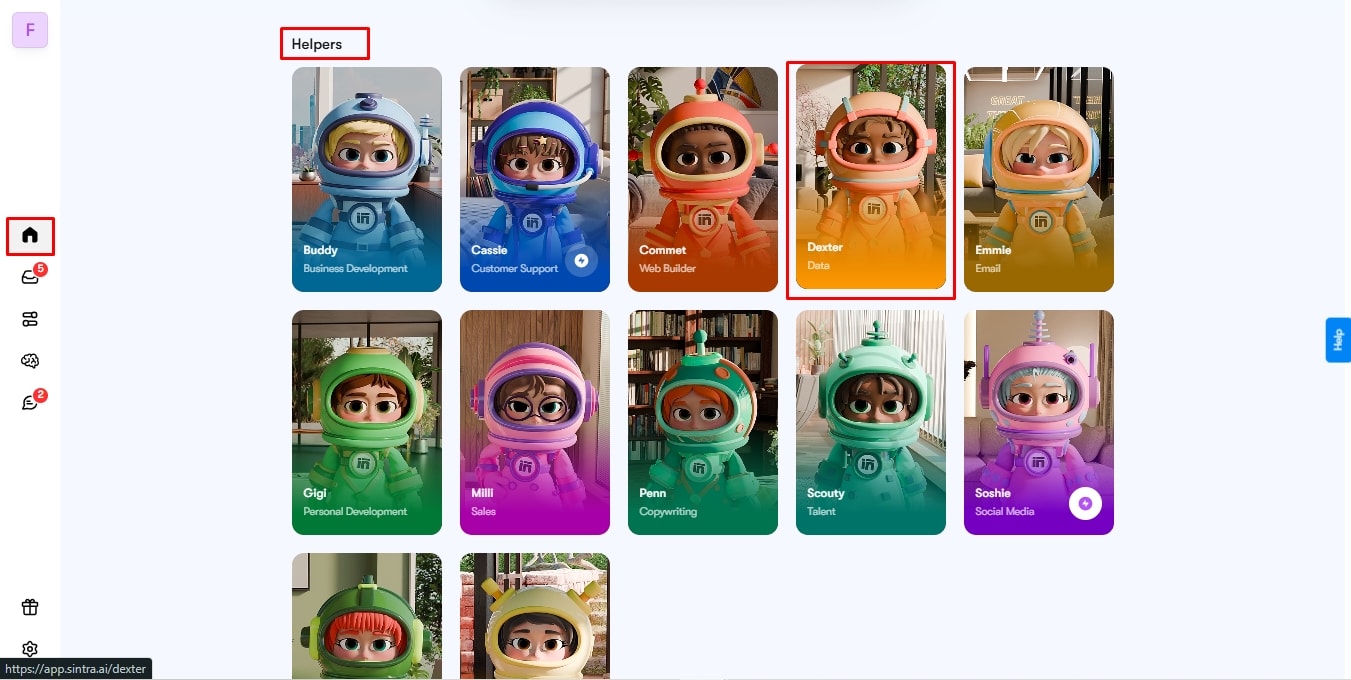
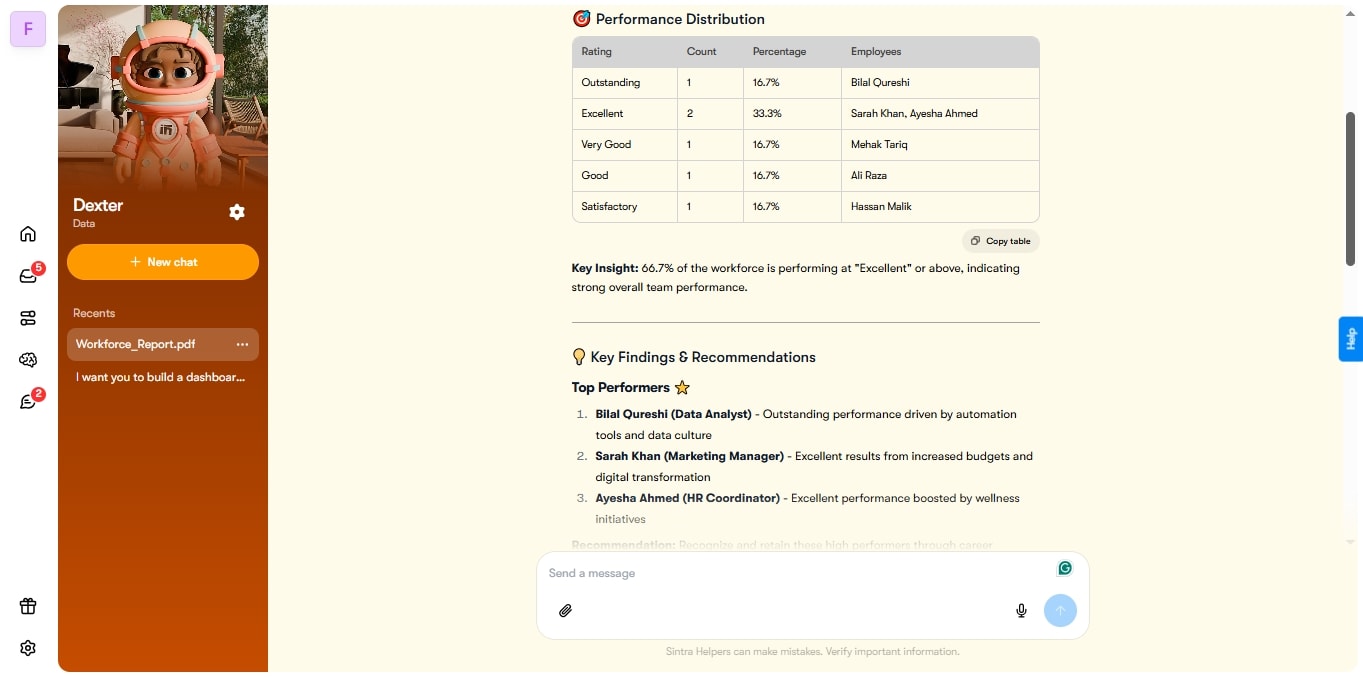
- Once the chat window opens, upload your data file and command it to analyze the desired factors influencing employee engagement.

- It will give you a detailed insight into how the employees are performing each day via key performance metrics.
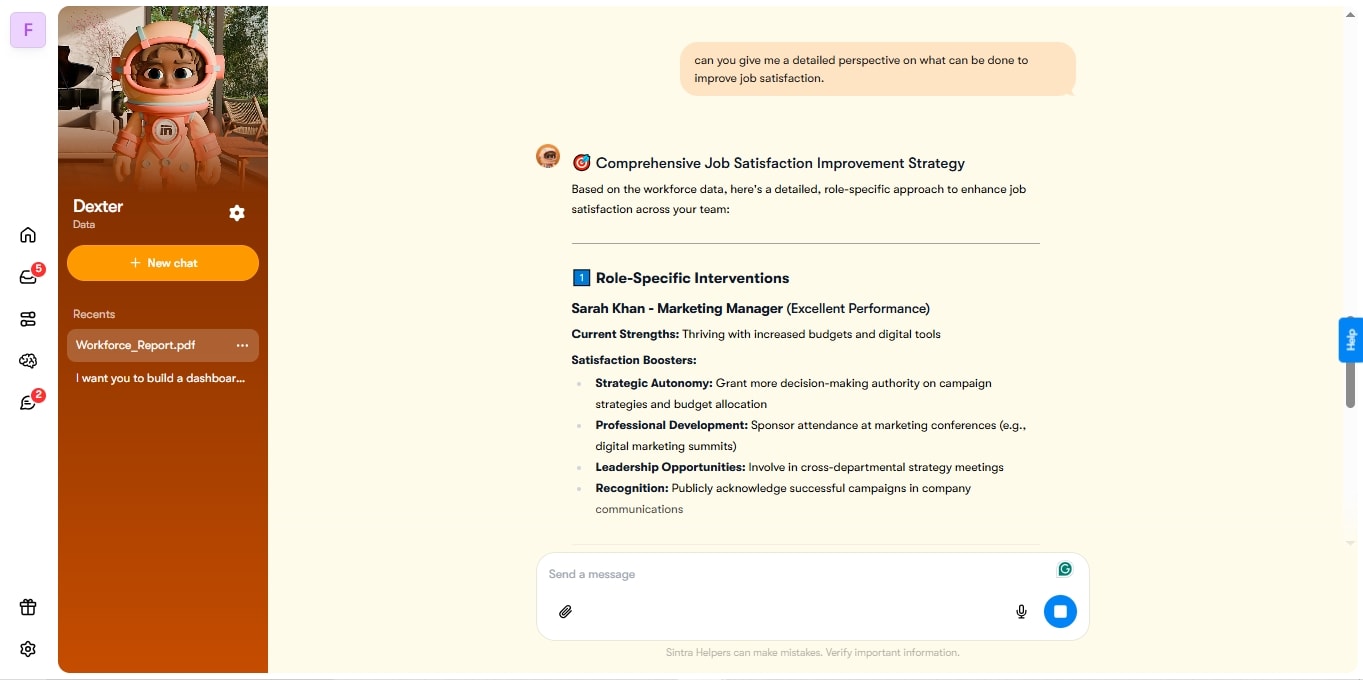
- You can further ask Dexter to provide suggestions on how to improve job satisfaction in the workforce.
Step 09: It’s Time to Scale
After communicating openly about the strengths, challenges, and considerations of AI use in your workspace, it is safe to scale. But don't go all in. Instead, gradually add on people and departments that you see as beneficial.
While doing so, always remember - AI is not intended to completely dash out your workforce; rather, it is there to assist them in building a positive and productive workplace culture.
Challenges and Responsible AI Use in HR
AI in human resources comes with effective decision-making, time-saving, and a focus on strategic HR functions. But before you jump in, let’s check out some challenges and how to cater to them.
Lack of Human Touch: While the temptation of automating and accelerating your HR processes might get to your head, it also sacrifices the human touch. This is especially critical in tasks involving direct interaction with employees, such as performance management, employee well-being, and personalized communication.
Privacy Concerns: When handling workers' data, privacy takes the forefront. Understandably, employees show reservations about feeding their sensitive information into an AI system. Hence, companies must ensure compliance with regulations like GDPR. Plus, having a clear consent mechanism and a thorough security mechanism becomes mandatory.
Ethical Considerations: Working with AI is complicated while staying unbiased. Designed to be impartial in theory, these algorithms can subconsciously use biases from historical data. For instance, when suggesting a profile from a department, it may favor certain people, as derived from the data. The only solution is to use structured and clean data.
Absence of Trust: It’s natural that people are fearful of using AI, especially when managing talent and evaluating performance. This skepticism translates into them having a negative attitude towards automation in the workforce. To avoid this, clear communication is the key. Make your employees realize: AI is to help them and not replace them.
Integration with Existing Systems: Modern HR systems are complex, constituting elements like payroll systems, learning mechanisms, tracking software, and more. However, the challenge comes when you try to integrate AI into your work platforms. Let’s say you employ an AI with an outdated HRIS system. It will obviously struggle to retrieve data.
The Future of AI in HR: Trends and Evolving Roles
As AI makes a shift towards unthinkable advancement, some evolving trends become more apparent and common in professional settings.
- An all AI-powered onboarding experience where virtual assistants handle everything, from document collection to distributing contracts, scheduling training, and answering queries.
- AI-driven tools are diminishing language barriers, creating an inclusive workspace. Translation software bridges the gaps for remote teams working in different geographies.
- Professional growth is a gateway to success, and automated performance coaches are making it possible. Machine learning algorithms analyze your habits, consider your goals, evaluate your performance, and give personalized feedback to course-correct employees consistently.
- While beneficial, the use of AI in human resources demands ethical considerations. Companies today are establishing cross-functional governance overseen by legal and policy experts to ensure a secure and enjoyable experience.
- Moreover, human supervision is critical for executing artificial intelligence in HR. Given AI’s susceptibility to fall for hallucinations and errors, it is especially crucial for sensitive tasks like interacting with employees. Read more about the importance and execution of hybrid teams consisting of humans and AI employees.
Conclusion
There you have it - all about how to use AI in HR processes effectively and to your advantage. In a digital world where half of the workforce is already using advanced agents in their routine HR functions, it’s high time to employ this technology and get ahead.
Don’t have the budget to invest heavily. Try Sintra AI team team of AI helpers. It allows for purchasing individual agents that might be of help for your pilot projects. Plus, you can always scale with its all-in-one workspace without having to switch to different channels for navigating work.
Frequently Asked Questions
What are the main benefits of using AI in HR?
Main benefits of using AI in HR include increased efficiency, reduced human error, informed decision-making, and better employee experience. Modern AI goes beyond automation and helps you gather real-time suggestions from big datasets. This way, HR practitioners can plan and execute effectively.
How does AI improve recruitment and onboarding?
AI improves recruitment and onboarding by streamlining repetitive routine tasks, providing valuable insights for narrowing down the right candidate, and recommending strategies for talent retention. AI-powered HR teams can generate job descriptions, screen candidates, and schedule interviews. Companies also use chatbots and virtual assistant to train new joiners at their own pace and skill set.
Can AI help reduce bias in hiring and performance evaluations?
Of course, AI Technology can reduce biases in the hiring process as long as it is trained on clean and structured data. Machine learning algorithms focus on objective qualification and clustering techniques to track applicants with the desired expertise. This ensures a fair evaluation of candidates applying.
Is AI in HR secure and compliant with privacy laws?
It depends. AI is not inherently secure or compliant with privacy laws. The company implementing it is responsible for designing a thorough execution plan, inclusive of cross-functional governance, transparency, data security, and compliance with industry standard regulations.
Related articles