10 AI Lead Scoring Hacks to Close Deals 2x Faster


Table of Contents

Quick Answer
Conversational AI lead scoring closes deals faster by delivering real-time intent analysis. It instantly isolates high-intent prospects and triggers immediate automated follow-ups. By substituting manual, slow routing with dynamic lead scoring automation, sales teams can bypass cold or dead-end prospects and focus their time on highly qualified opportunities.
Lead scoring is the process of ranking prospective customers based on their likelihood to purchase. This process helps sales teams prioritize their outreach. But traditional lead scoring is a bottleneck. It relies on rigid, manual rules that evaluate static data points. It often results in slow response times and low accuracy rates.
In contrast, AI lead scoring transforms this process into a dynamic, real-time system. Using machine learning and natural language processing, automated lead scoring evaluates thousands of leads in seconds. It also spots conversion patterns that humans miss, increasing overall leads and appointments by more than 50%.
Research from Gleanster shows that only 27% of B2B leads are ready for sales when first passed to teams. In simple terms, this means that sales representatives spend 70% of their time chasing dead ends. By deploying an advanced AI team, businesses can instantly capture qualifying data, analyze intent during live interactions, and ensure high-value prospects receive immediate follow-up when their interest is highest.
What Is AI Lead Scoring and Why It Matters Today?
AI lead scoring automatically ranks potential customers based on their likelihood to purchase. It uses smart software to analyze user intent and measure seriousness in real-time, allowing scores to change dynamically as conversations flow.
Traditional lead scoring slows down the entire process and often ends up in dead ends. AI lead scoring fixes this bottleneck. It utilizes machine learning to evaluate thousands of leads in seconds and spot conversion patterns that humans might miss.
This shift is increasingly driven by conversational AI tools that interpret human language and intent on the go. Instead of waiting days for manual review, businesses can deploy specialized AI employees to engage leads instantly while they are still on the website. This provides a crucial speed advantage where the AI captures qualified prospects at the moment of highest interest.
How AI Lead Scoring Actually Works Behind the Scenes?
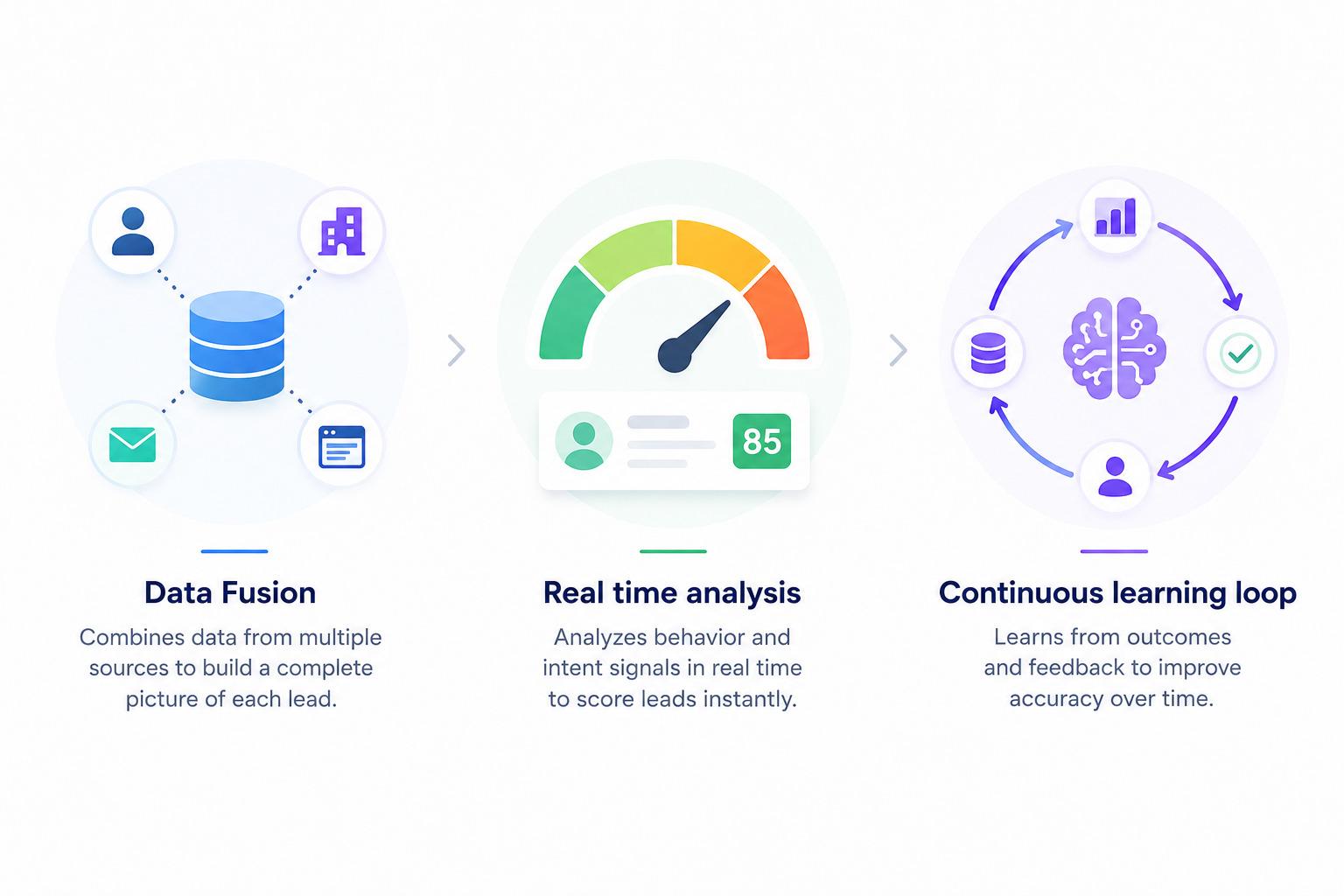
Traditional lead scoring uses manual point systems, while lead scoring using machine learning does the same, only faster and more accurately. Advanced software processes large datasets, evaluating hundreds of data points simultaneously to determine which combinations best predict a purchase.
The system operates across three core pillars:
- Data Fusion: It combines firmographic data (like company size and industry) with deep behavioral footprints, such as pricing page dwell time, content downloads, and email interaction patterns.
- Real-Time Analysis: By processing interactions through an advanced infrastructure like Sintra’s Brain AI, the system tracks user intent as it happens.
- Continuous Learning Loop: Unlike static models, lead scoring machine learning models continuously learn from historical data. The AI constantly analyzes the shared traits of closed deals versus dead ends, automatically refining its scoring criteria over time to maintain peak prediction accuracy.
10 AI Lead Scoring Hacks to Close Deals Faster
Turning raw traffic into closed revenue requires immediate action and flawless execution. And it is not possible without the help of AI tools. The following section breaks down practical, action-driven strategies designed to transform AI lead scoring from a passive tracking tool into an active growth engine.
These practical hacks focus on speed, precision, and instant decision-making. By implementing this framework, you allow your sales team to stop guessing, prioritize high-value intent, and use lead scoring automation to capture prospects at their exact moment of highest interest.
Hack 1: Use Conversational AI to Qualify Leads Instantly
Static forms create friction and delay follow-up times. Replacing them with conversational AI lead scoring allows you to engage, qualify, and score prospects in real-time while still active in the conversation.
Deploying an AI customer service agent transforms your top-of-funnel qualification through the following mechanics:
- Dynamic Questioning: Instead of forcing users to fill out long forms, the AI asks smart, contextual questions based on the user's live responses.
- Instant Intent Detection: The system analyzes natural language cues and engagement signals to calculate an automated lead scoring value mid-conversation.
- Frictionless Routing: High-intent prospects are fast-tracked immediately, while lower-scoring leads are routed to automated nurturing tracks without consuming sales team resources.
For example, a visitor lands on your pricing page. The AI chatbot immediately initiates a conversation by asking, "Are you looking to scale your current outreach team?" and they reply: "Yes, we need to automate 50,000 emails a month by next quarter." Within five seconds, the AI detects high intent, updates the CRM score to maximum, and immediately presents a calendar link to book a demo.
That's how fast AI lead scoring works!
Hack 2: Score Leads Based on Real-Time Behavior, Not Static Data
Static data is nothing but a bottleneck when it comes to lead scoring. A prospect might look perfect on paper, given their job title, company size, or firmographics, but if they have not opened an email in six months, that's a dead end.
Modern lead scoring AI shifts the focus from who a prospect is to what they are doing right now. Here's how you can implement a dynamic, behavioral model that capitalizes on active intent:
- Tracking Live Intent Signals: The system updates scores instantly based on high-value actions, such as visiting a pricing page multiple times, downloading a whitepaper, or opening an email sequence.
- Monitoring Interaction Recency: Traditional point systems leave old, inactive leads at the top of the pile. Behavioral lead scoring automation automatically decays scores when engagement stops, keeping your pipeline fresh.
- Connecting Siloed Data: By leveraging seamless AI integrations, you can sync data from your website, email tools, and product dashboard into one central repository, ensuring no buying signal is missed.
A VP of Marketing matches your ideal customer criteria, but they have been inactive for months. But as soon as they click a link in your newsletter, spend ten minutes on your case studies page, and view your documentation, the AI instantly bumps their score to "hot" and alerts the salesperson to reach out ASAP.
Hack 3: Automate Follow-Ups the Moment a Lead Hits High Intent
Timing is everything in modern B2B sales. If a representative takes hours to respond to a warm prospect, the lead often goes cold or turns to a competitor. Utilizing lead scoring automation allows you to eliminate these response delays entirely by triggering instant, contextual workflows.
By connecting your intent data to automated response systems, you can capture attention at the exact moment interest peaks:
- Instant Threshold Triggers: The moment a prospect's behavior pushes their automated lead scoring value past a predefined threshold, the system triggers an immediate action.
- Contextual Outreach: Instead of sending a generic template, the system pulls behavioral data from the prospect's recent session to customize the message.
- Continuous Engagement: If human reps are offline, specialized tools like an AI email assistant can take over, instantly launching personalized email cadences to keep the conversation moving forward.
Hack 4: Personalize Outreach Using AI Context Memory
No one wants to read a generic template that is sent to a thousand people. To build real engagement, your outreach must reflect the specific pain points and goals your prospect has already shared. In simple terms, your outreach should feel personal to every individual.
Combining an AI lead scoring platform with context-aware data storage lets you turn simple behavioral tracking into highly tailored conversations. Using a unified data infrastructure ensures your sales team always has access to the full story:
- Centralized Data Storage: By routing user interactions through an advanced engine like Sintra's Brain AI, the system safely stores every chat snippet, email reply, and viewed feature.
- Persistent Context Awareness: The AI does not look at interactions in isolation. It remembers past conversations and automatically updates the prospect's profile as new preferences come to light.
- Frictionless Handoffs: When a high score triggers a sales handoff, your team does not need to guess what the prospect wants. The platform delivers a clear summary of the lead's exact needs directly to your CRM.
Hack 5: Combine Lead Scoring with AI Copywriting
You may have gotten a high-intent prospect, but if you cannot properly get your message across, it's as good as nothing. Combining lead scoring with AI copywriting ensures that your outreach matches the prospect's exact level of interest and buying stage.
Here's what AI does:
- Dynamic Tone Adjustment: The system changes its communication style based on user actions. A low-scoring, top-of-funnel lead receives educational, low-pressure insights, while a high-scoring lead receives direct, value-driven product offers.
- Behavior-Driven Content: If an automated lead scoring spike is triggered by a prospect reviewing your security documentation, the AI automatically shifts the copy focus to data compliance, encryption standards, and enterprise trust signals.
- Optimized Call-to-Actions (CTAs): Instead of using a one-size-fits-all approach, the platform modifies the final ask. It serves soft CTAs (like reading a blog) to casual browsers, and hard CTAs (like booking a calendar slot) to buyers showing heavy intent.
Hack 6: Align Sales and Marketing with Shared AI Insights
Sales and marketing departments need to be aligned for the best results. They both use different definitions of a qualified lead; marketing might celebrate high download numbers, but the sales will frown that those same prospects are completely unready to buy.
What you need is a unified lead scoring platform that shares AI insights as an objective source of truth for user intent. This can be done by:
- Shared Intent Definitions: Both teams work from a unified model that combines marketing engagement (like email opens and webinar attendance) with sales intent signals (like pricing page visits and demo clicks) into one clear score.
- Closed-Loop Feedback: The AI platform continuously tracks which high-scoring leads actually convert into closed revenue, automatically refining the shared lead scoring criteria based on hard data rather than internal debate.
- Frictionless Handoffs: Marketing can confidently automate top-of-funnel nurturing tracks, while sales receives instant notifications the exact moment a prospect meets the agreed-upon qualification threshold.
Hack 7: Prioritize Leads Automatically Without Manual Review
Manual lead sorting is slow, inefficient, and highly prone to human bias. Teams often waste valuable hours cherry-picking accounts based on mere hunches or sorting through spreadsheets by hand. Transitioning to automated lead scoring removes this human bottleneck, ensuring your pipeline is sorted and updated every second of the day.
An automated ranking system implements the following mechanics:
- Dynamic Queue Management: The platform continuously updates your pipeline in real time. As prospects interact with your brand, their positions change instantly, pushing hot accounts straight to the top of your sales dashboard.
- Elimination of Human Bias: Traditional review often relies on subjective opinions about job titles or company names. An AI model uses hard behavioral data to rank prospects objectively based on their actual buying signals.
- Instant Sales Action: Sales representatives no longer need to spend their morning analyzing spreadsheets to decide who to call first. They simply open their CRM and immediately focus on the highest-ranked opportunities.
Hack 8: Use Social Signals to Improve Lead Scoring Accuracy
Relying only on website visits and open emails gives you an incomplete view of buyer intent. Modern B2B buyers do a large portion of their research on social networks before they ever talk to your sales team. This gives a complete picture of market interest before you start acting on your outreach.
Integrating multi-channel social data into your qualification workflow provides three distinct advantages:
- Tracking Off-Site Intent: The system monitors key actions like commenting on your product updates, sharing case studies, or interacting with your executive team's posts, and links them back to a user profile.
- Expanding Contextual Data: By deploying a specialized tool like an AI social media manager, you can track brand sentiment and product inquiries across various social channels in real time.
- Unified Pipeline Monitoring: The platform combines these social interactions with your active conversational AI lead scoring data, ensuring your sales reps see every touchpoint a prospect makes.
Hack 9: Continuously Train Your Lead Scoring Model
One great thing about AI models is that it gets better the more you use them. Keep feeding it with good data, and it keeps evolving. Market dynamics, buying behaviors, and your own product offerings change over time, meaning a static model will eventually lose its edge. True optimization requires treating lead scoring as an active, ongoing feedback loop rather than a set-it-and-forget-it installation.
To keep your predictions accurate, your team must maintain a structured optimization cycle:
- Feed the System Conversion Outcomes: Every time a lead converts into a paying customer, or a deal is marked as closed/lost, that data must route back into the AI. The system needs to analyze what went right or wrong to identify new success patterns.
- Track Evolving Behavioral Shifts: Buyer habits change. If prospects suddenly stop reading long whitepapers and start focusing on short video demos, your model needs to automatically lower the value of the former and boost the weight of the latter.
- Audit and Refine System Thresholds: Set up a regular review cadence to inspect your scoring tiers. If your sales team complains that "hot" leads are stalling, or if marketing notices highly engaged prospects are being ignored, use those signals to recalibrate your model's baseline assumptions.
Hack 10: Turn Lead Scores into Immediate Action
A high lead score is meaningless if it sits idle on the dashboard. The true value lies in execution; how quickly your systems convert that data into a direct sales interaction. To maximize revenue impact, a score increase must instantly trigger automated operational workflows.
Here's what a seamless, responsive pipeline looks like:
- Instant Workflow Triggers: The moment a prospect crosses into your highest scoring tier, the platform bypasses manual review and triggers automated data routing across your entire tech stack.
- Smart Task Assignment: The system instantly matches high-intent leads with the right representative based on account size, industry, or geographic territory, pushing a priority task straight to their device.
- Automated Outreach Initiation: While your sales rep prepares for a live call, the underlying lead scoring automation can automatically enroll the prospect into an immediate, highly personalized email or SMS nurturing sequence to maintain momentum.
By following these actionable hacks, you can transform your qualification pipeline from a passive tracking tool into a fast, revenue-driven engine. Integrating smart AI models into your daily operations eliminates human delay and ensures your sales team spends their time on high-value opportunities.
Common Mistakes to Avoid in AI Lead Scoring
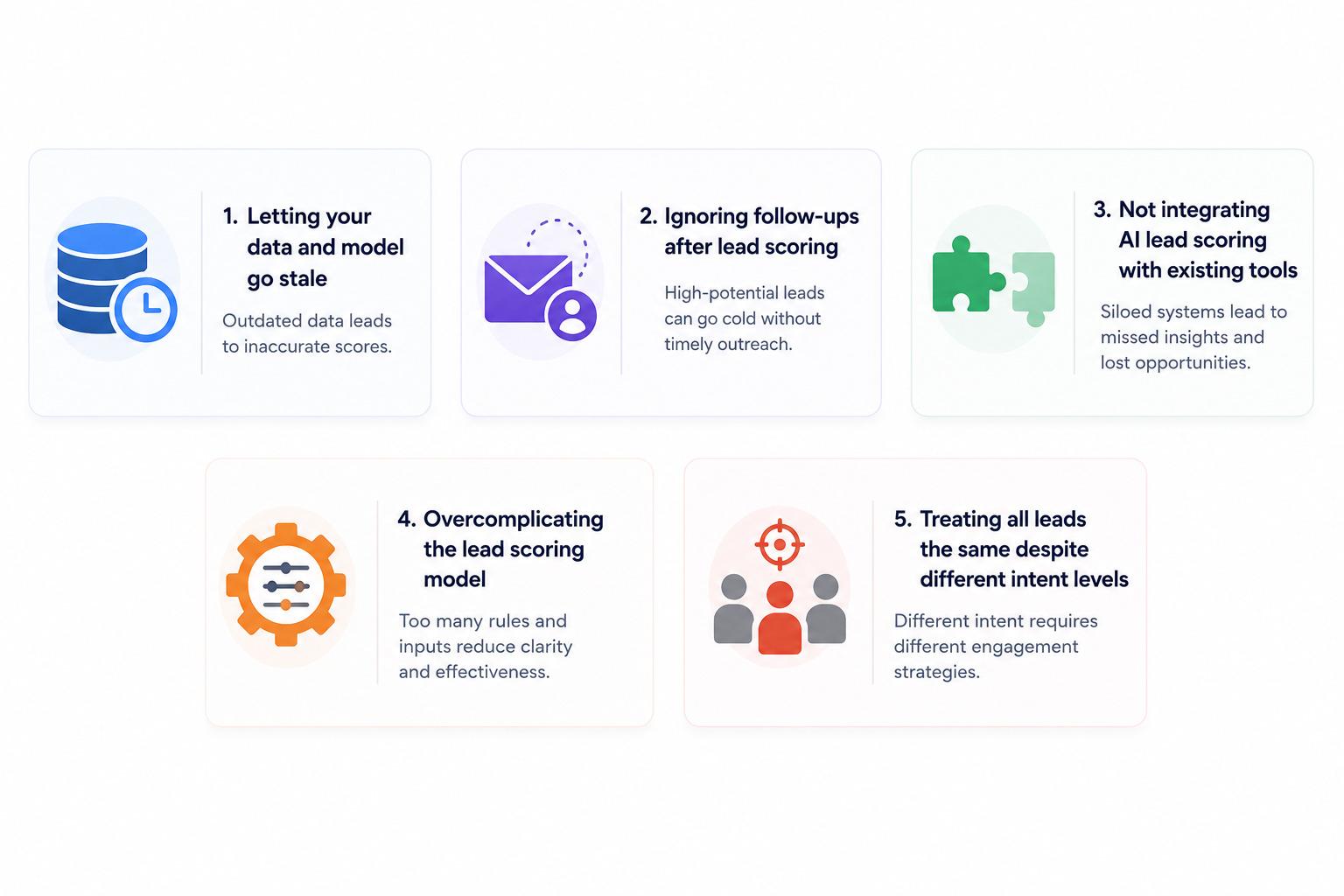
Implementing a lead scoring system can dramatically accelerate your sales, but it is not as foolproof as you might think. Without proper oversight, you will cause costly operational errors. Many companies suffer from frustrated sales reps and stalled pipelines simply because small, hidden implementation mistakes damage data accuracy and slow down conversion rates.
Let's take a look at some of the most common mistakes that people make when dealing with AI lead scoring:
Letting Your Data and Model Go Stale
The automated lead scoring system is not a one-time setup; it is there to stay and evolve based on your prospects' data. When this system runs on outdated assumptions, its predictions drift away from reality, actively misdirecting your sales team and wasting valuable outreach hours on dead ends.
Neglecting your data hygiene and system updates causes critical operational failures:
- Chasing Ghost Intent: The system continues to flag accounts as highly active based on old data points, ignoring the fact that the primary decision-maker left the company six months ago.
- Missing the Target Market: If your company updates its product focus to target enterprise buyers, an uncalibrated model will keep prioritizing smaller SMB leads because that is what it was originally trained to find.
- Wasted Sales Capacity: Sales representatives lose trust in the platform when they spend their mornings calling "hot" prospects who have completely cold engagement metrics.
Have a look at this example: Consider a system using lead scoring automation that was trained during a heavy Q4 marketing push. Six months later, your team shifts focus to a completely new industry approach. Since the underlying model remains unadjusted, it continues to push last year's prospects to the top of the queue. This leaves your reps blind to the current year's highest-value enterprise buyers while they chase leads that no longer fit your business goals.
Ignoring Follow-Ups After Lead Scoring
A high qualification score has zero business value if nobody acts on it. The ultimate goal of automated lead scoring is to help your team move faster. Yet, many companies treat a high score like a trophy on a dashboard instead of a signal to reach out right away. When a hot lead sits around waiting, their interest drops fast.
Here's what happens when you don't take immediate action on a qualified lead:
- Interest Fades Fast: A prospect looking at your pricing page right now wants answers today. If you wait days to reach out, they will forget about you or move on to a competitor.
- Wasted Marketing Money: Your team spends a lot of time and money getting great leads to your site. Letting those leads sit untouched completely burns that budget.
- Stuck Pipelines: If your system flags a hot buyer, but your team still waits for a weekly meeting to assign leads, the tool isn't actually helping you save time.
Not Integrating AI Lead Scoring with Existing Tools
Just because you have invested in new tools doesn't mean you need to abandon your existing stack. In fact, the new tools should and must integrate with your existing tools. When your scoring tool is isolated, your data gets stuck in separate silos.
This means your sales reps have to constantly jump between different tabs just to see who is actually ready to buy. This disconnection causes three major problems:
- Blind Sales Reps: If your scoring tool doesn't sync directly with your CRM, your sales team won't see when a lead's score suddenly shoots up. They will keep working out of their usual dashboards, completely missing the hottest opportunities.
- Incomplete Tracking: Without a connection to your email and marketing software, the AI can't see the whole picture. It might miss important clues, like a prospect clicking a link in a marketing email or opening a newsletter.
- Manual Work Bottlenecks: If your tools don't talk to each other, you have to manually copy and paste lead data from one system to another. This creates extra work, slows down your team, and leads to costly data entry mistakes.
Overcomplicating the Lead Scoring Model
It is easy to think that adding dozens of rules, metrics, and data tracking points will make your lead scoring more accurate. In reality, building an overly complex model just makes it harder to manage and understand. When a system gets too complicated, nobody on your team can figure out why a lead got a specific score, which completely breaks down trust.
Here's what it does:
- Slower Decision-Making: If your system weighs too many minor actions like tracking every single tweet a prospect views, it can stall your pipeline. Instead of giving a clear green light to reach out, the tool gets bogged down calculating irrelevant data.
- Confused Sales Teams: When a sales rep opens their dashboard and sees a lead with a perfect score, they need to know why that lead is hot. If the formula is too messy, the rep won't know what product or pain point to talk about when they call.
- Harder Troubleshooting: If your conversion rates start dropping, finding out what is wrong with your model becomes a nightmare. It is incredibly difficult to fix a broken system when you have to sift through hundreds of confusing variables.
Treating All Leads the Same Despite Different Intent Levels
If you treat every single sign-up the same way, you are wasting your sales team’s time. Not all leads are equal; someone downloading a generic checklist is not the same as someone actively reviewing your pricing page. Failing to separate these distinct groups means your reps end up chasing cold contacts while hot buyers get completely ignored.
Putting all your prospects into one bucket causes major efficiency issues, like:
- Wasted Effort on Cold Contacts: Your sales team spends valuable hours calling people who just wanted a free piece of content, leaving them exhausted and discouraged.
- Missed High-Value Opportunities: While your reps are busy sorting through low-interest leads, your best prospects get tired of waiting and head to a competitor.
- Irrelevant Messaging: Without clear segmentation from the system, you cannot tailor your pitch. You end up sending the same generic message to an executive who is ready to buy and a student who is just doing research.
Ready to Turn Lead Scores Into Revenue?
Knowing which leads are ready to buy is only half the battle; the real revenue happens when you act on that data before the interest cools down. Too many businesses lose out on perfect opportunities simply because of slow manual follow-ups and disconnected tools.
Implementing AI lead scoring is the first step, but pairing it with immediate execution is how you win the market. This is where Sintra AI steps in to close the gap. Instead of letting hot leads sit idle, this platform turns your data into distant action. It connects your pipeline directly to your workflows, ensuring that the exact moment a prospect crosses your qualification threshold, the system triggers targeted outreach and alerts your sales team.
Stop letting valuable opportunities slip through the cracks while you manually sort through your CRM. Get started with Sintra AI today and automate your pipeline from identification to a closed deal.
AI Lead Scoring FAQs
What is AI lead scoring, and how does it work?
AI lead scoring uses machine learning to automatically rank prospects based on their conversion likelihood. It analyzes real-time data, tracking behavioral patterns and intent signals to dynamically update scores as leads interact with your brand.
How is AI lead scoring different from traditional lead scoring?
Traditional scoring relies on rigid, manual rules and static data, often leading to outdated or inaccurate rankings. AI scoring uses machine learning to evaluate thousands of behaviors simultaneously, adapting instantly to live actions.
Can AI lead scoring improve conversion rates?
Yes. By automating prioritization and triggering instant follow-ups, it ensures sales teams engage high-intent prospects immediately, capturing them at peak interest and significantly reducing pipeline drop-offs.
What data is used in AI lead scoring?
It combines firmographics (company size, industry) with deep behavioral data, including website clicks, page dwell times, email opens, social media engagement, and real-time conversation context.
Is AI lead scoring suitable for small businesses?
Absolutely. It eliminates manual sorting bottlenecks, allowing lean teams to maximize their limited sales hours by focusing strictly on the highest-value opportunities with the best chance of closing.
Related articles
%20in%202026.avif)