10 Best AI Business Coach Agents for 2026


Table of Contents

TL;DR - What Is the Best AI Business Coach for 2026
Strong AI business coaching platforms share a clear set of characteristics that separate them from basic coaching apps or generic chat tools. Choose based on your goal - execution (Sintra), leadership (Hone/BetterUp), or personal/communication skills (Rocky/Poised).
- Sintra AI – all-in-one coaching + execution (best overall)
- Hone – leadership training for teams
- BetterUp – enterprise coaching & wellbeing
- CoachHub AIMY – scalable employee coaching
- Skillsoft CAISY – conversation & communication practice
AI business coaching has become a distinct category. Teams seek scalable ways to improve leadership, decision-making, and execution without relying solely on human coaches.
Improvements in AI models, integrations, and analytics have made these tools practical for everyday business use. This shift is also reflected in the broader market, with AI-driven HR and workforce tools seeing rapid adoption.
We reviewed AI business coaching platforms because they address common problems faced by founders and teams:
- Limited access to consistent coaching
- Inconsistent or delayed feedback
- Slow skill development
- High cost of traditional one-on-one coaching
Most AI coaching agents aim to solve these issues by offering always-available guidance. The usage data backs this up: workers who save more than 10 hours a week use 8x more AI credits than those saving zero, and users running AI across roughly seven task types report 5x more time saved than those using it for just four. In this guide, we break down 10 AI business coach agents based on coaching depth and approach.
It supports a personalized experience
The best AI software for corporate coaching adapts to the individual. It tailors guidance based on goals, behavior, and performance data instead of offering generic advice. This allows teams to receive scalable coaching experiences that feel relevant, even as usage scales.
It provides real-time feedback
The best AI coaching platforms do not rely on delayed reviews. They deliver feedback as work happens, allowing users to adjust decisions, communication, or priorities immediately.
It is available 24/7
Effective AI coaching is always accessible. Users can reflect, plan, or course-correct at any time, without waiting for scheduled sessions or availability windows.
It streamlines workflows
High-quality AI business coaching tools reduce friction. They help structure decisions, track progress, and remove administrative overhead so users can focus on execution and growth.
It tracks performance using real data
The best platforms use AI to monitor leadership behaviors, habits, and business KPIs. This allows executive coaching to be grounded in actual performance rather than perception alone.
It creates a non-judgmental coaching space
AI business coaching gives users room to think clearly. The absence of judgment helps founders and leaders explore challenges honestly and work through issues they may avoid in human settings.
It is cost-effective compared to human coaching
Most AI coaches cost a fraction of what traditional one-on-one coaching costs. This makes continuous coaching accessible to individuals and teams, not just executives.
It supports a complete digital coaching environment
Strong AI coaching apps often include tools for goal tracking, client or team management, and learning delivery. This creates a single environment instead of scattered tools.
In short, the best AI coach combines availability, personalization, feedback, and workflow support into one system. The platforms that succeed in 2026 are the ones that integrate naturally into daily business operations rather than sitting on the side as advice-only tools.
What Is an AI-Powered Coaching Platform? (Compared to Human Coaching)
An AI-powered coaching platform uses artificial intelligence to provide continuous coaching support tied to real work. Instead of scheduled sessions, users get guidance through prompts, feedback, and goal tracking as decisions and challenges happen.
In practice, AI coaching platforms help with leadership habits, decision support, communication feedback, and execution follow-through. They streamline workflows by automating tracking and reducing administrative effort.
Most are available 24/7, provide real-time feedback, and cost far less than traditional coaching. It makes them practical for teams, not just executives. Here’s a quick comparison table:
Area
AI-Based Coaching Platforms
Human Coaching
Availability
24/7, on demand
Scheduled sessions only
Cost
Often under $100/month
$200–$500+ per session
Scalability
Scales to entire teams
Hard to scale beyond individuals
Feedback
Real-time or immediate
Delayed between sessions
Personalization
Data-driven and adaptive
Experience-driven and contextual
Environment
Non-judgmental
Can feel evaluative
Best use
Ongoing support and execution
Deep personal or strategic work
Most modern teams use AI in coaching for daily guidance and consistency, then add human coaching selectively where nuance and emotional depth matter.
10 Best AI Coaches for 2026 – In-Depth Reviews
We reviewed each AI business coach based on how it performs in real work, not marketing claims. The main criteria were coaching depth, the actionability of the guidance, personalization, feedback and tracking, setup effort, pricing approach, and integrations.
Many of the tools below use AI helpers in different ways, from focused coaching agents to broader systems that support planning, communication, and follow-through across daily work.
The order below reflects the best fit for business owners and teams:
1. Sintra AI (Buddy – AI Business Coach)
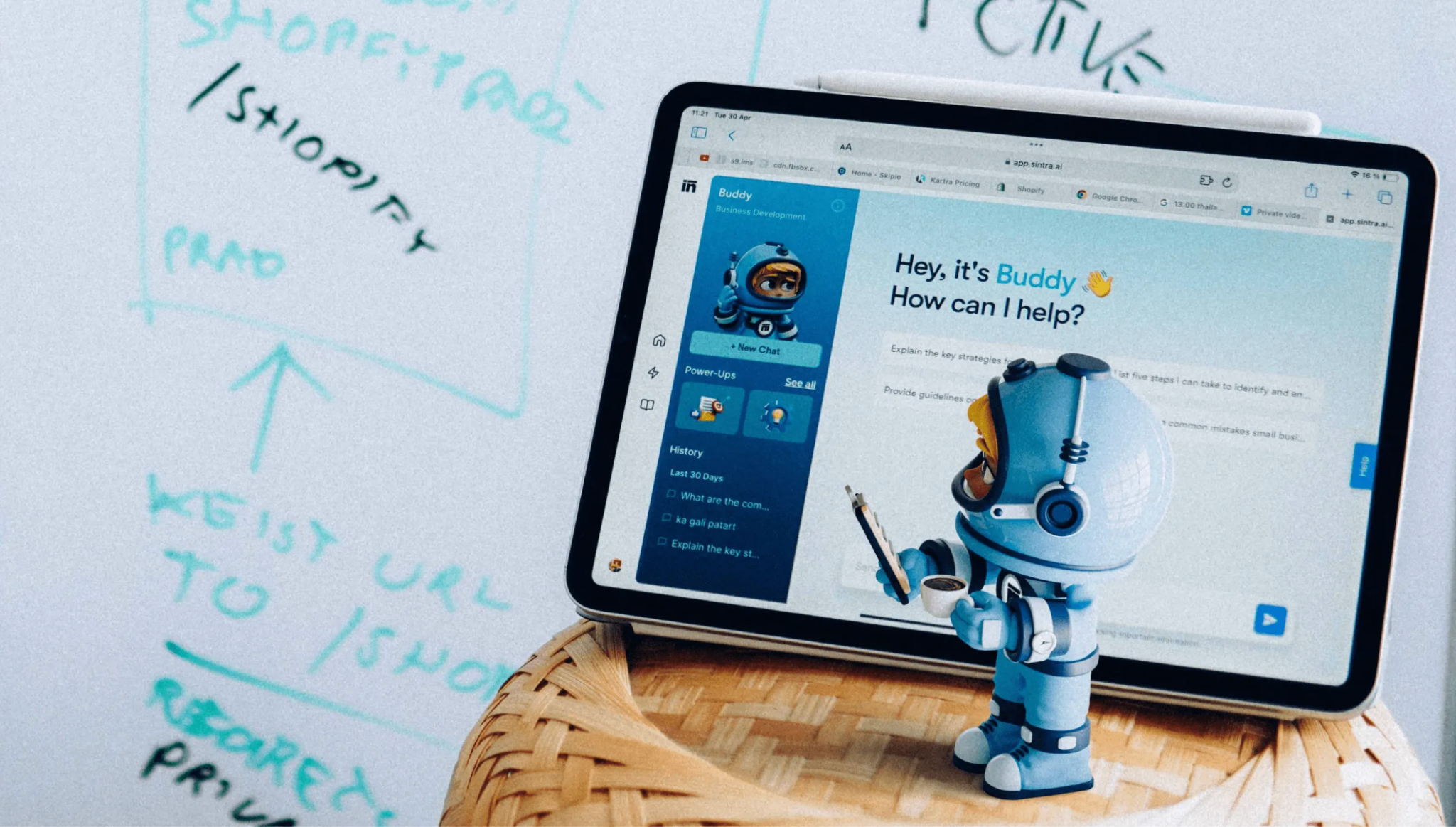
Sintra is built around multiple AI helpers, each focused on a specific role. For AI business coaching, the relevant agent is Buddy, Sintra’s business-focused coaching assistant. Buddy is designed to support founders and operators with planning, clarity, and decision-making, rather than just task execution.
Instead of acting like a one-off advisor, Buddy functions as an always-available business coach. It helps structure thinking, surface blind spots, and turn high-level goals into next steps.
Below are three practical ways to use Buddy in a real workflow. Each example is designed to let you test it directly and capture screenshots. Here's how to Buddy as an AI business coach:
1. Weekly Business Coaching Session
Prompt to try:
“Buddy, act as my AI business coach. Here is my business in two sentences: [describe business]. These are my goals for the next 90 days: [list]. Build a one-week plan with three priorities, clear tasks, and success metrics.”

Within one prompt, Buddy created a practical one-week plan that breaks big goals into clear actions and measurable outcomes.
2. Decision Coaching for a Blocker
Prompt to try:
“Gigi, I am stuck on this decision: [describe problem]. Ask me the questions a business coach would ask, then give me three clear options with trade-offs and recommended next steps.”

Buddy guided the decision by combining reflective questions, option trade-offs, and clear next steps, similar to a structured human coaching session.
3. Strategy Clarity and Alignment
Prompt to try:
“Buddy, help me clarify my business strategy. Based on this context: [goals, constraints, market], write a one-page strategy summary with focus areas, risks, and what to prioritize this quarter.”

Buddy condensed the entire strategy into a one-page plan with focus areas, risks, and priorities that are easy to act on and communicate.
Buddy works best when used repeatedly, so context builds over time rather than starting from scratch in every session.
Pricing
Gigi is available through Sintra’s subscription plans, which are structured by billing period rather than feature confusion. Users can choose between three options:
- Monthly plan: $97 per month
- Three-month plan: $59 per month (billed quarterly)
- Twelve-month plan: $52 per month (billed annually)
All plans include access to Gigi at a significantly lower price than ongoing human coaching.
2. Hone
What Makes Hone Stand Out
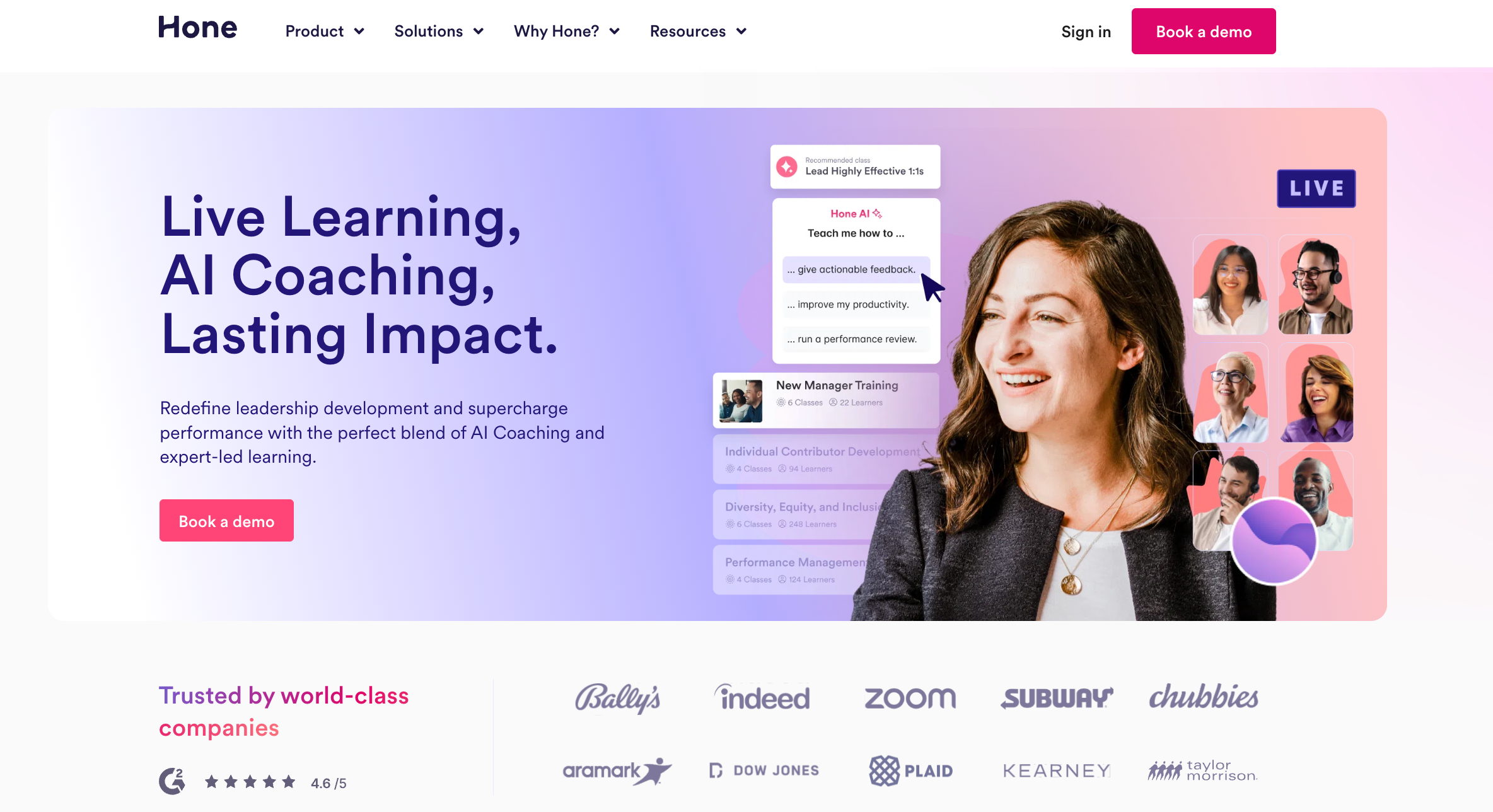
Hone is built for manager and leadership development at scale. It blends live, expert-led learning with an always-on AI coach that reinforces skills in the flow of work.
Key Features
- Hone AI for always-on, interactive coaching
- AI-led training + practice + coaching (voice and text)
- Live classes and masterclasses for cohort-style learning
- Private cohorts for role-based programs and psychological safety
- Impact data and insights to track skill improvement
- Slack integration for in-work coaching moments
Pricing Model
Hone is sold via demo and custom quotes. Pricing depends on team size and program needs.
3. BetterUp

What Makes BetterUp Stand Out
BetterUp is an enterprise “human transformation” platform. It combines AI leadership coaching, human coaching options, and behavioral science. It focuses on measurable org outcomes.
Key Features
- AI for coaching at enterprise scale with governance and security focus
- Configure + connect to business priorities and workflows
- Integrations with systems like HCM/LMS and workplace tools
- Real-time insights on capability gaps and performance signals
- Multiple products (leadership, manager performance, resilience, AI coaching)
- Enterprise security posture highlighted on the platform page
Pricing Model
BetterUp pricing is custom. You request a demo and get a proposal based on goals and scale.
4. CoachHub AIMY
What Makes CoachHub AIMY Stand Out
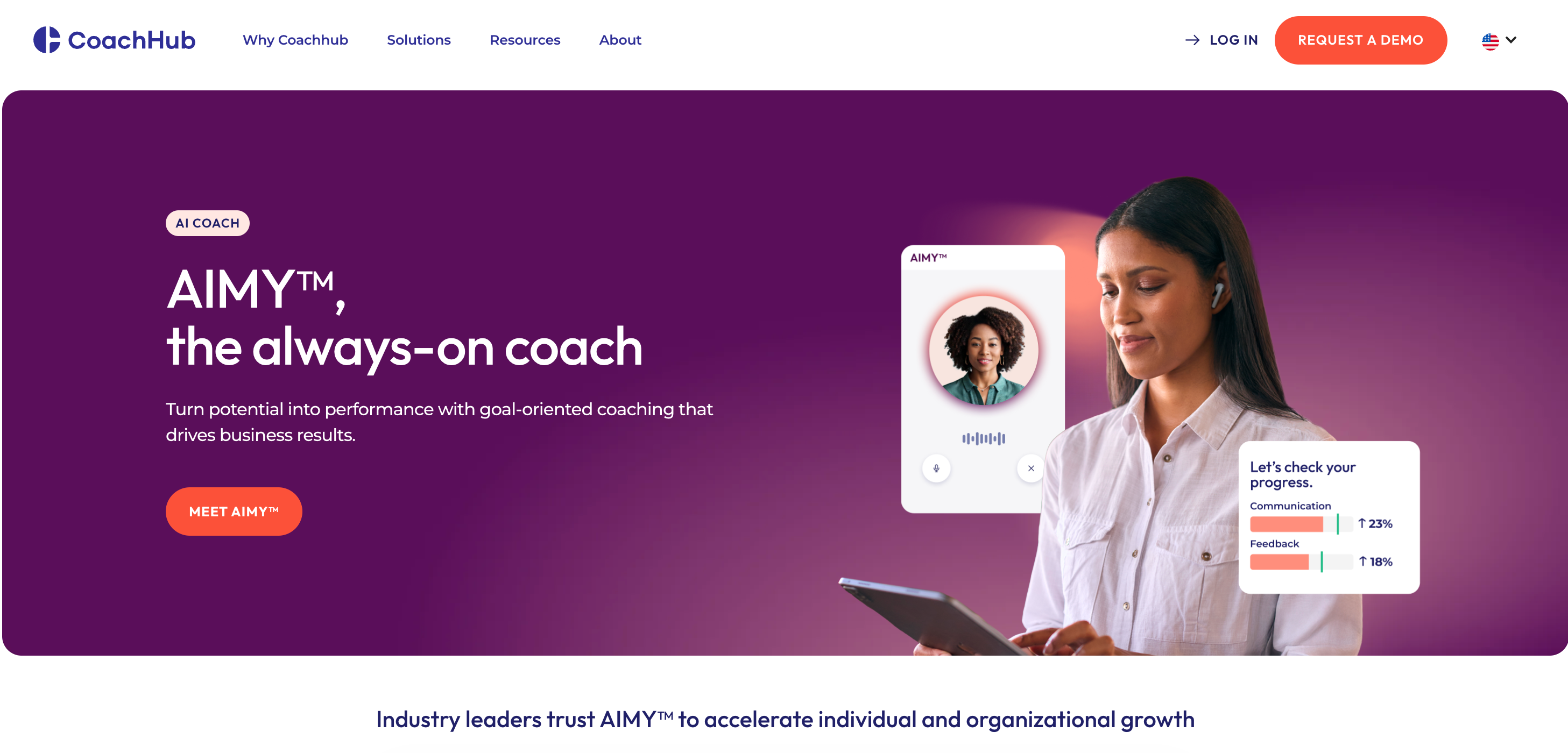
AIMY is CoachHub’s always-on AI coach for employee development. It runs interactive coaching chats, helps people set goals, and gives real-time exercises between work moments.
Key Features
- 24/7 AI coaching conversations tailored to each coachee
- Guided goal-setting, reflections, and skill-building prompts
- Micro-learnings recommended from CoachHub Academy
- Instant feedback plus data-driven insights during coaching chats
- Privacy approach: conversations stay private, HR gets aggregated insights
- Enterprise readiness and security certifications listed by CoachHub
Pricing Model
CoachHub positions AIMY as an enterprise solution. Pricing is typically custom and starts with a sales call or demo.
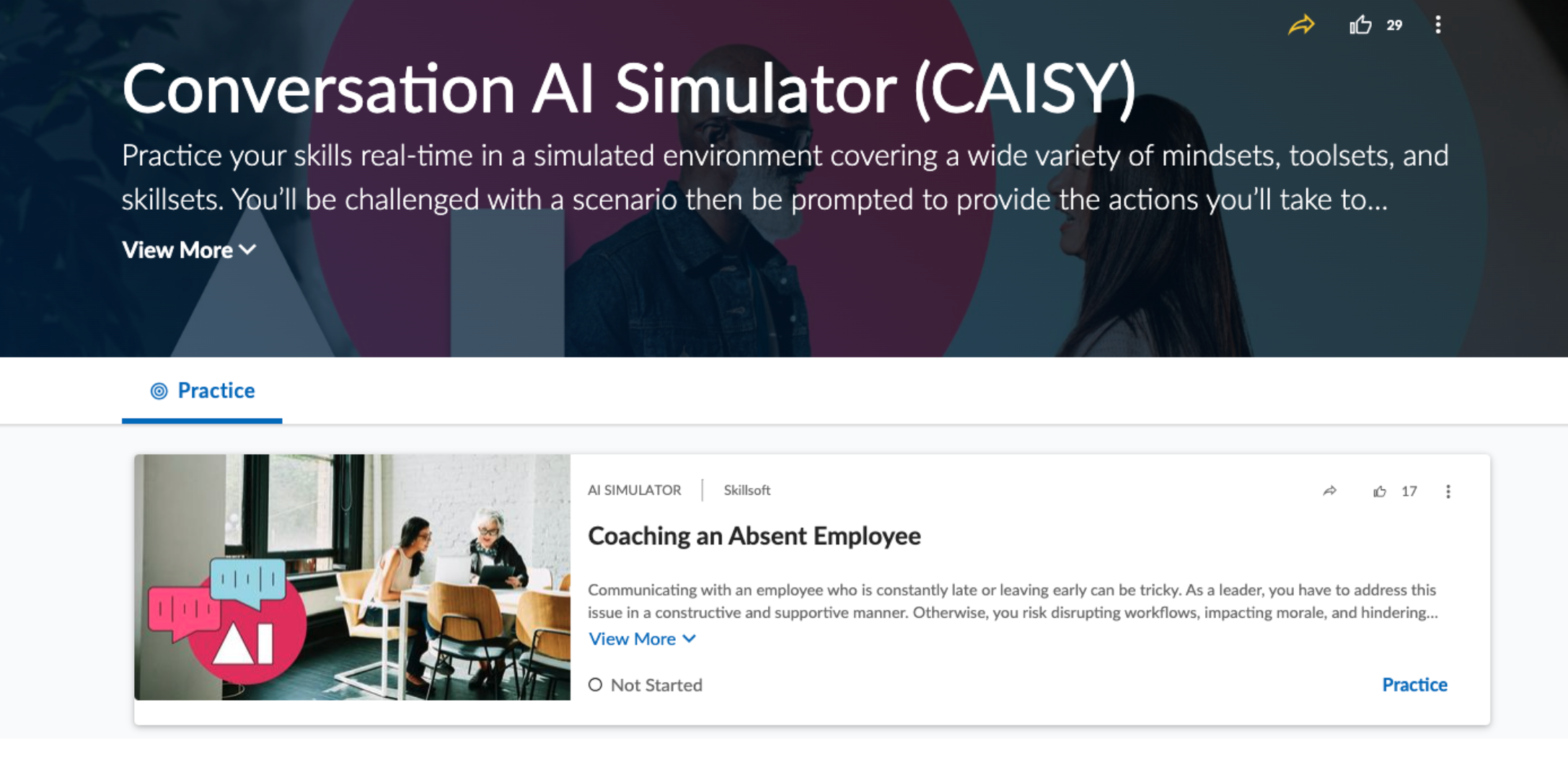
5. Skillsoft CAISY
What Makes Skillsoft CAISY Stand Out
CAISY is a conversation AI simulator for practicing hard workplace conversations. It gives a safe, judgment-free space with adaptive feedback.
Key Features
- Scenario-based role-play for coaching, conflict, negotiation, and HR talks
- Real-time responses with adaptive, personalized feedback
- “Emotional safety” focuses on so that learners can practice without fear
- Typing plus speech-to-text and text-to-speech options
- Ratings and evaluations at the end of a scenario
- Built for scale across departments and employee levels
Pricing Model
CAISY is licensed as part of specific Skillsoft packages, such as Expert Collections or SLDP. Teams usually buy via Skillsoft contracts through an account rep.
6. LearnWorlds

What Makes LearnWorlds Stand Out
LearnWorlds is a course and coaching platform that helps coaches package programs, run sessions, and deliver learning at scale. It also includes built-in AI tools across plans.
Key Features
- Course creation plus 1:1 and group sessions, with communities
- “LearnWorlds AI” tools to support course creation and learning experience
- AI translations on higher tiers
- Advanced Zapier support and a large set of integrations
- Interactive video features, including AI-supported video experiences
- Analytics and reporting features that scale with higher plans
Pricing Model
LearnWorlds lists tiered monthly pricing and a 30-day trial. Starter is $29/month, Pro Trainer is $99/month, and Learning Center is $299/month.
7. Mighty Networks

What Makes Mighty Networks Stand Out
Mighty Networks is a coaching platform built around community, courses, and events, with built-in AI that helps you design and run the experience faster. Its “Mighty Co-Host” and AI features help you plan structure, prompts, and engagement without starting from zero.
Key Features
- AI chatbot trained on “all things Mighty” to help with strategy and setup, available 24/7.
- Mighty Co-Host can generate community structure and launch assets during setup.
- Community, courses, memberships, and events in one place.
- Engagement tools like automated questions and polls.
- Integrations support common workflows, including Zapier.
Pricing Model
Mighty Networks offers tiered plans (Community, Courses, Business, Growth) and Mighty Pro for branded apps and services.
8. Rocky.ai

What Makes Rocky.ai Stand Out
Rocky.ai is a lightweight AI coaching app built for daily self-coaching, habits, and leadership growth. It is designed for ongoing check-ins, goal tracking, and structured personal development.
Key Features
- AI chat coach built for personal development, with structured coaching journeys
- Daily AI executive coaching style that supports reflection and consistency
- Goal-setting and progress tracking with guided development plans
- Team features add monitoring and a coach panel for organizations
Pricing Model
Rocky offers a free tier and a paid individual plan starting at $9.99 per month. Team pricing is shown at $19.90 per seat, and business white-label plans start at $99 per month, billed monthly, with a 14-day trial option.
9. Jasper

What Makes Jasper Stand Out
Jasper is a marketing-focused AI platform that can act like a content strategy coach for teams. It stands out for brand controls, collaboration, and workflows that keep output consistent across writers and channels.
Key Features
- Brand Voice training from your content, so output matches your style.
- Team workflows and collaboration features for content production at scale.
- A browser extension so that you can use it inside tools like Gmail and CMS tabs.
- Marketing agents and a no-code AI app builder are available on higher tiers.
Pricing Model
Jasper lists a Pro plan at $69 per month per seat (monthly view) and shows a discounted $59 per month per seat (yearly view). Business pricing is custom.
10. Poised

What Makes Poised Stand Out
Poised is a real-time communication coach for meetings. It gives private, live feedback while you speak. It’s built for leaders and sales calls.
Key Features
- Real-time meeting feedback on conciseness and filler patterns
- Works on Mac and Windows
- Runs in live meetings across standard tools like Zoom and Teams
- Private coaching is designed to be non-distracting
- Team option with multi-member accounts and priority support
Pricing Model
- Pro: $19/month, or $13/month billed annually
- Team: custom pricing
- Shortcut: free (limited time)
Benefits of AI Coaching for Modern Businesses
AI coaching works best when it supports real work, not just theory. For founders, managers, and teams, the value comes from consistent guidance, faster feedback, and better follow-through without adding more meetings.
Faster Decisions With Clearer Thinking
AI coaching helps leaders work through decisions in a structured way. It can surface blind spots, compare options, and keep choices tied to goals and constraints. This reduces decision fatigue and improves speed without rushing.
Personalized Coaching at Team Scale
AI coaching platforms deliver personalized coaching experiences that adapt to role, goals, and performance over time. This makes high-quality coaching available to more employees, not only executives.
Real-Time Feedback That Improves Skills Faster
Unlike traditional coaching, which occurs after the fact, AI coaching platforms can deliver real-time feedback. That helps people improve communication, leadership habits, and execution throughout the work.
24/7 Access That Fits How Teams Actually Work
AI coaching platforms are available 24/7, so coaching is accessible anytime and anywhere. That matters when problems show up during a sales call, a hiring decision, or a stressful delivery week.
Less Admin Work and Smoother Workflows
AI coaching platforms streamline workflows by automating tracking, reminders, and planning. This helps coaches and managers focus more on growth and outcomes rather than administration.
Better Tracking of Performance and Progress
AI enables personalized performance tracking across leadership behaviors and business KPIs. This makes coaching more measurable and helps teams link development to outcomes.
A Non-Judgmental Space for Real Challenges
AI business coaching provides a non-judgmental environment. Many founders and managers share more openly when they are not being evaluated, which improves reflection and problem-solving.
Lower Cost Than Human-Only Coaching
Artificial Intelligence coaching is often cost-effective, with many tools priced under $100 per month. This makes ongoing coaching affordable for individuals, small teams, and growing companies.
More Execution With Fewer Hires
AI agent coaching can support recurring routines like weekly planning, pipeline reviews, daily stand-ups, and content planning. That reduces busywork and frees humans to focus on high-leverage work.
Things to Consider When Choosing the Best AI Coach
Most teams fail with AI coaching for one reason. They buy a tool that gives advice, but cannot drive change. Use the checklist below to pick a platform that fits your workflows and goals.
Start With One Clear Outcome
Pick one primary outcome for the first 30 days.
- Better manager feedback and coaching
- Faster weekly planning and decision-making
- Stronger sales calls and communication
- Faster onboarding for new hires
- Better execution and follow-through
Write one success metric before you buy. For example: “Reduce manager 1:1 prep time by 30%.”
Check Coaching Depth
Not all AI coaches coach the same way. Ask what the tool does after it gives advice. Look for:
- Goal setting with progress tracking
- Real-time feedback, not only summaries
- Habit prompts and follow-ups
- Structured plans you can reuse weekly
Ask this vendor question: “Show me how it changes behavior over 4 weeks.”
Confirm Advice vs Action
Some tools only talk. Others help you execute. Ask:
- Can it create plans and checklists?
- Can it remind people and track completion?
- Can it connect to work tools and workflows?
If integrations matter, check the vendor’s list first.
Important AI integrations: https://sintra.ai/integrations
Demand Proof of Personalization
Personalization should come from your role and goals. It should not be generic. Ask:
- “What inputs does the AI use to tailor coaching?”
- “Does it track my goals over time?”
- “Can it coach different roles differently?”
Review Data Security With Specific Questions
Do not accept vague answers. Ask direct questions. For example:
- Where is data stored?
- How long is it kept?
- Is it used to train public models?
- Can admins control access?
- Can we delete data on request?
If the tool is for teams, request SSO and role-based controls.
Evaluate Analytics and Reporting
If you cannot measure progress, coaching turns into chat logs. Look for:
- Goal dashboards
- Skill progress over time
- Team-level reports
- Behavior change signals
Test With a Real Pilot
Do not test with fake prompts. Use real situations.
Pilot test ideas:
- One weekly planning session
- One tough decision
- One feedback conversation
- One onboarding workflow
Track time saved and outcomes changed.
Consider Pricing
Compare the real cost, not only the monthly fee. Include:
- Seats and scale costs
- Setup time
- Training time
- Admin effort
- Adoption risk
If you run a small business, use this guide to set the scope first: Role of AI for small business
Quick Scoring Sheet
Use this to compare tools quickly without guesswork. Score each area from 1 to 5, based on what you saw in a demo or pilot.
Criteria
Score (1–5)
Coaching depth and follow-up
Real-time feedback
Personalization
Integrations
Analytics and reporting
Data security controls
Ease of rollout
Total cost to scale
Pick the tool with the best score for your one outcome.
Why Sintra AI Is the Ultimate Choice for AI Business Coaching Agents?
Sintra stands out because its AI business coaching is built for execution, not just advice. You can run the same coaching loop repeatedly, week after week, without starting from scratch. It is structured enough to turn goals into plans, and practical enough to turn plans into actions.
To show what that looks like in practice, here is exactly how I tested Buddy myself, using one complete workflow from idea to execution.
Step 1: Validate the Idea in One Session
I started by giving Buddy a short business summary. Two sentences only. Then I asked it to pressure-test the idea, list competitor alternatives, and suggest a fast proof test.
Prompt I used:
Buddy, act as my AI coach. Business idea: I run an SEO content agency for SaaS companies that want more demos from organic search. Target customer: early-stage and growth SaaS founders or marketing leads.
Validate this idea. Give me:
- A one-sentence offer
- 5 competitor alternatives customers use today
- 3 ways to differentiate
- A proof test I can run in 7 days

Buddy returned an offer statement, a competitor set, and a fast validation plan I could run without building a full website. It also highlighted what would make the offer more specific.
Step 2: Pick One 30-Day Goal and Turn It Into Weekly Actions
Next, I asked Buddy to choose one realistic 30-day goal based on my time and constraints. Then I told it to convert that goal into weekly milestones and daily actions.
Prompt I used:
Buddy, I have 25 hours per week and a $300 budget. I want one 30-day goal that will move the business forward. Suggest 3 goals, pick the best one, then build a 30-day plan with:
- Weekly milestones
- Daily actions (Mon–Fri)
- 3 metrics to track
Keep it realistic.
Buddy proposed three goal options, chose one based on leverage, and produced a plan that was easy to follow. The best part was that it included metrics so that I could track progress weekly.

Step 3: Build the Offer and Messaging for Outreach
After that, I used Buddy to clean up the offer and generate messaging I could actually send. I gave it the niche, outcome, and proof, then asked for cold-outreach copy and a landing-page message.
Prompt I used:
Buddy, turn this into a simple offer and messaging.
- Business: SEO content agency for SaaS.
- Outcome: more qualified demos from organic search in 60 days.
- Proof: we improved rankings and signups for 2 clients.
Output:
- Offer in 1 sentence
- What’s included (3 bullets)
- Who it’s for and not for (3 bullets)
- Cold email opener (2 lines) + LinkedIn DM (2 lines) + website headline/subheadline

Buddy produced a tight offer, clear inclusion bullets, and messaging variants that were usable without significant edits. This step made it much easier to move from “strategy” to “execution.”
Step 4: Set Up Basic Systems Without Overbuilding
Once the offer was clear, I asked Buddy to design simple systems. I wanted a basic pipeline, onboarding checklist, and a weekly planning template. Nothing complex.
Prompt I used:
Buddy, help me set up simple systems for this business. Team size: 2. Tools: Gmail, Google Sheets, Notion.
Create:
- A basic CRM pipeline with stages
- An onboarding checklist (10 steps max)
- A weekly planning template (15 minutes)
- A simple support workflow
Keep it short and easy to implement.
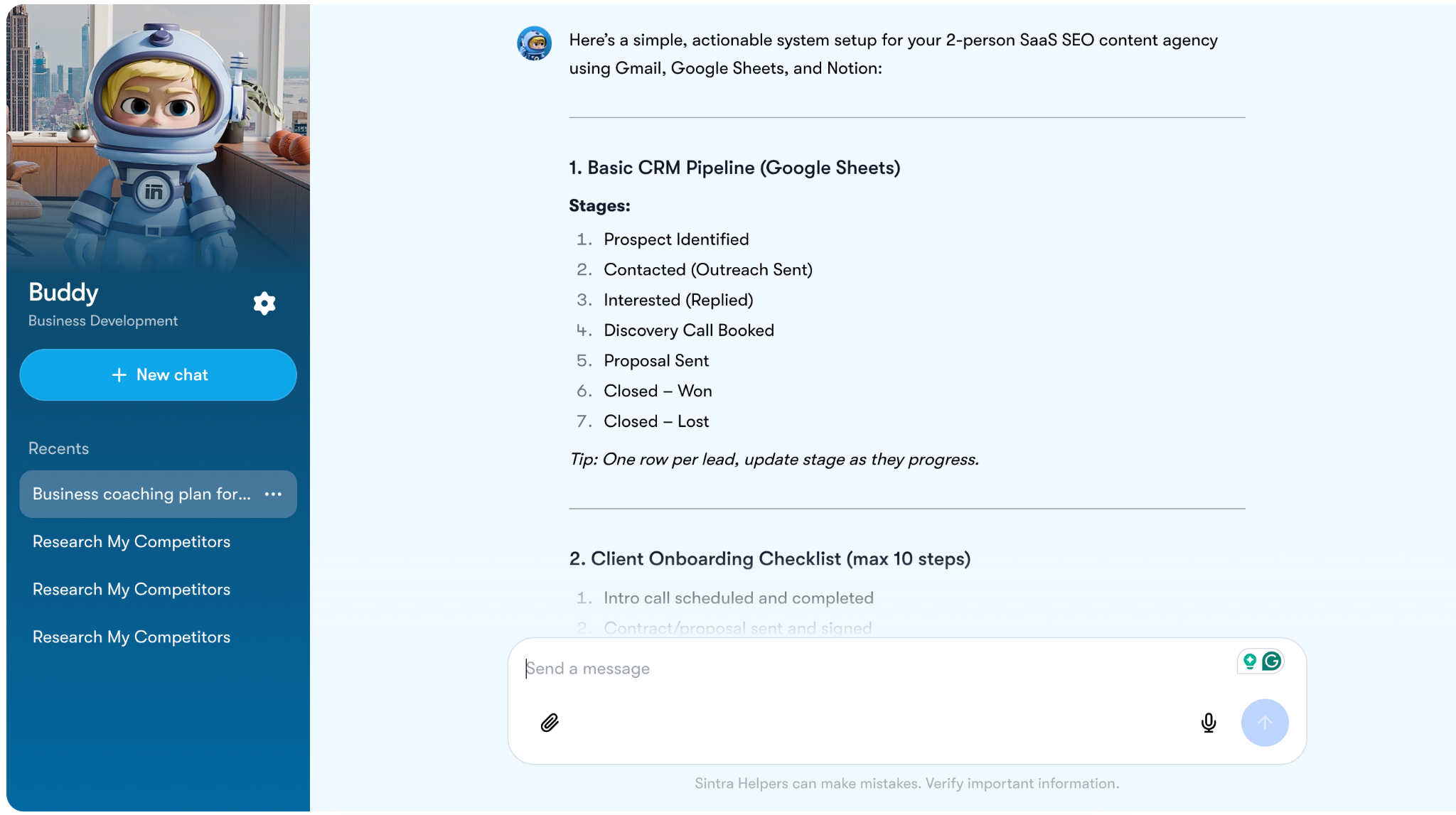
Buddy returned a CRM structure, a workable onboarding checklist, and a weekly template I could reuse. This is the kind of output that saves time because it removes the “blank page” setup.
Step 5: Run a Weekly Business Coaching Rhythm
Finally, I used Buddy as a weekly coach. I pasted a short weekly recap and asked it to identify the bottleneck and set the following week’s priorities.
Prompt I used
Buddy, run a weekly coaching session with me. This week: sent 80 cold emails, posted 3 LinkedIn posts, delivered 4 articles, took 2 sales calls.
- Wins: 1 warm lead replied, client renewed, delivery stayed on time.
- Problems: low reply rate and too much time spent editing.
- Metrics: 80 sent, 3 replies, 2 calls, 0 closes.
Give me:
- The main bottleneck
- 3 priorities for next week
- Tasks for each priority
- Success metrics and deadlines

Buddy identified the highest-leverage bottleneck and then provided a focused weekly plan with metrics. This makes AI coaching for professional development feel operational rather than motivational.
Ready to Launch Your First AI Business Coach?
If you want an AI coach that helps you make decisions and keep execution moving, start simple. Pick one workflow to test, run it for a week, and track the output quality and time saved.
The easiest next step is to try Buddy with a real business goal, then repeat the weekly coaching rhythm until you have a system you can run every Monday. If you want to get started today, you can review the current plans and choose a low-risk option here: Pricing Plans
AI Business Coach FAQs
What Is an AI Business Coach and How Does It Actually Work?
An AI business coach uses artificial intelligence to provide personalized, data-driven guidance for entrepreneurs and teams. In practice, it works through structured conversations that turn your goals, constraints, and inputs into plans, feedback, and next steps. Many AI coaching platforms also support performance tracking, so advice improves as you reuse it week to week.
Can an AI Business Coaching Agent Replace a Human Coach?
Not fully. AI and coaching are great for consistency, speed, and daily support, but they can miss context, nuance, and complex personal or cultural factors. A strong setup is often hybrid: AI handles day-to-day coaching and follow-through, while a human coach supports high-stakes leadership decisions and sensitive situations.
How Secure Is My Data When I Use an AI Coaching Platform?
It depends on the platform. Before using any AI coaching tool for work, check what data it stores, how long it is retained, and whether it is used to train public models. For business use, look for admin controls, role-based access, and clear deletion policies.
Is an AI Coaching App Worth It for Small Businesses and Solo Founders?
Yes, if it saves time and improves execution. Many of the best AI coaching apps are cost-effective, with monthly rates under $100, far lower than traditional coaching. The best value comes from using it repeatedly for weekly planning, decision-making, and execution support, rather than random one-off chats.
How Do I Choose the Best AI Business Coach for My Team in 2026?
Start with one outcome you want to improve, like faster planning, better onboarding, or stronger sales conversations. Then compare tools based on coaching depth, real-time feedback, integrations, analytics, and data security. Run a short pilot with real workflows before committing to a long contract.
Related articles