AI Sales Strategies to Boost Growth in 2026

Table of Contents

The old school sales playbooks are no longer sufficient. Cold calling lists you've manually scraped on LinkedIn. Sending email blasts to all simultaneously. CRM information that you update at your own convenience. The cost of inaction is strategic - end-to-end process redesign can speed up decision cycles up to threefold, and one CPG company that integrated its commercial, R&D, production, and procurement processes increased speed to market by 1.5x while lifting pipeline value by 20 percentage points. These strategies were effective when your rivals were doing them too, but now? You are competing against teams that apply AI to qualify leads during sleep and personalize outreach at scales that you could not add manually in spreadsheets and with your elbows.
You are wasting hours on something that AI can achieve within minutes, and your competitor is already making deals.
This is a particularly challenging area for small businesses. You cannot afford to hire five new sales reps or develop a large operations team. But you must grow revenue, and that too quickly. How much longer can you afford to operate the old way?
This is where AI-based sales strategies come into play. No longer experimental tactics. They are effective practices that enable you to compete with larger firms without having to match their staff numbers.
The AI implementation layer has evolved as well. We are not merely referring to software tools that have to be constantly monitored. AI employees collaborate with your workforce and do the tedious jobs that slow down your genuine sellers. They interpret data, follow up, update records, and surface insights for each task without supervision. This leaves your human team to do what they do best: build relationships and close deals.
Key Takeaways
AI-driven sales strategies automate repetitive workflows, deliver personalized outreach at scale, and provide information that helps a team close more deals with minimal manual work. AI can personalize each interaction to the prospect's needs and preferences, making the selling experience more enjoyable. By continuously implementing these strategies, you will experience shorter sales cycles, higher conversion rates, and improved resource allocation throughout the funnel.
Key benefits:
- Productive sales through effective AI use are projected to grow by up to 25%, and the win rate is projected to increase by 15-25%.
- Your staff spends less time on administration and more time selling.
- Strategic planning minimizes guesswork through data-driven insights.
- Scalable systems that expand with your business without a corresponding rise in costs.
Top AI Sales Strategies You Must Try
These are not theoretical notions. They are real-life examples we have applied and found effective across various business models and groups. Each strategy focuses on a particular aspect of your sales funnel, from the lead entry point into your system to the post-sale experience that drives retention and referrals. AI-based sales strategies help a team prioritize high-value activities and delegate repetitive work to automation.
Use AI-Vetted Leads to Boost Sales Effectiveness
How many hours did your team waste last month on dead-end prospects?
Your salespeople spend time on leads that will never convert. One of them downloaded a whitepaper six months ago and has not interacted since. There is another prospect who fits your target industry but lacks the budget authority to make a decision. Each hour spent on such dead ends is wasted on not talking to real, ready-to-buy customers.
AI also increases lead scoring by evaluating and ranking prospects based on the quality of their conversations, behaviors, and past data. The outreach lead generator examines dozens of signals that you would have missed manually:
- Patterns of engagement in email, social, and web action.
- Company growth indicators and budget cycles.
- Purchase intent behavioral cues.
- AI assists sales organizations in filtering the high-potential leads more accurately and efficiently.
The AI sales strategist will even take the next step and keep enhancing your ideal customer profile. AI can analyze customer contact data, purchase history, and demographics to create more accurate Ideal Customer Profiles (ICPs). The system will determine which features are most important as your business grows and you seal additional deals. AI can be used to improve lead qualifying thresholds by learning from past successful conversions, while sales teams will always have the most current knowledge.
Boost Email Engagement
When was the last time you actually replied to a generic sales email?
Generic email templates produce generic results. Your prospects can tell a mass email the moment they see it, and they will remove it as quickly as possible. You realize personalization is effective, but writing individual emails to each prospect takes hours, which you simply do not have.
Hyper-personalization at scale is a form of generative AI that generates personalized outreach based on the company's news and previous contact history, rather than a generic template. An AI sales email generator does not simply replace first names and company names. Sales teams can create highly personalized emails and messages using AI by analyzing data on people's preferences, behaviors, and previous interactions.
The system delivers:
- Matching subject lines with the engagement patterns of recipients.
- Body copy covering particular pain points.
- AI can analyze customer behavior to recommend the most appropriate time to contact them, increasing the likelihood they will respond.
- References to recent company news or social activity.
A sales team experienced a 23% increase in reply rates after changing its approach to personalizing emails with AI. AI enhances outreach customization by creating unique messages tailored to customer data, thereby engaging customers and strengthening relationships.
Set Up Automated AI Email Marketing Campaigns
How many leads slipped through because you were too busy to follow up?
Sending email campaigns needs continuous attention. You set up a sequence, run it, and realize you need to adjust the timing. Or the message is not getting through. Or you had left the right triggers undone. In the meantime, leads leak through the openings since you never got time to establish adequate nurture paths.
An AI email marketing assistant will create, execute, and optimize a campaign without requiring you to make decisions every single time. Routine tasks can be automated by AI, enabling immediate customer support and personalized interaction at scale. You define the objectives and overall plan, and the system constructs sequences and schedules, performs performance monitoring, and modifies itself based on what is working.
The AI strategy for sales and marketing sales and marketing strategy must be performed consistently:
- Buyer journey-based sequences.
- A/B testing call-to-action buttons and subject lines.
- Automatic adjustments and performance monitoring.
The system will handle the tedious task whilst you focus on strategy and high-value conversations.
Outsource Time-Consuming Tasks to AI
What is the average time of your team for updating CRM? Logging call notes? Setting follow-up reminders? Pulling reports? What if your reps could get back two hours every single day?
These are important for ensuring operations run smoothly, but they are not revenue-generating. You are paying professional salespeople to convert data entries when they are expected to sell.
The AI assistants can replace the monotonous administrative tasks that eat up your staff's time. Repetitive tasks, including data entry, lead scoring, and follow-up emails, can be automated with AI, and sales professionals can devote more time to activities that add value.
Following a sales call, the AI automatically:
- Records important information and highlights of the conversation.
- Progress indicators serve as the basis for deal stages in updates.
- Plans the next point of touch.
- Sales calls can also be analyzed by AI, which can summarize customers' requirements and opportunities.
The effect is immediately apparent in your team's ability. A sales rep who had 15 qualified conversations in a week can now handle 25, since they no longer need to spend 2 hours a day on administrative work. It is not about working more quickly. It is all about eliminating the friction that prevents them from performing their real job.
Leverage Sales Data Analysis, Insights, and Forecasting
Are you really making decisions based on data, or are you just going with gut feelings?
You have data everywhere. CRM logs, email reporting, call videos, and web logs. However, it takes time and analytical expertise (which might not be available to your team) to convert that data into actionable insights. Hence, decisions are made out of gut feel rather than evidence.
In sales, AI assists teams in working with large volumes of data and in detecting patterns and trends that human analysts cannot easily detect. Your sales data is run through an AI data analyst that finds patterns in your data that you could never identify by hand. The predictive analytics provided by AI enable sales managers to make more accurate predictions about trends and outcomes, informed by historical data and market conditions.
The system answers critical questions:
- What outreach messages get the highest number of replies?
- What deal features are predictive of successful closes?
- At what point do the prospects often become dark, and why?
- AI can quickly sort through large amounts of data to find patterns and trends that a human analyst might overlook.
AI assists sales teams in gauging risk factors affecting close deals by evaluating engagement and response rates, as well as previous interactions. Rather than using your guesses for the following quarter's number, depending on the size of the pipeline, you will have predictions that take action based on past close rates, the past season, the current economic trend, and individual rep performance.
AI can use historical sales data, market trends, and external factors to improve forecast precision. The system will alert you to deals that look healthy but have red flags of stalling, so you can step in before they stall.
Lean Into AI-Driven Sales Playbooks for Smarter Selling
There are dozens of minor decisions involved in every sales conversation. What should you say next? What case study would have the most appeal? What is your response to this objection? Skilled reps gain intuition with experience, while new team members are poor at making such decisions.
AI can analyze previous interactions to identify recurring objections and successful responses, enabling sales representatives to address concerns with confidence. An AI sales script generator does not produce fixed scripts that sound robotic. It examines your most successful discussions and finds out what worked: the wording that appealed, the examples that explained value, the questions that helped you see an unmet need.
AI may suggest additional steps or actions in the sales pipeline. Relevant talking points can be surfaced on the system during a call based on:
- The industry and size of the company of the prospect.
- The decision-making authority and its role.
- Buyer stage in the purchase cycle.
- Sales call recording, sales call analysis tools, give live feedback, and battlecards to overcome objections.
Once the call has been made, it proposes what to send, when to follow up, and the angle to take depending on what has been successful with other prospects. AI can analyze buying indicators to assess a lead's readiness to purchase. Their personality and relationship skills are still evident in your team. They possess superior information to make their choices.
Amplify Your Customer Service With AI
What happens when your best customers need help at midnight?
Sales do not stop with the signing of the contract. The way you respond to customer inquiries, provide customer support, and engage in interim interactions directly influences retention and expansion revenue. However, the impact of offering rapid, tailored service requires resources that are unavailable to most small businesses.
AI is used to increase the customer experience by offering timely, unique, and personalized interactions. AI Customer service responds to routine queries instantly without customers having to wait till business hours. AI sales technology customizes the customer experience based on historical interactions. The system is aware of their buying history, tastes, and historical problems, and so they do not get general answers.
Within an existing customer base, AI can identify cross-selling and upselling opportunities. When a customer requests a feature, the system recognizes that he may need an upgrade or a complementary product and notifies your team about the opportunity. AI can identify opportunities for sales representatives to follow up, cross-sell, and upsell. This AI product sales expansion strategy growth model transforms services into sales without customers feeling they are being sold to every minute.
Utilize AI Chatbots for Content Personalization
Why show the same message to a Fortune 500 executive and a startup founder?
When they are unable to locate what they want in a short period, the visitor bounces off the website. Generic homepage material does not appeal to everybody. The information requested by a startup founder and an enterprise IT director is entirely different, yet you cannot develop two different versions of your entire site.
An AI copywriter is dynamically adjusted to the visitor's behavior and context. A person who comes in because of a paid ad to read an article on scaling revenue will receive a different message than someone who comes in through an article about team efficiency. These AI-powered personalized sales strategies ensure that each visitor gets the correct information.
The implementation of modern AI chatbots can qualify and respond to complex queries 24 hours a day without human operators. The chatbot:
- Inquires about the needs of the visitors.
- Gets to know their particular struggles and objectives.
- Presents the most applicable case studies and resources.
- AI can analyze customer interactions and preferences to recommend relevant materials that appeal to potential customers.
AI can also track real-time customer activity across different channels, providing insights into engagement levels and behavior. This enhances a personalized experience for all visitors without requiring manual customization.
Get a Virtual Assistant to Handle Admin Tasks
How much selling time gets eaten by scheduling emails alone?
Inbox management. Meeting scheduling. Document organization. Follow-up tracking. These activities accumulate throughout the day, distracting your team and consuming productive selling time.
Your team is losing deals because it is submerged in administration and not talking to the buyers.
These are operational tasks that an AI virtual assistant can handle automatically. With AI, sales teams can expand without necessarily adding more employees.
The assistant handles:
- Inbox prioritization and triage of urgent messages.
- Common question draft answers.
- Meeting scheduling across time zone differences.
- Organizing and controlling a document.
- Call and meeting action item tracking.
- Email notifications of outstanding tasks.
One of the sales managers informed us that they had a virtual assistant and that their team felt like they had doubled in size, though no one was hired. The distinction was only the removal of the friction that slowed everything.
Use a Business Assistant to Develop Strategy
When did you last have time actually to think about strategy?
When you are running day-to-day operations, you end up putting strategic planning aside. You are supposed to research competitor positioning, review your ICP, or devise new strategies to enter the market, but there is never enough time.
An AI business strategist supports strategic thinking without bringing in a consultant. By tracking competitors' actions and market trends, AI tools can provide information that helps sales teams adjust their strategies in advance.
AI can monitor competitor pricing shifts, new product launches, and customer sentiment, which businesses can use to adapt their positioning and value propositions. When you are thinking about what to do next quarter, the AI:
- Scans market trends and growth opportunities.
- Evaluates the risks of the existing strategy.
- Recommends changing positioning in response to competitors' actions.
- AI may spot potential bottlenecks and propose changes to the sales process.
It does not overrule your judgment, but it better informs your decision-making.
Employ the Whole AI Assistant Team
What if your entire sales process ran itself while you focused on closing?
Individual AI assistants assist in specific tasks, but the real change will occur when you integrate several AI assistants into a complete system. Lead generation flows into personalized outreach. Email responses trigger CRM updates. Customer service interactions surface upsell opportunities. Data analysis informs strategy adjustments.
The AI team model implies that you do not operate a dozen independent tools. Various AI assistants handle their specific tasks while communicating with other assistants to build smooth workflows. AI can assist the sales team in prioritising leads by ranking prospects based on engagement levels and conversion potential.
An example of a workflow is as follows:
- Lead is generated via your site and is automatically scored.
- AI investigates the company's background and the prospect.
- An individualized outreach sequence is initiated depending on their profile.
- Every interaction is automatically recorded without manual intervention.
- Sales pipelines are simplified with AI tools that provide real-time data and identify leads with the highest conversion probability based on historical data.
- Highlight opportunities for human follow-up at the right moment.
It does not remove your human team in this end-to-end automation. In 2026, human-AI collaboration will characterize an effective AI sales strategy, in which artificial intelligence processes large volumes of data and provides administrative support, while human sellers take on strategic advisory roles. It increases their efficiency by managing the connective tissue among larger activities, so your people can concentrate on the high-value work that actually requires human judgment and relationship skills.
Benefits of Utilizing These AI Sales Strategies
It is essential to understand how specific strategies work, but you must also consider the bigger picture of how AI will change your entire sales operation. These advantages accumulate over time as systems learn and improve. Your AI sales strategy delivers quantifiable gains across multiple levels.
Increased Efficiency and Productivity
How many deals have you lost to simple human error?
AI eliminates human error, making sales predictions, lead scores, and customer insights more precise. Your paperwork brings in delays and mistakes. Sometimes you forget to log a call or a follow-up deadline. Data entry errors also corrupt your reporting.
These friction points are removed through automation. AI-based applications can analyze large volumes of data to optimize sales projections and guide your sales team in predicting market trends and customer demands. Work that would take hours happens in minutes. Your team works fewer hours on more prospects because the system eliminates bottlenecks and prevents things from falling through the cracks.
Other productivity improvements:
- AI provides live analytics and reporting, enabling sales teams to access up-to-date performance metrics and customer interactions.
- AI can automate routine processes (data entry, lead scoring, post-sale email) so salespeople can focus on more valuable tasks.
- We have observed that sales groups have generated 40% more qualified conversations without additional headcount.
Better Customer Experience
Can you honestly say you remember every detail from every customer conversation?
Buyers are seeking tailored, receptive communications. They would like you to recall prior discussions, be aware of their specific requirements, and deliver pertinent information promptly. It is not possible to provide this experience manually to dozens or hundreds of customers.
AI for personalized sales strategies customizes the customer experience based on previous interactions. Each email cites their definite circumstance. Support responses are based on their past activities. Their actual needs are matched with recommendations rather than generic ones. AI can intercept customer communications and propose relevant materials that appeal to potential customers.
Speed matters too:
- Answers to questions are provided instantly, not at the end of the working day.
- Follow-ups occur when they are due and not whenever a person recalls.
- AI can track customer interactions across multiple channels in real time and provide insights into engagement levels and behavior.
Such responsiveness creates trust and contrasts with competitors who have yet to go to manual operations. AI is used to improve customer experience through real-time, personalized, and relevant interactions.
Data-Driven Decision Making
You're making strategic decisions based on hunches instead of evidence.
Gut feel has limits. You may have a feeling that some of those methods are more effective than others, but you cannot measure and repeat success without statistics. You are making strategic choices on hunches, rather than evidence.
AI uses large volumes of data to reveal trends, patterns, and insights that would not be apparent at first glance. What are the fastest-growing industries? What are the best deal sizes to close? What objections kill deals, and what are noises? The system exposes these insights to enable you to redouble what is working and correct what is not.
AI enables real-time analytics and reporting, allowing sales teams to access current data on performance indicators and customer relations. You can know what is working and make amendments as soon as you learn, rather than waiting for quarterly reviews to find out how performance is doing. AI helps sales teams reduce the risk of loss and re-optimize their strategies beforehand, resulting in more stable, predictable revenue streams. This is an evolving method that will ensure you stay ahead of market changes rather than just responding to apparent issues.
Scalability
How long would it take you to double your sales team the traditional way?
Traditional scaling involves adding additional staff. However, the recruitment process is months-long, and training also lasts longer, resulting in increased overhead expenses. AI can help sales teams grow their business without expanding their workforce.
AI-powered systems can process the surge in demand or when you are expanding markets:
- Have to cultivate 1,000 leads rather than 100? The system doesn't care
- Prefer to target five industries rather than one? Same effort required
- AI-based lead-scoring systems process data to identify patterns and characteristics of successful leads and score new ones.
This scalability allows small businesses to compete with significantly larger enterprises that used to have an advantage only because of their size. AI improves customer segmentation by observing customer behavior, needs, preferences, and purchase patterns to adjust sales strategies.
Reduced Human Error
What was the last mistake that cost you a deal?
Paperwork introduces errors. One inserts information in the incorrect field. On another occasion, someone neglects to update a deal stage. A third person on your team is missing a necessary follow-up because it wasn't part of their calendar. Such mistakes cost deals and relationships!
The AI minimizes the chances of human error and can make sales projections, lead points, and customer insights more precise. Repetitive work is all done by automation. The updates are automatic when triggered. Nothing is based on someone remembering to do it.
Brain AI goes a step further to preserve institutional information on your business, processes, and customers. The capability of AI to handle large volumes of data can also be used to reduce the error margin in sales predictions. When team members quit or change their job roles, they do not lose the knowledge since the AI has been informed of their activities. New employees can leverage this cumulative knowledge immediately, rather than spending months discovering what works through trial and error.
Essential considerations for implementation:
- High-quality data is needed in AI, and organisations must uphold high standards of data entry to avoid poor performance.
- Data quality is central to AI integration in sales, as unreliable or incomplete CRM data can lead to inaccurate predictions and poor lead scoring.
- It requires developing comprehensive data collection and management practices to enable AI systems to access accurate, complete datasets.
Food for Thought
What could your business achieve if it got smarter with every single sale?
AI is not a one-time application. It is an ongoing collaborative effort that becomes smarter as your business expands. The system learns from each interaction, each deal won or lost, and each customer conversation. This creates a compounding advantage, making your sales operation more effective as it goes along rather than merely busy.
The companies that do well in 2026 and beyond will not be the ones with the largest teams. They will be the ones who best bring together human relationship skills with AI-driven execution and insight. Your competitors are already investigating these capabilities. The issue is not whether to use the strategy of sales and marketing through the use of AI. It is a matter of how fast you can put it to good use.
Consider how AI integrations will tie your current tools into a single system where data flows automatically, knowledge is generated without manual analysis, and processes can run without constant monitoring. The use of AI in Customer Relationship Management (CRM) systems streamlines prospecting by delivering detailed customer profiles and predictive analytics. This unified strategy makes the sales process not only a set of manual operations but also a data-driven, streamlined process that delivers continuous results.
Best practices for successful adoption:
- It has been suggested to start AI initiatives with a small team of users to gather feedback and optimize workflows, then roll them out at scale.
- When using AI, it is necessary to inform customers and protect their data.
- A Human-in-the-Loop strategy ensures that human sellers remain accountable to establish rapport during multi-layered negotiations.
- The implementation of AI solutions must be integrated with current sales operations to minimize workflow disruption and maximize their impact.
Maximize Your Selling Potential With Sintra AI
How much could you grow if execution were never the bottleneck?
Expanding revenue involves the routine performance of dozens of activities—generating leads, screening them, contacting, following up, processing data, and changing strategy. Many small businesses are not in a position to employ someone to cover every role, which places all the burden on a few individuals who become overwhelmed.
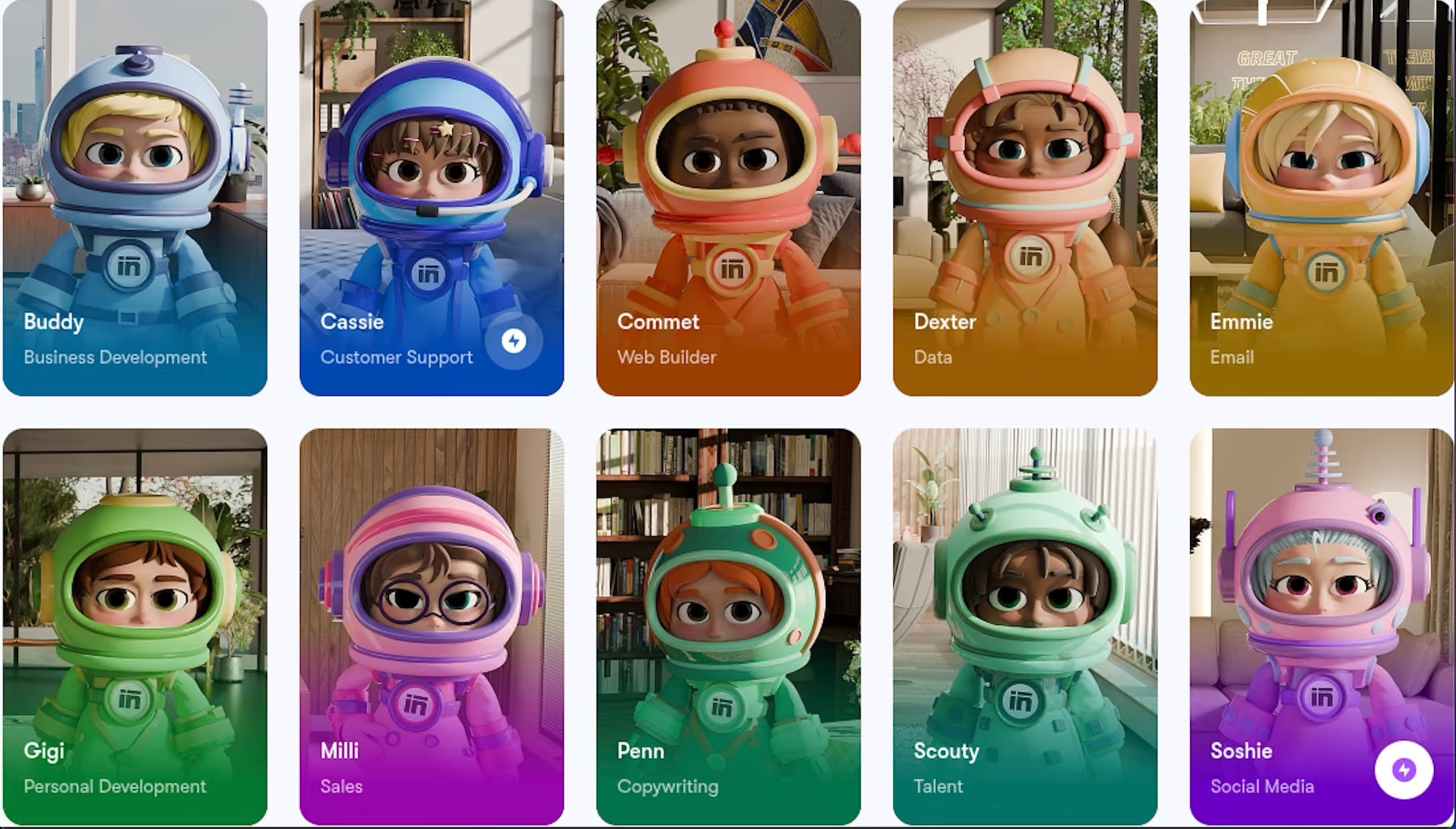
Sintra AI offers a round-the-clock support platform that manages the implementation tier of your sales procedure. Your team collaborates with our AI assistants, who handle the tedious tasks that slow growth and deliver insights that help make better choices. You have control over strategy and the customer relationship. Everything else is left to the AI.
This tool is designed to serve small businesses with enterprise features without the enterprise cost. Virtual assistants and AI-powered chatbots are already necessary elements of sales strategies. The system also understands your specific industry and can integrate with your current tools and work within your workflows, without requiring you to alter everything.
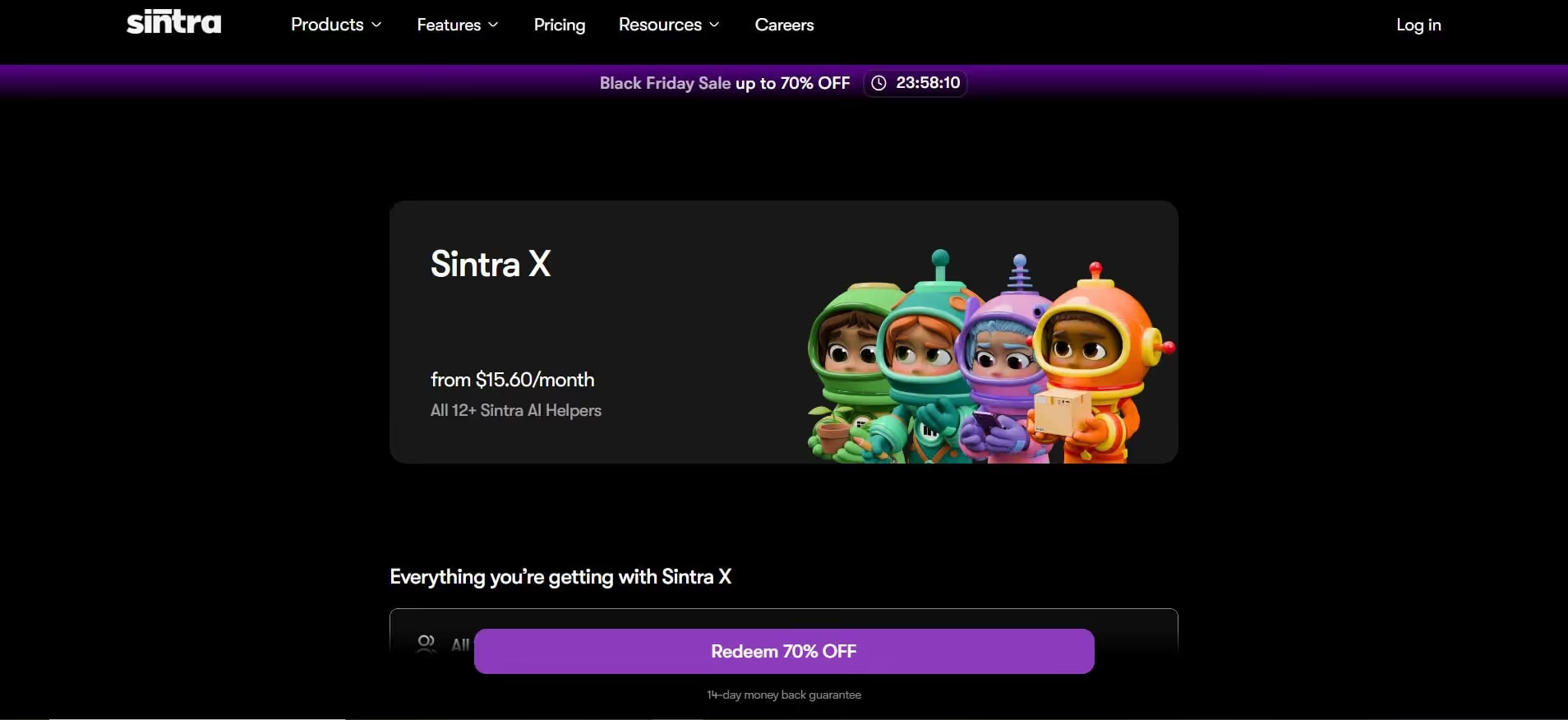
Explore Sintra pricing, which ensures professional AI sales support is available no matter how many people are on your team or how much you bring in.
AI Sales Strategy FAQs
Can AI be used in sales analytics?
Yes. Artificial intelligence analyzes sales data to identify patterns, calculate industry-specific win rates, assess messaging performance, and predict future performance based on historical trends and the market environment.
Can AI automate my sales department?
AI automates activities, such as lead qualification, outreach, data entry, and scheduling. Nevertheless, emotional intelligence and human judgment are still needed in relationship building and in complex negotiations.
Can AI help improve B2B sales processes?
Absolutely. The AI approach to B2B issues includes customer segmentation, the assessment of buying signals, and detailed account profiles, enabling teams to navigate the lengthy sales cycle involving multiple decision-makers efficiently.
Related articles