AI bot or Human: Which Delivers Better Customer Service?

Table of Contents
Quick Answer
AI bots win on speed, scale, consistency, and 24/7 availability, while human agents excel at empathy, judgment, and complex problem-solving. The best customer service doesn’t choose one over the other; it combines both. AI handles high-volume, routine tasks instantly, while humans step in when situations need emotional intelligence and decision-making, creating faster, smarter, and more trusted support at scale.
The debate about which one is better, human or AI service, is endless. If you are trying to determine whether human or AI is best for customer service, the question itself is wrong.
AI chatbots operate 24/7 and never tire of repeating details or answering instantly. The reasons consumers reach for them are clear - speed of response tops the list at 36.6%, followed by accuracy at 27.7% and 24/7 availability at 25.7%, with only 10% citing personalized assistance as the main draw. On the other hand, human agents are capable of empathy, ingenious problem-solving, and the ability to judge situations out of the script.
Then, which one is the winner AI bot or a human? Neither. Both.
The main concern shouldn't be "will AI replace customer service?" but rather how AI and humans can collaborate for optimal results. That is the key to success.
Let's break down exactly where AI delivers, where humans shine, and how combining both creates support that is faster, smarter, and more personal than either could achieve alone. At Sintra AI, we have seen this orchestration performing at a competitive advantage.
AI vs Human: Key Strengths
| Factor | AI Chatbot | Human Agent |
|---|---|---|
| Speed | Instant responses, 24/7 availability | Slower response time but deeper engagement |
| Consistency | 100% consistent across all interactions | Varies by agent, mood, and training |
| Empathy | Limited emotional intelligence | Excellent at emotional connection |
| Complex Problem-Solving | Struggles with nuance and edge cases | Excels at creative solutions and judgment calls |
| Scalability | Infinite scale without added cost | Requires hiring and training for growth |
| Memory | Perfect recall of all past interactions | Limited by individual knowledge and notes |
AI as a First-Line Support Agent (Not a Human Replacement)
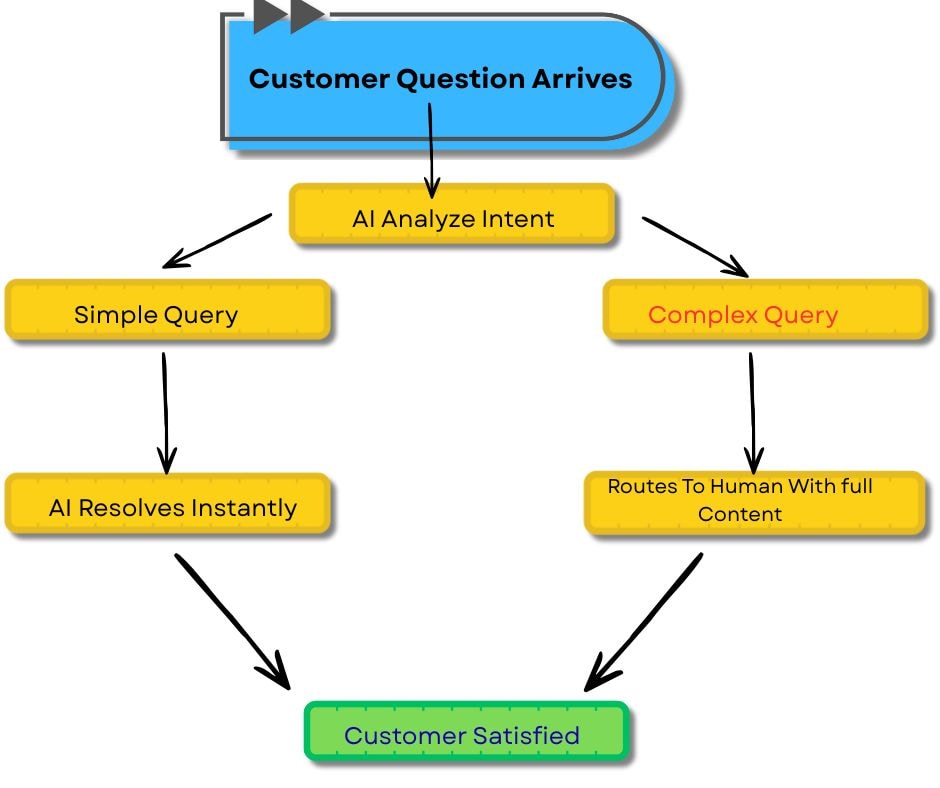
The first line of customer support involves FAQs, repetitive questions, simple troubleshooting, ticket classification, summaries, and routing. This layer prioritizes speed and accuracy over emotional nuance.
Zendesk research shows that 69% of customers prefer to work out as many issues as possible independently. AI delivers more reliable service at scale than human-powered customer service, particularly during high-volume periods.
Consider the circumstances that transpire when the human agents answer the same questions throughout their day. They experience fatigue. Their response quality declines. Their engagement drops.
Example:
A SaaS company receives 200 password reset requests daily. Without AI, employees spend 3-5 minutes per request explaining the same steps. In total, they spend 10-16 hours per day on a task that requires no judgment.
AI can be counterproductive. By eliminating routine performance, human agents can engage in judgment, empathy, and multi-faceted resolution. Artificial intelligence enhances human performance by freeing agents to focus on what humans do best.
AI for customer support is an efficiency layer that empowers human-led customer service. AI creates space for human agents to deliver personalized support where it matters most.
Consistency Beats Personality in Scalable Support
Industry experts consistently emphasize the importance of personality and the human touch in customer service. The issue, however, is that humans are not always consistent, and inconsistency erodes trust.
Every team struggles with variability. The varying responses to the identical question. Uneven policy enforcement. Tone drifts across channels. Incomplete onboarding and lost context create errors.
One agent grants a refund without question. Another agent informs the customer that refunds are not possible. One of the agents becomes unmanageable. The other will repeat the information to the customer three times.
Real scenario:
A customer asks about refund policies for annual subscriptions. Agent A says refunds are available within 30 days, no questions asked. Agent B states that manager approval is required and will take 5-7 business days. Agent C says annual subscriptions are non-refundable. Same company, same day, three different answers. The customer is now confused and frustrated, not because of the policy, but because no one seems to know what it actually is.
Consistency matters more than personality in most interactions, particularly in SaaS and subscription companies. Customers want predictable outcomes rather than unexpected interactions.
AI customer support serves as an engine of consistency. It correlates answers with brand voice, policies, and agents' previous decisions over time. Sintra's Brain AI, for example, standardizes all responses without human intervention. Stability builds trust quietly.
Personality does not replace anything, but only comes after teams establish consistency. You cannot build trust through charm when your responses vary by agent.
Speed Wins Trust Before Empathy Even Matters
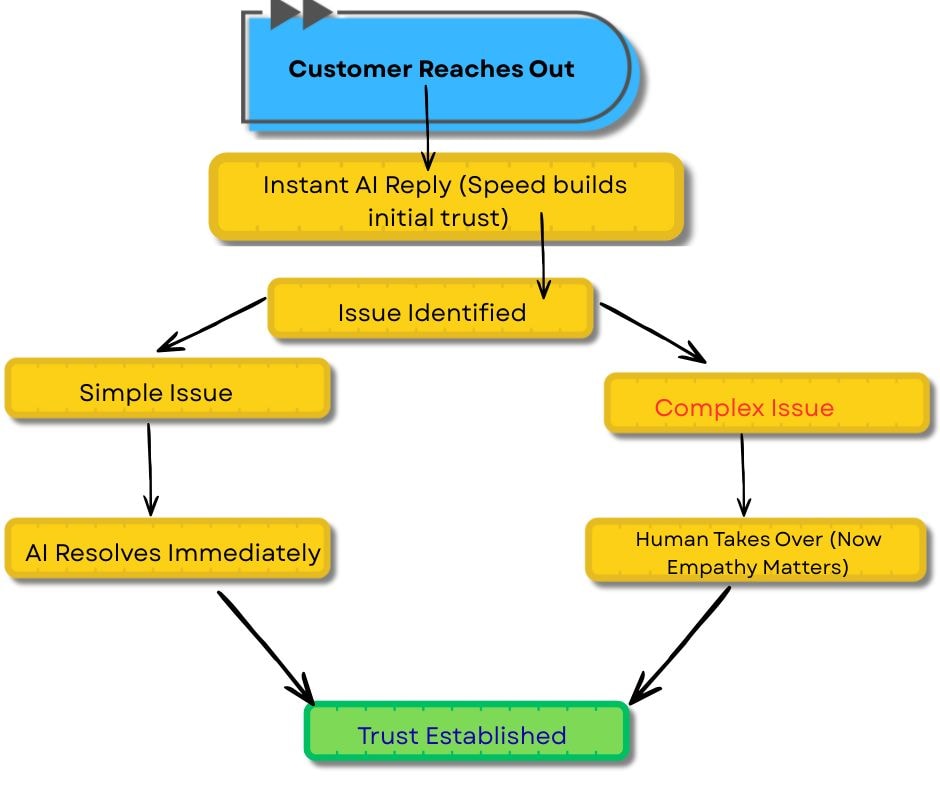
Most customer frustration stems from waiting. Customers desire recognition and traction before they care about tone or empathy
Simple, high-intent issues are a specific concern, and speed matters most: logging in, billing, order status, and clarifying a specific feature. At such times, clients prioritize a quick fix over human friendliness.
According to HubSpot data, 90% of customers consider an immediate response important or very important when they have a customer care question.
Chatbot customer service enables quick follow-ups, 24-hour continuous availability, and instant replies. This removes the support silence, which destroys trust. The emotional context before you introduce a human agent differs.
Empathy does not go away; it follows speed, which builds trust. Without responsiveness, empathy is empty. AI employees handle instant recognition, so when human agents step in, the customer already feels heard.
Speed builds perceived service quality from the ground up.
Compare these experiences:
Customer A emails support at 11 PM with an urgent login issue and receives an instant AI reply with a reset link and steps, resolving the issue in 90 seconds. Customer B contacts the same company without AI support and waits until 9 AM for a human to send the same link. Both receive the same solution, but Customer A trusts the company more because help arrived exactly when it was needed.
AI as the Memory Humans Don't Have
As teams expand, they lose internal knowledge because institutional memory depends highly on the size of the team. Documentation buries policies. Old tickets hide the answers. Teams mention decisions only in Slack. On top of all that, companies expect humans to remember everything
This results in people giving customers different answers, making the same mistakes repeatedly, and customers having to explain their issues repeatedly. This reflects limited memory, not limited ability.
Modern Fix
Teams view AI in customer support as an additional, centrally available memory layer. It keeps knowledge from tickets, FAQs, documentation, and in-house decisions in one place. AI shares this memory across time, agents, and channels without becoming stale.
Constant memory increases both employee productivity and customer loyalty. No matter the time or place, agents always give the same response. With the AI team feature, we guarantee that all agents have access to the full context of previous communications, whether from AI or human agents.
Major growth requires scalable memory for customer service. Humans cannot achieve this alone.
Example:
Suppose a customer comes to support for the third time with the same billing issue. Each time, they have to explain the problem again. Each agent tells the customer something slightly different. This destroys trust faster than anything else.
AI-powered customer service stores the memory of every conversation. Thus, in the 3rd call, the agent can immediately say, "I understand you have been in touch with us twice regarding this billing issue. Let me take care of it now."
Human Escalation Done Right (Not Too Early, Not Too Late)
The two most damaging escalation failures occur when teams escalate issues too early or too late. Both frustrate customers and make teams inefficient.
Escalating too early to human agents wastes their time, as AI can handle many cases. On the other hand, late escalation will make customers lose patience due to multiple interactions.
In most cases, system malfunction is the real issue, not the agent's incompetence. The former occurs when poor systems overload agents with simple cases or thrust them into emotional situations without context.
Modern Fix
A chatbot for customer support effectively sorts issues by not only performing routine tasks but also assessing case complexity, recognizing customer emotional states, and selecting cases that require human decision. AI helper tools, for instance, use the conversation's overall tone and urgency, rather than just keywords, to decide where to send the chat.
It's no longer about human delay. We aim to involve people precisely when they can have the greatest impact.
Poor escalation:
A customer reports being charged twice. The AI asks for details one by one, suggests things the customer already tried, and loops for 15 minutes before escalating. When a human joins, they must start over because nothing useful was verified.
Smart escalation:
The customer reports a double charge. The AI checks billing, confirms the duplicate, calculates the refund, and says it’s connecting a specialist with full context. A human joins in 30 seconds and completes the refund in 2 minutes.
Chatbot in customer service improves the handoff process, benefiting both customers and agents. When someone from the team takes over, they already have the full context, the client feels understood, and the agent can focus fully on resolving the issue.
Cost vs Quality Is a False Trade-Off
The old perception that AI support is a less expensive but low-quality service stems from early chatbots, which failed in a big way. Entirely scripted conversations. Matching keywords. Annoying conversation cycles.
Modern Artificial intelligence customer service reduces the cost of each ticket by eliminating repetitive tasks without sacrificing quality. Humans handle fewer tickets, but agents devote more time, attention, and care to each ticket.
The Gain?
Companies can reinvest the savings in training, better tools, and higher wages for human agents, rather than reducing headcount.
Think of AI as a quality enhancer. AI enables teams to deliver excellent support within a reasonable budget. Our AI email assistant is at your disposal for dealing with the usual emails, and you can then allocate your funds to a handful of complicated client relationships.
Juniper Research found that chatbot support will save businesses $11 billion annually by 2027, up from $6 billion in 2023.
The Real Question Is Task Ownership, Not Job Replacement
We have moved beyond discussions about whether a bot or a human service is best. In the future, customer service will focus on tasks rather than roles.
Clear Division of Work:
- AI takes care of: Drafting, summarizing, tagging, routing, documentation, and recall
- Humans take care of: Decision-making, empathy, negotiation, exception handling, and relationship management
As teams grow and complexity increases, task-based models scale more efficiently than role-based models. Roles blur over time. Tasks stay the same.
This clarity improves agent morale, reduces fatigue, and leads to better customer outcomes. An AI copywriter drafts the messages, and the humans adjust the tone and make the final decisions.
The winning customer service systems coordinate AI and humans rather than pit them against each other.
Don't keep wondering if humans or bots are better. Instead, ask which tasks each should own?
Task Ownership Model
| Task Type | Owner | Why |
|---|---|---|
| Answering FAQs | AI | Speed and consistency matter more than personality |
| Password resets | AI | Process is standardized and documented |
| Order status updates | AI | Information retrieval, no judgment needed |
| Billing disputes | Human | Requires negotiation and emotional intelligence |
| Angry customer calls | Human | De-escalation needs empathy and flexibility |
| Feature requests | Human | Strategic thinking about product direction |
| Refund decisions | Human | Policy interpretation and judgment calls |
| After-hours support | AI | Availability matters; most issues are simple |
Example:
A customer tells an e-commerce company, “My order arrived damaged, and I need it for an event tomorrow.” The AI detects urgency, checks stock and next-day shipping, and briefs a human agent with full context. The agent apologises, ships a free replacement for delivery by 10 AM, and issues a refund for the damaged item. The issue was resolved in 3 minutes, and the customer was retained.
How to Choose the Right Customer Support Bot?

Focus on fit, not features, when choosing your bot. Choose a bot that fits your company's needs. Too often, teams that fail choose a more feature-rich, versatile bot for demo scenes rather than one that is efficient in actual support workflows.
The perfect bot handles the ticket types your team sees most frequently.
Some core criteria that really matter:
- How well the bot understands the user's intent
- The ability to handle the context of the conversation across messages
- Consistency with brand voice and policies
- Smooth integration with existing tools
Once a conversation strays from the ideal path, scripted bots fail quickly.
Functionality, scalability, and maintainability also rank very high on the list of requirements. Choosing the right bot should reduce operational costs, not increase them. You should not have to constantly babysit a new system every time you introduce a bot. And a bot that's so manual and heavy, requiring manual tuning for every change, just won't scale with your business.
An excellent chatbot customer support system is so subtle that the team doesn't even notice its presence, and so easy for customers to use that it quietly takes over most of the work without degrading the experience. Support Bot?
IT support chatbots and other support bots are not limited to enterprises or teams handling a high volume of requests. In fact, they can be most helpful in places where human resources are disproportionately consumed by repetitive questions.
The following are some of the profiles that benefit the most:
- SaaS companies that have a user base that keeps growing
- E-commerce teams whose concern is orders and delivery queries
- SMBs that only have a couple of people in support
- Startups that are growing so fast that the number of employees is not keeping pace
When teams are simply responding to incoming work with no room to manoeuvre, that's when bots are at their strongest.
In fact, bots can provide the support that allows human agents to focus on more complex issues, onboarding new customers, and retention conversations, freeing them from repetitive work.
Teams should view an AI customer support bot not as a last resort when overwhelmed, but as a preventive measure. This applies as long as such proactive systems still have leverage.
Why even use a Customer Support Bot?
The team uses support bots because, with human-only models, scaling is not linear. The problem is that as volume grows, response time, consistency, and morale decline when there is no capacity to handle the heavier load.
Three core reasons bots exist in modern support operations:
- They completely remove the wait time for simple issues. Instant responses build trust five times faster than perfect responses that arrive hours later.
- They keep the standardized answers through channels and agents. Regardless of who, when, or where, every customer gets the exact same piece of information, which is the right one.
- They distance people from monotonous work, which undoubtedly leads to exhaustion. Doing the same job 40 times a day undermines morale and performance.
It was fair to say that early chatbot failures were numerous. Nevertheless, the chatbot customer care value is mainly because of (a) being aware of the context, (b) understanding the language, and (c) having the ability to integrate, as opposed to (d) being very limited with scripts.
Bots aren't about taking human jobs. What they do is ensure that, as the bar keeps being raised, human-led support remains sustainable.
Why Sintra Works Especially Well for Customer Support Teams?
Sintra AI is more of an orchestration layer, not a one-purpose chatbot. This matters for SaaS founders, e-commerce operators, startups, and fast-growing support teams that need to handle volume, context, and smart escalation without breaking workflows.
Sintra is a customer-support-first platform rather than a feature-heavy tool. It manages frontline replies, drafts, and summaries, shared memory, and intelligent handoffs without forcing rigid processes on lean teams and scaling businesses.
Having AI for customer support that aligns with brand voice and internal knowledge becomes a competitive advantage for companies managing growing user bases and limited support resources. It shortens training time and reduces inconsistency across agents.
The best customer service systems are built when AI and humans work together. AI handles execution, while people focus on judgment, empathy, and complex problem-solving. Sintra makes this AI orchestration practical for small teams, startups, and enterprise support organizations alike.
Ready to Build Smarter Customer Support?
For SaaS founders, e-commerce operators, startups, and growing support teams, orchestration thinking transforms customer service. Sintra AI eliminates redundant work, ensuring human teams deliver meaningful, high-quality help at scale.
Start with Sintra to understand how AI customer service and human expertise can be combined to achieve better results for your customers and your team. Implement an AI chatbot customer support system that works with, not against, your people.
AI Chatbot vs Human Customer Service FAQs
When should you keep humans in control?
Human agents should always handle the moments that call for empathy, negotiation, and judgment. That means de-escalating an angry client, working through refund negotiations, and tackling intricate troubleshooting that needs a creative fix, along with sensitive account issues and retention conversations. AI can help by gathering context and suggesting responses, but the final judgment and the actual reply should rest with a person.
When does a chatbot deliver a better experience than a human agent?
Chatbots win when the problem is simple and time-sensitive, where speed matters more than a personal touch. Think password resets, order status checks, and business hours questions, or policy lookups and account balance questions. These are things customers want answered fast, not turned into a conversation. A chatbot that sorts it out in 30 seconds beats waiting 10 minutes for a human to tell you the same thing.
How do AI chatbots and human agents work together in real support teams?
The workflow tends to look like this. AI takes the first contact and pre-screens each request, solving the simple problems on its own. For complex cases, it pulls together the details and routes them to the right human agent with the full conversation history attached, so the agent can review everything the customer already shared instead of asking for it again. While the agent works, AI supports them in real time by surfacing relevant knowledge base articles and similar past tickets. Once the issue is resolved, AI handles the follow-up survey and the documentation. The result is a clean handoff where each side does what it's best at.
Is AI customer support only for large or enterprise companies?
No. AI customer support is especially advantageous for small and mid-sized businesses compared to enterprises.
Smaller teams are repetitively asked the same questions but have fewer agents to serve them. With AI, the playing field is levelled, as small teams can deliver speedy, reliable support without scaling their headcount.
The trick is to select tools that do not require technical skills to implement. No-code platforms can enable teams of any size to use AI.
What is the biggest mistake teams make when adding a customer support bot?
The largest failure is the inability to set out clear escalation paths.
Teams use chatbots without defining how or when to hand off to humans. This creates frustrating cycles in which customers are left waiting to connect to a bot that cannot assist them.
The second error is to automate too quickly. Begin with a small application, such as FAQs. Validate that it works well and then expand. Attempting to automate both would result in substandard experiences and staff resistance.
Never forget: the purpose is not to prevent customers from approaching humans. The idea is to engage people when they are in a position to produce maximum value.
Related articles