10 Best AI Tools for PPC Management in 2026

Table of Contents

Quick Answer
The best AI tools for PPC management in 2026 are Sintra AI, Optmyzr, Acquisio, Quartile, Perpetua, Adzooma, Skai, PPC Entourage, AdCreative.ai, and Madgicx.
Some of these tools do one job well. Acquisio and Optmyzr focus on bids and budgets inside Google Ads and Microsoft Ads. Quartile and Perpetua are built for sellers running ads on Amazon and other marketplaces. AdCreative.ai handles the creative side. It makes ad banners and copy. Madgicx leans hard into audience targeting for Meta ads.
Sintra AI is different. It doesn't try to take over the bid auction. Google and Amazon already run that part well. Instead, it helps your team handle everything around the campaign. That means writing ad copy, learning what your customers care about, building reports your clients can read, and writing follow-up emails for new leads. It keeps the work moving without you needing to hire three more people.
Your ad spend keeps going up. Your results stay flat. And every Friday, someone on your team has to rebuild the same report by hand again. That's the real problem in 2026. Ad platforms got smarter. But most teams still do the boring parts the slow way. AI Tools for PPC Management fix that gap. The right one can give you hours back each week while also boosting your numbers.
We checked the pricing and tested the ten tools advertisers use most this year. Some only handle bids. Others hire AI employees to go further. They help with the work around the campaign, too, like writing ad copy or sending a follow-up email to a new lead. Below, we break down what each tool does well. We also cover where it falls short and who should actually pay for it.
Here are the top ten AI PPC management tools in 2026:
10 Best AI Tools for PPC Management in 2026
We picked these tools based on a few important criteria. How strong is the AI? How deep does the automation go? What do they offer for reports and integrations? How easy is the setup? Does the price make sense once you count the time saved? Some of these tools only focus on bids. Others handle the work that happens before and after a campaign goes live. That work matters just as much if you want PPC to make money.
Here's a detailed explanation of all 10 AI PPC management tools:
1. Sintra AI – Best for AI-Powered PPC Execution and Marketing Operations
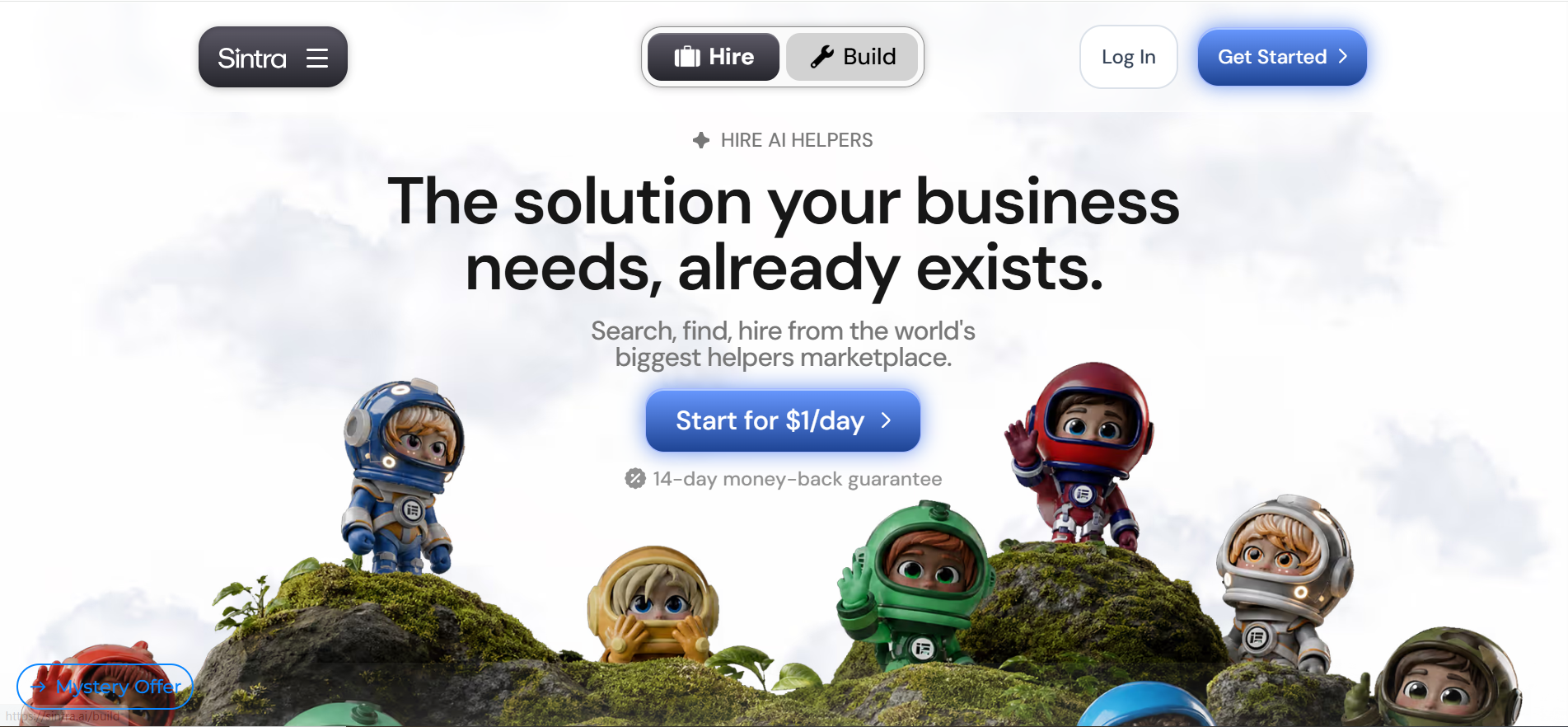
Most PPC tools stop at the auction. They adjust your bids. They flag a budget problem. Maybe they suggest a keyword. But they don't write your ad copy. They don't find out what your customers are struggling with. They don't draft the email your sales team sends after someone clicks. They don't build the report you hand your boss on Friday. Sintra AI was built to do that surrounding work.
Sintra AI runs on a group of specialized AI Helpers. Each one is trained for one job. One writes copy. One does research. One handles social posts. One handles email follow-ups. One builds reports. They all share the same memory of your business. So the Helper writing your Google Ads copy already knows your offer. It knows your tone. It knows what worked in your last campaign. AI revolutionizes Pay-Per-Click management by automating tedious tasks, and Sintra applies the same idea to the work on both sides of the bid.
Picture a small ecommerce team running Google Shopping and Amazon ads. One Helper drafts a dozen headline options to test. Another turns last week's data into a report that a client can actually read. A third writes the follow-up email for shoppers who clicked but didn't buy. None of that touches the bid strategy. But all of it decides whether the campaign makes money.
Strengths
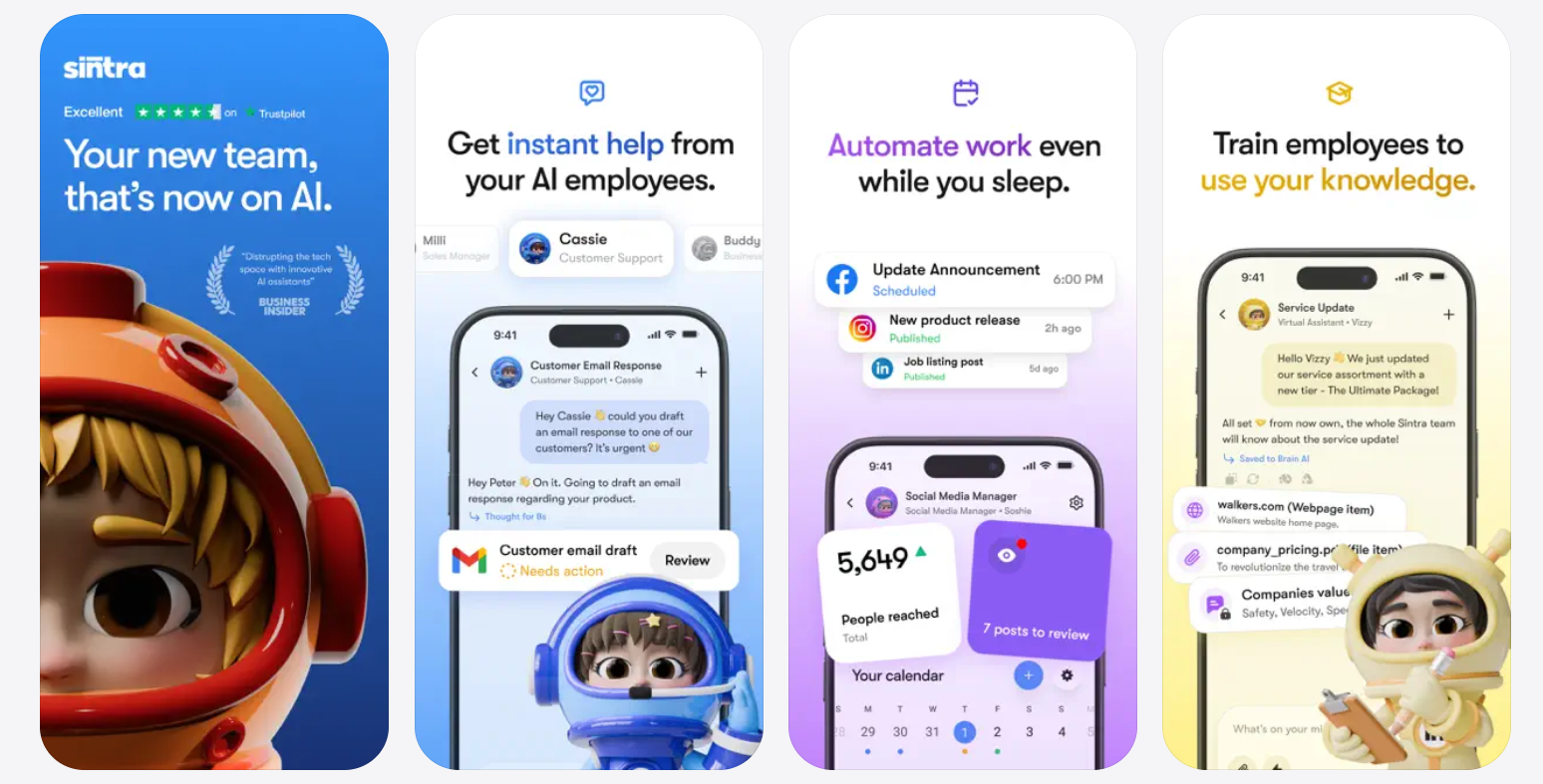
Sintra AI's biggest strength is that it remembers your business. Its Brain AI feature stores your brand voice, offers, customer pain points, and past campaign history. So every Helper you use already knows the background. It doesn't start from a blank page.
- Remembers your business: Brain AI saves you from re-explaining your product each time
- Covers many jobs: AI Helpers handle copywriting, research, reporting, content, and follow-ups
- Connects the dots: it links lead follow-up and reporting with no manual steps between them
- Built for small teams: one person can do the work of a copywriter, a researcher, and an analyst
A solo marketer running Google Ads for a small business could draft ad copy in the morning. They could build a report by lunch. They could have follow-up emails ready by the afternoon. All without opening five different apps.
Weaknesses
Sintra AI is not a bid management tool. It won't change your Target CPA in real time. It won't pause a weak ad group based on auction data the way Optmyzr or Acquisio will. If your biggest problem is manual bidding, you'll still want a dedicated PPC tool running alongside it.
Its real value shows up in the work around the bid. Think strategy docs, creative testing, client updates, and reports that turn raw numbers into something people understand. Teams that pair it with a bid-focused tool usually get the most out of both.
Pricing
Sintra AI uses tiered, value-based pricing. It doesn't take a cut of your ad spend, unlike some tools. That matters once your campaigns start scaling, since your software bill won't climb along with them. Compare it to hiring a part-time copywriter, a reporting analyst, and a research assistant on your own. One subscription covering all three jobs tends to pay for itself within the first month for most small and mid-sized teams.
2. Optmyzr – Best for Advanced PPC Optimization
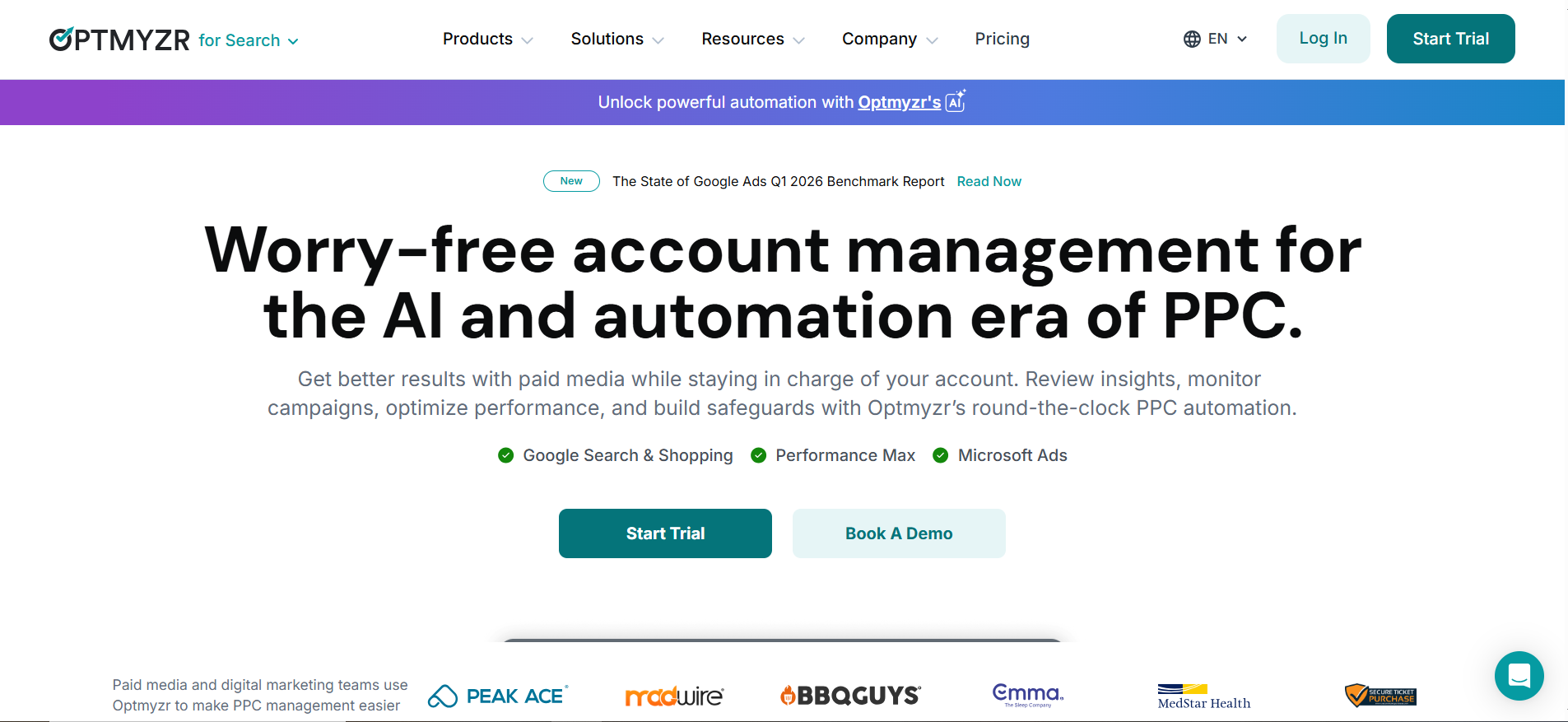
Optmyzr was built by former Google employees. Their goal was to automate the repetitive work of running paid search, and it shows in how deep the automation goes. This tool is for people who already know PPC strategy and want software that runs it faster than they could by hand.
The core of the platform is its Rule Engine. It lets you build fully custom automation. You could pause a campaign the moment ROAS drops below a set line. You could shift the budget toward whichever ad group is converting best that week. It also pulls together Google Ads, Microsoft Ads, and basic social campaigns into a single dashboard. Agencies managing dozens of accounts rely on this heavily.
Strengths
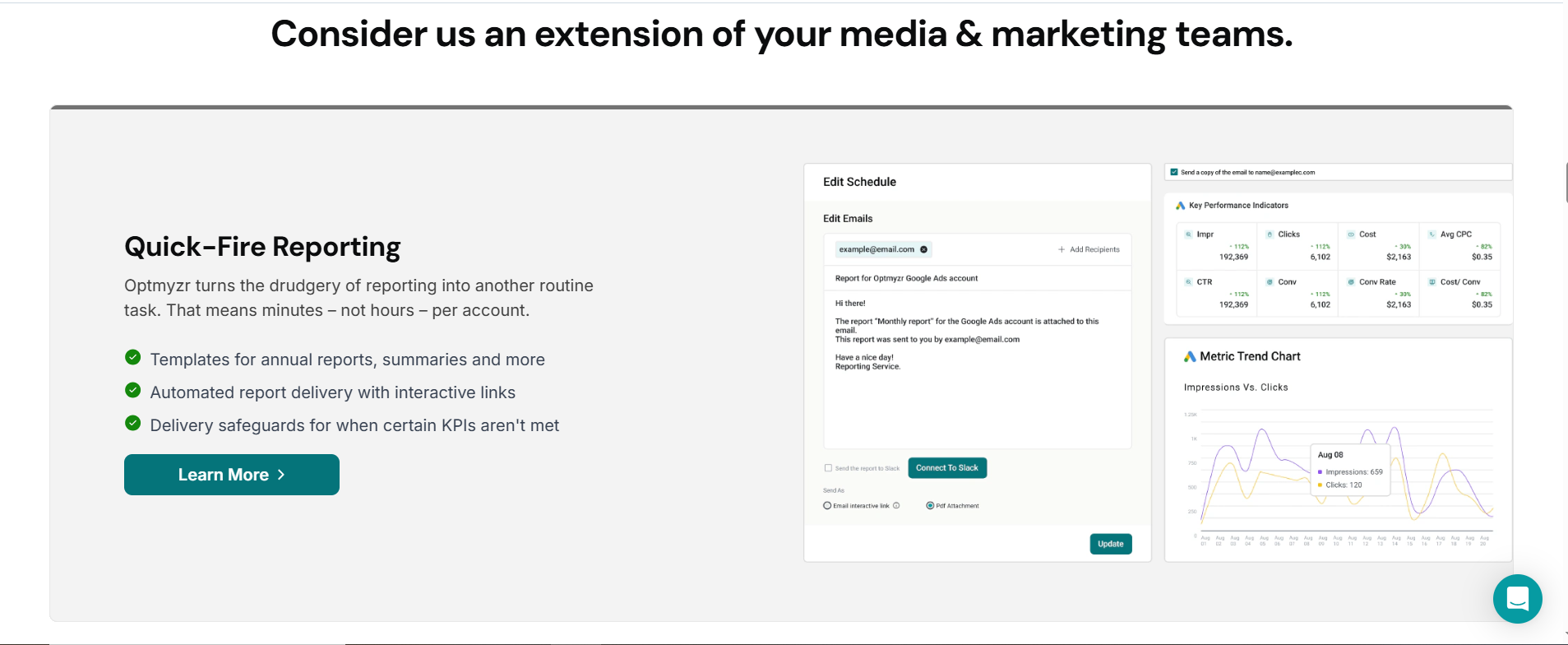
Optmyzr's account audit tool scans a full account in minutes. It finds issues that would take a human analyst hours to spot by hand. One agency using the tool saved four hours per audit from this one feature alone, according to Optmyzr's own case study with Made by Extreme, a UK-based digital agency.
- Goes deeper than native tools: the Rule Engine builds custom automation, Google's own bidding can't match
- Finds problems fast: account audits flag wasted spend and missed chances quickly
- Brings it all together: one dashboard covers Google Ads, Microsoft Ads, and select social channels
- Saves real time: agencies report saving roughly 20 hours per client weekly, per Optmyzr's own platform page
Weaknesses
The learning curve is real. Most teams need four to six weeks before they use the full feature set. Beginners can feel overwhelmed by how many settings exist. Optmyzr also won't make strategic calls on its own. It runs the rules you build. A person still has to decide what those rules should be and click approve on bigger changes.
It can also cause friction when paired directly with Google's native Smart Bidding. The two systems sometimes fight for control of the same bids. Teams running mostly manual bid strategies tend to get more out of it.
Pricing
Optmyzr's pricing scales with the ad spend you manage. The Starter plan runs $208 a month for accounts spending up to $25,000. The Professional plan is $416 a month for up to $100,000 in spend. The Agency plan reaches $832 a month for up to $500,000. A 14-day free trial is available. This fits agencies and in-house teams with real budgets across several accounts. It's a tougher sell at under $10,000 in monthly spend, where the cost takes longer to pay back.
3. Acquisio – Best for Automated Bid Management
Acquisio uses machine learning to handle bid and budget decisions. It works across search, social, and display campaigns from one dashboard. Its core feature is BBM, short for Bid & Budget Management. It adjusts bids, including local search bids, to hit the goals you set. No constant manual tweaks needed.
Strengths
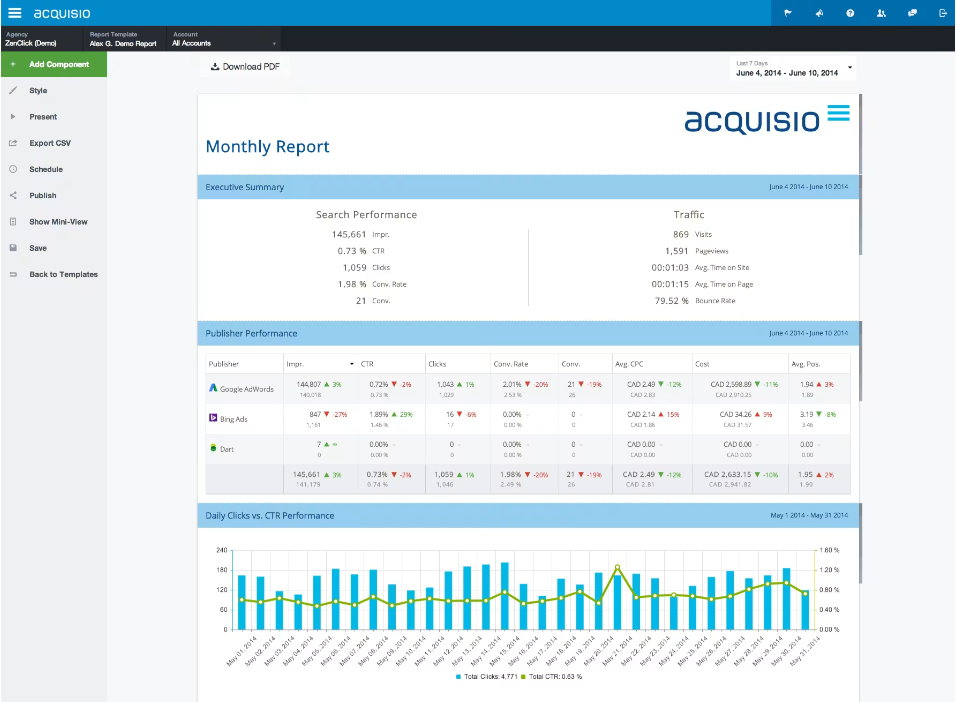
Acquisio's standout feature is how cleanly it pulls together multiple ad publishers into a single view. Agencies juggling several clients find this genuinely useful. It's also strong at batch work. It can clone campaigns across accounts and send automated reports straight to clients. No manual export needed.
- Pulls everything together: search, social, and display data sit in one view
- Cuts busywork: batch cloning and scheduled reports run on their own
- Adjusts on its own: bid layers react to local search conditions in close to real time
Weaknesses
Customer reviews keep pointing to a dated interface. Usability scores sit around 3.7 out of 5, behind newer AI-native competitors. The feature set is also narrow by design. Acquisio sticks to reporting and bid management. It skips the landing page tools or ad creative features that some rivals include.
Pricing
Acquisio's base plan starts at $199 a month with a free trial available. Enterprise and agency tiers require a custom quote based on total ad spend. It's a solid starting point for agencies that want centralized reporting and don't need built-in creative tools.
4. Quartile – Best for E-commerce PPC Automation
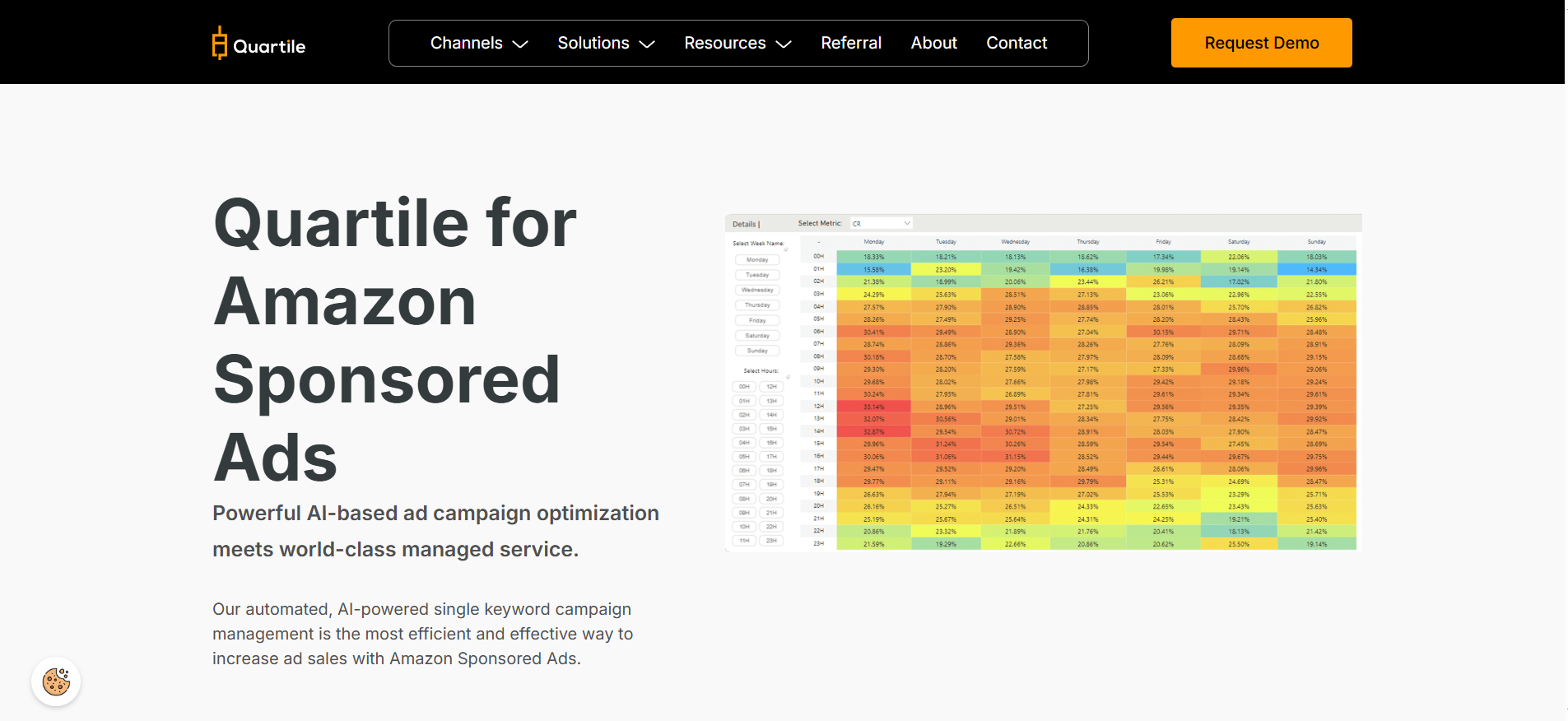
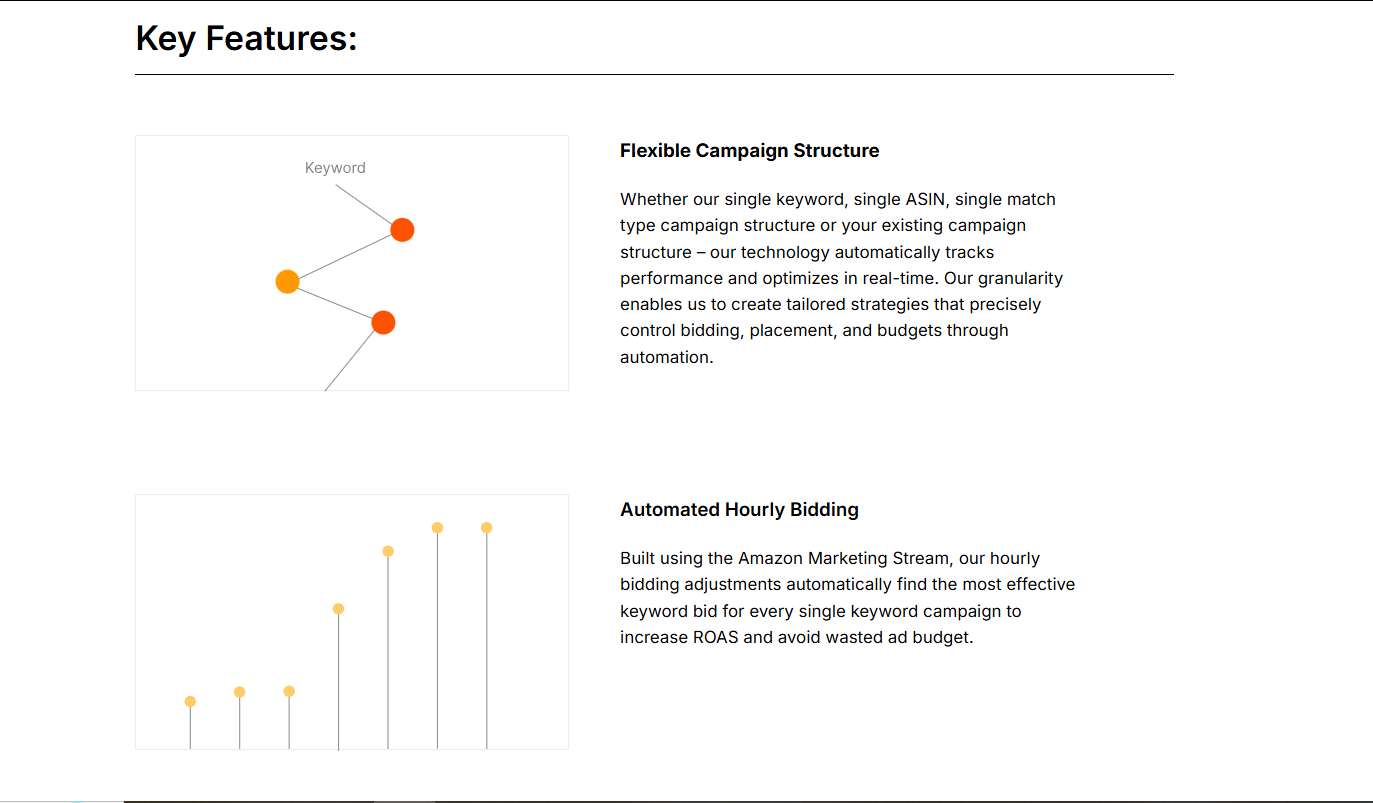
Quartile is built for brands that sell across multiple online marketplaces. As a form of Amazon advertising AI, it goes further than most tools by rebuilding your account structure around its own logic. It integrates Amazon, Walmart, Target, Instacart, Google Ads, and Meta into a single automated system.
Strengths
Quartile's strength is detail. It optimizes down to the single-SKU and single-keyword level. That matters a lot for catalogs with hundreds or thousands of products, where manual bid work just isn't realistic. Its connection across retail marketplaces is genuinely excellent. It syncs data across platforms that don't normally talk to each other.
- Covers every channel: it spans Amazon, Walmart, Target, Instacart, Google, and Meta
- Goes granular: single-SKU optimization works for catalogs too large to manage by hand
Weaknesses
The onboarding process is worth understanding before you sign anything. Quartile's algorithm takes apart your existing account. It rebuilds it into single-keyword, single-ASIN campaigns. That can mean hundreds of separate campaigns. They're hard to manage by hand if you ever decide to leave. It also runs the same logic across your whole catalog. A brand-new product gets treated the same as a mature, high-margin one.
But new launches usually need a more aggressive approach. The system also doesn't track stock levels or price changes on its own. A sudden stockout or price change won't automatically adjust your bids.
Pricing
Quartile charges 3%-5% of the optimized ad spend under an annual contract. Pricing needs a sales call rather than a posted rate. This makes it one of the pricier choices on this list, and costs climb fast for bigger brands. But the depth of automation can be worth it for sellers managing thousands of SKUs across many marketplaces.
5. Perpetua – Best for Amazon Advertising Automation
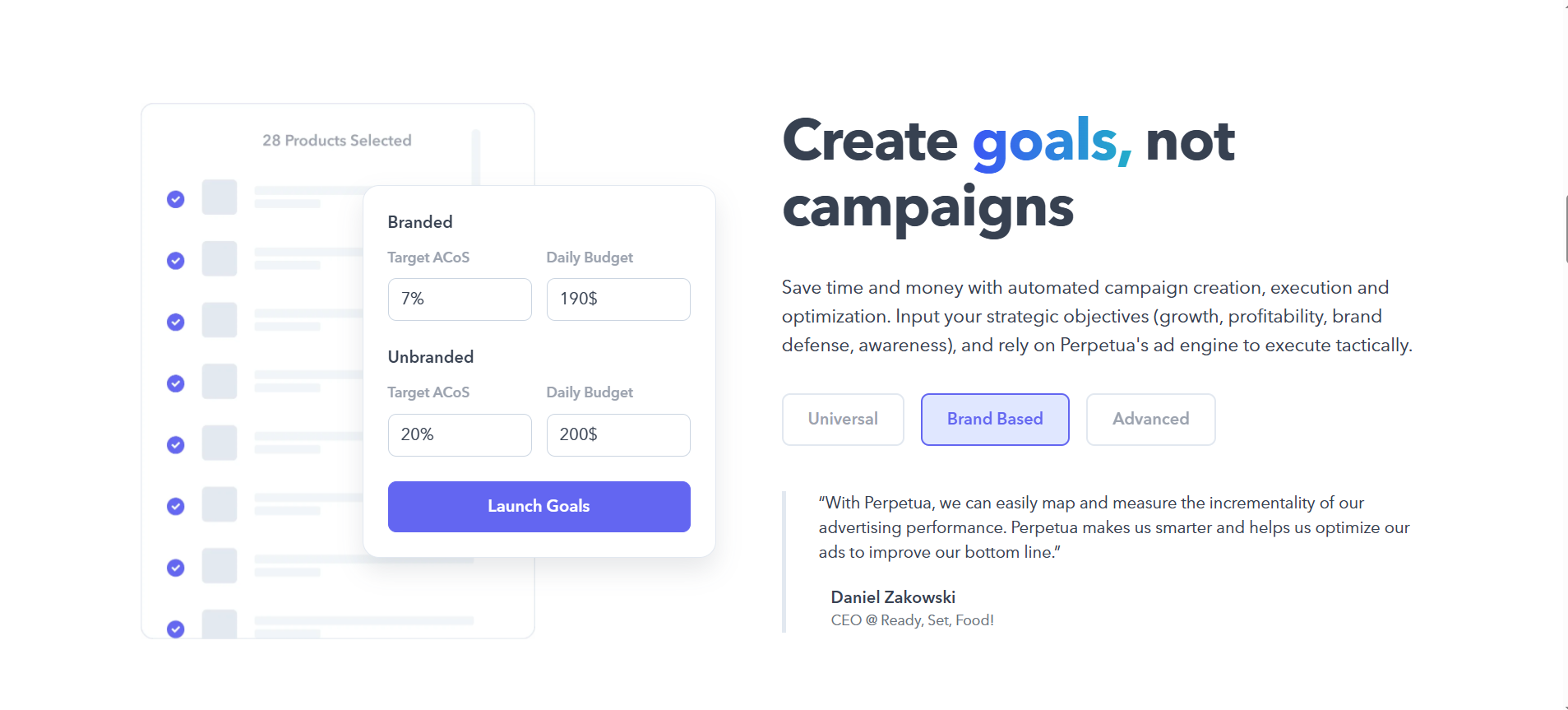
Perpetua focuses only on Amazon and similar retail platforms. As an Amazon PPC AI tool, it automates bids toward a TACoS goal you set up front. TACoS stands for target advertising cost of sales. With automated Amazon PPC running in the background, it's built for sellers who want to scale across hundreds of products without touching every bid.
Strengths
Perpetua can bulk-create Sponsored Brands, Video, and Display campaigns for up to 500 ASINs at once. That saves huge amounts of time for sellers with large catalogs. Its keyword harvesting runs hands-free. It pulls in converting search terms and builds Share of Voice data without you having to dig through search term reports.
- Scales fast: Bulk creation works across hundreds of ASINs at once
- Finds keywords for you: Harvesting surfaces, top search terms with no manual review
- Hits your target automatically: It balances revenue goals against spend on its own
Weaknesses
Switching to Perpetua often pauses or ends your existing campaigns to make room for its own structure. That can cause a temporary dip in revenue on keywords that were already working. Once you're on the platform, you also lose manual bid control entirely. The system runs on autopilot. Users have reported bugs and missing features that sometimes need manual fixes outside the tool.
Pricing
Perpetua starts at $250 a month for accounts spending up to $5,000. It's $550 a month for up to $10,000 in spend, and scales from $550 to $2,500-plus a month at higher tiers, plus a flat 3% commission on optimized spend. Annual contracts with rising pricing mean your costs climb sharply as performance improves. That's worth knowing before you sign.
6. Adzooma – Best for Small Business PPC Management
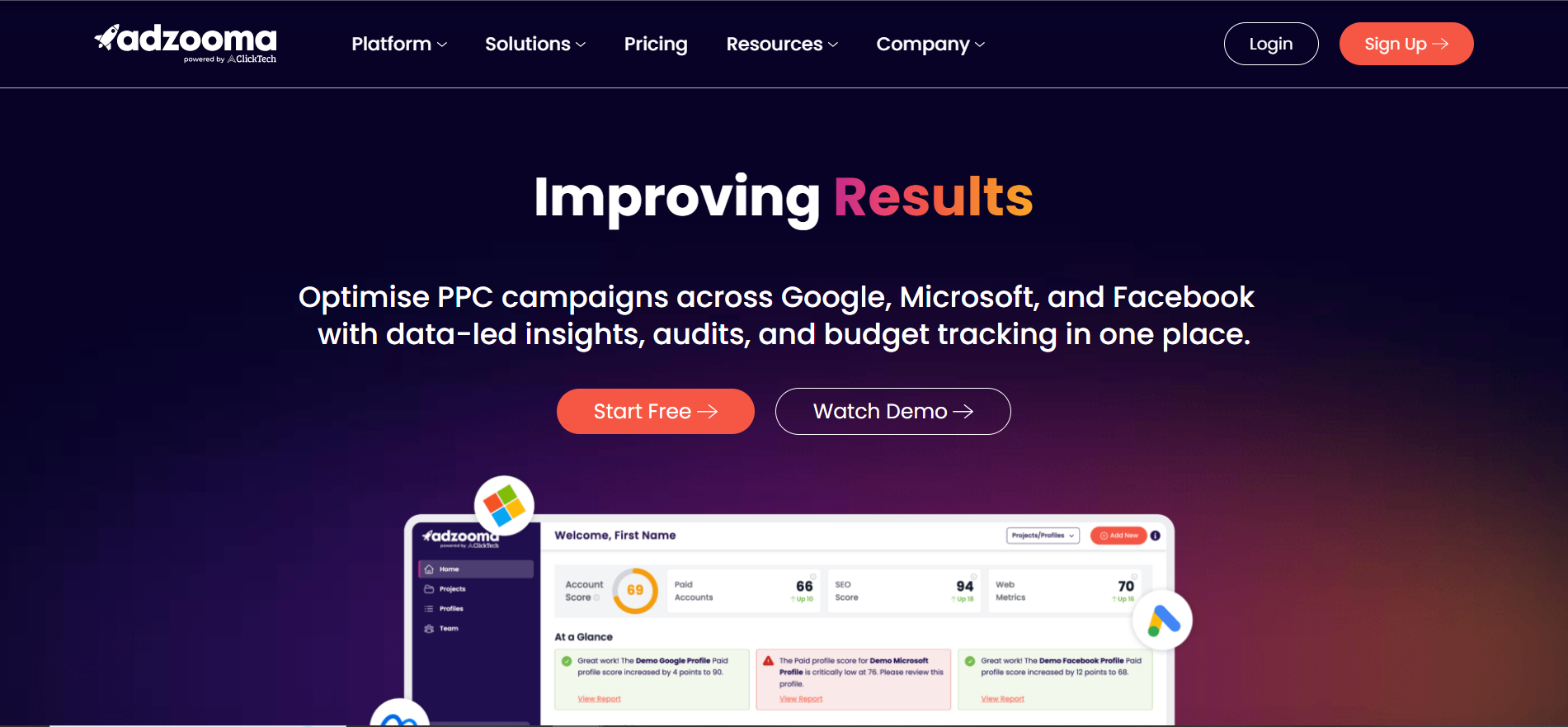
Adzooma is built for advertisers without a dedicated PPC specialist on staff. It explains what's wrong with your account in plain language instead of jargon.
Strengths
The free Essentials tier genuinely helps solo founders catch obvious budget leaks. There's no trial clock ticking down. Setup is fast. It connects through OAuth in minutes and builds a color-coded account health score right away. The whole interface runs on plain-English suggestions instead of the dense menus you'd find in a native ad manager.
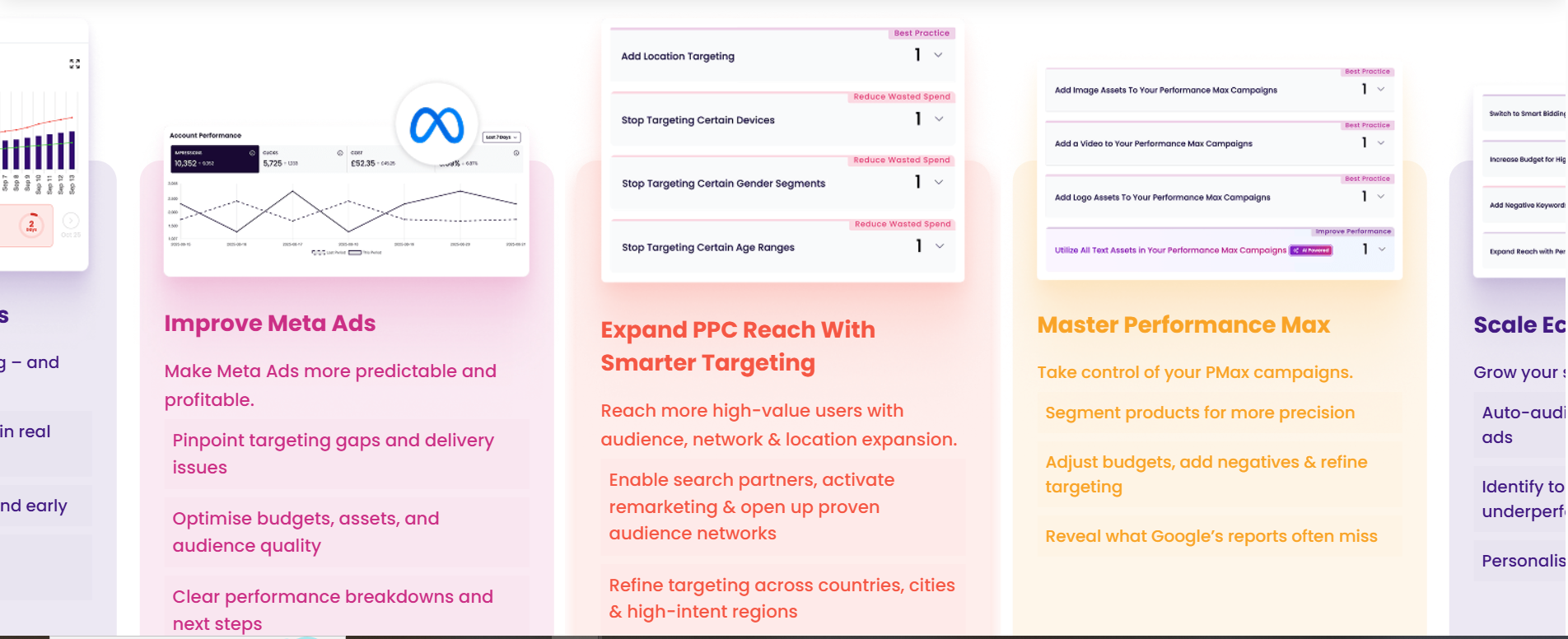
- Free tier that works: Essentials covers basic checks across Google, Microsoft, and Meta
- Sets up in minutes: a fast connection produces a readable audit almost right away
- Made for non-experts: plain suggestions replace confusing terms
Weaknesses
Adzooma mostly works as a suggestion engine. It tells you what to fix, but it won't make big strategic changes on its own. Its automated rules are basic if-then logic with little context. A good chunk of the useful features, like advanced reports and cross-channel rules, sit behind the paid Plus tier.
Pricing
Adzooma Essentials is free, no credit card needed, and covers basic account checks and suggestions. Adzooma Plus runs $69 to $99 a month, depending on combined ad spend. It unlocks landing page checks, custom reports, and automated rule triggers. For a small business just trying to stop wasting money, the free tier alone is often enough.
7. Skai – Best for Enterprise Omnichannel Advertising
Skai is built for large advertisers running campaigns across search, social, retail media, and app stores all at once. It's priced for that scale. This isn't a tool for small teams. It's infrastructure for enterprise media buying.
Strengths
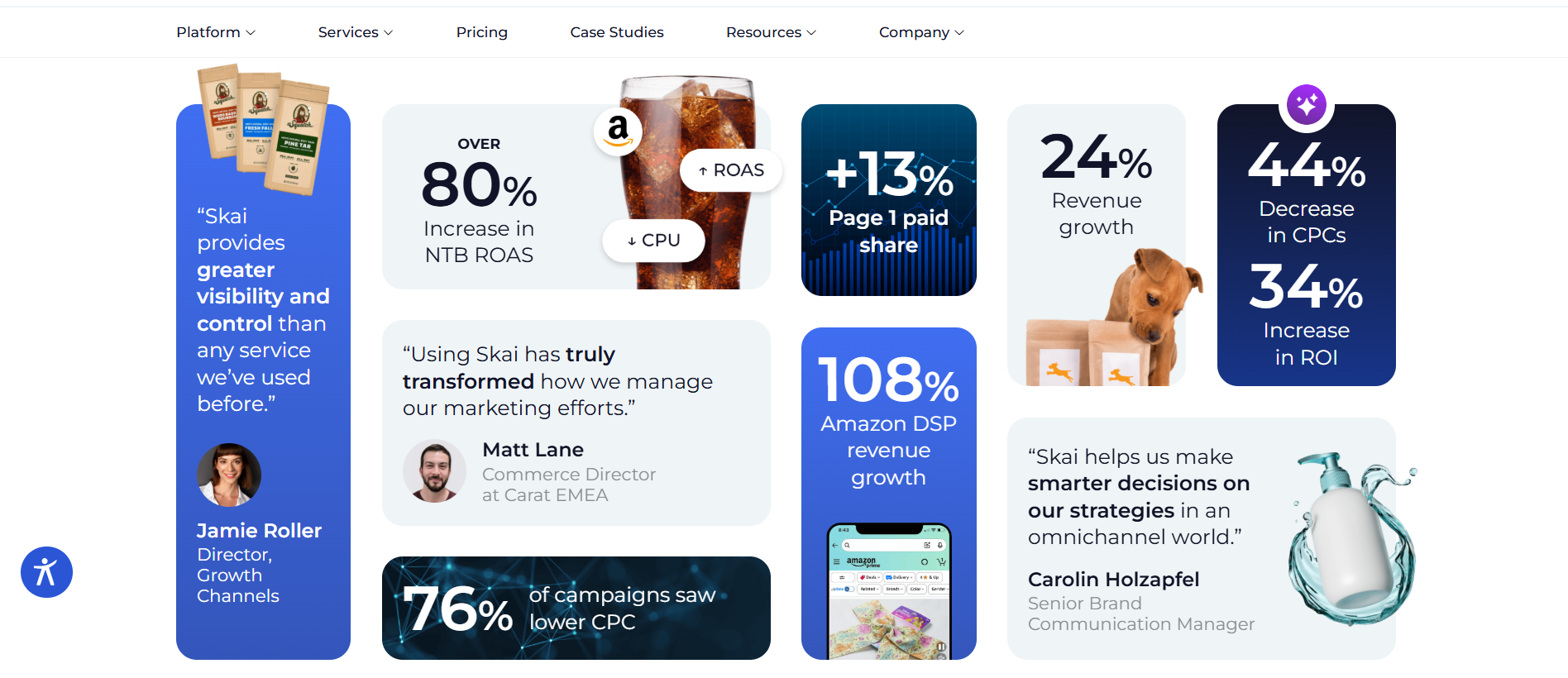
Skai's data depth is its biggest selling point. It lets media buyers pull raw, ad-level data through an API. That data feeds custom models that most mid-market tools can't support. In one documented case, a Fortune 50 consumer electronics brand used Skai to manage Amazon Advertising across many marketplaces. Conversions jumped 467%, and revenue rose 405%, while cost per acquisition dropped 60%, according to Skai's published case study.
- Scales across everything: coverage spans search, social, retail media, and app campaigns
- Opens up the data: API access feeds your own attribution models
- Tracks the bigger picture: it tests true impact and forecasts budget pacing
Weaknesses
Skai is overbuilt for small or mid-sized budgets. A percentage-of-spend price at this level can end up costing more than hiring a full creative team. The setup is also complex. It often needs onboarding help and weeks of technical work before it runs right.
Pricing
Skai is enterprise-only, with no free trial and no posted low-tier monthly plan. Pricing typically starts around $5,000 to $10,000 a month, or as a percentage of total media spend. That makes it realistic only for brands spending more than $100,000 per month on ads.
8. Helium 10 Adtomic – Best for Small to Mid-Sized Amazon Sellers
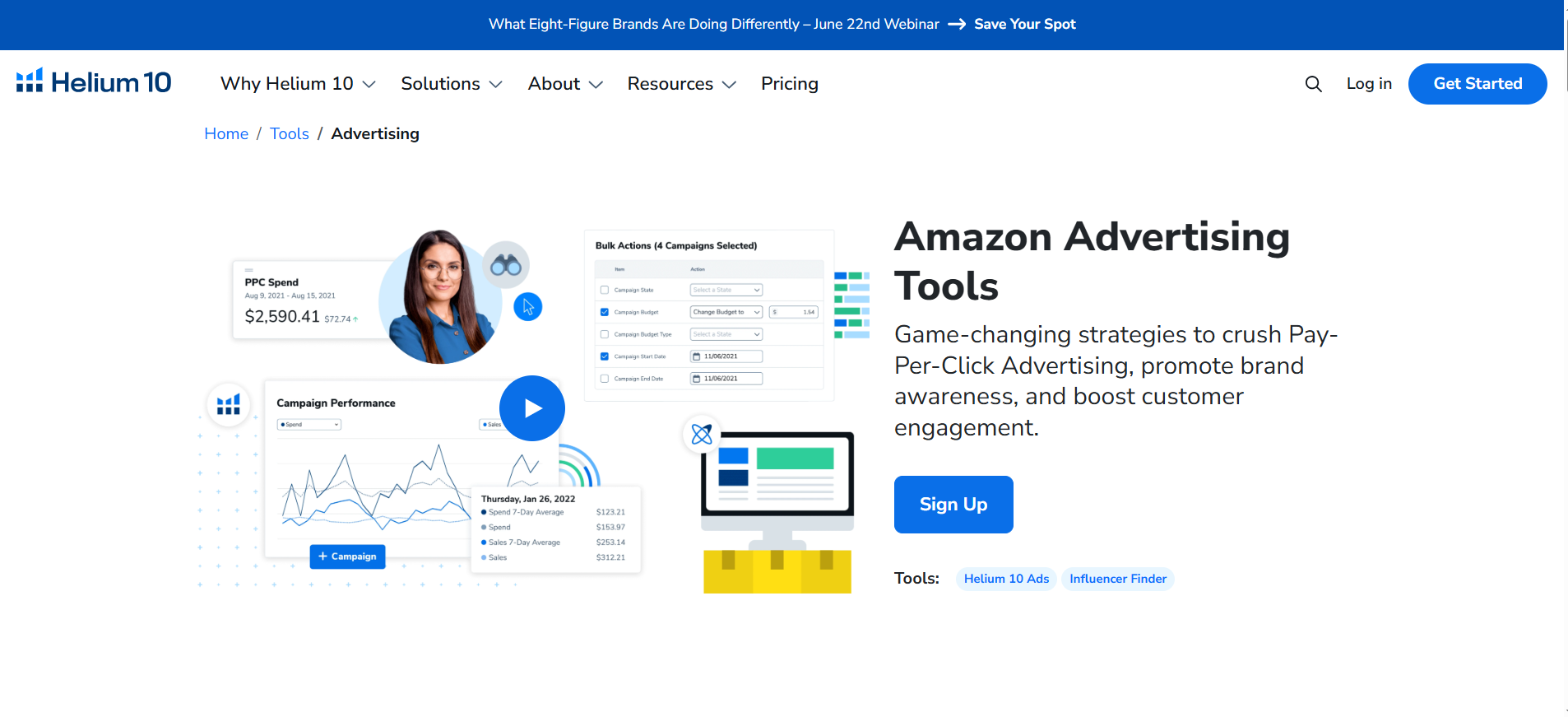
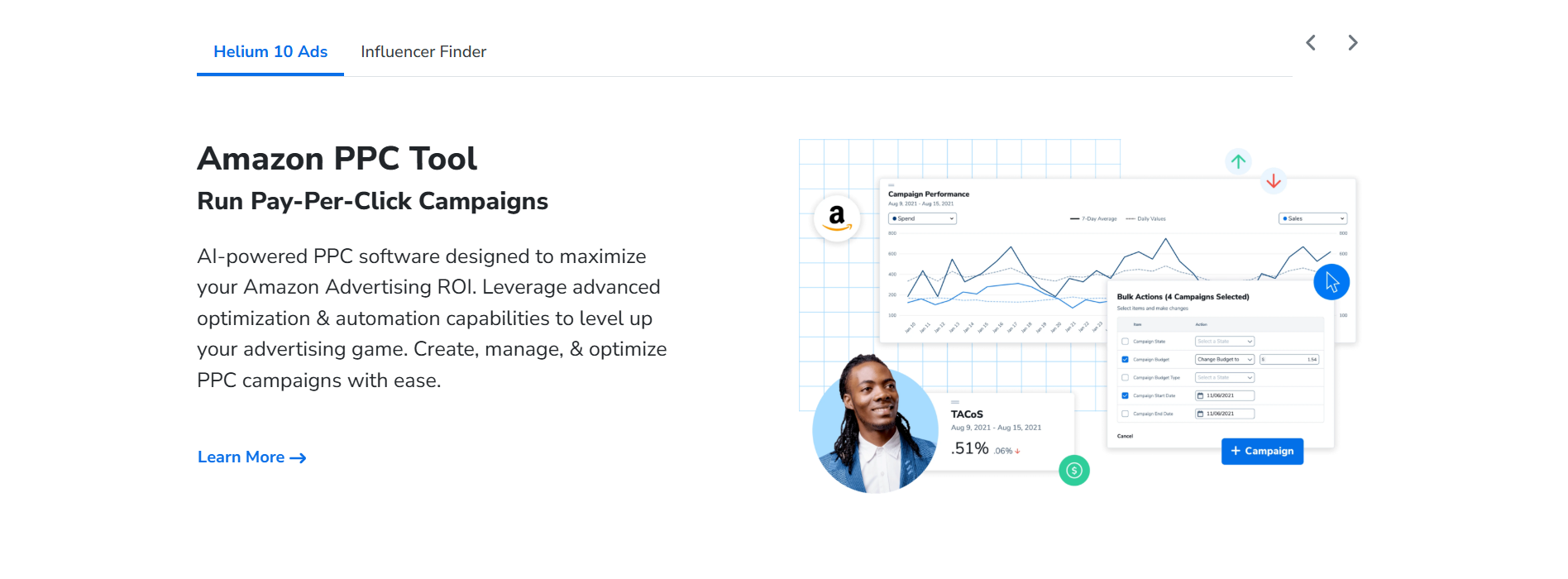
Helium 10’s Adtomic platform replaces legacy, rules-based tools by packing advanced AI PPC automation into a suite that Amazon sellers already use daily. Instead of forcing you to build manual rule logic from scratch, Adtomic uses machine learning to guide your bids, maximize organic keyword ranks, and protect your profit margins.
Strengths
Adtomic’s primary advantage is its deep integration with the rest of Helium 10’s keyword and product data. This connection allows the AI to harvest search terms, analyze competitor listings, and execute bid changes smoothly.
- Smart Keyword Harvesting: The tool automatically surfaces high-converting search terms from auto campaigns and moves them into exact match structures without manual data exports.
- Clear Profit Visibility: Its dashboard ties PPC ad spend directly to organic sales and total ACoS (TACoS), giving you a clear picture of real-world profitability.
- Data-Driven Automation: Moves away from rigid rules, adapting your bids dynamically based on changing marketplace signals.
Weaknesses
Because Adtomic is baked directly into the Helium 10 software platform, you must have a Helium 10 account to utilize it. It is also explicitly focused on Amazon, meaning omnichannel brands looking to scale heavily into alternative retail channels like Google Shopping or Meta will find its multi-platform reach limited.
Pricing
Adtomic is included within Helium 10's Diamond tier, which starts at $279 a month plus a 2% fee on monthly ad spend over $5,000. While more expensive than a standalone budget tool, it frequently pays for itself for active sellers by replacing multiple separate subscriptions for product research, SEO, and PPC management.
9. AdCreative.ai – Best for AI Ad Creative Generation
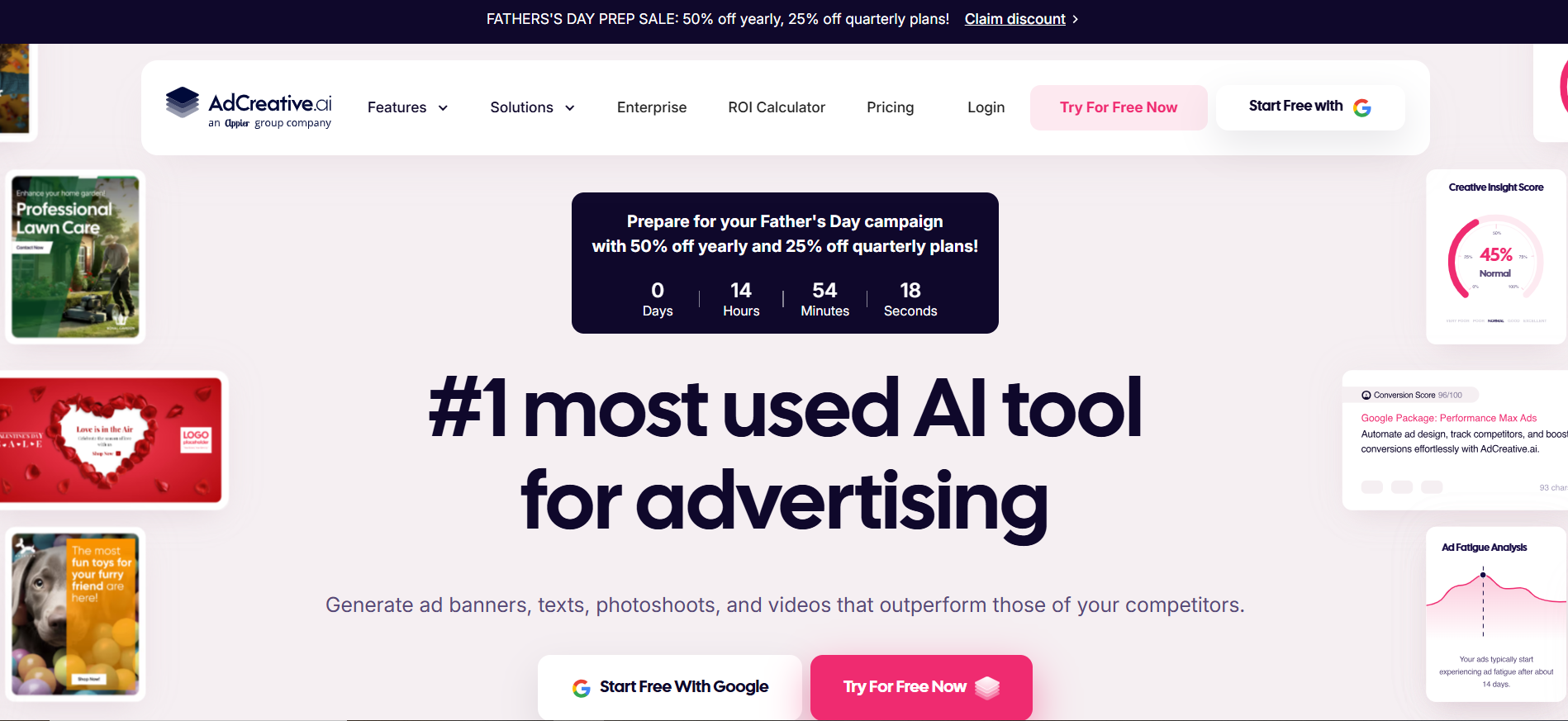
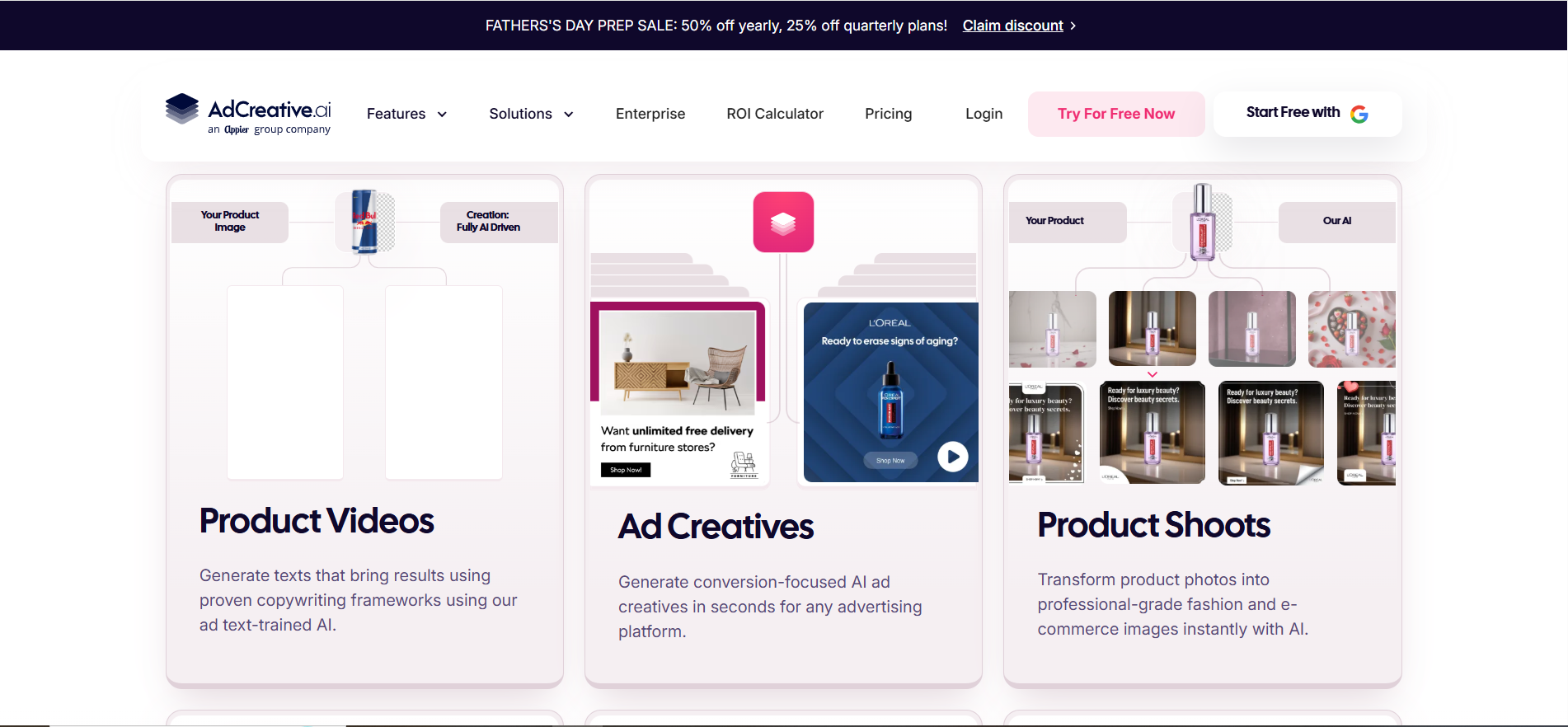
AdCreative.ai handles a different part of the PPC workflow. It builds the actual ad assets, headlines, and banners that go into your campaigns. Platforms test thousands of combinations of headlines and descriptions. Building that much by hand isn't realistic for most teams, especially small ones without a designer.
Strengths
The platform uses text prompts to quickly build hundreds of display and social ad banners. They match your brand's existing colors and logo. This cuts the time it takes to build test versions for Meta and Google from days down to minutes.
- Builds assets fast: rapid generation produces dozens of formats from a single prompt
- Matches your brand: output pulls automatically from your logo and color scheme
- Saves design hours: creative production time drops sharply compared to manual design work
Weaknesses
Users often say AdCreative.ai struggles with mobile-specific display ad sizes. These usually need a manual fix elsewhere. The platform has also drawn steady criticism over its billing. A 14-day free trial can roll over into a higher-tier paid plan, sometimes priced at over $339 per month, if the renewal notice is missed.
Pricing
The Starter plan runs $29 to $39 a month for up to 100 generated assets. The Professional plan is $249 a month. It unlocks bulk creative variety and competitor benchmarking. The Ultimate plan costs $300 to $599 per month and is built for agencies that need team tools and high-volume generation. Given the billing complaints, it's worth setting a reminder before any trial ends.
10. Madgicx – Best for AI Audience Optimization
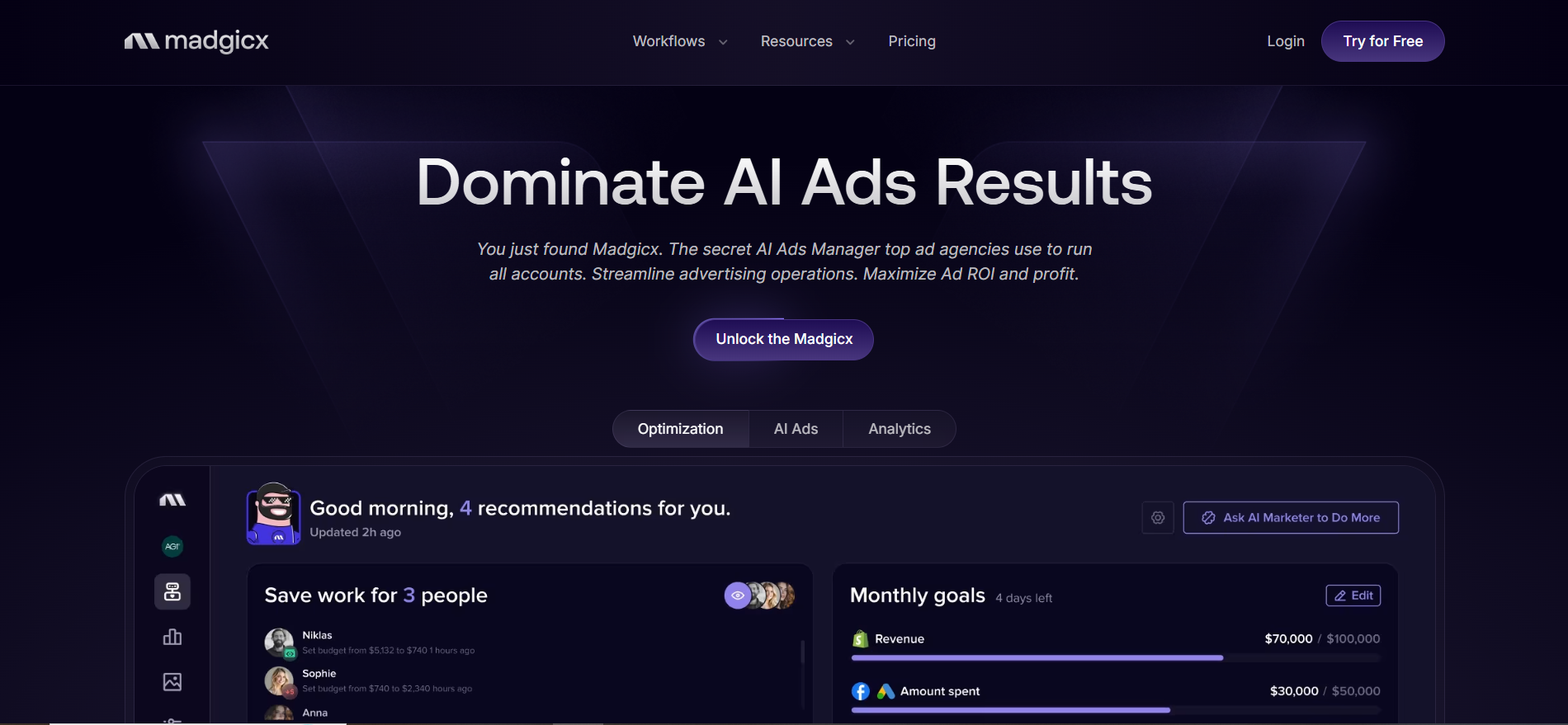
Madgicx focuses on audience targeting and budgets, mostly for Meta Ads. It uses AI to find and group audiences that convert better than those built by hand.
Strengths
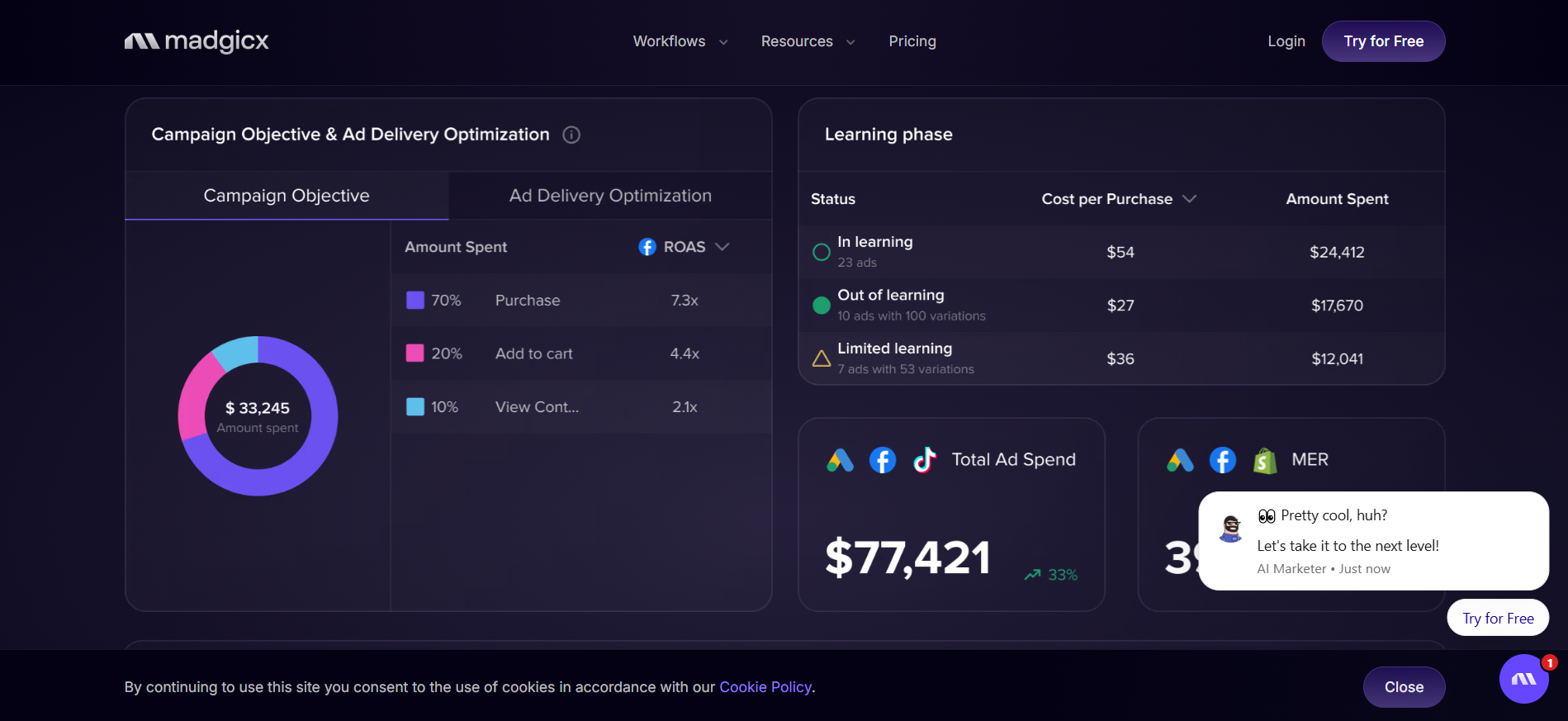
Madgicx's biggest strength is sorting audiences by funnel stage. It automatically splits prospecting, retargeting, and lookalike groups. No one has to build and test each one by hand. Its Creative Insights tool also scores ad hooks and calls to action across live campaigns. You see what's actually converting instead of guessing.
- Builds the funnel for you: it sorts prospecting, retargeting, and lookalike audiences on its own
- Scores your creative: Creative Insights tags, ad hooks, and CTAs on its own
- Backed by real results: the agency WizerLink used Madgicx's tools on a client's seasonal campaigns. They cut customer acquisition cost by 37% and grew sales 12.44x in three months, per Madgicx's own case studies
Weaknesses
Madgicx leans heavily on Meta. It does some cross-channel work, but it's weaker for Amazon or Google Search. If automation runs too often, it can reset Meta's learning phase. That wastes some budget while the system relearns.
Pricing
Madgicx starts at $49 per month for accounts spending under $10,000 per month. It scales into custom agency packages for larger budgets. It's accessible to smaller brands just getting started with Meta automation, though the value is mostly limited to that one platform.
What Is AI PPC Management?
AI PPC management means using artificial intelligence to plan, run, fix, and study paid ad campaigns. You skip doing every step by hand. In Google Ads, that might look like Smart Bidding, adjusting how much you pay per click. It bases this on how likely a click is to turn into a sale. In Amazon Advertising, it might mean software pausing a keyword on its own once it starts burning budget without producing sales.
In practice, AI handles tasks like:
- Bid adjustments based on real-time auction signals
- Budget pacing across multiple campaigns
- Keyword research and negative keyword discovery
- Audience segmentation and lookalike targeting
- Ad copy testing across dozens of variations
- Performance forecasting and reporting
None of this removes the need for a human strategist. AI tools automate routine PPC tasks like bid adjustments, which frees up your team. They can focus on the calls that actually need judgment. Think about which products to push this quarter, or how to position a new offer. AI handles the repeated math. People still decide what the campaign is supposed to do.
What PPC Tasks Can AI Help Automate?
AI now touches nearly every stage of running a PPC campaign. That's true from early research through final reporting. Here's where it helps most advertisers.
Campaign Optimization and Budget Management
This is where AI delivers the biggest wins you can measure. AI-driven bidding can reduce customer acquisition costs by nearly 30%, based on enterprise tracking of accounts that moved from manual bidding to Google's automated Smart Bidding system. One real example directly supports this. Columbus, a Merkle company, used Search Ads 360's Smart Bidding for a telecom client. They reported a 36% jump in conversion rate along with a 28% drop in cost per acquisition that same quarter. They also cut manual optimization time in half.
- Bids adjust live: AI sets bids in real time as each auction happens
- Budget moves on its own: funds shift toward whichever campaigns convert best that day
- Costs drop: AI can cut cost-per-click by 20% on average, alongside steady quality score gains
- Waste gets caught early: negative keywords get flagged before the spend adds up
Audience Targeting and Performance Forecasting
AI studies far more behavioral data than a person could process by hand. That changes how targeting decisions get made. AI analyzes vast amounts of user behavior to build highly targeted audiences. It spots patterns in past buyers that a simple demographics list would miss.
- Catches more searches: AI reads meaning, not just exact words, so it catches intent you'd miss
- Predicts who will buy: AI builds lookalikes based on what your best customers actually did
- Spots trends early: AI forecasts future trends based on past data, helping advertisers see seasonal shifts coming
- Spends more efficiently: predictive targeting can boost ad spend efficiency by 20%
Ad Creation and Creative Testing
Writing and testing ad copy used to be one of the slowest parts of running a campaign. AI changed that completely.
- Writes copy for you: AI drafts strong ad copy from your brand voice and past winners
- Tests at scale: AI tests hundreds of ad variations at once, far more than any human team could manage
- Tailors ads to viewers: AI adjusts headlines and images based on who's watching
- Boosts clicks: dynamic ads have raised click-through rates by 25% since they match what viewers want
Reporting, Analysis, and Marketing Execution
This is the part of PPC that eats the most time and gets the least credit. It's also where broader marketing platforms tend to add the most value, not just the bid-focused ones.
- Builds your reports: AI turns raw numbers into summaries people can actually understand
- Watches pacing nonstop: it flags issues before they waste a month of budget
- Blocks fraud instantly: fake clicks get spotted and blocked right away
- Goes beyond the numbers: tools like Sintra AI also draft follow-up emails and research customer objections
How to Choose an AI PPC Management Tool
The right tool depends on your actual workflow, not a list of features. A platform with fifty automation rules is useless if it doesn't even support the channel you're running ads on.
Match the Tool to Your Advertising Channels
Start by checking whether the platform supports your channels. Amazon sellers usually need Amazon-specific tools, like Perpetua or PPC Entourage. Google-focused tools like Optmyzr treat marketplace ads as an afterthought. Agencies running clients across Google, Meta, and retail media need a tool built for multiple channels, like Acquisio or Skai. That beats stitching together two or three tools.
Review Automation and Optimization Features
Compare how deep the automation actually goes, not just whether the word "AI" shows up on the pricing page. Look at bid management, budget pacing, keyword suggestions, performance alerts, and ad testing. The right tool should cut your manual work without taking away your control. Tools like Perpetua remove your bid control once you're onboarded. That works for some teams and frustrates others who want a say in each decision.
Consider Usability, Reporting, and Integrations
A powerful tool you can't actually use isn't useful. Look for clear dashboards, a setup process that doesn't take weeks, and reports that make sense without training. Also, check for integrations with tools your team already uses. Optmyzr's account audits and Adzooma's plain-English suggestions both solve this problem in different ways, depending on how technical your team is.
Compare Pricing, ROI, and Scalability
Judge pricing by time saved and results gained, not just the sticker price. A $416-a-month tool that saves twenty hours a week pays for itself fast if your time is worth anything close to industry rates. Also, think ahead. A flat monthly fee, like Acquisio or Adzooma charges, behaves very differently as you scale than a cut of ad spend, like Quartile or Perpetua charges, where costs climb automatically as your campaigns succeed.
Will AI Replace PPC Specialists?
No, and the data behind AI's gains actually proves why. AI is very good at the repetitive, data-heavy parts of PPC. Think adjusting bids across thousands of auctions, building ad variations, catching fraud clicks, and producing reports. It is not good at deciding what your brand should say. It can't judge which audience truly fits your business in the long term. It can't decide how to react when a campaign technically "works" but feels wrong for the brand.
What's actually happening is a shift in where specialists spend their time. AI tools can save up to 6 hours per day on PPC management, based on industry-wide tracking of teams that adopted automation for bidding and reporting. That time doesn't vanish from the job. It moves toward strategy, creative direction, and the calls that automation still can't make.
There are real risks worth naming honestly. Leaning too heavily on automation without human review can cause a platform to chase the wrong goal. It might optimize for volume when you actually need profitable revenue.
Bad data makes this worse. An algorithm trained on weak conversion tracking will confidently make bad decisions fast. The specialists who get the most from these tools treat them as helpers, not as replacements for judgment. They check in on automated decisions often instead of setting a rule once and walking away.
Why Choose Sintra AI for PPC Campaign Execution?
A profitable PPC campaign takes more than the right bid. Someone has to write ad copy that actually gets clicked. Someone has to learn what your audience cares about before you can target them well. Someone has to turn last week's numbers into a report your boss can read in two minutes. Most PPC platforms simply don't touch any of that.
Sintra AI was built to fill that gap. Its Brain AI feature stores your business context, customer insights, brand guidelines, and campaign history in one place. So every AI Helper you call on already understands your offer, rather than starting from scratch. That matters more than it sounds. A Helper drafting your next Google Ads headlines already knows what messaging worked last quarter, because Brain AI remembers it.
Here's what that looks like in a real PPC workflow:
- Drafting Google Ads copy for testing, pulling from your brand voice instead of starting from a blank page
- Writing Amazon product page text that supports your sponsored product campaigns instead of working against them
- Turning a week of campaign data into a summary that doesn't need a spreadsheet to understand
- Drafting personal follow-up emails for leads who clicked but didn't buy on the first visit
- Researching the exact objections your audience raises in reviews and support tickets
- Writing landing page text that actually matches what the ad promised, instead of sending traffic to a generic homepage
AI integrations connect these workflows to tools your team already uses. Reporting, follow-up, and content work no longer need manual exports between apps. For a small e-commerce brand running Google Shopping and Amazon ads, a single person can manage the entire campaign. No need to hire a copywriter, an analyst, and a support person just to keep up.
Ready to Scale Your PPC Operations with AI?
Your bids can be perfectly set, and you'll still lose money if your ad copy is weak, your reports are a mess, or your leads never hear from you after they click. Sintra AI handles the work around your campaigns. Think copywriting, research, reporting, and follow-up.
That gives your team more time for the decisions that actually drive revenue, rather than busywork that doesn't. Get started with Sintra AI and see what your PPC work looks like once the slow parts run on their own.
AI PPC Management FAQs
What is AI PPC management?
AI PPC management uses AI to automate parts of running paid ads. Think bid changes, budget pacing, audience targeting, ad copy, and reports. It cuts manual work. Human strategists focus on bigger decisions instead.
Which AI tool is best for PPC automation?
It depends on your channel and workflow. Optmyzr and Acquisio are best for advanced Google and Microsoft Ads bid automation. Sintra AI is best for the marketing work, like ad copy, research, and reporting, that surrounds a successful campaign.
Can AI improve Amazon PPC campaigns?
Yes. Amazon PPC AI tools like Perpetua, Quartile, and PPC Entourage handle tasks such as dayparting, keyword harvesting, and TACoS bidding. This kind of automated Amazon PPC can cut wasted spend on weak keywords and products.
Is AI PPC management suitable for small businesses?
Yes, with the right tool. Adzooma's free tier and PPC Entourage's low-cost plans were built for small businesses without a dedicated PPC specialist. They offer plain-language suggestions instead of complex enterprise dashboards.
Will AI replace PPC managers in the future?
It's unlikely to fully replace skilled PPC managers. AI still struggles with brand judgment and creative direction. Instead, it's changing how managers spend their time. Automating bidding and reports frees them to focus on strategy.
Related articles