Best AI Virtual Assistant For Customer Service in 2026

Table of Contents
Quick Answer: Shortlist
Here are my top picks for AI customer support virtual assistants in 2026:
- Sintra AI - Best virtual assistant for customer service, mainly for small to mid-sized teams.
- Intercom (Fin AI Agent) - Best for existing Intercom subscribers with a high volume of tickets.
- Ada - Best for structured support processes with predefined conversation flows.
Each platforms support various business requirements. Select according to the number of people in your team, the complexity of the support, and the level of customization required.
How many support tickets do you have in your backlog? It seems your inbox is bursting with communications, your customers have to wait hours for an answer, and your team is totally exhausted from constantly giving the same answers.
Does this situation sound familiar?
AI virtual assistants are AI-based software to interact with customers and answer inquiries. They are no longer the fancy chatbots. The best AI virtual assistant for customer service is the one that can conduct complex conversations, retain previous interactions, and expand your support without increasing staff. The financial upside of getting this right is significant - AI could deliver up to $1 trillion of additional annual value in banking alone, with revamped customer service a major driver, and two-thirds of millennials already expect real-time service.
Virtual assistant tools provide a structure for collaboration, with features such as task management, scheduling, communication, file sharing, and time tracking. The difference now? AI undertakes these tasks without human coordination. These applications typically use subscription-based models, charging per user per month.
We have tried out the most popular platforms to see which ones really keep their promises. Here's what works in 2026.
Top Virtual Assistants for Customer Support
Not all AI virtual assistants for customer service are created equally. There are those who are good at basic questions but fail miserably at subtle ones. Other systems take weeks to be operational.
They are apps that act as a central hub of tasks, files, and conversations. Current AI platforms bring together customer interactions, knowledge bases, and support processes under a single roof rather than managing several tools that are not connected.
These tools were gauged by what is important in the real support setting: the accuracy of responses, the ability to offer personal interaction, the complexity of their configuration, and their ability to scale during volume spikes.
1. Sintra AI - Best for Solo or SMB
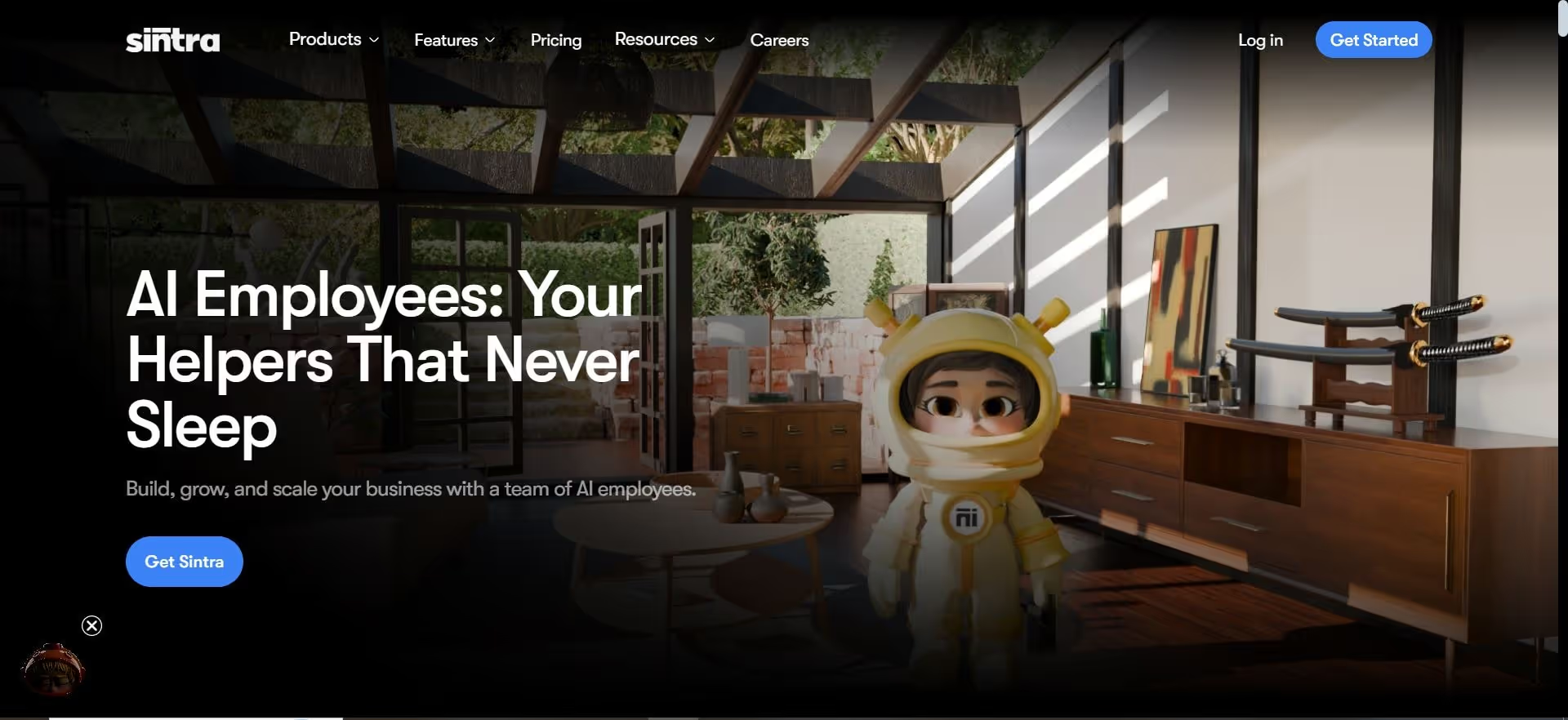
You just wished you could clone your support agent? This is what Sintra AI does.
The platform has dedicated AI assistants (such as Cassie) to provide customer support, supported by a central Brain AI that stores your company's knowledge. An AI virtual assistant can provide 24/7 service, thereby improving the customer experience by responding to queries when a human agent is unavailable. Using this common knowledge base, Cassie can consistently respond to questions via email, chat, and social platforms.
The multilingual support is literally handy. It is 2 AM, and a customer poses a question in Spanish. Cassie replies in Spanish, in your brand voice, and does not disturb anybody.
Example: Cassie is used by a developing ecommerce brand to respond to questions about returns policy, order tracking, and sizing recommendations, both in Instagram DMs, on the website, and in the mail. The team also reduced the time to respond from 6 hours to an immediate response, without the need to recruit new employees.
Assessment by Criteria
Brain AI centralizes your knowledge, helping maintain high response accuracy. Whenever you change product information or policies, all AI assistants are notified in real time.
Setup takes hours, not weeks. You link your sources of knowledge, set your tone preferences, and you are live.
AI virtual assistants can help companies reduce the burden on human agents by performing simple tasks that do not require their intervention. This is effective for expanding teams that do not require hiring five new agents.
Strengths & Weaknesses
What works?
What doesn't work?
Brain AI prevents unfocused responses due to stored knowledge.
Difficulties with highly emotional or complex edge cases that require empathy.
Quick installation of enterprise solutions.
Chatting is more the focus, and not phone support.
Reactions remain the same regardless of the size of your team.
Requires human intervention in emergencies.
AI virtual assistants can be integrated into other software solutions, such as CRMs and project management software, to support multifaceted workflows.
Technical learning curve of AI delegation teams.
Manage 10x support volume without proportional recruiting.
Pricing
Its pricing model is based on a flat subscription offering $39/mo (Individual Helper) or $97/mo (Sintra X).
2. Intercom (Fin AI Agent) - Best for growing teams
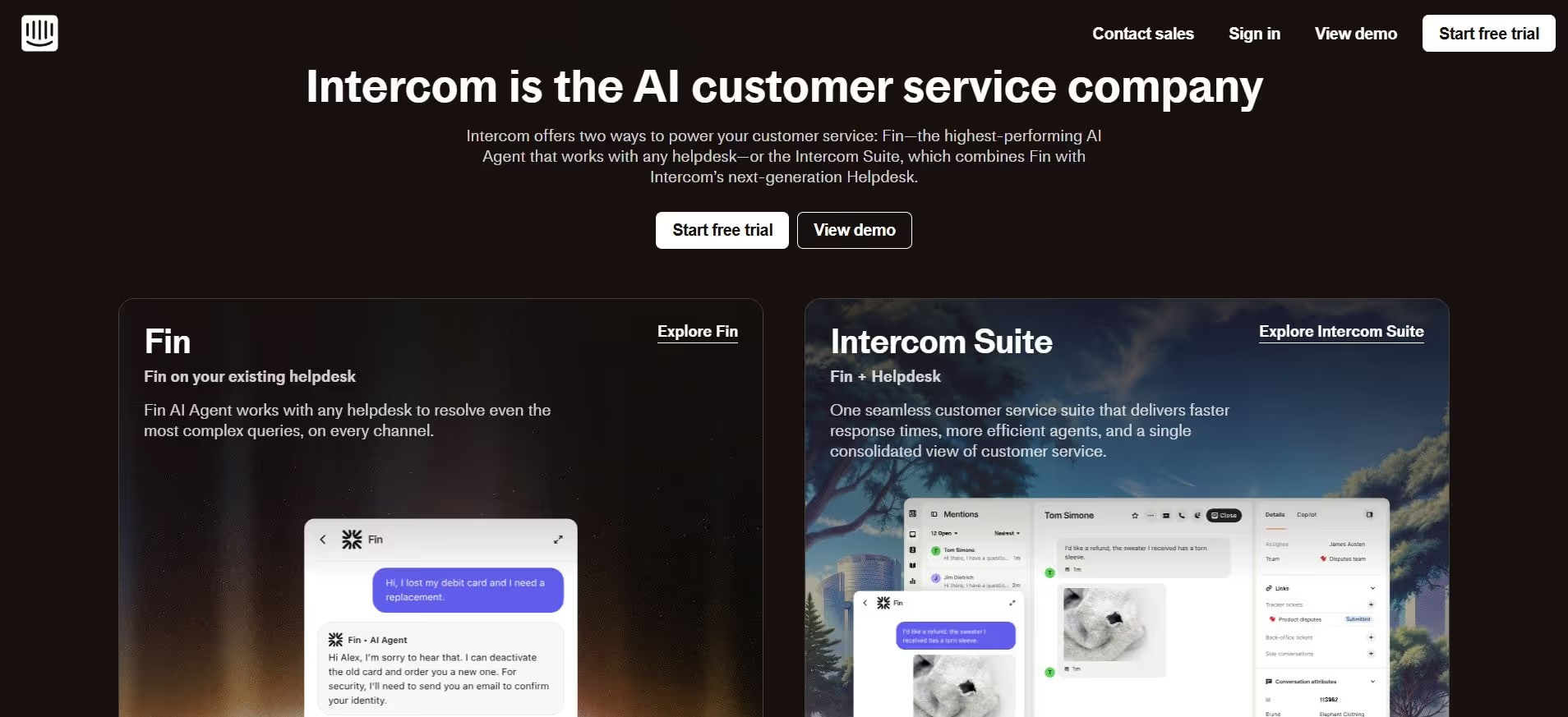
A huge help desk that no customer ever looks at? Fin AI Agent actually uses it.
The AI virtual assistant of Intercom exists within their current platform and finds answers in your help documents, previous conversations, and product knowledge. Natural Language Understanding (NLU) extends keyword-based understanding to encompass intent, slang, and other subtleties, enabling human-like responses. It is designed to support the SaaS teams with thousands of repetitive questions.
The ticket's deflection rates are remarkable. Fin is a problem solver that reduces the number of tickets your human agents handle by resolving them on the first attempt.
Example: A B2B SaaS organization with 50,000 users implemented Fin to answer password reset requests, billing inquiries, and feature-related questions. They reduced support tickets by 62% in the first month without lowering customer satisfaction.
Assessment by Criteria
The well-built integration with the Intercom help desk improves response accuracy. The system is trained on your previous conversation history, so it gets better over time.
The complexity of the setup is dependent on the quality of your help center. When your records are good, Fin works well at once. If they are old or scarce, you have to go through a cleanup process.
Fin excels in scalability to support high volume. The highest results are achieved in companies in the enterprise SaaS space that face similar question patterns.
Strengths & Weaknesses
What works?
What doesn't work?
Effective natural language understanding identifies intents even when the phrase is odd.
Bound to Intercom and not very flexible externally.
Close integration with the Intercom platform provides smooth workflows.
It is too expensive for small teams to afford.
AI-assisted customer service can cut operational expenses by a quarter to a half.
Brings a narrow perspective to the support ticket area, rather than cross-functional automation.
High-resolution rates on standard and support questions.
Needs good content on a quality help center to do well.
Good consistency even at volume spikes.
Less effective outside traditional SaaS support workflows.
Pricing
It has a Hybrid (Seat + Usage) pricing model that offers $39–$139/seat + $0.99 per resolution.
3. Ada - Best for Enterprise
Is the support process that you follow clear and repeatable? Ada thrives on structure.
It is a no-code platform that lets you create conversation flows to guide customers through common problems without writing any code. The use of natural language processing and machine learning enables AI virtual assistants to answer complex questions more effectively than conventional chatbots. Ada is intent-aware, tracks your predefined paths, and upgrades to a human when necessary.
Teams with well-documented processes have high ticket deflection. Ada manages predictable questions in 80% of cases.
Example: A telecom firm presented their top 15 support cases (plan changes, outage reports, billing disputes) as Ada flows. Non-technical support managers update the flows weekly without developer assistance, achieving 85% automated resolution rates.
Assessment by Criteria
The selling point of Ada is the ease of setup. Flows can be built and modified by non-technical team members using a visual interface.
Intent detection is effective in structured queries. Customization also allows you to chart out detailed support journeys. AI virtual assistants can provide real-time support to users regardless of the communication platform, such as websites or messaging platforms.
In-built scheduling, alerts, and time limits keep clients and assistants on track and help them manage their time better. In the case of Ada, the AI is responsible for follow-ups, appointment booking, and escalation timing.
Ideally suited to support-led organizations with questions that are categorizable and processes that are documented.
Strengths & Weaknesses
What works?
What doesn't work?
No-code configuration implies support iteration without developers.
It is based on predetermined processes that restrict flexibility.
Powerful intent classification points the customers in the right direction.
When customers pose questions that are not mapped, the performance drops.
AI virtual assistants increase customer interaction, improve response efficiency, and reduce the workload on human agents.
Not as effective when either unstructured or cross-departmental requests are involved.
High deflection rates when flows match common question patterns
Complex support logic needs to be maintained.
Fit well in teams that have support playbooks.
Difficulty in having subtle conversations that are not in templates.
Pricing
It is based on enterprise consumption, starting at $30,000/year ($2,500/mo).
Our Evaluation Criteria
How do you personally rate an AI virtual customer service assistant?
We paid attention to what breaks or makes support operations. Here are some crucial factors that require your keen interest:
Automation
The automation depth indicates whether the assistant can handle only FAQs or more complex, multi-turn dialogues. Does it handle a refund request end-to-end, or does it just direct customers to an article in the help desk?
Personalization
Personalization tests whether answers are robotic or genuinely valuable. Will the system recall that this is a customer who has already approached you three times regarding the same problem?
Integration capability
Virtual assistants powered by AI can be integrated with other software platforms, including CRM and project management applications, to execute complex workflows. The one you choose, is it capable of doing so?
Consistent Reliability
Scalability should enable AI assistants to handle sudden volume spikes of up to 100 times normal levels without performance degradation.
Cost efficiency
Evaluate whether the pricing makes sense for your team size and ticket volume. Implementing AI-driven customer service can reduce operational costs by 20–40% and eliminate the need for multiple tools.
Realistic support
AI virtual assistants are built to handle a wide range of customer service tasks, from answering frequently asked questions to guiding users through complex processes. We tested each platform against these criteria.
What Is an AI Virtual Assistant for Customer Support?
This is what makes real AI virtual assistants stand out from mere chatbots.
The Key Differences
Conventional chatbots have decision trees. You press button A, receive response B. They are ruined when a customer puts forth an unexpected phrase.
Live chat tools are merely a way of getting closer to human agents. They do not actually solve something themselves.
Helpdesk software groups tickets, but does not automatically resolve them.
On the other hand, AI virtual assistants can provide real-time services to users across a wide range of communication platforms, including websites and messaging services. They are intelligent, can be contextual, can learn your knowledge base to give suitable responses, and do not require human intervention.
What Makes Them Work?
The key difference? Memory and reasoning. An AI assistant recalls that one of your customers called you last week, reported that his shipment was late, and modifies its response accordingly. It does not put the same question twice. It does not lose its context when the conversation takes over several days.
Integrated customer profiles mean the AI assistant will have a history of previous interactions across all channels, so the customer does not need to repeat themselves. It is important that when an individual initiates a discussion on your site, contacts you through email, and then calls you on social media.
AI virtual assistant applications are intended to make the work organization more systematic, minimizing back-and-forth communication, messages, and phone calls.
Key Technologies to Look For
What actually makes the best virtual assistant for customer service work well?
Natural Language Processing (NLP)
NLP enables the system to comprehend questions regardless of their wording. A customer may ask, “Where is my order?” “Can you track my package?”, or “I haven't received my stuff yet.” The system identifies that he wants to know the same thing.
Intent Detection & Contextual Memory
Intent detection determines what customers want, rather than what they request. A person who typed “This is ridiculous” when enquiring about shipping is likely to require an escalation and not a tracking link.
Contextual memory stores the history of a conversation so that a customer does not repeat themselves in several messages.
Knowledge-Based Response Generation
This involves hallucination-prevention strategies, such as Retrieval-Augmented Generation (RAG), to ensure that answers are grounded in internal documentation rather than generic data.
This is important because an AI assistant that makes up policies or product specifications immediately erodes customer confidence. You cannot have it inform customers of a 30-day return policy when you only have 14 days.
Sentiment Analysis
Sentiment analysis can be done in real time to identify emotions of frustration or urgency, so the AI can adjust its tone or increase the severity of the problem. When one is evidently angry, the system ought to recognize that and send it to a human rather than automated responses.
Popular Customer Support AI Assistant Use Cases
Where do AI virtual assistants for customer service really contribute in our daily lives?
Common Support Scenarios
Most repeatedly asked are FAQs! Inquiries about return policies, shipping times, or account management are answered immediately by AI. Your agents no longer need to copy & paste the same response 40 times a day.
Think like this: How many times you hear your team responding about “It takes 5-7 working days to refund” to their customers on a call? AI assistant takes care of it silently.
Inquiries on the status of orders are swamping e-commerce inboxes. Customers expect instant responses to tracking or shipment updates. The AI will extract the data from your shipping system and respond within a few seconds without disturbing you.
Account password reset requests, billing requests, or access feature requests are resolved automatically. These are basic inquiries that consume agent time in their manual processing.
Proactive Support
The onboarding service helps get new customers onboard without burdening your team. The AI takes users through the installation process, providing answers to preliminary questions, and only when a challenging obstacle arises does the AI become more pertinent.
The customer experience can be enhanced with an AI virtual assistant that provides customer support 24 hours a day, even when agents are not online.
Proactive engagement involves anticipating the customer's needs through sending reminders or customized product suggestions. Instead of waiting to see the problem, the AI assistant will proactively contact the customer with helpful information based on the customer's behavior.
Example: A software company uses AI to detect when a user hasn't used their software in 10 days. The assistant generates a check-in message that contains helpful tips and a request to ask questions. Result? They minimized churn by detecting problems early.
Specialized Industry Applications
An employee virtual assistant can help with employee self-service by providing immediate answers to frequent HR questions without a human operator. AI is used by internal support teams to process PTO requests and benefits inquiries, and to troubleshoot IT issues.
Your human resources department will no longer receive the question “How many vacation days do I have left?” for the hundredth time.
AI virtual assistants have the potential to streamline patient intake in healthcare facilities, reducing wait times and administrative overhead. Medical practices use AI to gather patient information, book appointments, and respond to simple questions about office hours or insurance.
Benefits of Customer Support AI Assistants
What's the reason behind businesses investing heavily in these AI systems?
Speed & Efficiency
Response time will significantly increase customer satisfaction. No one enjoys spending 3 hours to get a simple response about store hours or the shipping company's return address.
The virtual assistant can free up employees' time by handling easy tasks that do not require human intervention. Your team deals with multifaceted problems that require human judgment and empathy, such as resolving angry customers or handling complex returns.
Cost & Consistency
AI virtual assistants are becoming increasingly important in businesses across a wide range of industries, improving efficiency and enhancing service delivery. The cost of support is reduced by efficiency, rather than replacement. You manage more, using the same number of people.
Increased consistency via AI means customers receive the correct response no matter which agent they call or at what time. There is no longer any contradictory information, such as one agent being unaware of the policy change when human assistants were involved.
Long-Term Value
The future of AI virtual assistants will be more personalized, with enhanced predictive capabilities and closer integration with other business systems. The systems learn with each interaction and become more adept at understanding your customers and your products.
A virtual assistant would allow business leaders to regain time and focus on strategic growth by removing administrative and repetitive tasks from their plates. Rather than micromanaging your support queues, you can focus on improving your product or entering new markets.
How to Choose the Right Assistant for Your Business?
So what really counts when you are choosing an AI virtual assistant for customer service?
Start with Your Current Situation
The size and volume of your business are the first things to focus on. Small teams with fewer than 100 tickets per day do not need what enterprises with thousands of tickets need.
One thing a startup would need is straightforward FAQ automation. A growing company requires full AI integrations with its helpdesk and CRM.
Example: What are the actual channels used by your customers to contact you? When everyone is sending you messages on Instagram and WhatsApp, pick a platform with strong social integration. When you are B2B and the support is mainly through email, focus on email processing.
Technical Requirements
Integration needs and memory requirements are based on your current tech stack. Do you require the assistant to extract the customer’s history from Salesforce? Check order status in Shopify?
Unified customer profiles ensure the AI assistant does not have customers repeat themselves, as it knows what the customer has already communicated through all channels.
Intelligent handoffs enable the AI to provide human agents with a brief overview of the conversation and pertinent customer context when an escalation occurs. This saves time and prevents frustrated customers from having to repeat their problem.
Budget Considerations
Budget matters, obviously. Calculate the total resolved ticket cost rather than the monthly fees.
Having a more expensive tool that answers 70% of the questions automatically could be cheaper than a cheap tool that does only 30%.
Find scalable platforms. You do not want to outgrow your solution six months down the line or pay for an enterprise option that you will not utilize in years to come.
Final Scroll
The ideal customer service virtual assistant creates a balance between automation and human supervision. AI is effective at answering repetitive queries and can also determine when to forward the case to your team in complex scenarios.
Concentrate on platforms that can be connected with your existing tools, retain context of conversation, and, in reality, learn from your documentation. The idea is to be quicker and more responsive, rather than automated replies that only exasperate customers.
AI virtual assistants can automate routine tasks such as customer support and scheduling, enhancing efficiency. Select systems designed to grow, not only to meet your present requirements.
Transform Your Customer Support with Sintra AI
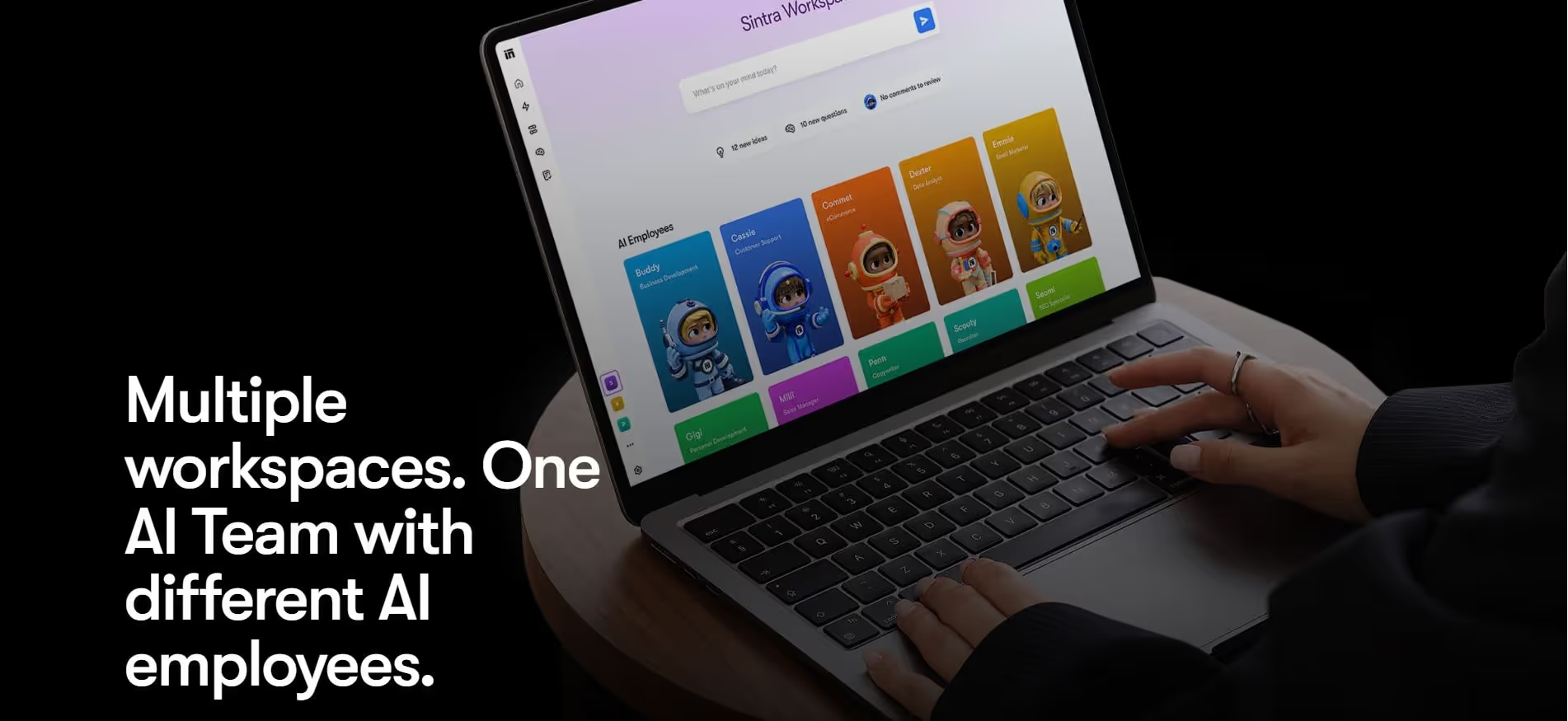
Tired of being drowned in support tickets?
Sintra AI provides you with multilingual 24/7 customer care that sounds like your brand. Their AI employees operate through channels, maintain customer records, and forward only complex cases to your team with context.
Its setup takes hours, not months!
Watch how 3x the volume of support is served without adding employees to your teams: Learn about Sintra pricing or their AI team.
Frequently Asked Questions
Can AI virtual assistants entirely replace human support agents?
No, and they shouldn't. The customer experience can be enhanced with AI virtual assistants that offer support 24 hours a day, even when human agents are offline, yet more complex scenarios require human input.
The most effective solution is to have AI answer basic questions and have human operators handle complex or emotional issues. Consider AI your initial defense, freeing your team for high-value interactions.
How accurate are AI virtual assistants for customer service?
Accuracy is all about the quality of the knowledge base and system configuration. Properly setting up assistants with clean documentation performs with 85-95% accuracy on standardized questions.
Performance is reduced by stale information, vague queries, or highly technical problems. Periodical repair is essential. Refuel the knowledge base once a month, review the failed conversations, and train the system on the new product launches.
Are AI customer service assistants suitable for small businesses?
Definitely, notably as expenses are reduced and arrangements are easier. In fact, it helps small businesses a lot, as AI can handle increased volume without the need to hire more people.
A virtual assistant would help a business leader regain time and focus on strategic growth by delegating administrative and repetitive tasks. The trick is to select platforms with relatively quick implementation and low prices when buying a smaller number of tickets.
Related articles