What is an AI automation?

Skip ahead
Building a successful business is challenging in today's competitive landscape. From developing a product or service to providing reliable customer support, performing continuous data analysis, and keeping team morale high, businesses juggle countless responsibilities at once.
With teams already stretched thin, it would be unwise to ignore the rising buzzword in business: AI automation. But what is AI automation? Simply put, it's the ultimate cheat code—technology that helps businesses streamline operations and get more done by automatically executing a series of actions.
If you're struggling with business optimization, this straightforward guide will walk you through the basics of AI automation. You will find out how AI employees can take repetitive tasks off your plate so your teams can focus on high-value work that drives real growth.
Quick Answer: AI automation defined
AI is a technology that mimics human intelligence, whereas automation performs routine tasks without human intervention. AI automation combines both. It not only automates repetitive tasks but also adapts, optimizes, makes real-time decisions, and improves through continuous interactions.
AI-powered automation can be applied across business operations, with AI helpers streamlining critical processes to significantly boost efficiency.
What’s AI automation?
Almost 90% of companies are exploring AI automation technologies in 2025. That's because AI automation uses artificial intelligence and automation to handle tasks and processes on its own. It works by reviewing data, recognizing patterns, and making logical decisions. This allows it to take over repetitive or time-consuming work like data entry, invoicing, inventory management, and even dynamic pricing.
AI workflow automation relies on machine learning to analyze and predict patterns, and natural language processing to understand and respond to human language. Advancements in large language models and generative AI have empowered these systems even more, allowing them to create content and personalize interactions.
Unlike traditional automation that follows a set of rules to perform tasks, AI task automation can learn and improve over time. With techniques like machine learning, reinforcement learning, and feedback, AI agents deliver more relevant and accurate results.
Here are a few practical examples of AI task automation.
- Email Triage: AI can scan incoming emails, detect intent, categorize messages, prioritize urgent requests, and draft quick responses.
- Social Media Scheduling: AI tools help streamline social media by scheduling posts, aligning content with marketing strategies, and publishing at optimal times for maximum engagement.
- Data Processing: AI automation extracts data from multiple sources, cleans it, organizes it, and turns it into actionable insights with minimal manual effort.
- Predictive Analytics: Predictive analytics uses historical data to interpret trends and make predictions. For instance, AI automation has transformed how the insurance industry operates by automating processes like fraud detection and claims processing.
- Customer Support: AI-powered chatbots provide 24/7 support, answering common queries, resolving issues faster, and escalating complex cases to human agents when needed.
AI automation is projected to reach a market value of $1.3 trillion by 2030, indicating its growing importance in business operations. This is why every business needs an AI automation tool to survive and grow in today's dynamic markets
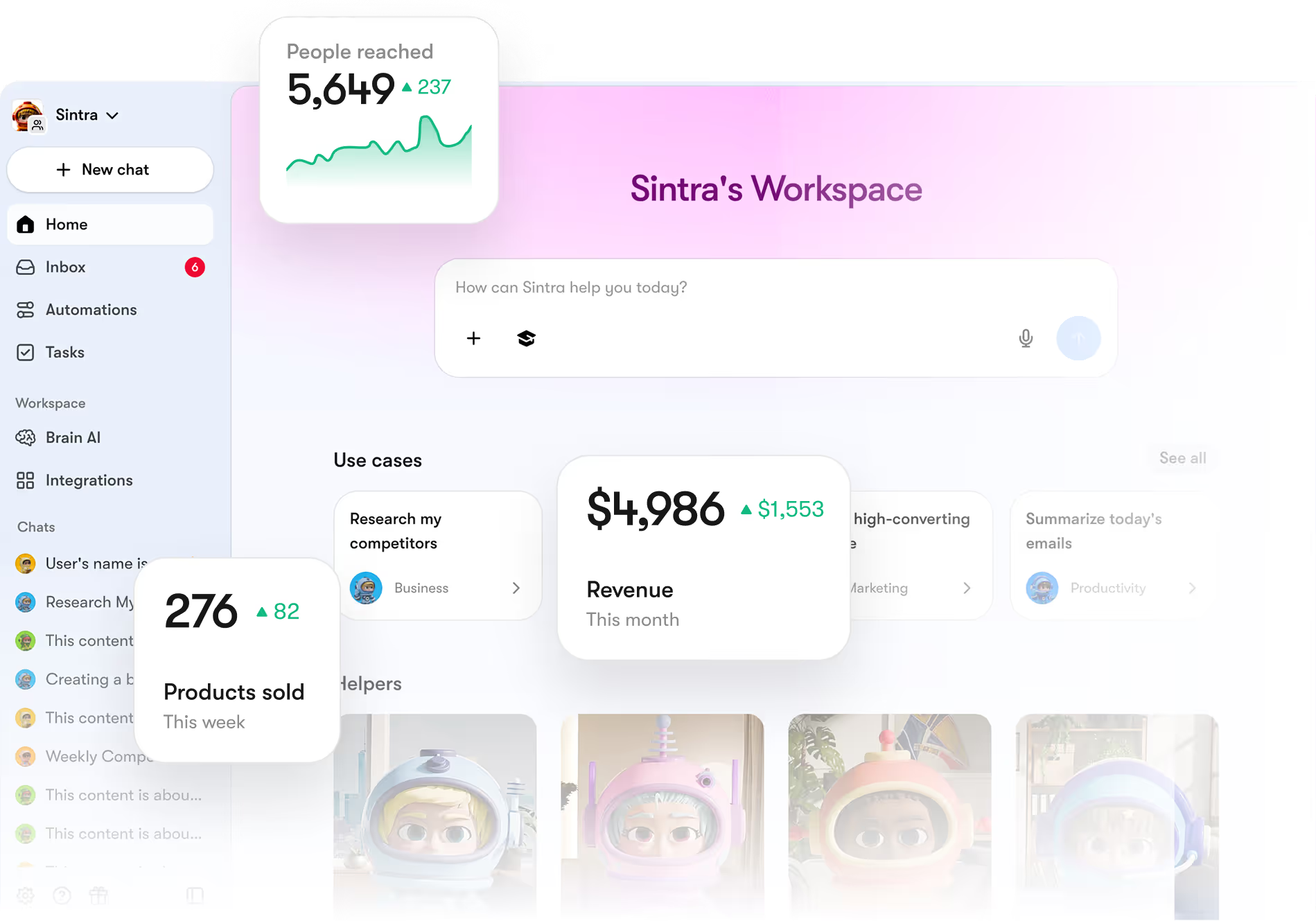
Sintra AI is a real-world model of AI automation in action that automates critical processes while interacting like a smart chatbot. Sintra AI understands context, analyzes data, and automates actions with accuracy, helping businesses achieve operational efficiency.
How does AI automation work?
AI business process automation ensures that tasks are executed with minimal human intervention. It relies on algorithms—sets of rules and calculations—that enable it to analyze data, learn patterns, and act autonomously.
Although AI does most of the heavy-lifting, humans still play an important role in automation systems. They review output, provide feedback, and correct errors when needed. Over time, this input allows automation systems to become more accurate and effective.
Let's break down the technologies and processes that enable automation using AI.
Foundational models and cloud services
For AI automation to scale, it requires two essential components: foundational models and cloud services. These work together to make AI fast, accessible, and reliable.
Foundational Models (The Brains)
You can think of foundational models as the brains behind AI-driven automation. They are large AI models that have been trained on massive amounts of data. Since the models learn from diverse sources, they understand patterns more effectively. That enables them to perform various tasks without requiring retraining from scratch.
They can:
- Understand and generate human language
- Power chatbots, virtual agents, and translation tools
- Analyze data and make predictions
- Create images, videos, or written content from prompts
But the challenge with AI models is that they learn from historical data, which can embed biases and often produce unfair outcomes. That's where bias and fairness audits can help maintain balanced datasets.
When you automate your business processes with Sintra AI, you leverage the power of foundational models along with Sintra’s built-in Brain. This Brain stores and learns every detail about your business to ensure outputs are always accurate, relevant, and personalized.
Cloud Services (Delivery System)
Cloud services provide the computing power, storage, and infrastructure needed to run foundational models at scale. Thanks to cloud services, businesses don't need to invest in expensive hardware. Instead, they can:
- Access AI models anywhere, anytime
- Perform heavy computations quickly
- Store and manage large amounts of data
- Scale operations without added hardware costs
Without the cloud services, foundational models would be too large and resource-intensive for most businesses to use. But with this delivery system, AI automation is possible for companies of all sizes.
Data collection
Data collection in AI automation is the process of gathering, organizing, and preparing data that systems use to perform tasks autonomously.
Data comes in two forms: structured and unstructured.
Structured data is:
- Neatly organized in rows and columns
- Easy for computers to search, sort, and analyze
- Follows a predefined format
- Examples: Spreadsheets, sales records, inventory lists, and customer data
Unstructured data is:
- Not organized in a predefined format
- Harder for computers to read without AI
- In the form of text, audio, images, or video
- Examples: Emails, chat messages, customer reviews, social media posts, and PDFs.
AI needs both types because data fuels its workflows and automation processes. It helps the system understand patterns, make predictions, and generate accurate responses.
For example, an AI automation system might use structured data to forecast customer demand and unstructured data to analyze customer feedback across social media posts and emails.
Data preparation
Data preparation involves cleaning, organizing, and formatting information so AI systems can understand it without confusion. It focuses on standardizing formats, removing errors or duplicates, and structuring data in a way that models can process.
Well-prepared data improves the output of AI automation and ensures smoother workflows, especially in AI content automation.
AI model training
AI model training is the process of feeding the system relevant data from multiple sources, allowing it to learn patterns and make predictions. During training, the model analyzes examples, adjusts its internal rules, and improves over time so it can perform tasks accurately.
AI models learn in different ways depending on the type of problem they're solving.
- Supervised training teaches the model using labeled examples. For example, showing an AI thousands of tagged product photos so it learns to identify items correctly.
- Unsupervised training finds patterns and relationships without labels. It's similar to how a product recommendation system on an e-commerce website suggests add-ons and similar items based on customer data.
- Reinforcement learning is where a system is trained through trial and error. Good decisions are rewarded, while bad decisions are penalized. For example, a warehouse robot is awarded points for choosing the fastest path.
Together, these methods make automation using AI more adaptive, reliable, and efficient.
Machine learning algorithms
Machine learning algorithms power AI automation by analyzing data, recognizing patterns, and making predictions that guide automated actions. They help systems continuously improve as they encounter new information.
Predictive maintenance is a typical application of AI used in manufacturing. Today, AI automations are helping manufacturing businesses to control their expenses by analyzing the machinery data. This helps avoid overwhelming repairs and using image recognition to identify potential defects.
Deep learning
Deep learning makes AI automation smarter by processing complex data like images, audio, and large text sets. This technology enables AI automation systems to perform advanced tasks such as image recognition, language interpretation, and fraud detection.
Natural language processing
Natural language processing is the human element in AI automation. It allows the system to understand, interpret, and generate human language. With NLP, AI automation in areas like customer support, content generation, and sentiment analysis becomes possible.
For instance, busy professionals can use Generative AI to draft context-aware emails and produce authentic content with a few clicks.
Execution
Once an AI model is completely trained, it is integrated into a workflow automation.
The execution process uses inference engines to apply what the system has learned and make decisions in real time. Trained models can analyze incoming data, choose the best action instantly, and trigger automated workflows without human intervention.
For example, an automated AI finance system can identify a fraudulent transaction and instantly block the invoices. It then escalates the issue to a human agent for further investigation.
The execution step becomes even more powerful when AI is connected with a company's existing tech stack. With powerful AI integrations, AI systems can make faster and more accurate decisions and automate processes from start to finish.
Continuous learning
The best part about AI systems is that they don't remain static. They constantly improve through online learning and feedback loops.
- The AI updates its knowledge automatically instead of waiting for a full retraining cycle.
- New data is processed in real time, allowing the model to identify emerging patterns.
- The system learns from corrections and user feedback.
Continuous learning creates a cycle where AI-powered automation gets more accurate the more it is used. However, this enhanced operational efficiency comes with unique challenges that require a holistic approach to mitigate the risks of AI automation.
How do AI Agents Differ from Traditional Automation Tools?

Autonomous AI agents represent software systems that can think, reason, plan, and retain information. Most importantly, they demonstrate autonomy. They can make decisions, learn, and adapt on their own.
Unlike rule-based automation (RPA) and simple reflex agents that follow predefined rules, intelligent agents operate independently in dynamic environments. This makes them ideal for handling multi-step tasks in marketing, commerce, sales, customer service, and beyond.
What makes an AI agent automation powerful is its unique mix of abilities, such as:
Context Interpretation
AI agents can understand context and sentiment behind user input and interact with them like a human agent. This ability to interpret intent and respond conversationally means they can perform tasks accurately without human intervention.
- RPA: Follows predefined rules. It can only handle tasks that it's been programmed for, and if the input changes or context shifts, the system fails
- Intelligent Agents: Understand context due to NLP and ML. They interpret meaning, analyze intent, and perform tasks in varying conditions.
Autonomy
An AI agent's defining characteristic is its autonomy. These intelligent agents can think, plan, prioritize, and complete tasks without predefined instructions. Since they operate with minimal human supervision, they can complete complex tasks faster and more effectively.
- RPA: Executes tasks only when triggered. It cannot make its own decisions.
- Intelligent Agents: Can plan the next steps in the workflows and take actions independently based on goals and real-time data.
Adaptability
AI agents can learn from past interactions and improve constantly with new information and insights. This allows them to adapt to evolving goals and parameters and seize new opportunities.
- RPA: Rigid systems that are unable to learn or improve.
- Intelligent Agents: Learn and improve through new data and feedback loops. They evolve with changing processes and improve accuracy constantly.
Multi-Step Execution
Smart agents can handle complex tasks that require several actions in sequence rather than just a single command. They can analyze user input, pull relevant data, make a decision, perform the correct action, and then trigger the next step automatically.
- RPA: Handles straightforward, repetitive tasks that follow a predictable sequence.
- Intelligent Agents: Can complete end-to-end workflows by managing complex, multi-step workflows.
Sintra's AI team consists of 12 intelligent agents that can automate critical business processes. These include sales, customer support, social media, and data analysis. It's a complete AI agent automation solution that helps businesses scale without losing operational efficiency.
If you're planning to integrate Sintra’s AI agents, it’s best to deploy them one at a time. Rolling out a large set of AI tools at once can overwhelm teams, leading to poor skill adoption rates. A phased, well-planned rollout helps teams adapt faster and extract greater long-term value.
Benefits of AI Automation
AI-driven automation combines the power of machine automation with intelligent reasoning to deliver superior results. While a robust AI solution often involves upfront costs for hardware, software, data acquisition, and personnel, the benefits easily outweigh the initial costs.
Here are a few advantages of AI-driven automation that prove why it's the next big thing in business.
Speed
Whether it’s data entry, scheduling meetings, processing forms, or any repetitive part of your workday, AI works like anything. With all the manual tasks taken care of, the workforce can focus on strategic tasks, meeting the market demands, and growing the business.
Plus, AI agents do not take breaks. From providing employee support to retrieving information from inventory or handling meetings, your AI automations can take care of almost everything instantly.
Accuracy
Think of your AI automation tools as machines that don’t get tired and distracted easily. These tools are built to perform to the set standards and with consistency.
Simply put, unlike humans, AI tools ensure accuracy by interpreting bulk data and handling complex calculations with no mistakes. You can also program AI to use the feedback to improve its performance over time.
Scalability
AI can handle a high volume of work without human errors. This means you can always expand your operations without thinking about cost, resources, or human effort. For example, in manufacturing, AI can monitor assembly lines in real time, reducing unplanned downtime by up to 50%.
That’s not it. You can also replicate and deploy an existing AI automation system in different locations. With such flexibility, companies can choose to scale and grow while maintaining performance.
Decision-Making
AI agents can make the most of the data that a human may overlook. This smart technology does not focus on guesswork and interprets massive data to identify patterns and make predictions.
Modern AI monitoring setups can also help businesses with risk management by detecting anomalies in real time. Hence, with AI-driven data analysis, leaders can take faster and more informed decisions.
However, many AI models function as 'black boxes', making it difficult to identify or correct biases in decision-making without transparency. That's why keeping humans in the loop is important when automating with AI.
Cost Reduction
AI-driven automation is expected to cut labor costs by 30% for several industries, allowing for more efficient operations with smaller teams. How? Because the traditional way of handling businesses’ operations is time-consuming and often leads to delays. Thankfully, AI not only helps with efficiency but also eliminates redundant steps and avoids bottlenecks - meaning you no longer have to spend excessive resources.
A real-life example is NIB Health Insurance, which employed AI assistance for its customer services and saved $22 million, reducing the cost by 60%.
This is just the beginning, as artificial general intelligence (AGI) is an area of active research that may enable AI to understand, reason, plan, and apply knowledge at an expert human level. This advancement will ensure even more benefits for businesses automating their systems with AI.
Examples of AI Automation in 2026
AI automation will reshape industries on a global scale as it continues to be adapted for more business situations, providing increased efficiency and helping companies solve more challenges. Here are a few examples of how AI employees have benefitted businesses across industries.
Business Development Partner - Buddy

The most obvious use case of AI-driven automation is business development. AI business strategists like Buddy can help teams work more effectively and proactively by automating routine tasks. Click Hive, a marketing agency, was struggling with creative growth.
With Buddy, the company moved from reactive to proactive decision-making and refined its campaign strategies. It connected with the business knowledge base and used advanced analytics to generate fresh ideas, beyond automation, to incorporate in routine operations.
Data Analyst - Dexter

AI-driven automations also help you with informed and data-driven decision-making across industries. AI analysts like Dexter are designed to make sense of your business data and interpret it to make patterns and predictions.
Rebecca Austin, the owner of Strive 4 Savvy, a company that helps businesses grow organically, used Dexter for expert guidance. It used the business's past data to make interpretations that may have missed by humans. Then, converts them into actionable insights to help businesses grow.
Email marketing specialist - Emmie

Struggling to communicate with your customers? AI email assistants have got you covered. Email specialists like Emmie are excellent at engaging the selected leads, personalizing your outreach messages, and following up on responses.
Simply Precious Hands, an NY-based healthcare small business, was struggling to make a connection with customers. Thankfully, employing Emmie helped it curate personalized messages and respond to queries.
Customer Support Expert - Cassie

An area where AI automations are making the most impact is customer support. Be it supporting customers’ experience, answering FAQs, and promoting businesses, automations are there to help you. Plus, AI agents in customer service not only offer 24/7 support but also know when to escalate complex cases to human reps.
For instance, H&M chatbots are helping customers every day with common queries like product recommendations, product availability, order tracking, and more. With this support, the company reduced the load on agents and cut down the wait time, leaving customers satisfied.
Personal Productivity - Gigi

AI automation tools are not restricted to helping people with professional tasks. Today, an AI personal assistant is equally beneficial in helping you stay on track, be organized, and reach goals.
It understands your priorities, automates reminders, and tracks activities to make sure nothing is left behind. It’s an excellent choice for entrepreneurs like Leyla Preston, managing multiple businesses with personal responsibilities.
Copywriter - Penn

Like social media managers, AI copywriters are also helping companies create content - be it lengthy articles, social media captions, ads, and more. For instance, content optimized using AI is known to improve engagement rates to 32% and conversion rates to 47%.
Learn more about how to humanize AI content and repurpose it for better engagement across platforms.
HR & Recruitment Assistant - Scouty

HR is not any different. AI automations empower HR to speed up their onboarding and hiring processes by taking over repetitive tasks like resume screening and document verification. Today, AI recruiters like Scouty create job descriptions, scan applicants, and reach out to potential talent to effectively build a reliable workspace.
Walmart, the renowned multinational retail corporation, integrated Vervoe, an AI hiring platform, into its hiring processes. The platform would interact with applicants using skill-based assessment. This helped the company reduce the time-to-hire by 50%.
eCommerce Manager - Commet

Struggling to keep up with your online store amidst a hectic routine? Commet, the AI-driven eCommerce manager, is here to help. It does almost everything, from inventory updates to automated order tracking, adding product descriptions, and resolving customers’ queries.
SEO Specialist - Seomi

No need to spend hours fixing the SEO of your website. AI does it for you. Smart SEO assistants like Seomi are designed to help you do SEO audits, identify opportunities or issues, and fix them.
It is helping businesses optimize content, improve ranking, and stand out from competitors. You can employ these assistants to conduct keyword searches, organize topics, and target the right terms to search.
Social Media Manager - Soshie

Struggling to keep up with your marketing? Employ an AI social media manager and let it handle all your content demands across social media just like Anil Puri did. A seasoned accountant struggling to manage client communication while keeping up with his socials.
Soshie, the AI social media assistant, produced content for Anil’s business and published it across platforms. With its scheduling function, he could plan entire weeks in advance, freeing up space to build connections with clients.
Sales Expert - Milli

Sales reps no longer have to invest most of their day to repetitive tasks - data entry, checking on leads, filtering prospects, etc. AI sales managers are built to do it all for them, so they can focus on building lasting relationships with the customers.
They get into your sales funnel, identify the target leads against your ideal customer profile, and personalize their outreach in minutes. Not only this, but you can also employ these agents to respond to customer inquiries, forecast sales, and update the CRM data.
Virtual Assistant - Vizzy

AI virtual assistants are a blessing in your busy day. AI automations can help employees in the healthcare industry to reduce administrative overhead, including billing and scheduling. This way, providers can truly focus on spending time with patients. Leyla Preston, the owner of Hand2Hold, a wellness solution, employed Vizzy in her workflow.
Like human assistants, this VA got into her workflow and learned about her priorities, goals, and objectives. Accordingly, it managed her calendars, booked interviews, conducted meetings, and followed up on communication.
Why You Need Automation?
Let’s address the elephant in the room. You have tons of work pending with no money to spend on recruiting new talent. Your team is doing the most with existing resources. But the issue is that most of their day is spent on manual and repetitive tasks.
It’s eating their workday off without realizing that nothing productive is being done. What’s left? Constant hustle with no prospects of growth and innovation.
Hence, the only sane way out of this mess is AI for business automation. Think of it as your backup workforce that does not take much money and does the tasks that don’t need much thinking - data entry, report generation, responding to messaging, etc.
With everything taken care of, your human workforce gets their time back to put in all their efforts on creative issues, making complex analyses, and building lasting relationships with customers.
It’s not just about improving productivity in the workspace; it’s about getting an edge over competitors. With automations handling the repetitive operations and human talent focused on high-impact tasks, your business moves faster and more accurately.
But it gets better because the future of AI automation promises even more advances in handling tasks that require perception, reasoning, and complex problem-solving. This means your teams will get even better value from AI automation tools moving forward.
Choosing Sintra AI
When you are just starting out with AI automation, it can get messy with experts talking about training AI models, programming your agents, and more. Don’t have the time or skill to get into the technicalities?
The solution: Sintra.ai. It is an advanced no-code business solution with AI task automation functionality. So, you don’t need any expertise to get started with this.
The platform features twelve special agents supported by a knowledge base, called Brain AI. Brain AI stores all your business information, from goals to objectives, documents, and more. With this data used as context, all these agents perform their respective duties - SEO optimization, content writing, customer support, email drafting, and more.
What’s even better? All these agents come with unique use cases. These use cases allow you to perform repetitive tasks almost instantly, with no need to write lengthy prompts.
Ready to Take the Next Step?
Finally, you must have an idea about what is AI automation. AI automations are an excellent way to reduce administrative overhead, so the employees can focus on their core strategic responsibilities. But keep in mind that as AI automates repetitive functions, job roles will shift, requiring employees to reskill and focus on developing strategic, creative, and tech-centric capabilities.
Don’t know where to begin? Try Sintra.ai. It is an all-in-one AI automation business solution with specialized AI agents that help you throughout your professional and personal day. Plus, it’s a no-code platform, so no more worries about onboarding or setting it up.
Get started today and see how it works for you.
AI Automation FAQs
What is AI automation, and how does it work?
AI automations refer to the use of AI in automating repetitive tasks like data entry, customer enquiries, etc. It uses deep machine learning and NLP to enable systems to learn, adapt, and handle complex problems with minimal human input.
How does AI automation differ from traditional automation tools?
Unlike traditional automation, AI automation moves beyond simple rules. It uses advanced algorithms to learn and adapt to complex problems. It makes sense of data (structured or unstructured), identifies patterns, and applies them to dynamic situations.
What business tasks can be automated with AI?
Today, AI can automate a wide variety of business tasks, including data entry, customer service, data analysis, SEO strategies, financial analysis, and marketing outreach. This frees up space in employees’ day for strategic planning.
Is AI automation expensive or hard to implement?
It depends. AI automation tools can be inexpensive, easy to set up, or very expensive, trained for custom workspaces. To begin with, a no-code solution with affordable, easy-to-customize AI helpers might be a better choice.
Will AI automation replace human jobs or support them?
While AI automation replaces many human jobs, it also creates new opportunities for employees to excel in their workspaces. For instance, AI assistants might take over a data entry task, but the strategic analysis still remains subject to human approval. The proof of this lies in the World Economic Forum's Future of Jobs Report 2025. It predicts a net increase of 78 million new jobs by 2030 due to the balance of automation and workforce transformation.
What challenges should businesses consider before adopting AI automation?
Before businesses adopt AI automation, they must consider challenges like integration of AI in the existing work setup, employees’ hesitancy to use AI, high setup costs, and talent gaps. They must also be mindful of new security risks as automated systems handle sensitive data, making them prime targets for cyberattacks.
How do AI agents improve workflow automation compared to basic bots?
As compared to basic bots that rely on rule-based actions, AI agents use proactive intelligence. They understand the intent behind users’ conversations, learn from data and experience, and adapt the learnings to various new and complex situations.
What industries benefit most from AI automation?
Typically, industries with high volumes of data, struggling with productivity, and in need of personalized solutions benefit most from AI. This includes healthcare, financial services, retail, e-Commerce, manufacturing, and logistics.
How can small businesses start with AI-driven automation quickly?
Small businesses can start with no-code AI-driven automation tools like Sintra. It allows purchasing individual agents that might be of their benefit and not the entire package. However, before you begin, it’s important to have a strategic approach with limited use cases that have scope for high impact.


.avif)


.avif)
.avif)
.avif)