A Business Guide to AI Implementation

Table of Contents

Quick Answer
To successfully implement AI in your business, you must first identify the specific bottlenecks in your daily operations and match them with role-specific AI tools. A winning AI implementation strategy follows four direct steps:
- Assess your manual tasks
- Choose specialized AI employees to handle them
- Integrate these tools into your current workflows
- Track the time or money saved.
By focusing on execution over complex infrastructure, you can implement AI and see measurable results in days.
When most people talk about artificial intelligence implementation, they make it sound like a multi-million dollar infrastructure overhaul. In reality, it is simply the process of selecting the right tools, plugging them into your existing workflows, and letting them do the heavy lifting.
Gartner reports that by the end of 2026, worldwide spending on AI will hit $2.5 trillion, as companies shift from "experimenting" to full-scale operations. For every $1 invested in AI, companies are realizing a $3.50 return, proving that this isn't just a tech trend; it’s a massive efficiency play.
This guide is your practical roadmap for how to implement AI in business without the headaches. We'll walk through building strategy, prepping your data, and integrating no-code solutions that turn AI implementation from a complex project into a straightforward business win.
What Is AI Implementation?
At its core, artificial intelligence implementation is the practical bridge between having a tech tool and actually seeing it produce business value. You identify problems in your workflow and choose the right AI tools to solve them. It isn't about building your own models from scratch; it's more about adopting automation.
Think of it as hiring an AI workforce. You give the tools a specific job description and the data they need to execute. This transition from theory to practice is what turns a buzzword into a competitive edge. AI implementation is a continuous process; it is not a one-and-done solution.
The implementation of AI now spans almost every business function:
- Customer Support: Deploying AI agents to handle FAQs, track orders, and resolve tickets 24/7. Companies with high AI adoption see a 30% reduction in operational costs.
- Content Creation: Using generative tools to draft blogs, social media posts, and ad copy in minutes rather than hours. Generative AI agents can deliver a 44% increase in human productivity across enterprises.
- Sales Outreach: Automating lead scoring and personalized email sequences to keep your pipeline full without manual data entry.
- Data Analysis: Plucking actionable insights from spreadsheets and customer behavior patterns instantly.
Overall, AI implementation is about integration. It's the act of weaving these capabilities into your existing stack so that your team spends less time on grunt work and more time on high-level strategy.
Why Are Businesses Prioritising AI Implementation Right Now?
The race towards AI implementation isn't just about blindly following a trend; it's a calculated move for survival and scale. In 2026, the gap between businesses that use AI and those that don't is no longer a "slight edge"; it's a deep, wide rift.
According to Forbes, over 60% of business owners now believe AI will improve their business productivity, as they shift their focus from curiosity to concrete operational outcomes. For a solo founder or a small team, this means having the output of a 10-person department without increasing the headcount.
Businesses are prioritizing implementing AI right now for three concrete reasons:
- Unmatched Speed: Turnaround times for content, data reports, and customer responses have moved from days to seconds. Generative AI (Gen AI) can deliver a 44% increase in human productivity across enterprises.
- Infinite Scalability: Unlike human teams, AI doesn't need to sleep or take breaks. Scalability is essential for any successful AI implementation, allowing systems to handle growing volumes of data, users, or processes without sacrificing performance.
- Consistent Execution: AI follows your "Brand Brain" or SOPs perfectly every time, eliminating the "human error" variable in repetitive tasks.
The only question that remains after this is how to implement AI in business. Because right now, this implementation has moved from a luxury for tech giants to a standard utility.
How to Implement AI in Your Business: A Step-by-Step Strategy
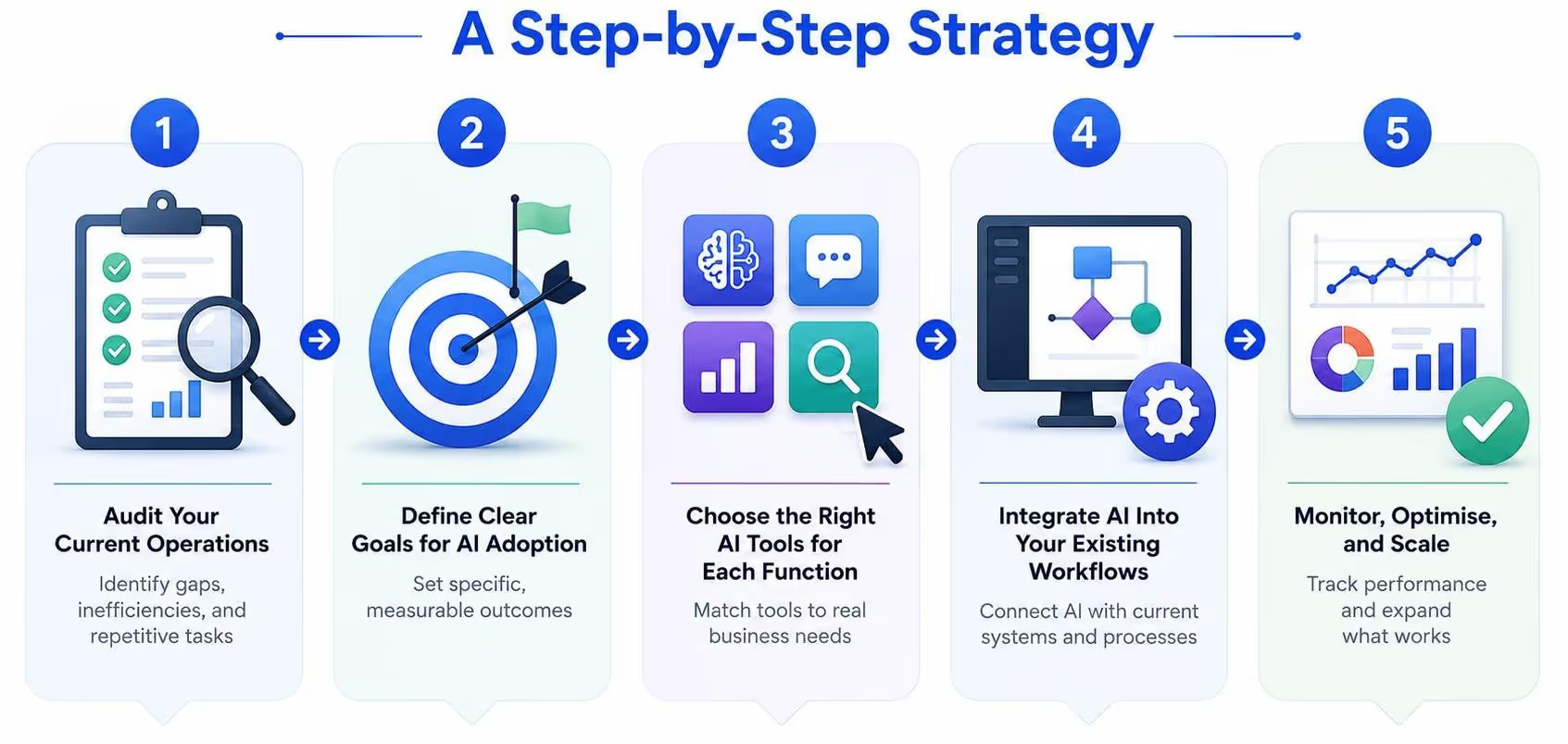
Devising a successful AI implementation strategy doesn't require a complex project to finish. But it does need a thorough plan that serves as a practical walkthrough to automate your manual, time-consuming tasks.
These steps are built to be followed in order, but they are flexible enough to adapt whether you are a solo founder or leading a growing team. AI implementation is a continuous process; it is not a one-and-done solution, and those starting today are securing a compounded advantage.
The goal here is simple: move fast and avoid the common pitfalls. By following this framework, you’ll ensure that every tool you add actually moves the needle on your bottom line. Let's get started.
Step 1 — Audit Your Current Operations
Before spending a fortune on expensive tools, you need to know exactly where your time is leaking. The foundation of any AI implementation strategy is the audit of your manual workflows. You need to move past broad categories and identify the granular repetitive tasks that prevent you from focusing on high-level growth.
The goal is to find the highest-value targets for the implementation of AI. Look for predictable, high-volume, and time-consuming tasks called bottlenecks. Ask yourself: "If I could have this task finished perfectly every morning, which one would save me the most stress?"
Start by auditing these specific areas:
- Content & Marketing: Pinpoint exact tasks like resizing images for different platforms, drafting three variations of a LinkedIn post, or turning a long-form blog into a newsletter.
- Customer Interaction: Identify how much time is spent answering the same five shipping or pricing questions in your inbox.
- Sales & Lead Gen: Look at the hours spent manually scraping LinkedIn profiles or sending "just checking in" follow-up emails to prospects.
- Data & Reporting: Track how long it takes to pull numbers from three different platforms just to create one weekly performance report.
Begin with small-scale pilots to test feasibility and demonstrate return on investment, reducing high-risk potential for failure. By mapping these specific tasks now, you ensure your AI implementation is surgical and effective rather than a shot in the dark.
Step 2 — Define Clear Goals for AI Adoption
A common mistake in any AI implementation strategy is falling for every new AI tool you come across. To see a real return, you must set measurable outcomes before you start clicking "sign up." Your goals should be crystal clear as to why you need an app, what you expect from it, and where you will deploy it in your workflow.
When you know how to implement AI in business effectively, you stop looking for general-purpose assistants and start looking for role-specific tools. An AI designed specifically for a task will always outperform a generic one because it is built for a clear function.
Defining clear, measurable objectives is essential for a successful AI implementation. It helps align the AI initiative with business goals and provides concrete targets for evaluation. Set your sights on specific KPIs such as:
- Speed: Reducing customer response times from 4 hours to under 60 seconds using automated support agents.
- Efficiency: Cutting content production time in half by using AI to generate first drafts and social snippets.
- Accuracy: Automating weekly reporting to eliminate manual data entry errors and ensure 100% data consistency.
- Growth: Increasing sales outreach volume by 3x without hiring additional staff.
Conducting pilot tests allows organizations to evaluate the effectiveness of AI technologies in a low-risk environment before full-scale deployment. It enables refinements based on feedback and performance data. By defining what "success" looks like now, you ensure your AI transition is driven by ROI, not hype.
Step 3 — Choose the Right AI Tools for Each Function
This is the stage where most businesses fail by trying to find a single tool for everything. Effective artificial intelligence implementation relies on matching specific tools to specific roles.
Think of it like building a team: you won't expect an accountant to run your social media, so don't expect a generic chatbot to handle your specialized business workflows. The most successful strategies utilize dedicated agents that are already trained for a specific department.
These role-specific helpers remove the need for you to spend hours writing complex prompts or configuring software from scratch. You get a digital employee that understands the goals of its position from day one.
For a smooth AI implementation, consider deploying specialized assistants for your core functions:
- Customer Support: Use an AI customer service agent to manage queries and resolve tickets 24/7 without human intervention.
- Sales & Outreach: Deploy a dedicated sales helper like Milli to handle lead scoring and personalized outreach across email and LinkedIn.
- Business Operations: An AI business assistant can act as your strategic partner, connecting signals across your business to help you make faster decisions.
- Data & Analytics: Use a data analyst to transform raw spreadsheets into actionable ROI reports and sales forecasts instantly.
By choosing a platform that offers a fleet of role-based helpers, you ensure that your implementation of AI can grow with you. When you’re ready to scale from marketing into sales or HR, you simply activate the next specialist rather than starting your tech search all over again.
Step 4 — Integrate AI Into Your Existing Workflows
A common misconception about implementing AI is that you have to tear down your current systems to make room for automation. In reality, the most effective way is to layer it directly on top of the platforms you already use - your CRM, email, calendars, and social channels.
There is absolutely no need for a costly integration consulting firm to get your tools to play nice. Instead, look for "plug-and-play" compatibility. When an AI tool features native AI integrations, it can pull data from one app and execute a task in another without you acting as the middleman. This creates a seamless flow where the AI works within your business, not just alongside it.
Sintra AI is built around this "ecosystem-first" approach. Its AI helpers are designed to connect directly to the tools your business runs on every day. Whether it's syncing a lead from your outreach bot to your CRM or having your customer support agent update a shipping status in your backend, everything happens in complete synchronization.
This integration ensures that your AI implementation feels like a natural extension of your team rather than a separate project.
Step 5 — Monitor, Optimise, and Scale
The final stage of any AI implementation strategy is launching the tools till you see growth. One important thing to remember is that this AI implementation is a continuous process; it is not a one-and-done solution. Its real value is unlocked through continuous refinement.
Once your tools are live, you must track their performance against the KPIs you set in Step 2. Are they hitting your response time targets? Is the content quality consistent? Ensure ongoing performance metrics are established to detect model degradation and retrain AI models with new data regularly.
The secret to long-term success in AI implementation is centralized memory. Instead of re-teaching your AI about your brand voice every single time you start a new task, you need a system that learns as it goes.
- Contextual Intelligence: When your AI understands your business goals, target audience, and past successes, its output becomes exponentially more accurate.
- Consistency Across Roles: Your customer support agent and your sales bot should speak the same "language."
- Long-Term Value: Sintra's Brain AI acts as the central nervous system for Sintra’s helpers, storing your specific business context so that every interaction is personalized and aligned with your brand.
By using a centralized memory system, you ensure that as your business evolves, your AI evolves with it, becoming more effective with every task it completes.
Common Challenges in AI Implementation (and How to Solve Them)
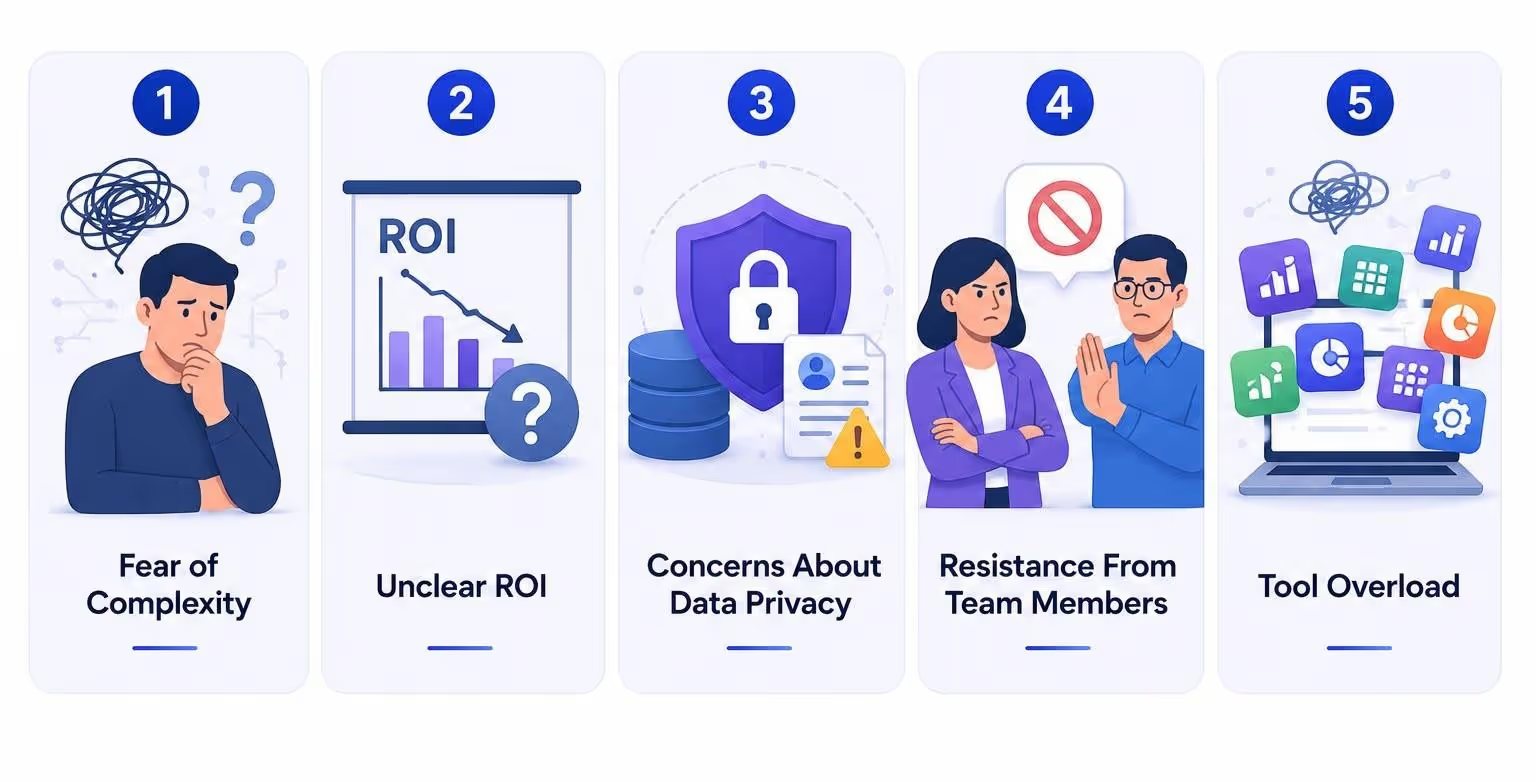
Transitioning to an AI-driven workflow is a major shift, and it's natural to hit a few speed bumps. Businesses often encounter challenges related to control, transparency, and trust in the AI system when implementing AI, including managing knowledge infrastructure and trust issues with incorrect information.
Most businesses face the same handful of friction points, but in 2026, these are no longer "project killers." They are simply logistical steps to manage. The key to a successful artificial intelligence implementation is not avoiding these hurdles, but having a plan to clear them.
Let's have a look:
It's Too Complicated for My Team
Many business owners delay implementing AI into their workflows because they assume their team members will struggle to adapt to it. It is a common misconception that handling AI tools requires complex prompt engineering and model configurations.
The Solution: Modern AI implementation strategy has shifted from building to deploying. The most effective tools are entirely no-code, designed specifically for non-technical users to hit the ground running.
You don't need to hire a developer or have your teammates take extensive training when you can use pre-trained, role-specific assistants that already understand the nuances of marketing, sales, or support.
Sintra AI is built for this exact scenario. Its AI helpers come pre-configured for their specific roles and offer plug-and-play connectivity to the tools your team already uses. By removing the technical barrier, you allow your team to focus on high-level execution while the AI handles the mechanical complexity behind the scenes.
We Don't Know Where to Start
The sheer scope of implementing AI in your business can be daunting at first. When every department could theoretically benefit from automation, leaders often get stuck in paralysis, fearing the overhaul that lies ahead. They think that if they don't renovate the entire company at once, they might fall behind.
The Solution: The most successful companies don't transform overnight; they scale through incremental adoption. A smart strategy involves starting with a single, high-friction function to prove the value before expanding.
Many businesses find their footing by starting with content and social media, as these are high-volume tasks with clear boundaries. For example:
- Content Production: Using an AI copywriter like Penn to handle first drafts and blog outlines.
- Social Presence: Deploying an AI social media manager like Soshie to manage posting schedules and engagement.
Begin with small-scale pilots to test feasibility and demonstrate return on investment, thereby reducing the high risk of failure. Once you’ve mastered one area, you can then layer in more complex automations, turning a single "pilot" into a full-scale digital workforce.
We're Concerned About Data Privacy
In an era of strict regulations like GDPR and CCPA, businesses are rightfully cautious about feeding sensitive company data into external models. The fear is that proprietary information, customer details, or "trade secrets" might be leaked or used to train public AI models that competitors can access. Also, AI solutions, particularly large language models, can provide incorrect answers.
The Solution: You need to opt for platforms that prioritize data sovereignty. Instead of choosing public consumer chatbots, professional businesses should go for enterprise-grade solutions that offer private, siloed environments. Implementing robust data protection practices, such as data anonymization, encryption, and access control, can help protect user information
The ROI Seems Unclear
It can be difficult to justify the monthly subscription costs of new tools when the financial payback isn't immediately visible. Without a clear way to measure how much money AI tools are actually saving or making, many stakeholders view it as a luxury expense.
The Solution: To see the value, you must shift your primary metric from "dollars earned" to "hours reclaimed." Conducting pilot tests allows organizations to evaluate the effectiveness of AI technologies in a low-risk environment before full-scale deployment.
If an AI business assistant saves a manager 10 hours a week on reporting and scheduling, that is a 25% increase in their capacity for high-value strategy. Once you quantify the "time-cost" of manual tasks identified in your audit, the ROI of automation becomes a simple math equation.
Our Team Is Resisting the Change
AI anxiety is real. It is the fear that implementing AI will cause downsizing, and team members will lose their jobs. When employees feel their roles are threatened, they may be slow to adopt new tools or even actively work around them, leading to wasted investment and fragmented workflows.
The Solution: You need to communicate with your employees and change the narrative from "replacement" to "augmentation." A successful AI implementation strategy requires transparent communication: position AI as the tool that handles the boring, repetitive work so that humans can focus on more meaningful tasks.
Training is essential to ensure the workforce knows how to effectively use AI tools, treating AI as complementary to human work. When the team realizes that an AI assistant can handle their soul-crushing tasks, they stop seeing it as a rival and start seeing it as a much-needed promotion to a more strategic role.
Too Many Tools to Try
New tools come to the market every day. And even though they seem too shiny to resist, not all of them are useful for you. This "tool overload" will most likely cause your employees to get overwhelmed easily.
Attempting to use every emerging option can result in inefficiency, cluttered workflows, and frustration if tools fail to meet expectations or create unsolvable unsolicited messages. It also becomes a burden on your budget very quickly.
The Solution: Success lies in discipline and strategy rather than hoarding more technology.
- Focus on Proven Platforms: Prioritize established, reliable solutions with robust research, support, and integration capabilities, which reduce the need to experiment with lesser-known alternatives.
- Work Backward from Problems: Ignore the "hype" and start by identifying specific business inefficiencies or decision points that require automation before evaluating which AI capability fits best.
- Intelligent Orchestration: For more advanced setups, implement an AI orchestration layer that dynamically routes tasks to the most effective tool at that moment based on cost, accuracy, and speed.
By shifting the conversation from "what's trendy" to "what's tangible," you transform AI from a collection of silos into a cohesive engine for results.
AI Implementation Best Practices for Business Leaders
A successful AI implementation strategy isn't about the number of tools you have bought but the quality of their integration into your existing culture. To ensure your AI deployment delivers long-term value, adhere to these core principles:
- Goal Alignment: Never deploy technology for its own sake; every AI initiative must solve a specific, audited business friction point.
- Role-Specific Selection: Favor specialized AI employees over generic chatbots to ensure higher accuracy and less time spent on custom prompt engineering.
- Human-in-the-Loop: Maintain human oversight to provide the accountability and ethical judgment that AI lacks in high-stakes decisions.
- Seamless Integration: Invest in tools that connect natively to your current tech stack to prevent fragmented data silos and workflow disruptions.
- Iterative Mindset: Treat implementation as a continuous cycle of monitoring, refining, and scaling rather than a static, one-time project.
By prioritizing execution over experimentation, you move past the common pitfalls and build a truly resilient, automated operation.
How Sintra AI Simplifies Artificial Intelligence Implementation
Most AI platforms provide the capability of AI, but it still leaves the execution entirely up to you. For the average business owner, this creates a "blank page" problem where artificial intelligence implementation stalls before it even begins. You’re left trying to figure out how to write the perfect prompt or how to connect three different apps just to automate a single email.
Sintra AI was built to close this gap by transforming AI from a complex project into a plug-and-play utility. It doesn't require a six-month roadmap or a dedicated technical team. It provides a comprehensive fleet of pre-built, role-specific helpers designed to start producing value from day one.
Here are some of the advantages Sintra AI has to offer:
- Zero Configuration: Skip the "model training" phase. Each assistant is pre-configured with the specific skills needed for its role.
- No Technical Overhead: You don’t need to be a prompt engineer. These tools use intuitive interfaces designed for founders and lean teams, not developers.
- Instant Integration: Instead of manual data entry, Sintra’s helpers connect directly to the platforms you already use, ensuring your data flows where it needs to go without human intervention.
- Unified Memory: Your AI isn't a collection of siloed apps. Through Brain AI, every helper shares a centralized understanding of your brand, goals, and history.
For businesses that want the benefits of automation without the headache of custom development, Sintra represents the fastest path to a fully automated operation.
A Full AI Team, Ready to Deploy Across Your Business
Sintra AI provides a full digital workforce of 12 specialized AI assistants, each meticulously trained to handle a different department of your company.
Instead of spending weeks building workflows from scratch, you simply activate the helper you need. These assistants are pre-trained on industry best practices for their specific roles, ensuring high-quality execution from the first task. For example:
- Marketing & Creative: Use dedicated agents for high-speed copywriting and social media management.
- Sales & Growth: Deploy specialized helpers to manage cold outreach and lead qualification around the clock.
- Operations & Analysis: Turn raw data into strategy with Dexter for automated reporting and analytics, or use Vizzy to transform complex numbers into clear, professional data visualizations.
Brain AI — The Memory Layer That Makes Implementation Stick
Most generic tools treat every interaction as a blank slate, forcing you to copy and paste your brand guidelines, product details, and customer personas repeatedly. Sintra AI solves this through Brain AI, a centralized knowledge base that serves as the collective memory for your entire digital workforce.
Brain AI acts as the "connective tissue" of your AI implementation, storing every vital piece of business context:
- Brand Voice: Ensuring your social media manager and your copywriter use the same tone.
- Product Knowledge: Keeping your sales and support agents updated on your latest features and pricing.
- Customer Personas: Maintaining a consistent understanding of exactly who you are talking to.
As we discussed in Step 5 of the strategy, optimization is key to success. Because Brain AI shares information across all 12 helpers, the longer you use the platform, the more personalized and accurate the outputs become.
Ready to Start Your AI Implementation?
Implementing artificial intelligence doesn't require a massive budget, a specialized technical team, or months of strategic planning. The businesses that gain a competitive edge are those that stop experimenting and start executing. By choosing the right tools that are pre-built, role-specific, and ready to integrate, you can bypass the "learning curve" and see measurable results in your daily operations within hours.
Sintra AI is the practical next step for founders and teams who want an AI implementation that works right out of the box. Instead of a blank prompt, you get a complete digital workforce designed for real-world execution.
Get started with Sintra AI and deploy your dedicated AI team in minutes.
AI Implementation FAQs
How long does it take to implement AI in a small business?
Most small businesses can automate their first three core workflows within 30 days. While deep enterprise overhauls take longer, "plug-and-play" assistants allow for deployment in as little as one to two weeks.
What's the difference between AI implementation and AI integration consulting?
Implementation is the act of deploying tools and training staff to use them. Integration consulting is a strategic service that builds a custom architecture, ensuring new AI connects seamlessly with complex legacy systems, data governance frameworks, and long-term business scaling roadmaps.
Can businesses implement AI without a technical team or a developer?
Yes. In 2026, the rise of "AI coworkers" and no-code platforms allows non-technical owners to deploy role-specific assistants via simple interfaces. These tools handle the "math" and coding behind the scenes, requiring only business logic and basic platform connectivity from the user.
How do you build an AI implementation strategy from scratch?
Start with a workflow audit to identify manual friction points. Set SMART goals (e.g., "cut lead response time by 50%"), select specialized tools for those specific tasks, integrate them into your CRM, and establish a feedback loop to optimize performance.
What are the most common mistakes in AI implementation projects?
The biggest pitfalls are scaling too fast before proving a pilot's value and "tool collecting" without a specific business problem to solve. Other errors include ignoring data quality, failing to train the team, and creating "silos" where different AI tools don't share information.
Related articles