What is AI SEO: Comprehensive Guide for 2026

Table of Contents
Around 80% of people in 2026 prefer AI-written answers for their queries. This growing reliance on AI-powered searches has made marketers and businesses ask, what is AI SEO?
Turns out, it’s your traditional SEO but upgraded for AI search engines. More than keywords and backlinks, it is built on user intent, thoughtful content, authoritative references, and more. Let’s dive right in and learn more about what AI SEO is and its new reality.
Quick Answer: What is AI SEO?
AIO or AI SEO refers to the process of optimizing your content so it is discovered, cited, and reused in AI-powered searches. It is the next step of traditional SEO. It generates thoughtful, technical, direct, and authoritative content. In AIO, you are using AI in SEO for two purposes: improving your traditional SEO and optimizing content for AI searches.
Evolution of SEO from Traditional to AI-Driven
Traditional SEO runs on straightforward factors: high-volume keywords with specific density, backlinking, and more. The strategy to implement this SEO was almost a formula, including X number of keywords, Y number of links, and that’s it.
However, that has changed, as keywords evolve to become more conversational and intent-driven. Today, people don’t ask about “best marketing software”; they would rather inquire, “What’s the right marketing software for emails within my budget?” The generational shift is already visible - Gen Z runs up to 31% of searches on AI platforms like ChatGPT rather than traditional search engines, though Google still holds 93–95% of global search market share overall.
AI search engine optimization has come a long way; from focusing only on key phrases to understanding the user intent and delivering relevant and to-the-point information. Let’s break this down to further simplify the evolution of SEO.
Rise of AI-Powered Searches
Today, you would rather read an answer from an AI-generated snipper on search engines than scroll pages on Google, right? Search engines have undergone a major architectural transformation.
Even engines like Google use AI and SEO at the core in AI overviews, Search Generative Experience SGE, and even Multitask Unified Model. These technologies provide users with AI-generated, easy-to-digest snippets and simpler explanations to complex queries.
It’s no longer about retrieving data from webpages; instead, AI-powered searches interpret your intent, establish entity relationships, and provide dynamic yet reliable explanations.
AI SEO, AEO, and GEO: What’s the Difference?
As AI-generative answers are getting popularized, marketers are giving priority to optimization for AI engines. Here are some terms you would find used interchangeably. Learn them and don’t get confused.
- GEO: In academia, GEO refers to describing how generative models decide which content to reuse and cite. Simply put, these are the practices that help content appear in AI responses - ChatGPT, Google AI Overviews, etc.
- AI SEO: Many confuse GEO with AI SEO, but that’s not technically sound. AI SEO involves a broader practice of optimizing content for AI search visibility.
- AEO: Answer Engine Optimization refers to the practices focused on getting cited within the AI-generated answers, like Perplexity.
- LLMO: Large Language Model Optimization involves efforts to make your content discoverable, retrievable, and citable inside LLMs like ChatGPT, Gemini, and Claude.
While these engine optimizations have different names, the purpose is one - helping your brand get discovered and visible.
Why AI SEO Matters?
AI chatbots have completely changed search. People today prefer AI-generated summaries, multimodal responses, and conversational answers, and rightfully so. Unlike search engines like Google that rely on hundreds of ranking factors, AI-powered search is concerned with making you understand the content.
- Traditional SEO was about ranking a page.
- Artificial intelligence in SEO helps you understand the terms, their explanation, and relationships.
But how AI engines do it? Turns out, Gemini and ChatGPT are not relying on a single webpage. They focus on retrieving relevant information from multiple sources. Let’s say it picks up a definition from one page, an example from a video, and a stat from another site.
Plus, these engines are built to reward content that is structured, clearly written, and semantically in sync. So, as long as your webpage has it, be hopeful about ChatGPT using your information.
Simply put, visibility is no longer only about ranking high on a search engine, but rather, how easily AI engines understand your content and cite it in the responses.
How Users Interact with Content Changed?
Let’s get this right. Wouldn’t you like an assistant that responds to your questions the way you understand? AI does that. And this is why user interaction with content has completely shifted from searching through extensive pages to grasping the concepts.
Let’s say a person, before ChatGPT, searched for a pair of sneakers. He would scan the blue links on Google, find his preferred page, click it, and then read the entire page.
With ChatGPT, he can search directly into the chat interface and get an AI-generated summary, recommendations, and more. He can also decide to click on websites if he wants.
Here are some reasons it’s high time you start optimizing your content for AIO.
- Gen AI is Everywhere: Today, engines like ChatGPT, Gemini, and DeepSeek are becoming go-to information sources. If your content is not optimized to show in these engines, you’re missing out.
- Voice Search: Voice assistants have become the norm. Everything works on simple, direct queries and responses.
- User Attention Span: In a world of reels and short videos, no one’s got the time to scroll through endless links and lengthy content. They want competent and easy-to-digest answers.
- AIO Drives Competitive Advantage: Companies optimizing for AIO are witnessing more visibility, clicks, and trust with AI engines. Those who feel hesitant are falling behind.
- Optimization is Multidimensional: Search is not just to be seen on Google. AIO helps your content show up across platforms - social media, chatbots, search engines, voice search, and more.
Shifting User Expectations
Users are expecting more as they are getting used to the new norm of search and shifting interactions with the content. AI SEO has transitioned users’ expectations in a specific manner. They just want content with the following attributes.
- Instant and definitive answers
- Clear
- Aligned with their intentions
- Consistent across all platforms
- Authoritative and reliable
Here’s what you need to understand about AI SEO to make your content visible in these engines accordingly.
- Contextual Depth of User Intent: Gen search engines understand user intentions better. They include information (definitions, factual details, etc) in the answers that you expect. Understanding these patterns can help you create content that complements emerging search behaviors.
- Cross-Surface Visibility: Search is no longer just about clicking Google’s blue links. It’s happening everywhere, from AI engines to voice answers and multimodal interfaces. When your content is optimized for all, AI makes sure it stays consistent throughout. This makes your brand authoritative and trustworthy.
- Content Quality: AI engines reward content that offers concise definitions, accurate explanations, and clearly defined entity relationships. AI SEO helps businesses prioritize the structure and content quality for modern engines.
- Better Pattern Recognition: Businesses are using AI-supported analysis to fix what humans miss - inconsistent terms, unclear relationships, and semantic gaps. With these issues fixed, your content becomes clear and reliable.
Core Components of AI SEO
Wondering what is AI SEO in a nutshell? Learn more about its components.
Entity Clarity and Semantic Understanding
Unlike traditional engines, AI systems rely on entities. It can be a brand, product, or explanation. So, in a sense, EEAT matters more than ever. Having clearly explained content that demonstrates unique experiences, authority, and trust can help generative models pick your webpages.
AI-Driven Keyword and Intent Research
AI not only looks for keywords but also prioritizes intent. Beyond words, it uses advanced algorithms to understand why users search for something and what they expect. AI keyword generators understand query patterns, historical behaviors, and context to classify intent for certain keywords.
Content Creation and Optimization with AI
AI SEO text generators in marketing have simplified content creation significantly. While there are tons of assistance to publish content at volume, it has also raised the bar high. Today, you need depth and expertise in content that makes it stand out in the crowd.
Technical SEO and Structured Data for AI
While many isolate traditional SEO from AI engines, it’s not entirely true. Technical components like internal linking, crawlability, and structured data still matter. For instance, leading businesses are using schema markup generators to let AI understand your content. With these elements, AI engines access, parse, interpret, and reuse your data.
Automation, Workflows, and Execution
AI integration into your routine marketing workflow has changed the game. You no longer have to track ranking, monitor traffic, analyze competitors, and more. AI has taken it over for you to focus on what matters - building reputation among users.
Performance Analysis and Feedback Loops
AI can also predict for you. It turns guesswork into strategy by using historical data, emerging trends, feedback loops, and user interactions. With this, you always know where to improve and refine your SEO decisions.
10 Unique Tips to Optimize for AI
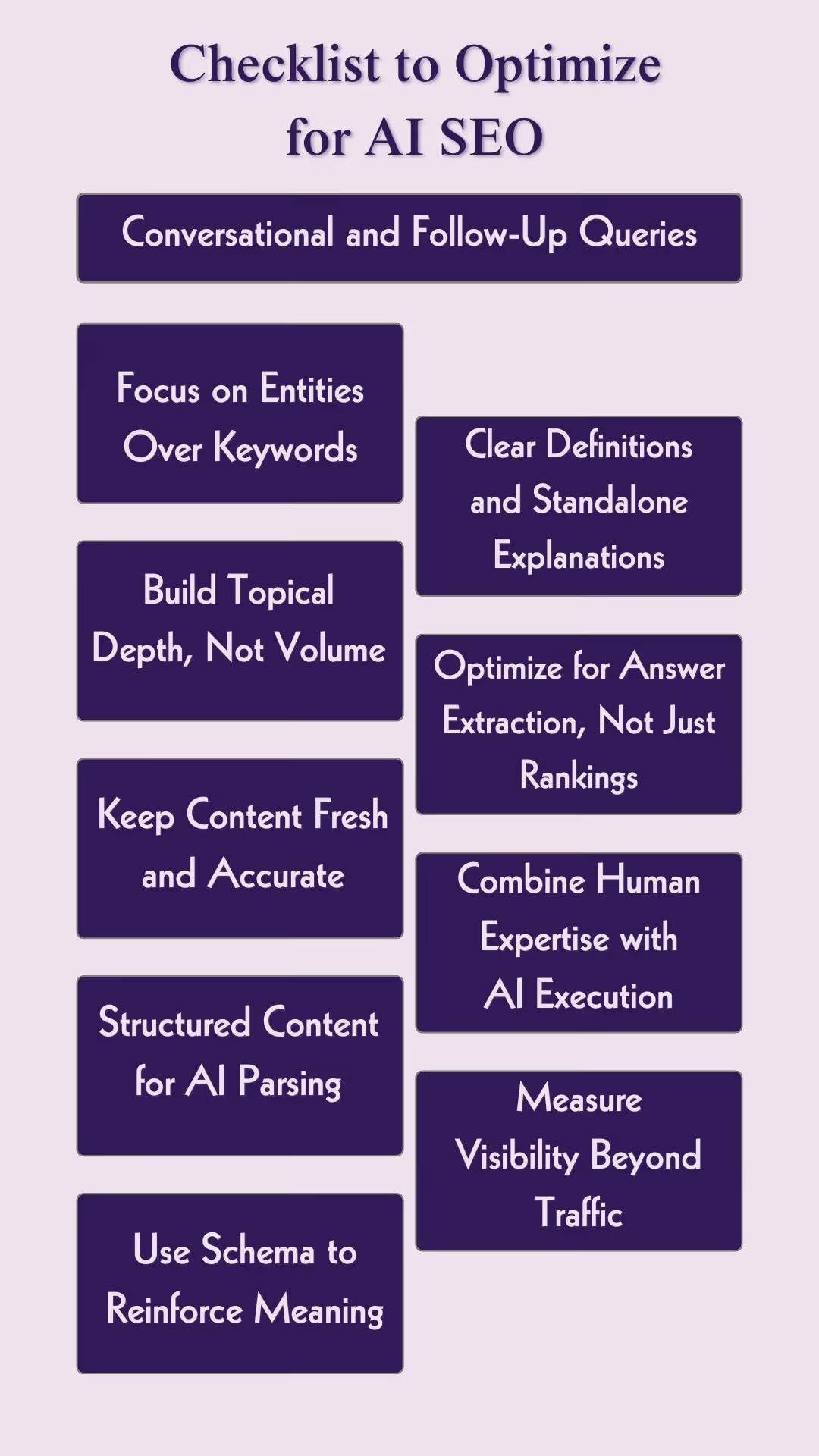
AI SEO optimization is not about the cheat codes. It’s a collection of fundamental SEO practices that allows your content to surface on engines where AI is playing a growing role. Here are some things you must follow to get ahead in both the traditional and AI search engines.
1. Focus on Entities Over Keywords
AI-powered search responses are driven by clarity of thoughts and ideas. This technology picks up information that is clearly defined and explained in connection with relevant elements. Simply put, it checks what you are talking about and what its relationship is with other entities.
How to Implement It?
- Clearly identify the intent and topic of your webpage. Follow this up by introducing supporting entities. For instance, if your core topic is AI SEO, its relative entities would be schema markup, knowledge graph, etc.
- Always use consistent terminology. Stick to it and avoid synonyms for the most part.
- Establish a relationship between entities and use credible references to build authority.
For Instance,
What is AI SEO, and how is it different from AEO? The better answer would be: AI SEO is an umbrella term that refers to optimization efforts that help content to show up in AI searchers. In comparison, AEO represents specific efforts to get your content cited in AI-generated answers.
2. Write Clear Definitions and Standalone Explanations
Almost all AI systems work by extracting key information that’s easy to quote and summarize. So, you should write content accordingly. Simply put, your explanations should be understandable, even when someone’s reading them in isolation.
How to Implement It?
Execute clear, standalone responses at the beginning of your content. By providing immediate and easy-to-digest answers, you improve the likelihood of showing them in AI search engines.
Build authority in language. Use phrases like “experts recommend” or “according to analysts” to demonstrate confidence and credentials.
Use statistics in your content. Numerical data from well-known sources promote the educational value and reliability of your content.
For Instance
A cheese cake recipe can walk the reader through some common questions in each section. E.g., the best cheese for this recipe is …, or the oven should be preheated at a certain temperature for a specific time, etc.
3. Optimize for Answer Extraction, Not Just Rankings
Accordingly, AI scans passages and not the entire pages. Understand that they are not humans; they only look for the clearest answers in shorter paragraphs. Hence, it’s probable that the AI-extracted answer from your content stands alone in summaries, chat responses, etc, with context.
How to Implement It?
Always begin your passages with a direct and obvious answer.
Write standalone passages that make sense independently as well as in the broader scheme of concepts.
Always structure your content. Include descriptive headings, bullet points, etc., to aid readability.
For Instance
An apt depiction of such a passage with AIO definition: AI SEO refers to optimizing content in a way that AI search engines can understand it. Once understood, these engines reuse it in responses, summaries, and conversations.
4. Structured Multimodal Content for AI Parsing
Today, search results are multimodal. You may find your answers in texts, images, visuals, and other formats. AI search engines reward content that is structured and multimodal. So, that’s what you should do too.
How to Implement It?
Plan integrated content strategies. Users engage deeply with diverse media. So, identify the strengths of each format and blend all to get the most interactive content. Use text for context, images (lists, tables, etc) to improve the understanding, videos for AI overviews, and more.
Optimize content as per the format. Adding images means using descriptive filenames, alt texts, etc., while video optimization means adding structured chapters, captions, keyword-rich descriptions, etc.
For Instance,
A cooking website can improve users’ and AI engagement by adding ingredient lists, step-by-step video tutorials, and more. This way, AI can use your content for different types of queries.
5. Use Schema to Reinforce Meaning
Structured data, technically known as schema, is crucial to your website AIO. It gives your search engine context about what’s in the content and helps it interpret entity relationships. AI works on exactly this principle. Assistants like ChatGPT use schema markups to extract meaning, connect points, and generate responses.
How to Implement It?
For starters, allocate schemas for the page types - Article, Product, FAQPage, HowTo, etc.
Don’t stop at just the headline and URL. Extend your schema markups to all relevant properties, including DatePublished, About, Image, and more. Be consistent throughout.
Establish entity connections through the schema. AI and SEO engines love it. Include about, mentions, and SameAs to clearly establish how two things connect. This helps the engines better understand context and build authority by reinforcing the knowledge.
Opt for nested schema structures. Simply put, include multiple markups in one page (FAQs, HowTo, etc, within an Article).
For Instance,
A business selling a work-related software implements a product schema on the content that includes prices, ratings, specifications, etc. This will help the AI engine reference specific product features while answering user queries.
6. Build Topical Depth, Not Content Volume
Anyone curious about learning what is AI SEO must know that understanding matters more than coverage. AI SEO refers to sites that show depth of knowledge, have clearly stated definitions, well-explained concepts, and more. So, it’s time to go beyond mass publishing with no depth.
How to Implement It?
Create comprehensive content clusters around your core keywords. This will help your content do better in both the traditional and AI search engines.
Cover a specific topic from multiple dimensions instead of just publishing isolated articles.
Use consistent terminology across all your content. Sometimes, AI does not connect synonyms and might confuse them with another entity.
For Instance,
A B2B SaaS business offering an AI SEO platform wants to rank on AI SEO related queries. It should focus on building an authoritative pillar page, “Whats AIO,” or "AIO Meaning", and then follow it up with supporting cluster pages like Common Mistakes to Avoid, AI Vs. Traditional SEO, etc.
7. Optimize for Conversational and Follow-Up Queries
AI searches are built on question-based queries and follow-ups. The responses, accordingly, cater to how people actually converse and ask for information. And that’s how your content should be.
How to Implement It?
Conduct a thorough query analysis. Go to community platforms like Reddit, Quora, perform site search, sift through support questions, or simply use AI to detect exact phrasing and relevant long-tail keywords. See what people are talking about and incorporate it in the content.
Don’t underestimate FAQs. These questions are your windows to show in AI search engines. Use real user phrasing with proper semantic structure and see the difference.
AI is conversational, and your content should be optimized for that. Let’s say a person has asked what AI SEO is, and follows it up with, How do I implement it? Or does it improve my search engine ranking? Anticipate users’ needs and produce content accordingly.
For Instance,
Suppose you own a marketing firm. The content you should be making should address specific queries, such as: how do I use the feedback to launch a drip email campaign? Instead of simply targeting generic terms like what is AIO, what is AI SEO, what does AIO stand for, etc.
8. Keep Content Fresh and Accurate
Keeping the content fresh has become significant, especially if the topic is relevant today. AI and traditional search engines favor content that is up-to-date. Remember! Your fresh content will rank higher than older articles, even when they have stronger traditional SEO.
How to Implement It?
Perform regular content-driven audits. Use Google Analytics to identify where you need updates urgently, depending on performance metrics, competitiveness, etc.
Prioritize content that focuses on rapidly evolving concepts. This is where information is changing every day. So, regularly reviewing and updating such content will make it accurate and helpful for your audience.
Update meaningful stuff. Include new stats, examples, and explanations to make helpful, reliable, and people-first content. Superficial edits like rephrasing, wording changes, and date updates won’t make a difference.
For Instance
A marketing firm shouldn’t just publish blogs about GEO, AIO, and similar terms. In addition, it should also focus on updating existing blogs on traditional SEO, how the trends are changing, Google’s new guidelines, etc.
9. Combine Human Expertise with AI Execution
Double down on E-E-A-T: Experience, Expertise, Authoritativeness, and Trustworthiness. How can you do it? Be using AI as an assistant. Use it for the manual tasks, so you can focus on building a reputation.
How to Implement It?
Allocate a human representative to decide the target audience, plan a content strategy, and choose topics. To save time, use AI to identify semantic gaps, suggest headings, and structure the content.
Use AI to scan through sources, summarize massive datasets, and spot market trends. Accompany it with a human researcher to verify the accuracy and add unique expertise.
Allocate human writers to add examples, first-hand experiences, and detailed explanations. With this, let the AI SEO text generators sort information, improve readability, etc.
For Instance
A marketing firm wants to launch a detailed guide on AI SEO, using a combination of AI tools and human reps for each stage.
10. Measure Visibility Beyond Traffic
Unlike traditional SEO, it is tricky to measure your success with AI. It does not send traffic to your page, but rather references content and cites it in the responses. So, your brand gets recognition without the clicks.
How to Implement It?
Ask questions in the AI-powered search engines and monitor the responses for your brand mentions. You may use the respective AI visibility tracking software.
Check your content in the AI-generated summaries and see if the entities and products are referenced accurately.
Track consistency across AI searches - voice search, smart snippets, and summaries. See if your brand and products are correctly displayed.
For Instance,
A marketing firm has published content on strategy planning for SEO, and the AI engines have reused its content one time in an AI summary and two times in a voice search. It's doing well.
10 Common Mistakes in AI SEO
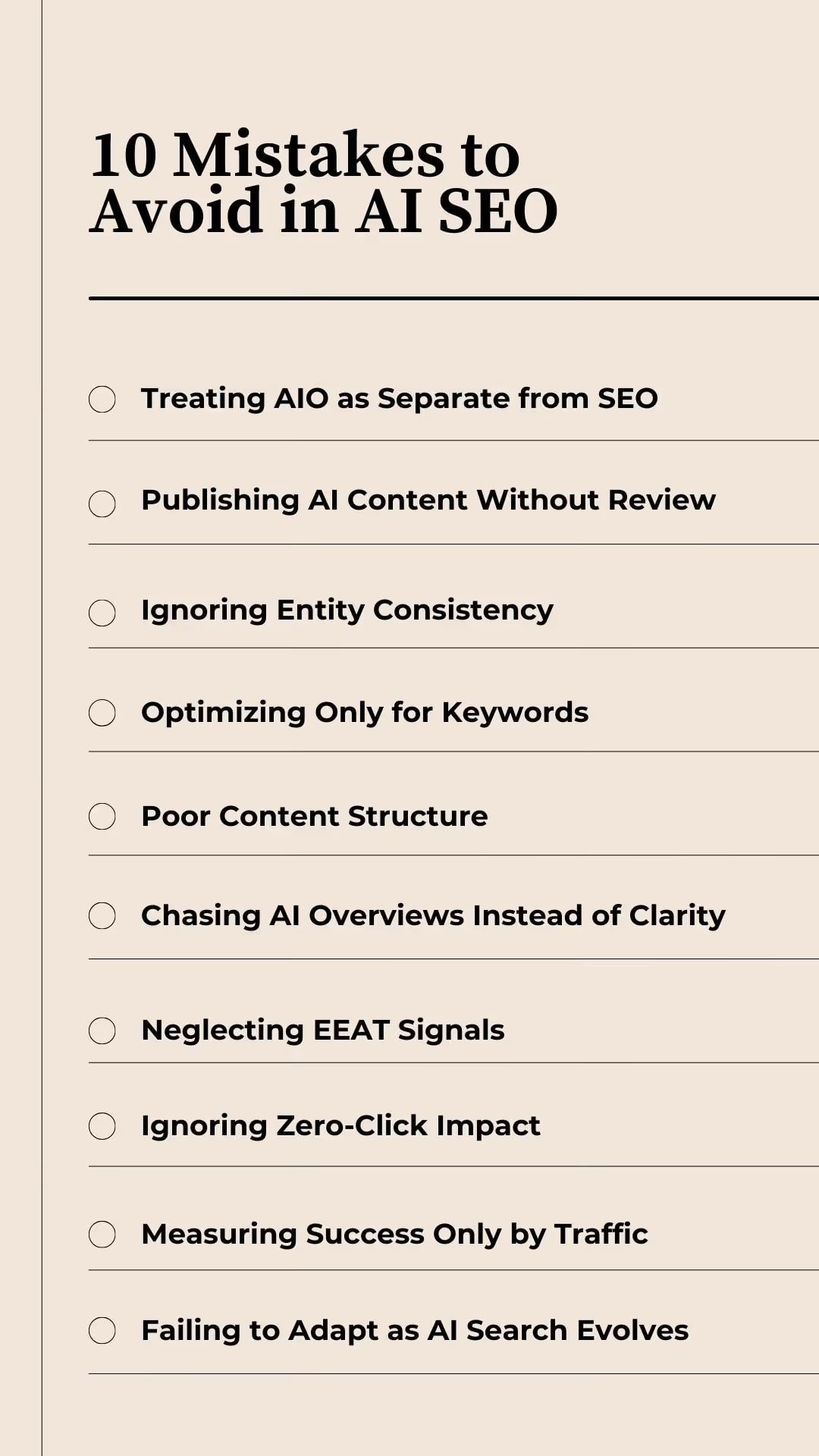
Many marketers are still using outdated strategies to land on AI search engines without realizing their impact. You must not fall into these assumptions.
Treating AIO as Separate from SEO
AI SEO does not exist in isolation. Think of it as the continuation of your traditional search engine optimization. So, following the foundational SEO practices still applies. The only difference is that it's for AI-powered searches. Hence, your approach should extend to making the content clearer and more consistent.
Publishing AI Content Without Human Review
However good it is, AI can still not replace humans. AI tools are there to assist you; never let them take over the decision-making. Let’s say you have employed an SEO optimized blog post generator for research and writing. You must thoroughly review it, fact-check, evaluate, and add unique experiences to reinforce E-E-A-T.
Ignoring Entity Consistency
Generative engines are built on semantic understanding and entity relationships. Unclear entities, ambiguous synonyms, and inconsistent terms tend to confuse these engines. The wise way out is to focus on using the same terms throughout.
Optimizing Only for Keywords
AI SEO does not care about your keyword density. To AI engines, other things are important, be it structure, clarity, stats, explanations, and more. So, don’t just stick to keyword-first strategies. And even when incorporating keywords for AI optimization, focus on long-tail, contextual phrases.
Poor Content Structure
Webpages that are inconsistent, unstructured, and cluttered have minimal visibility. That’s no surprise. AI search engines look for clarity and straightforwardness. So, optimizing your content structure and technical signals is the only way to promote exposure.
Chasing AI Overviews Instead of Clarity
As search evolves, teams are trying to find the loopholes in AI search SEO, trying to simply show up in AI snippets. While it may work for short-term visibility, you are going to lose performance and trust gradually. The only thing that’s going to help you is the content quality itself.
Neglecting EEAT Signals
Your page can still rank well, but still not be visible in the AI generative systems. This is because it lacks the EEAT signals. AI SEO rewards information that comes from first-hand experiences, derived from expertise, and establishes authority.
Ignoring Zero-Click Impact
Around 80% of consumers today rely on zero-click results at least 40% of the time. The reason? They get their answers in AI-written smart snippets and summaries. So, how to still be visible? By optimizing your content towards precision, directness, and clarity.
Measuring Success Only by Traffic
Understand this - visibility in AI engines does not come with clicks. And absence from the ranking does not necessarily mean your content is not influencing the SERPs. AI SEO has unconventional success metrics, including AI voice search results, AI presence rate, citations, etc. So, don’t always assume and do your research.
Failing to Adapt as AI Search Evolves
AI systems are evolving frequently. How it interprets and summarizes across SERPs might be different than what it used to be a month ago. Accordingly, your strategies should adapt as well. The only solution lies in continuous learning. So, monitor your AI success and update existing pages to show up in the AI search engines.
How to Measure AI SEO Success?

The success metrics of AI SEO work differently from traditional ones. Here are some of them to help you see if your content is making any difference.
AI-Generated Answer Inclusion
The most obvious way to measure your AIO success: finding yourself in AI-generated snippets. Be it Google AI overviews, Copilot summaries, or ChatGPT’s responses, if you are anywhere, think of it as a major achievement. This may be in the form of,
- AI summaries
- Citation or references
Entity Presence and Brand Mentions
AI quickly recognizes entities across platforms. See if your brand entity appears anywhere in searches, whether voice search, AI conversations, and more. Make a checklist to look for the following,
- How many times has your brand been mentioned?
- How accurately does it appear?
- How often does it appear compared to your competitors?
Remember! All this comes with authority, unique experiences, and expertise.
Passage-Level Visibility
SEO for AI is concerned about independent and standalone passages. Pages with shorter paragraphs and clearly stated definitions have a maximum chance to show up in AI responses. Here are some factors that can help you measure success in this regard.
- Your content paraphrased in AI responses.
- Specific paragraphs are repeatedly extracted by AI engines.
Brand and Product Accuracy
While it may quote you, AI can easily fall victim to misinterpreting outdated and inconsistent information. So, it's crucial that you monitor responses for brand safety. Here’s how.
- Fact-checking.
- Checking for clarity of products’ features.
- Accurate comparison with other products.
Use automated SEO report creators to analyze mentions and check for consistency while saving time.
AI Traffic
AI SEO does not come with usual clicks; we’ve already established that. But it can still result in clicks. Here’s how you can trace them.
- Users directed from AI-assisted citations.
- Traffic patterns after AI answer visibility.
Hybrid SERP Visibility
Searches have become hybrid, lying between the traditional and AI-powered search engines. Hence, visibility should also be monitored in the same sense. Some signals include,
- Traditional SEO ranking.
- AI answer inclusion.
- Long-term SERP stability.
Tools and Technologies in AI SEO
Marketers use tools and technologies to support both traditional and AI SEO. Let’s check out some of them, so you know where to begin.
AI for Keyword Research and Topic Discovery
AI-driven keyword research tools help you find the right content topic. Capable of NLP and deep learning, these tools use massive datasets to identify keywords (short and long-tail) that have potential for both traditional and AI SEO.
AI for Competitor Analysis
Content and semantic analysis software are your best friends to analyze competition. AI competitor analysis tools help your marketing teams examine structures, content clarity, entity coverage, and inconsistent semantic gaps. With this knowledge, you can keep up with the giants.
AI for SEO Content Creation
Content marketers are dealing with tight schedules and multiple projects. Here, AI-powered content generation tools can assist them with things like drafting outlines, identifying target keywords, and knowing what the audience wants. This way, it’s easier to write content that ranks.
AI for Building Backlinks
Internal links and crawlers are still making a difference in how AI understands your pages. These tools help you diagnose where you are lacking: structural issues, indexation problems, or inconsistent performance signals.
AI for Visibility Monitoring
Leading AI visibility optimization tools not only help your efforts for exposure but also assist in monitoring success. They track common success trackers (entity strengths, extractions, answer patterns, etc) to give a holistic picture of your performance.
Benefits of Implementing AI SEO
AI in SEO has helped content marketers with clarity, visibility, and adaptability. Here’s how.
- Speed and Efficiency: With AI implemented in routine marketing processes, there is no overwhelming workload and better speed. This empowers marketers to focus on strategic plans.
- Accuracy: Artificial intelligence does not rely on guesswork. Rather, it provides you with detailed data analysis and valuable insights to help with decision-making. Today, you can evaluate millions of SERPs to pinpoint trends and apply them for better performance.
- Scalability: AI tools understand complex SEO metrics and help you achieve them. 52% marketers testify that using AI helped them with efficiency. With this speed, companies are expanding their SEO plans without compromising on quality and rankings.
- Adaptability: AI helps marketing teams identify algorithmic changes and adapt accordingly. Around 49.2% businesses witnessed better rankings with AI in SEO operations.
Ready to Scale SEO with AI Employees?
Now you must have an idea about what is AI SEO. As search changes from traditional methods to audience-oriented conversational interfaces, it’s time you approach your content plans differently.
Good news: you don’t have to do it manually. AI helpers from Sintra are an excellent way to declutter the manual noise, so you can focus on connecting with the audience and resonating your brand message across. See Sintra AI pricing and get started today.
AIO FAQs
How to use AI for SEO?
You can use AI for SEO to handle the manual workload. This includes making outlines, finding long-tail keywords, generating topics, and analyzing competitors.
Will AI replace SEO?
No, AI will not replace SEO. Instead of isolating AI from SEO, treat them in combination. Use AI to automate routine tasks like keyword research and data analysis. Then, employ your saved time on building expertise, establishing authority, and adding experiences.
What does AI mean for SEO?
AI for SEO means search is shifting from traditional to AI-driven architecture. Users' expectations from searches to be more intent-driven. Clear, structured, and direct content is valued more than traditionally high-ranked pages.
Do keywords still matter in AI SEO?
Of course, keywords still matter in AI SEO. However, their role has evolved from high-volume to intent-driven. Now, engines appreciate long-tail conversational keywords that understand user intent, build context, and answer queries.
What is generative engine optimization?
Generative Engine Optimization or GEO refers to efforts that refine your content to be easily understood, cited, and reused by AI search engines. Beyond traditional SEO, it demands content to be factually accurate, relevant, clear, and easily understandable.
What's the difference between AIO and GEO?
AIO is an umbrella term used for optimizing content, so it is understandable and summarizable by AI (search engines, voice search, etc). Whereas, GEO is a subcategory of AIO that focuses on making the content structured and clear, so it appears in AI-generated answers.
What is the difference between SEO and AI SEO?
Traditional SEO prioritizes keywords and backlinks to optimize webpages, so they rank on search engines like Google. In comparison, AI SEO refers to the content optimization that helps it appear in AI searches, overviews, and summaries, even without clicks.
What skills are needed for AI SEO?
AI SEO demands a collection of skills, including technical, content-related, and data analysis. With this, you must also have sound knowledge of machine learning, prompt engineering, and using AI tools.
Related articles



.avif)