ChatGPT o3 vs 4o vs GPT-5: What Changed and Which Model Should You Use Today?


Table of Contents
Quick Answer: GPT o3 vs GPT 4o vs GPT 5
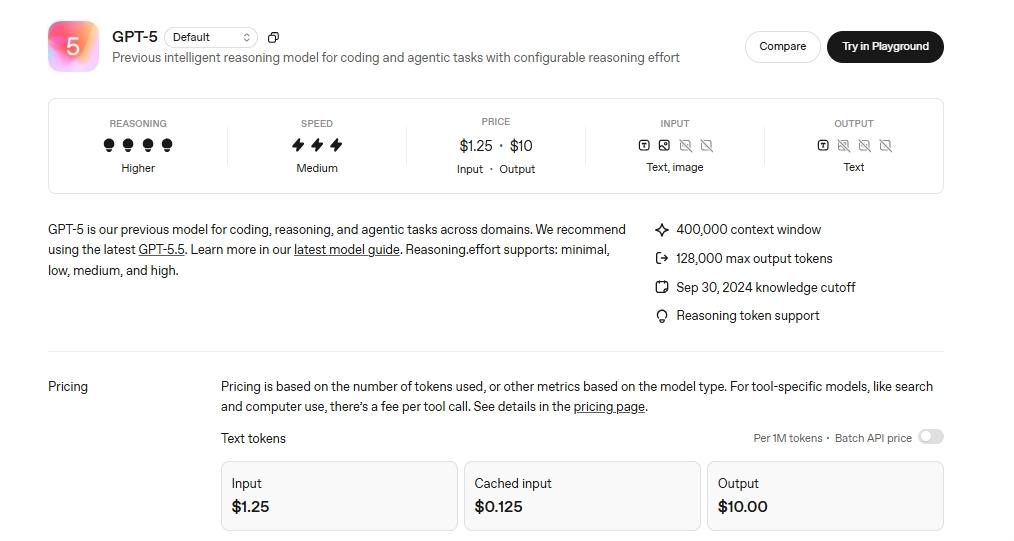
GPT-5 is the latest version of ChatGPT and the most capable among the three. GPT-5’s hybrid state-of-the-art reasoning also outperforms other reasoning models in content creation, complex problems, and advanced coding workflows. While GPT-o3, also a reasoning model, focuses more on structure, it is a strong choice for logic tasks, such as strategic planning, competitive analysis, and research.
GPT-4o, however, is a non-reasoning fast model, optimized for multimodal interactions. It naturally excels at daily productivity tasks, such as summarizing documents, writing short-form content, and web browsing.
OpenAI’s model lineup has always been in the limelight. The company has released capable models through the years, but it also comes with a lot of confusion about feature lists, potential, and use cases.
For starters, GPT-5 is the latest and default ChatGPT AI model, while GPT-4o recently retired from the official ChatGPT interface. And, GPT-o3 is one of the reasoning predecessors of GPT-5.
As ChatGPT got an upgrade to GPT-5, many of us were using o3 and 4o. The question is, should you upgrade to GPT-5 or stick to the one you are comfortable with? To answer this, here is an in-depth ChatGPT o3 vs GPT 4o vs GPT 5 comparison guide based on key strengths, features, and performance.
Here is a side-by-side GPT-5 vs o3 vs 4o comparison at a glance.
GPT-4o vs o3 vs GPT-5: Full Feature Comparison
ChatGPT o3 vs 4o vs GPT5: which is better for your unique requirements? Let’s learn more about each model’s strengths, reasoning, performance benchmarks, and efficiency.
Reasoning and Problem Solving
Reasoning is where the GPT-5 vs o3 vs 4o difference becomes obvious. GPT-4o is not a dedicated reasoning model, but rather relies on generative pre-training. Whereas, the GPT-5 and o3 are state-of-the-art reasoning models that think longer before answering.
Let’s break this down in detail.
GPT-4o is a general-purpose chat model that uses generative pre-training. Simply put, OpenAI has trained this model on large textual, visual, and audio data. Through this, it learns language intuition and pattern recognition. So, whenever you ask a query, it goes back to the training data, finds similar patterns, and makes the response accordingly.
Compared to other reasoning models released before, 4o is native multimodal. Meaning, it’s training data also has billions of images and thousands of hours of podcasts. Having this, the model can make connections between things, their material, appearance, and sound. For instance, GPT-4o knows what a cow is, what it looks like, and how it sounds.
With data training and linguistic and pattern recognition, GPT-4o shines at situations requiring speed, multimodal inputs, and basic logic, then deeper queries. Professionals use it widely for language learning, customer service, data extraction, and real-time camera interpretation.
In comparison, GPT-o3 is a dedicated reasoning model that gained its reputation for agentically accessing and using tools, beyond extended thinking. For starters, it uses chain of thought reasoning, which means the model breaks down your problem into multiple steps and interprets the intent better. Hence, naturally, it is trained to think longer before responding.
The entire o3-series models from OpenAI showed significant benchmark gains across coding, science, and visual perception. For instance, the o3 (69%) performed better than the o4-mini (68% accuracy) in the SWE-bench verified.
In the Scale Multichallenge multi-turn instruction following benchmark, the o3 gained the highest accuracy (56%) compared to other reasoning models in the o-series, including o4-mini (42.99%) and o1 (44.93%).
GPT-o3 is also the first model to integrate images directly into the CoT (chain of thoughts). It not only sees images, but thinks through them. Meaning, you can upload an image of a textbook diagram or your handwritten notes, and the model interprets it. Even if the image is low quality.
Developers and analysts favor the GPT-o3 model for high-complexity tasks, such as bug tracking, agentic coding, data analysis, and document synthesis. Beyond this, the o3 model works great at advanced STEM apps, including complex math calculations.
Similar to GPT-o3, GPT-5 is also a reasoning model that uses a multi-step chain of thought reasoning. However, OpenAI built it as a hybrid system with deeper logic, which is commonly known as GPT-5 Thinking. Also, compared to GPT-o3, GPT-5 is faster, more reliable, and has cheaper production. Yet, it lacks the nuanced conversational style of the o3 model.
GPT-5 is a hybrid system. But what does it actually mean? This OpenAI model acts as a unified system that responds to your complex and basic queries through real-time processing. Once you ask a question, it has a router mechanism that accesses the complexity of the problem. Depending on parameters like complexity, intent, and response rate, it answers your query.
Compared to other reasoning models, GPT-5 also asks you clarification questions to analyze the intent. This is why it takes longer to respond. In performance benchmarks, it shows better results in technical areas, including coding, instruction following, and multimodal queries. In the massive multi-discipline multimodal understanding test, GPT-5 scored 84.2% against 4o’s 74.4% (a native multimodal model).
Speed and Responsiveness
All three ChatGPT versions in this guide have varying speeds and performance parameters, depending on the complexity of the logic and the accuracy. For instance, GPT-4o, being a non-reasoning model, is the fastest and most conversational. In comparison, both GPT-5 and GPT-o3 are intentionally built to respond slowly to compensate for deeper reasoning.
Let’s learn the logic behind each model’s speed and performance.
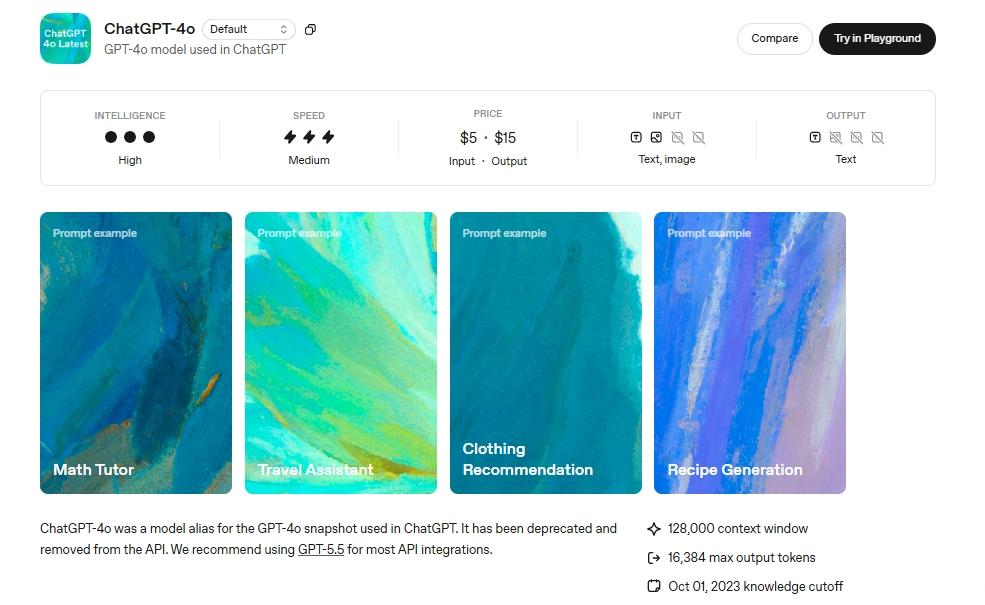
OpenAI claims that GPT-4o answers a textual query within 0.32 seconds and an audio input in 232 milliseconds. The 4o API also excels at vision and audio understanding, without compromising on performance. This is possible because the GPT-4o model uses one unified base model, compared to previous models that used multiple separate models to respond.
So, when you ask GPT-4o a question, it uses a three-step mechanism to answer. So, first, it employs a speech-to-text model to translate what you said into text form. Once done, the AI analyzes the text against the training data and responds to it by translating the text into audio. Accompanied by the conversational tone, it works great at rapid prototyping, ad mockups, and vision-based assistance.
Compared to this non-reasoning mode, the GPT-o3 uses special thinking phases, which makes it slower. That said, it has three different reasoning effort options: low, medium, and high, each of which is optimized for specific use cases. Accordingly, the developers can prioritize speed or performance to tackle complex or basic queries. For instance, the o-3 mini medium reasoning offers a perfect trade-off between accuracy and speed.
In the AIME performance benchmark, the o3-mini performed better than the predecessor o1 across all three reasoning efforts. At low effort, the o3-mini showed 60% accuracy, whereas it showed 79.2% accuracy at medium effort, and the highest (87.3%) at high effort. Compared to this, o1 didn’t go above 83%, even when it took the longest to respond.
GPT-5 works similarly to GPT-o3, primarily because both are reasoning models. It’s slower, but that’s intentional. Rooted in a multi-step chain-of-thought reasoning, GPT-5 offers structured and in-depth chats. Meaning, it pauses to brainstorm and explore data for complex problems.
What’s good in terms of speed is the GPT-5’s adaptive speed. For instance, you can use the GPT-5 Nano and Turbo for routine queries, like document drafting, writing, and so on. Whereas GPT-5.5 Pro with the thinking mode works great for research, coding, and advanced autonomous agentic workflows.
Multimodal Capabilities
All three OpenAI models, GPT-4o, GPT-o3, and GPT-5, have multimodal capabilities. However, each is different, which is why it’s important to know which one is better for your unique requirements.
For starters, GPT-4o is a native real-time multimodal model. The “o” in 4o stands for omni, which means it accepts multiple input forms, including text, audio, and images. It uses a single base model to interpret all these input types simultaneously. This explains why it is fast and sounds natural for real-time interactions. Plus, it naturally integrates with the ChatGPT tools, including vision analysis, voice mode, canvas, and more.
Compared to this, the GPT-o3 is focused heavily on textual and image logic, though it also processes audio inputs as well. Beyond complex textual queries, the GPT-o3 has native tool use. With this, the model can manipulate images, such as zooming in on them, filling in some parts, and rotating them.
It is among the pioneer models where OpenAI included images directly into AI’s chain of thought. Meaning, you can ask it complex problems having a combination of visuals and texts. So, whether it's a handwritten note, a textbook diagram, or a whiteboard, the GPT-o3 can interpret it and respond accordingly.
GPT-5 - the current version of ChatGPT, however, is the most advanced state-of-the-art multimodal model among the three. Similar to the other two models, it can interpret textual, visual, and audio inputs. But beyond this, the GPT-5 model has a live video sharing function. Through this, the AI connects to your camera and assists you in tasks like fixing a bike or getting outfit recommendations.
Moreover, GPT-5 supports a unified pipeline. Meaning, it integrates all forms of inputs in a single pipeline natively. So, if you are uploading a chart or an image of the code, the AI will follow your prompt step-by-step and respond accordingly, within a single prompt.
Coding and Technical Tasks
Each of the three, GPT o3, GPT-5, and GPT-4o, serves different coding needs. GPT-5 is a natural at end-to-end, complex coding operations, while o3 excels at medium-hard multi-step tasks, such as solving algorithmic puzzles or debugging logic. In comparison, GPT-4o is a fast non-reasoning model, which is best suited for basic problems like syntax fixes.
OpenAI designed GPT-4o to be a fast, cost-effective, and performance-efficient model for everyday queries. So, expecting it to do heavy lifting would be foolish. That said, it can do routine coding, rapid prototyping, and basic debugging. Be mindful that it gets confused with back-and-forth chats, so you should stick to one-prompt problems.
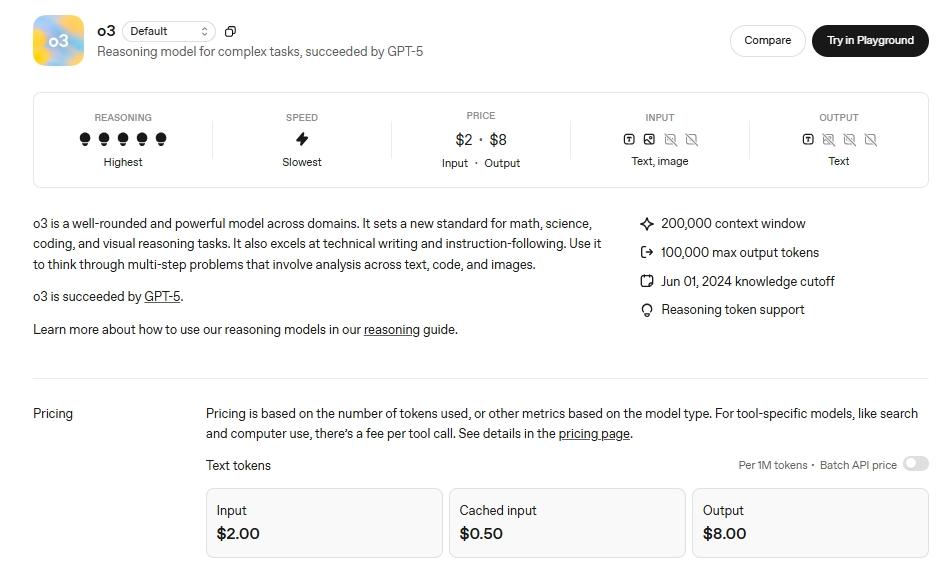
In comparison, the GPT-o3 shows significant gains in performance benchmarks across coding, maths, and science. In the AIME test, the o3 achieved 91.6% accuracy with no tools, and the o3 mini showed 87.3% accuracy with no tools. Similarly, the o3 model showed 69.1% accuracy in SWE-Bench Verified and 81.3% accuracy in Aider Polyglot.
Hence, the o3 model excels at complex queries that combine multi-faceted answers and deeper thinking, such as complex debugging, data structure, and refactoring. Developers also use o3 independently to write, run, and test code by connecting it with tools like Code Interpreter.
Finally, GPT-5 is superior in serving developers’ needs. OpenAI claimed that this model set new state-of-the-art values in coding benchmarks. It scored 74.9% on SWE-bench-verified and 88% on Aider polyglot, both of which values are higher than GPT-o3.
The GPT-5 model also has verbosity parameters, low, medium, and high, for developers to fine-tune its answer length and response time. Overall, it shines in situations requiring complex coding frameworks, including generating front-end UI, debugging large-scale repositories, executing a long chain of tools, and creating aesthetic web designs.
Content Creation and Marketing
GPT-5, 4o, and o3, all three ChatGPT models are optimized for structured and formal writing. However, their approaches to writing differ, and it shows in their answer’s length, tone, and response time. Let’s find out more about each in detail.
For starters, GPT-4o is a conversational AI model. Its training data helps it maintain linguistic excellence, meaning its responses are more structured, predictable, and warm. This formal yet warm tone works best for facilitating business communication, writing clients’ proposals, and generating technical reports. The model also works great at writing ad copy, meta tags, and social media captions.
Similar to this, GPT-5 also has formal and tight responses. But, in this latest version of ChatGPT, the reason behind the structure lies in its focus on clarity, directness, and context. The writings produced by GPT-5 seemed template-driven, which is why it works best for technical user guides, report writing, SEO blogs, and other factual pieces. Plus, it has better memory than the other two, meaning it will remember your brand guidelines and style preferences, even in lengthy conversations.
Moreover, because it’s a reasoning model, GPT-o3 also has better writing logic and structure than creative potential. Marketers usually prefer this model for drafting outlines, writing SEO captions, and brainstorming content angles. Be mindful that all the models in the o-series, including o3, struggle at generating long-form content, such as SEO blogs, lengthy technical documents, and reports.
Which ChatGPT Model Is Best for Different Use Cases?
For Business Users
A startup or established business, knowing when to use which AI makes all the difference. While GPT-5 brings all-around support across use cases, GPT-4o helps you with no-brainer tasks. Here is when to use these ChatGPT versions in your everyday business tasks.
GPT-5: An All-Round Business Model
When it comes to business users, GPT-5 is the first choice for executives, corporate officials, project managers, and more. It’s an all-round generalist help with structured reasoning and direct responses. Here is why it can be your business companion on a busy workday.
- Technical/ Structured Writing - helps professionals draft technical documents, in-depth reports, and summaries from raw data files without switching between specialized models.
- Instruction Following Tasks - GPT-5’s reasoning engine understands instructions better, meaning its outputs are structured and accurate. Plus, with a low hallucination rate, you can rely on it for accuracy-crucial tasks like writing client proposals, conducting research, and so on.
- Decision Support - assist executives in evaluating vendor options, conducting market analysis, analyzing business strategies, and synthesizing stakeholders’ feedback.
- Diverse Use Cases - helps across domains, including complex code generation, data-driven business analysis, customer support, web design, and more.
GPT-o3: A Deep Thinker for Complex Business Problems
GPT-o3 acts as a thinking specialist that businesses use for analytical tasks. Executives favor it for deeper data synthesis, complex problem-solving, and data-driven decision-making. Here are common areas where using o3 can help you get through a busy workday.
- Strategic Planning - helps leaders with routine tasks requiring layered reasoning. This includes step-by-step planning, medium-to-complex coding, and visual data interpretation.
- Competitive Analysis - assist analysts with performing risk assessments for a product launch, or draft a business strategy based on market analysis, and perform multi-step analysis on customers’ behavior toward the new launch.
- Advanced Data Synthesis - o3 is built for step-by-step reasoning, with different levels of effort (low, medium, and high). With this, professionals can synthesize documents with adjustable depth.
GPT-4o: Fast and Versatile for Daily Workflows
OpenAI builds GPT-4o with one idea: helping users with fast and natural interactions across multimodal inputs. It responds as fast as a human. The reason: it does not think and identify patterns from its training data. Here’s where it makes a difference in business workflows.
- Fast-Paced Routine Work - helps executives and corporate officials with quick raw drafts, on-the-go meeting management assistance, mockup meetings, and casual web browsing.
- Quick Document Synthesis and Generation - builds meeting agendas, client proposals, internal memos, and email threads from existing project documents in minutes.
- Brainstorming - helps explore content ideas, develop stories, and build narratives with emotional nuances.
- Multimodal Problems - handles everyday queries combining visual, textual, and audio inputs. This could be research, exploring business ideas, and communicating with the client.
For Developers
For developers, GPT o3 was the most favored OpenAI model for a long time. But with the release of GPT 5, things have changed a little. Its speed and performance balance help developers facilitate advanced coding workflows. Let’s see how all three models perform.
GPT-5: Most Advanced for Developer Workflows
GPT-5 is the latest version of ChatGPT. This model is known for its advanced coding potential that outperforms o3 and other reasoning models across benchmarks and real-world cases. Here is what makes it stand out for developers.
- Complex Debugging - GPT-5 can catch bugs in complex and lengthy code and run multi-turn background agents to find layered errors alike.
- Front-End Development - developers use GPT-5 for front-end development tasks, including designing UI components, building dashboards, and developing landing pages. Its aesthetic choices are better than those of other reasoning models.
- Instruction Following - GPT-5 is collaborative in its approach, meaning it follows your instructions in detail. You can even ask this model to explain the follow-up action before tool calls. This makes it useful for style guide review and linting rules.
- Documentation - gives you almost-instant answers to everyday code explanations, error handling, and debugging.
GPT-o3: The Senior Coding Assistant for Medium-Hard Problems
Before GPT-5’s release, the o3 model was a good fit for complex coding workflows. Developers still use it, but for medium-hard complexity scenarios that require a long chain of logic. Here’s why and when you should use this model for development tasks.
- Architecture Planning - helps developers plan database migration, understand trade-offs, and evaluate microservices when designing new distributed mechanisms.
- Logic-Heavy Code Reviews - review codebase implementations, stress-test different error handling logics, and evaluate authentication flows.
- Multi-Step Script Analysis - helps run multi-step CSV analysis, predict the next algorithms, forecast the following quarter, and identify trends.
GPT-4o: On-the-Go Assistant for Everyday Development
GPT-4o helps non-tech users with speed and performance balance. You can use it to write code across multiple languages, explain code, and find errors. Here is where the GPT-4o works well.
- Rapid Iterations - helps employees with quick syntax fixes, error finding, and writing an automation script.
- Code Explanations - gives clear and easy-to-digest explanations of libraries. This is especially useful when you are onboarding to a new codebase.
- Multimodal Development Jobs - interprets code images, UI mockups, and hand-drawn diagrams for code explanations, debugging, and error fixing.
For Content Creators and Marketers
Content is crucial in establishing your brand identity across channels. But it’s not just about writing, but brainstorming, strategizing, and executing. Let’s find out where each of the three ChatGPT models, GPT 4o, o3, and 5, excel in your content pipeline.
GPT-5: The Professional Content Companion
GPT-5 is an all-around professional content companion that helps you create and publish content across channels. Its longer memory retention, context awareness, and strategic planning help you build marketing assets. Here’s why it is a better match for content creators and marketers.
- SEO Content - understands search intent, keyword positioning, and topical authority to create coherent and readable articles that are visible on search engines.
- Multichannel Content Production - helps marketers maintain brand voice across content channels. Its longer memory retention helps you create content with similar style preferences and tone guidelines.
- Multilingual Content - produces high-quality, high-volume content, from ad copy to video scripts, and explainer tutorials, in multiple languages for a regional audience.
- Email Management - helps professionals write email sequences for outreach, nurturing leads, or launching new products. Its warm tone and context-awareness treat individual messages with attention.
GPT-o3: An All-in-One Content Strategist
GPT-o3 might not be the best for writing and drafting content. Rather, its advanced reasoning gives you a kickstart to audience research, business strategy, and brainstorming. Here is where it makes a true difference in your content pipeline.
- Audience Research - helps marketers build an ideal customer profile based on buyers’ behaviors, demographics, feedback, and business goals.
- Competitive Analysis - analyze competitors’ content, identify SEO opportunities, understand their messaging frameworks, and suggest content strategies.
- Content Briefs - assist marketers in mapping topic clusters, identifying competitors’ ranks, drafting outlines, and building topical authority.
- Planning Campaigns - help agencies manage content calendars, content production, messaging frameworks, content channels, and format recommendations.
GPT-4o: The Creative Brainstorm Partner
GPT-4o excels in generating ideas and writing short-form content almost instantly. It is conversational, warm, and offers precise responses. Here’s why it stood out for creators and marketers.
- Quick Content Generation - helps marketers create high-volume social media content, including caption variations, bulk meta tags, and script variations for A/B testing.
- Ideation - interprets open-ended prompts to explore multiple dimensions of a topic. This is useful for brainstorming, filtering meaningful ideas, and strategizing content channels and formats.
- Visual Content - helps content creators produce images that match your written drafts and brand values. It can also analyze ad campaigns from competitors, review landing pages, and brief on the launch from raw images.
- Quick Ad Copy Variations - can produce quick ad copy variations for social media campaigns.
The Limitation of Comparing ChatGPT Models Alone
ChatGPT model comparisons are useful for businesses to get an idea of whether to invest or not. But they don’t tell you the entire truth. When a startup compares the latest version of ChatGPT, GPT-5, against previous models like o3 and 4o, they are mostly looking at benchmarks and features. But this approach is wrong, and here is why.
Capability Doesn’t Always Translate into Outcome
A pilot AI model may have multi-step reasoning, earn strong reviews from the technical team, and still fail to process a complex real-world business scenario. This is the code problem of businesses with model-first thinking.
Leaders invest in AI and expect it to help with everything: lower cost, faster decisions, and executing entire task sequences. But a model that performs well in testing does not guarantee exceptional performance in practical workflows.
An MIT study, The State of AI in Business 2025, reveals that 95% of AI pilots fail because businesses rely on generic tools that are impressive in demos but stay brittle during workflows. So, they may have a high adoption rate, but do not perform well in transforming business operations. Only 5% designs are built for high-value task execution and integrate meaningful tools like memory and learning loops. Meaning, companies are missing out on opportunities to introduce productivity gains in their day-to-day operations.
To understand this, you must know that the problem is not the model, but everything you are trying to build around it. Reason: Businesses don't just need answers from a generic assistant. But rather modern businesses run on
- AI that executes end-to-end task sequences.
- AI solutions that are embedded in their existing processes.
- An AI model that has a low hallucination rate and offers reliable and consistent outputs across teams and channels.
- AI that works alongside people and not in isolation.
Imagine a startup that has picked GPT-5 to support its everyday operations, just because it has a high score on multi-model and coding benchmarks. But they are using it as a standalone tool to answer their occasional queries or to draft content.
In parallel, another team is using it with a slightly better approach: to maintain internal documentation and update content calendars. This team that has embedded AI into its structure will gain more value from it, and eventually, the employees will build confidence with the tool.
Workflow Bottleneck Issue
Another problem companies overlook in AI adoption is that an improved model does not always mean improved outcomes. Imagine your in-house developers using ChatGPT model’s API keys to complete double the amount of tasks and pull more requests. However, the time they are saving is going to the PR reviews, human approvals, and manual prompting.
So, let's say they have cut down the time for writing the code, but it still stays for longer in the reviews. And, an AI upgrade is no longer the solution. This happens because you don't have a clearly defined oversight mechanism, governance structure, and feedback loops.
The impact shows across departments. Even if your marketing team is upgrading from GPT-4o to GPT 5, they won't see an improvement in campaign output, as the human approval alone takes weeks. A support team can use the advanced GPT 5 reasoning, but they will lose customers if a person is not manually routing the ticket.
How Should Businesses Evaluate AI Models?
Instead of asking which model scores highest across benchmarks, a business should look into the following areas.
- Where is your team spending most of their manual effort and time?
- Does the specific AI model fit into your existing stack of work tools?
- Who from your team will be using the AI tool, and whether they have enough experience to do so?
- What will be your success measurement criteria once you deploy the AI model in your workflows?
How GPT-5 Changed the Role of GPT-4o and o3?
The GPT-4 series models have officially retired from ChatGPT. Today, users can access the latest version of ChatGPT, GPT-5, in the free and premium tiers. Hence, it’s important to know what has changed in terms of performance and features. Here is a quick GPT-5 vs o3 vs 4o rundown for anyone thinking of which model to choose.
If You Previously Used GPT-4o
OpenAI designed GPT 4o to have faster responses, multimodal capabilities, and the ability to answer everyday queries. It has a natural conversational tone across textual and audio interactions.
So, whenever you ask it for a daily task, such as writing an email, summarizing a report, or retrieving information from a document, GPT-4o offers near-instant responses. The core strength: accessibility for everyday use.
This was the truth for ChatGPT users before the release of GPT 5. GPT 5, with adaptable thinking and adjustable reasoning, already has these strengths. What’s better is that it builds on top of them. Being the default model for all ChatGPT subscriptions, this AI model offers unparalleled performance across use cases, be it writing, coding, or business use.
There is a side-by-side comparison of what has changed for GPT-4o users after the release of GPT 5.
If You Still Use o3
GPT-o3 is a reasoning model that excels in situations that require deliberate and structured logic. OpenAI designed this model for complex use cases, such as software engineering, maths, technical development, and scientific reasoning.
To an extent, GPT-5 has pretty much achieved this, and it shows in technical benchmarks across coding, instruction following, and multimodal capabilities. GPT 5 shows a better performance than o3 and o4 combined. Meaning, it is comparatively faster and more efficient across various everyday and complex tasks.
Still, a core strength of the OpenAI o3 model lies in its adjustable reasoning effort controls. With this, developers and analysts can always fine-tune their AI models' reasoning capability, answer length, and depth of the logic, according to the task. It works best for businesses that want to deliberately delay their model response and maximize the depth of the logic.
The bottom line is that GPT-5 is the better default model available in ChatGPT for daily and professional work. However, the O3 API is still relevant when you need maximum reasoning effort on an isolated complex problem.
Here is a side-by-side comparison of both models, so anyone using o3 can decide if they should upgrade.
Why Sintra AI May Be a Better Choice Than ChatGPT for Business Workflows?
ChatGPT is a genuinely useful AI chatbot. However, it’s not meant to run a coordinated business. This is why Sintra AI might be a better choice in this scenario. It bridges the gap between ChatGPT’s outputs and manual execution, which is the biggest edge for fast-paced businesses.
Specialized AI Helpers Instead of One General Assistant
Businesses using ChatGPT for everyday productivity are essentially getting assistance from a capable general-purpose chatbot. With this tool, every chat starts from scratch. Meaning, to complete every task, the employees have to explain the context, style preferences, brand voice, and project details.
With such tools, role switching also remains a big challenge. The copywriter will have different instructions than analysts or customer support reps. Not to mention, prompt engineering takes a lot of time
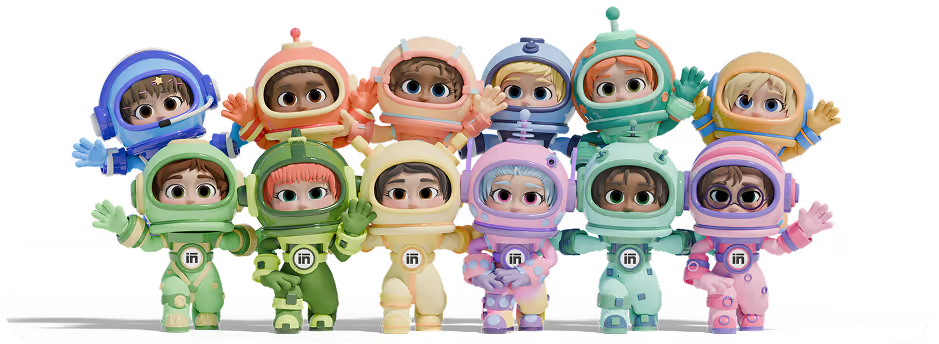
Sintra AI works differently. Unlike a general-purpose assistant, it's a multi-agent setup with an AI team of 12 specialized persona-based helpers, each having expertise in a business domain.
- Seoshi, the social media manager, helps marketers generate posts, publish them, and manage social media profiles across channels.
- Penn is the copywriter who writes landing pages, ad copy, social media scripts, blogs, and more.
- Cassie is the customer support rep. It automates your customer communication across channels, including email, website, and social media channels.
- Buddy is the business strategist. It understands your business, does competitor analysis, finds growth opportunities, and builds strategies around it.
- Vizzy is the virtual assistant. It manages your meetings, handles the content calendar, oversees projects, and takes meeting notes.
The difference: convenience and operational workflow. These AI helpers do not help you with one-off tasks, but rather take over the role and do relevant duties. An end-to-end task sequence with this AI team looks like this.
- Buddy plans your content briefs, messaging frameworks, and suggests content channels based on its research.
- Seoshi takes over and generates visuals accordingly.
- Penn follows and writes the content, from ad copies to SEO blogs, social media captions, and so on.
- Seomi checks the SEO and approves if the written content is ready to be published.
- Once everything’s done and a human employee validates the output, Seoshi updates the content calendar and schedules it for posting.
- Cassie is already present on your social media sites and websites to answer your customer queries.
There you have it - an entire task sequence executed with minimal human input. No prompts, no lengthy explanations, and no context switches.
Shared Business Memory with Brain AI
Another limitation of using ChatGPT models is that every conversation starts fresh. You are working with a blank slate, telling it exactly what to do and how to do it. While it can be useful at tailoring responses, the constant hassle of re-explaining your brand voice, style guidelines, and client preferences can be a lot. And every time, it produces a different response.
The only solution: Brain AI. It is a centralized digital knowledge space where your organizational data lives. It has everything your AI helpers need to execute a task: brand goals, vision statement, audience details, competitor analysis, market reports, previous projects, and decisions you took six months back. All helpers use it to pull context, understand your business, and execute tasks consistently.
How does this look in practice? Everything is in sync, from your social media posts to customer answers, marketing copy, and outreach emails. The wording might be different, but the essence stays the same. It’s like having a repository or a rulebook that employees use for maintaining consistency across routine operations.
What’s better is that it learns as your team grows. As you feed more information, interact with the helpers, and fill in surveys, Brain AI learns about your business and implements it accordingly. For growing teams, it is a meaningful benefit that scales with you and offers tailored solutions without having to learn prompt engineering.
Workflow Automation Through Integrations
That’s not it. This multi-agent system also has a connection advantage over ChatGPT. Using the latest version of ChatGPT means connecting to third-party tools and executing tasks, but within the chat interface. Sintra AI works differently. It has AI integrations that connect with your work tools, access your business data, and use it to execute tasks directly from the platform.
Good thing: its third-party integrations are compatible with all popular work and productivity tools, including Gmail, Outlook, Google Drive, Notion, LinkedIn, Instagram, Slack, and so on. Plus, they work on a no-code mechanism. You simply press connect, enter your login details, and that’s it. Once activated, the agents can send emails, post content, answer customer queries, and manage projects all independently without human intervention.
ChatGPT vs Sintra AI Comparison
ChatGPT assists you while Sintra works independently. ChatGPT hands over the final output for you to take action, whereas these AI helpers autonomously take action. One is reactive, and the other is proactive. The choice depends on what you need and what you can afford. To make the decision easier for you, here is a side-by-side comparison of ChatGPT models and Sintra AI.
Who Should Choose Sintra AI?
Before you jump into making a decision, note that Sintra AI is not for everyone. It’s a specially curated advanced business solution that helps brands with execution and not generation. So, if you are a startup with a few human employees and need to scale, this AI team can help you execute routine tasks, so humans can focus on growth.
Solopreneurs, startups, and small business owners favor this multi-functional AI solution, instead of relying on disconnected, multiple isolated AI tools. Here are a few areas where Sintra AI can make a difference.
- Marketing and writing agencies handling multiple client accounts.
- Small to medium-sized business who can’t afford an entire team for each department (marketing, sales, customer support, and so on).
- Marketing teams that are running multiple campaigns simultaneously.
- Sales teams who want to automate repetitive tasks (follow-ups, outreach messages, etc) that are eating up their day.
- Founders who are serving in multiple roles and need to delegate routine business tasks to a reliable AI.
Build an AI Team Instead of Managing AI Models
There you have it - all about the differences between ChatGPT o3 vs GPT 4o vs GPT 5. All three ChatGPT models excel in different situations. One is optimized for faster everyday multimodal queries, whereas the other two shine in complex logic problems.
However, whatever model you are using currently, GPT is not enough to run a coordinated business. This is why businesses and founders should look for automation platforms like Sintra AI. It not only saves time, but care for your brand voice, consistency, and online presence. Get started with Sintra AI today and see how it works for you.
ChatGPT o3 vs 4o vs GPT-5 FAQs
What is the difference between GPT-5 and GPT-4o?
GPT-5 is a deep reasoning, hybrid AI model for complex and basic problem-solving. Whereas GPT-4o is a non-reasoning model, optimized for faster and natural multimodal interactions. GPT-5 replaced the 4o and other 4-series models in the official ChatGPT interface.
Is o3 better than GPT-4o for reasoning and coding tasks?
Yes, o3 is inherently better than GPT-4o for reasoning and coding tasks. This is because o3 is a deeper reasoning model that uses chain-of-thought logic and delayed thinking. Whereas GPT-4o is a non-reasoning model, optimized for faster responses.
What is the latest version of ChatGPT?
GPT-5 series, especially GPT-5.5, is the latest version of ChatGPT. It is an advanced state-of-the-art hybrid reasoning model that interprets your prompt complexity and answers accordingly, with different response times and answer lengths. GPT-5 excels at various tasks, such as coding, content generation, document synthesis, and so on.
Can I still use OpenAI o3 in 2026?
Yes, of course. You can use OpenAI o3 via OpenAI APIs for coding and complex logic tasks.
How does Sintra AI differ from ChatGPT?
ChatGPT is a general-purpose AI chatbot that helps you with everyday complex and basic tasks. It could be coding, producing content, and brainstorming. In comparison, Sintra AI is an execution platform with specialized helpers that help businesses automate their workflows. It uses a combination of AI models from Anthropic and OpenAI, depending on their strengths.
Related articles