Blog
Business

DeepL vs ChatGPT: Which AI Tool Is Better for Businesses?

deepl vs chatgpt which tool ai tool is better for business

Table of Contents

Your AI team that deliver
and never sleep!
Try Sintra Today!

Quick Answer: DeepL vs ChatGPT Key Differences

DeepL is stronger for accurate translation and localization. ChatGPT is better for writing, summarizing, brainstorming, and adapting content across formats and channels.

When comparing DeepL vs ChatGPT, most business teams end up using both tools, not by design, but out of frustration. You translate a document using DeepL, copy and paste it into ChatGPT to fix the style, and then manually tweak the tone. It is a slow, messy loop because neither tool does it all. The rule of thumb is simple: use DeepL for flawless, publish-ready translation, and ChatGPT for creative writing and brainstorming.

But if you want to stop playing digital bridge builder, Sintra AI combines both engines into autonomous AI employees, allowing your work to get completed effortlessly without ever switching between two separate tools. This is what business teams are better at: reducing manual work and enabling fast execution.

However, if you want to test DeepL and ChatGPT head-to-head, which is better? This guide compares both tools, their capabilities, limitations, and use cases.

Feature DeepL ChatGPT
Translation Accuracy ✅ Stronger ⚠️ Capable but prompt-dependent
Content Writing ❌ Not built for it ✅ Core strength
Language Coverage ~30+ (deep accuracy) 100+ (broad, less nuanced)
Document Translation (PDF, DOCX) ✅ Yes ⚠️ Limited
API Availability ✅ Yes ✅ Yes
Glossary/Customization ✅ Yes ⚠️ Prompt-based only
Data Privacy / GDPR ✅ Strong (Pro deletes data) ⚠️ Plan-dependent
Workflow Automation ❌ Limited ⚠️ Moderate
Team Collaboration ⚠️ Limited ⚠️ Limited
Scalability ⚠️ Translation-specific ⚠️ Broad but manual
  • Best for pure translation accuracy: DeepL (ideal for contracts, technical manuals, and localized product pages).
  • Best for content rewriting and creation: ChatGPT (ideal for drafting emails, brainstorming campaigns, and summarizing research).
  • Best for end-to-end automated workflows: Sintra AI, the only platform that links both tools into automated AI employees, eliminating manual copy-pasting.

What Are DeepL and ChatGPT?

Before comparing them, it helps to be clear on what each tool was actually built to do.

DeepL is a translation-first AI platform. It was designed specifically for document translation, multilingual communication, and localization. Businesses use it to translate contracts, manuals, websites, and internal communications across languages.

deepl interface

ChatGPT is a generative AI assistant built by OpenAI. It handles writing, brainstorming, summarizing, research support, customer communication, and content generation. It can also translate, but that is not its primary purpose.

chatgpt interface

Neither tool is a competing product in the traditional sense. They were built for different jobs. The problem starts when teams expect one to do the other's job well.

How DeepL Translation Works

DeepL is built on a neural machine translation (NMT) framework, which allows it to excel at capturing nuance and delivering fluent, polished output, especially in formal and technical contexts. Instead of translating word by word, it reads full sentences and paragraphs to understand meaning, grammar, tone, and structure before producing output.

This matters in practice. A legal clause, a product specification, or a formal business letter has to come out clean on the other side. DeepL handles complex sentence structures better than most translation engines because it was trained specifically on such content.

It also includes a formal/informal tone toggle that lets you control whether the output reads like a business document or a casual conversation. That is not something you get from a generic AI prompt.

Where human review is still needed:

  • Legal documents where liability depends on exact phrasing
  • Medical content where terminology must be verified
  • Marketing copy where cultural tone matters beyond grammar
  • Technical documentation where industry-specific terms need validation

DeepL offers a glossary feature that allows users to define specific terms for consistent translation, which is particularly useful for professional and technical documents. If your product has a specific name or your industry uses terms that should never be translated loosely, you can lock those in. That consistency across every document is something ChatGPT cannot replicate without repeating the instruction in every single prompt.

How ChatGPT Generates Content

ChatGPT is a Large Language Model (LLM) developed by OpenAI, designed for a variety of language tasks beyond translation, including conversation, content generation, and summarization. It works by responding to prompts, which means the quality of what you get depends heavily on how you ask.

For content tasks, this flexibility is genuinely useful. You can ask it to:

  • Draft a cold outreach email in a specific tone
  • Summarize a 10-page report into three bullet points
  • Rewrite a product description for a different audience
  • Generate five campaign concepts for a product launch
  • Write a customer support response that matches your brand voice

Where ChatGPT runs into issues with translation is consistency. ChatGPT can adapt its translation style based on user prompts, allowing for flexibility in tone and phrasing, which is beneficial for creative and conversational contexts. But if you do not include the right instructions, the output tone and terminology can shift between sessions. There is no built-in memory for your preferred terminology unless you include it in every prompt or use a custom system prompt.

That works fine for one-off tasks. It becomes a problem for teams handling high volumes of translated content that needs to stay consistent across channels and time.

DeepL vs ChatGPT Features Compared

deepl vs chatgpt features compared

This is where the real differences show up for business teams. The marketing page version of each tool sounds impressive. The day-to-day version has friction points that matter when you are working at scale.

Translation Accuracy

DeepL generally delivers higher accuracy for professional translations, especially in legal, technical, or formal business contexts, thanks to its ability to produce fluent, natural translations. Here is how the comparison breaks down across three specific areas:

Contextual awareness

DeepL was trained on a large corpus of professional and formal text. This gives it an edge when translating industry-specific content. Legal jargon, medical terminology, and technical specifications come out more accurately because the model was built to handle that kind of language.

ChatGPT has broad general knowledge, but it applies it broadly. It understands what a legal clause means, but it was not optimized to translate it with the same precision as DeepL. For everyday content, the gap is small. For high-stakes documents, the gap matters.

Tone adjustment

DeepL has a built-in toggle between formal and informal registers. You switch it before you translate, and the output adjusts accordingly. It is consistent across every document you run through it.

ChatGPT adjusts tone based on your prompt. If you tell it to write formally, it will. But if you forget to include that instruction, or if different team members prompt it differently, outputs vary. This inconsistency adds review time that teams often do not account for.

Language depth vs. breadth

  • Targeted Library vs. Broad Volume: DeepL supports around 32 languages compared to ChatGPT’s 100+, prioritizing deep localized accuracy over sheer variety.
  • Next-Gen Upgrades: DeepL recently launched specialized LLM updates that mastered complex linguistic nuances for major markets, including Japanese, Chinese, and Arabic.
  • Cultural Precision: For localized idioms, colloquialisms, and formal business tones, DeepL's targeted engine consistently outperforms ChatGPT’s broader, more generic outputs.

ChatGPT's translations tend to be more literal and word-for-word, but omissions are less common than with DeepL, which sometimes leaves out information in longer sentences. That is worth knowing if you are running long-form documents through DeepL. A review pass on complex or lengthy content is still a good idea, regardless of which tool you use.

For sensitive, legal, or technical translations, human review remains necessary, no matter which AI tool you use.

Language Coverage and Localization Depth

The 30 vs. 100+ language comparison often comes up in the DeepL vs. ChatGPT debate, and it is worth addressing directly because the number alone is misleading.

If your business operates in German, French, Spanish, Japanese, or Portuguese, DeepL's localization quality within those languages is hard to beat. DeepL is known for its ability to handle complex sentence structures and maintain natural flow in dense or jargon-heavy texts, making it the industry standard for raw translation precision. Its neural networks were built to handle formal business syntax and local idiom, not just grammatical structure.

  • The Breadth Use Case: ChatGPT’s 100+ language coverage is perfect for quick, light-touch translations across smaller, less common global markets.
  • The Depth Use Case: DeepL remains the enterprise gold standard for core business languages, preserving natural sentence structures across Western European, Asian, and Middle Eastern markets.
  • Strategic Verdict: Use ChatGPT if you need to cast a wide, multilingual net; use DeepL if you require publishable-grade, high-precision localization for key business regions.

The trade-off is simple: breadth vs. depth. What matters for your team depends on whether you need wide language access or precise, publishable-quality localization.

Content Writing and Creativity

This is not a close comparison. ChatGPT is built for content generation. DeepL is not.

ChatGPT excels in contexts where tone, creativity, or flexibility are key, making it suitable for marketing, social media, and conversational content. When a content or marketing team needs to produce first drafts, rewrite existing copy, brainstorm campaign angles, or generate 10 subject-line variations for an email test, ChatGPT handles the work efficiently.

DeepL's role in content workflows is different. It translates finished copy into other languages. If you have a blog post written in English and you need a Spanish version, DeepL can do that. But it will not help you write the blog post in the first place, generate ideas for it, or adapt it for a different audience.

Teams that use both tools effectively tend to create content in ChatGPT, then localize it using DeepL. That workflow makes sense. The problem is that it still requires manual steps, copy-pasting, and review at every stage.

Data Privacy and Enterprise Security

For SaaS teams, legal departments, and businesses handling confidential documents, this section often decides the question before anything else.

DeepL offers both a free and a paid version (DeepL Pro), with the paid version providing additional business and confidentiality features, such as API integration and translation data protection. On DeepL Pro, texts submitted for translation are deleted immediately after processing. They are not stored, used to train models, or retained on their servers. This makes DeepL Pro compliant with GDPR requirements, which matters significantly for European businesses and any company handling personal or sensitive data.

ChatGPT's data handling depends on the plan and the settings your team uses:

  • The free version may use conversations to improve models unless you opt out
  • ChatGPT Plus and Team plans offer more control
  • ChatGPT Enterprise provides stronger privacy guarantees, including the option to turn off training data usage entirely

For a startup handling internal documents, the default ChatGPT settings may be fine. For a legal team translating client contracts, or a healthcare company managing multilingual patient documentation, DeepL Pro's data deletion policy is not a feature; it is a requirement.

This distinction does not come up enough in most comparisons. Enterprise buyers often make their decision here before they ever look at translation quality scores.

Workflow Automation and Productivity

Both tools save time on individual tasks. Neither one runs a complete workflow on its own.

With DeepL, you paste or upload content, get a translation, and then use that output elsewhere. With ChatGPT, you write a prompt, get output, review it, adjust it, and then take it somewhere else. Both tools are still stops on a longer manual journey.

The productivity gains are real but limited:

What neither tool does is hand work off automatically, maintain context from one task to the next, or coordinate between departments. You still do that manually. And as team size grows, that manual coordination becomes the frustrating part.

Team Collaboration and Scalability

This is where both tools start to show the same limitation, just in different ways.

With DeepL across a team:

  • Different users may apply different glossary settings
  • There is no shared brand voice layer
  • Team plans exist, but context does not carry across members automatically

With ChatGPT across a team:

  • Prompts are not standardized unless someone builds and enforces a system
  • Brand voice and tone depend entirely on what each person types
  • There is no shared memory of the company context unless you build it into every session

DeepL's glossary feature allows users to maintain consistency across translations, which is crucial for specialized documents, while ChatGPT lacks this built-in functionality. That glossary feature helps with terminology consistency, but it does not solve brand voice consistency across full content workflows.

As teams grow, the real problem is not which tool is better. It is that using either tool at scale requires someone to manually manage prompts, check outputs, maintain brand standards, and coordinate handoffs. That overhead grows with headcount, and it does not go away on its own.

DeepL vs ChatGPT: A Practical Side-by-Side Test

Let us take a real example and run it through both tools to show how the difference plays out in practice.

The input: A formal business contract clause.

Prompt: "The Licensee agrees not to sublicense, sell, resell, transfer, assign, or otherwise commercially exploit or make available to any third party the Service or the Content."

DeepL's output (translated to German)

deepl translation process

Clean, formal, and legally precise. DeepL maintains the structure and register of the original without requiring any instructions. DeepL is particularly effective for high-stakes, high-precision professional translations, making it the preferred choice for legal, technical, and formal business contexts.

ChatGPT without a context prompt (translated to German)

using chatgpt for translation

Acceptable, but the phrase "erklärt sich damit einverstanden" (agrees/declares agreement) is slightly less formal and precise than DeepL's "verpflichtet sich" (commits/undertakes). In a legal context, that difference can matter.

ChatGPT with a specific context prompt

Prompt: "Translate the following contract clause into formal German legal language, maintaining the exact legal register and precision of the original."

chatgpt translation response

With the right prompt, ChatGPT gets much closer. The output is formal and legally sound. But it required explicit instruction to get there, and you would need to include that instruction every single time, for every document, across every team member using the tool.

What this test shows

DeepL delivers professional-grade translation by default. ChatGPT can match it when prompted correctly, but that prompt dependency creates inconsistency at volume. For a team translating hundreds of documents per month, building and enforcing prompt standards is an additional workload that DeepL's default behavior removes.

DeepL vs ChatGPT Pricing

Pricing for both tools has changed over time, so specific figures should always be verified on their official sites. The structure of each tool's charging, however, tells you a lot about which use case each is designed for.

DeepL pricing structure

DeepL separates its pricing into user-facing translator accounts and developer-facing API keys. Subscribing to a premium tier scales costs with usage and targets two specific operational triggers: strict data privacy (immediate server erasure) and custom glossary locking.

Standard Web and App Tiers

Rates reflect annual billing configurations, which save approximately 16 percent over monthly plans.

  • Free ($0): Covers basic translation tasks. Features a cap of 50,000 characters per month and three files monthly, up to 5 megabytes each. Data is saved to refine the translation software.
  • Starter / Individual ($8.74 per user/month): Geared toward solo professionals. Unlocks infinite text translation and three editable documents per month, up to 30 megabytes each. Guarantees immediate data deletion and includes one glossary up to 5,000 terms.
  • Advanced / Team ($28.74 per user/month): Created for shared localization workflows. Includes infinite text translation, 20 editable files per user each month, centralized administration controls, pooled glossaries, and CAT tool integrations.
  • Ultimate / Business ($57.49 per user/month): Tailored for larger departments. Expands limits to 100 editable documents per user each month. Adds single sign-on provisioning, domain capture, and infinite glossary creation.

Programmable API Tiers

  • API Free ($0): Grants developers 500,000 characters monthly at no cost. This tier does not have access to next-generation linguistic models.
  • API Pro ($5.49 flat base fee + $25.00 per million characters): Uncapped usage billed exactly to consumption. Full documents run through the API incur a minimum processing fee of 50,000 characters per file, regardless of the internal word count.

The Business Case

If a team relies heavily on high-volume, exact localization, paying for a dedicated DeepL tier is highly economical. Rather than funding a broad, general-purpose generative AI suite, budget allocations go directly toward specialized, publishable-grade translation capabilities.

ChatGPT pricing structure

OpenAI organizes ChatGPT into flat-rate consumer accounts and secure enterprise workspaces. These tiers scale based on data allocation, processing power, and corporate security needs.

Individual Tiers

  • Free ($0): Baseline conversation access. Includes capped messages for flagship models, limited data analysis, and restricted file uploads.
  • Plus ($20/month): Standard tier for individuals. Unlocks higher messaging limits for reasoning models, advanced voice features, and custom assistant building.
  • Pro ($200/month): Built for researchers and power users. Provides unrestricted compute access during peak times, wider context windows, and advanced generation models.

Collaborative Business Tiers

Workspace plans that explicitly exclude user data from training OpenAI models.

  • Team ($25 per user/month billed annually, or $30 monthly): Requires a minimum of two seats. Includes shared team spaces, higher message caps than Plus, an admin console, and workspace analytics.
  • Enterprise (Custom Quote): Built for large organizations scaling. Requires a larger seat minimum and delivers top-speed access, advanced compliance logging, single sign-on, and dedicated support.

The Business Case

While specialized tools target isolated tasks like translation, ChatGPT functions as a general-purpose utility. A corporate workspace seat serves as a multi-role asset: writing drafts, analyzing spreadsheets, summarizing long reports, and generating code. The cost per individual task remains highly efficient if your workforce uses the tool for diverse daily workflows.

The honest value question:

  • If you mainly need accurate translation, DeepL Pro gives you more precision per dollar for that specific task
  • If your team needs help across a range of content and communication tasks, ChatGPT offers a broader return on the same budget
  • If you need both, you are paying for two separate tools, managing two separate logins, and doing the integration manually

That last scenario is where the cost conversation shifts. Two separate subscriptions plus the time cost of manual coordination add up quickly for a growing team.

DeepL and ChatGPT Strengths and Limitations in Business Workflows

deepl and chatgpt pros and cons

Both tools bring clear value. Both also hit a wall when teams try to use them as full workflow solutions rather than as single-task tools.

Where DeepL and ChatGPT Work Well

DeepL works best for:

  • Translating contracts, legal documents, and compliance materials
  • Localizing product documentation across supported languages
  • Translating internal communications for multilingual teams
  • Any workflow where GDPR compliance and data deletion are required
  • Maintaining consistent terminology through the glossary feature

ChatGPT works best for:

  • Writing first drafts of blog posts, emails, and sales copy
  • Summarizing long documents, reports, or meeting notes
  • Brainstorming campaign angles, product names, or content structures
  • Adapting existing content for different audiences or channels
  • Generating customer support responses at volume

For many teams, the ideal setup uses both: creating content with ChatGPT and localizing it with DeepL. That workflow exists for a reason. It plays to each tool's actual strengths.

Where DeepL and ChatGPT Fall Short for Business Workflows

The gaps become visible when you look at what happens between tasks, not just during them.

Common friction points that come up repeatedly in team workflows:

  • Repeated prompting: Every ChatGPT session starts from zero. There is no retained memory of your brand voice, product details, or previous decisions unless you rebuild it in each prompt
  • Manual copy-pasting: Output from one tool does not automatically flow into another. Someone has to move it, check it, and format it at every stage
  • Inconsistent brand voice: When different team members prompt ChatGPT differently, outputs vary. There is no system-wide standard unless someone enforces it manually
  • No task handoffs: Neither tool can hand a task to another system, trigger an approval, or notify a teammate. That coordination still lives in email, Slack, or a project management tool
  • No shared business context: Both tools treat each session as independent. They do not know your company's history, your customer segments, your product roadmap, or your communication preferences unless you tell them again

ChatGPT does not have a built-in glossary feature, which means users must specify terminology in prompts each time they translate, potentially complicating the process for consistent terminology. That same problem extends to every other type of context. Brand guidelines, tone preferences, audience details, and product specifications have to be re-entered manually, which creates both extra work and inconsistent outputs.

This is the real gap. Not translation quality scores or language support counts. The gap is that neither tool was built to coordinate work across a team, retain business context, or run a workflow from start to finish without human intervention at every step.

Sintra AI: Beyond DeepL and ChatGPT

DeepL solves a translation problem. ChatGPT solves a content generation problem. What growing businesses actually face is a coordination problem, and that is what the Sintra AI team infrastructure is designed to address.

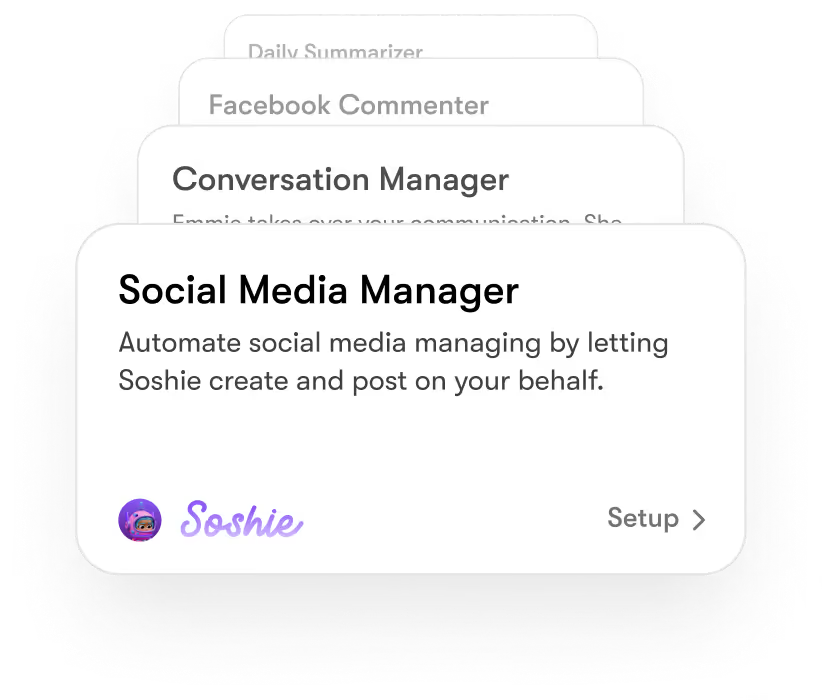
Sintra AI is not another single-use tool. It is a system where role-based AI Helpers cover specific business functions, share a common memory layer, and connect to the tools your team already uses. The result is AI that works like part of the team, not like a tool you have to keep briefing from scratch.

From AI Tools to AI Employees

The shift worth understanding is not from manual work to AI-assisted work. Most teams have already made that move. The next shift is from isolated AI tools to AI employees who handle full functions.

With single-purpose tools, humans still do the coordination. With AI Helpers built around business roles, the coordination happens inside the system. Marketing, sales, customer support, operations, content, and strategy each have Helpers trained for those specific functions. They do not need to be re-briefed every session because context carries forward.

DeepL is designed specifically for translation, utilizing a neural machine translation framework that excels in capturing nuance and delivering fluent output, particularly in formal and technical contexts. That precision is valuable. But translation is one task in a much longer workflow. AI employees cover the entire workflow, not just one step.

How Brain AI Maintains Context Across Tasks

One of the core limitations of both DeepL and ChatGPT for business teams is context loss between sessions. You explain your brand voice today; tomorrow, it is gone. You define your audience once; next week, someone else starts from zero.

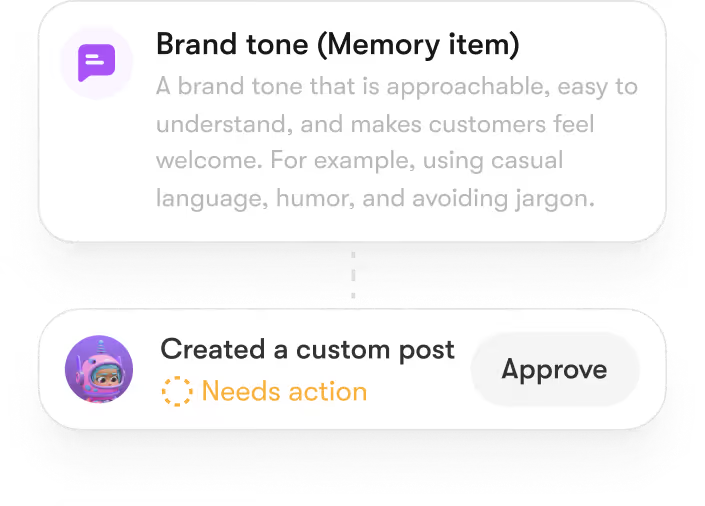
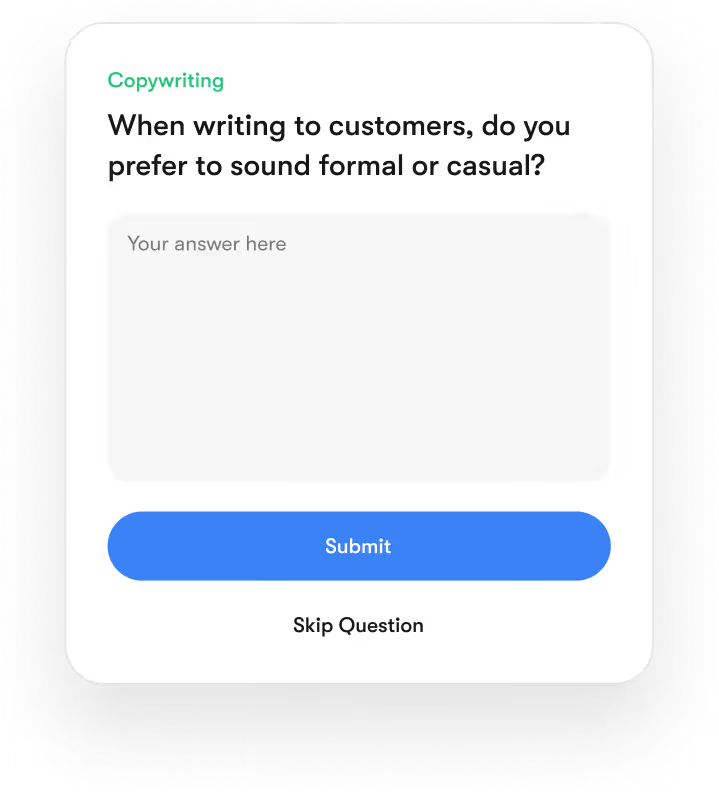
Brain AI solves this by storing company knowledge at the system level. Brand voice, product information, audience details, workflow rules, and communication preferences are stored once and available to every Helper every time. You do not brief it. It already knows.

This matters practically because consistency stops being a manual job. Every output, across every Helper, across every department, draws from the same source of company knowledge. That is what makes AI outputs actually usable at scale without a review layer to catch inconsistencies.

AI Integrations for Real Business Workflows

The other gap that neither DeepL nor ChatGPT fills is integration with the tools where work actually lives. Translating a document in DeepL does not update your CMS. Generating copy in ChatGPT does not send it to your email platform or log it in your project management tool.

AI integrations that connect to Gmail, Notion, and other platforms bring AI outputs into the same systems where your team works. That removes the copy-paste step, speeds up handoffs, and keeps AI-generated work visible and trackable alongside everything else. The result is AI that fits into your workflow rather than sitting alongside it.

Ready to Build Your AI Team?

If your team is still using separate tools for translation and content and manually bridging the gap between them, you are adding coordination overhead that scales poorly as your business grows. DeepL and ChatGPT both do their jobs well. The problem is that they are separate jobs.

Get started with Sintra AI and move from disconnected AI employees handling isolated tasks to a connected AI team that shares context, runs workflows, and covers the full range of functions your business needs.

DeepL vs ChatGPT FAQs

Is DeepL better than ChatGPT for translation?

For professional translation, yes. DeepL is built on a neural machine translation (NMT) framework, which allows it to excel at capturing nuance and delivering fluent, polished output, especially in formal and technical contexts. ChatGPT can translate well, too, but it needs careful prompting to reach that same level of consistency. For legal, technical, or client-facing content, DeepL is the safer default.

Can ChatGPT replace DeepL?

For casual or creative translation, possibly. For professional volume, no. It lacks DeepL's built-in glossary and tone toggle. ChatGPT's translations tend to be more literal and word-for-word, but omissions are less common than with DeepL, which sometimes leaves out information in longer sentences. Teams with high translation volume and consistency requirements still need DeepL.

What is DeepL mainly used for?

Document translation, multilingual business communication, and localization. DeepL is particularly effective for high-stakes, high-precision professional translations, making it the preferred choice for legal, technical, and formal business contexts.

Is DeepL accurate for professional translation?

Yes, especially for the languages it supports. Its neural framework handles complex, formal content well. That said, human review is still recommended when exact phrasing carries legal or financial consequences.

Which is better for businesses, DeepL or ChatGPT?

Depends on the primary need. DeepL wins for translation-heavy workflows. ChatGPT excels in contexts where tone, creativity, or flexibility are key, making it suitable for marketing, social media, and conversational content. Many teams use both, but that creates manual coordination overhead that grows with team size.

Share this post
Your AI team that deliver
and never sleep!
Try Sintra Today!