Generative AI vs Predictive AI: What's the Difference?

Table of Contents
Quick Answer
Predictive AI uses historical data to forecast what is likely to happen. It ingests structured datasets, runs them through statistical models, and outputs a probability, a score, or a number. Think of it as a very sophisticated trend spotter that tells you a customer is about to churn, a machine is likely to fail, or demand for a product will spike next quarter.
In comparison, Generative AI creates new content from scratch based on context and prompts. It does not retrieve stored answers. It generates responses, documents, images, workflows, and code by predicting what output best fits the input it has received. The output did not exist before you asked.
A company spends months rolling out an AI system. The dashboards look impressive, and the forecasts are accurate. But then someone asks, "Can it write the follow-up email to the customers it just flagged as at-risk?" It cannot. That is a different kind of AI entirely.
This is the gap that most AI buying decisions fall into, and it costs teams real time before they figure out what went wrong. The confusion between Generative AI vs Predictive AI is about the misconception of vendors, selling "AI" as a single category when the two types solve fundamentally different problems.
Predictive AI reads your past data and tells you what is probably coming. Generative AI takes a prompt and produces something that did not exist before: an email, a workflow, a block of code, a synthetic dataset.
The business case for each is distinct, and the way companies approach AI is shifting. Rather than using AI as a reporting layer that sits above human work, more teams are moving toward a model where AI handles tasks from start to finish, with predictive systems flagging what needs attention and generative systems acting on it. Building an AI team that covers both ends of that loop is where the real efficiency gains are.
Generative AI vs Predictive AI: At a Glance
Both types are increasingly used together, with predictive AI providing the signal and generative AI acting on it.
Generative AI vs Predictive AI: How Do They Work?
Before comparing business applications, it helps to understand what is actually happening under the hood, without needing a machine learning degree to follow along.
There is a subtle irony worth noting: at their mathematical core, both types of AI are prediction machines. Predictive AI predicts macro-level outcomes, things like next quarter's revenue or whether a loan will default. Generative AI predicts at the micro level, specifically, which word, pixel, or token comes next in a sequence.
The difference is in the scale and type of what gets predicted. One produces a number representing a future event. The other produces a stream of tokens that assembles into something new. This is what we call the Predictive Paradox, and keeping it in mind prevents a lot of confusion when vendors pitch their tools.
How Predictive AI Works
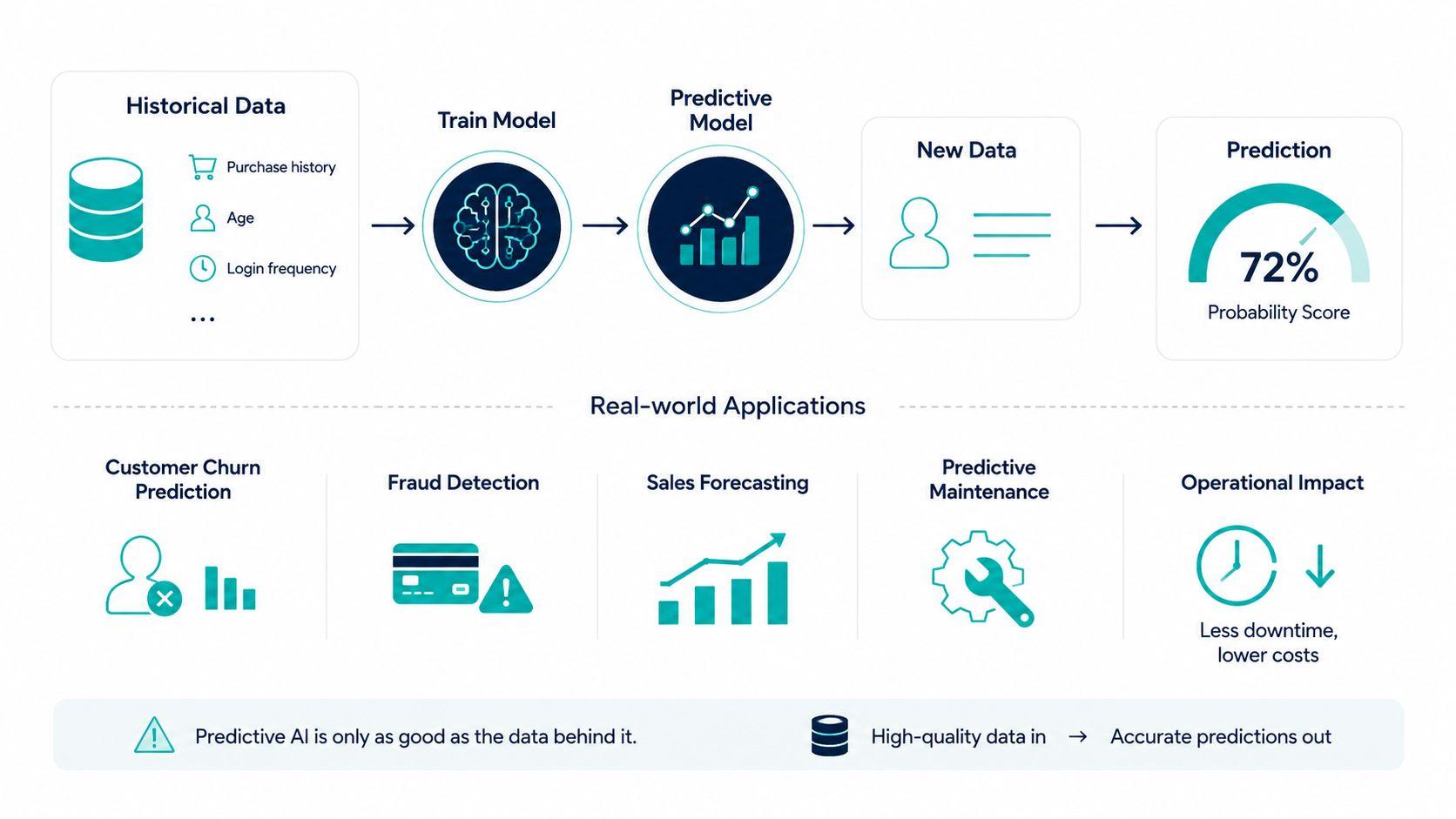
Predictive AI trains on historical, structured data. It learns the relationship between inputs (a customer's purchase history, age, and login frequency) and outcomes (they canceled their subscription). Once trained, it applies that learned relationship to new data and returns a probability score or forecast.
Common real-world applications include:
- Customer churn prediction: A SaaS platform identifies accounts showing usage drop-off patterns associated with past cancellations
- Fraud detection: A bank flags transactions that match statistical patterns linked to previous fraudulent activity
- Sales forecasting: A retailer uses last year's seasonal demand data to project inventory needs for the coming quarter
- Predictive maintenance: A manufacturer monitors equipment sensor data and schedules maintenance before failure occurs
Predictive AI models can improve operational efficiency by predicting equipment maintenance needs, thus minimizing downtime in manufacturing and supply chain management. This is one of the most measurable ROI cases for predictive AI, because equipment failure is expensive and largely avoidable with good data.
A significant disadvantage of predictive AI is its dependence on large amounts of high-quality data; insufficient or poor-quality data can lead to inaccurate predictions. Garbage in, garbage out applies here more literally than anywhere else in software.
Core Algorithmic Architectures of Predictive AI
Predictive AI relies on statistical modeling, machine learning, and classification algorithms. The three architectures most commonly used in enterprise predictive systems are:
- Regression Models: These establish a mathematical relationship between input variables and a target output. Linear regression predicts a continuous value (next month's revenue). Logistic regression predicts a binary outcome (will this customer churn: yes or no).
- Decision Trees and Random Forests: Decision trees map out branching if-then logic based on data features. Random forests combine hundreds of decision trees and average their outputs, which significantly improves accuracy and reduces overfitting on noisy data.
- Time-Series Analysis: Techniques like ARIMA (AutoRegressive Integrated Moving Average) are designed specifically for data indexed by time, making them the standard choice for demand forecasting, financial modeling, and capacity planning.
These are auditable architectures. A compliance officer can trace why a loan was denied or why a customer was flagged as high-risk. That auditability matters enormously in regulated industries.
How Generative AI Works
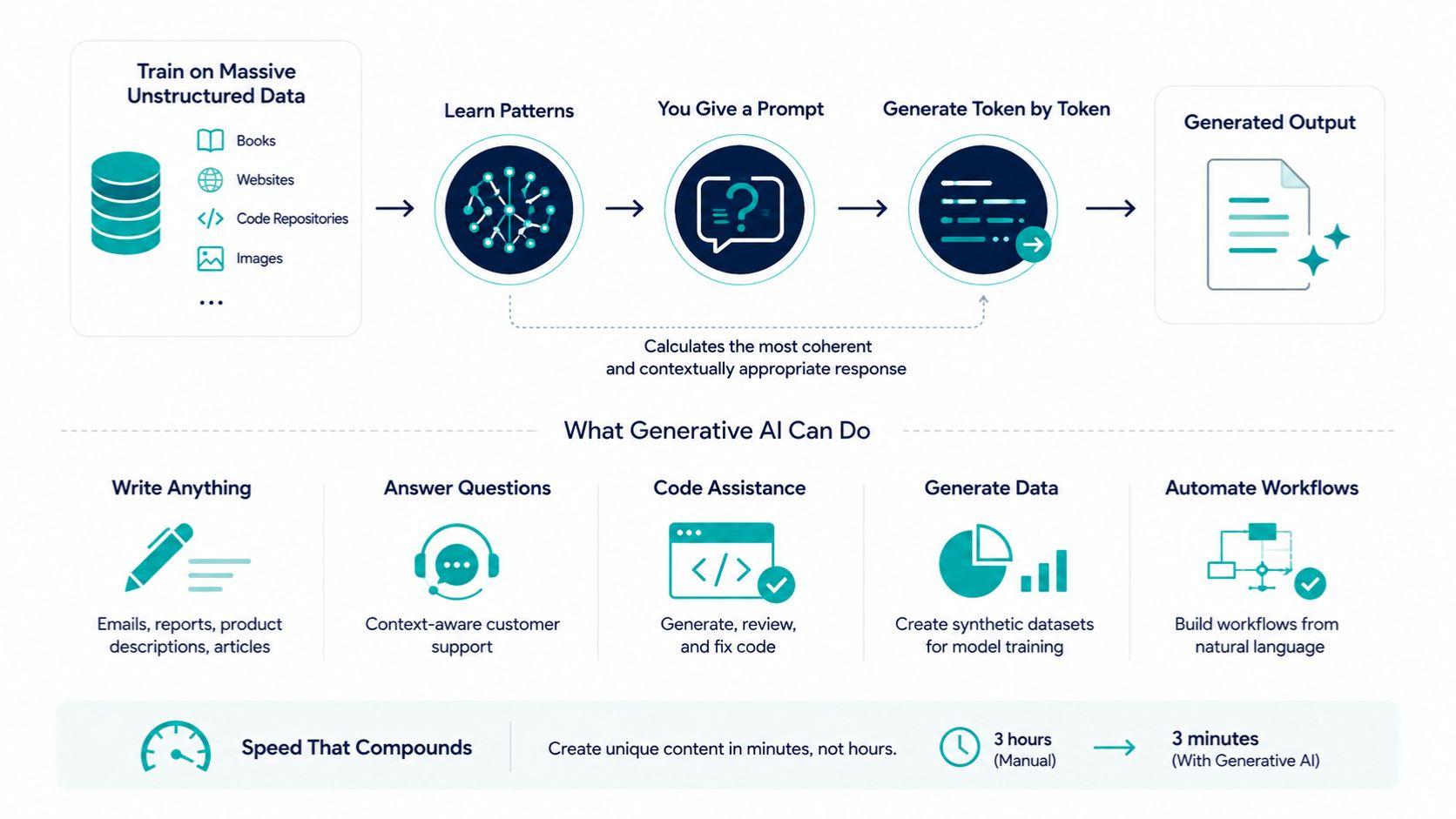
Generative AI trains on massive unstructured datasets (books, websites, code repositories, images) and learns to generate new outputs that fit the statistical patterns in that training data. When you give it a prompt, it does not look up an answer. It calculates, token by token, what sequence of words or pixels would make the most coherent and contextually appropriate response.
Generative AI creates novel content by learning from existing data, while predictive AI forecasts future outcomes based on historical data patterns. This single sentence contains the entire distinction in compressed form.
Modern generative AI systems handle:
- Writing emails, reports, product descriptions, and long-form articles
- Answering customer support queries with context-aware responses
- Generating code, reviewing it, and suggesting fixes
- Creating synthetic datasets for training other models
- Building automated workflows based on natural language instructions
Generative AI can create unique content quickly, which enhances productivity and allows users to focus on more complex tasks. That speed advantage compounds across teams. What took a copywriter three hours can take three minutes.
Core Algorithmic Architectures of Generative AI
Generative AI is built on architectures like Transformer models, Generative Adversarial Networks (GANs), and Diffusion models. Each serves a different generation task:
- Transformers (LLMs): The architecture behind ChatGPT, Claude, and Gemini. Transformers process entire input sequences simultaneously using attention mechanisms, allowing the model to weigh relationships between all words in a prompt at once. This is what enables coherent long-form text generation.
- Generative Adversarial Networks (GANs): Two neural networks compete. A generator creates fake outputs (images, data); a discriminator tries to identify them as fake. The generator improves by fooling the discriminator. GANs are widely used for realistic image synthesis and synthetic data generation.
- Diffusion Models: These start with random noise and progressively refine it into a coherent image or output through a learned denoising process. DALL-E and Stable Diffusion use this approach. Diffusion models currently produce the most photorealistic image outputs.
Generative AI typically requires large datasets for training, whereas predictive AI can operate effectively with smaller, more targeted datasets. This is a practical distinction for smaller companies deciding which type of AI to build versus buy.
Predictive AI Use Cases
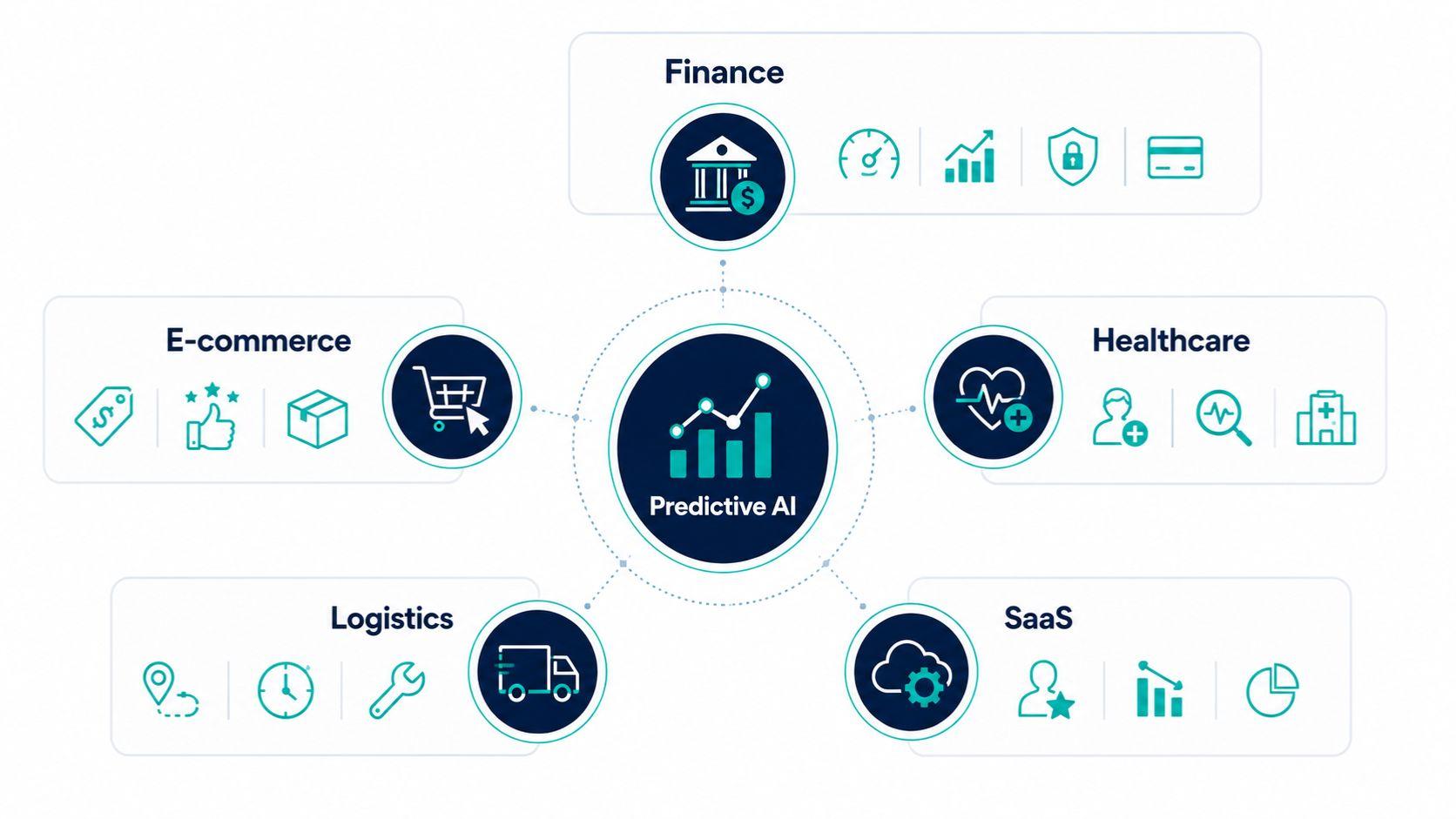
Typical applications of predictive AI include business and finance forecasting, healthcare predictions, marketing analysis, and operations maintenance. Across industries, the pattern is consistent: wherever there is historical data and a future outcome worth anticipating, predictive AI has a role.
Predictive AI is primarily used in finance, retail, e-commerce, and manufacturing to forecast trends and improve decision-making processes. Specific examples by sector:
- Finance: Credit scoring, loan default prediction, algorithmic trading, fraud detection at the transaction level
- E-commerce: Dynamic pricing, recommendation engines based on purchase history, and inventory demand forecasting
- Healthcare: Predicting patient readmission risk, identifying early markers for disease progression, optimizing hospital staffing
- Logistics: Route optimization, predicting delivery delays, fleet maintenance scheduling
- SaaS: Lead scoring models that rank prospects by conversion probability, churn prediction tied to product usage signals
By analyzing historical data, predictive AI can identify patterns that help businesses anticipate customer behavior, optimize inventory, and enhance marketing strategies. A study by McKinsey found that companies that embedded AI in decision-making processes consistently outperformed peers on revenue and cost metrics, with supply chain and marketing as the leading application areas.
Generative AI Use Cases
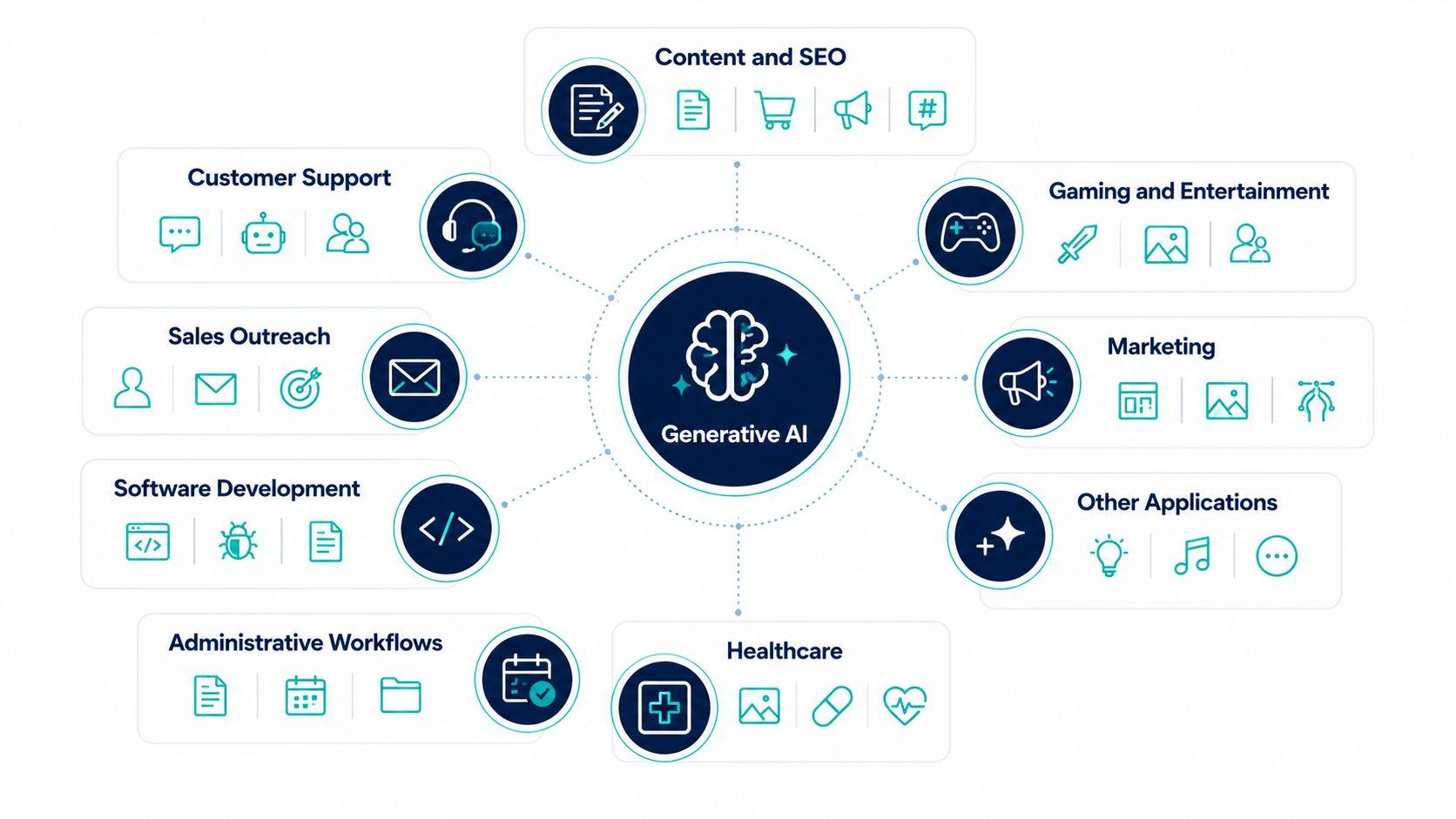
Typical applications of generative AI include content creation, design and art, software development, and customer support. But that list undersells the operational depth of modern generative systems.
Practical use cases include:
- Content and SEO: Drafting articles, product pages, ad copy, and social posts at scale
- Customer support: Automated first-response systems that handle common queries without a human queue
- Sales outreach: Personalized email sequences tailored to prospect data
- Software development: Code generation, debugging assistance, documentation writing
- Administrative workflows: Meeting summaries, scheduling coordination, internal knowledge base management
- Healthcare: Generative AI is used in healthcare for creating realistic medical images, aiding in drug research, and developing personalized treatment plans based on patient data
- Gaming and entertainment: In the gaming and entertainment industries, generative AI is revolutionizing content creation by producing immersive experiences, lifelike environments, and dynamic interactions among players and characters
- Marketing: Generative AI can assist in marketing and advertising by automatically generating compelling content, visuals, and designs, which helps attract and engage target audiences
Generative AI vs Predictive AI: Key Business Differences
The technical differences matter less to most operators than the practical business question: which one do I actually need, and for what?
Explainability vs. Creativity: The Black Box Dilemma
This is where the two types diverge most sharply for regulated industries. Predictive AI models offer math-backed audit trails. You can show exactly why a model scored a particular customer as high-risk. The path from input to output is traceable and documentable. This matters enormously in banking, insurance, and healthcare, where regulators may require an explanation for every automated decision.
Generative AI operates through deep neural layers that do not produce a clear linear decision path. You can observe the output, but cannot fully trace why those specific words appeared in that specific order. For creative and operational tasks, this is fine. For a loan denial or a medical recommendation, it is a compliance liability. Choosing the right AI type means understanding which side of that tradeoff your use case falls on.
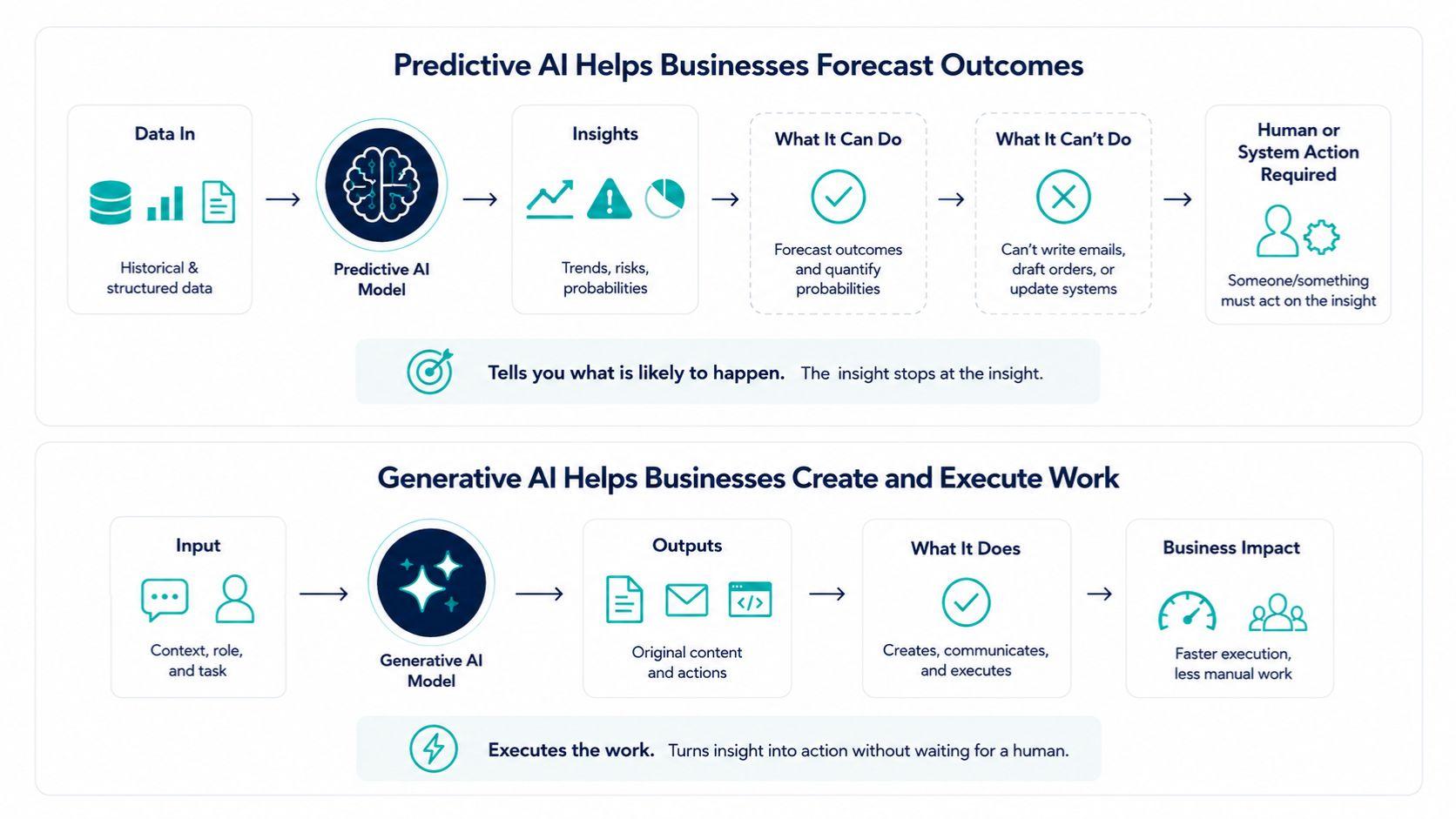
Predictive AI Helps Businesses Forecast Outcomes
Predictive AI is genuinely useful for strategic planning. It surfaces trends, flags risks, and quantifies probabilities that humans would struggle to calculate manually from large datasets. Predictive AI can automate routine tasks, allowing employees to concentrate on decision-making and complex problem-solving, thus improving overall efficiency. What it cannot do is write the email to the at-risk customer, draft the inventory order, or update the CRM. The insight stops at the insight.
This is the ceiling of pure predictive AI in a business context. It tells you what is likely to happen. Someone, or something, still has to act.
Generative AI Helps Businesses Create and Execute Work
Generative AI does not forecast. It executes. Given a context, a role, and a task, it produces output immediately. This makes it the better fit for operational use cases where the bottleneck is creation and communication, not analysis.
The outputs of generative AI are original creations, while predictive AI outputs are forecasts of likely future events or trends based on data analysis. That difference in output type is also a difference in where each AI sits in a workflow. Predictive AI informs a decision. Generative AI can execute on that decision without waiting for a human to translate insight into action.
How Businesses Combine Predictive AI and Generative AI
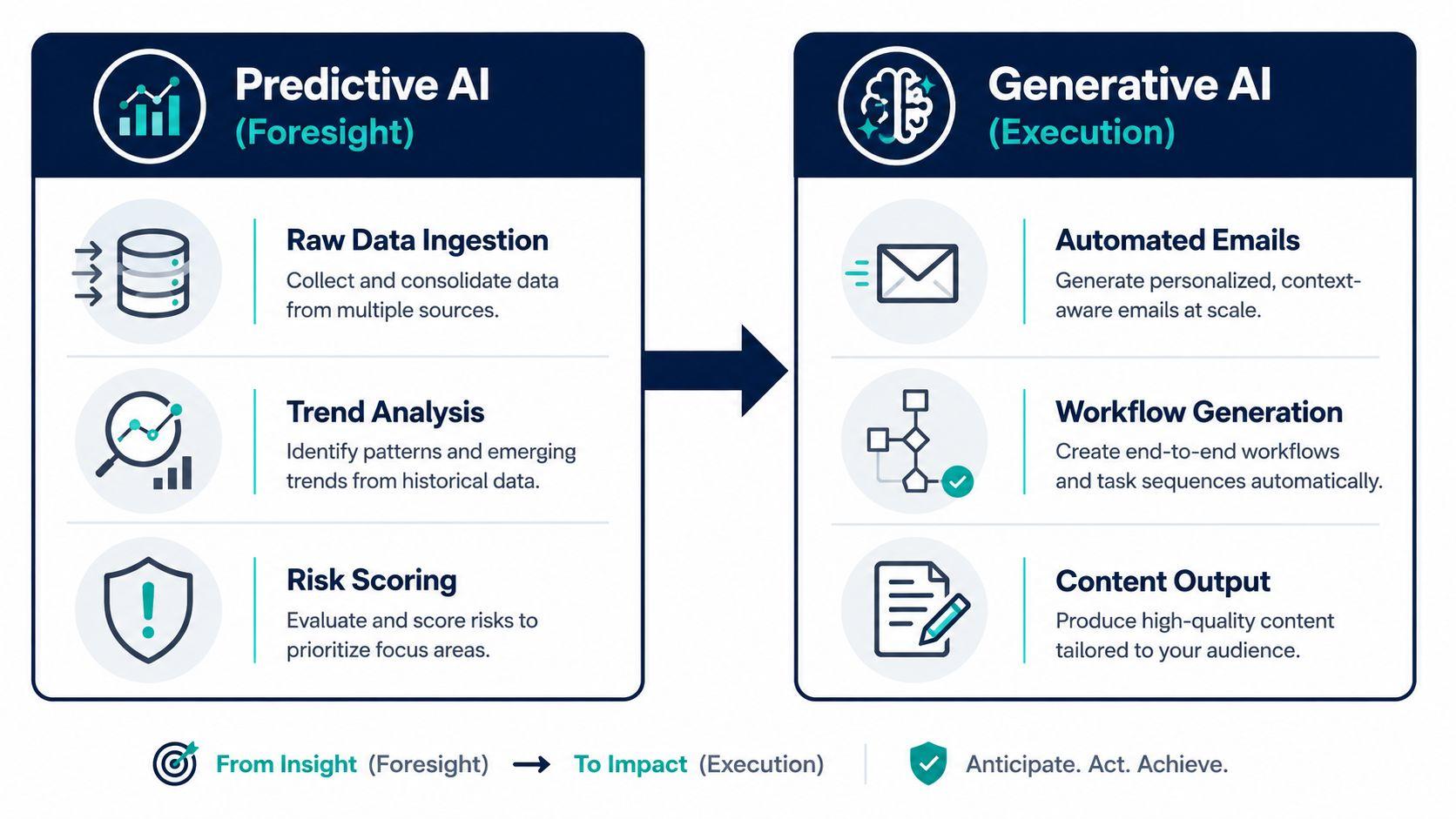
In advanced data workflows, generative and predictive technologies often operate in tandem for enhanced effectiveness. This is becoming the standard architecture for AI-forward companies, not a cutting-edge experiment.
The combination works because both types complement each other's gaps. Predictive AI sees patterns humans miss. Generative AI acts on those patterns at a speed and scale humans cannot match.
Predictive AI Finds Opportunities and Risks
Predictive AI relies on statistical modeling, machine learning, and classification algorithms to score, rank, and flag. In a combined workflow, it handles the reconnaissance. It identifies which customers are about to churn, which leads are most likely to convert, which shipments are at risk of delay, and which equipment needs attention before it breaks.
This front-end work is essential. Acting on all customers equally wastes resources. Predictive AI prioritizes where action will have the highest return.
Generative AI Turns Insights Into Action
Once the predictive layer has flagged the opportunity or risk, the generative layer executes. It writes the personalized retention email to the churning customer. It drafts the follow-up sequence for the high-probability lead. It generates the maintenance work order for the flagged equipment. It produces the inventory adjustment recommendation in plain language for the operations manager.
Generative AI can create synthetic data that expands and diversifies datasets, which can enhance predictive analytics by helping models anticipate a broader range of potential outcomes. This is an underappreciated feedback loop: generative AI can also improve the predictive models feeding it by creating richer training data.
Real-World Examples of Combined AI Workflows
E-commerce Personalization
A predictive model analyzes a customer's browsing and purchase history and scores their likelihood to buy from three product categories. A generative AI system uses those scores to write personalized product recommendation emails, homepage banners, and push notification copy, each tailored to the individual customer and their predicted interest.
SaaS Churn Mitigation
Predictive AI monitors in-app usage signals and flags accounts showing declining engagement patterns associated with past cancellations. Generative AI drafts individualized outreach messages for the customer success team, each referencing the specific features the customer has underused and suggesting relevant resources.
Healthcare Administrative Scheduling
A predictive model forecasts patient volume for the coming two weeks based on seasonal patterns, referral data, and historical appointment loads. A generative AI assistant drafts staff scheduling recommendations, patient reminder communications, and capacity planning memos for department heads.
Limitations of Predictive AI and Generative AI
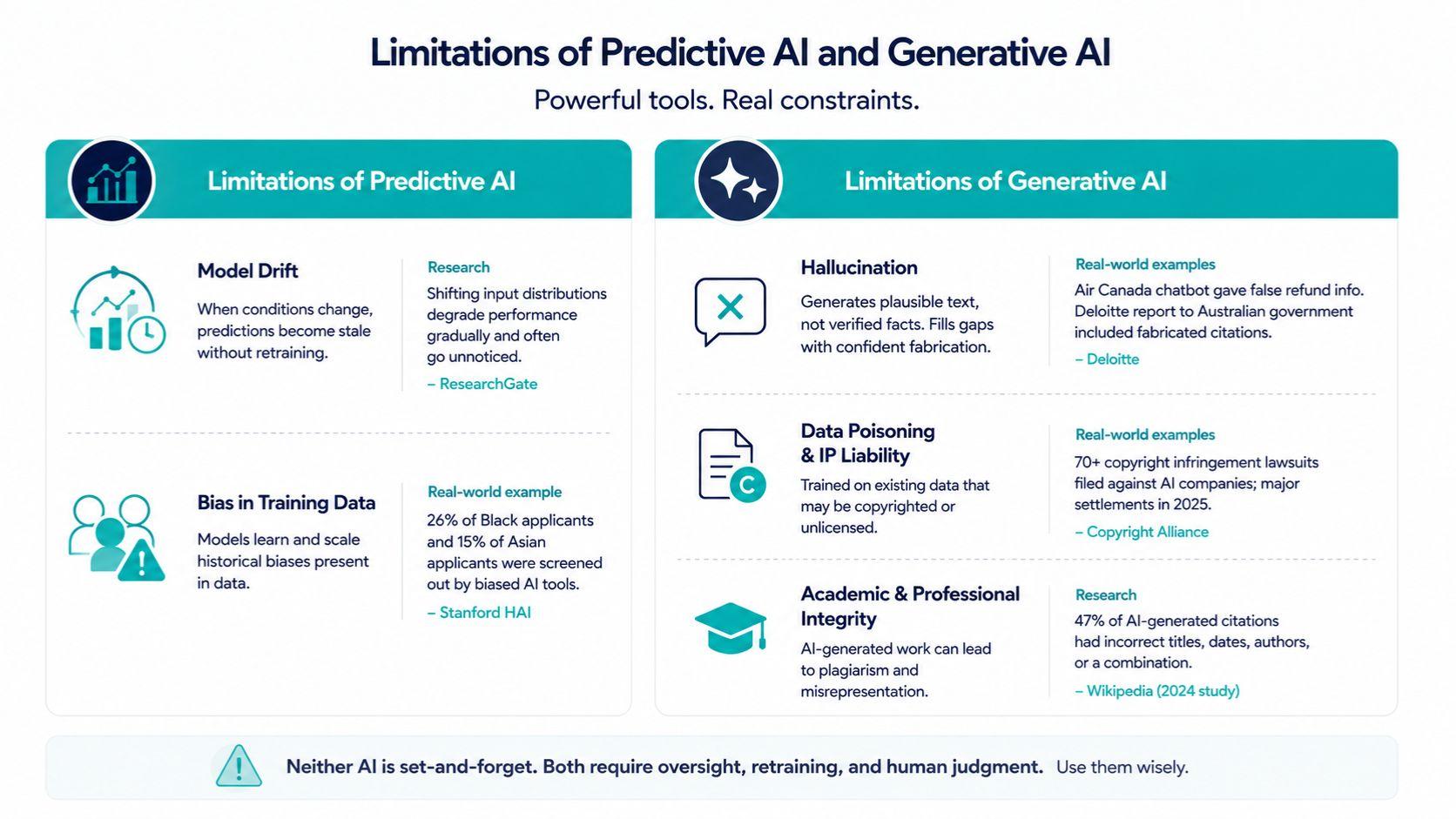
Neither technology is a finished product. Both come with real constraints that do not get enough airtime in vendor marketing materials.
Limitations of Predictive AI
Model Drift: Predictive models are trained on historical data that reflects past market conditions. When those conditions shift, the model's predictions become stale without retraining. A churn model built during a period of economic growth may miss the signals that indicate churn driven by budget cuts. Research published on ResearchGate on ML model drift documents this directly: shifting input data distributions degrade predictive performance in ways that are often gradual and go unnoticed until decisions are already affected.
A real-world case study from ScienceDirect found that a machine learning model for predicting diagnostic imaging follow-up experienced lower precision and recall over time, requiring full retraining to restore its original accuracy. Organizations that set and forget their predictive models often discover this expensively.
Both generative and predictive AI face ethical concerns regarding bias, as predictive AI can perpetuate historical biases present in training data, while generative AI can produce biased outputs based on the data it was trained on.
A Stanford HAI study found that 26% of Black applicants and 15% of Asian applicants applied to positions where AI screening tools discriminated against their racial group, with the bias traced directly back to patterns in historical hiring data. These systems scale that discrimination faster and more consistently than any human recruiter could.
Limitations of Generative AI
Hallucination
Generative AI systems generate plausible-sounding text, not verified facts. When they lack information, they fill the gap with confident fabrication. Real-world cases include Air Canada's chatbot providing a passenger with false information about refund eligibility, and a Deloitte report submitted to the Australian government that was found to contain fabricated citations generated by an AI tool. For tasks where factual accuracy is critical (legal documents, medical information, financial disclosures), human review is not optional.
Data Poisoning and IP Liability
Generative AI's reliance on previously created data raises concerns about copyright infringement, as it may produce content that is unlicensed or not original. The legal exposure here is significant and actively litigated.
According to the Copyright Alliance, over 70 copyright infringement lawsuits have been filed by copyright owners against AI companies, with major settlements reached in 2025. The U.S. Copyright Office has also stated that some uses of copyrighted works for generative AI training will not qualify as fair use. Organizations using generative AI for public-facing content need review processes that catch potential IP problems before they become legal ones.
Academic and professional integrity
The use of generative AI in educational settings has led to issues of academic dishonesty, as students may submit AI-generated work as their own, constituting plagiarism.
A 2024 study cited by Wikipedia's AI hallucination page found that 47% of AI-generated citations submitted by students either had incorrect titles, dates, authors, or a combination of all three. The same issue applies in professional contexts, where AI-generated work submitted as original human work creates misrepresentation problems.
One disadvantage of generative AI is its reliance on existing data, which can lead to issues such as copyright infringement if the generated content is not original. This applies especially to image generation systems, where cases like Getty Images v. Stability AI center on the alleged unlicensed use of over 12 million photographs to train image generation models.
Why Generative AI Platforms Are Becoming Essential for Modern Businesses
The shift from insight to execution is the key transition happening in enterprise AI right now. Predictive AI has been mature and in production for over a decade in finance and retail. Most of the straightforward forecasting problems have tools. The gap that remains is not knowing what to do. It is doing it consistently, at scale, without proportionally scaling headcount.
Generative AI fills that gap. A small operations team can use it to communicate with thousands of customers individually. A two-person marketing team can produce content that previously required a full agency retainer. A solo founder can delegate scheduling, inbox management, research, and first-draft writing to AI systems that do not clock out.
Generative AI is used in healthcare for creating realistic medical images, aiding in drug research, and developing personalized treatment plans based on patient data. Outside healthcare, the same principle applies: generative AI takes the structured insight from predictive systems and translates it into real operational output across every business function.
For businesses evaluating AI integrations, the practical question is whether you need an AI that tells you what is coming or one that helps you respond to what is here. Increasingly, the answer is both, connected in a single workflow. That is where platforms combining AI personalization with task execution become genuinely useful, not just technically impressive.
How Sintra AI Uses Generative AI to Execute Business Tasks
Sintra AI is built around a straightforward idea: most businesses do not need a research tool. They need something that actually does the work. Our AI employees are purpose-built generative AI systems organized by business function, designed to take operational tasks off your team's plate rather than just surfacing insights about them.
This positions Sintra differently from analytics-focused predictive platforms. We are not primarily predicting outcomes. We are executing tasks, writing content, managing communication, and running workflows in real time.
Sintra AI Helpers and Operational Automation
Each AI Helper in the Sintra ecosystem is focused on a specific business function rather than being a general-purpose chatbot. This matters because generality creates friction. An AI Helper trained and configured for customer support handles support conversations differently than one built for SEO content, and that specificity produces better outputs with less prompt engineering on your end.
Current function areas include:
- Content writing: Long-form articles, product descriptions, landing page copy
- Customer support: First-response handling, FAQ resolution, escalation routing
- SEO assistance: Keyword-optimized content, meta descriptions, internal linking
- Email outreach: Personalized sequences, follow-up drafting, reply handling
- Social media management: Post drafting, scheduling copy, engagement responses
- Administrative workflows: Meeting notes, scheduling coordination, internal documentation
Generative AI can create unique content quickly, which enhances productivity and allows users to focus on more complex tasks. That is the direct business case for deploying AI Helpers rather than adding headcount for repetitive operational work.
How Brain AI Personalizes Business Context
One common complaint about generative AI tools is that they sound generic, because they are. They have no context about your business, your brand voice, your customers, or your history. Every conversation starts from zero.
Brain AI solves this by functioning as a centralized memory system for your business. It stores company information, preferred workflows, brand guidelines, product details, and operational context. Every Sintra AI Helper draws from Brain AI when generating responses, which means outputs reflect your specific business rather than a generic template.
Over time, Brain AI accumulates context that makes every Helper more relevant. An SEO Helper that knows your product positioning writes differently than a generic content AI. A customer support Helper that knows your pricing tiers and refund policy gives more accurate answers. The personalization compounds.
How Sintra AI Connects With Existing Business Tools
Generative AI platforms that operate in isolation quickly become another tool to manage rather than a tool that manages other things. The value of AI Helpers increases significantly when they connect directly to the platforms your team already uses daily.
Sintra AI's AI integrations include connections to email platforms, calendars, CRM systems, communication tools, and social media management platforms. This means AI Helpers can read context from existing systems (what is already in the CRM, what emails are pending, what calendar slots are open) and write outputs back into those systems (updating records, drafting replies in the email client, scheduling posts).
Why Execution-Focused Generative AI Platforms Are Growing
The limitations of standalone chatbots have become clear. GPT wrappers that accept a prompt and return text are useful for one-off tasks but do not scale as operational infrastructure. They have no memory, no integration with business tools, no task sequencing, and no role-specific configuration.
Operational AI platforms like Sintra address these gaps by combining generative AI's creation capabilities with structured workflows, tool integrations, and persistent context. Where predictive AI gave businesses better answers to look at, execution-focused generative AI platforms give businesses better work getting done. That is a qualitatively different value proposition, and it is why growth in this category is outpacing general-purpose AI chatbot adoption among business users.
Ready to Build an AI-Powered Team?
If your business has outgrown the chatbot phase and you are looking for AI that actually handles operational work, get started with Sintra AI. Our AI Helpers take on the repetitive, time-consuming tasks across content, customer support, outreach, and administration so your team can focus on decisions and work that genuinely requires human judgment. Predictive AI tells you what is coming. Sintra helps you act on it.
Generative AI vs Predictive AI FAQs
What is the difference between generative AI and predictive AI?
Predictive AI analyzes historical data to forecast future outcomes, such as churn probability or demand forecasting. Generative AI creates new content, responses, or workflows from a prompt. One produces predictions; the other produces output.
Is ChatGPT generative AI or predictive AI?
ChatGPT is generative AI. It uses a large language model (transformer architecture) to generate text responses. While it technically predicts tokens sequentially, its purpose and output are generative, not forecasting.
Can predictive AI and generative AI work together?
Yes. A common workflow: predictive AI identifies at-risk customers, and generative AI automatically drafts personalized retention messages for each one. The two types handle different stages of the same business process.
What are examples of generative AI tools?
ChatGPT, Claude, Gemini, Midjourney, Stable Diffusion, GitHub Copilot, and Sintra AI are generative AI tools. They create text, images, code, and workflows from prompts rather than returning stored results.
Which is better for businesses: predictive AI or generative AI?
Neither is universally better. Predictive AI suits businesses with data-rich forecasting needs. Generative AI suits those with high-volume operational and content tasks. Many modern businesses benefit most from using both together.
Related articles


.avif)