Kimi vs ChatGPT: Which AI Assistant Is Better in 2026?


Table of Contents
Quick Answer: Is Kimi Better Than ChatGPT?
When comparing Kimi vs ChatGPT, Kimi is better for high-volume API automation, repository-scale coding, and parsing massive files due to its 256K context window and cost-effective open-weight architecture. Conversely, ChatGPT is superior for turnkey out-of-the-box deployment, polished creative copy, and broad multimodal voice applications.
Picking an AI tool without testing it on your actual work is like buying running shoes based on the box design. You end up with something that looks right but performs wrong. The Kimi vs ChatGPT comparison trips up most buyers for exactly this reason: both tools are genuinely capable, but they are built for different kinds of work, and choosing the wrong one means spending more time fixing outputs than you save generating them.
We ran both platforms through real use cases: research, writing, coding, and business operations. We found that Kimi is an engineer at heart, while ChatGPT is a communicator. If you match the tool to the task, both deliver.
However, the performance gap is narrowing, and many teams are moving beyond chat-based assistants entirely toward specialized AI employees designed to autonomously execute workflows from start to finish.
Here is how they compare across the dimensions that matter most:
| Feature | Kimi AI (K2.7 Code Series) | ChatGPT (GPT-5.5 / Thinking) |
|---|---|---|
| Model Ecosystem | Open-weight (self-host via GGUF/MIT License) | Closed-source, proprietary API |
| Architecture | 1T Parameter Mixture-of-Experts (MoE) | Dense / Advanced Mixture-of-Experts |
| Context Window | 256K tokens | 128K tokens (varies by tier) |
| Reasoning | Always-On Thinking Mode (mandatory) | Adjustable reasoning levels |
| API Cost (per 1M tokens) | Input: $0.75 / Output: $3.50 | Input: $5.00 / Output: $30.00 |
| Agent Capabilities | Native Agent Swarms (up to 300 sub-agents) | Custom GPTs and tool connectors |
| Data Governance | Local infrastructure or Beijing-based Moonshot | US-based OpenAI cloud |
| Known Weaknesses | Multi-turn context loss, overconfident on code bugs | Hallucinations, high API costs at scale |
| Best For | Developers, data parsing, large-scale automation | Creative writing, general chat, non-technical teams |
Recommendation at a glance: developers and data engineers should lean toward Kimi for cost and depth of context. Marketing teams, operations managers, and non-technical users will get faster results from ChatGPT's more polished interface and creative output.
Kimi vs ChatGPT: Feature-by-Feature Breakdown
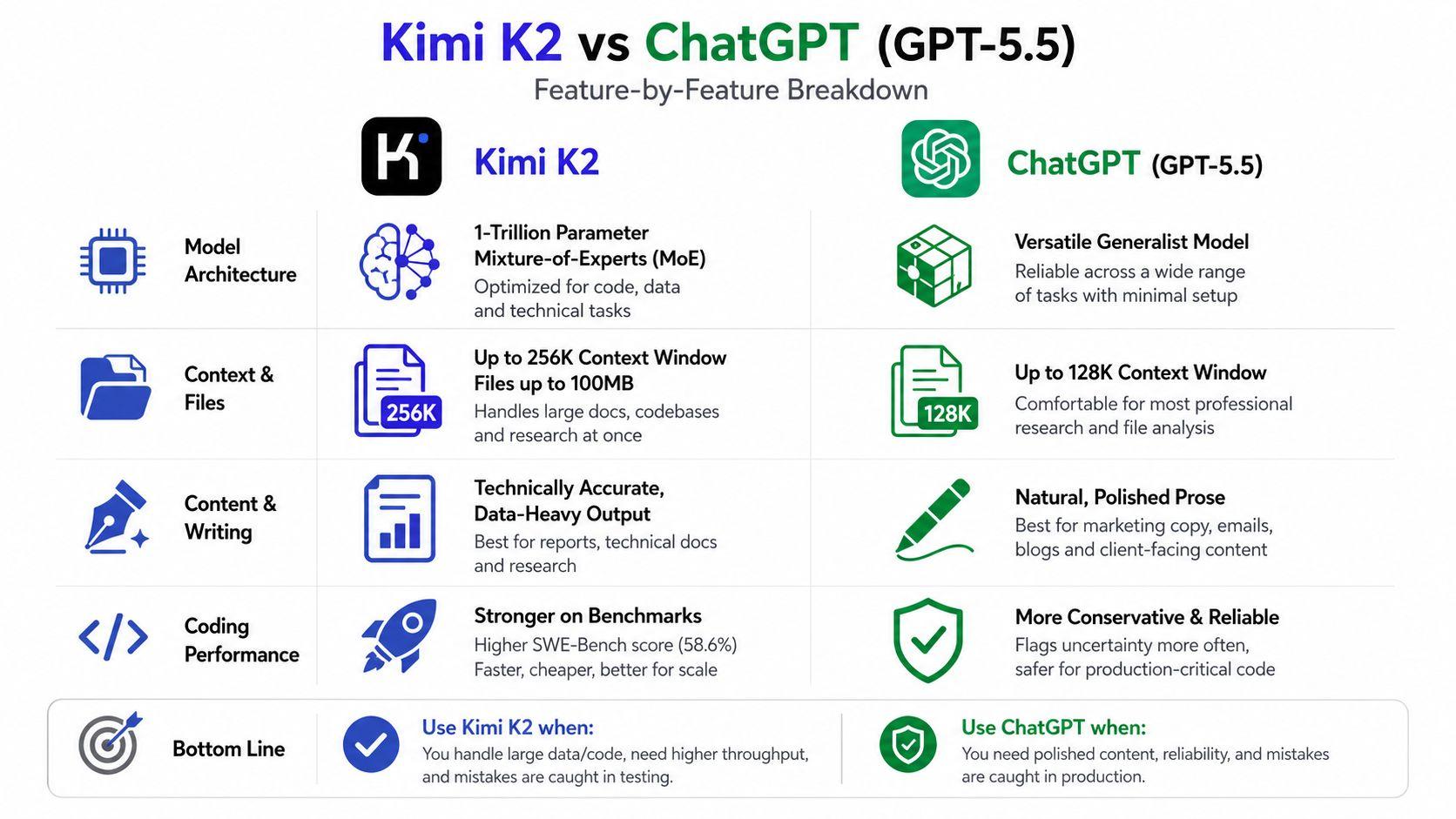
Numbers in a table only tell part of the story. A 256K context window means nothing if the model quietly forgets your first document by the time it processes the tenth. A price gap of $5 vs $0.75 per million tokens is irrelevant at low volume and mission-critical at scale.
Below is what each feature difference actually means in practice.
Model Architecture: What Powers Each Tool
ChatGPT (GPT-5.5) is built for versatility. It handles the full breadth of professional tasks: legal summaries, casual emails, coding assistance, data analysis, and creative writing. Its training corpus is broad, and its reasoning is generally reliable across contexts, which is why non-technical users can get usable results without much prompt engineering.
Kimi K2 takes a different approach. It runs on a 1-trillion-parameter Mixture-of-Experts (MoE) architecture, routing each task to the most relevant subset of its model rather than activating all parameters simultaneously. This reduces latency and compute cost on the tasks it is optimized for, specifically heavy data work and code.
What this means day-to-day:
- ChatGPT produces consistently good output across a wide range of task types with minimal setup
- Kimi K2 is sharper on code, document parsing, and structured data analysis, but requires more deliberate prompting for creative or open-ended tasks
- Kimi's Always-On Thinking Mode processes chain-of-thought reasoning before every response, which improves structured output quality and adds slight latency on simpler queries
- ChatGPT lets you toggle reasoning depth by task, which is more flexible for lighter work
Real developer data:
For multi-file refactoring and API integration mapping, Kimi outperformed competitors by 12-18% due to its cross-reference tracking capability, according to the latest NeuraPlusAI Kimi Benchmark Study. Furthermore, developers reported a 30% reduction in follow-up prompts on large-scale migrations. That is a meaningful gain, but it applies specifically to structured technical work. A marketing team running email campaigns will not see the same benefit.
For non-technical users, the architecture difference is less relevant than the day-one usability difference. ChatGPT is faster to produce something useful from, without needing to understand how to structure prompts for data-heavy tasks.
Example to make this concrete: A marketing manager who needs a competitor comparison report will get a usable draft from ChatGPT within minutes using a conversational prompt. The same person using Kimi will get a more thorough, data-dense output, but only if they know to upload the competitor PDFs, structure the analysis request clearly, and double-check for confident-sounding errors. The output ceiling is higher with Kimi. The barrier to reaching it is also higher.
Research and Knowledge Retrieval
Both tools can search the web, read uploaded files, and synthesize multi-source data into summaries. Where they part ways is in how much they can hold at once.
Kimi's depth advantage
- Kimi K2 supports context windows up to 256K tokens, roughly the equivalent of 10 full research reports in a single session
- Kimi K1.5 can process large files up to 100MB, which makes it practical for ingesting full documentation libraries, lengthy RFPs, or regulatory filings
- Useful for auditing a codebase, reviewing a 300-page contract, or running competitive analysis across multiple uploaded PDFs at once
ChatGPT's accessibility advantage
- ChatGPT supports up to 128K tokens for long conversations, which comfortably covers most standard professional research tasks
- Web browsing integration is tighter and easier to use for non-technical users
- Source citation formatting in outputs is generally cleaner
Worth noting
Users in developer communities have flagged occasional context drop-off during lengthy Kimi sessions, in which the model loses track of details established early in a multi-turn conversation. This is a known limitation across large-context models, not specific to Kimi, but it is worth testing against your actual document size before assuming 256K solves the problem.
Practical scenario: A legal team reviewing a 200-page vendor contract can upload the entire document to Kimi in one session and query specific clauses without re-uploading. The same task in ChatGPT would require chunking the document and managing context manually across multiple sessions. For this specific task type, Kimi's advantage is real and significant. For a marketing team reading a 10-page campaign brief, both tools handle it the same way.
Content Creation and Writing Quality
This is where the gap between the two tools is most visible for business users.
ChatGPT produces prose that reads naturally, adapts tone well, and requires less editing before it is usable. GPT-5.5 handles brand voice consistency, varied sentence rhythm, and marketing register in ways that feel polished. For output that goes directly to a client or customer, ChatGPT has a clear edge.
Kimi's writing output is technically accurate and structurally sound, but leans toward a more utilitarian style. Blog posts read more like reports. Ad copy lacks the rhythm that drives conversions.
Where each tool fits
| Writing Task | Better Tool |
|---|---|
| Ad copy, email sequences, social content | ChatGPT |
| Data-heavy white papers and research reports | Kimi |
| Technical documentation and API guides | Kimi |
| Blog outlines and SEO article drafts | Both (ChatGPT for final drafts) |
| Brand voice calibration across multiple pieces | ChatGPT |
Benchmarks put Kimi K2.5's math and coding performance at or above GPT-4 (96.2% vs. 95% on MATH 500), but English writing quality scores lower at 8.5 out of 10 versus ChatGPT's 9 out of 10. That gap is small on paper and noticeable when you are producing client-facing content at volume.
Coding and Technical Tasks
Where Kimi leads
On April 20, 2026, Kimi K2.6 posted 58.6% on SWE-Bench Pro, beating GPT-5.4 at 57.7%, while costing only $0.60 per million tokens. On Arena.ai's Code Arena WebDev leaderboard, Kimi K2.6 ranked sixth among 67 models as of April 2026. For developers running high-volume pipelines, that performance-to-cost ratio is hard to argue with.
Additional strengths
- Kimi K2 is optimized for coding tasks and agentic behavior, with native MCP tool integration
- Native Agent Swarm support coordinates up to 300 specialized sub-agents running in parallel
- Kimi K2 can process large files up to 100MB, allowing full repository ingestion without chunked uploads
- Strong multi-language support across Python, TypeScript, Rust, and Go
The honest caveat
There is a well-documented pattern in developer forums around what is sometimes called the "lying paradox." Kimi confidently reports it has fixed a bug, generates code that looks correct, and quietly skips a critical implementation step that only surfaces in testing.
Artificial Analysis measured Kimi K2.6's hallucination rate at 39.26%, down significantly from K2.5's 64.6%, but still worth accounting for. Never rely on Kimi's self-assessment of whether code is working. Always run actual test suites.
ChatGPT is more conservative in its coding outputs. It flags uncertainty more often, which can feel slower but is more reliable for production-critical work, where confidence without correctness is a real risk.
Which to use for coding tasks
- Greenfield projects, UI prototyping, batch refactors, test generation: Kimi K2.6 delivers 80 to 90% of Claude Code quality at a fraction of the price, making it the practical default for cost-sensitive builds
- Production-critical debugging or security-sensitive code: ChatGPT's more conservative flagging behavior reduces the risk of confidently wrong output slipping through code review
- Large repository analysis across multiple files: Kimi's 256K context window and 100MB file processing give it a structural advantage over ChatGPT's more limited ingestion
The cleaner summary: use Kimi when the cost of a mistake is caught in testing, use ChatGPT when the cost of a mistake is caught in production.
Kimi vs ChatGPT: Pricing Breakdown and Accessibility
The pricing difference between these two tools is large enough to change how you architect an AI-powered product.
API Costs Side by Side
| Cost Type | Kimi K2 | ChatGPT GPT-5.5 |
|---|---|---|
| Input (per 1M tokens) | $0.60 | $5.00 |
| Output (per 1M tokens) | $2.50 | $30.00 |
| Cache hit input | ~$0.19 | Varies |
Kimi K2's input cost is significantly lower than competitors, roughly 8x cheaper than comparable frontier models. At 50 million tokens of input per month, that is approximately $30 on Kimi versus $250 on ChatGPT.
What Cost Comparison is in Practice
- At low volumes (personal use, occasional tasks): the price difference is irrelevant; use whichever interface you prefer
- At medium volumes (small teams, regular workflows): Kimi's pricing starts to matter, particularly for document-heavy tasks
- At high volumes (API-powered products, large-scale automation): Kimi K2 is orders of magnitude cheaper than Claude Opus and significantly cheaper than ChatGPT; the savings are structural
Free Tier Reality Check
ChatGPT's free tier is widely accessible but caps daily usage and limits access to model versions. Kimi's free tier on kimi.ai offers solid context allowance for document tasks but has similar daily limits. Neither free tier is viable for production workflows at real scale.
Accessibility Differences
- ChatGPT.com works immediately for any user with no setup required
- Kimi's full capabilities (Agent Swarms, extended context, MCP integrations) require API access or developer configuration
- For non-technical teams who need a capable AI tool on day one, ChatGPT removes more friction
A Practical Cost Scenario
Imagine a startup running an AI-powered customer onboarding flow that processes roughly 100,000 user interactions per month, each averaging 1,000 tokens of input and 500 tokens of output.
- On ChatGPT (GPT-5.5): 100M input tokens at $5 = $500 in input costs alone
- On Kimi K2: 100M input tokens at $0.60 = $60 in input costs
That is $440 per month in pure API savings on a relatively modest scale. At 1 million monthly interactions, the gap becomes $4,400 per month. For a bootstrapped startup, that difference funds another feature, another hire, or another month of runway. These are not abstract numbers when you are building at scale.
Kimi vs ChatGPT for Business Teams

Both tools deliver real value in business contexts. The pattern we see consistently, though, is that teams adopt them expecting broad operational support and end up using them mostly for drafting. The tool generates the content, and a human still handles the coordination, verification, and distribution.
That is not a failure of the tools. It is an accurate picture of what they are designed to do. The teams that get the most out of them treat them as skilled drafters, define specific, bounded tasks, and build clear human-review workflows around the output.
Where the GPT vs. Kimi question matters most for business users comes down to three things: cost at scale, content quality for external-facing communication, and compliance risk for regulated industries. Each of those factors points to a different answer.
Which Tool Fits Which Team
- Developer or engineering team: Kimi wins on cost and context depth; add an approval step for code output quality
- Marketing or content team: ChatGPT wins on writing quality and ease of use; the higher API cost is a quality investment
- Operations or mixed team in a regulated industry: Evaluate Kimi's data governance carefully before routing sensitive business data through it
Marketing and Content Teams
What works reliably
- ChatGPT drafts ad copy, email sequences, and campaign briefs where tone and readability matter
- Kimi audits lengthy industry reports and extracts structured summaries from multi-document sets
- A combined workflow: feed a dense product brief to Kimi for structural analysis, pass the output to ChatGPT for creative execution, and have a human editor review for brand alignment
- Both tools generate first-draft content at volume for social media and email newsletters, where speed matters more than perfection
A concrete example
A SaaS company launching a product update needs a multi-channel campaign. The process might look like this:
- Upload the product spec and three competitor landing pages to Kimi
- Ask Kimi to extract key differentiators and map them against competitor gaps
- Pass that structured output to ChatGPT with a brand voice brief
- ChatGPT produces the homepage hero copy, LinkedIn post, and email sequence
- A human editor reviews for accuracy and tone before anything goes live
That workflow takes two hours instead of six. But it requires deliberately using each tool for what it is actually good at, and still requires a human in the loop for the final review pass.
What still requires human involvement
- Maintaining a consistent brand voice across sessions and team members
- Verifying claims and citations before publication
- Strategic campaign decisions involving audience judgment, timing, and competitive positioning
- Legal review of AI-generated content before it goes live
The two-tool handoff workflow is effective, but it adds coordination overhead. Teams need to weigh whether the quality gains from using both tools are worth the cost of managing two separate interfaces and two separate prompt libraries.
Sales and Customer Support Teams
Where Kimi AI and ChatGPT save real time
- Cold email drafts personalized to a prospect's industry or stated challenges
- Summarizing customer call transcripts into key themes and next steps
- Generating FAQ matrices from product documentation or support ticket history
- Building objection-handling scripts by deal stage
- Creating follow-up sequences after demos using notes from the call
Where the gaps become apparent
- Neither tool can sync data back to your CRM after drafting an outreach email
- Neither monitors live support queues nor escalates tickets without a human trigger
- Customer history resets each session; there is no memory of what was drafted for this account last week
- Routing tickets to the right team member requires a human to copy-paste between systems
What this looks like in practice
A sales rep drafting 20 personalized emails per day still copies each from the chat interface to their email client, logs it manually in the CRM, and re-uploads context the next time they need help with the same account. The AI compresses the writing step. The operational overhead of moving outputs into actual systems remains the same.
For support teams, the pattern holds at higher volume. An AI that generates a response template is useful. One that reads an incoming ticket, drafts a response, routes it to the right team member, and logs the interaction without human copy-paste is a different category of tool entirely. Neither Kimi nor ChatGPT is in standard form.
Limitations of Both Kimi and ChatGPT
The Core Structural Problem
Both tools are text generation interfaces. That ceiling is real and worth naming clearly, because the marketing language around both platforms tends to blur it.
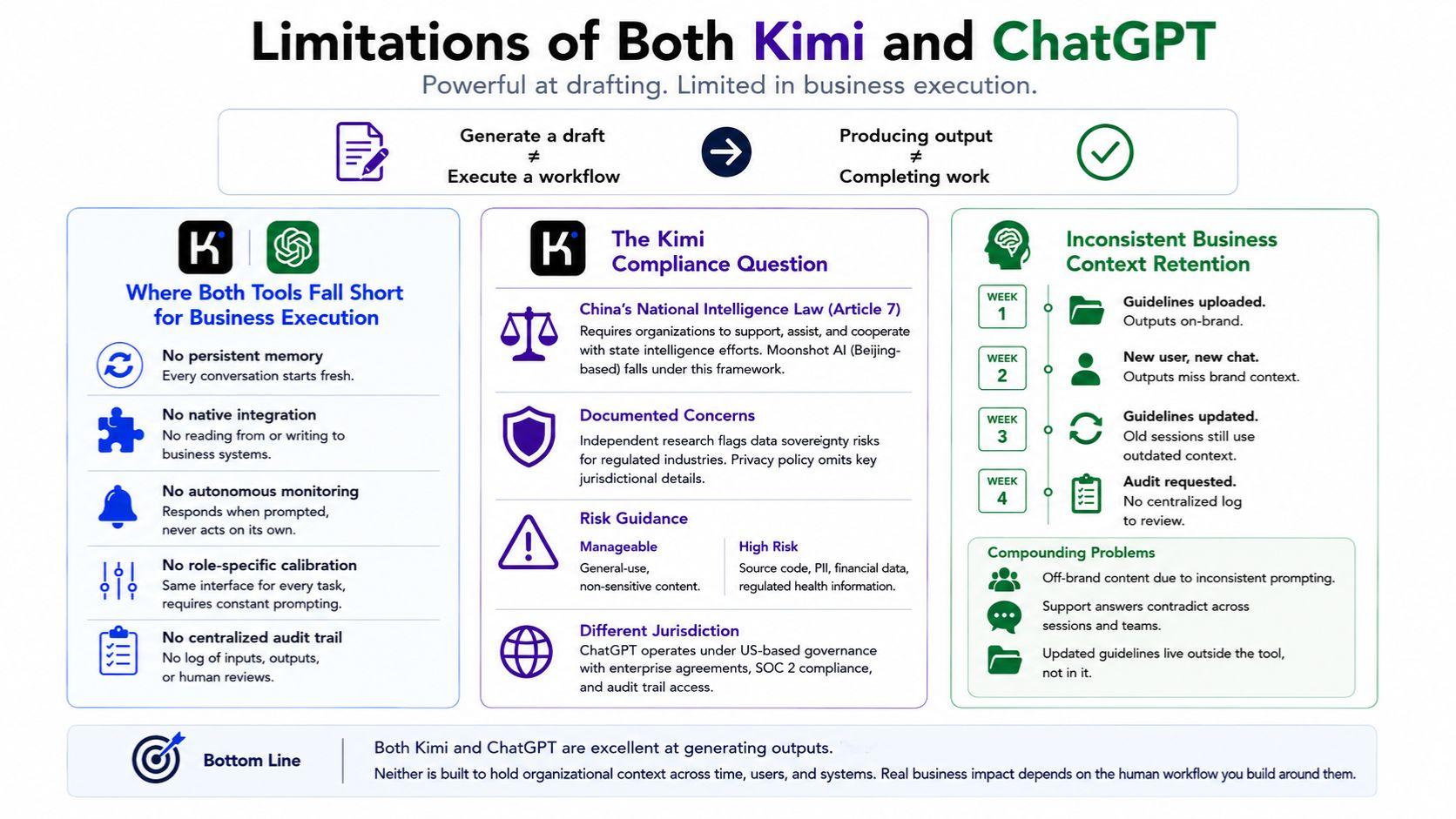
Generating a draft strategy document is not the same as implementing the strategy. Drafting an outreach email is not the same as sending it, logging it, following up on replies, and updating the CRM. The gap between producing a useful output and completing a workflow is where most AI ROI calculations quietly underperform.
Where Both Tools Fall Short for Business Execution
- Persistent memory across sessions: every conversation starts fresh without manual re-uploading of context
- Native integration with business systems: no reading from or writing to CRMs, project tools, or email without external API customization
- Autonomous task monitoring: both tools respond when prompted; neither watches for new inputs and acts on them independently
- Role-specific calibration out of the box: the same general-purpose interface handles every task type, requiring constant prompt engineering for domain-specific quality
- Centralized audit trail: no organizational log of what the AI was told, what it produced, and who reviewed it
The Kimi Compliance Question
For businesses considering Kimi specifically, there is a geopolitical dimension that deserves direct attention.
China's National Intelligence Law (Article 7) requires organizations to support, assist, and cooperate with state intelligence efforts. Moonshot AI, as a Beijing-based company, falls under this framework. Security researchers at Mend documented in March 2026 that companies in regulated industries could be violating data sovereignty requirements by sending sensitive data or source code to Moonshot's infrastructure.
The Institute for AI Policy and Strategy notes that Moonshot's privacy policy never mentions China, Beijing, or Singapore by name, creating a misleading impression of the company's jurisdictional footprint.
For general-use tasks with non-sensitive content, the risk is manageable. For workflows involving proprietary source code, customer PII, financial data, or regulated health information, the compliance exposure is real and legally documented. Finance, healthcare, and defense-adjacent organizations should treat this as a legal question before adopting Kimi for any production use.
ChatGPT operates under US-based governance with clearer enterprise agreements, SOC 2 compliance, and audit trail access for business accounts. The jurisdictional risk profile is categorically different.
Inconsistent Business Context Retention
Here is what the session-based memory limitation looks like in practice for a content team using ChatGPT:
- Week 1: Someone uploads brand guidelines, positioning docs, and tone-of-voice examples. Outputs are on-brand.
- Week 2: A different team member opens a new chat. Outputs are technically fine but miss the brand register.
- Week 3: Guidelines get updated. Older sessions still reference the outdated version.
- Week 4: A manager asks for an audit of what the AI was told and what it produced. There is no centralized log to pull.
The problem is not the model quality. It is that both tools are designed around individual conversations rather than organizational memory. Output consistency is only as reliable as the human process built around the tool, and most teams have not built one.
This creates compounding problems:
- Off-brand content slips through because a team member prompted differently on a Tuesday
- Customer support answers contradict what another rep said last month, using a different session
- Updated brand guidelines live in someone's local folder, not in the tool, so half the team's outputs reference the old version
Every one of these is a problem that has nothing to do with the quality of the model and everything to do with the fact that neither Kimi nor ChatGPT is designed to maintain organizational context across time, users, and sessions simultaneously.
Why Sintra AI Is a Stronger Business Alternative to Kimi and ChatGPT
The Kimi vs. ChatGPT comparison, when applied to business teams, ends up in the same place: both are excellent text-generation tools that require significant human orchestration to produce operational outcomes. They produce content. The workflow execution still falls to a human.
The companies seeing measurable AI ROI in 2026 are not the ones using a better chat tool. They are the ones that moved past chat entirely, toward AI systems that operate within their actual business environment rather than alongside it.
Think about the difference between a contractor and an employee. A contractor delivers a specific output when asked. An employee understands your business, remembers previous context, picks up recurring tasks, and connects their work to the next person in the process. ChatGPT and Kimi are contractors. Sintra AI is built to function more like that employee.
That is what Sintra AI's AI team is built around: role-specific helpers with persistent business memory and native integration with the tools where work actually happens. With Kimi or ChatGPT, you generate an output and figure out what to do with it. With Sintra AI, the output is the completed action: an email sent, a report filed, a ticket updated.
Specialized AI Helpers for Marketing, Sales, Support, and Operations
Sintra AI deploys purpose-built digital helpers calibrated for specific roles. You are not routing every task through a single general chat window and re-explaining the context each time.
- Soshie handles social media: scheduling, content variation, platform-specific formatting
- Penn focuses on copy: ad copy, emails, and landing pages tuned to your brand voice
- Cassie manages live customer support with access to your product knowledge base
- Buddy covers business development: prospect research, outreach drafting, pipeline summaries
- Vizzy handles design asset briefs and visual direction
The difference between this and a ChatGPT system prompt is structural. These helpers are not informed of a brief at the start of each session. They are built for their specific domain, calibrated to your business, and do not require you to re-establish context every time you open a new conversation. The starting point is already your business, not a blank chat box.
How Brain AI Keeps Your Business Context Consistent
The session-based memory issue that affects both Kimi and ChatGPT is addressed in Sintra AI through Brain AI, a persistent shared memory layer that anchors every helper to your company's actual data.
Brain AI stores brand voice guidelines, product specifications, customer segmentation, competitive positioning, and operational procedures. Every helper automatically references this, without requiring file uploads at the start of each session.
In practice, a marketing brief generated by Penn in January uses the same brand voice as a customer support response written by Cassie in March because both draw on the same underlying business memory. When guidelines change, they change in one place, and every helper updates immediately.
That level of consistency is structurally unavailable in session-based chat tools, regardless of how capable the model is. It eliminates a category of quality-review work that previously required a dedicated editor to catch AI outputs that drifted off-brand or referenced outdated product information.
Built-In AI Integrations That Turn AI Into Workflow Support
Copying an AI output from a chat window into your email client, logging it in the CRM, and then finding the next thing to do is not automation. It is manual work with a faster drafting step.
Sintra AI's AI integrations connect directly to the tools teams use daily: Gmail for outreach, Notion for documentation, and other core productivity infrastructure. A task that starts as an AI-generated draft becomes a sent email, a filed document, or an updated record, without a human manually bridging the gap.
What Integration looks like for a real team
A growth team runs a weekly competitive analysis. Previously, it took an hour: pulling data from three sources, writing up the summary, formatting it, dropping it into a Notion page, and sharing the link in Slack.
With Sintra AI's integrations, that process is triggered automatically, runs through the appropriate helper, and files the output to the correct Notion workspace. A human reviews the final output rather than producing it. The hour becomes ten minutes of review.
For teams that have reached the ceiling of what a chat interface can do, this kind of native connectivity is where actual time savings compound, and where the comparison to Kimi or ChatGPT stops being relevant. Those tools are not competing for the same job.
Ready to Move Beyond AI Chat?
Kimi and ChatGPT both have a real place. Kimi is the practical choice for developers building cost-efficient, high-throughput pipelines. ChatGPT is the right call for teams needing polished writing output without technical setup.
If your goal is to run business functions on AI, and not just produce better drafts, both tools will hit the same ceiling. They are conversation interfaces. The gap between what they produce and what a workflow actually requires is where organizations continue to lose time.
Where Teams Typically Stall
Most teams reach this ceiling between months two and six of serious AI adoption. By then:
- Prompts are optimized and documented in a shared folder nobody updates
- Team templates exist, but they generate inconsistent results depending on who uses them
- A meaningful chunk of each day still goes toward manually moving AI outputs into actual business systems
- Someone has to re-upload the same brand brief at the start of every new session
The tool is faster than starting from scratch. It is not reducing operational overhead.
The Question That Leads to Better Tools
The teams that break through stop asking "how do we use AI to help us work" and start asking "what would it look like if AI actually did the work." That shift leads to a different category of tool entirely, one built around execution rather than generation.
The comparison to Kimi or ChatGPT becomes less relevant once you make that shift, because you are no longer choosing between two basic chat interfaces. You are choosing between a simple drafting assistant and an advanced operational layer. If you have already hit the limits of what a text box can do, explore how specialized AI employees can complete your workflows from start to finish.
Kimi vs ChatGPT FAQs
What is the difference between Kimi and ChatGPT?
Kimi is an open-weight model from Beijing-based Moonshot AI, built for coding, large document processing, and high-volume API work. Kimi K2 supports context windows up to 256K tokens and costs significantly less per token. ChatGPT is OpenAI's closed-source model, stronger on creative writing, multimodal tasks, and ease of use for non-technical users. Kimi suits data-heavy technical workflows; ChatGPT suits communication-heavy and creative ones.
Is Kimi better than ChatGPT for research?
Yes, for large-scale document research. Kimi K2 excels at analyzing lengthy PDFs, codebases, and multi-file document sets, and Kimi K1.5 supports up to 128,000 tokens per prompt. For standard research tasks on typical document lengths, both tools perform comparably. ChatGPT produces slightly cleaner prose in the final output.
Does ChatGPT-5 outperform Kimi for content creation?
Yes, for most marketing and creative work. ChatGPT scores approximately 9 out of 10 for English writing quality, compared to 8.5 out of 10 for Kimi, in direct comparisons. That gap becomes noticeable at volume. Kimi is stronger when the task is primarily synthesizing source material into structured reports rather than producing original creative copy.
Can Kimi or ChatGPT automate business workflows?
Neither can do so completely. Both generate content and assist with planning, but workflow execution still requires human coordination. They do not update CRM records, send emails, or monitor business systems without external integrations and manual triggers. The automation is in the drafting, not the doing.
What is the best alternative to Kimi and ChatGPT for business teams?
Sintra AI is built specifically for business execution, not general chat. It combines role-specific AI helpers (for marketing, sales, support, and operations), persistent business memory through Brain AI, and native integrations with core business tools. Sessions retain organizational context, and AI outputs connect directly to the systems where work actually happens.
Related articles