Comparing Qwen vs ChatGPT

Table of Contents
Quick Answer: Qwen vs ChatGPT
ChatGPT is best for general-purpose AI applications, particularly for content teams and businesses that want a polished, ready-to-use AI with a strong ecosystem. Qwen is the better fit for developers, technical teams, and organizations that need open-weight flexibility, large context windows, local hosting, or stronger multilingual performance. Neither is universally better. The right answer depends entirely on what you are building or trying to get done.
Most businesses picking an AI tool right now are making the same mistake: treating it as a one-size-fits-all decision. The Qwen vs ChatGPT debate is growing because cost, data control, and customization have become real concerns, not just developer preferences, and more teams are now evaluating non-OpenAI alternatives seriously.
Qwen is Alibaba's open-weight model family, built for technical flexibility, multilingual depth, and deployment control. ChatGPT is OpenAI's consumer-facing AI assistant, built for accessibility, breadth, and ease of use.
Model performance is only part of the decision, though. This article covers how each model performs in writing, analysis, coding, privacy, and pricing. Also, it addresses what neither model can do on its own when a business needs AI employees to run real workflows, not just answer questions.
What Are Qwen and ChatGPT?
Most people have heard of ChatGPT. Far fewer have spent time with Qwen, even though it has quietly become one of the most capable open-weight model families available. That gap is closing fast, and understanding what each tool actually is makes the comparison far more useful than a benchmark table alone.
What Is Qwen?

Qwen is Alibaba's AI model family, developed under Alibaba Cloud. It covers a wide range of model sizes and specializations, from lightweight versions built for speed to large-scale models designed for reasoning, coding, and document processing.
The most significant structural advantage Qwen has is its open-weight nature. Businesses can download the models and run them on their own infrastructure, which is especially important for teams with data privacy requirements or cost constraints at scale. You are not dependent on a single vendor's API pricing or data handling policies.
The context window is another genuine differentiator. Qwen Plus and Turbo models support up to 1 million tokens, while Qwen-Long supports up to 10 million tokens for document-heavy workflows. Qwen 2.5 Max excels at multilingual tasks, and according to Alibaba's official announcement, Qwen 3 supports 119 languages and dialects, with leading performance in translation and multilingual instruction-following. The model is also strong in math, coding, and structured reasoning.
As of 2024, over 90,000 enterprises had adopted Qwen via Alibaba Cloud's Model Studio, reflecting rapid, widespread enterprise adoption. One caveat worth being direct about: using Qwen through Alibaba's hosted API still routes data through their servers. Teams with strict compliance requirements, such as GDPR or HIPAA, typically self-host the open-weight version rather than relying on the cloud API.
What Is ChatGPT?
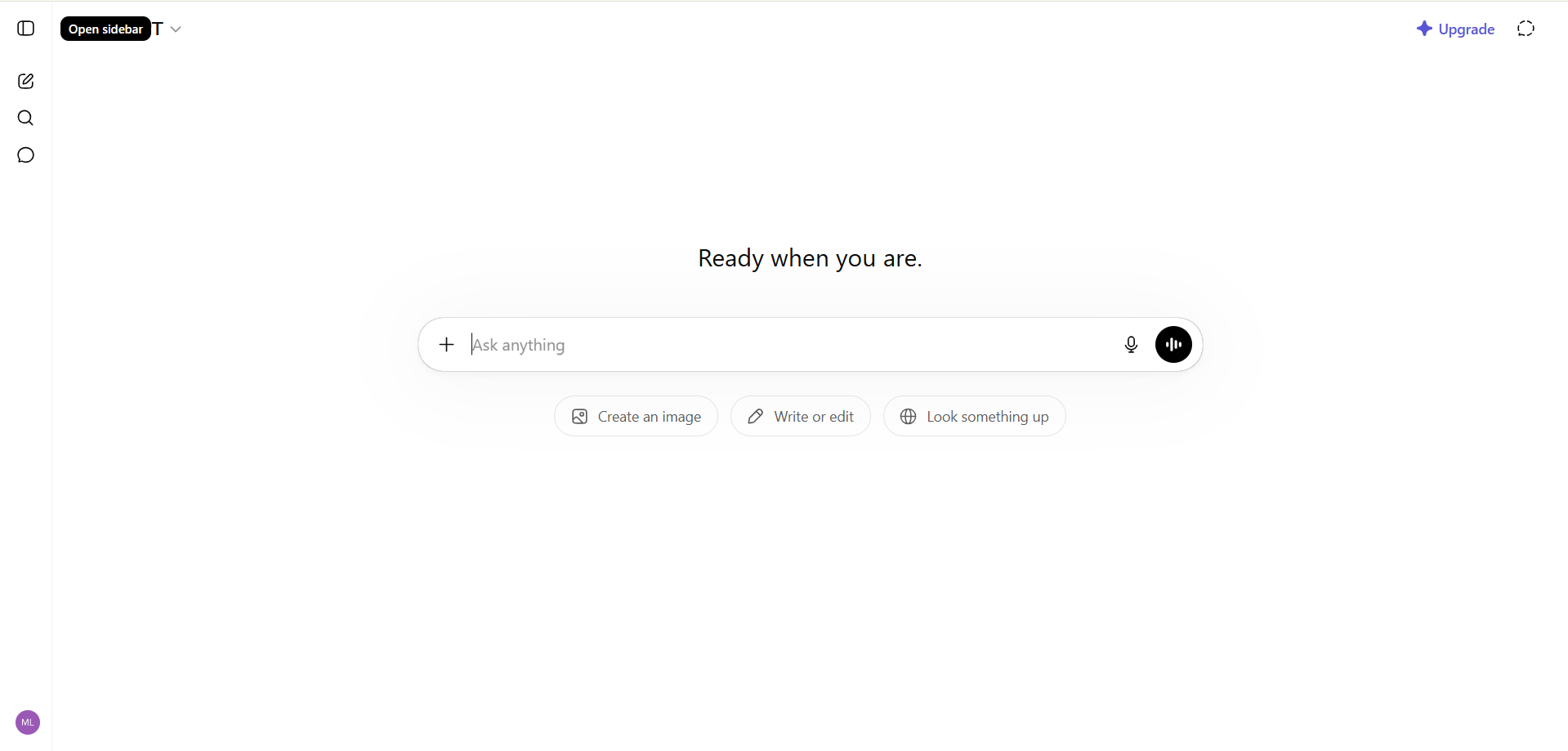
ChatGPT is OpenAI's consumer-facing AI assistant. It is fully proprietary and cloud-based, meaning there is no option to self-host or run it on your own infrastructure.
What it has instead is reach and polish. According to OpenAI's official announcement reported by TechCrunch, ChatGPT reached 900 million weekly active users by February 2026, making it the most widely adopted generative AI product in the world. That scale of usage has built a mature ecosystem: an extensive plugin library, deep integration with Microsoft's tools through Copilot, strong community documentation, and a reliable interface that most users can use to get productive immediately.
ChatGPT is best for general-purpose AI applications. It handles the full range of common business tasks without requiring any technical configuration. The trade-off is real: less flexibility, higher API costs at scale, and no option to run it on your own servers. For teams where data sovereignty or infrastructure control matters, those constraints become meaningful quickly.
Feature Comparison: Qwen vs ChatGPT
Instead of running through spec sheets, the sections below compare how each AI actually performs on the tasks businesses use AI for most.
Content Creation and Copywriting
ChatGPT is superior for general conversations and content writing. In practice, this means it produces more fluent, tonal, and polished English-language content out of the box. Blog posts, brand emails, marketing copy, product descriptions, and social captions are areas where ChatGPT delivers with a level of narrative flow and tonal range that requires less prompt tuning to get usable output.
Qwen holds its own, especially in technical writing. For creative content in English, though, it is less consistently reliable. The output often needs more editing passes before it is ready to publish or send. Where Qwen has a real advantage is in multilingual content. If your business needs product descriptions in Arabic, French, and Japanese alongside English, Qwen's depth in native languages produces more accurate, tonally appropriate output than running everything through ChatGPT.
Real Test
Prompt #1: Act as an expert B2B SaaS copywriter. Write a punchy, 100-word product email introducing a new B2B SaaS automation tool to marketing teams.
- Target Audience: Busy Marketing Directors and CMOs.
- Key Pain Point to Solve: Wasting hours manually syncing data across different marketing platforms.
- Core Value Proposition: Automate workflows, preserve context, and save 10+ hours a week.
- Requirements: Include a compelling subject line, a short hook, and a clear, confident call to action (CTA). Keep the tone professional, engaging, and completely natural in English.
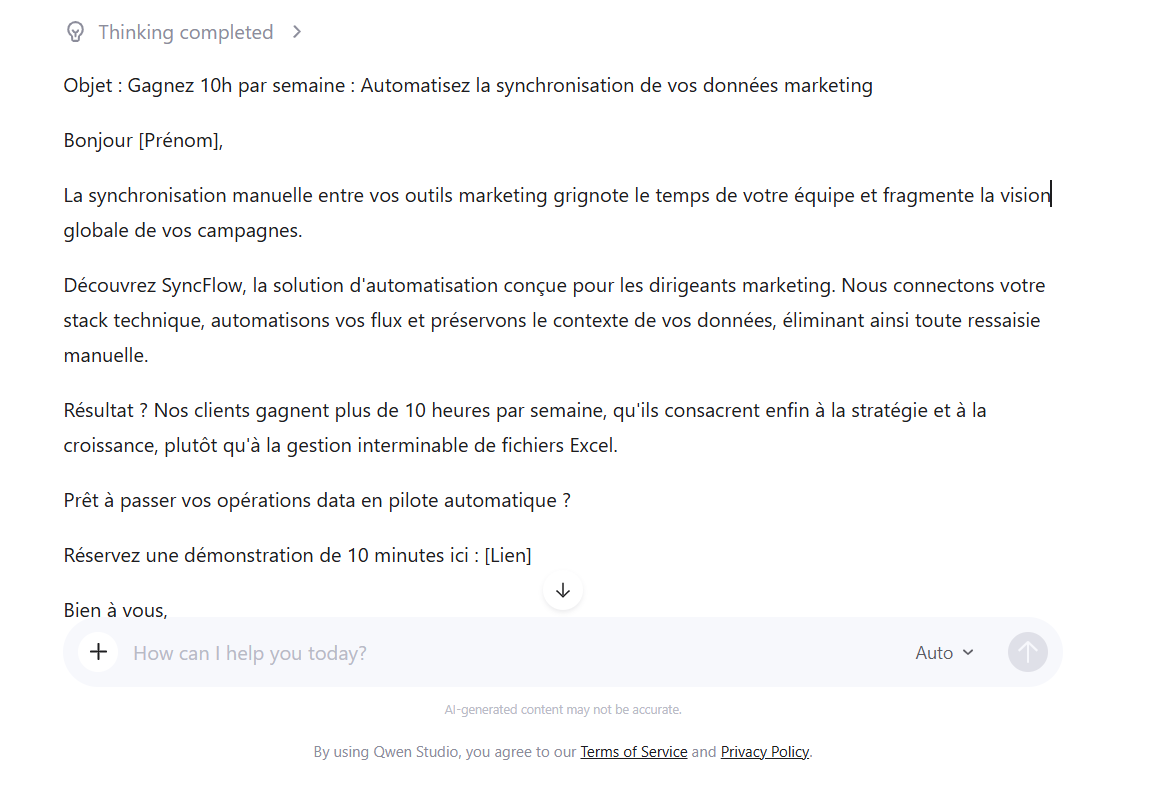
Prompt #2 after response of prompt #1: Now, adapt the exact email you just wrote above for a French-language audience. Do not just do a literal word-for-word translation; adjust the tone, cultural phrasing, and professional norms so it sounds native and persuasive to a marketing team in France.
ChatGPT response:

Qwen response:
ChatGPT produced a clean, structured email with a clear value proposition in the subject line, a short hook in the opener, and a confident call to action. It did not need significant editing. The tone was professional without being dry.
Qwen produced a technically accurate email, but the flow was slightly more formal, and the phrasing in the middle paragraph was less natural in English.
For a marketing team sending to international segments, the Qwen version adapted better when we switched the brief to a French-language audience. ChatGPT is known for its structured writing and speed. For English-language content work, that advantage is consistent.
Verdict: Which AI Is Better at Writing?
ChatGPT wins for English-language content tasks where tone, polish, and speed matter most. Qwen is competitive in technical writing and pulls ahead in multilingual content. For most content teams that work primarily in English, ChatGPT produces output that requires less rework before it goes out the door.
Research, Analysis, and Reasoning
This is where the context window difference starts to show up in real workflows. Both models are capable of structured reasoning and analysis. But the scale of what you can feed into a single session changes what is actually possible.
Qwen's large context window is a meaningful advantage when the task involves:
- Summarizing lengthy policy documents or legal contracts without breaking them into chunks
- Processing multiple research reports in one pass and synthesizing findings across them
- Analyzing a full product roadmap document alongside strategic questions without losing context
ChatGPT is strong at structured reasoning and produces clear, well-organized analytical output. It hits context limits earlier on document-heavy tasks, which means larger inputs have to be chunked, introducing the risk of losing coherence across sections.
Real Test
Prompt: Act as an expert enterprise risk analyst and B2B strategist. I have uploaded the Fuel Cycle 2026 Market Research & Insights Trends Report.
Please analyze the entire document in full and complete the following task:
Identify the three biggest structural, operational, or compliance risks for a mid-sized B2B company attempting to scale its data operations in 2026.
For each of the three risks, provide:
1. A clear title for the risk.
2. A detailed explanation of why this risk is critical, explicitly connecting insights across different trends in the report (e.g., combining the compliance pressures mentioned in Trend 4 with the data silos mentioned in Trend 5).
3. An actionable mitigation strategy tailored specifically for a mid-market business with limited technical staff.
Do not just summarize the introduction or surface-level trend headings. I am looking for deep synthesis across the sections to test your long-context reasoning capabilities.
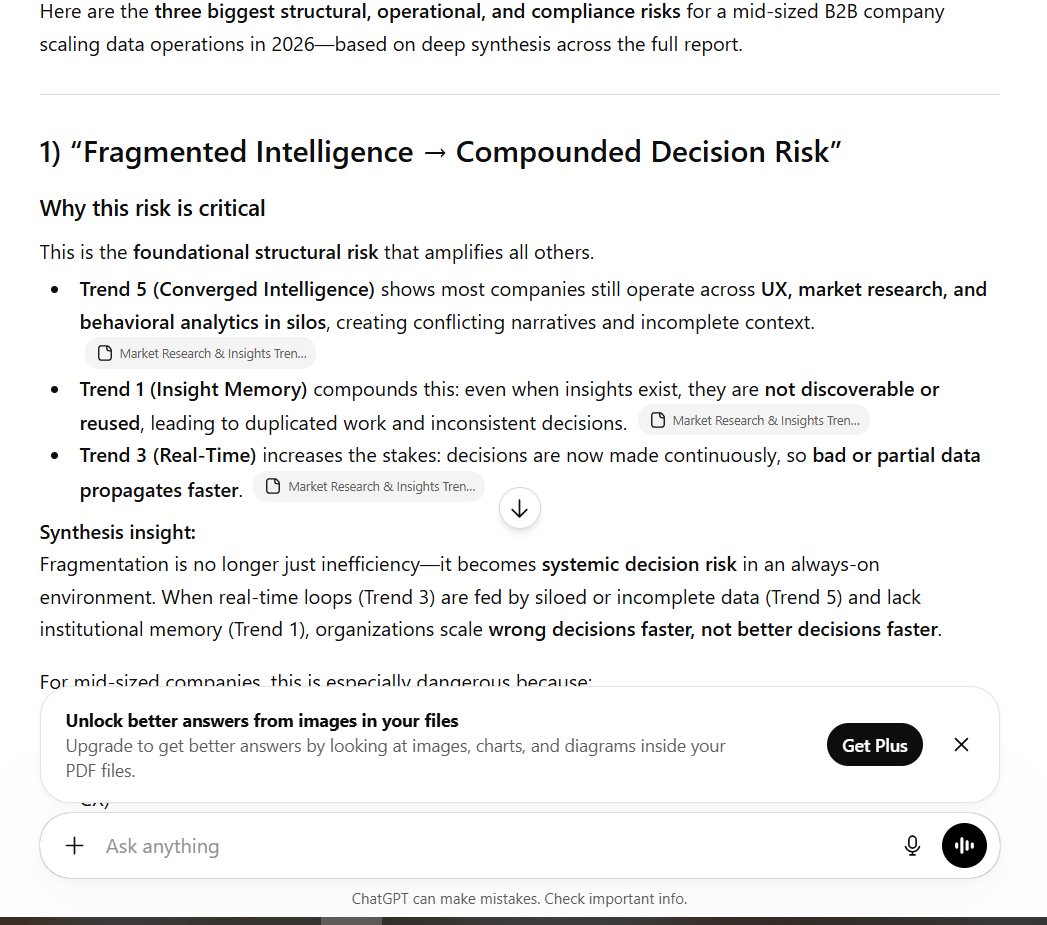
ChatGPT response:
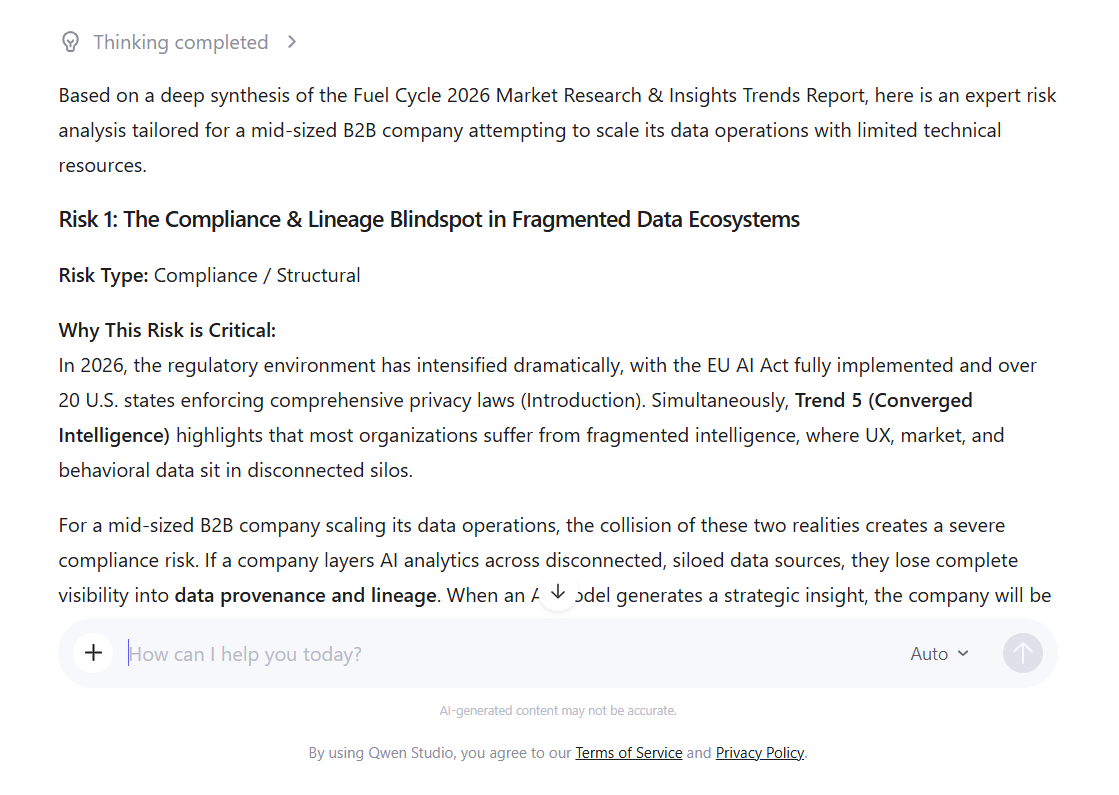
Qwen response:
ChatGPT handled this well when the document fit within its context window. The three risks it identified were clearly structured and actionable. When we pushed beyond its limit, we had to split the document, which required extra prompting and some loss of synthesis quality across sections.
Qwen processed the full document in one pass. The risk analysis it produced was equally well-structured, and the synthesis across sections was tighter because it had the full context available at once.
Verdict: Which AI Performs Better at Analysis?
For large-document analysis and research-heavy tasks, Qwen's context-window advantage is real and practical. For everyday research prompts and business decision support where documents stay within normal limits, ChatGPT produces equally strong and well-organized output. The right choice depends on how often your tasks involve large, complex documents.
Coding and Technical Tasks
Both models are strong here, and the gap in raw code quality is narrower than most people expect. Qwen-Coder is highly effective for programming tasks. Qwen3-Coder is purpose-built for repository-scale development work, meaning it can reason about large codebases rather than just generating isolated functions. Qwen delivers strong performance on coding tasks, and its open-weight nature means development teams can fine-tune models to their specific codebase, language conventions, or internal libraries.
ChatGPT provides high-quality code generation and debugging support. Its edge is accessibility and ecosystem integration. GitHub Copilot is powered by OpenAI models. Code Interpreter inside ChatGPT lets non-developers run and test code without leaving the interface. For a non-technical product manager who needs a quick script or wants to understand what a piece of code does, ChatGPT explains it in plain language more reliably.
Real Test
Prompt: Act as an expert Python developer and software architect. Please write a clean, production-ready Python function based on the following requirements:
1. Core Functionality: The function must pull data from a standard REST API using a GET request.
2. Authentication: It must handle API token authentication securely (assume a bearer token is passed as a parameter or environment variable).
3. Robust Error Handling: Implement explicit try/except blocks to gracefully handle:
- Authentication/Authorization errors (e.g., 401 Unauthorized, 403 Forbidden).
- Rate limiting issues (e.g., 429 Too Many Requests).
- Standard connection or timeout issues.
4. Output: The function must format and return the successful API results as a clean, structured JSON object.
Provide clear inline comments explaining your logic, and maintain a professional, developer-focused technical tone throughout the code and explanation.
ChatGPT response:
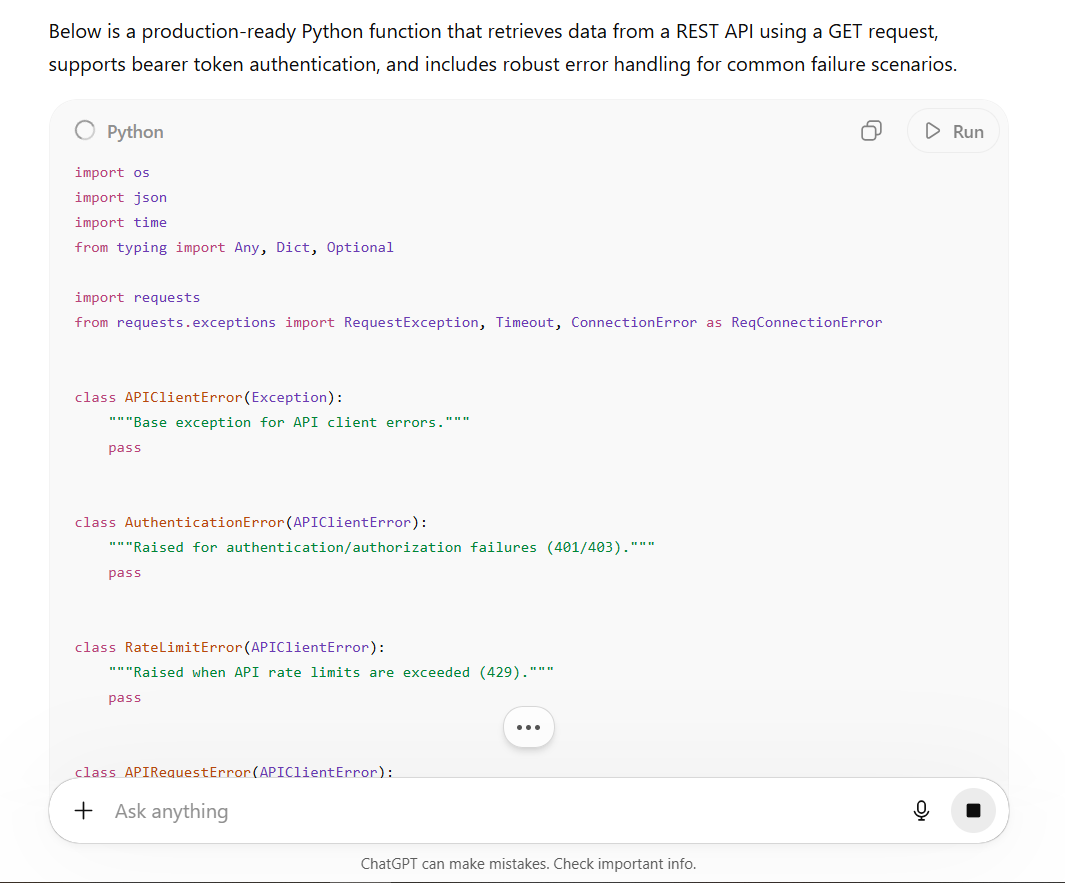
Qwen response:

ChatGPT produced working code with clear inline comments and handled authentication errors using try/except blocks. The function ran without modification. Qwen produced equally functional code, and the error handling was slightly more detailed, including support for rate-limit responses that ChatGPT had to be prompted to add separately. The explanation in Qwen's output was more technical in tone, which works for developers but would need translation for non-technical stakeholders.
Verdict: Which AI Is Better for Developers?
For developers who want open-weight control, fine-tuning capability, and strong multilingual code support, Qwen is the stronger choice. For developers or non-technical users who want fast, accessible coding help inside a familiar ecosystem, ChatGPT wins on convenience. Both are capable of production-quality code, and the decision comes down to how much control and customization your team actually needs.
Multilingual and Localization Tasks
This is one of Qwen's most underappreciated advantages, and one of the places where the comparison is least even. Qwen offers strong performance in Chinese and English, and its multilingual architecture extends well beyond those two. According to Alibaba's official Qwen documentation, Qwen3 breaks language barriers by supporting 119 languages and dialects, and is trained on multilingual instruction-following from the ground up.
In practice, this matters for:
- Translating marketing copy while preserving the original tone rather than producing a flat, technically correct version
- Handling customer support queries that come in mixed-language formats, which is common in Southeast Asian and Middle Eastern markets
- Adapting product content for regional audiences where formality norms differ significantly from English
ChatGPT handles translation and multilingual content adequately. Qwen's outputs in Arabic, Mandarin, Japanese, and Indonesian hold up better under scrutiny from native speakers, particularly for content that carries brand or commercial weight.
Data Privacy and Deployment Control
This is one of the most commonly discussed concerns in enterprise AI forums, and it is worth being direct about.
ChatGPT is fully cloud-dependent. Every prompt, every document, every business input you send goes through OpenAI's servers. For businesses handling sensitive customer data or proprietary business information, or operating under compliance frameworks such as GDPR or HIPAA, this is a structural limitation in how the product is built, not a theoretical risk.
Qwen's open-weight models can be downloaded and run locally on private infrastructure. Data never leaves your environment. This is the primary reason a significant portion of enterprise teams using Qwen choose to self-host rather than use the Alibaba Cloud API: the hosted API shares the same cloud routing concerns as ChatGPT.
The caveat: self-hosting is not a plug-and-play solution. It requires:
- Technical staff capable of managing model deployment and infrastructure
- Server resources appropriate to the model size being run
- Ongoing maintenance as new model versions are released
- Internal processes for access control and monitoring
Qwen offers more transparency and customizability than ChatGPT, and that extends to data handling. Qwen is an open-source alternative to ChatGPT, with its weights publicly available, giving compliance and security teams concrete targets for audit rather than relying on vendor documentation alone.
Ease of Use and User Experience
Day-to-day experience is where ChatGPT has its clearest advantage for non-technical users.
ChatGPT is purpose-built for accessibility. There is no setup. You open a browser, sign in, and start working. The interface is clean, onboarding is minimal, and documentation is extensive. A new team member can be productive within minutes.
Qwen's consumer-facing interface, Qwen Chat, has improved significantly. For general queries and basic tasks, it works well. But the strongest use cases for Qwen often require API access or local deployment, both of which introduce a technical barrier that non-developer users will find frustrating without support.
The practical comparison
- A marketing manager with no technical background: ChatGPT, with minimal friction
- A developer building a product on top of AI models: Qwen's API gives more flexibility at a lower cost
- An enterprise team with IT support and compliance requirements: Qwen self-hosted, with upfront setup investment
- A small business team needing quick content help: ChatGPT, easier to adopt and maintain
Verdict: Which AI Is Easier to Use?
ChatGPT wins on ease of use for non-technical and general business users. Qwen's ceiling is higher for technical teams willing to invest in proper configuration, but the floor is lower, and setup takes considerably more effort. Both tools are genuinely capable. The next question most businesses ask after comparing features is what it actually costs.
Pricing Comparison: Qwen vs ChatGPT
Advanced features in ChatGPT require a paid subscription. According to OpenAI's official pricing page, the current structure breaks down as:
- Free tier: access to ChatGPT with usage limits
- Plus: $20 per user per month with higher limits and priority access
- Business (formerly Team): $25 per user per month on annual billing, or $30 billed monthly, with shared workspaces and a contractual guarantee that business data is not used for model training
- Enterprise: custom pricing for large organizations with compliance, SCIM provisioning, and advanced admin features
API pricing scales with usage and model tier, which can become significant for high-volume applications.
Qwen is free for most use cases through Qwen Chat. Qwen operates on a flexible pricing model for API access through Alibaba Cloud, and the self-hosting option effectively converts per-token API costs into infrastructure costs, which can be more economical at scale if your team has the technical resources to manage it.
The honest summary of the cost:
- For individual users and small teams: both are accessible, with ChatGPT's Plus tier offering a predictable flat fee
- For high-volume API users: Qwen's pricing is often more competitive, particularly for teams that can self-host
- For enterprise scale: the comparison depends heavily on technical resources, because Qwen's lower API costs come with higher infrastructure overhead
- For teams without technical staff: ChatGPT's predictable subscription structure is easier to budget and manage
Neither tool is definitively cheaper. The answer depends on your scale, your technical resources, and how you are actually using the model.
Limitations of Standalone AI Models
This is where the conversation shifts. Choosing between Qwen and ChatGPT is a meaningful decision, but it is still a model selection decision. Both tools are strong at generating outputs. Neither one runs your workflows.
Manual Prompting Slows Down Daily Work
The real cost of prompt dependency does not show up on day one. It shows up three months in, when the weekly social content post still requires someone to open the AI tool, write out the brand context from scratch, paste in this week's focus topics, generate a draft, edit it, and manually move it into the scheduling tool. Every recurring task follows the same cycle: write the prompt, add context, review the output, and act on it.
Qwen maintains deep contextual understanding in conversations, and ChatGPT has improved its memory features. But neither model carries institutional context, brand voice, or team processes from session to session without someone actively maintaining them.
For a marketing manager using ChatGPT for social content, this means rewriting context every single week and editing outputs before they are usable. The AI is helping, but the workflow around it is not structured, and over time, that friction adds up.
Business Context Does Not Stay Consistent
Neither Qwen nor ChatGPT retains your brand voice, your customer history, your company processes, or decisions made in previous sessions unless you build that memory architecture yourself. For a single user, this is manageable. For a team of five or ten people using AI for different tasks, the inconsistency becomes visible in outputs.
The results look like this in practice:
- One team member's social posts sound casual, another's sound corporate
- A customer email drafted with AI uses different terminology than the support documentation
- The product blog has a different tone from the sales copy
These are not model failures. They are the natural result of a tool that has no shared context across users.
AI Models Suggest Work, But Do Not Run Workflows
Both Qwen and ChatGPT generate answers and suggestions. They do not execute a sequence of tasks across your actual tools, notify the right people, track status, or handle edge cases when something goes wrong. The difference looks like this in practice:
- Getting a draft email versus managing a follow-up sequence that monitors replies and escalates based on non-response
- Generating a content idea versus scheduling and publishing that post with the right format across channels
- Writing support documentation versus routing incoming tickets, applying tags, and resolving them in your help desk system
Qwen's agentic capabilities are genuinely useful and improving. But even agentic AI still operates within prompt-level boundaries. It does not replace the infrastructure a business needs to run repeatable processes at scale.
Scaling AI Across Teams Creates New Problems
What works for one person using ChatGPT daily breaks down when ten people in a company start using AI in different ways. The problems that emerge are not about model quality. They are workflow and governance problems:
- No shared prompt library, so each team member reinvents their approach independently
- No approval layer before AI-generated outputs go to clients or get published
- Unclear ownership of AI-assisted work, which creates accountability gaps
- Weak integration with actual business tools like the CRM, project management system, or email platform
- No repeatable process for recurring tasks, so efficiency gains stay individual rather than becoming organizational
A better model does not fix these problems. They require workflow infrastructure built around the model, not just a better model sitting in a chat window.
Why Sintra AI Is More Practical for Business Execution
Both Qwen and ChatGPT can help your team produce better drafts, faster answers, and sharper ideas. What they cannot do is function as structured team members across your business. Sintra AI is built around that gap, not as a single chatbot, but as a set of role-based AI helpers with shared business context and connected workflows.
Specialized AI Helpers for Every Department
Instead of prompting a general model for every task, each Sintra helper is built for a specific business function. The specialization matters because a scoped context produces better output than a general model tasked with everything. In practice:
- Soshie handles social media. You give her the week's content themes, and she produces drafts formatted for each channel, without you having to paste brand guidelines every time.
- Penn handles copywriting. Brief him on a campaign, get structured copy that matches your brand voice without extensive editing.
- Cassie manages customer support. She handles incoming queries using your company's documented processes and tone rather than generating generic responses.
- Buddy supports strategy and decision-making. Ask him to evaluate a business decision, and he works from your company context, not just general knowledge.
- Vizzy handles visual tasks. Brief her on a concept, and she produces creative direction grounded in your brand.
The output quality improves because each helper works within a defined scope, not because the underlying model is fundamentally different.
Shared Context Through Brain AI
Shared memory is what makes Sintra work at the team level rather than just at the individual level. Brain AI stores your brand voice, company knowledge, customer details, and workflow rules, and applies that context automatically across all helpers.
The practical result is that a social post written by Soshie and a customer response written by Cassie both sound like the same business, without anyone needing to paste brand guidelines into a prompt. A new team member using Sintra gains access to the same business context that a senior team member has built up, rather than starting from scratch each session.
Built-In Integrations for Business Workflows
AI value in a business context comes from AI connected to actual tools, not AI that generates text you then have to manually copy into other systems. Sintra's AI integrations connect the helpers to email, documents, planning tools, and daily business systems, so work moves through the process rather than sitting in a chat window waiting for someone to act.
For teams where AI adoption keeps stalling because the handoff from "AI generates it" to "it actually gets done" requires too much manual effort, this is the structural change that makes AI practical at scale.
Ready to Move Beyond AI Chatbots?
Choosing between Qwen and ChatGPT is a reasonable first step, but it remains a model-selection decision. What businesses that see real results from AI have in common is structure: clear roles for what AI handles, consistent context that does not have to be rebuilt every session, and workflows that connect AI outputs to real actions in real business systems.
That is the difference between a tool that helps individual team members work faster and one that changes how the business operates. Get started with Sintra AI if your team is ready to move from evaluating AI models to building the infrastructure that actually makes AI work at scale.
Qwen vs ChatGPT FAQs
Is Qwen better than ChatGPT?
It depends on your use case. Qwen has real advantages in multilingual tasks, large context windows, open-weight flexibility, and deployment control. ChatGPT is superior for general conversations and content writing, particularly for English-language tasks. For most general business users and content teams, ChatGPT is the easier and more reliable starting point. For technical teams, multilingual businesses, or organizations with data privacy requirements, Qwen often fits better.
What is the difference between Qwen and ChatGPT?
The core difference is architecture and philosophy. Qwen is an open-source alternative to ChatGPT, meaning you can download and run it on your own infrastructure. ChatGPT is fully proprietary and cloud-based with no self-hosting option. Qwen's context window is dramatically larger, supporting up to 10 million tokens in Qwen-Long, compared to 128K in GPT-4o. Qwen is stronger for multilingual tasks and deployment flexibility, while ChatGPT wins on ease of use, English-language content, and its mature ecosystem of integrations.
Is Qwen free to use?
Qwen is free for most use cases through Qwen Chat, Alibaba's consumer interface. API access through Alibaba Cloud incurs usage-based fees, though Qwen-Flash and Qwen-Plus have been offered at highly competitive pricing. The self-hosted option is technically free in terms of licensing since the weights are open, but it carries real infrastructure and maintenance costs that should be factored in honestly.
Which AI is better for coding, Qwen or ChatGPT?
Both are strong, and the gap in raw code quality is narrow. Qwen-Coder specializes in generating precise programming code, and Qwen3-Coder is purpose-built for repository-scale development with fine-tuning capability.
ChatGPT provides high-quality code generation and debugging support and integrates more easily into existing dev workflows like GitHub Copilot. Our take: for developers who want control and customization, Qwen is the stronger choice; for those who want convenience and ecosystem fit, ChatGPT wins.
Are Qwen and ChatGPT enough for running business workflows?
For individual productivity, yes. For running structured business workflows at team scale, no. Both models generate strong outputs in response to prompts, but neither maintains a consistent business context across a team, integrates natively with your business tools, or executes task sequences without manual handoffs between each step.
The limitations of standalone AI models are not about output quality; they are about the infrastructure gap between "AI generates something useful" and "the business process actually runs." That gap is exactly what Sintra AI is built to fill.
Related articles