8 Best Relevance AI Alternatives and Competitors in 2026

Table of Contents
Quick Answer: What is the Best Relevance AI Alternative in 2026?
The best Relevance AI alternatives offer agent customization capabilities, feature a no/ low-code interface, have reasonable monthly pricing, and support automation workflows. For instance, Lindy AI and Sintra AI are enterprise-grade no-code automation solutions for multi-agent workflows. Whereas, Crew AI and Flowise are developer-focused open-source platforms for building, testing, and deploying custom AI agents.
The multi-agent AI workflow market reached $7.81 billion in 2025 and is projected to grow by up to 47.7% till 2030. It alone reflects how essential AI workflows are for survival.
And, one of these is Relevance AI, the most talked-about agent automation platform. It’s great, but not for everyone. Some say it’s not the easiest to use, while others complain that Relevance AI pricing has user-based add-ons.
Whatever the case, you need a competitor that delivers equally but costs less. We have reviewed the best Relevance AI alternatives, based on automation model, use cases, standout features, and pricing. So, dive right in.
Best Relevance AI Alternatives in 2026
Here is a list of the top Relevance AI alternatives you can try in 2026.
8 Best Relevance AI Competitors in 2026
Fed up with the soaring Relevance AI pricing and constant onboarding training? Let’s check out the eight best Relevance alternatives and streamline AI workflows.
1. Sintra AI

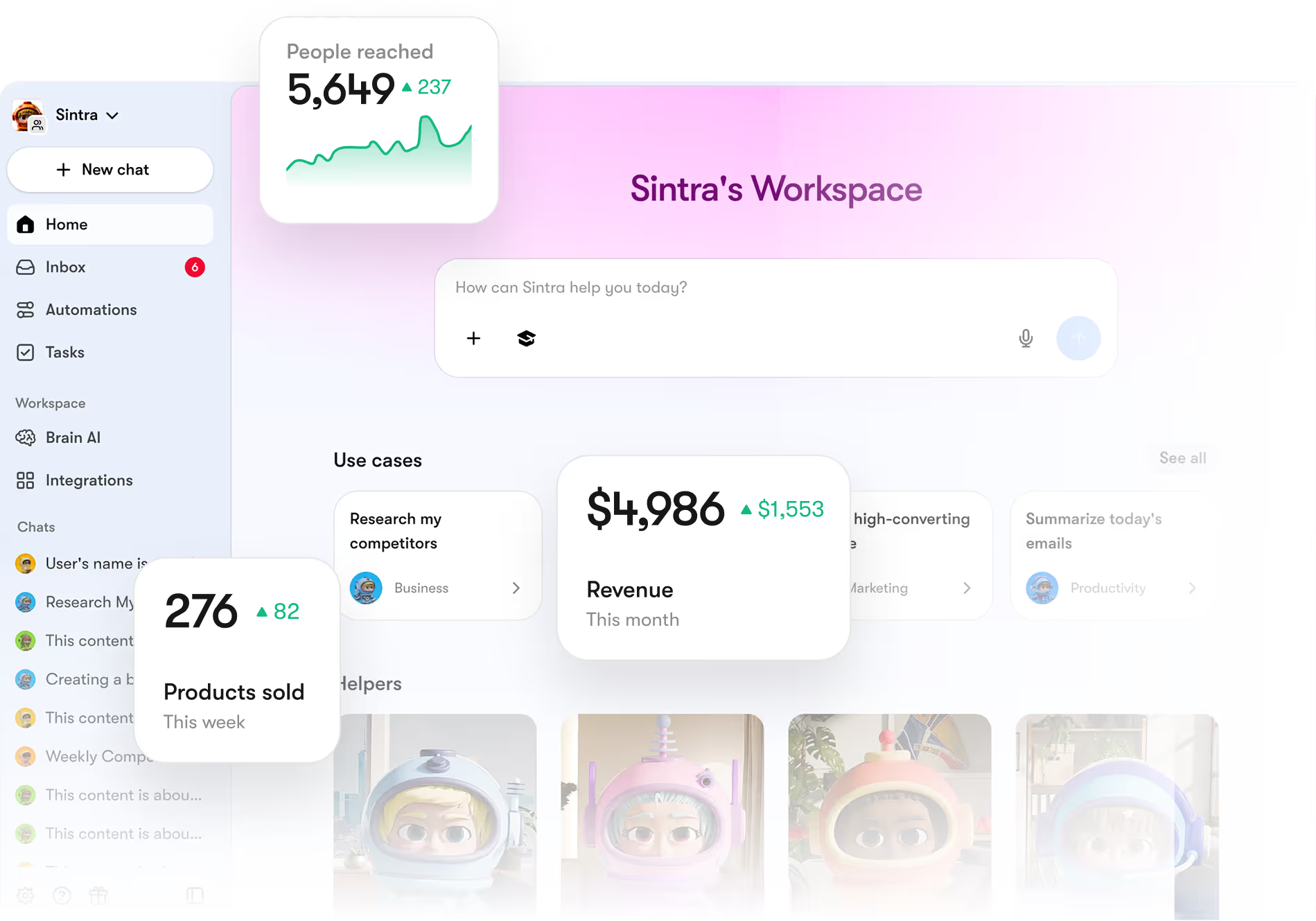
The closest match to Relevance AI, Sintra AI, also taps into the AI employee workforce. It is an advanced workflow automation tool with a no-code interface and ready-to-deploy role-based AI agents. Each of the twelve agents specializes in a domain, such as
- Cassie for customer support
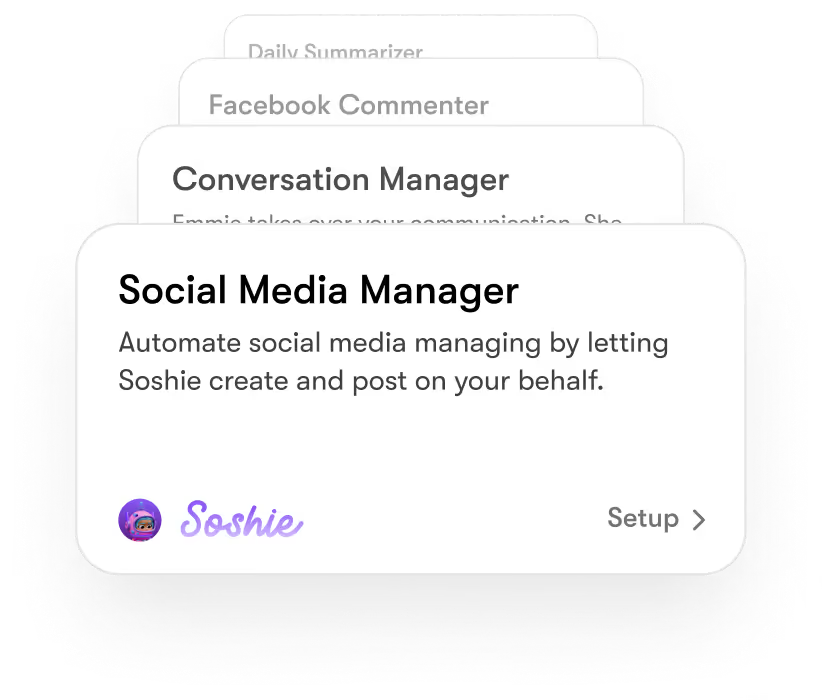
- Soshie for social media management
- Scouty for recruitment
- Dexter for business analytics
What’s better is that it has different LLM models (ChatGPT, Claude) for different parts of the automation tasks. For instance, the GPT-4.1 Mini is for email summarization and website analysis. Gemini-2.5 Flash for image generation, and Claude-4 Sonnet for sentimental analysis. With this, the agents stay up to date on the latest technology and don’t miss anything.
Another highlight of this Relevance AI competitor is the centralized business knowledge space, called Brain AI. This space stores everything from your business details, customer feedback surveys, and documents. The AI team uses this information as context, reason, adapt, and execute tasks consistently.
Advantages
- Supports up to five workspaces, each for a different business.
- One-click use cases are designed to complete rule-based repetitive processes without extensive prompts.
- Similar to Relevance AI, its no-code interface is easy for non-technical users.
- The agents work across platforms (marketing, sales, customer, operations, and more)
Limitations
- It has no free plan for you to test the agents before committing.
Ideal for marketing teams, startups, and established businesses requiring specialized, ready-to-deploy agents for linear and complex multi-step task sequences.
2. Lindy

Lindy is an advanced conversational Relevance AI competitor developed to build custom agents for your workflow. To get started, you simply tell Lindy what agent you need, be it managing your meetings, responding to your inbox, or updating your CRM, and that’s it.
Similar to Relevance AI, Lindy focuses on building an AI workforce that can take over routine business tasks, eating away at your employees’ day. Plus, both offer no-code setup for non-technical users.
Unlike Relevance, which specializes in complex, data-intensive agent systems, this AI assistant focuses on building all-in-one automation. This is why Lindy is faster to set up and excels at simple tasks. However, you can still employ it for complex tasks with human supervision.
Advantages
- Enterprise-level security with SOC 2 and GDPR certification.
- The chat interface is easy to use
- Numerous integration options to work with your existing setup
Limitations
- Though efficient, it does not allow for deeper customization.
Ideal for small-to-medium businesses that want to automate multi-step task sequences without the hassle of writing code.
3. Gumloop

Gumloop is yet another AI agent builder that allows you to build automated workflows by connecting your tech tools. Its AI workflows focus on predictable, linear automations across sales, marketing, customer support, and admin tasks.
Like Relevance AI, Gumloop enables employees to add an extra layer of AI models, such as ChatGPT, DeepSeek, and Claude. On top of the automations, these models reason and make decisions on your behalf automatically.
That said, Gumloop’s scope of workflows is different from Relevance AI. It feels intuitive, offers visual workflows, and excels at faster, flexible automations. And, the billing is not like Relevance AI pricing. You don’t have to pay hidden costs or be restricted by per-user billing.
Advantages
- It feels intuitive to build automations visually.
- Offers numerous pre-built templates to get started
- You don’t need LLM APIs for the Gumloop assistant
Limitations
- The available automation triggers can feel restrictive.
Ideal for marketing and sales reps who want predictable, linear AI automations at a reasonable price (unlimited seats with no per-user add-ons).
4. MindStudio

MindStudio is next on my list of apps like Relevance AI that enable businesses to automate complex tasks without technical expertise. It also gives you access to 200+ AI models from Google, Meta, OpenAI, and Anthropic. You can choose them easily from a single interface.
Moreover, both platforms offer low-code visual interfaces. For instance, you simply drag and drop blocks on MindStudio to create agents for sales or HR. You can also add agent modules for user input, image creation, web scraping, and data queries.
While both platforms excel at AI workflows, they approach automations differently. Where Relevance builds autonomous agents that make decisions without human supervision, MindStudio wants you to control each step. You can literally visualize everything on the canvas. Plus, MindStudio includes an Evaluations tool for structured testing, while Relevance AI focuses on monitoring agent performance in production.
Advantages
- The drag-and-drop editors offer complete control over the workflow structure
- Includes evaluation tools for structured testing
- Over 1000+ native integrations to connect to your tech stack
Limitations
- Lacks the pre-built templates for common business functions.
Ideal for rapid prototyping and cost control. The agentic setup takes anywhere between 15 and 60 minutes, thanks to visual control. Plus, it has transparent pricing.
5. Flowise

Flowise AI is an open-source automation tool that enables developers to build AI agents using a visual interface. Its block-based editor works similarly to MindStudio. You just drag and drop modules to build something from as simple as a chatbot to complex multi-step LLM systems.
The highlight of this automation software is Chatflow. This is for developers who want absolute control over the single-agent AI systems. While for multi-agent architectures, Flowise has Agentflow, which allows developers to
- Assign specialized tasks to the respective agent.
- Set conditional logic.
- Coordinate sequential execution.
Moreover, its human-in-the-loop function is different to Relevance AI. Unlike autonomous agents that make decisions independently, Flowise supports review checkpoints. Once these points trigger a situation, a human operator steps in and validates the agent’s output.
Advantages
- Developers can track agents’ performance at every stage.
- High flexibility for developers, as it allows custom JavaScript functions
- Affordable, open source tool
Limitations
- Although it’s marketed as a low-code solution, LLM knowledge is a prerequisite.
Ideal for developers who want to interchangeably use the faster no-code interface and flexible, code-first agent building mechanism.
6. CrewAI

Crew AI is yet another open-source, low-code AI workflow platform. However, it requires Python knowledge to create and deploy agents. What’s better? Once you log in, Crew AI gives you access to 20 premade templates for varying use cases (lead scoring, content, and more).
What makes it stand among the top Relevance alternatives is the extensive number of LLMs. Between ChatGPT 4-o and Gemini, you can integrate the desired capability for agent building. With this, you can always implement the latest AI technology into your system.
The slight difference between the two tools is automation focus. While Relavence is built on AI pipelines, Crew AI truly specializes in orchestration. Its agents collaborate and communicate to solve complex, multi-step sequences, which are context-driven and highly relevant.
Advantages
- Great at automating enterprise-level complex processes.
- Its developer-centric approach promotes extensive customization.
- The massive integration scope is great for broader AI workflows.
Limitations
- As it’s an open-source platform, Crew might not be the best choice for proprietary processes.
Ideal for teams that aim to scale over time or already established businesses that require AI workflow orchestration.
7. LangChain

Langchain is a complicated, but open-source solution for programmers to build AI-driven agents using LLMs. Established businesses use this framework to build flexible, context-aware, and reasonable RAG (retrieval augmented generation) pipelines and multi-agent AI workflows.
The LangGraph is specifically developed to build multi-step, cross-functional systems that work best for enterprise-grade processes. In comparison, the LangSmith helps developers with debugging and monitoring capabilities. This ensures the automations remain consistent.
While Langchain is primarily a developer-oriented framework, Relevance focuses on providing low-code, pre-defined, rigid AI agent deployment processes. This is also why LangChain is better suited for scalability and customization.
Advantages
- LangChain simplifies the LLMs integration. This way, you don’t have to spend time figuring out APIs.
- It has extensive, well-documented resources that help developers get started on this tool.
- Offers pre-built modules for common use cases (sentiment analysis, text summaries, and more).
Limitations
- Even though it attempts to simplify LLM integration, the tool itself has a learning curve.
Ideal for developers and engineers building complex, reasonable, and context-aware AI workflows, especially RAG and multi-step reasoning.
8. Dust AI

Dust AI is a user-friendly AI automation platform for enterprises that want to tailor workflows without the hassle of programming. This Relevance AI competitor integrates into your existing tools and executes tasks using company-specific knowledge and business context.
Similar to the Relevance platform, Dust focuses on creating specialized agents rather than simple chatbots. So, you can handle complex tasks without human supervision. For instance, you build a team of sales AI employees, including a lead agent, a research agent, or a customer agent.
With Dust AI, employees can create agents and share them on the collaborative workspaces. These workspaces let the creator decide who can access, view, or edit the agents. You also get 50 premade templates for common use cases, so you don’t have to start from scratch.
Advantages
- Strong security, compliant with GDPR, HIPAA, and SOC 2.
- Numerous native integrations with existing tools, including Slack, Motion, and Google Workspace.
- Agents tailored specifically to handle your unique business requirements.
Limitations
- Pricing can be a restriction, depending on the tier.
Ideal for digital or remote businesses that need a reliable AI automation solution tailored to their unique requirements rather than generic multi-agent systems.
How We Researched and Ranked the Best Relevance AI Alternatives?
The core functionality of Relevance AI is to help businesses create an AI workforce that handles both repetitive and complex task sequences. So, to find the best Relevance alternative, we needed a similar set of functions, primarily focused on AI agent orchestration.
Here is how we evaluated each tool in this list. Before you dive in, note that your business’s nuances are unique. And only you know them, so do count them in the evaluation.
- AI Agent Orchestration - is the tool capable of building multiple AI workflows to handle complex tasks? Ideally, you want a platform that allows agents to cross-communicate and collaborate, not just run isolated automations.
- Multi-LLM Models - Does the tool let you choose between LLM models during deployment (GPT, Claude, DeepSeek)? Different models have varying strengths.
- Ready-to-Use Templates - Does your automation AI agent builder have a template library? Starting from scratch can be scary.
- Integration Capabilities - Does your chosen Relevance AI alternative integrate with your existing systems? An isolated solution is useless in the long run.
- Visual Workflow Builder - Does the platform have visual block-based modules for agent building? Drag-and-drop editors are better suited for non-technical users.
- Low/ No-Code Interface - Does your chosen platform support a no-code, conversational interface?
- Pricing and Scalability - Can you afford this tool as you grow and add more use cases?
How to Choose the Best Relevance AI Alternative?
Not all AI automation tools are built the same. So, finding the best Relevance AI alternative means understanding what Relevance AI is, identifying the core functionality of AI like Relevance, and narrowing down the selection criteria.
For starters, Relevance AI is designed to automate repetitive tasks, allowing human employees to focus on more strategic activities. The productivity gains from getting this right extend well beyond tech - hyperautomation lets healthcare professionals work 2–3 hours faster per day, improves diagnosis accuracy by up to 90%, and in banking is tied to $170 billion in profit gains and 20–30% cost reductions. Plus, it's a low-code interface. So, your chosen tools should reflect this.
Here is a breakdown of some ground rules you must know before making a decision.
Define Your Main AI Use Case
The first step of finding a value-for-money Relevance AI alternative is deciding what you actually need the AI to do. It may sound obvious. But this is where many businesses go wrong.
Typically, the AI automations fall into two broad categories: AI workflows and AI agents. Different AI platforms specialize in different domains. Relevance AI excels at both multi-agent systems and automation pipelines by enabling AI agents to collaborate and handle repetitive tasks and multi-step complex sequences.
Here is what both categories excel at.
- Multi-Agent Systems: These are autonomous AI setups that learn, adapt, and make decisions in real time. Typically, these systems involve role-based agents specializing in a specific domain. Such systems work best in dynamic environments that require context-aware and relevant tasks, such as customer service, data entry, inventory management, and more.
- AI Automation Pipelines: These AI workflows are structured, rule-based processes that handle repetitive tasks, such as document processing, email drafting, and ticket management. Such systems move data between systems, trigger actions, and automate approval chains. The focus is to integrate into various tools and execute tasks under a controlled environment.
Compare AI Agent Capabilities
Early AI automation tools were reactive. A prime depiction of these assistants would be chatbots, where you would type a question and get an answer. Today, the technology has moved beyond that. Now, businesses are mostly using AI agents.
AI agents go beyond just answering queries. Simply put, an AI agent is an autonomous intelligence solution that makes decisions and executes tasks on your behalf. These agents run through multiple steps, from understanding the query, triggering an action, retrieving information, using external tools, and carrying out a task.
Let’s say you prompt an AI agent to follow up on an email from the investor on the project’s progress. Once commanded, it will
- Connect to your work tools (project management platforms, email, calendar),
- Retrieve details about the project,
- Analyze previous conversations with the investor
- Interpret the information and draft the reply
- And send it automatically.
It does everything without human oversight. Now, within the AI agent category, you have platforms that support pre-built AI agents and platforms that allow building custom agents from scratch, similar to Relevance AI.
- Pre-Built Agents are ready-made, plug-and-play AI solutions for quick deployment. They are convenient, faster, and have predefined capabilities. For instance, a customer support agent can direct user queries to sales reps, schedule appointments, or process documents.
- Custom-Built Agents are developed from scratch to meet a specific purpose. They require domain specialization and API integration to move the data. Typically, these agents grow with your business. For instance, a retailer’s custom agent would connect with the brand inventory to recommend products to individual customers based on their browsing history, demographics, or previous purchases.
Once you clearly know your requirements and budget, it’s easier to make a choice.
Evaluate Workflow Automation and Integrations
An AI automation platform that runs in isolation means you have to build entirely separate workflows, which is not practical in the long run. In comparison, one that fits right into your existing workflows grows with you. What differentiates the two is AI integrations.
Integrations bridge the gap between your AI and existing tech stack. Think of them as connectors that allow the AI to retrieve data from your business inventory, trigger actions across channels, and actually execute tasks.
Hence, it’s a no-brainer that your AI platform must seamlessly connect to your work tools. Just like Relevance AI offers integrations with major business tools, including ChatGPT, OpenAI, Slack, HubSpot, and Zapier. So, make a list of your routine work platforms and ask yourself,
- Can the AI talk to your work platforms (CRM, marketing tools, support platforms)?
- Does it allow customizing API integration?
- How does your AI model handle information?
- Can your AI model trigger action across multiple channels?
Remember! As long as your AI agents are well-connected to routine apps, your operational efficiency will truly deliver toward sustainable growth.
Consider Ease of Use and Setup
Another most obvious yet overlooked aspect of choosing the right Relevance AI alternative is the convenience of deployment. The thing is, convenience for different people means something different. For instance, what’s doable for the developer might not be for a sales rep.
Hence, the question to ask is: who will handle the AI automation platform?
An open-source AI platform that uses a programming language to deploy agents might be customizable, but requires expertise. Hence, such tools (Flowise, Crew AI) are strictly for developers or technical teams. With these platforms, there is an assumption that the user is comfortable in debugging, writing code, identifying structural issues, etc.
In comparison, ones that support no-code AI helpers (Sintra, Relevance, MindStudio) are perfect for non-technical users. Such AI agents offer an intuitive interface with conversational capabilities, drag-and-drop editors, premade templates, and block-based agent customizations. With these platforms, the goal is to help business people use AI to its maximum potential.
Review Pricing and Scalability
Subscription is where it gets difficult. Unfortunately, Relevance AI might fail for some here. Relevance AI's pricing model has many loopholes, including per-user restrictions, add-ons, and credit-based billing. Hence, the total sum becomes unpredictable, especially for solo developers and startups. Established businesses might also face issues with the scaling cost.
Hence, you need to be intelligent about choosing the right Relevance AI alternative. Remember! The mentioned price of an AI platform rarely tells you anything. Details like the add-ons, credit charges, per-user billing, and feature costs need your attention.
Typically, you can choose between
- Usage-Based Pricing means you have to pay per credit or token. It is best for startups, as it only bills you for what you are using.
- Subscription-Based Pricing means you pay a fixed charge (per month or annually). These are best for established businesses that need to plan finances ahead of time.
When a Multi-Agent AI Workspace Makes More Sense?
The multi-agent system market is estimated to grow up to $54.91 billion. And here is why businesses are increasingly moving toward multi-agent workspaces.
What Is a Multi-Agent AI Workspace?
A multi-agent AI workspace, commonly known as MAS, is a network of autonomous AI agents that collaborate to execute tasks and solve problems. Unlike traditional automations, these systems rely on role-based agents that specialize in a domain (sales, marketing, writing).
Imagine a coordinated team of experts performing routine business duties. The calendar agent is scheduling meetings, the support agent is sending email invites, and the note-taking agent might be recording the meetings. The result: an intelligent, proactive AI team that learns from your interactions and adapts accordingly, having shared situational awareness.
At its core, MAS shifts from static automation to dynamic AI workflows characterized by
- Autonomy: Individual agents use LLMs to make decisions independently.
- Collaboration: Agents communicate with one another to delegate tasks and validate output.
- Scalability: As tasks become complex, the system scales by adding more agents.
A platform must have these capabilities to count as a Relevance AI competitor. In today’s saturated environment, where time and innovation are prerequisites, MAS becomes mandatory. Any business that fails to employ a similar system may risk falling behind competitors.
The Difference Between AI Agents and Workflow Automation
As discussed above, AI agents and AI workflows are two different categories of agentic automation. Let’s discuss them further.
AI Workflows
AI workflows or automation pipelines refer to structured or scripted processes that handle rule-based repetitive tasks. Such automations are crucial for improving operational efficiency and eliminating human error. Here is what goes behind AI workflows.
- Process Automation uses Robotic Process Automation that trains agents to mimic human actions and execute rule-based tasks. This significantly cuts down the manual workload.
- Data Analysis employs AI sentiment analysis and predictive algorithms to analyze and repurpose historical data. Such technology enables continuous improvements in the automation process.
- Language Processing uses Natural Language Processing to understand human language and respond to text queries.
- Decision Support applies your scripted rules for consistent outcomes.
An example of an AI workflow is ticket management in the retail industry. Here, once the customer sends a query, the AI uses NLP to interpret it and routes the ticket to generate the response.
AI Agents
In comparison, AI agents are autonomous, flexible, and context-driven. Such agents use reasoning to analyze the prompt and make decisions without human oversight. Their functionality largely builds on these three capabilities.
- Autonomous Learning refers to the agents' learning from constant interactions and outputs. Over time, it boosts performance.
- Real-Time Adaptability helps agents amend decisions as the situation on the ground changes. This helps them provide quick responses in edge cases.
- Contextual Understanding that analyzes and interprets complex information that aligns with your unique requirements. Using this, AI agents produce consistent and relevant responses.
An example of AI agents is supply chain management, where the agents optimize the inventory using predictive algorithms. This could be based on how consumers behave, current buying trends, and market demands.
Which is Better?
Here is a quick comparison table of AI workflows and AI agents for you to decide.
When Businesses Benefit Most from AI Agents?
Here are two of the most practical scenarios where MAS can help businesses be more productive and get a competitive edge in the market.
Marketing Teams Launching a Campaign
Typically, a business without automation has dedicated people to launch a campaign. A research explore trending topics, the copywriter produces content, a graphic designer generates visuals, the social media manager posts, and the data analyst tracks performance.
Multi-agent systems do all this with consistency. Every employee is replaced with an agent. For instance, the AI copywriter writes all the content, whereas the AI social media manager publishes. The human team rarely has to do one thing: validate and approve the AI output.
Customer Support Agents Answering Common Queries
Most support agents are caught up with the same thirty to forty questions: about payments, refund policies, order status, and password resets. However, this ends up taking up all their day.
In such a situation, an AI assistant is the best deal. It classifies incoming queries, directs them to the specialist agent (support, sales, marketing), and resolves the issue, with minimal human oversight. Let’s say the agent sees the situation unfit for its capabilities, it will then refer it to a human rep.
How AI Agents Help Teams Scale Operations Faster?
Before AI agents, the business scaling phenomenon was different. More output would mean more headcount and more investment. But it’s different now. Today, with AI assistance, a fifteen to twenty-person team is reduced to a five-person group working in half the time, and even less. Now, they are delegating tasks that were continuously taking up their time in the background,
- Drafting content, from blog posts to website copy, emails, proposals, and more.
- Analyzing data: sales, feedback forms, market reports, project documentations, etc.
- Summarizing conversations, meeting recordings, customer calls, and email threads.
Once the AI employees take over these duties, the responsibilities shift. Let’s say the knowledge worker who used to research, write, and summarize now makes decisions, makes judgments, validates outputs, and builds relationships. The result: your business shifts its focus from surviving to expanding, tapping into new markets and reaching out to a wider audience.
Choosing Between an AI Agent Platform and Workflow Builder
Not every business demands the same AI automation structure. The choice comes down to how complex your existing workflow is and how much capacity your team has to adopt an AI infrastructure.
Workflow automation tools like Zapier and Crew AI might work best for teams that want control over the automation. These visual programming tools give developers the flexibility to define logic, add modules, and set the conditions. In comparison, AI agent systems suit businesses that want results without coding interfaces. For instance, an AI business strategist who plans for them based on their unique business knowledge.
The deciding platform should not be about what’s powerful but what suits you better.
Why Sintra AI Is the Best Relevance AI Alternative?

Most Relevance AI alternatives work on build-it-yourself development, though highly efficient. They give you module blocks, textual interfaces, and programming mechanisms to assemble and deploy the agent. This might only work well for technical teams. Everyone else faces a barrier that either delays or completely fails AI adoption.
That said, Sintra takes a different approach. Similar to Relevance AI, it has a no-code interface with customizable, ready-to-use agents that help you build workflows in minutes.
Each agent has a defined role, be it for email drafting, handling customer queries, taking care of social media, conducting research, and more. All these agents combine to work through a working memory called Brain AI. This memory helps them with context, relevancy, and consistency.
So, instead of dealing with pipelines or juggling separate tools, you just manage everything from the digital workspace with specialized agents at your assistance.
Ready to Build Your Own AI Team?
There you have it - all about Relevance AI alternatives. While you are finding the right tool, chasing the exact features is not practical. Go for the closest match. Among all, prioritize easy deployment, cross-functional agent communication, and reasonable pricing.
If you are confused, get started with Sintra AI. This software has ready-to-use, customizable AI agents with a no-code interface, enabling non-technical teams to achieve maximum success.
Relevance AI Alternatives FAQs
What are the best Relevance AI alternatives in 2026?
The best Relevance AI alternative has a low-code interface, specializes in role-based AI agent deployment, and offers better security. Top contenders for Relevance AI competitors include Lindy AI, Gumloop AI, and Sintra AI.
Why do companies look for alternatives to Relevance AI?
Relevance AI pricing has a high usage-based cost and add-ons. Plus, it lacks a user-friendly agentic interface. This is the reason companies are always looking for Relavance AI alternatives.
Which AI platforms are similar to Relevance AI?
Several automation platforms similar to Relevance AI include Gumloop for no-code AI workflows, Sintra AI for ready-to-use, customizable multi-agent systems, Lindy AI for conversational agent building, and Stack AI for enterprise-grade automation.
Are there AI tools that provide ready-to-use AI agents?
Definitely. AI tools like Lindy AI, HubSpot, and Sintra AI provide ready-to-use AI agents. Most of these agents are customizable to your unique business requirements.
How much does Relevance AI cost compared to competitors?
Relevance AI's pricing structure includes a free tier, a Pro plan at $29/ month, a Team plan at $349/month, and a custom-priced Enterprise plan. Compared to this, competitors like Lindy have plans starting around $49 per month, and Gumloop costs around $37 per month. However, Relevance AI's pricing can become complex due to additional costs for knowledge storage and API integrations.